
7 Stockade
1The winter of 1923 was, in Bucky’s words, “a winter of horror.” Tragedies seemed to pursue the Hewlett family. The year before, Anne’s brother, Willetts, had been killed in an automobile smash. In 1923, Mrs. Hewlett died suddenly, leaving Monroe Hewlett desolate. Anne took over the management of the household and the care of the younger children. A little later Bobby Burr died of scarlet fever which he caught from his two-year-old son, Page Burr.
2 Bucky was deep in debt and jobless. However, Mr. Hewlett had invented and patented a new type of building construction, specially formed blocks which gave the structure unusual solidity and strength. Bucky says: “I thought it extremely good, but nobody would do anything with it. So I said to Mr. Hewlett, ‘I think I’ll just go ahead and produce it for you.’ ”
3 Bucky’s factory was the red Rock Hall barn. The first problem was what material to use for the blocks which were the basis of Mr. Hewlett’s invention, so that they would be both strong and light and would insulate. Bucky experimented with marsh grass and peat moss; then he tried chopped-up cornstalks. Finally he hit upon excelsior bonded with a binder of magnesium-oxy-chloride cement and formed in a mold under heavy pressure. The finished blocks were shaped like dominoes and looked a little like shredded wheat. In fact, one night Bucky had Scott Perky, the son of the man who had invented shredded wheat, to dinner at Martin’s Lane to describe the technology of making it.
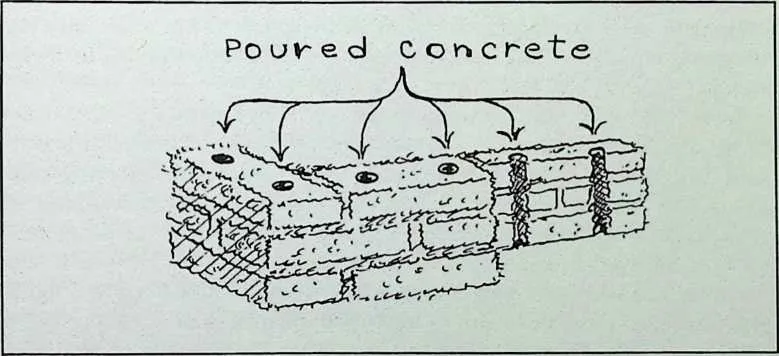
4 Though they looked like a breakfast food the blocks were excellent for supporting walls for a house or curtain walls for a larger structure. They were 16 inches long by 8 inches wide by four inches high with a hole 4 inches in diameter at either end. When the blocks were piled on top of each other and concrete was progressively poured through these holes it formed interior columns four inches in diameter. At every floor and at all doors and windows these columns were tied together horizontally with concrete lintels, thus forming a continuous, integral concrete framing.
5 These big building blocks weighed only two pounds each—doing more with less. They provided insulation equal to 4 inches of cork, were fireproof and waterproof. The system was a genuinely new development in building construction. Bucky felt that he and his father-in-law had made a real advance toward his ultimate goal of better housing for people everywhere.
6 The relations between those two were extremely warm and affectionate. Bucky had great respect for Mr. Hewlett, and the older man understood him and recognized his extraordinarily imaginative mentality. Mr. Hewlett’s confidence and wisdom and loyal support kept Bucky going during a very difficult period of his life. Many years later, when people throughout the world were acclaiming Buckminster Fuller’s daring ideas and profound philosophy, he said, “Mr. Hewlett was the first man ever to tell me that my own ideas were valid.”
8 Seeing that he was really on the track of something big, Bucky moved his “factory” to Mr. Hewlett’s studio in Brooklyn. It was a former rollerskating rink, a huge place where Mr. Hewlett had painted his murals and the scenery for various Broadway productions including the fantastic sets for Edmond Rostand’s Chantecler in which Maud Adams had been a smash hit.
9 There Bucky set to work to invent the machinery for the mass production of what was now aptly named the Stockade Building System, because the concrete pillars were like the supporting poles of a stockade. After very hard work, in a surprisingly short time he designed the machinery and built a working model on which he was granted the first of the twenty-odd patents he holds—Stockade (Building Structure) No. 1,633,702 and Stockade (Mold and Process) No. 1,634,900.
10 President R. Buckminster Fuller of the Stockade Building System was now ready for business. Stock was sold in the company to people who wanted to start organizing for manufacturing the blocks and erecting houses by the Stockade Building System; and subsidiary companies were organized, under the parent company. Many of the investors were kinfolk of Bucky’s. The first factory was in New Jersey. Then Neddy Larned started one in Baltimore called the Blue Ridge Company. There was one in Massachusetts in which Anglesea’s husband, George Abbott, had an interest—five in all, including one in Joliet, Illinois, just outside of Chicago, run by Bucky’s cousin, Andrew King. The houses could be built much more cheaply than by conventional methods and were better than those costing far more. With the postwar boom in building rising to a climax the investors foresaw a fabulous opportunity to make money.
11 Bucky was very busy, rushing from one location to another, overseeing the construction of the houses, giving advice, improvising brilliantly to meet unexpected problems. In his home office he was concerned with financing the expanding business, marketing new issues of stock, organizing new companies, keeping the materials flowing, and the work up to his high standards.
12 But he was very unhappy. The work-filled days were fine; the nights were hideous. For Alexandra’s death had thrown him into profound melancholia. The moment the day’s work was done he began to drink. He often drank all night and went to work the next day with undiminished vigor. Somehow his ironclad constitution withstood it.
13 Bucky says: “I was never what you would call an alcoholic. The drinking side in those first years was really for companionship; I craved friendship and understanding. People would take me on as a comrade when we were drinking together; they would not take me on sober. The unfriendly ones became friendly, and I don’t like anybody to be unfriendly to me. Drinking did not make me testy as it does some people, but rather very warm and optimistic; overoptimistic. This was a false kind of manner, which I did not like, for it made me undertake to do more than I could carry through, and would often get me into trouble.
14 “It was really a very peculiar part of my life. I do whatever I do very thoroughly. I would drink very copiously, but my behavioral reflexes were tremendously under control, so I was able to handle it to such an extent that people did not talk about me, or think about me, as a drunk.”
15 Bucky in a genial mood was a most delightful person, the gayest of companions. That talent for light verse, warm and witty, was put to frequent use. An example was when Mr. Hewlett was scolding the now teen-age twins for some peccadillo. Bucky wrote:
16 They were young with young ideas
17 And their eyes would fill with tears…
18 “You say we can be a pain
19 And will never do what you ask us to
20 We’re young and foolish twins.”
21 But quite little things would put Bucky in a foul mood. Anne was still a very young and pretty woman who loved to flirt in a perfectly harmless way. Bucky would get the idea she was being disloyal or did not love him anymore. One evening in the Hewlett house when Anne was flirting with Alaric Mann, Bucky sat silently, his face getting blacker and blacker. Suddenly he stood up and stormed out of the house. He walked all the way to New York; twenty miles over country roads and boulevards with no sidewalks, while the night traffic roared by. Across the Queens borough Bridge he went, into the city, which by the time he reached it was gray and weary in the dawn. Anne did not hear from him for two days. He had very little money. Where he slept, how he ate, no one knows; perhaps in speakeasies or empty warehouses, perhaps in some girl’s room. Then he came back cheerfully nonchalant as though nothing had happened. Anne was serene.
22 After a while Bucky moved to Chicago to oversee the starting-up of the Stockade Company in Joliet. Anne remained behind to hold the Hewlett family together. Bucky was even lonelier in that alien city. The days were still all right, the nights disastrous. He soon found his way to the speakeasies. A favorite was a gangster’s hangout on the way in from Joliet, where the new factory was building. He stopped by almost every evening on his way home. There he met Al Capone, then rising to the height of his underworld career as the chief of the rackets and head of the immensely profitable bootlegging industry. By his ruthless organizational ability, he had changed it from a haphazard individual enterprise into just that—an industry. Bucky did not like Capone. “He was not a very attractive man,” he said.
23 Bucky, still in search of company, also frequented brothels. With customary exaggeration he says: “I’m sure I went to over a thousand of them. They seemed to be the only place where people really talked straight to me; those girls. Many of them had babies. I wanted to see them as human beings, to know how they got there. They were terribly interesting as people. I enjoyed talking to them.”
24 When Anne came to Chicago to join her husband in 1926, things were better. As president of one Stockade Company, general manager of another, an officer of a third, Bucky was getting a rather good salary. The Fullers took a very pretty apartment overlooking Belmont Harbor and Lake Michigan. It was quite close to where Birchwood Farm had been when Bucky’s mother was a little girl. Bucky loved to watch the coming and going of the yachts in Belmont Harbor. It was good to have Anne with him.
25 To his delight she became pregnant again. He was happier than he had been for a long time.
26 The stockholders of Stockade were not happy in 1927. The golden tide they had envisioned ebbed instead of flowed. Some of them blamed Bucky. In some respects they were right; in others it was not his fault.
27 The construction industry was the most backward in the United States. Architects and builders were intensely conservative. The former looked backward to the beautiful models of antiquity; they copied Greek temples, Gothic cathedrals, Renaissance palazzos, Wren churches. They carried it so far as to adorn the Woolworth Building, the tallest in the world, with Gothic spires and gargoyles. The builders were equally backward. They opted for the time-tried ways that assured them a fancy profit with as little risk as possible.
28 The strong building trade unions—carpenters, bricklayers, steelworkers, plumbers, electricians, and so forth—with their hard-won perquisites, like work rules, apprentice systems, closed shops, and white supremacy policies that made it impossible for Negroes to join a craft union, were equally calcified. They viewed with distaste any innovation that might increase efficiency and thereby cut down the number of jobs a given piece of construction required. So the entire, building industry establishment—architects, contractors, and unions—however much they might fight among themselves, were solidly united against progress. Since, under the Stockade System, a house could be built far more cheaply with less labor and much more quickly than by conventional methods, they were against it.
29 Nor was this all Bucky had to contend with. There were also the government-enforced building codes and zoning restrictions. Originally conceived to protect the citizenry against dangerous building practices, inferior materials, and shoddy workmanship, they had become the sacrosanct means of perpetuating antediluvian techniques, backed as they were by the enormous political power of the construction establishment.
30 Baffled by deliberate inertia and voluminous red tape, morally outraged by the stupidity and greed he encountered, and furious with frustration, Bucky became totally disgusted with the whole building industry and all its members. More than ever he conceived Alexandra’s death as due to its roadblocks to progress. Though his bitterness against this establishment was justifiable on technological and humanitarian grounds, it was less than logical in regard to Alexandra.
31 In defense of his position, Bucky points out that the diseases she contracted have now been brought pretty much under control. But the finest housing conceivable could not impede the entrance of poliomyelitis viruses, or pneumococci; and at the time of Alexandra’s death she was living in the Hewlett’s house, an extremely comfortable residence in which ten children grew to adulthood in abounding health. Rather, it was due to the fact that medical science, through no fault of its practitioners, was a few years late in discovering the serums and antibiotics that stopped those epidemics.
32 Though the Stockade Companies were badly handicapped by the obstructions thrown in their way, Bucky was not entirely blameless for their lack of profitability. He is, in fact, one of the world’s worst businessmen. To succeed in any financial enterprise, a man must have a strong affinity and great respect for money. Bucky had none whatever. He regarded it as a false quantity, a fallacious way of computing wealth, which at least as early as his Annapolis days he believed to have been foisted upon the human race by the greed and cunning of their rulers—his “great pirates.” To him the only sensible way of reckoning real wealth was by “the addition of value (or wealth) by manufacture effected between raw materials and gained by the rich synergetic mixture of technology and energy…[both of which] were fundamental assets that defied exhaustion in apparent universe.”
33 At the time, what he wanted to do was to build better housing for human beings. The money involved was to him nothing but counters in a game whose rules he distrusted to the point of abhorrence. Increasingly he came to regard the natural desire of those who invested in his companies to make money as an obscene example of greed. From Bucky’s point of view, this was perfectly logical, but it was rough on his associates with more conventional views of the object of enterprise. At least he succeeded in building quite a few houses—234 of them to be exact.
34 As long as Mr. Hewlett held a controlling interest in the Stockade Building System, Bucky was safe, for Hewlett’s loyalty and faith were unshakable. However, financial difficulties forced him to sell his stock in 1927. Eventually it came into possession of the Celotex Corporation, which thereby gained ownership of Bucky’s patents. Improved and modified almost beyond recognition, they are today embodied in some of the company’s insulating and sound-proofing systems.
35 Bucky was now in the situation of being merely an employee; a position that never suited his temperament. He continued to work as hard as ever, and do his best according to his principles. But, perhaps with some justification, the new regime did not appreciate his methods. As to what fired the train that eliminated Bucky, there is a story, possibly apocryphal, that an official of the holding company called up Stockade’s main Chicago office late one afternoon. Whoever answered the phone incautiously left the line open, so while he waited for Bucky to come on the official was treated to a Rabelaisian chorus sung in not very close harmony by Bucky and his brother-in-law, Carmen Hewlett. There was also a bitter fight with his cousin Andy King about policy at the Joliet plant.
36 Whatever the cause, Bucky was fired without benefit of severance pay. “I got pushed right out,” he says, “and the people who pushed me out were eager to be vindicated for doing so. They tried to make me out a bad man.”
37 Since he had saved no money, he was again almost penniless. Furthermore, Anne had just given birth to a daughter whom she named Allegra. “Allegra was a good name,” said Bucky. “Anne had been reading the letters which Lord Byron’s bastard daughter, Allegra, wrote him from the convent; so our Allegra was named after her. I think she has been a happy child.”