
4 Love And War
1That summer of 1915, Bucky’s sister Leslie and her husband rented a house on Lover’s Lane in Lawrence, on the south shore of Long Island. In July, Bucky went down to spend the weekend with them. His friend Tilden Hazard, whose father, William A. Hazard, had a big, ivy-covered house overlooking the polo field of the Rockaway Hunting Club where Mrs. Fuller frequently visited, arranged to take him to a young people’s dance given by Mr. and Mrs. Anthony Perkins for their niece, Mary Esther White, in their charming brick colonial house on Ocean Avenue. It was a pleasantly informal, teen-age party—at twenty Bucky was one of the oldest people present. There were fifteen or twenty extraordinarily pretty girls dressed in demure, ankle-length chiffon or voile dresses and an equal number of tuxedoed boys, who were either at one or another of the famous prep schools or were freshmen in college.1
2 Bucky loved to dance, and that evening he particularly enjoyed dancing with one of the older girls—aged nineteen. She was an extremely pretty brunette, with a softly curving figure, dark brown hair, giant brown eyes, and cheeks exactly the color of the roses that were climbing the pergola outside the house. He learned that her name was Anne Hewlett, and he gathered that she was the best girl of his friend, Kenneth Phillips, who also lived in Lawrence.
3 The next day, Sunday, Kenneth suggested that he take Bucky over to the Hewletts for a double date with Anne and her younger sister, Anglesea. Anx, as she was called, was even prettier than Anne, an authentic beauty with the same exquisite skin, sea-blue eyes, and veritable golden hair worn in long corkscrew curls of which she was so vain that she refused to put her hair up until she was eighteen, which was three years off.
4 Bucky liked Anx immediately. Though he had first been attracted to Anne, she seemed to belong to Phillips, and he was far too honorable to try to take a friend’s best girl away from him. Besides, Anx was so beautiful it fairly stopped his heart.
5 After that Bucky, who was living at the YMCA on Fort Greene Place in Brooklyn while his mother was on Bear Island, spent many weekends at the Larneds, and had many double dates with Kenneth and Anne and Anx. They sailed over to Lawrence Beach in Kenneth’s one-design sloop and had picnics among the dunes of that almost deserted sandspit, which is now famous as Atlantic Beach, but then had neither roads nor bridges to the mainland. They also went to the movies in Far Rockaway, and to small parties.
6 Just staying home at the Hewletts was great fun. There were five boys and five girls, who, with their father and mother, Mr. and Mrs. James Monroe Hewlett, lived in a long, brick and shingle house at the end of Martin’s Lane in Lawrence, looking over the salt marshes to Reynold’s Channel and beyond the white beach to the open sea. Nearby, past the duck pond and the red barn, Anne’s grandmother, Mrs. James Augustus Hewlett, lived with her two bachelor sons, George and Arthur Hewlett, in Rock Hall, originally Rockaway Hall. It was unquestionably the most beautiful eighteenth-century house on Long Island. Built by Josiah Martin of Antigua in 1767, it was white-shingled with the grace of simplicity. There was the conventional broad hallway running across it so as you came in the front door, you could glimpse blue water through the garden door at the other end. Four big, square rooms on either side of the hall had fireplaces with finely wrought mantels, and there were exquisite moldings which are now regarded as classic examples of the period. As in warm climates, the kitchen was originally separate from the house, near the slave quarters, though later it became part of an east wing. Anne’s great-great-grandfather, Thomas Hewlett, had bought the house and farmlands from the Martin heirs in 1824.
7 Rock Hall had never been profaned by electricity or central heating —Grandmother Hewlett only lived there in summer. The finely proportioned rooms were lit by the soft glow of candles and oil lamps, which, reminding Bucky of Bear Island, made him feel very much at home.
8 Compared to the rather stately measures of life at Rock Hall, Martin’s Lane was a place of violent turmoil. Anne’s mother, a beautiful woman who had thus endowed her daughters, was a semi-invalid who seldom left her upstairs bedroom. James Monroe Hewlett, a celebrated architect
9 noted also for his superb mural paintings, was a gentle, quiet'man who usually sat in a tweed jacket smoking a pipe and regarding his boisterous progeny with genial amazement. Ranging in age from nineteen (Anne) down to Roger, a toddling two-year-old, they were, with the exception of Jim, the oldest boy, all extroverts with high spirits, high tempers, and such quick wits as made life in their midst a constant gaiety. With their father frequently away on important commissions and their mother unable to cope, they were bringing themselves up, and doing a surprisingly good job of it.
10 Bucky came to love them all, and they him. In time he became more at home with them than with his own family—a sort of honorary Hewlett.
11 When autumn and schooldays came, the Hewletts retired to their house at 80 Columbia Heights on Brooklyn Heights overlooking New York Harbor. Bucky wondered, rather unhappily, if he would see much of them now. But by great good fortune he was then working at the Armour plant near the Long Island Rail Road in Brooklyn. As he says, “I don’t think Anx was particularly interested in me,2 but Anne seemed to think it would be nice for me to come to dinner. So I was invited there several times by her. I was very much honored…”
12 Though Bucky was, by now, falling in love with Anne, who was far warmer and more loving than Anglesea, he dared not admit it to himself and made no move even to flirt with her because he thought she was engaged to Kenneth Phillips, and to do so would be dishonorable.
13 However, Anne soon set him right. In Bucky’s words, “She made it perfectly clear to me that she was not engaged to Kenneth and she thought it was perfectly appropriate for me to call on her. Really, that would not have happened if she had not made that very clear.”
14 So began Bucky’s courtship of Anne, which was one of the more rugged ordeals of his life.
15 “It was a very extraordinary experience with a family like that,” Bucky says, “to be the first outsider coming into that closed circle. Mr. Hewlett sat at the head of the table, and Anne at the foot, with the other nine children in between. When I was there that made twelve of us. You know the Hewletts; they did not go out of their way to spare your feelings, particularly an outsider.”
16 That is an understatement. Roger Hewlett says, “Bucky came into the family when the full force of the opposition was there, with Jim 2 Half the boys in Lawrence were madly in love with Anglesea, including the author.
17 leading it.” The Hewlett children did everything possible to tease Bucky and Anne. Because he worked for Armour and Company they referred to him as “The Butcher Boy.” They never gave the lovers a moment’s privacy; one or another, or all of them were constantly popping into any room they sat in. Later, when Anne and Bucky became engaged, they would chant in unison:
18 Listen! Listen! Listen!
19 Anne and Bucky kissin’.
20 Where? Where? Where?
21 In the big, red chair.
22 How? How? How?
23 WOW!
24 The children used to have terrific family fights, first-class brawls with five or six of them taking part, punching, biting, and pulling one another’s hair; boys and girls all mixed up, fighting like wolf cubs. Once Bucky incautiously stepped into the fray to try to separate them, whereat the whole pack turned on him and nearly tore his clothes off.
25 The twins, Hope and Hester, who were only four years old, did not take part in the teasing. They never said a word, but stood side by side silently staring at Bucky, which was, perhaps, more unnerving.
26 Many an evening Anne and Bucky would sit with Mrs. Hewlett in her big bedroom on the second floor. It was not privacy, but it was quiet.
27 Eventually the children took Bucky into their hearts. “It really developed into a wonderful friendship.” But they never stopped teasing, not even today.
28 Bucky’s affectionate response to friendship even included the Hewlett servants, especially Mammy Annie in the kitchen, an enormous black woman who held the household together. Then there was Roger’s nurse, Mrs. Van, who was quite short and built like one of the wooden dolls of the period, with a small head and a bosom that jutted out horizontally. “Roger used to sit on this plateau she had up there.”
29 A far more dangerous obstacle to Bucky’s courtship than Anne’s siblings was her maternal grandfather, Daniel Willetts. He was a magnificent old gentleman with fine, white hair and side-whiskers, a nose like the prow of a ship, and icy blue eyes; the very picture of a merchant
30 prince, which he was. In fact, he owned the warehouse on the waterfront street below Columbia Heights, the roof of which, covered with turf, formed the Hewletts’ backyard. There was a trapdoor set in the grass through which he could descend to his office in the warehouse.
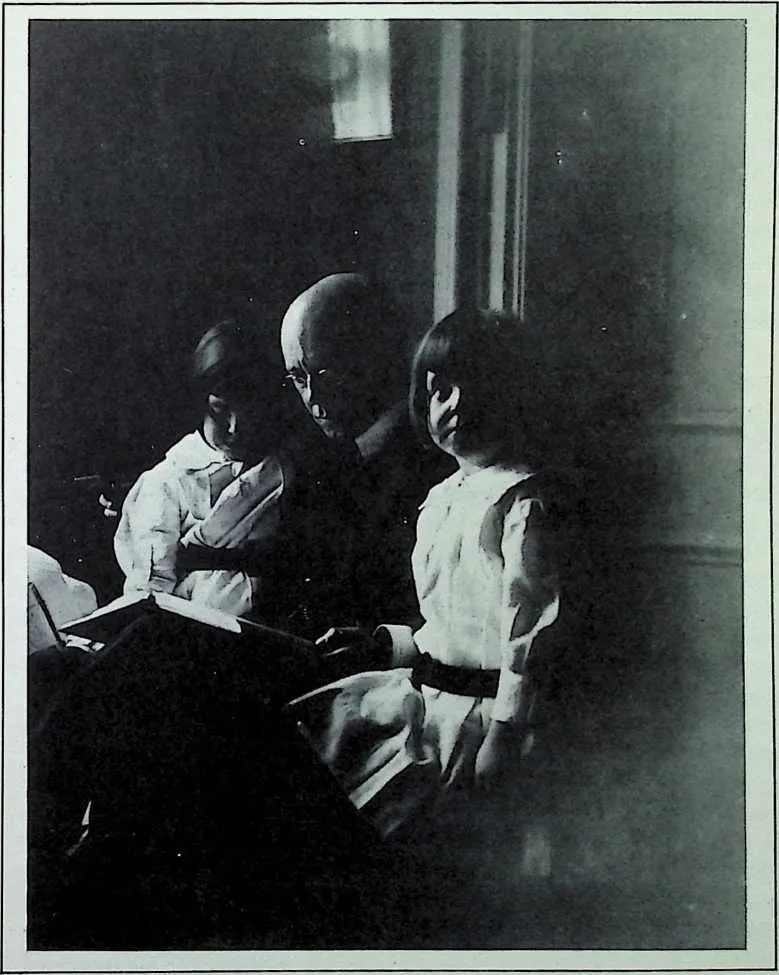
32 Grandfather Willetts loved Anne more than anything in the world, and she “loved him to pieces.” He sometimes took her to Europe with him on the slow but comfortable cattle boats named after Indian tribes —Minnetonka, Minnewaska—and he could deny her nothing except a serious beau. The thought of any man, let alone a chap with Bucky’s poor record at Harvard and dubious prospects, marrying his darling granddaughter turned him hard as black ice. He lived at 77 Columbia Heights, right across the street from the Hewletts, and every time Bucky walked up their brownstone stoop he thought he felt Mr. Willetts’ eyes boring into his back.
33 However, Bucky continued his courtship. He says, “The only way I could express my feelings for Anne—I was pretty inarticulate about my emotions—was to send bunches of red roses from Weir’s, the florist on Fulton Street. It was quite an investment for me—five dollars a week for flowers, leaving me ten dollars for everything else. But I saw that she liked them.”
34 Then Bucky asked Anne for her picture. Unlike most girls, she did not have a formal photograph; so she rummaged through some drawers and finally found one of her standing beside an old gentleman, with very white hair and black brows, on the deck of a liner. Bucky took it gratefully, and when he got home snipped the old gentleman out of it. Mark Twain went into the scrap basket. “Which,” Bucky says, “shows my priorities at that time.”
35 Finally things came to an impasse. Both Mr. and Mrs. Hewlett liked Bucky, as they proved later, but he believes that Grandfather Willetts put it straight to Anne and that she yielded—temporarily. In a sad and emotional scene Anne “sort of dismissed me.” Bucky was undone; this rejection was more than he could bear. But it did not last long. Anne called him up and asked him to come back.
36 Mr. Willetts and his ally, Anne’s great-aunt Kate Barnard, had one more card to play. Hoping that distance would make Anne’s heart less fond, Aunt Kate asked—no, commanded—Anne to go with her on a long trip across the United States to California, and to British Columbia and Lake Louise.
37 The trip had the opposite effect from what had been intended. It precipitated Anne’s feelings, and when she arrived back in Lawrence again she accepted Bucky’s proposal of marriage.
38 Then, of course, he had to go and ask Mr. Hewlett for his daughter’s hand in the approved manner of that vanished time. He must have been very worried since he had so little to offer a wife. However, Mr. Hewlett had penetrated beyond the superficial oddity of Ducky’s manner and become very fond of him; Mrs. Hewlett was even more affectionate. Their consent was immediate.
39 Then Bucky received the most scarring blow ever dealt him. When he told his mother he was engaged to Anne, Mrs. Fuller became frantic with alarm. She said Bucky was unfit to marry a charming young girl like Anne; that he was too lacking in stability, ambition, and means to support a wife. Driven by anxiety and her Puritan conscience, as Bucky believes, she actually called on Mr. Hewlett and told him that Bucky was irresponsible, thoughtless, and selfish, and advised him that he was sure to make Anne unhappy and on no account to let his daughter marry her son. It was one of the bitterest moments of Bucky’s life.
40 Mr. Hewlett, bless his generous and loving heart, replied that he liked Bucky very much and had confidence in him.
41 So Bucky and Anne became formally engaged. Mrs. Fuller made some amends by giving Bucky a beautiful ruby ring that his father had given her, for Anne’s engagement ring.
42 The engagement was announced in the early summer of 1916 in Lawrence, and was followed by a round of parties including a dance in their honor in the Hazards’ Victorian-Gothic mansion. Immediately afterward Bucky left for the camp at Plattsburg, New York, where former President Theodore Roosevelt and General Leonard Wood were unofficially training young men for the defense of their country in the event of the United States’ entering the European war. Bucky was alive with patriotism and ardent in the belief that America should take her part in what he and many of his fellows believed was the defense of freedom and civilization against the German warlords.
43 The intensity of Bucky’s emotion had been force-fed by a chance event. In the spring of 1915, he had been checking a cargo of Armour’s beef into the hold of a freighter lying at a North River dock. Across the narrow strip of water between the piers, the Cunarder Lusitania was preparing for a voyage to England. To Bucky, who loved ships so much, she was the most beautiful man-made object in the world; the fastest and most graceful of liners. Enviously he had watched the passengers boarding her, and thrilled to the tremendous vibrations of her whistle, as with flags and pennants flying from her masts and the red ensign at her stern, she slowly backed into the stream and, shepherded by her attendant tugs, swung stately on the tide and headed out to sea.
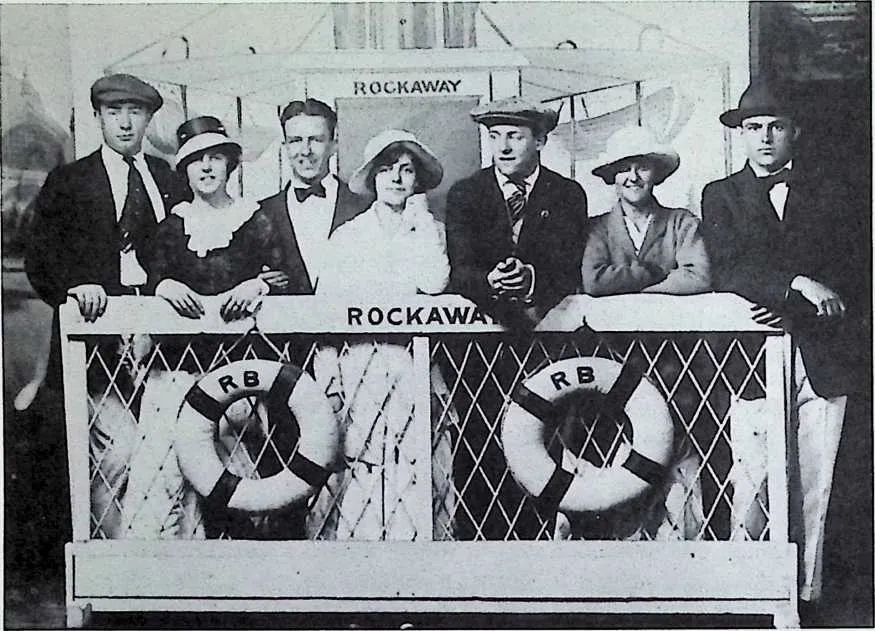
45 Five days later he read the black headlines that told of her torpedoing by a German U-boat off the coast of Ireland, her sinking in twenty minutes, and of the drowning of 1,198 men, women, and children. He almost wept as he vividly pictured that beautiful ship in her final agony and the gay, innocent people he had seen crowding her rails struggling in the underset of her sinking. To him, innocent as we all were then of the terrible potential of human savagery, it seemed the most barbarous act ever done by man against his fellowman. He raged against its perpetrators.
46 Bucky enjoyed Plattsburg as he ever did camps and simple living. In addition, many of his former Harvard classmates were there. But it confirmed his former intention of joining the navy if there should be a war. Army ways were old-fashioned, even primitive, compared to the advanced technology of ships; besides, he felt at home on the sea. However, when President Woodrow Wilson was reelected on a peace platform in November, the immediate prospect of American involvement in the war receded somewhat.
47 During that autumn and early winter, Bucky continued to work very hard at different Armour and Company operations in the metropolitan area. This left him little time to be with Anne, mostly just at family dinner at the Hewlett’s and a quiet hour in Mrs. Hewlett’s room before he had to rush home to his mother’s new apartment at the old Hotel Wentworth on 46th Street for three or four hours sleep before starting off to work at three a.m.
48 On weekends he and Anne sometimes had a gala evening when Mr. Hewlett would take them to one of the dances at the American Academy of Design on 57th Street where the New York Architectural League then had its headquarters. In those days the leading sculptors, painters, and architects of New York were closely associated, and Mr. Hewlett, who functioned in both spheres, knew them all. Bucky always remembered one fancy dress ball at the Academy called the Fetes des Foux where “Anne and I had a lovely time.” There he met many well-known artists, among them Ray Hood who, a very young man, had just won the Tribune Tower prize and thus achieved fame; sculptor Leo Lentelli and his wife, Mimi, and the Tony Salaemis, all of whom became his close friends. Bucky always felt more at ease with artists than with the members of any other profession, except, perhaps, men of the sea.
49 The false detente in American-German relations ended abruptly on January 31, 1917, when the imperial German government announced a policy of unrestricted submarine warfare—every ship that sailed in unilaterally delimited war zones would be sunk on sight. President Wilson sorrowfully broke off diplomatic relations with Germany. The American people, formerly badly divided on the issue of belligerence, united behind him. Everyone knew that this meant war.
50 Bucky was determined to become a naval officer. He knew that with his poor eyesight he had not the faintest chance of passing the navy physical examination, but he thought of an ingenious circumvention. He persuaded his mother to present the Wego to the navy, provided her son commanded her. The navy, desperate for ships to patrol the coastal waters against submarines, was taking anything that would move on the water. They gladly accepted the deal Bucky proposed to them, and gave him the rank of Chief Boatswain.
51 This was, as Bucky says, “a fantastic rank.” At that time there were comparatively few chiefs in the navy, all old hands who had twenty to forty years of service. It was the highest rank to which an enlisted man, who had not been to the Naval Academy, could rise. They were commissioned warrant officers and their uniform was the same as that of an ensign except that the single gold stripe denoting their rank was broken by short blue bars. In those last days of naval snobbery they were considered officers but not necessarily gentlemen, and they messed apart from both the officers and crew. The young ensigns just out of the academy were supposed to learn about seafaring from them and obey their orders. When Bucky first walked into the Navy Yard in his new uniform with his dress sword slapping satisfactorily on his thigh, he was amazed to find the ensigns respectfully saluting him. “Considering my naval experience,” says Bucky, “it was slightly ridiculous.”
52 Bucky was to enlist his own crew, and his first choice for first mate was Link Pierce. Other members of the crew were Wolcott Fuller, who was ready to enter Harvard but keen to volunteer, and Richard Morse, as deckhands, William Hall as engineer, and Warren Tribou, cook—six in all, later augmented to seven. When they were finally all aboard, the little Wego was as crowded as Noah’s Ark.
53 Bucky, Link, and Wolcott went up to Maine to get Wego ready for sea. Bear Island in winter, with mushy salt-water ice covering the harbor, winds blowing straight out of the Arctic Circle, and no heat except the fireplace in the Eating House and the iron wood-burning stove in its kitchen, was rugged. But Bucky was aflame with enthusiasm. He worked hard and fast, so fast that late in February Wego was officially commissioned as Navy SP (Scout Patrol) 1196.
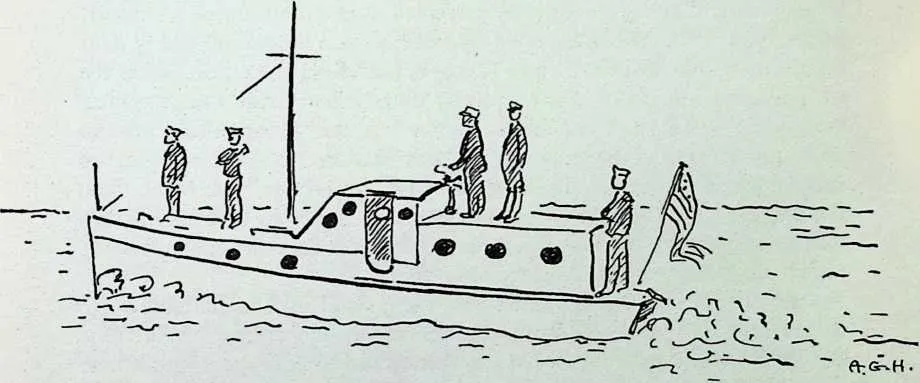
54Wego was only about forty feet long—too small to mount even a machine gun, but her valiant crew was armed to the teeth. Her top speed was 8 knots—a U-boat could have left her standing. She was an ugly little boat, anything but streamlined, with a square stern and sharp bow. Her entire length was crowded by living quarters, the forecastle rising abruptly to a wheelhouse barely big enough for two men squashed together. Just aft of it was the main cabin which looked like a little square house with round holes for windows. Behind it was no more than three feet of open deck. In naval service she had a disproportionally tall mast from which to fly her signal flags. In good weather Bucky, standing unprotected on the flat top of the main cabin, conned her at an auxiliary wheel.
55Wego was probably the smallest regularly commissioned vessel in the entire United States Navy. Based on Bar Harbor and the only “warship” in that area, she was known for a time as the “State of Maine Navy.”
56 Bucky says: “So we started off in that strange little boat without the slightest idea of what the navy really was. Of course, we had seen pictures of submarines, but I had no real conception of them; I thought they were far smaller than they turned out to be.”
58 But Bucky had read books about the navy and had a highly romantic notion of its traditions and usages. He took his responsibilities as captain intensely seriously. Even if his ship was the tiniest, he was determined that she should be as smart as the biggest battleship. He worked his crew very hard, polishing brass, painting everything, working on the poor old engine to bring it to peak efficiency. He says: “I wanted my boat to be in good shape and the rest of the crew did not care too much. As I continually kept trying to improve her, they thought the captain was much too fussy.” Bucky did carry his naval punctilio rather far. Having read that the captain always ate alone, he insisted on having his meals in lonely state.
59 On April 6, 1917, the United States declared war on Germany. Now what had been practice became the Real Thing. Even in springtime the North Atlantic off the coast of Maine can be a furious ocean, gale winds howling over huge, white-capped seas that smash against rocky promontories and boil over half-submerged reefs. If there had been small craft warnings in those days, the big red SCW pennants would have been flying three-quarters of the time. But if Bucky was ordered to patrol, by Poseidon! he did so if it was humanly possible, pushing little Wego through thundering seas to the uttermost limits of prudence and beyond.
60 The moment war was declared many other yachtsmen gave their boats to the navy. They were quickly accepted and commissioned, usually under their professional captains and crews. A number of fine yachts turned up in Bar Harbor to join Wego in patrolling the coast. Since the navy had become chary of giving away rank, it had made their captains boatswains. As a chief boatswain, Bucky was the senior officer present and thus became commander of the Bar Harbor flotilla, consisting of such splendid yachts as the Mist, Content, Cherokee, the Hobo, and the mystery ship, Eta M. Burns. His only discontent was that his flagship was so small and slow that when his little fleet sailed on maneuvers the others soon left her hull down behind them.
61 Pure chance and Bucky’s favor with the gods of the sea enabled Wego to perform the only significant war service of the entire flotilla. One day orders came for a full-speed emergency run to Jonesport in desolate eastern Maine near the Canadian border, where a submarine sighting had been reported. The flotilla tore out of Frenchman’s Bay and headed east wide open, flags whipping, crews alight with the hope of combat. Naturally, Wego was soon left far astern. One can imagine Bucky’s furious frustration as his fleet disappeared hell-bent over the horizon.
62 As if that were not enough, toward midnight in a heavy fog Wego's engine began to miss and slow. Bucky, who knew this coast as an engineer on the New York Central knows the run from Albany to New York, reckoned they were abreast of Cross Island. Reluctantly he ordered his helmsman to port his helm and head for the coast. Skillfully he navigated Wego through the fluffy fog into Machias Bay inside Cross Island, where they anchored at about one a.m.
63 Leaving Wolcott Fuller and Dick Morse on watch, Bucky, Link Pierce, and Bill Hall went furiously to work on the engine. At about two o’clock the fog lifted. Woolly and Dick, who were “sharp on Morse code,” saw a rapidly flashing light at the end of the Machiasport pier, answered by similar flashes from Cross Island. In high excitement they called Bucky up on deck and told him the flashes were in Morse, but they could not read the message as it seemed to be in a secret code. As they watched, a big diesel-engined sardine fisherman came out of Machiasport and hustled across the bay toward Cross Island, without apparently seeing Wego, which lay without lights.
64 As soon as his engine was repaired, Bucky headed back for Bar Harbor, where he reported the incident to the naval authorities. Within twenty-four hours United States destroyers swooped down on Machiasport and navy intelligence agents swarmed along the coast.
65 Not until after the war did the Wego’s crew learn that she had inadvertently unearthed a refueling depot for German U-boats, the very spot where the German spies Boy. Ed and Count Von Papen had landed to conduct a sabotage campaign in the United States.
66 The place was well chosen. The Maine coast in that vicinity had been colonized by German immigrants, some of whom remained loyal to the Fatherland. Two years before the war, in 1915, a German-American businessman from Chicago came to Machiasport and offered to buy the big sardine factory and its fleet of fishing boats. Its two New England owners, expecting to be bargained with, asked double its value. The Chicagoan snapped up the offer. The astounded partners, feeling they had sold too cheap, conferred and decided to double the ante by announcing that they had meant the asking price for only one partner’s share. Unfazed, the Chicagoan met the raise, only insisting that the transaction be kept secret.
67 This became the perfect setup for a U-boat base. Maine natives were accustomed to seeing tank cars full of diesel oil for the sardiners and cottonseed oil for packing their catch arrive at the installation; a few extra large shipments went unnoticed. The lonely, fog-bound coast was far east of the big resorts, and with its many deep-water coves, would have been ideal for secretly transhipping fuel and supplies from the big sardiners to submarines had it not been for Wego’s faltering engine.
68 The only thing that marred Bucky’s delight in the activity of serving his country on his favorite element was his separation from Anne. He missed her more than he could have thought possible, and she missed him more than that. It was not an insoluble problem.
69 At Armour and Company Bucky had been making $15 a week; as a Chief Boatswain his salary was $1,800 a year, more than twice as much. He felt affluent for the first time in his life—“absolutely high order.” The obvious answer was to marry the girl. Anne was willing.
70 In June she wrote Bucky to be sure to get leave to marry her on Saturday, July 12, his birthday. He immediately asked Link Pierce to be his best man. They both obtained leave, which pretty well put Wego out of action for the weekend, but all hands felt that the United States was not endangered.
71 The ushers were Tommy Whitehall, Tilden Hazard, Mack Lloyd, and Anne’s brother, Jim Hewlett, who was also in the navy. Her next brother, Willetts Hewlett, who had joined the marines, was also to have been an usher, but he came down with measles and had to watch the proceedings from the quarantine of a car.
72 Anne asked Anglesea to be her maid of honor, and among the bridesmaids were Helen Babbet, Josephine de Selding, Catherine Bunnell, and Anne’s younger sister, Laurence Hewlett, all strikingly pretty girls.
73 At this point the author must step into the mainstream of his narrative.
74 On the morning before the wedding I went down to Martin’s Lane to call on Anglesea, as I did nearly every day. It was a scene of even more happy chaos than usual, with bridesmaids and ushers arriving by every train. Bucky was there, of course, looking very trim in a brand new uniform on which the gold braid fairly glittered. Most of his ushers were in the uniform of their respective services. Everyone was in high spirits. I pictured them planning a gala party, and in the hope that they would ask me along, I hinted broadly, “What are you all doing this evening?”
75 “Nothing,” they said. “We have not planned anything.”
76 “You can’t do nothing the night before your wedding,” I exploded.
77 “Let’s see if I can fix something.”
78 I called my mother, who at that time had a large house in Woodmere, some three miles away, manned by six or seven servants. “Muzzi,” I said, “we’re having fourteen for dinner tonight.”
79 “Really!” Mother answered. “Who are they?”
80 “Anne’s wedding party,” I said. “They’ve got nothing to do tonight and I thought they should have a party. Can you do it?”
81 “Of course,” Mother replied. “Tell them we dine at seven thirty.”
82 That evening I sat happily at the head of the long, candlelit table with Anne on my right and my beloved Anglesea on my left. During the meal Anne said never a word, her eyes looking into an unknown future. Finally I said to her, “My, you’re silent, Anne,” and quickly added, “but I can understand your feelings. It must be quite something to think about—going off with a strange man in the morning.”
83 Anne snapped out of it, stared hard at Bucky, his big head close-cropped navy style, his eyes lambent with love behind his goggle-like glasses, and said briskly, “You know, he isn’t as strange as he looks.”
84 Over half a century later, when Anne and Bucky, at the peak of his worldwide fame as the prophet of a benign and unimaginable universe, came to visit me in Florida, I said to her, “Anne, you know you were wrong. He was even stranger than he looked.”
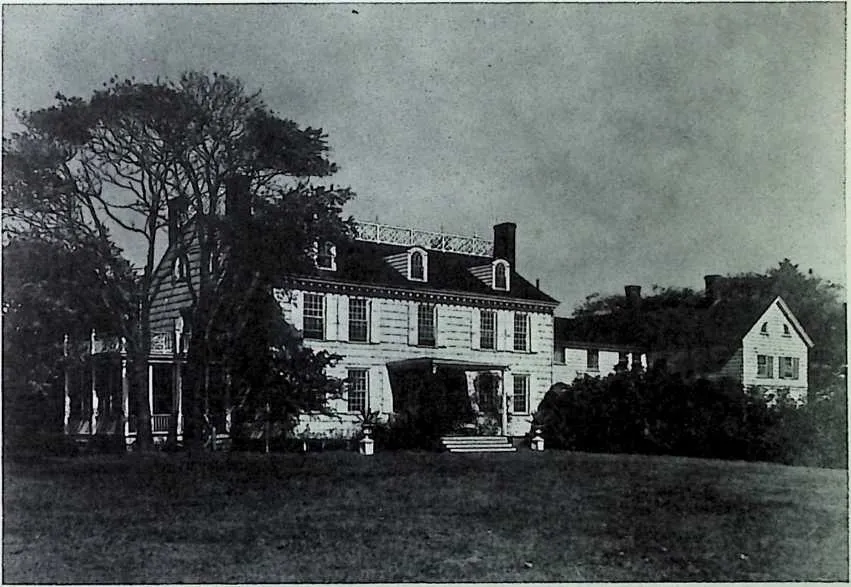
86 The wedding was on the south lawn of Rock Hall on a perfect summer day. The old house, with roses climbing up the trellis of its porch and the dark green turf running down to meet the lighter green of the salt marshes, had a graceful air of permanence in a world in the flux of war. Anne had wisely dressed her bridesmaids, not in the current tube-skirted fashion, but in white, low-cut organdy dresses with belled skirts and bright sashes. Anne’s wedding dress was the same except that her lovely face sparkled under a veil of ancestral-lace. She had chosen the dresses “to go with the house” and the scene was straight out of the eighteenth century when Rock Hall was new.
87 Anne and Bucky took their vows before the Episcopal minister, then formed the receiving line. The families of both sides were almost all there; Hewletts of all generations, Fullers and Kings and Wolcotts; and most of the people we knew from the Five Towns. As Bucky stood in the line, his little sister Rosey kept running around his knees offering him food and drink, taking care of her big brother.
88 It was very charming and happy, with a kind of pre-twentieth century, innocent gaiety. But beneath that was an edge of anxiety—the war, pushed temporarily to the back of our minds, but raising the question if we would ever again see those laughing boys in their bright uniforms. When the time came for them to leave, Bucky and Anne ran under an arch of flashing swords toward a future that in its tragedies and accomplishments was beyond anyone’s dreaming—least of all theirs.
89 Anne and Bucky drove straight to Brooklyn to spend a few hours with Mrs. Hewlett and Grandma Willetts, who had left the wedding early.2 Then they took the midnight train to Boston and the old J. T. Morse to Bar Harbor. At the dock the captains of Bucky’s flotilla met them, and presented them with a beautiful silver basket with all their names engraved on it. Bucky, so sensitive to any gesture of friendship, was very deeply touched.
90 The Fullers rented a little cottage on Snow Street in Bar Harbor for their honeymoon, which was, of course, very episodic because Bucky was continually at sea with his little fleet. In any event, a Hewlett honeymoon was not the conventional aloneness, but rather a family affair. Link Pierce inevitably had fallen in love with Anglesea, and she found his masculine good looks and sunny disposition very attractive. So Anx came up to stay with the Fullers, and Link also stayed with them. Jim Hewlett was in love with Margery Beard, whom he afterward married. “So,” says Anne, “she stayed with, us, too.” They were pretty crowded. Bucky did not mind.
91 A few weeks later, the navy decided that Wego was no longer useful and retired her. The crew was broken up. Link Pierce and Wolcott Fuller went to the naval training school at Harvard. Woolly afterward served in the transport Mount Vernon, which had formerly been the Kronprinzessin Cecilie. Link Pierce served in the battleship Louisiana. Bucky was ordered to command the much abler Whistler, patrolling the outer approaches to Boston Harbor.
92 As for the Wego, she was eventually returned to Mrs. Fuller. For forty years she served as Bear Island’s family boat, general freighter, and ferry until she was retired in 1957.