
13 No Chains
1Bucky has described the summer of 1936 as a low point in his and Anne’s life. Not the lowest—the night by Lake Michigan was that—but they were scraping bottom. From that time on their course turned ever upward; not in one serene, ascending curve—life with Bucky could never be serene—but in mountain peaks and deep ravines that never quite reached the nadir. A graph of it would look like a chart of the Dow Jones average in a turbulent bull market.
2 Bucky had a gift for making new friends, at once fascinating them by his brilliance and endearing himself to them by his genuine warmth, his eager acceptance of affection. Among those he had acquired recently was William H. Osborn. Bill Osborn was a big, ruddy-faced gentleman—the word is used precisely—who was that rare combination of a splendid sportsman and a man of venturesome intellect. Like everyone imaginative and intelligent enough to understand what Bucky was saying, he was enthralled by the coruscation of ideas which erupted from Bucky’s mind like the stream of sparks from steel in contact with a grindstone.
3 Osborn was a power in the great Phelps Dodge Corporation—his mother had been a Dodge—which was beginning to move out of its traditional business of mining copper into the wider field of manufacturing copper products. He decided that Bucky would be a valuable source of new directions for the company. In the autumn of 1936, Osborn offered Bucky the position of Director of Research with Phelps Dodge. It paid a handsome salary.
4 Bucky’s job was to help create this new research department and pour out ideas from his fecund brain that might evolve into new devices for the company to manufacture. Despite one abortive project Phelps Dodge got their money’s worth, not only from new inventions, but from the publicity Bucky’s original conceptions generated and the ideas he threw off which other men seized upon and carried through.
5 His first big contribution was a new type of brake drum, made of solid bronze and fitted with hard rubber insets so designed that it rapidly dissipated the heat generated by braking. This eliminated the grab and fade caused by overheating in existing braking systems, thereby cutting in half the deceleration time. The Fuller bronze brake established the metallurgical principles of the now widely used disc brakes.
6 He also devised the oxyacetylene, melted-tin-ore centrifuge that made it possible to process hardhead tin ore which had heretofore been impossible to refine.
7 Bucky’s most widely publicized spectacular for Phelps Dodge was the Dymaxion bathroom. It was basically a refined version of the prototype he had built for Standard Sanitary, this time made of copper, of course! It consisted of two compartments—tub-shower and lavatorytoilet. Its four basic sections were designed to be dye-stamped out of sheet metal. The lower halves of both compartments were copper sheet coated with a noncorrosive alloy of silver, tin, and antimony; the upper halves were made of aluminum sheet with an interior surface of synthetic resin colored to individual taste. Plumbing connections were standard; easily hooked up to water pipes and drains, as were the electrical connections. There were electric resistance strip heaters and a fan for cooling.
8 The whole Dymaxion bathroom occupied a floor space of five square feet, could be manufactured for about three hundred dollars, and weighed only 420 pounds, about the weight of one conventional bathtub. Bucky intended that it should ultimately be made of plastics—not then perfected—in which case it would have weighed and cost even less.
9 Having learned his lesson at Standard Sanitary, this time Bucky was careful to sell the ideas to the plumbers’ union first. So persuasive were his arguments concerning the vastly increased work opportunities such inexpensive mass-produced bathrooms would provide, that in their official magazine, The Ladle, the union came out for it enthusiastically.
10 All in vain! Standard Sanitary, which was one of Phelps Dodge’s largest customers, was so terrified by the plumbers’ former reaction that they talked Phelps Dodge out of putting it into production. Bucky thought it was just due to the inertia of The housing industry as a whole.
11 However, Phelps Dodge did build thirteen prototypes, all but one of which were sold. Chris Morley loyally bought two for The Knothole; the Osborns took one or two, and one ended up in the hydraulic testing section of the Bureau of Standards in Washington, which certified that it complied with all requirements of the United States building codes.
12 Naturally, the Dymaxion bathroom would not have appealed to everyone even if it had been put into production. Very tall men found its five-by-five dimensions too confining, though they fitted Bucky well enough. And an architect friend of his said of its ultimate development as a self-contained unit, “Bucky thinks people ought to get weighed sitting on a toilet seat, brushing their teeth with a cake of soap and taking a shower with a fog gun. But I ain’t gonna. I just ain’t gonna.”
13 As always, when Bucky had a spectacular new device to exhibit, he had a marvelous time. He mounted one of his bathrooms on a pickup truck and drove all around the East Coast showing it off. The author happily recalls tearing through the more sedate streets of Lawrence in the truck with Bucky at the wheel, assorted Hewletts in the bathroom, one of them sitting on the john, and streamers of toilet paper flying out behind.
14 Because it was never put into production, the Dymaxion bathroom was generally considered just another of Bucky’s failures. But not by him. He was perfectly justified in considering it a resounding success, because it worked, and proved out the principles from which it derived.
15 Nor did it engender any bitterness between Bucky and the Phelps Dodge officials. As long as he proved his point, Bucky did not care tuppence whether it made money or not, and the Phelps Dodge people realized that Bucky had delivered the goods, and that their decision to abort it was not his fault. Until Bill Osborn died he remained Bucky’s devoted friend.
16 Phelps Dodge officials often had great difficulty reading Bucky’s reports. He had carried his theory of navy days that he “would rather not be understood than be misunderstood” to extremes. In his meticulous endeavor to be absolutely precise he had evolved a labyrinthine prose style involving the use of esoteric Latin-and Greek-root words that few people could understand; Time magazine later christened it “Fullerese.” His oral discourses were, and have remained, easily understandable because his sensitivity to audience reaction immediately informs him when he is losing their interest and he automatically readjusts to their limits of comprehension. But when writing, he has no such check on his lack of intelligibility.
17 On one occasion Bucky handed a report for the board of directors to his immediate superior. Several hours later the official came back in despair. “This completely defeats me,” he told Bucky, “and if I can’t understand it, heaven knows, the board can’t. Do something!”
18 Bucky read it to him, breaking up the long sentences into short lines, pausing after each to make sure his audience understood. “I get it now,” the official said. “See if you can write it that way.”
19 Bucky took it and, without changing a word, wrote it in the form of a prose poem with each line containing a single thought. It was far more easily understandable. As an example of how this worked, consider a typical Fuller sentence from his book No More Secondhand God: “So amplified in degree are these quantities of motion, captured by faithful extension of both ends of the sensibly charted scales beyond the sensorial limits, as progressively to place a working measure of the original omnipotent power within man’s conscious control.”
20 In the book it is written:
2122“So amplified in degree
23are these quantities of motion captured by faithful extension of both ends of the sensibly charted scales beyond the sensorial limits
24as progressively to place
25a working measure
26of the original omnipotent power
28 This is not exactly easy reading, but it is far more comprehensible than the prose version.
29 In the case of the Phelps Dodge report, Bucky’s superior agreed that it was now quite understandable. “But,” he said in horror, “it is poetry! I can’t get the board to read that.”
30 He and Bucky worked out a compromise version in which the sentences were broken up by dashes, stars, asterisks, and parentheses.
31 This was the beginning of Bucky’s couching his more esoteric thoughts in verse form. Whether it is poetry or not is a matter of sharp controversy among critics. Some enthusiastically say it is; others that it is nonsense in doggerel form. Evidently Bucky’s alma mater is among the ayes. In 1962 Harvard awarded him the Charles Eliot Norton Chair of Poetry.
32 During all those summers, Bucky, Anne, and Allegra managed to spend at least one month on Bear Island. But maintaining it had become a financial drain. Bucky had been able to contribute virtually nothing except the pleasure of his company, and other members of the family were hard pressed by the depression.
33 When Mrs. Fuller died Rosey took over the management of the island. Though she had not blown her inheritance, her income was very small, and Leslie, who had divorced Neddie Larned and married Nelson Borland, Jr., could not help much. However, Rosey staunchly sustained it for the family. To save money she even spent one whole winter on the island, an experience almost comparable to Admiral Byrd’s lonely vigil on the South Polar Plateau. However, Rosey said she would not have exchanged her memory of that winter for a pleasure dome in Xanadu.
34 In the late thirties and early forties things became so stringent that Rosey even took in boarders to help defray expenses. Anne, despite her distaste for the rugged life, sportingly stayed there on several occasions to help out with the chores. The experiment was hardly a resounding success. Bucky says, “Rosey was so tender-hearted and charged so little for room and board that I think her boarders often cost her more than they paid.”
35 Eventually the island was made into a corporation, with shares held by every member of the family down to Mrs. Fuller’s great-grandchildren, each contributing proportionally to its upkeep. By whatever means, Bear Island was preserved for the family, especially for Bucky. This is the important thing; for on it he has, year after year, renewed his strength to continue his strenuous vocation of explorer of Universe, reorganizing civilization for the benefit of all peoples.
36 In 1938, Ralph Ingersol Davenport, managing editor of Fortune magazine, came to Bucky with such an attractive proposition he could not turn it down. “Mitch” Davenport offered him the job of technology consultant (idea man extraordinary) and writer at a salary of $15,000 a year. In those times this was quite magnificent, and the work was exactly suited to Bucky’s temperament. It proved to be a fertile field.
37 Members of Fortune's staff say that, contrary to general expectations, Bucky turned out to be “a very soldierly employee.” He came to his office promptly on time, stayed there until closing, and kept busy all the time writing long memoranda that were quite difficult to understand. Patricia Divver Lynch, who was one of the top editors, says: “I often went down to his office to talk with him. He just bubbled like a fountain, he had so many ideas, he never ran dry. Never! Everything was new; he never repeated what he said yesterday. Bucky was difficult for me to understand when he was talking about scientific things, even more difficult when he wrote about them. The more pedestrian financial reporters did not understand him at all. But his architectural things and inventions made great sense to me. I thought his house on a pole was a splendid idea. I would have liked an office building like that because everybody wants to have an office next to the managing editor. If you put him in the center of a circular building then everybody could be next to him.” 2
38 Mrs. Lynch did not know about Bucky’s hexagonal dwelling units, which would have accomplished this purpose.
39 There were many brilliant editors of Fortune who became Bucky’s friends, such as Charles J. V. Murphy, John Chamberlain, and John Jessup. John Cort of Time, who became devoted to him, was another. Bucky did not write many articles while he was there, though he contributed to several, including a brilliant piece on national resources, illustrated with Dymaxion projection maps 3 showing the location of minerals, sites for dams, oil wells, and the great deposits of oil shale under the mountain states, which are just now technologically possible to extract profitably, and the population density. It was a modest forerunner of his World Game, an exhaustive inventory of the resources of the entire earth.
40 Though Bucky did not write many articles, the whole staff was electrified by the sparks that flew from his brain. While he was at Fortune the Business Department made one of its periodic checks on efficiency and productiveness. They looked into Bucky’s reportorial output; then went to Davenport and asked, “What does Mr. Buckminster Fuller write for his $15,000 a year?”
41 Davenport replied, “It doesn’t matter.”
42 “Doesn’t matter?”
43 “Look you,” said Davenport: “as managing editor I have to have new ideas every single, solitary day, and sometimes I just dry up. So I send for Bucky; and Bucky comes in and talks for about two hours. By the time he leaves I have more ideas than I can publish in the magazine in ten years. He recharges my batteries, and he’s worth twice what he’s being paid.”
44 While Bucky was on Fortune he was working on and refining many of his own ideas, especially about the progress of humankind through the advantages gained by the tools of industrialization. To clarify them in his own mind and for others, he made enormous historical charts of the progress of all the history of inventions and discoveries from earliest recorded history to the present, allowing one-quarter inch for every year. Every time there was a new discovery the chart went up one increment so you could see the acceleration of energy-utilizing events. In 1938, Bucky gave a lecture on the charts at the Bureau of Standards in Washington. The charts went completely around the walls of that big auditorium. They were color coded. The most completely abstract intellectual generalizations were in purple and so down the spectrum to mere mechanical inventions, which were in red. Bucky says, “Looking at the charts you could see that the purple of the mind was well over the red of matter. Every time an advance in technology was made it could be traced back to the thinking that had gone on well before it. As you moved around the room you could walk along in history and sort of feel the rate of gains mankind has made.”
45 As Bucky has written: “Every time a man uses his know-how, his experience increases and his intellectual advantage automatically increases. Energy cannot decrease. Know-how can only increase. Wealth which combines energy and intellect can only increase with use…the faster the more!”
46 Bucky was also refining and expanding his theories of energetic-synergetic geometry, which he calls “nature’s geometry.” As the basis for this he reached far back into the ancient history of mathematics, back before Archimedes (d. 212 B.c.), back before Euclid (who taught in Alexandria about 300 B.c.), back to Pythagoras (d. 550 b.c.), who was entranced by triangles and discovered the tetrahedron, the octahedron, and the icosahedron.
47 The basic premise of Bucky’s dynamic geometric system was that there was no such thing as infinity. He accepted Einstein’s curvilinear finite universe. Therefore, there was no such things as a straight line, because it would continue to nonexistent infinity. This knocked Euclidean geometry into a cocked hat except as a convenient means of inexact measurement.
48 He also affirmed that nature always worked in whole numbers—chemical elements always combine in “beautiful whole numbers,” H2O, never tt, for example. This eliminated such irrational numbers as pi (tt) and alogon (the diagonal of the square), which straggle off infinity in an infinitely repeated gaggle of numerals also only useful as a convenient means of inexact calculations.
49 Finally, Newton’s static universe—“a body persists in a state of rest,” etc., was clearly false since science had discovered that there was no such thing as either a body or rest, only nodes or quanta of energy. Bucky wrote one of his strange little poems about this:
5051Newton was a noun
52And Einstein is a verb
53Einstein’s norm makes Newton’s norm
54Instant universe
55Absurd
56A body persists.
57In a state of rest
58Or—
59Except as affected—
60Thus gravestones are erected!
61Non-simultaneous, physical universe
62Is energy, and
63Energy equals mass
64Times the second power
65Of the speed of light
66No exceptions!
67Fission verified Einstein’s hypothesis
68Change is normal
69Thank you, Albert!
70 Bucky says: “I don’t think Nature is using any of the constants men have been using. The constants came about by people making a very arbitrary choice of starting with the cube, and I don’t see any cubical crystals; some may look cubical, but they never are.
71 “I said, ‘Nature is not operating on the basis that man is trying to make her work on. She is operating quite clearly on a rational basis. I think she is using models, and man simply picked the wrong model—the cube which requires perpendicularity.’
72 “I said: ‘I think Nature has a superb, rational coordinate system and I am absolutely intent to find it. So I went on to what is sometimes called vectoral geometry.’ ”
73 As a first step in devising his new geometry, Bucky, using pingpong balls as spheres, packed them as closely as possible around a central sphere. He found that they do not form a supersphere, but a polyhedron with fourteen sides; this is a vector equilibrium because the value of its radial vectors (lines of force) is exactly the same as that of its circumferal vectors—it is in perfect balance. A single-layer vector equilibrium has exactly twelve spheres. Another closely packed layer around the first takes 42 spheres, and to form a third layer 92 spheres are required.4 Ninety-two is the number of unique atomic systems called elements, and the heaviest element, uranium, is number 92. Now, if you add the numbers in the three layers together—12, 42, 92 —you get 146, which is the exact number of neutrons in a uranium atom. Add another 92 and you get 238, the number of nucleons in a uranium atom.
74 If you remove the center sphere from a vector equilibrium it closes down to an icosahedron—a twenty-sided “solid” structure. If you continue to contract it, you get an octahedron—an eight-sided figure, and this can be split into tetrahedra. All polyhedra can be subdivided into component tetrahedra, but a tetrahedron, which is a triangular pyramid having four equal sides, cannot be subdivided into component polyhedra having less than four faces. It is indivisible. It is “the minimum prime divisor of omni-directional universe,” for it encloses the minimum volume with the most surface of all polyhedra. (The sphere encloses the most volume with the least surface.)
75 Therefore, Bucky wrote a first principle: “The tetrahedron is the basic structural system, and all structure in the universe is made up of tetrahedronal parts.”
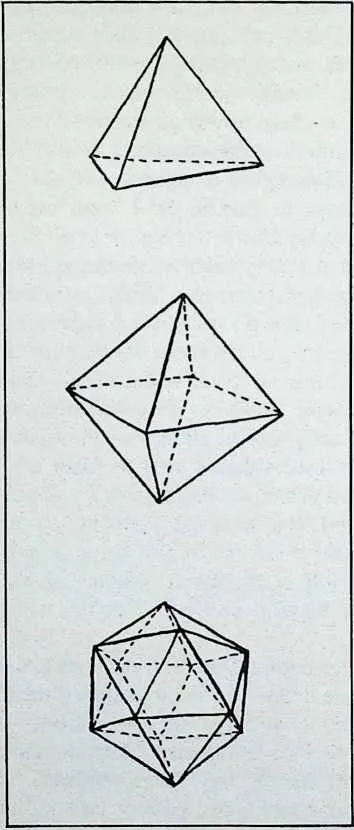
77 From top to bottom, tetrahedron, octahedron, icosahedron.
78 It is not the intention here to endeavor to describe Bucky’s system of synergetic-energetic geometry as differentiated from conventional static geometry. It will suffice for the present to state that, working from those general principles, he made many unique mathematical discoveries which were later confirmed by such pragmatic proof as the discovery by doctors A. Klug and J. T. Finck of Birbeck College, London, of the icosa-geodesic structuring of the polio virus with the probability that all spherical viruses have similar arrangements of proteins; and, more importantly, by Nobel Prize winner Linus Pauling’s documentation of the basic omnitetrahedronal constellations characterizing not only all of organic chemistry, but also all of the combining patterns of metallic atoms.
79 Bucky himself was to prove some of his own geometrical discoveries in the structure that made him famous.
80 Bucky says of his work: “You see, I was looking for the coordinate system of nature, and I was absolutely confident that I had found that system. I still am, and I think that in later years I will be most remembered for the fact that I found nature’s coordinate system and it will be possible to make models of it.
81 “The most important thing about it is that for centuries scientists have been saying that ‘Nature is not using models, because there is a fourth dimension, energy, but you can’t make a model of the fourth dimension. It is so abstract as to be immodelable.’ This brought about the enormous dichotomy between the humanities and the sciences. The humanities people simply could not understand what the scientists were doing, because the scientists could not show them in models or drawings, and the humanities people could not understand their abstract and unreal mathematics. Right there is the basis of C. P. Snow’s assumption of the two intellectual worlds and the great chasm between them. I later told C. P. Snow about my mathematics, and he agreed that they might really span the chasm.
82 “But I am perfectly confident today that tomorrow you will be able to see little children being able to do nuclear physics in model form because that is the way Nature is doing it. She is not static, she’s dynamic, and the models make it clear now, how she can do these things dynamically.”
83 While Bucky was living in the unusual security of an assured income, and doing all this high thinking, he did not yet retire to plain living. On the contrary, he continued to drink copiously and to enjoy gregarious occasions. However, he adopted a form of exercise to keep his magnificent body in shape. Some twenty years before the Kennedys, he took up jogging—he called it dog-trotting.
84 In Manhattan’s Central Park, lovers strolling through a summer evening—it was still quite safe in 1939—would be startled by the sight of a stocky figure in a sweat shirt and undershorts pounding around the reservoir. In Lawrence, where Bucky still frequently went on weekends, he imbued a whole group of Hewletts and their husbands and friends with the habit of this exercise. They might be sitting around in Martin’s Lane convivially drinking at midnight or later, when suddenly Bucky’s “vectors” would overpower the restraining circumferential forces, and he would shout, “Come on, Dog-Trot Club, time for a run!”
85 Stripping off their jackets and pants the whole pack would follow him through the quiet lanes and lighted thoroughfares on a three-or four-mile run. The inhabitants, returning from formal dinners in tuxedos and evening gowns, would stare a moment and then comment, “It’s that crazy Bucky and his friends.”
86 In New York Bucky continued to acquire ever more friends as his more comfortable circumstances permitted him a wider scope. Inevitably, Clare and Harry Luce were among them, as well as many of the Time-Life people. Another man who became an intimate was Hailey Fisk. Fisk was a lively young fellow with red hair, pale blue eyes, and no noticeable abundance of brains, who moved in New York’s most fashionable circles. He became devoted to Bucky, who, as he always did, returned this affection in full measure. At some point in their friendship he invited Bucky to join the Racquet and Tennis Club. Bucky eagerly accepted.
87 Why he wanted to join a club whose membership was almost entirely composed of rich, empty-headed, sporting society characters with no social consciousness and an antediluvian political orientation considerably to the right of Herbert Hoover is one of the apparent paradoxes of his character. It is doubtful if he went to it twice a year, and certain that he met few congenial spirits there. Yet, on further examination, there appears an emotional explanation.
88 It must be remembered that Bucky’s failure to make any of Harvard’s fashionable clubs had made a wound on his psyche whose cicatrice remained, and still remains after fame and fortune beyond the reach of most men have come to him. Rejection was the thing that hurt him most. The Racquet Club was one of the most fashionable in New York, indeed, in the whole country. Ergo, to be accepted by it was to show those snobbish Harvard boys of long ago that they had made a bad mistake.
89 While discussing Bucky in the unlikely role of clubman, it is convenient to consider his present affiliations of that type; they are much more sensible. Eventually he resigned from the Racquet Club and joined the Century Association, which is equally swell, but whose membership is far more intellectual and which owns the finest private library in New York. He also belongs to the New York Yacht Club —a natural because of his love of sailing—and the Somerset Club of Boston, which gives him an excellent base of operations in his native state. In addition he belongs to the Coffee House, New York; the Cliff Dwellers Club, Chicago; the Northeast Harbor Fleet, Mount Desert, Maine; and the Camden Yacht Club, Maine.
90 Bucky continued to knock out inventions almost casually during this period of philosophical-mathematical-sociological mental activity. In 1940, for example, he designed, but did not build, a contraption he called “The Mechanical Wing.” Designed to fit on a triangular A-frame, two-wheeled trailer to be towed behind an automobile, it was “a compact mobile package in which the essentials of contemporary U.S. living can be transported to a Vermont farmhouse, a lakeside campsite, a weekend or vacation house, or incorporated into a permanent dwelling.” 5 In a space no larger than a small powerboat Bucky concentrated all the necessities for luxurious living in the wilderness. To wit: A Dymaxion bathroom with hermetically sealed waste packaging and chemical disposal apparatus; a diesel engine air-compressor, electric generator, and water heater, and a kitchen and laundry unit with sink, laundry tub, electric range, refrigerator, and storage space for dishes and silver. All you needed was a tent and you were in business anywhere.
91 Though the whole package was never marketed—heaven knows why!—Bucky’s A-frame carrier became the small boatman’s favorite vehicle for transporting his craft.
92 Just at the end of this period Bucky designed his first shelter which was actually put to use. In the early summer of 1940, he and Christopher Morley were driving through Missouri near Mark Twain’s Hannibal. Glistening in the sunlight across the level fields stood a cluster of circular corrugated steel grain bins. The sight of them fired a spark in Bucky’s imagination that was a combination of intuition and his consistent preoccupation with housing. “Do you see those grain bins over there?” he asked Morley.
93 “Yes,” said the writer. “Kind of pretty, aren’t they?”
94 “They are,” Bucky agreed. “They could also be the most efficient unit for a small prefabricated house now available for mass production by present industrial methods. You could house a small family in one at a cost of about a dollar per square foot of floor space.”
95 As Morley looked dubious, Bucky launched into an enthusiastic, explanation of why and how: “A cylinder encloses considerably more space than a cube of the same wall area; ergo, less material is needed. Properly capped by a roof or fitted lid, the cylinder would be inherently rigid and require no bracing, as those bins are. Their natural streamlining would cut internal heat loss to a minimum and the circular shape produces the most efficient distribution of internal heat.”
96 Bucky added imaginative details of how insulation could be obtained by introducing fiberglass between the outer walls and an inner plywood lining; windows made like portholes—he always thought in terms of ships—would not weaken or clash with the circular walls; a dozen other refinements. The circular plates and the lid could be shipped anywhere and quickly bolted together on the spot.
97 As Bucky expanded on this theme, Morley, like everyone who ever heard him in the first bright flash of a new idea, glistened with enthusiasm. “Why don’t you make them yourself?” he asked.
98 “Because I haven’t got the money.”
99 Morley became very serious. “Look,” he said, “Kitty Foyle has made me a sinful amount of money. It’s just pouring in—book, paperback, movies, everything! Let me finance it.”
100 Ordinarily Bucky, the burnt child, would have been wary of again accepting money from an acquaintance for one of his projects. But Morley was a true friend—one to be trusted beyond cavil. “Let’s do it,” Bucky said. “First we’ll find out who makes those things.”
101 The war in Europe, which Bucky had long foreseen because of what he considered the greed and stupidity of financiers and politicians, had begun the previous fall (September, 1939) with the invasion of Poland by the Nazis. For a time after the fall of Warsaw, while the German and Allied armies had sat in fortifications just looking at each other, it had seemed as though the United States would not fight in this one, though Bucky thought otherwise. However, in April, the Germans had taken Denmark and Norway. Even as Bucky and Chris Morley were driving through Missouri, the Nazi armies were sweeping through Holland and Belgium toward their lightning invasion of France. From smug complacency Americans had suddenly launched a panic preparedness program against the time when they, too, might be attacked. Thus was Bucky’s new idea almost aborted and as suddenly saved.
102 The Butler Manufacturing Company of Kansas City, Missouri, turned out to be the best equipped for Bucky’s purpose. As he headed west Bucky was feverishly making engineering drawings in his fine-lined style of the details of his new house, his mind racing ahead of his pencil, evolving ingenious problem-solving devices.
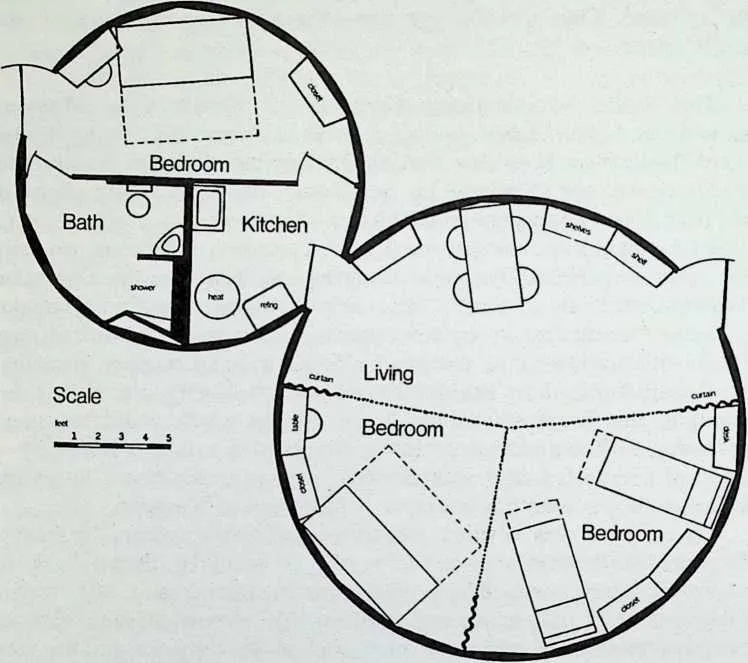
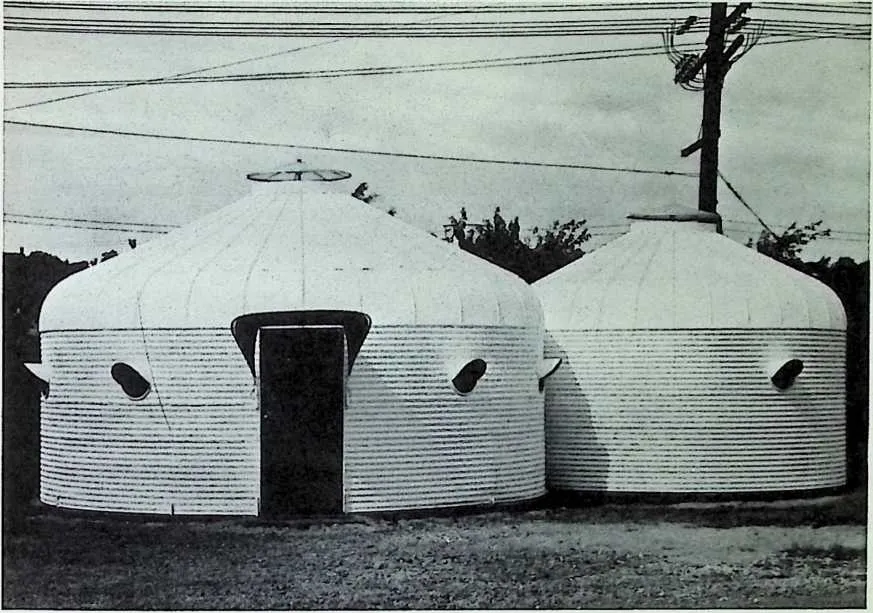
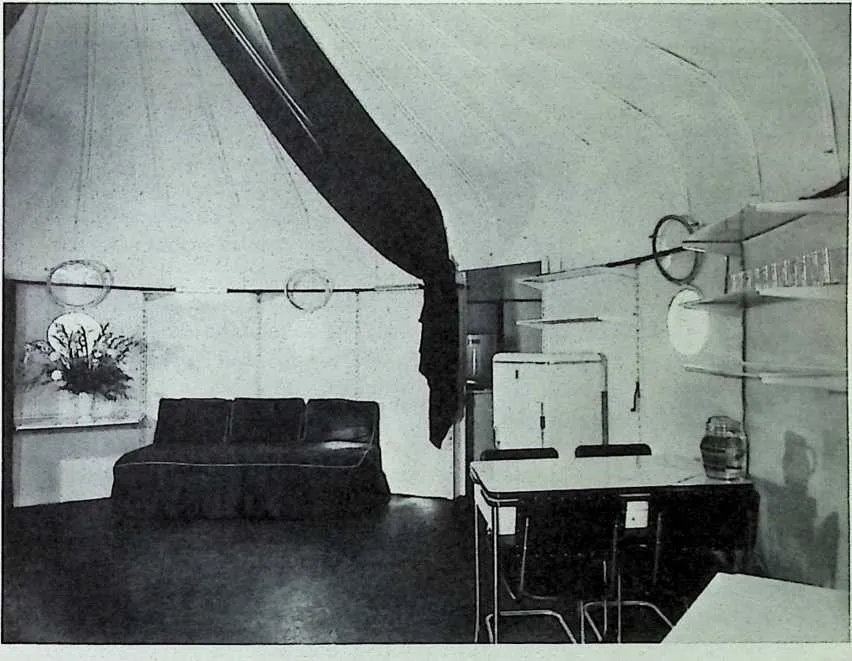
103 As finally turned out by the Butler Company under contract with the newly organized Dymaxion Company of Delaware, the Dymaxion Deployment Unit, as Bucky later named it, was a perfectly circular structure twenty feet in diameter made of corrugated galvanized steel lined with wallboard to the inner side of which fiberglass insulation had been laminated. The lidlike roof, fitted tightly all around for strength, had a translucent ventilator on top which could be raised or lowered. The foundation was a circular brick floor covered by a layer of corrugated steel covered with one-half-inch Celotex insulating boards on top of which was a layer of hard-pressed Masonite.
104 The interior was divided into three pie-shaped rooms by heavy, fireproof curtains strung on wires, which could be drawn back to make one large room. The round portholes were glazed with acrylic plastic, the first time it was ever used for this purpose. A small circular bin was hitched on the back of the main building for utilities and bathroom.
105 The DDU, minus the bricks, weighed only 3,200 pounds, about as much as a medium-sized car, and with Montgomery Ward furnishings, including a kerosene stove and refrigerator, was priced at $1,250.
106 Bucky always built things in an unorthodox way. Like the 4D house, this one was erected from the top down. First the roof was assembled and hoisted up on a specially designed pole. Then the top sections of the walls were bolted together and to the roof and hoisted up. The lower circle was installed by the same procedure. Then the mast was removed.
107 On a hot day in August, 1940, the prototype was erected outside the Butler factory, and their engineers, headed by President E. E. Norquist, came to inspect it. They studied it with admiration. “Now let’s go inside,” said Norquist.
109 The temperature was over 100ř and the sun-heated steel walls of the house almost burned your hand. “No thank you,” said one engineer. “You’ll fry in there.”
110 Norquist was a sport and went in anyway. Then he shouted, “Hey, it’s air-conditioned!”
111 Very cautiously the others followed. It was, in fact, much cooler inside. Bucky was laughing in high delight. The house, was, as he had expected, air-conditioned by nature. The superheated air rising from the steel walls created a vacuum under the house which sucked cool air down the ventilator.
113 The vicissitudes of the DDU began when the British government ordered some for troop housing, then cancelled the order due to priorities of shipping space for weapons. Manufacture of it began for cheap civilian housing as Bucky had intended. But the crash rearmament program of the United States forced the government to ration steel: there would be none for experimental civilian housing. Bucky and the Butler Company thought they would be forced to abandon the whole idea.
114 Then there was a sudden dramatic change. Great Britain was now fighting alone against the Nazis, who had conquered France and were continuing their victorious advance through the Balkans and Greece. The United States Government was openly supporting England by all means “short of war,” and greatly enlarging its own perimeters of defense. This meant that small bodies of American troops and technicians must be stationed in far-off places where housing was unavailable. Some bright character in the general staff realized that the DDU, so light that it could be shipped by air, and easily erected at any spot on the globe, would be ideal housing for these cadres. A unit was installed in Haynes Point Park in Washington for study by the military. They looked at it, and saw that it was good.
115 Moving as quickly as government can only in wartime, Butler Manufacturing was accorded top priority for steel and orders for as many DDUs as they could turn out running twenty-four hours a day.
116 The units were soon pouring off the assembly lines, and being shipped all over the globe. Bucky insisted that each shipment should include a tool kit and the special sectional mast used in erecting them. They were used at radar installations on remote Pacific islands and in other distant places. A small city of them was built on the coast of the Persian Gulf for the use of American pilots and mechanics who were assembling and flight-testing American war planes sent there by ship to be flown on to Russia who had now (June 30, 1941) been attacked by Germany. These DDUs were air-conditioned and lighted by electrical hookup to generators on an American ship moored alongside the pier.
117 When the United States entered the war after the Japanese attack on Pearl Harbor on December 7, 1941, an enormously increased war production produced a stringent shortage of steel. No more was available for housing, even for troops. The Butler Company’s priority was cancelled and the production of DDUs ended even more abruptly than it had begun. But thousands of them had been profitably built. To his surprise, and almost against his principles, Bucky—and Chris Morley —had made money—not a lot, but some.
118 After the war, as always with Bucky’s attempts to improve housing for mankind, the domes
ran head-on into building codes and zoning restrictions. No matter how popular domes were for
auditoriums and other large enclosures, the individual homeowner had enormous difficulties in
building one to inhabit personally unless he lived in a very remote area, or one managed by an
extraordinarily intelligent and flexible board of supervisors. Thus, the domes became a symbol of
Bucky’s
continuing battle against the rigid rules of the construction establishment, in which he has been
joined by thousands of people who want to break the shackles that capital and labor
have fastened on debt-ridden homeowners in the name of protecting them against
shoddy workmanship and cheap materials. So far very few dome-houses have been
built.
120 It was during this summer of 1941 that Bucky decided to stop drinking forever. Though he was very busy with the DDU, he was thinking of many other things and constantly refining his concepts of the design revolution. And he was talking to anyone who would listen about his great design for the future of mankind, which, in his dedication to it, had become a holy crusade to him, a feeling that was intensified by his emotions concerning the useless war that was being fought. He says: “I found that my drinking was interfering with the design revolution; because when you are drinking, even if it doesn’t distort the sense of what you are saying, people think it does. They think you are just babbling. I realized that you cannot drink and be taken seriously as a prophet of the future. So I stopped.”
121 Just like that, Bucky stopped drinking. And ever since that day his habits of both eating and drinking have become more and more ascetic, much as the saints of old gave up all worldly vanities for their dedication to God. He eats, not for enjoyment, but merely to keep himself in the best possible physical condition.
122 He has also given up all other stimulants except very weak tea. He believes this flushes out his system and he drinks forty or fifty cups of it every day. Wherever he is, except on the lecture stage, a kettle is always kept boiling and the teapot close by his hand. “Hot water would do as well,” he says, “but it is so insipid. I just put in enough tea to give it a faint flavor.”
123 The tea does, indeed, keep his system flushed out. He goes to the bathroom about once an hour. Concerning this habit he made one of his humorous little sketches, neatly framed for his sister-in-law, Hope Hewlett Watts, which is reproduced herewith:
124 One of the things Bucky was conceiving at this time was a new kind of map of the world. Projecting an accurate flat map of something that is spherical like the earth is fantastically difficult, so difficult that it had never been done successfully. The maps generally in use were based on the projection first made by Mercator back in 1569. In the Mercator projection the meridians of longitude are straight lines running north and south. But on a globe the meridians converge at the North and South poles. At the equator they are approximately 69 miles apart. But if you were to draw a circle 360 feet in circumference around the North Pole, the meridians of longitude would be one foot apart. It is easy to see that carrying them up from the equator in straight lines produces increasing distortion, until in the Arctic it is absurd. On a conventional map Greenland looks almost as large as South America, when it is really no larger than Argentina.
125 Various attempts had been made to achieve less distorted projections—orthographic, stereographic, external perspective projections, etc. The Encyclopaedia Britannica of 1952, ignoring Bucky, states flatly, “It is impossible to retain throughout the proportion of lines or areas or equality of angles…” It goes on to state that if some areas are accurate, others must be distorted. Bucky decided that in his future world of extreme rapidity of transit such distortion would not do.
126 He started with the tremendous handicap of not having studied spherical trigonometry except for the little he had picked up in navigation courses in the navy. In any event it would have required days, perhaps months of calculation, in those precomputer days. Bucky decided to work it out empirically. He proposed to base his map of the world on the principle of a three-way great circle grid, which mathematicians said could not be done. While he was still in Kansas City he had the Butler mechanics make him two “beautiful copper hemispheres” so accurately machined that they fitted one inside the other as perfectly as a universal joint. He explained:
127 “Being pure hemispheres the edge of one became a great circle ruler and I could take any two points on the inner one and bring the outer one to that and this edge made an absolutely perfect great circle ruler because a great circle is a line formed by a plane going through the center of a sphere. So the hemisphere was a plane going through the center. Now, with this I was able to lay out my map with squares and triangles—60-degree edges on all squares; all the triangles were 60 degrees of arc. Working very, very carefully on the inner hemisphere with an extremely sharp scribe I would make my mathematical points. Then I would take my great circle ruler and scribe the great circle between those points very, very accurately. I did the spherical triangles within one degree of accuracy. I had 60 intervals along the edge of the triangles and I connected those with my great circle ruler and it made a three-way great circle grid of perfect triangles.”
128 Though it was done for the map, this was the inception of the geodesic dome; for Bucky said to himself, “If I can ever do the mathematics of this, I feel that I can make a completely triangulated spherical structure. I think the same grid can be worked there. If I have tension between the legs of the triangles they won’t spread under a load. Therefore I can load any one' point on a sphere and it will distribute the load through tension to three other points and on to hexagons—[made up of triangles] and icosahedrons. At each vertice [point] the load will be distributed three ways so in no time the load will become so diffuse it will not in any way jeopardize the structure. I haven’t done it yet. I’ll have to do that by trigonometry…”
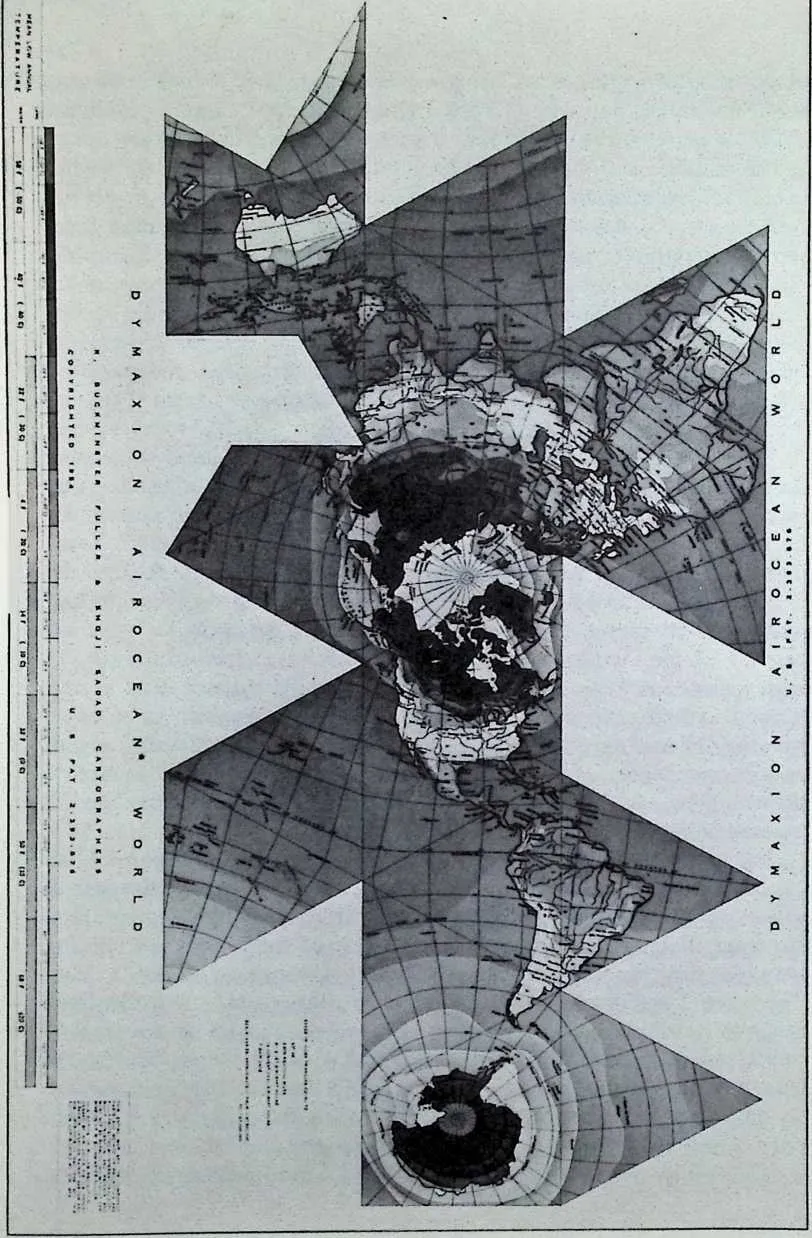
130 Meanwhile, Bucky worked out his map of the world using triangles,and squares very accurately measured. These triangles and squares with portions of the globe upon them were then cut out of paper so they could be fitted together in any perspective—the view from the North or South Pole, or from one great continent or another, or the ocean world. They could also be fitted together to make an icosahedronal vector equilibrium—a twenty-sided globe. Thus, one could study different routes or angles; and in other variations one could chart the density of populations along parallels of latitude; or mineral belts, or fertile agricultural lands. But the main great point of Bucky’s map was that, although there were slight distortions in all areas incident to projecting a sphere on a flat surface, no single area was distorted in sacrifice to another, and the proportion of lines, areas, and angles was retained throughout, which the Encyclopaedia Britannica said could not be done.
131 Bucky offered the Dymaxion Airocean World Map, as he called it, to the editors of Life magazine, with whom he had consulted once a week during his time on Fortune. They assigned his close friend Gerard Piel of the beer family to write the explanatory article. Piel went through a great deal of discussion with the scientists and mathematicians, who were brought in by Life as consultants, before they dared to publish the Dymaxion map. They unanimously said in a derogatory manner that it was “pure invention”; that Bucky had somehow fudged it.
132 In spite of this, Life concluded that it really worked and decided to publish it anyhow. That issue (March 1, 1943) sold 3,000,000 copies, the greatest circulation Life had ever attained up to that time.
133 The derogatory remarks made by the scientists redounded to Bucky’s benefit when he applied for a patent on his map. His patent attorney told him that in 1900 the United States Patent Office had ruled that it was impossible to patent any further cartographic projection, as all the possible mathematics and projections had already been exhausted. However, Bucky pointed out that: “We have three noted experts, who say this map is ‘pure invention.’ Even though they said it in a negative way, it is the best possible testimony to prove to the patent examiners that it is really an invention.”
134 Bucky got his patent.
135Dymaxion map of the world.