
3 Not So Fair Harvard
1The trauma of his father’s illness and death was the first of several psychic shocks that distorted Bucky’s youthful character, and led him at times to wildly irresponsible behavior. More than ever he needed love and approval; and when they were denied him he overreacted. For example, the Fullers’ reduced circumstances shamed him unduly, and he magnified unintentional slights into deliberate insults, attributing them to his lack of means. Because he had so little money he set up a dichotomy concerning wealth, at one and the same time exaggerating its power for evil and trying to convince himself of its total unimportance. He succeeded so well in the latter endeavor that throughout his entire life he has treated his personal finances in a downright feckless manner.
2 Mrs. Fuller unwittingly contributed to this attitude. Determined that her children should have the best possible education, she scrimped and sacrificed to send Bucky as a day scholar to Milton Academy, one of New England’s finest and richest preparatory schools. But it never occurred to her that he should have an allowance, no matter how small—some money of his own to budget and spend as he saw fit. Bucky says, “If my father had been there he would certainly have given me an allowance. As it was, I had to ask mother for everything I did or bought; and feel very badly about asking for it. Sometimes, really needing something and not quite daring to ask for it, I charged it. Then the bill would come in and things were messy.”
3 Not only were they messy, but Mrs. Fuller began to feel that her son was thoughtless and irresponsible.
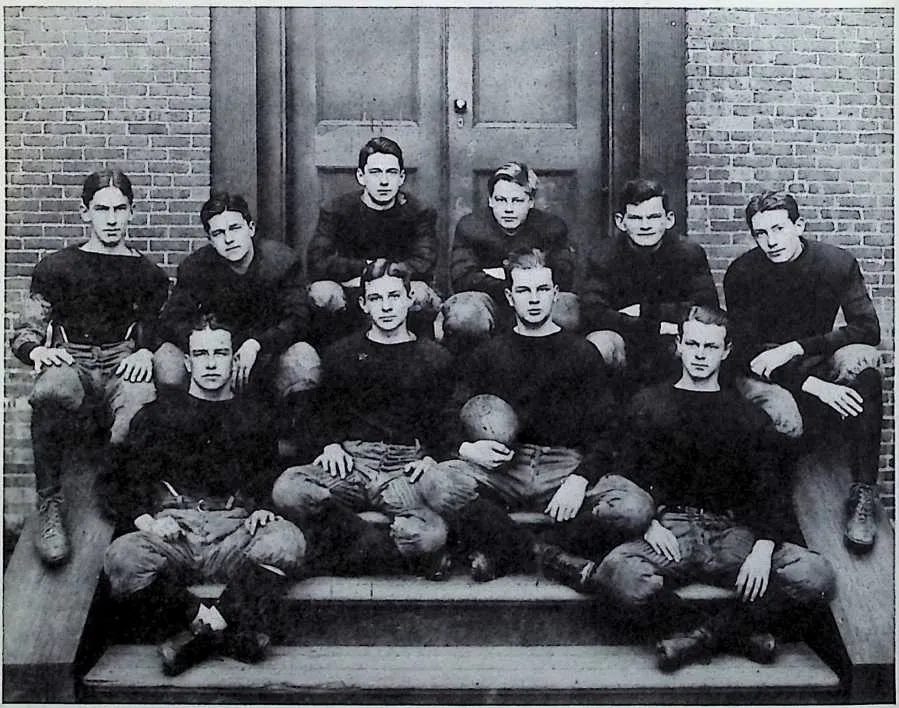
4 There was the incident of the football helmet. Milton had an excellent football team and Bucky went out for it. He was small, but he was a compact mass of muscle, and was speedy. His great ambition at this time was to make quarterback of the team. When he first began to play he told his mother he needed a helmet. What he had in mind was the regulation leather helmet of the period which all the other boys wore. Mrs. Fuller, struggling desperately to make ends meet, went to the ten-cent store, and bought him a cheap helmet made of a sort of Chinese quilting. Bucky thanked her politely enough, but when he wore it, as he had to in order to be allowed to play, he felt shamed. Sixty-odd years later he still mentally cringes at the memory. It all became very much a part of his attitude toward wealth.
6 At Milton, though, Bucky had one thing no other boy had, and he gloried in it. In his senior year he was given a beautiful little kayak. He quickly learned to handle it with great expertise. Once he paddled all the way down the Charles River to Boston and out on the choppy water of the harbor itself. Though no great feat for a boy who had been nurtured on the tide-ripped, fog-bound waters of Penobscot Bay, it was considered a rugged and daring stunt by his fellows. Bucky basked in the glow of their admiration.
7 In fact, Bucky’s record at Milton was very good. He was, of course, stubbornly independent in his thinking. When he began Euclidian geometry his teacher first made a dot on the blackboard which she explained was not a thing of substance but merely an imaginary point in space. She then made other dots and connected them by a line which she said did not exist either. A series of parallel lines made a plane which was also nonexistent, but when the planes were stacked up to make a cube, she said that existed. Bucky could not see how you could make something real out of nothing. He asked how much it weighed; this was considered impertinent. There followed a series of nonexistent triangles, and circles which could not be squared. Bucky’s logical mind instantly rejected these fictitious objects, with no substance, and he voiced his doubts, which persisted until he invented his own synergetic geometry many years later. However, with the weight of authority pressing upon him, and the knowledge that he would get into trouble if he questioned traditional thinking, he “shut up.” He decided to conform and play the game according to its illogical rules—for the time being. He played it so well that he got As in all his science and mathematics courses throughout his school career. He did not do as well in Classics, Latin, English Literature, and History because they bored him, but he managed good grades except in Latin, which he barely passed.
8 Bucky loved athletics, which he later rationalized in Fullerese as “an enthusiastically broad experience in the historically differentiated family of controlled physical principles, known as athletics, which greatly heightened what I call the intuitive dynamic sense, a fundamental I am convinced, of competent anticipatory design formation.”
9 Anything Bucky liked, he did very well indeed. Despite his comparatively small size and the fact, which he did not then know, that one leg was three-quarters of an inch shorter than the other, he realized his ambition to become quarterback of the varsity football team.
10 All in all, his experience at Milton was a happy one—despite those awful stinks. So he came to Harvard in the fall of 1913, with a good scholastic and athletic record, and very high hopes.
11 Bucky’s hopes were far too high. Based on his father’s descriptions of Harvard and the reminiscenses of his father’s friends, he had created a place as idyllically unreal as Tennyson’s “Avilion; Where falls not hail, or rain, or any snow, Nor ever wind blows loudly.”
12 As Bucky put it in an address to the Planning Committee of Southern Illinois University in 1961, “I was too puerilely in love with a special romantic, mythical Harvard of my own conjuring—an Olympian world of superathletes and alluring, grown-up, worldly heroes.” He expected to become an equal and good companion of that exalted company. The reality was dismally different.
13 First off, due, he thinks, to the unequal length of his legs, he broke his knee at football practice, which ended his glorious dream of becoming Harvard’s quarterback; the ranks of superathletes were closed to him forever.
14 Then, because he found mathematics too easy, he chose to major in “something really difficult like government or English.” Since literature was not the love of his life, and politics and politicians soon became anathema to him, his college work seemed “a chore done only to earn the right to live in the Harvard community.” The things he was taught and the way they were taught appeared to him either untrue or irrelevant, though he would not have used exactly that word at that time. To these disillusionments was added an unexpected and crushing rejection.
15 In 1913, Harvard was socially stratified by the clubs. Porcellian was the social pinnacle, followed by others in descending order. In the outer purlieus were barbarians who belonged to no club at all. As his first semester drew to a close Bucky was “shockingly surprised” by the looming prospect that he would not be invited to join any club.
16 In his speech at Southern Illinois Bucky said, “I soon saw that I wasn’t going to be included in the clubs as I might have been if I had been very wealthy or had a father looking out for me; for much of the clubs’ membership was arranged by the clubs’ graduate committees…I hadn’t anticipated these social developments. I suddenly saw a class system existing in Harvard of which I had never dreamed. I was not aware, up to that moment, that there was a social class system and that there were different grades of citizens. My thoughts had been idealistically democratic. Some people had good luck and others bad; but not because they were not equal. I considered myself about to be ostracized or compassionately tolerated by the boys I had grown up with. I felt that my social degradation would bring disgrace to my family…”
18 This is Buckminster Fuller the egalitarian philosopher speaking, not Bucky Fuller the prep-school-educated son of Boston’s best. It is typical of Fuller’s habit of endowing his youthful self with the ideals he acquired through pain and compassion very much later. In 1913, Harvard was about as democratic as the court of Louis XIV, and it is difficult to believe that a boy brought up in the atmosphere and traditions of Harvard’s elite should have been surprised and disturbed to discover that it was not an egalitarian society—he had heard talk about the clubs all his life. In fact, it is highly improbable that young Bucky, who up to that time had never thought seriously about the social condition of mankind, gave a hoot whether Harvard was democratic or not.
19 In his final sentence he unconsciously gives it away. felt that my social degradation would bring disgrace to my family. There is the pith and substance of it; the dismaying discovery was not that there were social classes at Harvard, but that Bucky was not to be accepted into the upper class.
20 The reasons he gives for his “ostracism”—lack of wealth, no father to look out for him—are also a rationalization long after the fact. However deplorable Cambridgian snobbery may have been, wealth was not the key to acceptance. The clubs were very inexpensive and the richest boy in the world could not have bought his way in. Nor is there much more validity to the argument that lack of a father had a great deal to do with it. It is true that the graduate committees could bring a certain amount of pressure to bear on the undergraduate membership committees of the clubs, but the final decision was up to the boys themselves.
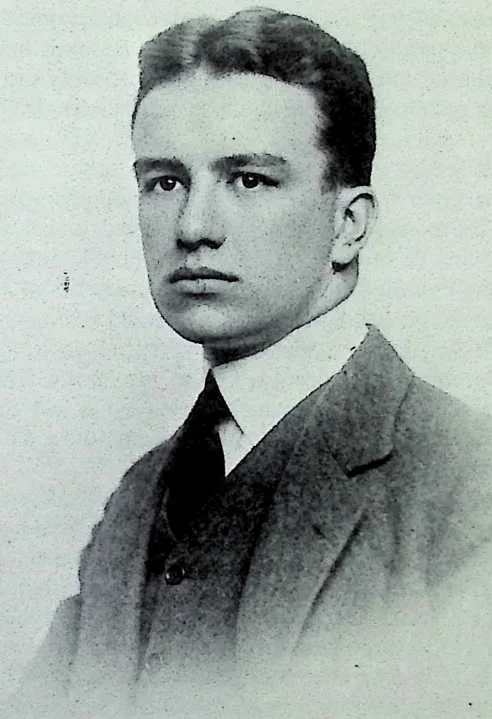
21 The plain truth is that Bucky was too individualistic, too much of an oddball in thought and appearance to meet the conformist standards of those young, so-sure-of-themselves aristocrats. He was short, carelessly dressed, with a head much too large for his body. His teeth, which had not then been straightened, were oddly arranged and those enormous magnifying lenses made his eyes look like big pools of amber liquid. Above all he was too vulnerable, too eager, and too emotional to be acceptable to young men who conformed to New England’s mode of suppressing all emotion. His brother-in-law, Roger Hewlett, says, “As a young man trying to make an impression he went to excesses. If he went on a drunk it was a bigger drunk than it should be in that crowd, or if he went to a party he made too much noise. By trying too hard he managed to keep himself out of being in all the time.”
22 So it must be concluded that Bucky was unloved for himself alone; another rejection and one most bitter.
23 This analysis is not to imply that Bucky was consciously sophistical in his speech at Southern Illinois. He believed it to be an accurate statement of fact.
24 Bucky was so deeply hurt and disillusioned that Harvard became hell to him. He wanted desperately to get away. As to the manner of his going he had, of course, several reasonable options. He could simply resign; he could leave without resigning; or he could stop studying and quietly and deliberately fail his examinations. The latter course was unthinkable because, to the “social degradation,” it would add the stigma of mental incapacity, and, though he found his courses so uninteresting, by sheer perseverance he had maintained a better than the C average, which was all anybody expected of a Harvard man in those halcyon days. Nor did the other options appeal to him. Though he clearly did not think it out, they were much too undramatic. So he chose an imaginative if egomaniacal alternative.
25 In the depressing depth of a New England winter as midyear examinations approached, Bucky’s desperation cracked the shell of reason and submerged filial feeling and even ordinary consideration of others. He drew from the bank a considerable sum of money which his mother had put there for his tuition, lodging, board, and other expenses, and headed for New York and one grand and glorious bust.
26 Even at his least rational no one could accuse Bucky of lack of enterprise. He put up at one of the great hotels, and the second night went to the Ziegfeld Follies. Of course he fell in love with Marilyn Miller. The next night he went again and sent Miss Miller a huge bunch of roses and five bottles of champagne with his card. So she let him come to see her backstage.
27 Bucky was, and is, one of the world’s great natural salesmen. He induced Miss Miller and several of the other girls to come out to dinner after the show. He gave them a smashing party at Churchill’s famous restaurant with champagne flowing like the Hudson River. By the time it all ended, Bucky had not only blown his entire capital, but run up some large bills which his family eventually had to pay. Harvard promptly expelled him for “irresponsible conduct,” which was a Cambridge understatement.
28 One would not have liked to be present at Bucky’s confrontation with his family. Despite the Fullers’ very real love and loyalty for one another, when they had a disagreement they tightened up like piano wires. In those moments, in the words of one friend, they got along “like rheumatism and St. Vitus Dance. The things they said to each other were positively terrifying.” Mrs. Fuller was a wonderful mother, who bailed Bucky out of many financial difficulties, but she could be venomous when she felt that one of her children had traduced her moral code. In this case she had good reason.
29 The family council decided that Bucky had disgraced them and should be sent as far away from Boston as possible. One of Mr. Fuller’s loyal friends got him a job with the Connecticut Canada Textile Company as an apprentice mechanic at a new mill they were erecting in Sherbrooke, Canada. They all felt that such a rugged experience would teach him a lesson. It taught him several lessons that Bucky considers among the most valuable of his early life.
30 Sherbrooke was a small manufacturing town in the desolate hinterland of Quebec Province. When Bucky reached it on a bleak February day in 1914, he found the acme of discomfort amid a population who spoke the peculiar French-Canadian patois that even a Frenchman cannot understand. The new mill building, standing among raw piles of earth, dirty snow, and wooden crates of machinery in a freshly cleared field, was empty and ominous. The prospect before him was as bleak as the weather. And he thoroughly enjoyed the whole experience.
31 He never minded physical hardship and seems impervious to cold. Even in his seventies he could stand for hours in a chill wind in his shirt sleeves while other men were bundled in sweaters and windbreakers. Give him something to do with his hands, machinery to understand and work with, and he is totally at ease. In Sherbrooke there were none of the expectations or social pressures of Harvard; no need to deal with the patterns of arbitrary and unreasonable customs and bans by which people in Boston evaluated what he could not be. Here was just work to be done and a crew of Lancashire and German engineers and mechanics who knew how to do it. Here a man stood on his own feet with no one to care what he looked like or if he conformed, provided only that he was worth his weight in doing the job at hand. Fifty years later Bucky wrote: “I liked the people I met at work and I liked mechanics. I worked hard…” The men liked him. He was accepted and appreciated.
32 The job was installing textile machinery, shipped over from England and France, in the new mill. Bucky quickly learned the techniques of assembling and installing the machinery, which was crated in disassembled parts, and running the belts and shafting throughout the building, big as a car bam, and aligning them exactly to the large stationary steam engine, much like that in his uncle’s cold storage plant, in the powerhouse. He also gained “a dawning awareness of a major economic pattern factor,” the addition of value by manufacture gained by the admixture of technology and energy.
33 Evaluating the big cotton-weaving machines, he found that those from Combers in France were superior in both metal quality and exact tolerances to those from Dobson and Barlow in England. The British-made parts were frequently damaged or broken in transit. Noting Bucky’s keen interest and initiative, the chief engineer gave him the job of finding local facilities for repairing or replacing those parts. This gave Bucky a “self-tutored” course in the metallurgy, stresses, and function of each of the parts, as well as a very rich experience in the actual processes of manufacture in the small local forges and machine shops that he found in the vicinity. Just how he communicated with the French Canadians who manned them is something of a mystery, but he has always been able to communicate with people of other countries, mainly because of his genuine friendship and interest in them, and his total lack of any chauvinistic prejudice or even sense of their foreignness.
34 Because of this, and also because of his genius for unconventional solutions of mechanical problems, Bucky was extraordinarily successful in improvising the new parts. In some cases his inventive mind actually designed better-functioning parts than the original ones.
35 His friend, the chief engineer, advised Bucky to keep an engineering notebook complete with sketches of the work, which became a valuable resource, far more useful than any college notebooks. Bucky regards this whole experience as of basic importance in his education, a cornerstone of his self-taught engineering expertise, and he considers that his intimate association with engineers, foundry men, and mechanics was a vitally important preparation for his future career as well as a thoroughly enjoyable episode.
36 Typically, Bucky also credits himself with beginning to perceive a magnificent reorientation of mankind from the role of inherent failure to inherent success through experience-rich competence in design which transcendentally integrated man’s conscious planning. In other words, physical laws and teleological necessity were, without man’s deliberate intent, developing “an organic workable complex—industrialization—which would eventually liberate humanity from the old problem of scarcity and provide abundance for all.”
37 In real fact he did nothing of the sort at that time—this is another transference backward of Bucky’s later-developed philosophical insights. However, there is no doubt that remembrance of these highly educative experiences eventually played an important role in forming his fundamental theorem, just as the practical knowledge of metallurgy and engineering enabled him to apply the general principles he later discovered to concrete particulars in his inventions.
38 So happy was he at Sherbrooke that, when the work on the mill was done, he stayed on to oversee the start of operations and cope with any bugs that might develop.
39 In July, Bucky was back on Bear Island. He was also back in the good graces of his family. Reports of his good work in Sherbrooke had amazed and delighted them. He had proved that he could be a sane, responsible young man; he was rehabilitated.
40 In July, 1914, Europe was rushing down the steep declivity toward war with the suicidal abandon of particularly moronic lemmings, but the alarm bells were hardly heard on Bear Island. The inhabitants of Eden tend to ignore the news of the world lest it disturb their tranquillity. Even today there is not a radio on the island and the latest information concerning events beyond the azure horizon is contained in a two-day-old New York Times, which hardly anybody bothers to read. In the summer of 1914, only vague repercussions of earth-shaking events sounded dimly in their ears.
41 On August 3rd, the day England sent her final ultimatum to Germany and the huge new Krupp howitzers opened fire on the “impregnable” fortifications of Liege, Bucky packed a fantastically imagined fish costume into a suitcase and sailed Ursa Minor over a tranquil summer sea to Mount Desert Island. In the late afternoon he coasted around its forested cliffs, glimpsing the huge summer cottages through the evergreens, and eventually dropped anchor in Frenchman’s Bay off Bar Harbor.
42 It was quite a feat to get into his costume in the narrow cockpit of Ursa Minor, and his appearance as he rowed ashore, with round thick glasses adding verisimilitude to his aquatic outfit, must have given thought to any Maine fishermen who happened to be on the wharf. However, it was not one of Bucky’s fantasies, but a perfectly sane, sensible performance. He was on his way to the Herman Oelrichs’ undersea masquerade ball.
43 At the ball Bucky had a splendid time. He loved parties, and though he was often somber and withdrawn, no one could be gayer and more fun when he was in the mood. He heard some talk of the war, but with all those pretty girls, Japanese lanterns, champagne, and an orchestra dashing off syncopated tunes and everyone doing the daring new dances like the Turkey Trot and the Bunny Hug, it was no time to discuss the end of a world At six o’clock Bar Harbor time the British ultimatum had expired and in New York the newsboys were shouting, “Extra! Extra! England at war!" But nobody in Bar Harbor knew or cared about that.
44 Some time before dawn Bucky made his way back to the wharf and rowed out to Ursa Minor where he curled up in the cockpit and went to sleep.
45 He was shaken awake by the immense vibrations of a big ship’s whistle, followed by excited shouts on the dock and the rattle of great anchor chains. Grabbing his glasses Bucky looked seaward at a quite unbelievable picture. Just beyond the mouth of the harbor, filling the entire sea and blotting out the sky, was a great ocean liner with row upon row of portholes in her black hull and tiers of white superstructure, looking from water level as tall as New York’s skyscrapers. Her funnels were painted in the colors of the North German Lloyd and from her stern, lit by the level sunlight, flew the flag of the German Merchant Marine. Bucky could only gaze in awe, and wonder what the devil she was doing in Frenchman’s Bay.
46 Going ashore he found the town abuzz with rumors and eventually learned the facts. The ship was the Kronprinzessin Cecilie, which had sailed from New York over a week earlier with a full passenger list and a cargo of gold bullion in her hold worth thirteen million dollars. When war became imminent her captain had put about and headed for the safety of a neutral port, chased halfway across the ocean by French and British warships hungry to take the treasure she carried as a prize of war. It suddenly brought the war much closer to the coast of Maine.
47 Bucky was also rehabilitated at Harvard. Due to his excellent record at Sherbrooke, his previous good marks—until he flew the coop—and, doubtless, to the persuasive efforts of his father’s influential and devoted friends, he was allowed to return in September, 1914. This time his tenure was even shorter. His excursion into the real world made the academic atmosphere seem even more phantasmagorical to him, and the old social dichotomy still troubled him. He was utterly wretched and bored, so he rapidly became unrehabilitated. This time Harvard fired him for “lack of sustained interest in the processes within the university.”
48 While at Harvard, both times, Bucky had two really close friends —Lincoln Pierce and Pierce’s roommate, Thomas Whitehall—Bucky roomed alone. Link Pierce—pronounced Purse in Massachusetts—had been Bucky’s first and dearest friend, and remained so until he died in 1970. His father, Doctor Vassar Pierce, had attended Bucky’s arrival on Spaceship Earth just six months before his own son was born. Link and Bucky both remembered being pushed by their nurses through the country lanes around Milton and scraping the mud off the wheels of their baby carriages with their hands, much to the dissatisfaction of their attendants. Link had grown up to be a strikingly handsome young man. He was graduated from Milton in Bucky’s class.
49 Tommy Whitehall had also been graduated from Milton Academy. There, and in Harvard, he had straight As and was intellectually brilliant. Of him Bucky says: “He used to stimulate me more than all the other students I knew. In those days what the young men were talking about was of a pretty low order intellectually—mostly about athletics. They did not even talk very much about sex, because our parents had not allowed them to learn anything about that taboo subject and we were pretty much in a fog about it.
50 “Tommy was a tremendous freshman, superbly well read, he got me interested in doing my own reading—some very, very good books. And he really understood my reaching out, all of a sudden, for knowledge about the world and history. Most of us had no ideological challenges; we knew virtually nothing about social problems and economics. But Tommy knew a great deal about history and the way such problems had come about. I got much more from him than I did from my schoolbooks—he influenced me greatly, in big ways and small. For example, he was inclined to be an epicurean, so I became an avid epicurean…
51 “Tommy was really a great joy to be with—he was so intellectually rich.”
52 It is evident that Bucky’s sojourn at Harvard was not entirely in vain, for he was thus awakened to what was to become his great preoccupation, the welfare of humanity.
53 After leaving Harvard, Bucky resumed what he called “his real lessons,” though not without “deep anguish and shame at having brought hurt to my family.” They, especially his mother, were about ready to write him off as a total failure. But he experienced an enormous sense of relief at working in the functioning economic pattern.
54 His new job was with Armour and Company, the great meat-packing house. During the next two years he worked in twenty-eight branches of the company in the New York metropolitan area. This rapid change of venue was not due to failure on his part, but more likely to the fact that Armour recognized executive material in him. For he was a very hard and intelligent worker.
55 The hours imposed by the marketing routine were arduous. Bucky went to work at three a.m. and finished, if he was lucky, at five p.m.— a fourteen-hour day, often at hard physical labor such as manhandling quarters of beef aboard refrigerator ships bound for Europe. His extraordinarily tough constitution enabled him to take it, and even to like it.
56 For Bucky, alert to profit by every experience, was learning a great deal. He studied at first hand the techniques and economics of slaughterhouses, refrigeration, by-product utilization, and preservatives. He also acquired more than a superficial knowledge of marketing, shipment of perishables, distribution, accounting, shrinkage, and, most important of all to him, human relations in a competitive and complex business.
57 For his diverse functions Armour paid him the magnificent sum of $ 15 a week. But, though he was often tired and had little if any recreation, Bucky had “a sense of deep enjoyment.”
58 He was able to survive on his meager earnings only because he lived with his mother. Mrs. Fuller had sold her house in Milton when Bucky first went to Harvard, and her daughter, Leslie, who had grown up to be “a charmer,” had married Edward P. Lamed, a brother of William A. Larned who was eight times tennis champion of the United States. Neddy Larned was pleasantly affluent and almost as fine a tennis player as his brother. In fact, he twice played him in the finals at Newport—an all-Larned match for the championship of the United States.
59 Probably to look after her sparkling black sheep, Mrs. Fuller rented an apartment in a small apartment hotel at 22 East 31st Street in New York. Bucky lived with her there. It was not an entirely happy arrangement—too close quarters for two such high-powered people, but Bucky was so absorbed in his work that he was impervious to minor inconveniences.
60 Then he fell in love for the first and final time.