¶ Coincidental Articulation Sequence (3)
← Coincidental Articulation Sequence (2) | Coincidental Articulation Sequence →
Index Entry
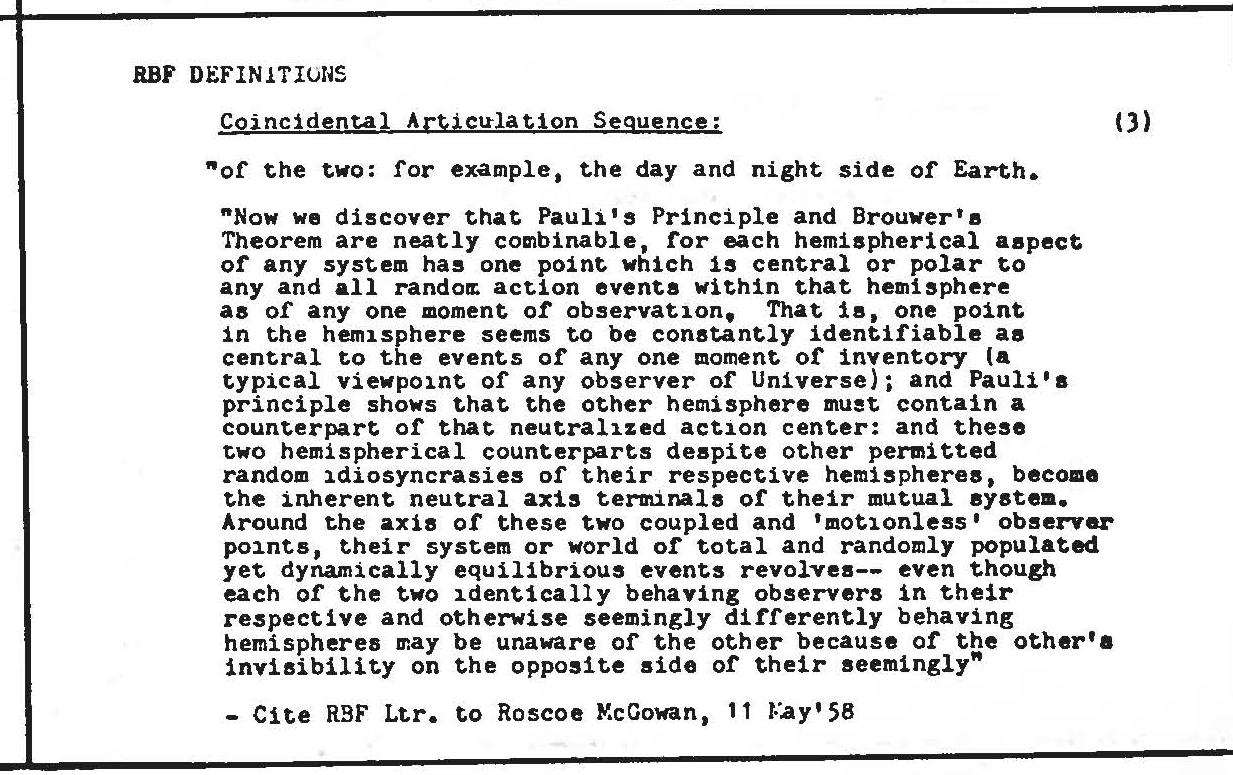
of the two: for example, the day and night side of Earth.
“Now we discover that Pauli’s Principle and Brouwer’s Theorem are neatly combinable, for each hemispherical aspect of any system has one point which is central or polar to any and all random action events within that hemisphere as of any one moment of observation. That is, one point in the hemisphere seems to be constantly identifiable as central to the events of any one moment of inventory (a typical viewpoint of any observer of Universe); and Pauli’s principle shows that the other hemisphere must contain a counterpart of that neutralized action center: and these two hemispherical counterparts despite other permitted random idiosyncrasies of their respective hemispheres, become the inherent neutral axis terminals of their mutual system. Around the axis of these two coupled and ‘motionless’ observer points, their system or world of total and randomly populated yet dynamically equilibrious events revolves-- even though each of the two identically behaving observers in their respective and otherwise seemingly differently behaving hemispheres may be unaware of the other because of the other’s invisibility on the opposite side of their seemingly”