¶ Coincidental Articulation Sequence (2)
← Coincidental Articulation Sequence (1) | Coincidental Articulation Sequence (3) →
Index Entry
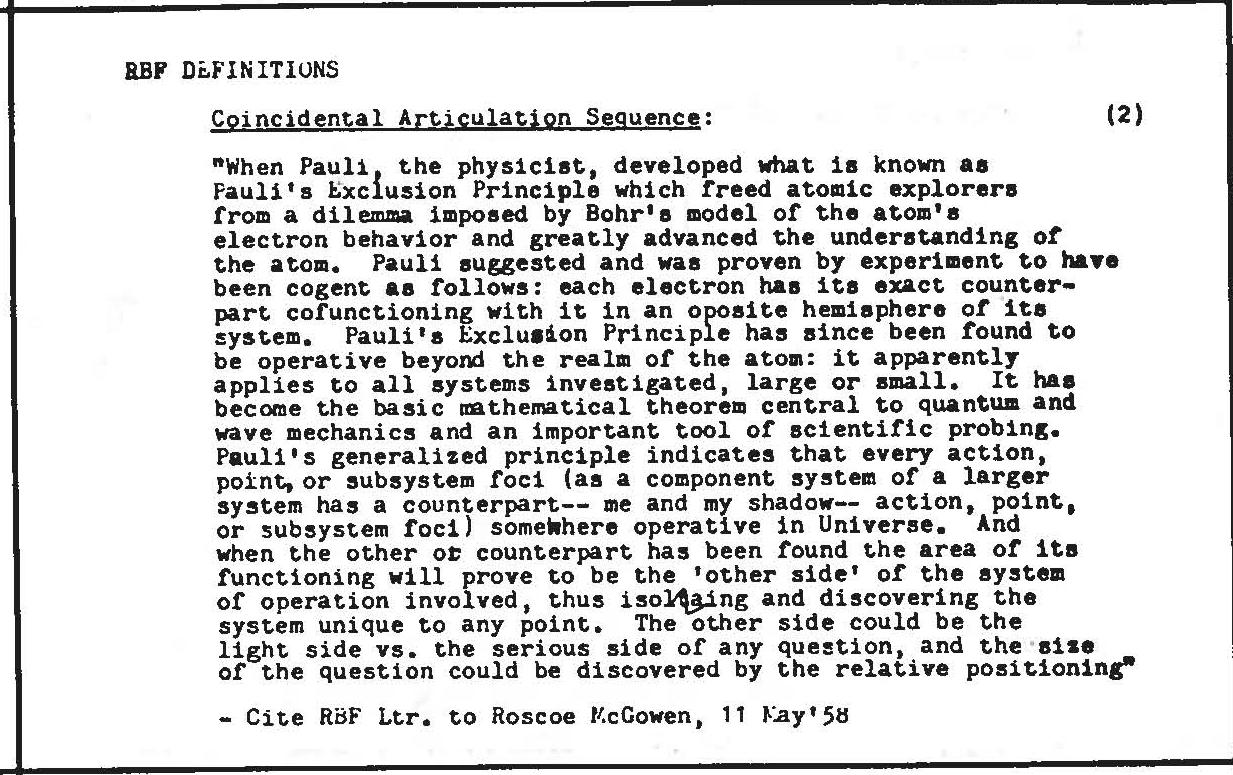
When Pauli, the physicist, developed what is known as Pauli’s Exclusion Principle which freed atomic explorers from a dilemma imposed by Bohr’s model of the atom’s electron behavior and greatly advanced the understanding of the atom. Pauli suggested and was proven by experiment to have been cogent as follows: each electron has its exact counterpart cofunctioning with it in an oposite hemisphere of its system. Pauli’s Exclusion Principle has since been found to be operative beyond the realm of the atom: it apparently applies to all systems investigated, large or small. It has become the basic mathematical theorem central to quantum and wave mechanics and an important tool of scientific probing. Pauli’s generalized principle indicates that every action, point, or subsystem foci (as a component system of a larger system has a counterpart-- me and my shadow-- action, point, or subsystem foci) somewhere operative in Universe. And when the other or counterpart has been found the area of its functioning will prove to be the ‘other side’ of the system of operation involved, thus isolating and discovering the system unique to any point. The other side could be the light side vs. the serious side of any question, and the size of the question could be discovered by the relative positioning