¶ Unzipping Angle: Tetrahelix
← Unwrap: Unwrapping | Unzipping Angle →
Index Entry
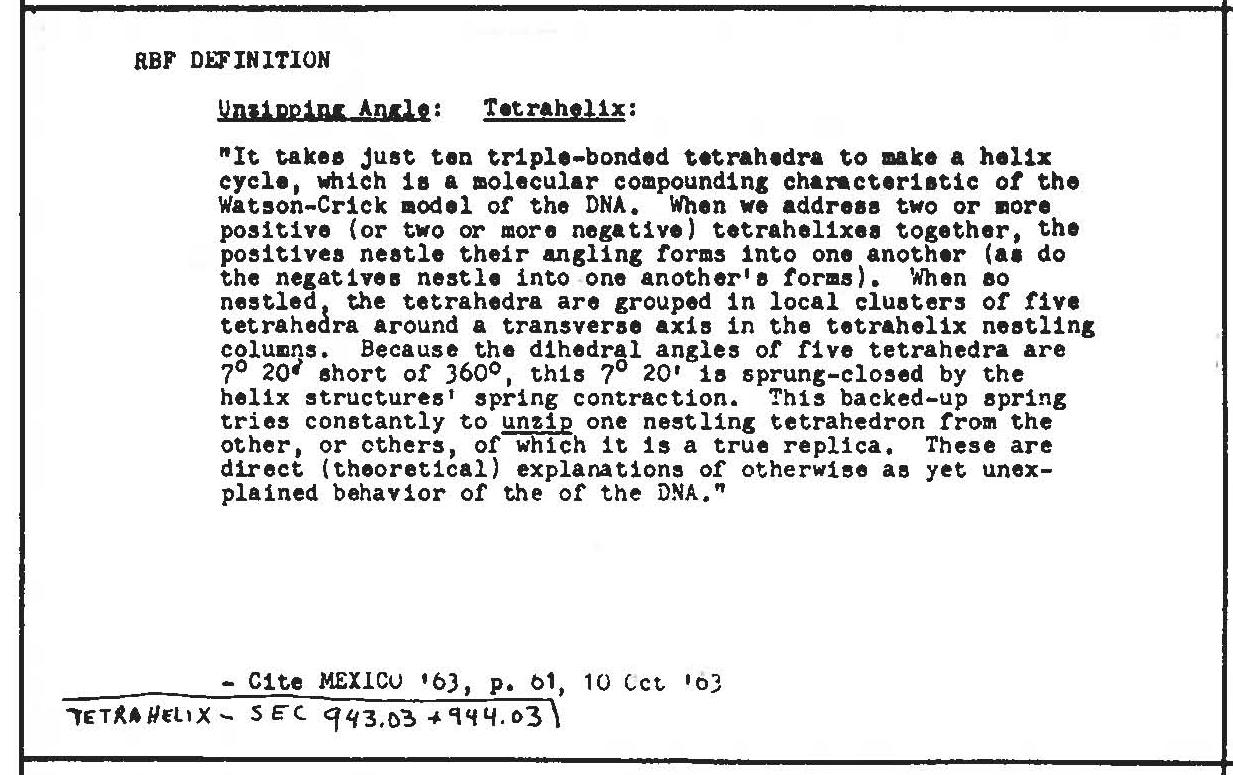
It takes just ten triple-bonded tetrahedra to make a helix cycle, which is a molecular compounding characteristic of the Watson-Crick model of the DNA. When we address two or more positive (or two or more negative) tetrahelixes together, the positives nestle their angling forms into one another (as do the negatives nestle into one another’s forms). When so nestled, the tetrahedra are grouped in local clusters of five tetrahedra around a transverse axis in the tetrahelix nestling columns. Because the dihedral angles of five tetrahedra are 7° 20’ short of 360°, this 7° 20’ is sprung-closed by the helix structures’ spring contraction. This backed-up spring tries constantly to unzip one nestling tetrahedron from the other, or others, of which it is a true replica. These are direct (theoretical) explanations of otherwise as yet unexplained behavior of the of the DNA.