¶ Twelve Universal Degrees of Freedom : General Systems (3)
← Twelve Universal Degrees of Freedom: General Systems (2) | Twelve Universal Degrees of Freedom: General Systems →
Index Entry
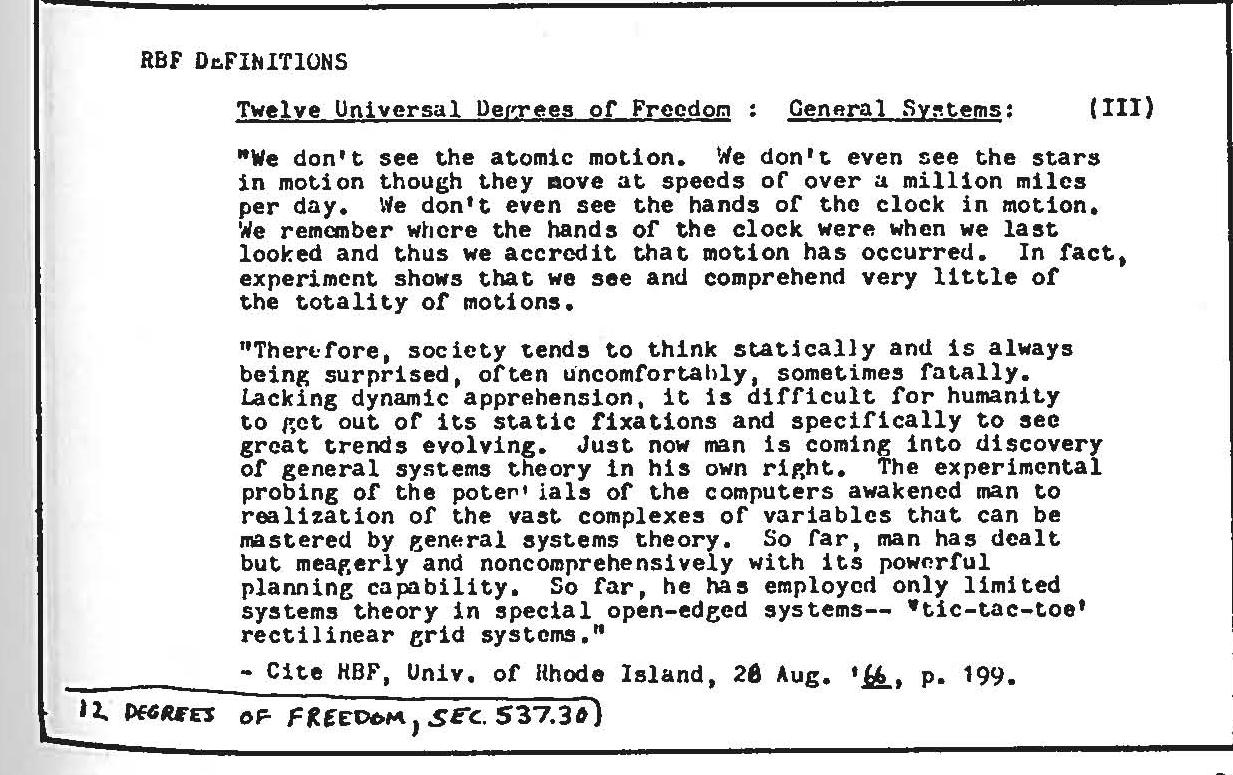
We don’t see the atomic motion. We don’t even see the stars in motion though they move at speeds of over a million miles per day. We don’t even see the hands of the clock in motion. We remember where the hands of the clock were when we last looked and thus we accredit that motion has occurred. In fact, experiment shows that we see and comprehend very little of the totality of motions.
Therefore, society tends to think statically and is always being surprised, often uncomfortably, sometimes fatally. Lacking dynamic apprehension, it is difficult for humanity to get out of its static fixations and specifically to see great trends evolving. Just now man is coming into discovery of general systems theory in his own right. The experimental probing of the potentials of the computers awakened man to realization of the vast complexes of variables that can be mastered by general systems theory. So far, man has dealt but meagerly and noncomprehensively with its powerful planning capability. So far, he has employed only limited systems theory in special open-edged systems-- ‘tic-tac-toe’ rectilinear grid systems.