¶ Thirty Minimum Topological Characteristics (1)
← Thirty Minimum Aspects of a System | Thirty Minimum Topological Characteristics (2) →
Index Entry
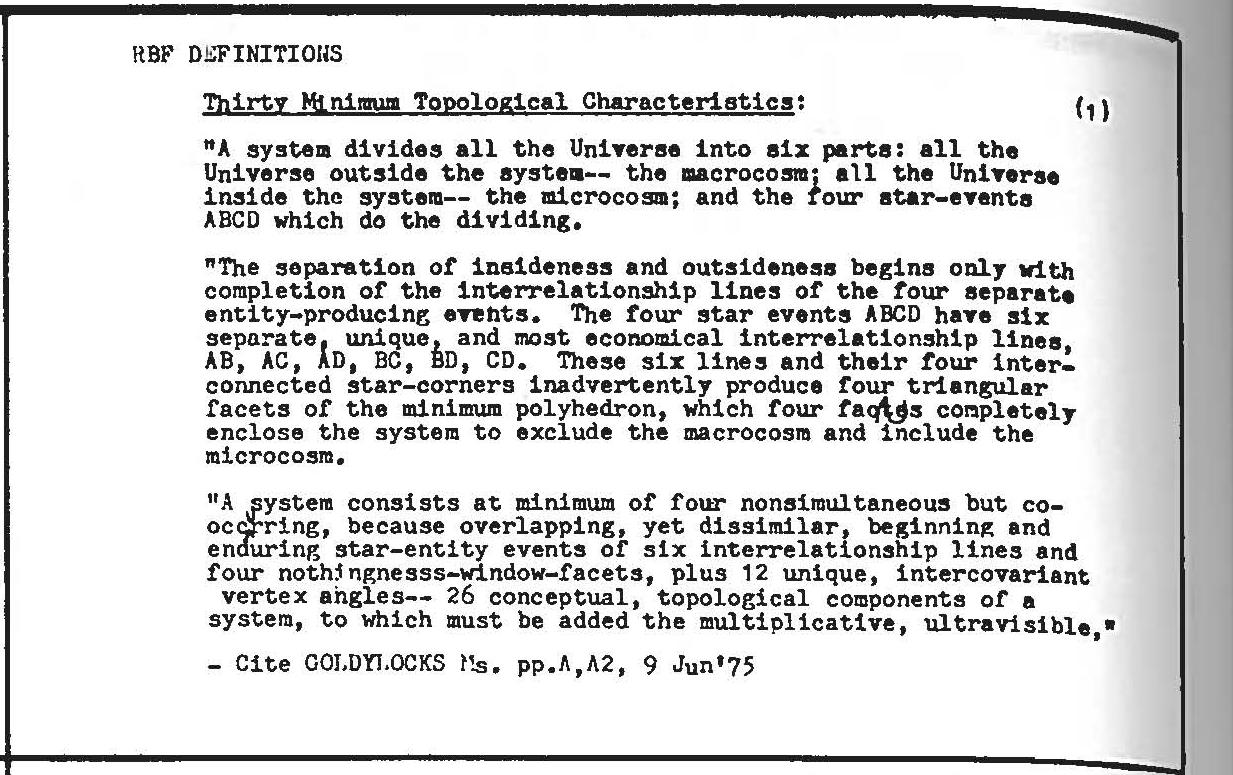
Thirty Minimum Topological Characteristics:
"A system divides all the Universe into six parts: all the Universe outside the system-- the macrocosm; all the Universe inside the system-- the microcosm; and the four star-events ABCD which do the dividing.
"The separation of insideness and outsideness begins only with completion of the interrelationship lines of the four separate entity-producing events. The four star events ABCD have six separate, unique, and most economical interrelationship lines, AB, AC, AD, BC, BD, CD. These six lines and their four interconnected star-corners inadvertently produce four triangular facets of the minimum polyhedron, which four facets completely enclose the system to exclude the macrocosm and include the microcosm.
“A system consists at minimum of four nonsimultaneous but co-occurring, because overlapping, yet dissimilar, beginning and enduring star-entity events of six interrelationship lines and four nothingness-window-facets, plus 12 unique, intercovariant vertex angles-- 26 conceptual, topological components of a system, to which must be added the multiplicative, ultravisible,”