¶ Tetrahedron: Coordinate Symmetry
← Tetrahedron: Coordinate Symmetry | Tetrahedron: Coordinate Symmetry →
Index Entry
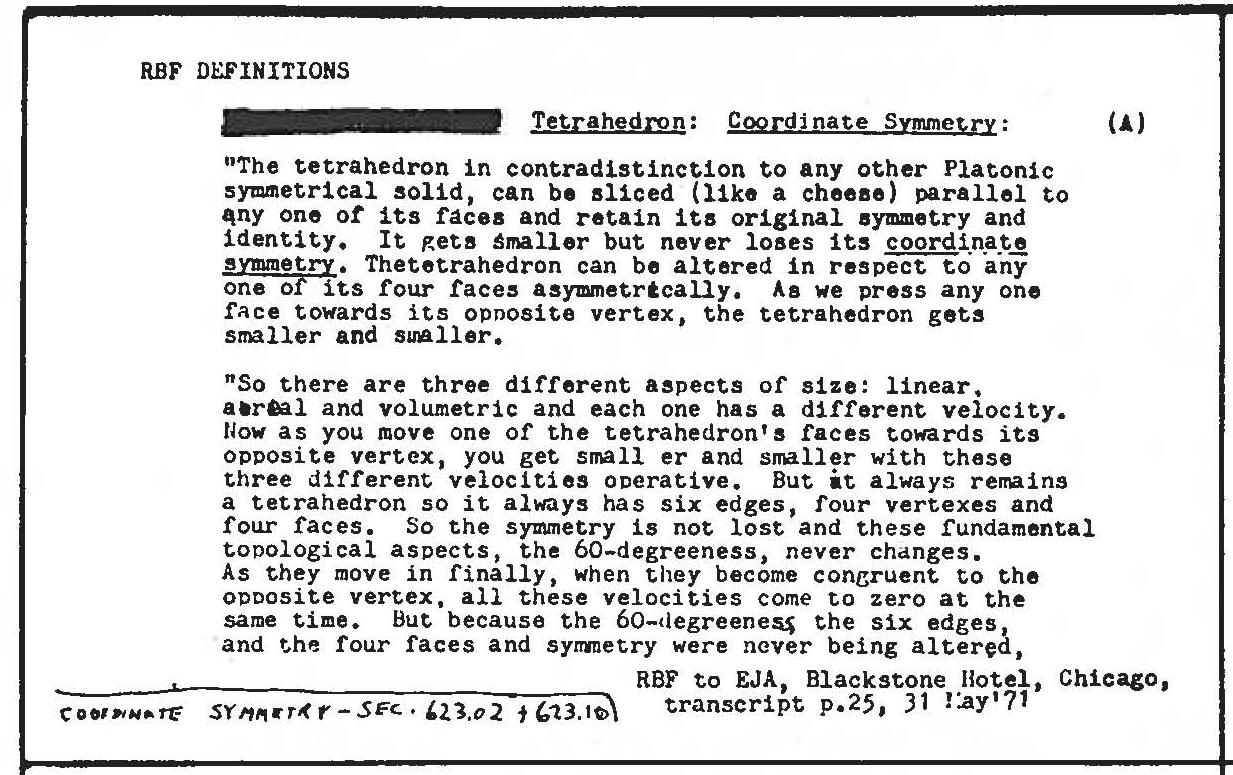
The tetrahedron in contradistinction to any other Platonic symmetrical solid, can be sliced (like a cheese) parallel to any one of its faces and retain its original symmetry and identity. It gets smaller but never loses its coordinate symmetry. The tetrahedron can be altered in respect to any one of its four faces asymmetrically. As we press any one face towards its opposite vertex, the tetrahedron gets smaller and smaller.
So there are three different aspects of size: linear, areal and volumetric and each one has a different velocity. Now as you move one of the tetrahedron’s faces towards its opposite vertex, you get smaller and smaller with these three different velocities operative. But it always remains a tetrahedron so it always has six edges, four vertexes and four faces. So the symmetry is not lost and these fundamental topological aspects, the 60-degreeness, never changes. As they move in finally, when they become congruent to the opposite vertex, all these velocities come to zero at the same time. But because the 60-degreeness, the six edges, and the four faces and symmetry were never being altered,