¶ Probability Model of Three Cars On a Highway (1)
← Probability Laws (1) | Probability Model of Three Cars on a Highway (2) →
Index Entry
Probability Model of Three Cars On a Highway:
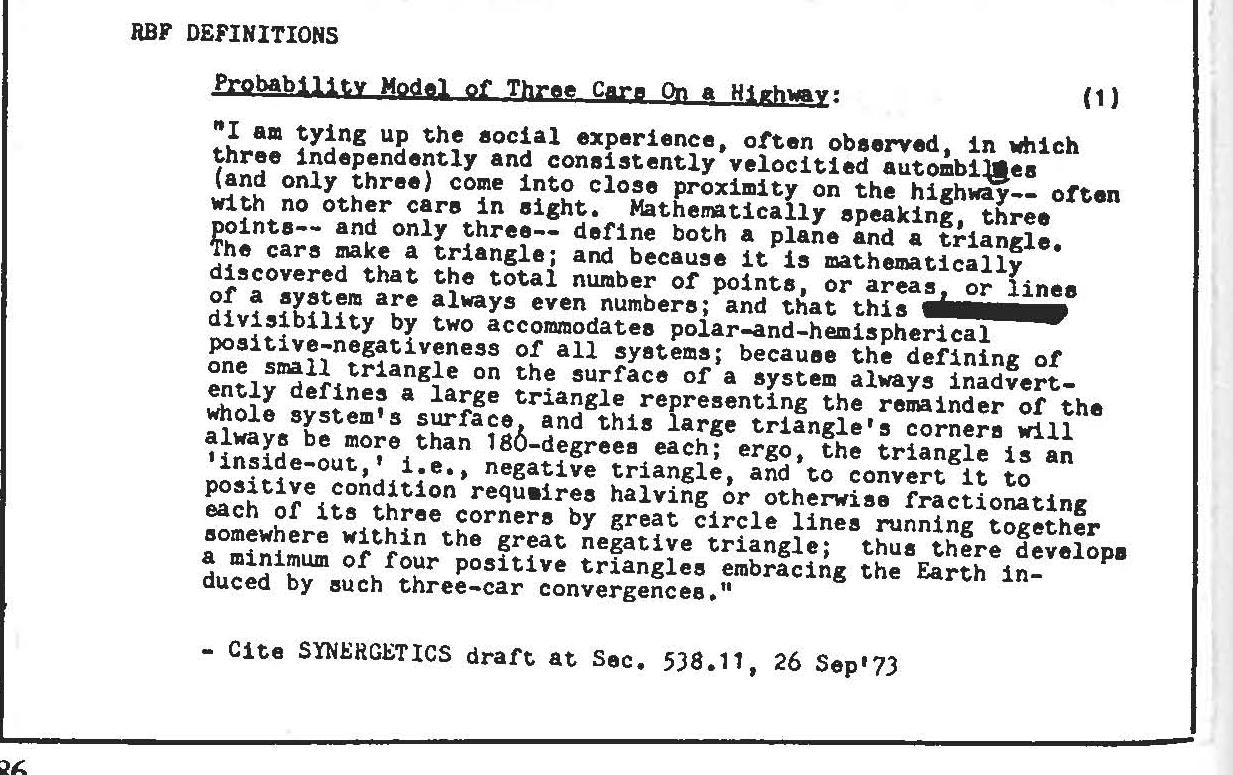
“I am tying up the social experience, often observed, in which three independently and consistently velocitied automobiles (and only three) come into close proximity on the highway-- often with no other cars in sight. Mathematically speaking, three points-- and only three-- define both a plane and a triangle. The cars make a triangle; and because it is mathematically discovered that the total number of points, or areas, or lines of a system are always even numbers; and that this divisibility by two accommodates polar-and-hemispherical positive-negativeness of all systems; because the defining of one small triangle on the surface of a system always inadvertently defines a large triangle representing the remainder of the whole system’s surface, and this large triangle’s corners will always be more than 180-degrees each; ergo, the triangle is an ‘inside-out,’ i.e., negative triangle, and to convert it to positive condition requires halving or otherwise fractionating each of its three corners by great circle lines running together somewhere within the great negative triangle; thus there develops a minimum of four positive triangles embracing the Earth induced by such three-car convergences.”
¶ Citations