¶ Population Sequence (2)
← Population Sequence (1) | Population Sequence (3) →
Index Entry
Population Sequence:
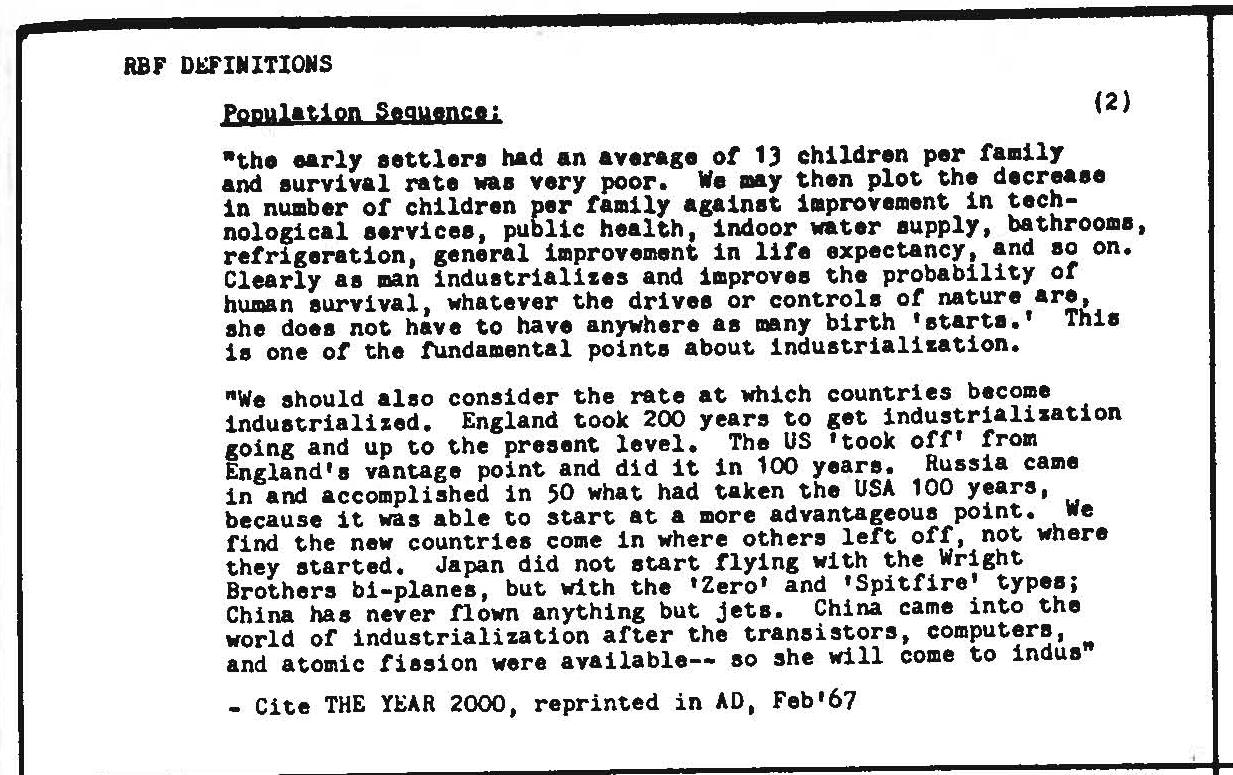
"the early settlers had an average of 13 children per family and survival rate was very poor. We may then plot the decrease in number of children per family against improvement in technological services, public health, indoor water supply, bathrooms, refrigeration, general improvement in life expectancy, and so on. Clearly as man industrializes and improves the probability of human survival, whatever the drives or controls of nature are, she does not have to have anywhere as many birth ‘starts.’ This is one of the fundamental points about industrialization.
“We should also consider the rate at which countries become industrialized. England took 200 years to get industrialization going and up to the present level. The US ‘took off’ from England’s vantage point and did it in 100 years. Russia came in and accomplished in 50 what had taken the USA 100 years, because it was able to start at a more advantageous point. We find the new countries come in where others left off, not where they started. Japan did not start flying with the Wright Brothers bi-planes, but with the ‘Zero’ and ‘Spitfire’ types; China has never flown anything but jets. China came into the world of industrialization after the transistors, computers, and atomic fission were available-- so she will come to indus”