¶ Planck’s Constant (1)
← Planck’s Constant | Planck’s Constant (2) →
Index Entry
Planck’s Constant:
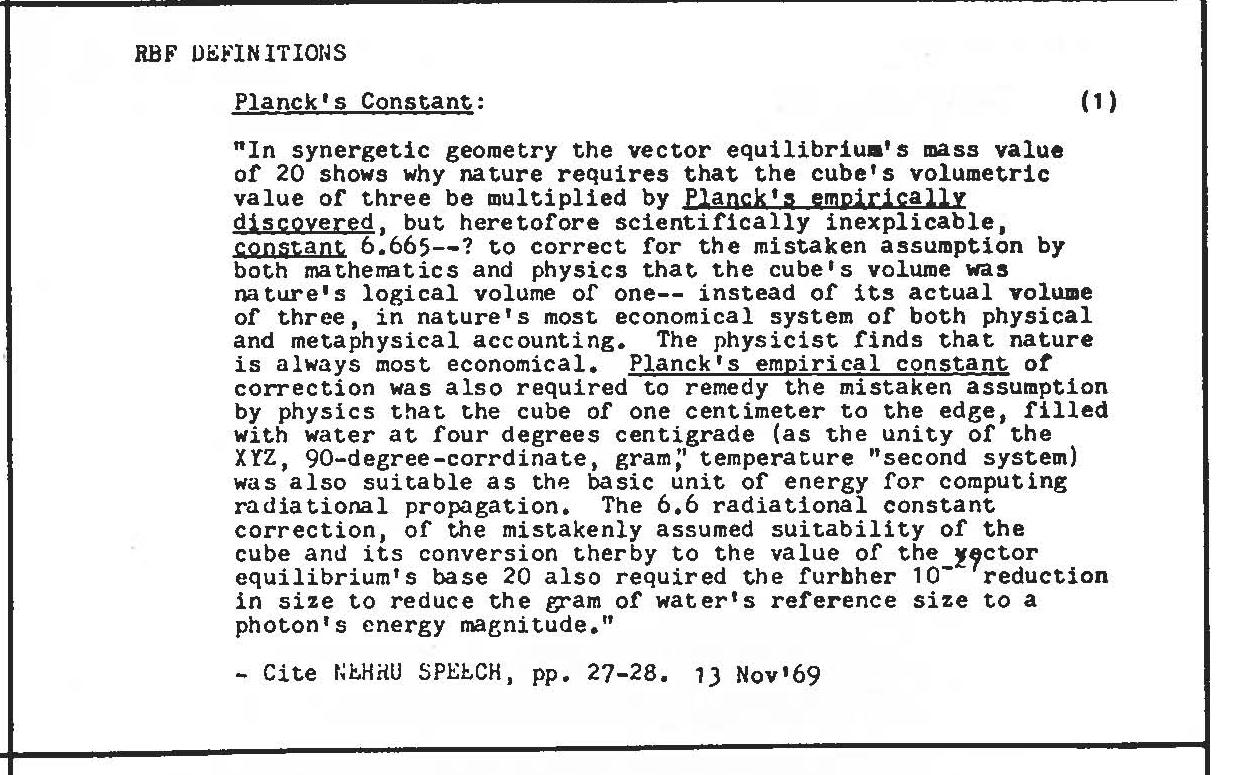
“In synergetic geometry the vector equilibrium’s mass value of 20 shows why nature requires that the cube’s volumetric value of three be multiplied by Planck’s empirically discovered, but heretofore scientifically inexplicable, constant 6.665–? to correct for the mistaken assumption by both mathematics and physics that the cube’s volume was nature’s logical volume of one-- instead of its actual volume of three, in nature’s most economical system of both physical and metaphysical accounting. The physicist finds that nature is always most economical. Planck’s empirical constant of correction was also required to remedy the mistaken assumption by physics that the cube of one centimeter to the edge, filled with water at four degrees centigrade (as the unity of the XYZ, 90-degree-coordinate, gram, temperature “second system”) was also suitable as the basic unit of energy for computing radiational propagation. The 6.6 radiational constant correction, of the mistakenly assumed suitability of the cube and its conversion therby to the value of the vector equilibrium’s base 20 also required the further 10^-27 reduction in size to reduce the gram of water’s reference size to a photon’s energy magnitude.”
¶ Citations
- NEHRU SPEECH, pp. 27-28. 13 Nov’69