¶ Planck’s Constant
← Planck’s Constant | Planck’s Constant →
Index Entry
Planck’s Constant:
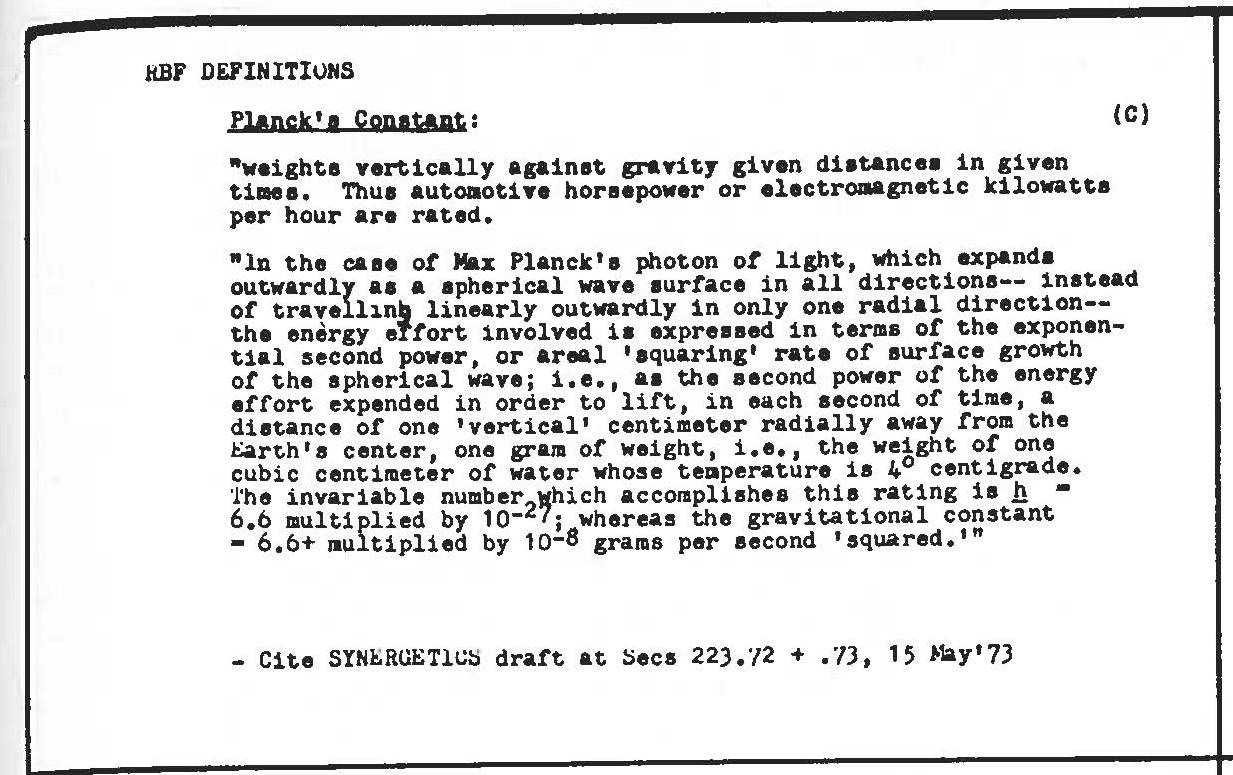
"weights vertically against gravity given distances in given times. Thus automotive horsepower or electromagnetic kilowatts per hour are rated.
“In the case of Max Planck’s photon of light, which expands outwardly as a spherical wave surface in all directions-- instead of travelling linearly outwardly in only one radial direction-- the energy effort involved is expressed in terms of the exponential second power, or areal ‘squaring’ rate of surface growth of the spherical wave; i.e., as the second power of the energy effort expended in order to lift, in each second of time, a distance of one ‘vertical’ centimeter radially away from the Earth’s center, one gram of weight, i.e., the weight of one cubic centimeter of water whose temperature is 4° centigrade. The invariable number which accomplishes this rating is h = 6.6 multiplied by 10^-27; whereas the gravitational constant = 6.6+ multiplied by 10^-8 grams per second ‘squared.’”