¶ Piaget: Jean: Child’s Spontaneous Geometry (1)
← PI (2) | Piaget: Jean: Child’s Spontaneous Geometry (2) →
Index Entry
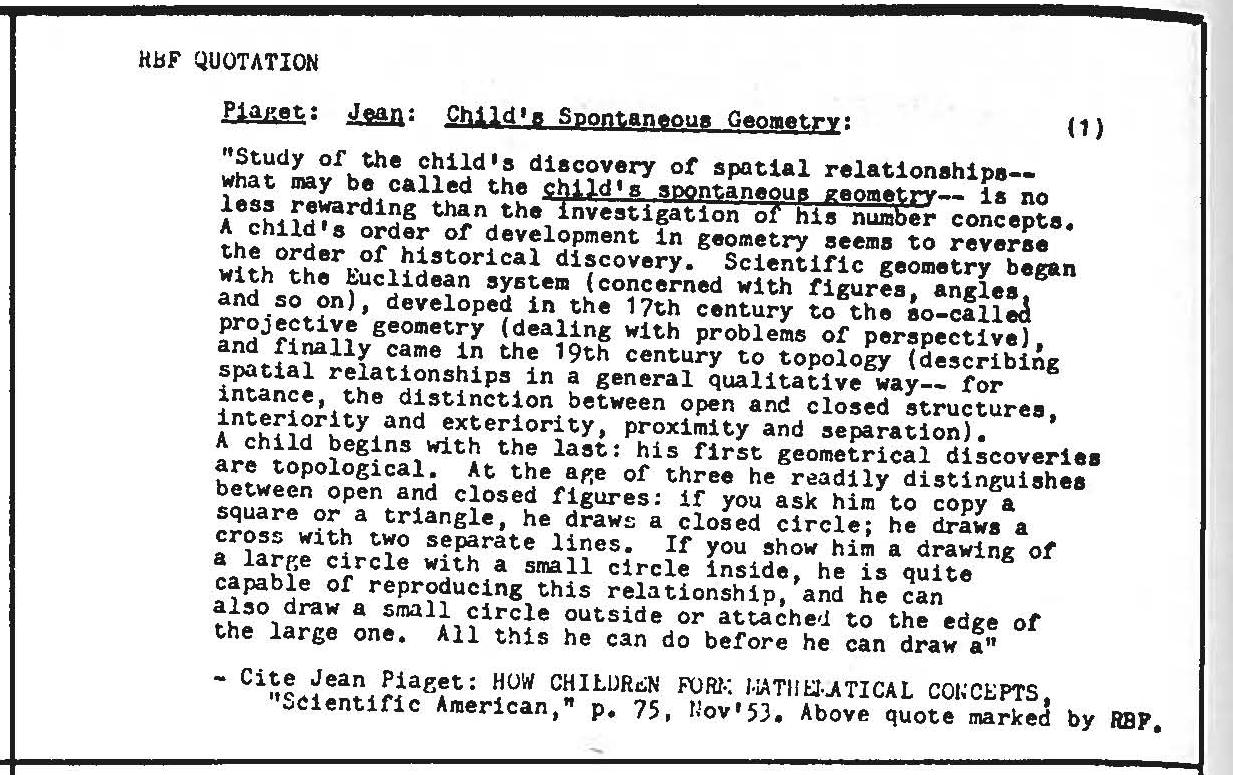
“Study of the child’s discovery of spatial relationships-- what may be called the child’s spontaneous geometry-- is no less rewarding than the investigation of his number concepts. A child’s order of development in geometry seems to reverse the order of historical discovery. Scientific geometry began with the Euclidean system (concerned with figures, angles, and so on), developed in the 17th century to the so-called projective geometry (dealing with problems of perspective), and finally came in the 19th century to topology (describing spatial relationships in a general qualitative way-- for intance, the distinction between open and closed structures, interiority and exteriority, proximity and separation). A child begins with the last: his first geometrical discoveries are topological. At the age of three he readily distinguishes between open and closed figures: if you ask him to copy a square or a triangle, he draws a closed circle; he draws a cross with two separate lines. If you show him a drawing of a large circle with a small circle inside, he is quite capable of reproducing this relationship, and he can also draw a small circle outside or attached to the edge of the large one. All this he can do before he can draw a”