¶ Lever: Fallen Tree as a Lever (1)
← Lever: Fallen Tree as a Lever | Lever: Fallen Tree as a Lever (2) →
Index Entry
Lever: Fallen Tree as a Lever:
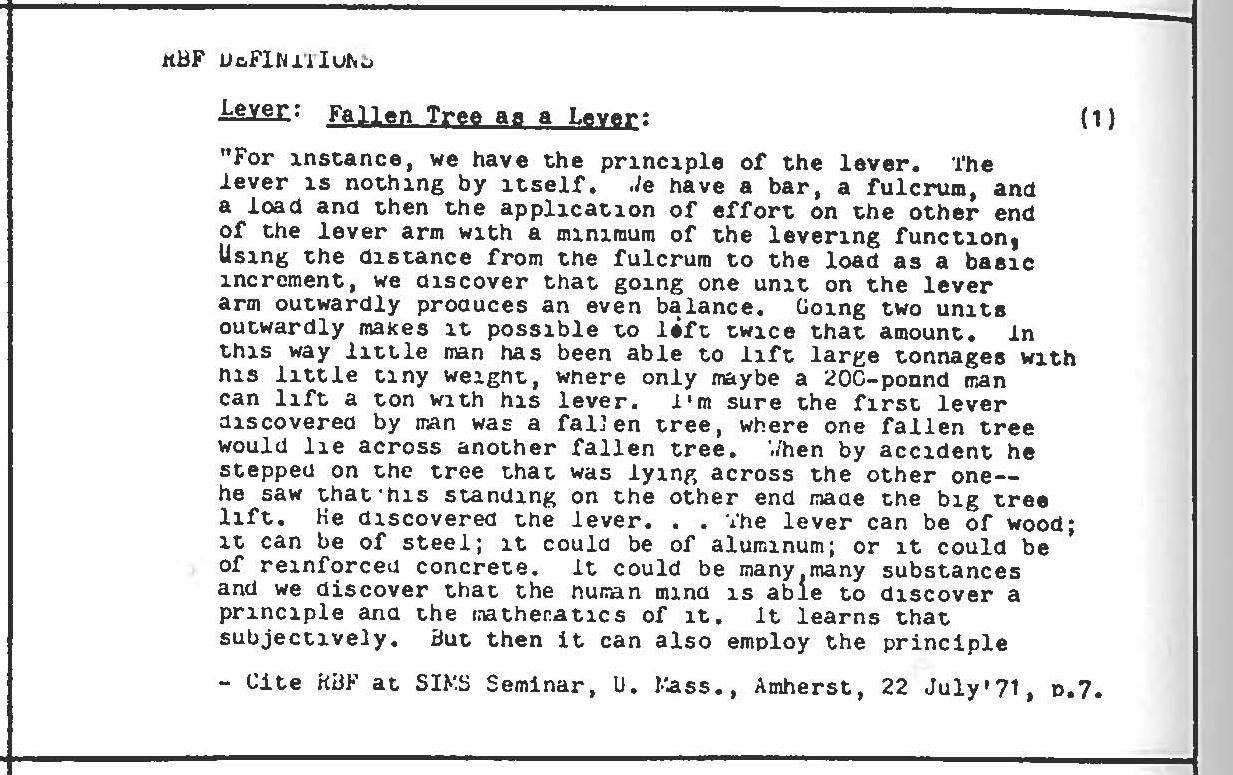
"For instance, we have the principle of the lever. The lever is nothing by itself. We have a bar, a fulcrum, and a load and then the application of effort on the other end of the lever arm with a minimum of the levering function, Using the distance from the fulcrum to the load as a basic increment, we discover that going one unit on the lever arm outwardly produces an even balance. Going two units outwardly makes it possible to lift twice that amount. In this way little man has been able to lift large tonnages with his little tiny weight, where only maybe a 200-pound man can lift a ton with his lever. I’m sure the first lever discovered by man was a fallen tree, where one fallen tree would lie across another fallen tree. When by accident he stepped on the tree that was lying across the other one-- he saw that his standing on the other end made the big tree lift. He discovered the lever. … The lever can be of wood; it can be of steel; it could be of aluminum; or it could be of reinforced concrete. It could be many, many substances and we discover that the human mind is able to discover a principle and the mathematics of it. It learns that subjectively. But then it can also employ the principle
¶ Citations
- RBF at SIMS Seminar, U. Mass., Amherst, 22 July’71, p.7.