¶ Human Unsettlement
← Human Unsettlement (3) | Human Unsettlement →
Index Entry
Human Unsettlement:
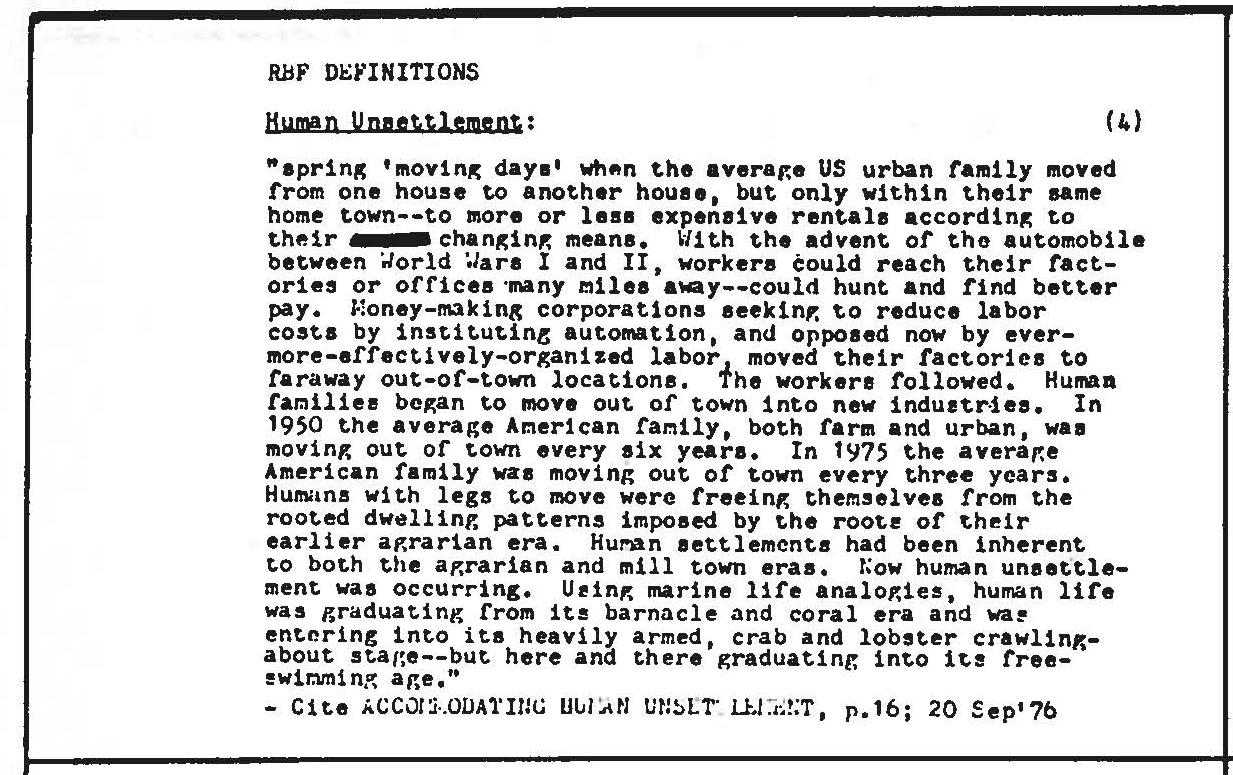
“spring ‘moving days’ when the average US urban family moved from one house to another house, but only within their same home town–to more or less expensive rentals according to their changing means. With the advent of the automobile between World Wars I and II, workers could reach their factories or offices many miles away–could hunt and find better pay. Money-making corporations seeking to reduce labor costs by instituting automation, and opposed now by ever-more-effectively-organized labor, moved their factories to faraway out-of-town locations. The workers followed. Human families began to move out of town into new industries. In 1950 the average American family, both farm and urban, was moving out of town every six years. In 1975 the average American family was moving out of town every three years. Humans with legs to move were freeing themselves from the rooted dwelling patterns imposed by the roots of their earlier agrarian era. Human settlements had been inherent to both the agrarian and mill town eras. Now human unsettlement was occurring. Using marine life analogies, human life was graduating from its barnacle and coral era and was entering into its heavily armed, crab and lobster crawling-about stage–but here and there graduating into its free-swimming age.”
¶ Citations
- ACCOMMODATING HUMAN UNSETTLEMENT, p.16; 20 Sep’76