¶ Gross World Product Sequence (2)
← Gross World Product Sequence (1) | Gross World Product Sequence (3) →
RBF Definitions
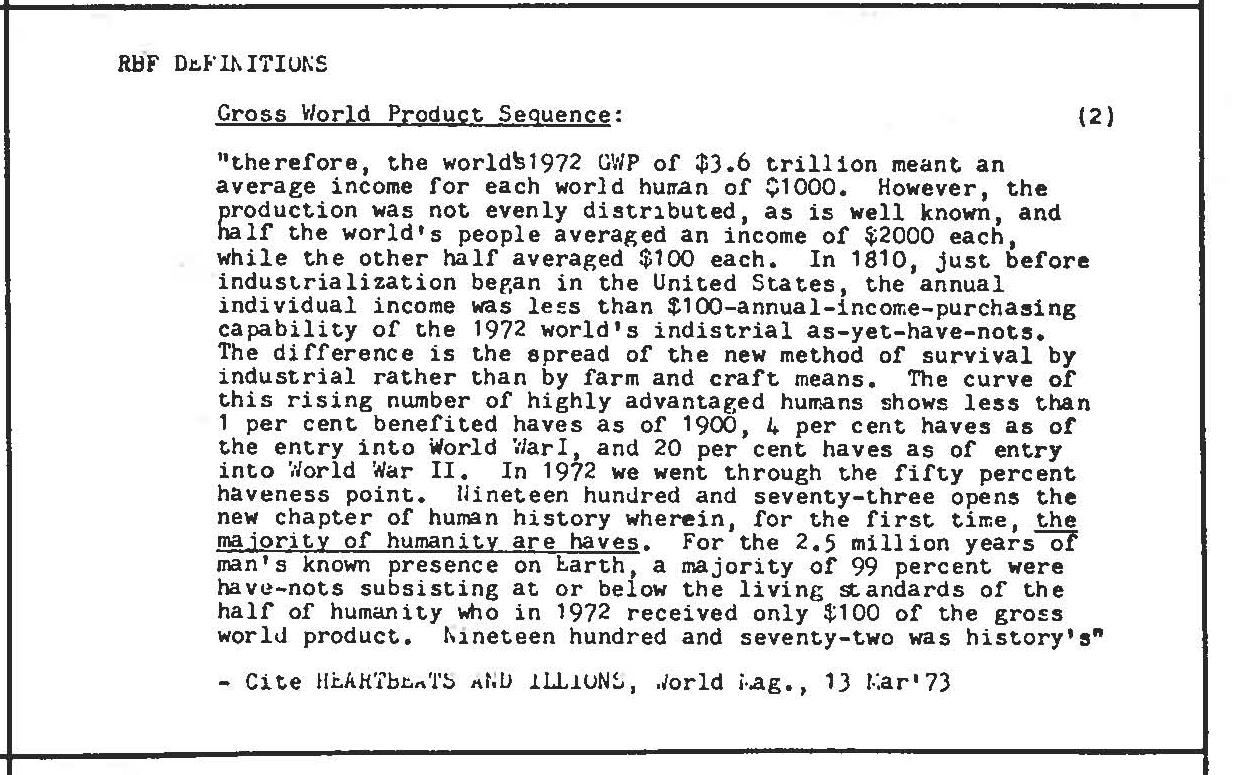
“therefore, the world’s 1972 GWP of 3.6 trillion meant an average income for each world human of 1000. However, the production was not evenly distributed, as is well known, and half the world’s people averaged an income of $2000 each, while the other half averaged $100 each. In 1810, just before industrialization began in the United States, the annual individual income was less than $100-annual-income-purchasing capability of the 1972 world’s industrial as-yet-have-nots. The difference is the spread of the new method of survival by industrial rather than by farm and craft means. The curve of this rising number of highly advantaged humans shows less than 1 per cent benefited haves as of 1900, 4 per cent haves as of the entry into World War I, and 20 per cent haves as of entry into World War II. In 1972 we went through the fifty percent haveness point. Nineteen hundred and seventy-three opens the new chapter of human history wherein, for the first time, the majority of humanity are haves. For the 2.5 million years of man’s known presence on Earth, a majority of 99 percent were have-nots subsisting at or below the living standards of the half of humanity who in 1972 received only $100 of the gross world product. Nineteen hundred and seventy-two was history’s”
¶ Citations
- HEARTBEATS AND ILLIONS, World i.ag., 13 Mar’73