¶ Gravity
Index Entry
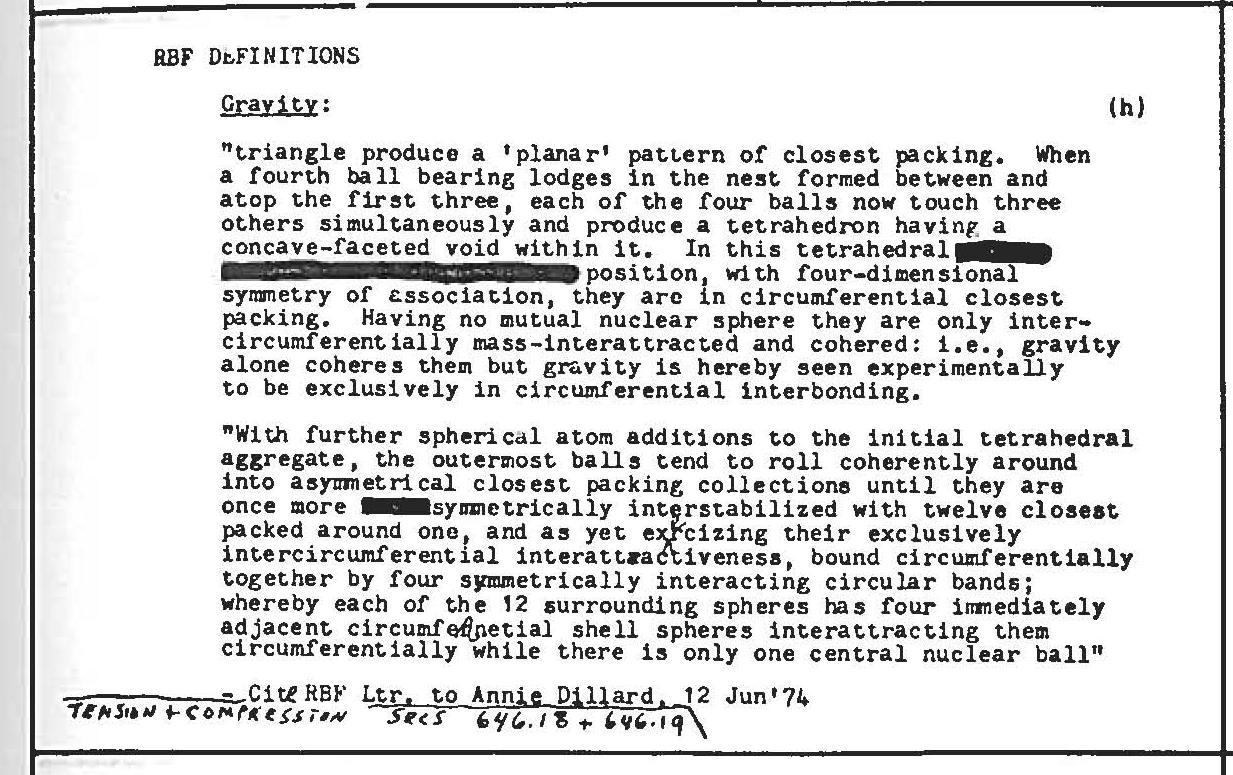
triangle produce a ‘planar’ pattern of closest packing. When a fourth ball bearing lodges in the nest formed between and atop the first three, each of the four balls now touch three others simultaneously and produce a tetrahedron having a concave-faceted void within it. In this tetrahedral position, with four-dimensional symmetry of association, they are in circumferential closest packing. Having no mutual nuclear sphere they are only inter-circumferentially mass-interattracted and cohered: i.e., gravity alone coheres them but gravity is hereby seen experimentally to be exclusively in circumferential interbonding.
With further spherical atom additions to the initial tetrahedral aggregate, the outermost balls tend to roll coherently around into asymmetrical closest packing collections until they are once more symmetrically interstabilized with twelve closest packed around one, and as yet exerting their exclusively intercircumferential interattractiveness, bound circumferentially together by four symmetrically interacting circular bands; whereby each of the 12 surrounding spheres has four immediately adjacent circumferential shell spheres interattracting them circumferentially while there is only one central nuclear ball