¶ Generalized Principle
← Generalized Principles | Generalized Principle →
Index Entry
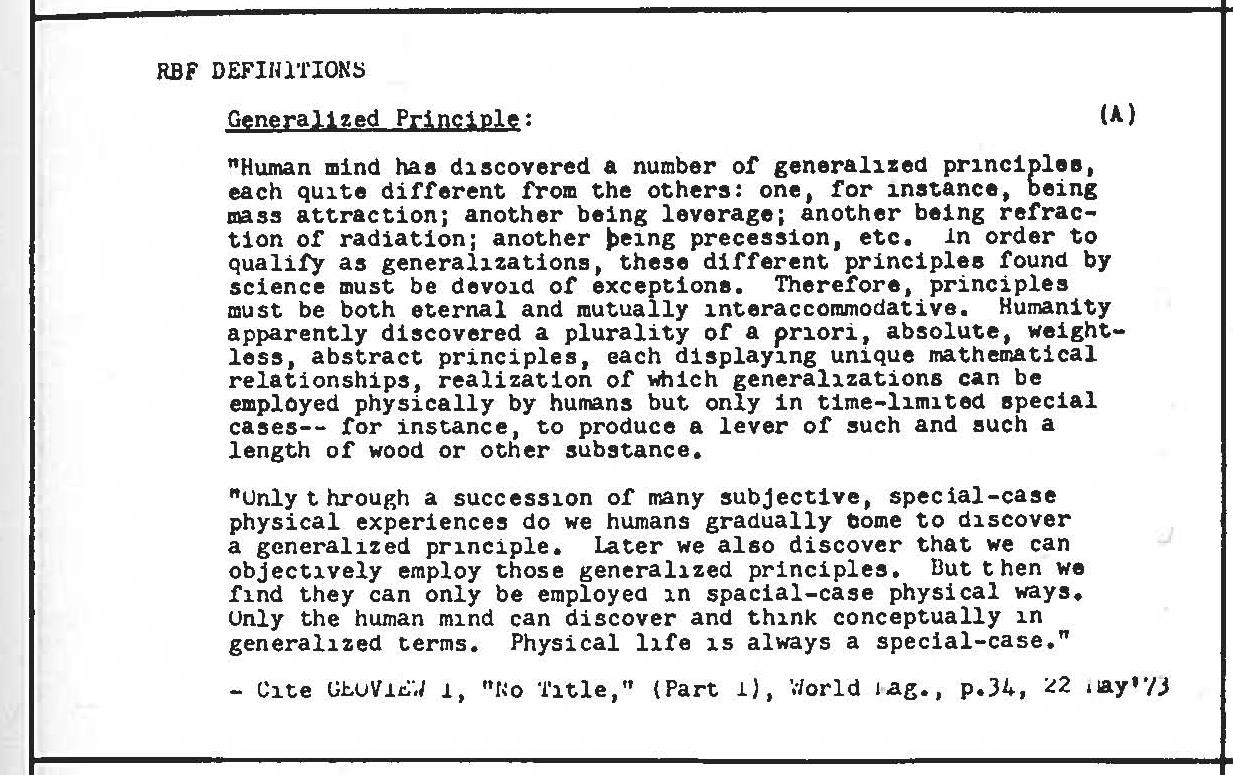
Human mind has discovered a number of generalized principles, each quite different from the others: one, for instance, being mass attraction; another being leverage; another being refraction of radiation; another being precession, etc. in order to qualify as generalizations, these different principles found by science must be devoid of exceptions. Therefore, principles must be both eternal and mutually interaccommodative. Humanity apparently discovered a plurality of a priori, absolute, weightless, abstract principles, each displaying unique mathematical relationships, realization of which generalizations can be employed physically by humans but only in time-limited special cases-- for instance, to produce a lever of such and such a length of wood or other substance.
Only through a succession of many subjective, special-case physical experiences do we humans gradually tome to discover a generalized principle. Later we also discover that we can objectively employ those generalized principles. But then we find they can only be employed in spacial-case physical ways. Only the human mind can discover and think conceptually in generalized terms. Physical life is always a special-case.