¶ Cube: Diagonal of Cube As Wave Propagation Model
← Cube: Diagonal of Cube As Wave Propagation Model | Cube: Diagonal of a Cube as Wave Propagation Model (1) →
Index Entry
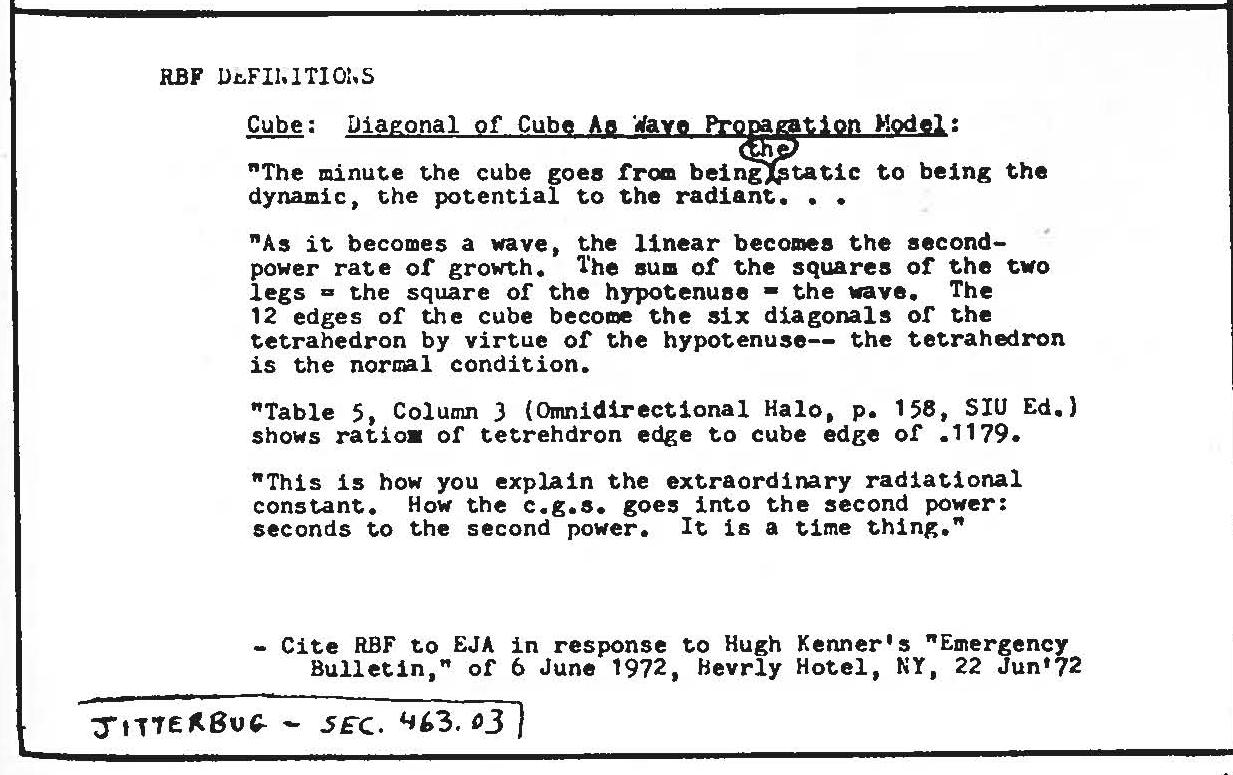
Cube: Diagonal of Cube As Wave Propagation Model:
"The minute the cube goes from being static to being the dynamic, the potential to the radiant. . .
"As it becomes a wave, the linear becomes the second-power rate of growth. The sum of the squares of the two legs = the square of the hypotenuse = the wave. The 12 edges of the cube become the six diagonals of the tetrahedron by virtue of the hypotenuse-- the tetrahedron is the normal condition.
"Table 5, Column 3 (Omnidirectional Halo, p. 158, SIU Ed.) shows ratios of tetrahedron edge to cube edge of .1179.
“This is how you explain the extraordinary radiational constant. How the c.g.s. goes into the second power: seconds to the second power. It is a time thing.”
¶ Citations
- RBF to EJA in response to Hugh Kenner’s “Emergency Bulletin,” of 6 June 1972, Beverly Hotel, NY, 22 Jun’72