¶ Convergent vs. Parallel Perception
← Convergence & Nonconvergence | Convergent vs. Parallel →
Index Entry
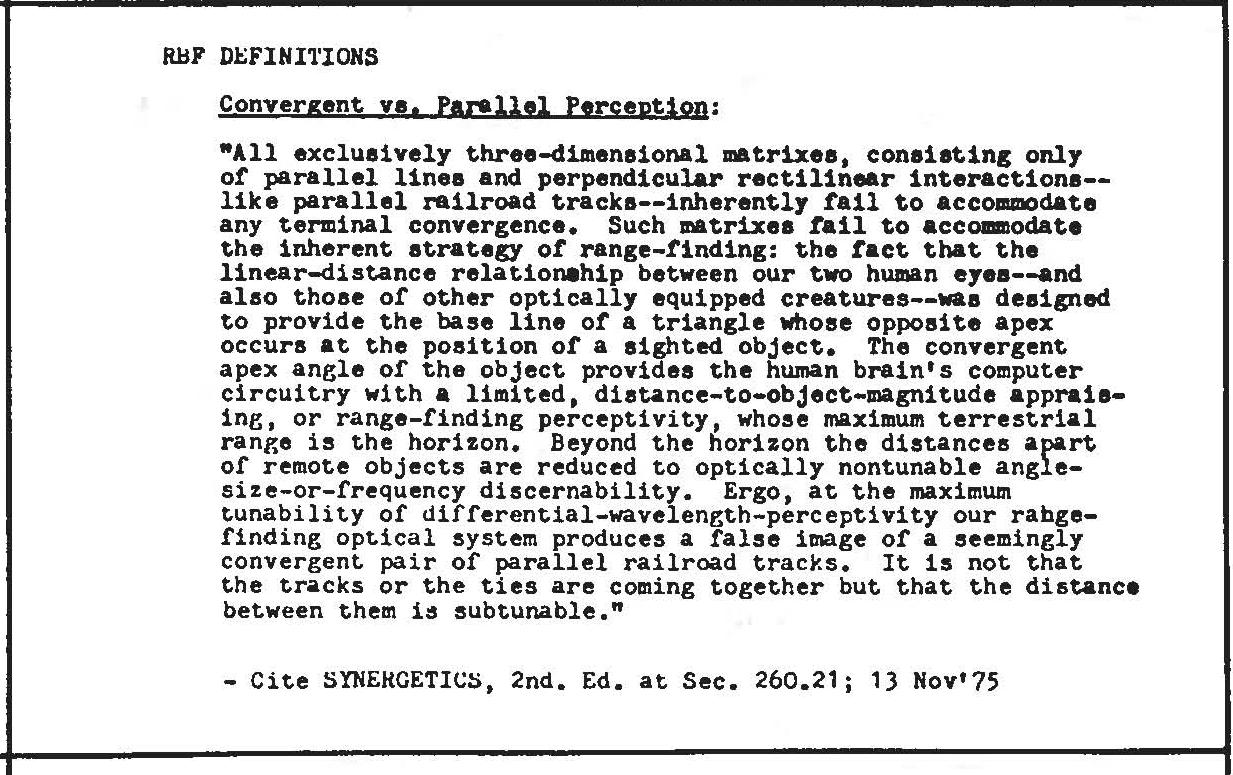
Convergent vs. Parallel Perception:
“All exclusively three-dimensional matrixes, consisting only of parallel lines and perpendicular rectilinear interactions–like parallel railroad tracks–inherently fail to accommodate any terminal convergence. Such matrixes fail to accommodate the inherent strategy of range-finding: the fact that the linear-distance relationship between our two human eyes–and also those of other optically equipped creatures–was designed to provide the base line of a triangle whose opposite apex occurs at the position of a sighted object. The convergent apex angle of the object provides the human brain’s computer circuitry with a limited, distance-to-object-magnitude appraising, or range-finding perceptivity, whose maximum terrestrial range is the horizon. Beyond the horizon the distances apart of remote objects are reduced to optically nontunable angle-size-or-frequency discernability. Ergo, at the maximum tunability of differential-wavelength-perceptivity our range-finding optical system produces a false image of a seemingly convergent pair of parallel railroad tracks. It is not that the tracks or the ties are coming together but that the distance between them is subtunable.”
¶ Citations