¶ Computer Asks an Original Question (3)
← Computer Asks an Original Question (2) | Computer Asks an Original Question →
Index Entry
Computer Asks an Original Question:
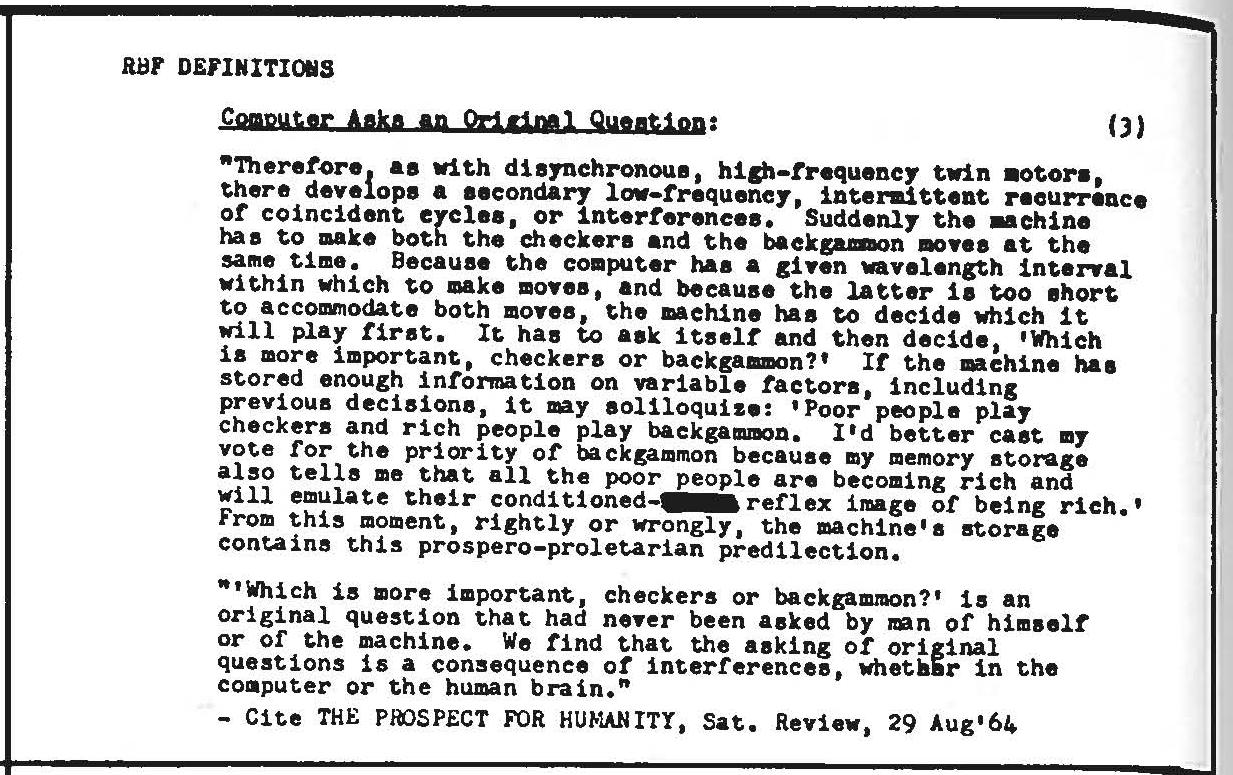
"Therefore, as with disynchronous, high-frequency twin motors, there develops a secondary low-frequency, intermittent recurrence of coincident cycles, or interferences. Suddenly the machine has to make both the checkers and the backgammon moves at the same time. Because the computer has a given wavelength interval within which to make moves, and because the latter is too short to accommodate both moves, the machine has to decide which it will play first. It has to ask itself and then decide, ‘Which is more important, checkers or backgammon?’ If the machine has stored enough information on variable factors, including previous decisions, it may soliloquize: ‘Poor people play checkers and rich people play backgammon. I’d better cast my vote for the priority of backgammon because my memory storage also tells me that all the poor people are becoming rich and will emulate their conditioned-reflex image of being rich.’ From this moment, rightly or wrongly, the machine’s storage contains this prospero-proletarian predilection.
“‘Which is more important, checkers or backgammon?’ is an original question that had never been asked by man of himself or of the machine. We find that the asking of original questions is a consequence of interferences, whether in the computer or the human brain.”