¶ Computer Asks an Original Question (1)
← Computer Asks an Original Question | Computer Asks an Original Question (2) →
Index Entry
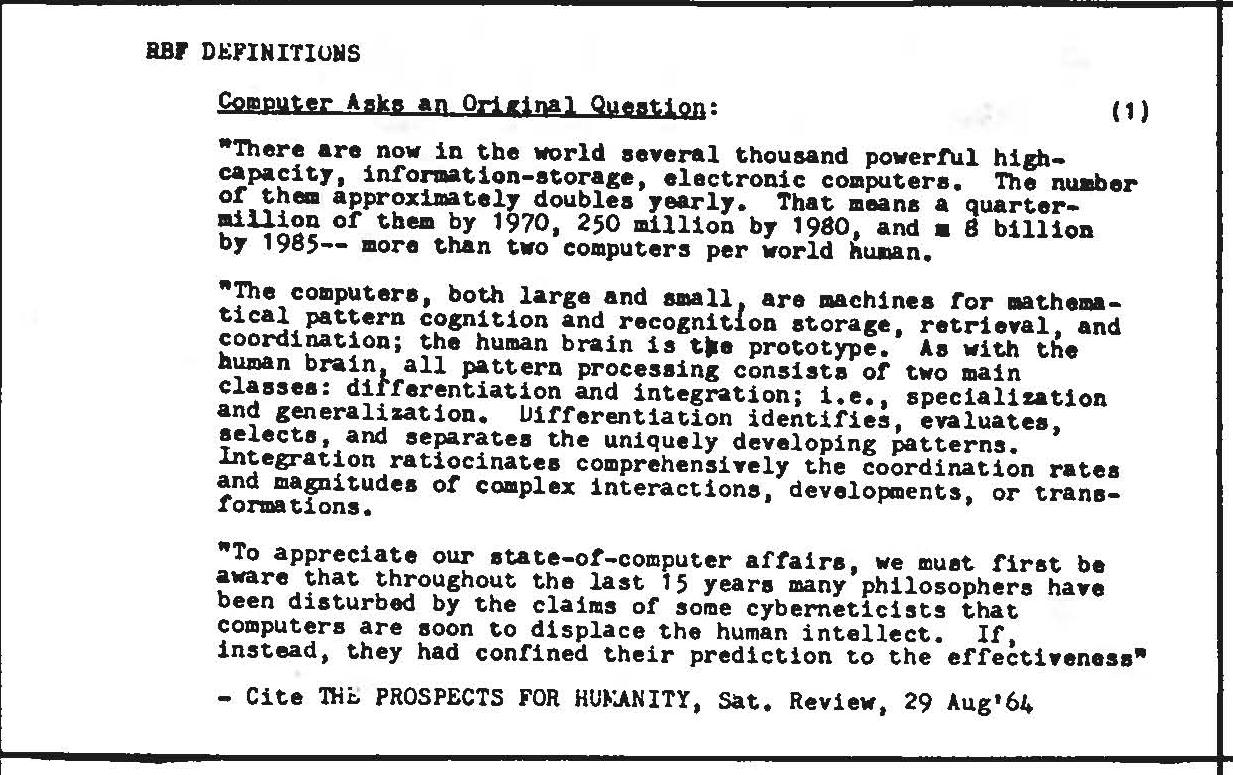
There are now in the world several thousand powerful high-capacity, information-storage, electronic computers. The number of them approximately doubles yearly. That means a quarter-million of them by 1970, 250 million by 1980, and m 8 billion by 1985-- more than two computers per world human.
The computers, both large and small, are machines for mathematical pattern cognition and recognition storage, retrieval, and coordination; the human brain is the prototype. As with the human brain, all pattern processing consists of two main classes: differentiation and integration; i.e., specialization and generalization. Differentiation identifies, evaluates, selects, and separates the uniquely developing patterns. Integration ratiocinates comprehensively the coordination rates and magnitudes of complex interactions, developments, or transformations.
To appreciate our state-of-computer affairs, we must first be aware that throughout the last 15 years many philosophers have been disturbed by the claims of some cyberneticists that computers are soon to displace the human intellect. If, instead, they had confined their prediction to the effectiveness