¶ Acceleration: Angular & Linear (1)
← Acceleration: Angular and Linear Acceleration | Acceleration: Angular & Linear (2) →
Index Entry
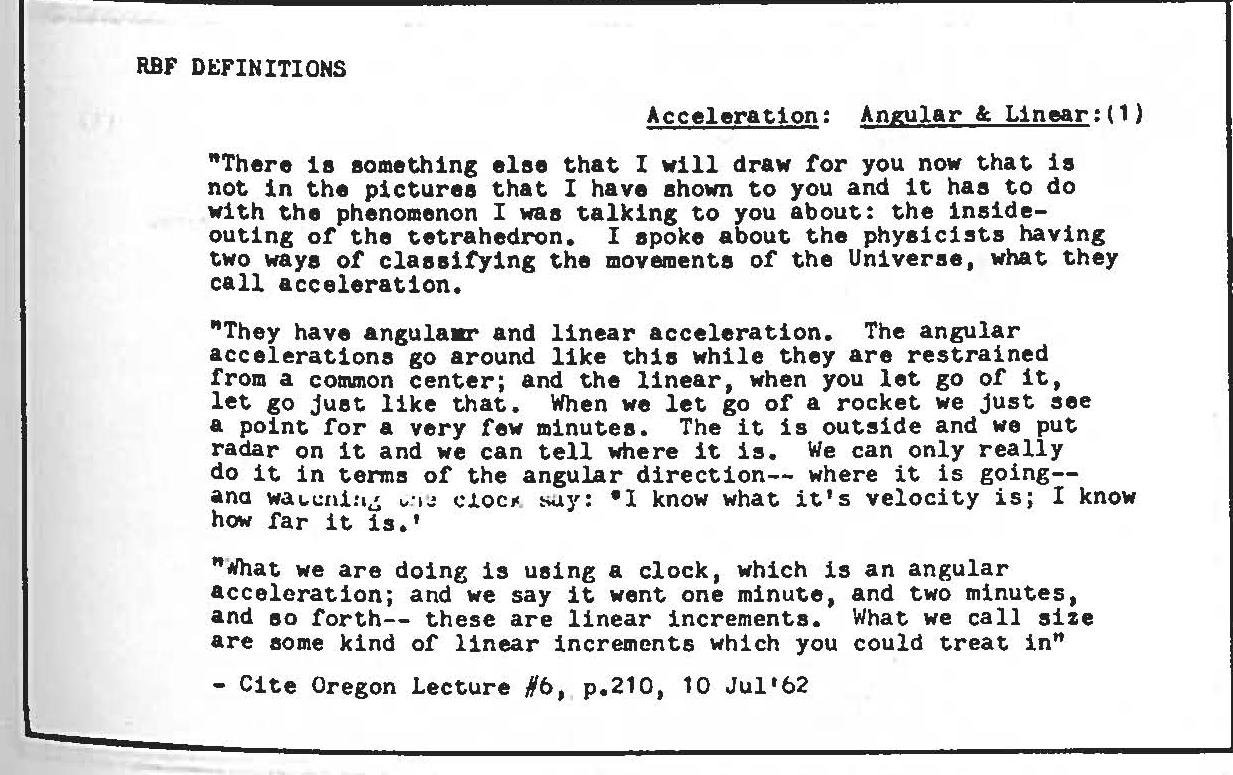
There is something else that I will draw for you now that is not in the pictures that I have shown to you and it has to do with the phenomenon I was talking to you about: the inside-outing of the tetrahedron. I spoke about the physicists having two ways of classifying the movements of the Universe, what they call acceleration.
They have angular and linear acceleration. The angular accelerations go around like this while they are restrained from a common center; and the linear, when you let go of it, let go just like that. When we let go of a rocket we just see a point for a very few minutes. The it is outside and we put radar on it and we can tell where it is. We can only really do it in terms of the angular direction-- where it is going-- and watching the clock say: ‘I know what it’s velocity is; I know how far it is.’
What we are doing is using a clock, which is an angular acceleration; and we say it went one minute, and two minutes, and so forth-- these are linear increments. What we call size are some kind of linear increments which you could treat in