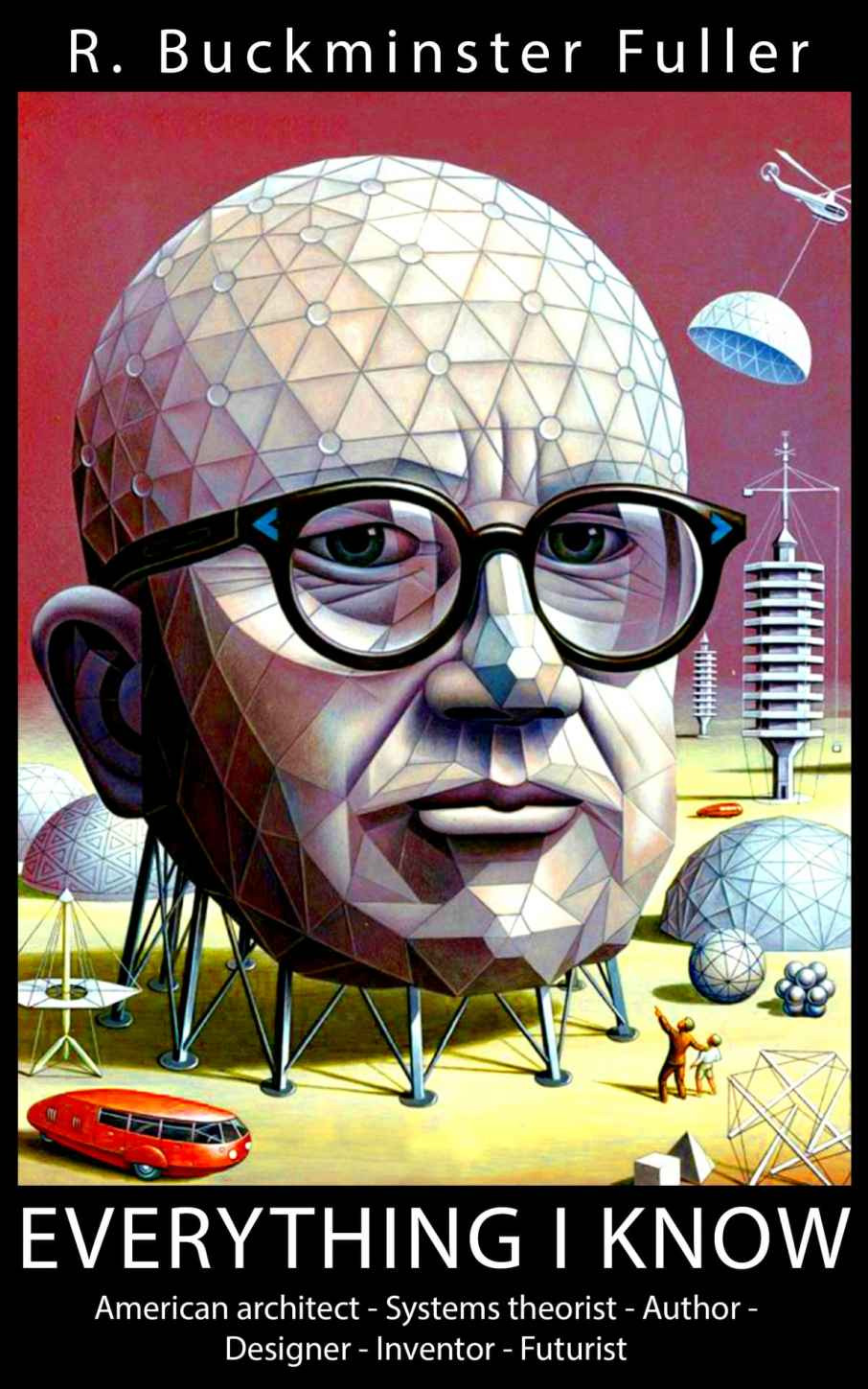
Everything I Know
Everything I Know
R. Buckminster Fuller
|
ISBN: 978-0000000000
ISBN-10: 0000000000
Updated: 2024-12-20
Copyright
All rights reserved. No part of this book may be reproduced or transmitted in any form or by any means, electronic or mechanical, including photocopying, recording, or by any information storage and retrieval system, without permission in writing from the Copyright Holder.
ENCODED IN THE UNITED STATES OF AMERICA
¶ Chapter 1
We tried to think about the most primitive information we have regarding our extraordinary experience, is that, I think we choose the fact that, all humanity has always been born naked, absolutely helpless, for months, and though with beautiful equipment, as we learn later on, with no experience, and therefore, absolutely ignorant. That’s where all humanity has always started. And we’ve come to the point where, in our trial and error finding our way, stimulated by a designed in hunger designed in thirst these are conscious inputs; designed in procreative urge we have such an enormous amount of, as we learn later on, of designed in automated processing of the interrelationships of all the atoms in our organism, starting then, with a consciousness of the hunger, giving a drive to go after…to seek to experiment. Man having, then, no rulebook, nothing to tell him about that Universe, has had to really find his way entirely by trial and error. He had no words and no experience to assume that the other person has experience. The at first, very incredibly limited way of communicating. We now know, human beings being on our planet for probably 3 1/2 million years, with, as far as we can see, not much physiological change pretty much the same skeleton, and from what we can learn of human beings in their earliest recorded communicating, in an important degree, people in India 5,000 years ago, and in China 5,000 years ago, were thinking very extraordinarily well in the terms of anything we know about our experience, the way we’ve been able to resolve experiences into the discovery of principles that seem to be operative in our Universe.
I’m astonished at how well the early Hindu and Chinese thinker how well he was able to process his information, in view of the very limited amount of information humanity had as of that time in comparison to anything we have today.
Just making a little jump in information, as we, as humanity on board of our planet, entered into what it called World War I, the scientists around the world have ways of reporting to one another officially; and chemists have what they call Chemical Abstracts. Chemical Abstracts are methodical publications of anything and everything any chemist finds that he publishes information regarding, it becomes Chemical Abstracts. As the world entered World War I, what was called the twentieth century it’s a very arbitrary kind of accounting matter, we had some hundred I think we had (I’m doing this off the top of my head from memory) about 175,000 known substances, approximately almost a quarter of a million substances by the time the United States came into the war, known to chemistry. And we came out of World War I with almost a million substances known. By the time we ended World War II, we were well up into 10 million, and we’ve come out of it now where the figures really are getting astronomical. We can’t really keep track of the rate at which we are discovering more. Just to talk about differentiable substances chemically distinct from one another. Those are typical of the information, really it is a bursting rate now in relation to just I’m speaking just in relationship to my own life. One life in the extraordinary numbers of lives there must have been on board of our planet. The information is multiplying at that rate during just one lifetime indicates that something is going on here right now that is utterly unprecedented, and we’re in such indication of acceleration of experiences of human beings the integration of the accelerated, the experienced, to produce awarenesses that are indicative of Humanity going through some very, very important kind of transition into some kind of new relationship to Universe, I’d say, the kind of acceleration that would occur after the child has been formed in the womb, taking the nine months, and suddenly begins to issue from the womb out into an entirely new world. So I think we are apparently coming out of some common womb of designedly permitted ignorance, given faculties which we gradually discovered and learned to employ by trial and error, and we’re at the point where I now have, which would also seem absolutely incredible to a generation before, I’ve now completed 37 circuits of our earth kind of zig-zagging circuits not straight around not as a tourist just carrying, just responding to requests to appear here and there, to lecture in Universities, or to design some structure whatever it may be. So, that is in the everyday pattern that I am circuiting that earth. It certainly makes it in evidence that we are dealing in a totality of humanity, not the up to my generation completely divided humanity, spread very far apart on our planet.
My father was in the leather importing business in Boston, Massachusetts, in the United States, and he imported from two places, primarily, Buenos Aires and India for bringing in leathers for the shoe industry, which was centered at that time in the Boston area. And his mail, or a trip that he would like to make to Argentina took two months each way, and his trips to India in the mail took exactly three months each way. And, it seemed absolutely logical to humanity when early in this century, Rudyard Kipling, the English poet, said “East is East, and West is West, and never the twain shall meet.” It was a very, very rare matter for any human being to make such a travel as that, taking all those months there were not many ships that could take them there. All that has changed in my lifetime, to where I’m not just one of a very few making these circuits of the earth, but I am one of probably, getting to be pretty close to 20 million now who are making living a life like that around our planet, and very much of the whole young world doing so. I keep meeting my students of various universities from around the world, half way around the world again. They are all getting to be living as world people. So, this is a very sudden emergence into some new kind of relationship to our Universe is being manifest. None of it was planned. There was nobody in the time of my father or my mother, as I was brought up, prophesying any of the things I’ve just said.
The year I was born Marconi invented the wireless, but it did not get into any practical use until I was 12 years of age when the first steamship sends an S.O.S., its in distress, by wireless so think of it a great many miles and the world began to know the ship was in distress and ships began to rush to its aid. Absolutely unexpected! My father and mother would say “wireless! such nonsense!”
And when I was three the electron was discovered, and nobody talked about that. It wasn’t in any of the newspapers nobody was interested in electrons didn’t know what an electron was that had been discovered.
I was brought up that humanity would never get to the North Pole absolutely impossible, they’d never get to the South Pole; and our Mercator maps didn’t even show anything…the Northern-most points were kind of a rugged line, but you didn’t see or know anything up beyond that.
When I was 14 man did get to the North Pole, and when I was 16 he got to the South Pole, so impossibles are happening.
Like all other little boys, I was making paper darts, which you could make at school; and boys must have been making them for a very long time; and we were hoping we might be able to get to flying. But the parents, your parents were saying “Darling, it’s very amusing for you to try that, but it is inherently impossible for man to fly. So when I was 7 the Wright brothers suddenly flew and my memory is vivid enough of seven to remember that for about a year the engineering societies were trying to prove it was a hoax because it was absolutely impossible for man to do that.
So then, not only was there the radio, but when I was 23, which you think well I guess many in this room are not 23 yet when I was 23 the human voice came over the radio for the first time, and that was an incredible matter. When I was 27 we had the first licensed radio broadcasting. When I was 38 I was asked to go on an experimental TV program in New York where the Columbia Broadcasting had 70 sets in various scientists’ and their Board of Directors’ homes, and they had experimental programs going on, they didn’t have any money for paying anybody. The man who ran it, Gilbert Seldes was a friend of mine, and ran the studio, and so, I often appeared on his program, but we don’t have television operating in the United States until after World War II. So we’re talking about when I was 45 when we had our first television. So this is very it couldn’t be a more recent matter; and yet nobody thought at that time we were going to have they didn’t know you were going to have transistors; they didn’t know man was going to have satellites going around the earth; they didn’t know we were going to have radio relay satellites, that we were going to be able to have programs coming out of any part of the earth, going to any other part of the earth. Absolutely not one of these steps was ever anticipated by any of the others, so that having experienced that, I also experienced living with my fellow human beings, who I find, no sooner has it happened, then he says “I knew it all the time. I’m not one of those to be surprised I was sort of in on it you know…I was a little bit responsible” There is a strange vanity of man, and I think the vanity that he has, was essential to his being born naked and helpless, and having to make the fantastic number of mistakes he had to make in order to really learn something. And I think he would have been so disgruntled, so dismayed by the mistakes, the errors, that he would never have been able to carry on. He would just have been absolutely discouraged, so he was given this strange vanity to say, to continually sort of make himself exempt, and he was some kind of privileged, and always in. And he was able, then, quite clearly, to deceive himself a great deal. So I find everybody today saying “getting to the moon anybody can do that. That’s absolutely simple and logical.” Now, it is obvious, and simple, and logical provided you were born and this has happened in your lifetime, you can see how it happened. I began to realize that with that rapid changing going on, which was not anticipated then what people called “natural” when I was young…the natural related to the state before these great changes occurred… where we were supposed to stay we were inherently remote from other human beings…no way you could get to other human beings. And all the customs that developed over millions and millions of years of tribes and little communities being isolated one from another…how you get on with one another, seeing everybody, you saw everybody a great deal all the time. The conditions that were really brought about by that constant proximity, brought about human behaviors which we have now rules and everybody the older people say that’s the way you carry on; but it is really no longer germane to the conditions that are prevailing. And, I began to realize that, for instance, to me, having been born before flying, before the Wright brothers, to me it was a very extraordinary matter that man could fly. And certainly, his first flying was fraught with a great deal of danger, and you admired very much the people who were able to accomplish it without failing; and our first automobiles that I had, my first automobile; the automobile tires, on my first car would probably blow out within a hundred miles. You were stopping really very, very frequently getting out and taking off that tire and repairing it…with ways of vulcanizing it and getting it back on. We didn’t have the easy mounting tires that we have today, so it was a very great task to do it. The engine continually broke down. The brakes burnt out and wore out very, very rapidly, so that driving a car doing your own cranking and cleaning your own spark plugs, and often taking out the spark plugs and priming them with gasoline so you could get the engine going you were very intimate with your machine. And, if you were, you knew how relatively unreliable it was. Therefore, you drove with great caution. I still drive in the terms of brakes that fade out, and I allow certain distances, and I find the space that I’m allowing to the next car inviting young people who have good brakes, and who assume that they have good brakes, to drive into that spot with great safety.
Now, that would be typical, really, of the difference between people born under one set of conditions and those born under others. What seems safe, what seems logical. It was a very amazing matter to me, when my own daughter, Allegra, was born, the year that Lindbergh flew across the Atlantic ocean; but flying was still a very infrequent experience, for the average human being to view an airplane actually in flight. You went to air meets. You knew that there were battles of half a dozen planes over Europe during World War I, but the Lindbergh flight was great news to everybody. The biplane was still the major ship, and I was wheeling my child in her baby carriage in Chicago’s Lincoln Park in 1927, and she was lying on her back looking at the sky, and suddenly a little biplane went overhead; and it was a very extraordinary matter to have an airplane show up over Chicago. And, I said, “Isn’t this amazing! My daughter is born with an airplane in the sky.” To her an airplane would seem very logical. Her daughter was born 21 years ago, and she was born in New York, and her father and mother took her to (this is my granddaughter) took her to their new home on a place called Riverdale just north of Manhattan Island across the bridge North of Manhattan Island you get to quite high land it was called Riverdale, it’s quite high. And there was that old wooden house that was about the highest point there a three-story house, and my daughter and her husband had an apartment on the top floor of that wooden house. It had old-fashioned glass porches on it, and the, my grand daughter lying in her crib and coming right over Riverdale was La Guardia Field traffic, all the Westbound flights flying in the prevailing South-west, westerly winds took off right over the house, so literally every 30 second, my grand daughter would hear “arrarrrr” going over the roof, and everybody would say “airplane” to her. I was not surprised the first word my grand daughter said was not “mum” or “dad” but “air”, and the parents and uncles, and aunts and grandparents would take her out in their arms onto the glass porch. She was born in the late Fall of the year. The leaves were off the trees in New York. She saw, and they’d get out on the glass porch and point to the airplanes; and she saw literally thousands of airplanes before she ever saw a bird. To her an airplane in the sky was much more “normal” than a bird, and looking from that glass porch down the West side drive of New York, went by, and it came over the bridge and it went thru a valley that was just below their house, she saw millions of automobiles in her first year; and the children’s books that she was given were of farm pigs, horses, ducks and all the things that I was brought up with which seemed absolutely normal to me, because the grown-ups said these are outside the house, and kept point to them, but my grand daughter had never seen any such thing. She’d seen all those airplanes and those automobiles, and a pig to her was about the same as a picture of a polio virus. She saw that the grown-ups were enjoying showing it to her, so she’d laugh along with them, but it was absolute pure cartoon. Now, this is the way in which the world really has been changing, and the publishers hadn’t caught on to that kind of a change and they were still publishing what was/is called a “child’s book.”
Now, and I’ll grant that there might have been plenty of people who were born where there still
were some ducks and pigs; but that was not the prevalent condition any more. Because, during and following World War I, the enormous capacity to produce machinery occurred, and farm machinery was developed in a very big way, and began to do the work on the farm more readily than the human beings could with their muscle and the people used to have to be where the food grew or they would perish. But, suddenly, there was refrigeration and there was canning the food could reach them any distance, and they weren’t needed on the farm to produce the food, so people were all flowing into the city. So my grand daughter’s experience was really the dominant experience by far the majority of experience, that she would never have seen these things in that farm book.
So, I now assume, that when people say that something is “natural,” “natural” is the way they found it when they checked into the picture, and this picture has been changing incredibly rapidly, and with the society in general going along all the old rules of cities and customs where you are seeing a whole lot of each other which is really irrelevant. And so that is one reason why then, the young people of our day, began to see things very, very differently from their parents; and to realize that the long traditions and customs were really no longer appropriate. It wasn’t a matter of the unfriendliness of a young generation with an older generation; it was simply that the new generation was being born into a new “natural,” which was absolutely “unnatural” to grown ups.
That’s enough of what I’m saying to introduce the concept of there being very large pattern changes affecting the lives of human beings on board of our planet. They were not in anyway anticipated by any of the humans, yet they are overwhelming, and would have to be really read in the terms of being evolutionary; and that Universe apparently had it in “Universe.” If this is the first time that you were ever a lily, you might assume that you were just going to be a seed, and not realize that you were going to then grow up with some green leaves. Then you don’t know that all of a sudden you’re going to sprout a white, beautiful bell shaped flower; and you don’t know that you’re going to have stamen. Each of these things are a surprise. So that I think that humanity as a whole is going thru a great transition which is superbly designed, as is the organization of the human, the human chemistries and associabilities of all those atoms of which we are comprised. And, my whole thinking out loud with you from now on is going to relate to seeking for more and more of these large patterns that are operative, that become deprecated by human beings very rapidly because they don’t like to have seemed to have been caught by surprise, and because of that vanity factor it is not too easy to make humanity comprehend as possibly readable and significant and predict other such waves to come about.
Again, I find human beings, with the news that we now are sharing around the world, which all of the world finds disturbing, reporting everybody around the world is aware of the troubles of other peoples as they never were before. They had troubles before, but they were never so aware of the other people’s troubles, so we have an awareness of the totality of great trouble. And, I think human beings’ vanity factor make them really feel “I am solely responsible for how this is going to come out,” and “I can then deputize my authority to one political leader, and it’s up to him to really get us out or half a dozen that we elect and expect performance,” as if human beings really can master and understand in a great way that I feel they do not. To me it has been clearly manifest that we have been very, very innocent and that we do respond, we have to respond to the environment, whatever the environment is doing. And we can only do, I say, I don’t really have a word “artificial” …I don’t really have a word “unnatural.” I say, “if nature permits it, it is natural if nature doesn’t permit it, you can’t do it.” You may not be familiar with the fact that nature allows that, but the fact of your unfamiliarity doesn’t make it unnatural. If it is unfamiliar to us we tend to say it is artificial or unnatural.
I’m going to review two or three ways in which I discipline myself to try to get myself thinking in a little more adequate manner concerning what we know of our Universe and what may be going on in a larger way, and to try to get things in a little better proportion. As for instance, I would like to have a picture of the Milky Way galaxy (may I have that picture please), and here we are looking at an array of stars, you can see the Milky Way running thru the stars. The number of stars you are looking at is about 18,000; they are approximately 1/6 millionths of all the stars in our Milky Way galaxy. We now know of, we have been able to get our great telescopes trained on other galaxies and so forth, and we now have taken photographs and are aware of a billion such galaxies of a hundred billion stars each.
Next picture, please. This picture we are looking at a galaxy very far away (may I have that next picture); we are looking at an exploding phenomena. I spoke about those hundred million galaxies of a hundred million stars each 99.9% of them are invisible to our naked eye, but their sizes are of great, great magnitude. To get a little idea, our own star “Sun” is a our own earth is 8,000 miles in diameter, and the diameter of the sun is just a hundred times that, and so our little earth looks very tiny against that enormous big ball. But our star sun is a small star. Most of you are familiar with Orion’s belt, and in Orion’s belt, one of the two bright stars is reddish in color, and this is Betelgeuse, and Betelgeuse’s diameter is greater than the diameter of the orbit of the earth around the Sun so that’s a good sized star; so we are a little planet, of a rather inferior star, which is one of a hundred billion stars in our galaxy, and we know there are billions of galaxies, so we get an idea our little planet, and you and I are utterly invisible. We’ve taken pictures of our planet coming in from the moon; when you can see through the cloud cover, you can see the blue of the water and the brown of the land, but you can’t make out any human being; you can’t make out a mountain let alone a human being; there is absolutely no visibility of a mountain because the aberration of the deepest water five miles below sea level, and five miles above the mountain top, and eight thousand miles is so, so meager that a polished steel ball is probably rougher than that. So, we are absolutely invisible on a negligible, little tiny planet of a rather negligible star which is one of a hundred billion of a known billion galaxies, so multiply the billion times 100 billion and you get a little idea.
Now, as we look at things at a great distance the picture that I have this is of a bursting phenomena in the heavens. Which looks like a tiny little light, and it keeps remaining like a tiny light, but at such a distance. And the distances involved are so great this particular phenomena is expanding at a velocity of three million miles an hour, which with the distance between the earth and the Sun (92 million), so that in 30 hours just little over a day, this expands the complete distance between the earth and the Sun, and yet it remains for the thousands of years we may be looking at it, like a little tiny speck there in the sky. You get a little sense of the size and the deceptiveness to us in the magnitude of the information in which we are really dealing in today.
I am quite confident, and this is then just as far as you and I have been able to when I say you and I I mean all our fellows the human beings who have been born naked and helpless and finally have discovered the principles of refraction of light and have developed the telescope, and have been able to make a sweepout we are getting information, as tiny as we are, we have information of approximate spherical sweepout of observation of 11 1/2 billion light-year radius; and a light year is 6 1/2 trillion miles, so when you get to 11 1/2 billion times 6 1/2 trillion you get a little idea of the distance from which you and I are getting information reliable information. We get the rate at which this thing is expanding. And, thru the spectroscope we have learned about refraction of light, and thru the spectroscope we are able to take the light from all of those observations and each chemical element has its unique frequencies when incandescent; human beings on our planet, have been able to take inventories of the relative abundance of chemical elements in a sweep-out of 11 1/2 billion year observation. We have that kind of capability despite our absolutely negligible magnitude physically. That we can deal with our minds in such magnitudes and do so quite reliably, gives a hint that the human being must have some very great significance in the scheme, because we don’t know of any other phenomena that has this mind the human mind. Because, what I talk about is discoverable only by virtue of the mind. There are a great many creatures that have brains, and all the creatures that have brains disclose that the brains are always and only synchronizing, integrating a plurality of informations from touchings and smellings and hearings and coordinating those into some composite information that tends to produce images. But brain is always and only as each of those senses are, dealing in each special case experience. This is the smell of that one. This is the height of that one. Touch whatever it may be. Finally, the human mind we find the human mind able to do something that the brain cannot do. So I differentiate between brain and mind completely.
What human mind is able to do is, from time to time, reviewing the special case experiences, because they are recallable, and the brain is very good about recalling them calling them up again, is to review a plurality of those special case experiences. From time to time mind has intuited that there is something going on, some relationship between the special case experiences that was not being predicted or suggested in any way by any of the special case experiences considered only by themselves.
Take the very extraordinary experience, while we’re dealing in stars, of the fact well-recorded in the earliest annals of man that he became aware of there being five lights in the sky five little points of light quite bright ones, much smaller than the sun and the moon. And these five bright ones behaved in ways that all the other myriads of light did not. The other myriads of lights stayed in beautiful constant patterns, as far as human beings could see, but five of them moved around, and were a little brighter than the others and moved around in some strange kind of way and if you kept track of them they would reappear; and they had some regularities about them so that long-long ago in Mesopotamia, Egypt, Greece, good recordings were made of these behaviors of what we began to call the planets. So there were five special case informations that have some relationship it seems, because they were behaving the way nothing else behaved, so they differentiated out by this unique behavior.
We have, then, the human beings gradually acquiring calculating capability. And I’d like to make great note of this. We will go back and talk about this in much more detail later on, but if you’ve ever tried to do any multiplication or division with roman numerals, you find you don’t get anywhere. So supposing you were intrigued by some motions, or something like that, you couldn’t make any calculations with roman numerals. So that, no matter how intrigued you might be by the fact that there is something going on there, and “I’d like to know something about it,” there’s really no way that you can calculate. The Arabic numerals came into the Mediterranean world and began to supplant the roman numerals about 700 A.D. But they were used at first entirely as shorthand for say, instead of three marks of
the roman numerals, you just go like that ‘3’, it was a little quicker. So they were sort of a shorthand for this larger scratching. But I want you to realize that the roman numerals were used entirely as scoring devices. And you could have a servant that was very ignorant, but you station him here and say “every time one of those sheep go by I want you to make a scratch,” so he kept doing this faithfully just matching/scoring/matching the experiences. The Arabic numerals, I’m quite confident, were derived from the invention of the abacus as a calculating device; and if you are familiar with the abacus, having rods and beads that slide on them; and you can do it in fours or fives there are different module systems you can use. You would then have what we call decimally, or finger wires. With five, you fill up a column of five and then you knock them back again, empty it, and move one over into the next column. And, the convention is to move the incrementation leftward and when you then close out the five and put one over in the next column to take its place of those five, then you have an empty column. I’m quite certain that the navigators over the great deserts or the navigators of the sea, who did deal in the stars as the only way to give them information about where they are, probably developed the first trigonometry and the first important geometrical calculations; did then, from time to time, lose their abacus overboard on the ship, or it was lost in the sands, but being so familiar with it, they could draw a picture, they could see it in their mind’s eye very nicely, and they could then manipulate the concept of filling up that column and then moving over one. I’m quite certain that the Arabic numerals represented a symbol for the content of the columns; and when they moved over and left an empty column, they had to have the cipher, so the Arabic numerals had the cipher. It is interesting then that the Arabic numerals were first taken over in the Mediterranean world as substitutes for roman numerals, the cipher had no significance whatsoever because you couldn’t eat “no” sheep, so they didn’t have a score for “no” sheep. They didn’t have any need in the roman numerals, which was just a scoring system, for something called “nothing.” So that, the cipher was recognized as being there but having no use, they just thought of it as kind of a decoration used like a period, just put at the end or something like that. It is a matter of the slowness of the information gain that there is 500 years between the Arabic numerals coming into the Mediterranean world and beginning to take the place of the roman numerals before the significance of the cipher was discovered, and published by a Latin in North Africa, in Latin, showing that if occasioned the positioning of new numbers, the moving of your multiplication over one column; and with it came the capability of anybody to calculate. Now, calculations had been very much monopolized by the navigators and the priests, who were unquestionably astronomer navigators, who came up on the land. And the temporal power had to come to them, and they found that the temporal power, while he was a strong man, just could not cope with the kind of information they could obtain by virtue of their calculating capabilities, so they guarded it very carefully.
We have the temporal powers if you think about it a little like in Italy where you see all those great castellos, valley after valley; hill after hill; castle commanding its particular valley; and you have all these little kingdoms all over these city-state-kingdoms, were everywhere all around the Mediterranean world. And the king, or the overlord, or whatever he wanted to call himself, would have the people bring in their sheep and their wheat, and/or whatever it may be their food, their produce and they would want to exchange it, so that they could go home with some of the other produce. All exchanging was calculated at the church the priests would do the calculating for them. And they probably used the abacus.
At any rate, the process of having the temporal power being vested in the church the calculating capability, required also then that the church then in effect, tax the people for making the calculation and so you would give so many sheep to him, and so many bags of wheat to him, but you left bags of wheat and sheep out in back of the church; so that there was a very large take on the part of the temporal power by virtue of controlling the calculations. As a consequence, the publication of this book explaining the way in which you position numbers, illiteracy was rampant, so not too many people could read it, but it became very much a threat that anybody could do their own calculation and not have to go to the authorities to do the calculations for them. So that, in many, many of those little kingdoms throughout the Mediterranean world, it became a death penalty for anybody caught using the cipher. The word cipher has secret connotations for this reason. Because people used it, they needed to use it, you understand “I’ve got to do my own calculations” but if I get caught so I must be very secretive. Gradually the significance of the cipher permeates society, particularly the young student world that was literate. So the students of Northern Italy and Southern Germany began to realize more and more the significance of the cipher, and the positioning of numbers to do their own calculations. Young peoples’ faces are less familiar than the older peoples’ faces, and so the young people could get away with what the older people couldn’t, so approximately the year 1200, 500 years after the Arabic numerals came into the Mediterranean world, that the treatise was written, that’s 1200, and 300 years later it was impossible to ever again enforce the prohibition against use of the cipher. And this is a wonderful date we’re talking about 1500, five hundred years ago. And this is exactly when Copernicus comes in. Here was Copernicus, suddenly, with the capability to calculate; and calculating the positions and some of the interrelationships of these, what we call the planets, he came to the conclusion that our earth was also a planet, and behaving in relationship to the sun the way the other planets were.
And this opened up a completely new excitation of humanity. Remember now, I’m saying, here was brain getting all this special case business, and mind intuitively stimulated…there must be something going on here, I’d like to find out what it is that is going on; and suddenly we had this calculating ability, and Copernicus coming out with a very new, fantastically new idea, that we were not standing still with all this show going on around us, but that we were one of the planets of our sun. And so we have then, Tycho Brahe, very inspired by Copernicus, and a man of great means, and he acquired instruments for much better observation, and he had his great observer who was Kepler, and Kepler then made extraordinary new, much more accurate observations of the planets. In the first place, he discovered that they were moving in ellipses, and not in circular orbits. If you yourself have ever made an experiment of just drawing a circle having a pen and a string, or a pencil, you know you have a single restraint. But if you want to make an ellipse, you have two restraints. So the fact that they were moving in ellipses indicated that there was not only some relationship to the sun, but so some other possibly some integrated effect of the other planets. And Kepler, then, now had beautiful data, which showed that they were a team, alright, they were all going around the Sun but they were different sizes, they were different distances from the Sun, they all went around the Sun at different rates, so the team was a very disorderly team; and yet he felt that the fact that they were all on one team, they must have something more about them. But now that he had his calculating capability, he did then what a mathematician can do, he said, “I want to find something common to this…and superficially there is nothing common to them. They are all different. But, I’m going to give them a certain amount of time, very much less than one orbit, of the fastest orbiting…so I think the amount of time was 21 days. And now he knew how far they were from the sun, each one, so on the beginning of that 21 days, he’s here, and then he knows exactly the amount of arc in 21 days. Then he has the radius from the end of that arc back to the sun again makes a piece-of-pie shape area. He found that in the same 21 days some of them were short, fat pie, and some were long, thin pie. But because he had the actual mathematical data, he was then able to calculate the areas of the piece of pie. An extraordinary intuition must have made him do such a think, must have said “as long as I have the data, might as well calculate it,” and to his absolute astonishment he found that the areas were all exactly the same in a given amount of time. So where there was a superficial difference I want you to try to think of yourself as being the first human being, and with all this stimulation going on for thousands of years, you suddenly realize that hidden in this superficial disorder was the most incredible, elegant mathematical order. Absolute coordination. And, he would have to reason, that if they were touching each other you can understand how gears could coordinate, but with the incredible distances intervening, how could they possibly coordinate with this elegant mathematical manner. Well, one thing you could say about that was that there were these great distances apart, and he knew that if he had a weight on a string, and swung it around his head, it was in an orbit if he let go it would go in a line. The fact that they were in orbits indicated that there was some kind of a tensive restraining, so it really got down to that there is a tensive restraint, and it could be that the other planets got into various positions where there was a composite of their pulls, to effect, to bring about this elliptical phenomena.
We have Galileo, like other brains, then, terribly stimulated by experiences, but suddenly with calculating capability. So he began to measure the rates at which objects would go down inclined planes of different angles, then free-falling bodies. And he found that these free-falling bodies were increasing in their rate of falling. There was an acceleration. And he found the rate in which they were accelerating was actually multiplying the number times itself it was a second power rate of acceleration.
We have, then, Isaac Newton enormously stimulated by all the foregoing events of all these other discoverers, and he, himself, then also with mathematical capability. And he had a deep drive to somehow understand that tensive relationship Kepler had discovered. And he, himself, then, like you and I, could swing a weight around his head, and every time he let go off like that, then he set it off in a line like that, but the earth pulled on it, and pulled it that way. Quite clearly the earth was much more powerful than he was in sending it this way. Isaac Newton, then, evolved his first law of motion. That a body will persist in a straight line, except as affected by other bodies. And he said, “I see this other body, the earth, is very, very powerful how much they pull must have something to do with their sizes.” He then said “I am informed by the astronomers and the navigators, we have very good information regarding the interrelationships of the moon and the earth the tides three quarters of the earth is covered with water, and all those waters are pulled by the moon so there are trillions of tons of water being lifted by the moon pull obviously the pull between them is something vastly greater than my muscles involved so it’s something to do with size here. Then, Isaac Newton, having evolved his first law of motion, a body persists in a straight line, except as it is affected by other bodies he then conceived, hypothetically, which a mathematician can do if he has the calculating capability the patterns of the heavens were very well charted by now by the astronomers and the navigators; and for any given minute of any night of the year, they knew exactly what the patterns would be, what would be in zenith over any given point that’s how you could navigate. So, Isaac Newton had some very reliable patterns of the heavens to go by for a given time, so he chose a night when the moon would be fairly easy to observe, and probably clear weather, and then he made an assumption that the earth would suddenly stop pulling on the moon. In effect, he doesn’t use these words, but, you would annihilate the earth, therefore if you have that weight, and you swing it around your head, if you let go of it, it goes over this line. So he said, if the earth suddenly stopped pulling on the moon, the moon would go off on a given line, so he calculated what that line would be on that night at that time, and he was able, then, to pattern it against the heavens in a clearly patternable line. Therefore, on that night, at that time, he then measured the rate at which the moon was falling away from that line towards the earth, and he found that the rate at which the moon was falling exactly agreed with Galileo’s rate of falling bodies, that is the accelerating rate; it was moving, apparently, to the second power, that is, multiplying the number times itself. Therefore he said: l) we multiply the two masses times each other to get the relative amount of interpull compared, between any other two objects, and we half the distance between the two, we will increase the interattractiveness fourfold (that is the second power). He spoke about how this being an inverse ratio, because he spoke about going away, so if we go twice as far away there is only one quarter of the pull, so we have the inverse ratio to the second power of the relative proximity. There were relatively very few literate people in his day, very few people really listened to what he was saying, but the other astronomers did pay attention and began to apply his hypothetical relationships to other astronomical phenomena, and gradually began to discover and explain all the astronomical interbehaviors of these remote bodies. So we have then suddenly, human mind, all these various minds of the generations the many generations stimulated by something going on there between that is not of it wasn’t in any one of those planets by itself at all, and we have then, Isaac Newton finding this interrelationship which has proved to be absolutely valid, and holds as we get into the microcosm long after when Isaac Newton didn’t know we were going to get there at all there were no electromagnetics involved, this mass interattractiveness is operative.
Isaac Newton was able to say that these two apples would pull towards each other, therefore you and I on the planet would not tend to think about this interpull because the pull of the earth is so enormous, as the friction of the apples on the table completely prevent demonstration of any local two bodies pulling towards each other. One reason that it escaped man for so long. It had to be free bodies that were greatly removed that would have to stimulate man to think this way.
Now, where I’m coming to then, is that there was nothing in the moon, in its geometrical dimensions, there was nothing in its chemistry, there was nothing in its electromagnetics, that in any way said it was going to attract the earth. There was nothing in the earth that said the same. It was not until you saw the interbehavior being manifested in free space that you realized there was something going on between. This is why I say that mind, and mind alone, has been able to discover relationships that exist in between that are not of any of the special case phenomena. And brain is always dealing in special case. So brains deal in special case and mind is dealing in discovering relationships existing in between. This then comes to the word SYNERGY. SYNERGY means: behaviors of whole systems, and a minimum system would be two, behaviors of whole systems unpredicted by behavior of any of the parts of the system, when the parts are considered separately, one from the other. And the word Synergy, I find going around the world, I’ve spoken to more than five hundred colleges and universities around the world, in the first three hundred I checked my audiences asking how many were familiar with the word Synergy, and less than 3% and properly known by only about 1% said, so it became evident to me that the word Synergy was not popular, but is the only word that means behavior of whole systems unpredicted by behavior of any of the parts when considered only separately. The fact then that the great interbehaviors, in fact all great generalized principles discovered by science, are relationships existing between, that are not of the parts themselves. That’s why scientific discoveries are few and far apart. Because you are always just finding relationships, and these relationships can only and will always be expressed mathematically. They are completely generalizable mathematically.
So, I find then, the Universe is quite clearly these important generalized principles that we discover. A generalized principle in science is one which no exception has ever been found to the mathematics of the principle.
Our brains are always dealing in special case, and each special case is inherently terminal, finite, syntropic, physical. Therefore brain wants to have things begin and end, and brain would like to have a beginning and an end of the Universe; a beginning and an end of the world. But mind, then discovers principles which must have no exceptions, which means that they are inherently eternal, and not the kind of word that brain is familiar with. It is implicit that they are eternal; they must never have any exceptions. We find then a plurality of these eternal generalized principles operative, and if you become, then, preoccupied with the family of known generalized principles, then you become deeply impressed to realize that, being eternal, they are all concurrently operative, and none of them has ever been found to contradict any of the others. In fact they are all found to be interaccommodative. They all have absolute regularities, and the regularities are interaccommodative. When you and I use the word design, we use it to mean a complex in which the various components are ordered in respect one with the other. That’s a design in contradistinction to randomness. There is a deliberate, deliberate placement and ordering. So I say then that human mind is gradually discovering. If you are looking at a plurality of generalized principles, there is a great A Priori Design of Universe. And the human mind has access to the rules and the design of Universe a little glimpse of it, because as we keep pulling the curtain up slightly we realize that there is a lot more than we don’t know. What is most impressive, really, about this whole experience I gave you about Isaac Newton or Kepler, is that you ask Mr. Newton what the gravity is, he’s able to tell you how it behaves. I can’t possibly tell you what it is, because there is nothing in any data of any special case you can point to that says it’s going to happen absolutely nothing. Therefore, when you come to great moments, the actual fact of how great generalized principles are discovered, you come to A Priori Absolute Mystery, within which A Priori Absolute Mystery, this most sublime and reliable relationship is manifest, is existing. So that, to me, the more intimate you become with the actual working moments of those who made the great discoveries, the more deeply moved you are by an A Priori Great Mystery. I am going to take a little break.
[BREAK]
Since the great generalized principles that have been discovered by Science are synergetic, I’d like to think about the world SYNERGY a little more, and as I said, I found audiences, university audience, around the word approximately unfamiliar, only 3%, and l% of the popular audiences. Therefore it’s perfectly clear that the word, not being popular, would tell me that people are not thinking that there ARE behaviors of wholes unpredicted by behaviors of parts, because if they did think there were then they would have had to find a word to express it, and the word SYNERGY is that word. The fact that it is unfamiliar makes it quite clear to me society has become quite content that all you have to know is about parts. Society has been quite content to be specialized, feeling the parts are all going to add up take care of themselves. So I’d like to think a little more about that word Synergy. The word is the companion of the word ENERGY, EN-ERGY,
SYN-ERGY. ERGY work, the SYN and the syn of synchronization, it’s the withness prefix, it’s the integrating prefix; whereas the EN-ergy was a separating out, differentiating out. Now the word ENERGY is very familiar to man because he has been quite content to separate out, he felt that he gained by isolating scientifically you discover, and he has discovered a certain amount by that, you get a great deal of data by isolating; but he hasn’t found these great principles by the isolation. At any rate, energy has been a preoccupation of man, and synergy has been really overlooked. But Synergy is to energy as integration is to differentiation. Energy is differentiating out, and Synergy is integrating. There was nothing in atoms per se that predicts chemical compounding. There is nothing in chemical compounds per se that predicts biological protoplasm. There is nothing in biological protoplasm per se that predicts camel and palm tree and the respiratory exchange of gases between the mammals and the vegetation. In fact you discover that the larger complex of Universe is never being predicted by the lesser. There is nothing in the chemistry of human toenail that predicts human being. So, I find then that the Universe, itself, is synergetic it is a great complex of generalized principles, each of which IS synergetic, so that we really have a Synergy of Synergy, there is an exponential synergizing of the generalized principles of Universe themselves. Now, quite clearly, then, the Universe being complex, and synergetic, if we were able then to cope with the totality, we might be able to find out about parts, and we have what I call three well-known Synergetic Strategies of obtaining important information.
First, is the Greek’s triangle, where the triangle, having six distinct parts the three angles and the three edges, and the known sum of the angles of the triangle, 180 degrees, plus then any two sides known and the included angle known you can find out you know half of the information you can discover the other half; be able to get half that is all unknown before is a very powerful capability.
We find, then, you can always institute in trigonometry, you can always invent a right triangle in any triangle because you can drop a perpendicular line to a base line that’s going to be 90 degrees, and you can divide any triangle into two right triangles. And, with having two rights, you know one of those angles is right, therefore it gives you a whole lot of information right away plus the 180 degrees known; and you really only have to find out two other times in order to be able to solve your problem with the trigonometry. Now, there was then the Greek triangle it is a synergetic strategy, working for the whole, the known behavior of the whole, and the known behavior of the sum of the parts and finding out about other parts.
Into the Synergetic strategies comes a relatively short time ago historically, Euler, and Euler realized an extraordinary pattern generalization. Euler doesn’t phrase it in these words, but I will give you my own phrasing of what Euler said. He said “All visual experiences can be reduced to three fundamental aspects. There are visual experiences that are trajectories something is in motion leaves a trail; or, I scratch that’s leaving a trail, or I leave a deposit of an amount of chalk that’s a trail. There are trajectories, and where two trajectories cross we get a fix. That will give you a location. And, if then, a plurality of lines crosses the same line and comes back and crosses itself and has then a perimeter, a closure, then you have areas. And he said then that lines, and areas, and crossings, or fixes, are never to be confused one with another, and all visual experiences are reducible into those three. So you can look at any picture you’ve ever seen, and I would say it does not include the color it could be any color; and looking at that picture you can say, consider that line, that’s an outline of a face. You can decide that this is a crossing or a point (it would be the same), it is not an area, but if the point is big enough you think it’s an area and you can make a line around it; and Euler found that when you decided what it is you are looking at in the picture and you take inventory that is a line, that is an area, and that is a crossing. Then, he said, the numbers of the crossings, which he also, because lines are crossing and converging as they cross, called a vertex coming towards one another, indicating, working towards a point; so he said, the number of vertexes plus the numbers of areas (if it’s a flat picture on the wall) will equal the number of lines plus the number one.But, he said, if you recognize than that the picture is on the wall, the wall is a part of some kind of a polyhedral phenomena. So, I say then that the picture, I see the picture, then, has an edge and a back to it, and seems to be a very asymmetrical polyhedron, but that whole blackboard and its wheels, and I deal then with what I’m looking at, as a polyhedron. Then, he said, the numbers of the crossings plus the numbers of the areas equal the numbers of the lines plus the number two. It is absolutely constant. Then, he said, if you put a hole thru the system, like the hole in a donut, or coring an apple, then the numbers of the crossings or vertexes, plus the number of the areas are equal to the numbers of the lines.Well, this is a very extraordinary kind of a total capability now. You know the behavior of the whole this is all there is, there isn’t any more; and if you know something is out there you can find out about the others.Then we have in chemistry, Willard Gibbs, and Willard Gibbs said that crystalline, liquid and gaseous states; that these have an inter-relationship. We call it the “phase rule,” which is very similar then to the Euler this plus this equals this plus two. And, I have now been able, as I will go on with you in the hours and days to come, I am going to give you then the topological identification of the Willard Gibbs phase rule. It’s not the appropriate time for us to do it here, but what I’m getting at is, I’ve given you three Grand Synergetic Strategies, where you know the behavior of a whole, there is something you have observed about the whole, and you know some of the parts you can find out about other parts. This is a very, very powerful matter. I find that our whole education system around the world is organized on the basis of the little child being ignorant. Assuming that the little child that’s born is going to have to be taught, in a sense it’s an empty container, waiting for information to be given to it from the grown-ups; and so the little child demonstrates time and again an interest in the whole Universe. A child is very enthusiastic about the planetarium. A little child will ask the most beautiful questions about total Universe, continually embarrassing the grown ups who have become very specialized and can’t answer great comprehensive questions. We find the child then, with its propensity to comprehend totally, ready to be Synergetic, humans have the proclivity to be
Synergetic, and yet, our education is to say, “Never mind, darling, about that Universe, come in here and I’m going to give you an A and B and a C, and then if you learn that well I’ll give you a D and an E and an F. We keep adding to the parts. We do what we call building up a body of knowledge of brick on brick. And, this all both perplexed me and stimulated me into thinking about how we might somehow or other reorganize our self-education, because education is in the end a self-educating. The experiences stimulate, but then the significance in the experience has to be apprehended and then comprehended by the individual and the Synergetic educational system, then, became of great excitation to me and I wondered how we might be able then to it seemed logical, if you could start with Universe itself. Let’s just start with the whole, and then we’ll have no variables left out. So I felt that we would have to have a definition of Universe and incidentally as I disciplined myself along these lines starting almost a half century ago, I said, I must never use a word that I cannot really relate to experience. I must be able to define each word that I use, and if I don’t have a good definition going back to experience, I must give it up. So I said, I either have got to give up the word Universe, or define it on an experiential basis.Now, we find that Eddington defining Universe no, Eddington defining Science, and he says Science is the attempt to set in order the facts of experience the raw materials of experience. I found another very great scientists, and I’m quite certain that he was unaware of Eddington’s statement, I cannot really certify this, but the man was relatively remote, and it was Ernst Mach, the physicist of Vienna and Ernst Mach, the physicist of Vienna is a man who the name “Mach number” as we come to ultrasonic speed is named for Ernst Mach. Mach, the physicist said: “Physics is arranging experience in the most economical order because the physicist has discovered, that absolutely unique to nature, is that nature always does things in the most economical ways. There are many ways of talking about this, the principle of least resistance or least effort, but she is always most economical. However, this is not a “yes” “No” “Stop” “Go” affair. We find as you are going to go on with me, that there are a plurality of equally economical alternatives optional to every event in Universe a plurality of them. But Mach said, Nature will use one of those equally most economical ways.So the physicist then, was concerned with the economy of arrangement of experiences, and Eddington, the scientist general interested in experience all experiences, and he didn’t specify he said arranging experiences in order. Now a mathematician such as Boole Boole developed the concept of the mathematicians to a little further degree while the mathematicians had been unable to find any grand strategy approach to gain information from, in a logical matter, they find it expedient to, then, assume the most absurd condition, and then gradually eliminate the improbability of the most utterly absurd this is a little less absurd. If they can get down to something that might be reasonable, this is a way of sharpening up this reductio ad absurdum. We have then a Boole, able to introduce non, most not-economical order. I just want you to understand that general science might then trying to put experiences in order, but they may not be the most economical that’s the difference between the physicist and the mathematician, then, would be the physicist is only interest in the most economical those are the only ones that really correspond to the way nature is behaving; the absurd is what Nature doesn’t do; which is very fortuitous on the part of the mathematician to employ such a strategy.Now, we have Einstein saying the beginning and the end is an experience. Experience becomes, quite clearly, THE raw material of all science. And, this would mean it is experimentally evidencible. And once you’ve learned how it behaves, you’re going to be able to repeat the experiment and that behavior is manifest, so that I then felt that it would be very necessary to describe Universe in the terms of experience. So I said, what do I mean by the word Universe? I said, I must mean the aggregate of all of humanity’s consciously apprehended and communicated experiences. That would be the whole roll of stuff. What else could I mean? And at first when I said that quite a few years ago, I know I, myself, and many others felt, that maybe it’s inadequate you’ve left something out there. They said you’ve left out dreams. And I said, No, it’s part of it I said the aggregate of all experiences, we have experienced dreaming. We also experience becoming. We’ve experienced that the number of words in the dictionary increase every day because it’s part of our experience of continually discovering a further another facet of the information. So, I can’t find anything that has really been left out of the definition. And if you can find anything, tell me about it, and it’s already going to be one of our experiences, so that it seems to work pretty well; and having then developed this scientific definition of Universe, I then said I have a way now of dealing in totality. I know what it is.I found it very interesting that Einstein, then, sought and did define “physical Universe,” in contradistinction to “comprehensive Universe.” Because he differentiated between the physical and the metaphysical, and he said he was only concerned, really with the physical, because the physical can be coped with experimental evidence, you can reproduce the experiment. But, I also say that you and I do have metaphysical experiences. He defined Science, rather, his physical energy physical is energy, energy associative and energy disassociative; and both turnaroundable. Note the disassociative could be come associative, radiation could be reflected and through lens reconcentrated and so forth. So that Einstein’s physical Universe consisted entirely of energy energy associative as matter and energy disassociative as radiation, and the, and one transformable into the other. We have, then, the physical Universe of Einstein, being all energetic, as he said, usually it’s called ponderable, it was weighable, but we find that weighing is then the effect of a lever, and gravity can pull, but electromagnetics could pull equally; so when we get into electromagnetics, we simply say that anything that is physical can be identified by moving a needle. We can get actually a physical indicator of the presence of the physical.But, the metaphysical does not move needles. Now, the metaphysical experience is a very preponderant one all that is going on in this room between you and I is metaphysical what we call “understanding” is utterly metaphysical. There are no arrows, there is nothing going on to really weigh or indicate, really understanding. I find it is a very extraordinary matter; I can see your eyes physically, and your eyes will communicate to me as my tongue can wag and make sounds over the air waves, which gives you some kind of words, and so forth, but the understanding is not physical. Einstein did not try to include the metaphysical in his definition of Universe, but he defined the physical Universe the following way, stimulated by experiences which had come in great prominence in his time at the turn of the century. Where he was very much impressed by what you call the Brownian movement, the absolute constant motions in the liquids. He was very impressed with Black Body Radiation but he was particularly impressed by the measurement of the speeds of radiation, both light and other forms of radiation in vacuo, linearly in vacuo, and finding that they were all the same speed. Einstein, I want to identify, what he thought about these stimulants that I gave you, in the terms of previous thinking proclivities of humans. We have the human beings over great ages seeing smoke, seeing steam in nature, seeing metals. We have a very extraordinary time when Priestly the priest-scientist undertook to isolate fire under a bell jar, because up to this time there had been four mystical elements: the air, earth, water and fire; and he felt that fire might be a chemical element, and he gave it a temporary working name, and he then set about to isolate this fire under a bell jar. And he weighed the items that he was going to ignite, and then ignited them, and when the fire was over, he found that the products under there weighed more than the weight that they had put in. We have Lavoisier explaining what had happened in the following manner: He said that they had not weighed the air under the jar. Up till this time all the chemical elements then known to human beings were metals, they were iron, copper, silver, zinc and so forth. There were eleven of them, and they were very easy to identify. For Lavoisier to say that the nothingness under the bell jar consisted of a plurality of invisible chemical elements, and that one of them had separated out and joined then in with the other inputs of the fire separating from the other, and he gave it the name “oxygen”.This is, to me, one of the most extraordinary metaphysical jumps in history, for a human being to assume that the non-metal “nothingness” consisted of a plurality of “somethings”, and “something” so fundamental as to be actually rated an element was extraordinary conceptioning. He then went on to show that this is exactly that the oxygen joined with the mercury and you had mercury oxide. He showed that what you called iron ore was simply when the oxygen was joined, you take the oxygen away and there is your iron. He went on demonstrating this oxygen joining so that combustion really was oxidation. So that we have then Lavoisier’s explanation then enlightened all those who ever had an experience really about metallurgy. You’d had good luck in having fire and melting metals out, suddenly it gave chemical controls to metallurgy. It also explained what combustion was. It also explained what steam was, it was water vapor where you had the associating of the oxygen. Out of this you could not have avoided inventing the steam engine, out of the new metal and atmosphere of science and the steam engine came along very shortly. And with the steam engine, the masters of the water-ocean world, three quarters of it covered with water, with the lands all divided, and the men who had enough power to command the carpenters, and the metal workers to produce a ship and to build a great ship; having developed this design of it through eons of experience of the sea, imagine that anyone did constitute an adequate ship, to be able to send it to great distances, to integrate the resources which were very different in the different parts of the world, bring about the Synergetic interaction in one place with another, and suddenly what was at home that didn’t seem to be of much value to anybody is suddenly of very great value. Masters of the water-ocean world suddenly had steam and didn’t have to wait for wind in their sails, outperformed completely the people who still had to wait for wind in their sails.We have then the masters of the water-ocean world of great wealth of incredible wealth, saying “you scientists” up to this time energy had just been some kind of a God. Some countries had several kinds of energetic Gods, some of speed (and Mercury, or whatever it may be), but they were just Gods. And suddenly you have that energy coming thru a pipe with a valve, and you turn it on to do extraordinary work; and what other kind of capabilities do you scientists have?This was the first time science really came into very important patronage by great wealth. This really brought about the Royal Society and other equally high standing scientific organizations in the various competing countries in Europe to see who was going to control and get water trade…and giving this money to the scientists, really was a good amount of money, developed then, identified energy uniquely with the heat with the fire. Therefore the development of what is called thermodynamics. And with the thermodynamic scientific researching, came the great Second Law of Thermodynamics discovering that all local systems always continue to lose energy…this was then the phenomena entropy, and the energy given off may be orderly, and be giving off in an orderly way in respect to that particular system, but the rate at which it was given off by another system is another periodicity and so the two coming together do not necessarily synchronize, so they seem to be producing randomness and disorder.
At any rate incidentally I find it very interesting to look up the first law of thermodynamics, as it was formulated in England, and was that, the unit of measure of energy should be the British Thermal Unit (BTU). It’s a highly political first law. And the second law was then about entropy.Now, we have, at the time of Newton, so far as the scientists knew, we had instant Universe; and Newton thought of light as a quality permeating all the Universe at exactly the same rate. So, that he said, the scientists say if the clouds get out of the way, there are the stars they’re instant stars.There had been a great astronomer, Roemer, who, to explain certain astronomical phenomena that he observed, had to assume that it could be that light also had a speed the way that sound has speed. And Roemer’s calculations regarding this were very extraordinary, coming really very close to what was found out experimentally when man on board our planet in vacuo did then actually with mirrors develop speed-of-light experiments. But, the scientists were not thinking Roemer’s way at all. Scientists in general were thinking “Instant Universe,” and because the Universe was “Instant Universe,” then it, too, was a system. And, with the great Second Law of Thermodynamics, then, the Universe itself must be losing energy, therefore the Universe is running down. This is the very essence of classical conservatism; where people thought they were being well informed by science that the Universe somehow or another had a big bang.Isaac Newton, also, in his first law of motion said, as I gave you, “a body persists in a straight line except as affected by other bodies…but his first phrase is: “a body persists in a state of rest or in a line of motion except as affected by other bodies. To Isaac Newton, “at rest” was the norm, and all the motions were abnormal, that somehow or other suddenly we had this big bang and Universe is going to expend it’s energy, and anybody who expends his energy is going to bring us all to rest a little quicker, rest being death, the normal. It’s quicker to the death. We had, then, in view of what I just said to you, Einstein being informed that radiation did have a speed, and astronomer’s employing this right away, discovering that it took light eight minutes to come to the earth from the sun; and, I’m going to use items that Einstein did not use, but you’re very familiar with the Big Dipper the Big Bear. And as we go in, the first star in the end, in the handle of the Big Dipper, you’re seeing a live show taking place 75 years ago. Going to the next star at the turn of the handle, you’re seeing a live show taking place one hundred years ago, and going in one more star, you’re seeing a live show taking place two hundred years ago. It’s anything but on the same blackboard, because a hundred years difference at 6 l/2 trillion miles each year, you’ve got incredible depth of observation, where the brightness makes it seem to be akin in that pattern.At any rate, then you look at Andromeda and you can see a few little sparkling lights of a whole galaxy there; and you’re looking at a live show taking place just one million years ago…it takes exactly l million years for that light to get here.Come back again to looking at Orion’s belt and the Betelguese and the other bright stars, one is a live show 1500 years go, and another 1100 years ago. So Einstein said “The Universe is an aggregate of non-simultaneous and only partially overlapping energy events.” Each one of these great energy events, each one has its own duration, they have their beginnings and their endings, so we have then, to him then, the physical Universe was an aggregate of non-simultaneous and only partially overlapping energy transformation events.Now, this is a very interesting kind of a definition, because it is also the definition of what you and I would call “scenario.” In a scenario we have a man born, and then he gets to be “daddy,” and he has children, and then he gets to be a “grand daddy,” he overlaps the grandchildren, and then he dies. There is an introduction of a life, and it blooms, and a star is the same. And the star has its duration, so are the beginnings and endings of these local energy systems; but Einstein said “I think that in this non-simultaneous Universe, that the energies that are being given off by this one might be associating elsewhere. And he said, I see on board of our planet, this little child is not entropic, this little child gets to a bigger child it doesn’t deteriorate, it doesn’t come apart; there seems to be organisms where there is a growth, and the little sapling gets to be the big tree. So, I can see then, later on, when he begins to shrivel, and shrink, and then disappears there is an overlapping. And these energies then he said there was another great scientist Boltzmann. And Boltzman had the feeling, the concept intuitively that energies then pulsed in our Universe. You and I are familiar then with our weather where we give the weather in terms of high and low pressures of the atmosphere. And we find that the lows are always exhausting the highs, like a vacuum cleaner, until they become full and they become the new high, and the other low is elsewhere. So Boltzman had the idea of exporting and importing that one place becomes exportive and then finally exhausts in some place that is importing, so there is pulsing of the Universe. But the energy is not getting lost. So Einstein said, in contradistinction to the conservatives who thought the Universe was entropic and nothing else, and therefore the Universe was running down, and coming
apart Boltzman and Einstein, then, think in the terms of, it could be that energies that are disassociating here are associating there. And so, out of Einstein’s expression of that powerful working hypothesis, came very much greater attention to energy accounting. And, we have then, as of this century, scientists having to say that there was no experimental evidence of energy either being created or lost.We do have the word in science, in physics, of annihilation. And many of the words used by the physicists are ill-chosen, I find. For instance, the physicists talks about particles, and he says, I don’t mean about any THING at all, this is an event, but he’s so used to a little something being called a particle, he calls it a particle, so I find it is ill-chosen for him to use the word annihilation. His annihilation is of the following kind. I have one rubber glove. There is only one rubber glove in Universe here. It’s on my left hand, and I start stripping it off my left hand, and I finally end up by pulling it off like that, just gradually rolling it off; and suddenly it’s off my left hand, but now it fits my right hand. So there is a right hand now. You have the right hand, and then the right hand gets annihilated and you have a left hand. One is convex and assembled, and focal, and the other is simply for the moment, invisible that does not make it annihilated. And all the annihilations that physics have of that character are reinstateable, you go from the positive to the negative.So I have Einstein’s then thinking and instituting way of thinking which now at this point of the 20th century, really makes it quite clear that as far as experimental evidence goes, Universe is eternally regenerative. Now we have, as Einstein said, each of the energy events. And here again we had this beautiful the photon, we come down to a quark, we come down to a minimum energy package. And it’s a finite package, and each is absolutely discontinuous from the next package. And so he said, “The Universe is an aggregate of finite, therefore the total is finite, an aggregate of finites is finite.” But, you and I tend to say, the proclivity of man is to say, that finite is viewable, is seeable, conceptual. Einstein’s definition which I said comes into the category of scenario, he didn’t call it scenario there have been other scientists who talked about it as serial Universe and so forth, meaning scenario; there was a fascinating English scientists-philosopher, James Dunne, who wrote the serial Universe. Now scenario, I want you to think about, is an aggregate of frames. And there is nothing in the single frame caterpillar that tell you it’s going to be a butterfly. There is nothing in one single frame butterfly that tells you a butterfly could fly. You have to have a whole lot of frames of butterfly and interrelationship of environment to realize the butterfly is flying. You find that in scenario Universe, there is no meaning whatsoever until you get a great many of the special case experiences, and there is a little intuition of some relationships going on here, that’s why scenario is so fascinating. You’re looking for relationships all the time, that are being increasingly suggested as probably present, as one event after another.Now, we have then a scenario Universe, that is then non-unitarily conceptual. Single frames are unitarily conceptual, so the Universe is defined by Einstein as non-unitarily conceptual. Now we have then that it is finite, because it is an aggregate of finites, and it is eternally regenerative. Yet it is non-unitarily conceptual. So when you find yourself asking yourself the question, having heard that the astronomers just found a further out star, when you say, I wonder what is outside outside, you are asking a sculptural question, a single frame. The outside means that you do have a picture, a single one, and that’s like asking which word is the dictionary? It actually is a meaningless question in the terms of scenario Universe. I want you to realize what it was that Einstein was actually introducing here. So we have aggregates of finites.Now, I felt that I could expand Einstein’s scenario physical Universe to also include my metaphysical experiences, because all of those always begin and end. My information stimulus from the brain is always terminal so all my inputs are finite. So I said, I’m going to define physical and metaphysical Universe, which I’d like to do now if I can, so in order to be able to start with the whole is then, I said, the aggregate of all humanity’s consciously apprehended and communicated experiences. You communicate to yourself or to others, but the experience has no meaning until we have some kind of communication with it. That is it’s beginning is that communication, so experience is a communication, so I said I think I combine the metaphysical and the physical by saying it is then the aggregate of all humanity’s consciously apprehended and communicated experiences which are an aggregate of non-simultaneous, and only partially overlapping events, both metaphysical and physical, energetic as well as metaphysical, weightless. So, therefore I said, I see then, Universe, all each one of those metaphysical experiences always begins and ends. Our experience is that way, it is the nature of the special cases that they are terminal. Therefore, I said, they, too, are an aggregate of finites, so the Universe as defined, both metaphysical and physical, combined, is finite, but non-unitarily conceptual. So I said, what is, then, conceptual, and what is thinkable?This brought me then to, now pursuing a grand strategy, having been able now at least to get to a definition of Universe, which I got a lot of actual inputs about what it is, knowing its behavior as a whole, what the whole is, then going to get to know what I can about some of the parts.
Now, what other parts do I know something about? Well, I come now to the very extraordinary phenomena you and I call thinking. Throughout the whole of my thinking out loud with you, you are going to find that I always come back to an experiential base. I don’t deal with any axioms. I don’t say anything is self-evident. I don’t say, then, I believe. I can hypothesize that this may be the explanation of what I am experiencing, but I’d have to say that is as a guess, it’s an informed guess; but I will always be dealing in an experiential strategy, and I’m now doing everything I can to understand how we can develop a synergetic grand strategy of approaching problem solving by human mind. So, what is it that I am personally conscious of doing when I say I am thinking? I’m not saying thinking may be a bright light, we’ve all heard people say “I had a bright idea.” I say what am I conscious of about it, and as I become really fairly well disciplined in identifying what it is I am experiencing. Now I call your attention to a common experience of all of ours, which is, we say, “what is the name of that beautiful blonde tall boy, you remember?” His name is on the tip of my tongue, but it doesn’t come right away. And both of us forget we said it, and then tomorrow morning, when we’re busy with something, in comes the name, Tom Turner, and you are little annoyed at this thing; but what we do, is we both experience that when we ask ourselves questions we have a mechanism which goes back and gets the answer, and maybe it might be quite difficult to retrieve, maybe it is hidden under a lot of other input, but we have this mechanism that does it absolutely inexorably. That’s a mutual experience, that’s one reason we can remember it, because we can check up with each other that it did happen. But we have a solo experience, and I also have learned from doing what I’m doing thinking out loud and being on the stage many times with large thousands of people out there, a word doesn’t come to me quite right away, because I’m doing my thinking out loud, and I have to pull out those word tools that I’ve gradually learned to employ; and one comes a little slowly and I need to explain what it is, I find I can get around it by using quite a few other words to inform you what I’m thinking about, but then just as I am getting it out that way, then suddenly I find the right word comes to me. I find that there are lags in recall rates, which we would not really identify because that name seems to come back tomorrow, or sometime later on, sometime today, but such big lags that we haven’t been able to say any given, identifiable periodicity of lag, length of lag. However, I have learned that the words that I am standing on the stage needing, they are rather frequently used words, and every word I use has little lag, and some of them a little longer lags. I find that people who are not used to thinking about what it is they are doing when they say they are thinking and talking, tend to go ah, ah, ah in between, really giving you the periodicity of the lag. Now, the point, is, I discovered there is a plurality of lags and rates of recall, and some of them are really very short, and particularly these ones in relation to the word tools. And the names take longer because the names used to be names of functions, descriptions of a Smith was smithing, a Miller was milling, and so on, and so you could see that by your experience, and it came to you very quickly. But now we say Miller, but he is not doing milling, and it gets to be then just a sound pattern. Smith is in an area of sound, and it’s a graphing, a sound pattern, so we only have a certain amount of memory cubbyholes for this kind of non-functional pattern, and so they get buried very deep, like magazines, so it takes a long time to go down and pull
it out of the stack, since that cubbyhole has been filled up vertically now.
Now coming, then, to the idea that there are lags in rates of recall and that there is an inexorable searching that is initiated when you ask yourself a question What I said to you is different, but when I ask myself something, I’m going down the street and I say, What is the name of that tree? My mother gave me the name of that tree. I haven’t seen one in a very long time. And then your attention is called to something else some friend waves from a car and you have to go on. You ask yourself questions all day long like that. So when you’re trying to go to sleep sometimes, in comes maple trees and you wonder why all these things keep coming in. And, because there is no identified lag of the different types. They don’t come back on schedule.
✽✽✽
¶ Chapter 2
I think it’s important for all of you to share very intimately with me what I do in the way of conscious disciplining of myself as we meet. I am an experientialist. My grand strategy, which I am discussing with you, of coping with problem solving, is one which has an important name operational, the word operational came to be applied to science, I think, it was an invention of Percival Bridgman at Harvard, a natural philosopher at Harvard, who invented the term early in the century. When Einstein made his first announcement, and Percival Bridgman at Harvard, the natural philosopher, said he was deeply interested in how it happened, science in general was caught so off-guard, so unexpecting of Einstein’s kind of an announcement, and the viewpoint that was demonstrated by Einstein. And he became a great student of how all the circumstances surrounding Einstein’s developing the thoughts that he had developed. And he, then, found that Einstein was concerned not with just some data discovered in an experiment, but with all the circumstances surrounding the faithful reporting of the immediate local intimate conditions under which the discovery was made. And, I’ll come back to that to give a working demonstration of why Einstein felt it was so important to record all the circumstances as well as that which was especially isolated out and discovered. The example that I am going to give you is my own invention, but I did include Einstein and Einstein’s philosophy, and my own interpretation of how he came to develop his equation and other of his strategies, in my first book NINE CHAINS TO THE MOON, and because I had three chapters on Einstein, my publishers who were Lippincott of Philadelphia at that time, in the mid-30’s, around 1935, said that they found I had three chapters on Einstein. And they were, at that time, there was a general myth that there were only 9 people in the world who could understand Einstein. They said they had looked at all the lists of the people who understood Einstein, and I was not on any of the lists in fact they didn’t find me on any list, of any authority, and they felt for me to be writing three chapters on Einstein would make Lippincott be accused of being a partner to charlatanry. That I was just a faker.
And so, I was a little stunned, and still quite young, and so I simply wrote back, in a sense quite facetiously, to Lippincott, saying that Dr. Einstein has just come to America, and was in Princeton at the newly organized Institute for Advanced Study. And I suggested that they send my typescript to him that he would be the best authority. I really did not think they would take me seriously about that, and I forgot all about that. And it was about six months later, I had a telephone call from a doctor in New York, and he said my friend Dr. Albert Einstein is coming in to spend the weekend with me, and he has your typescript, and he would like to talk to you about it. And, could I possibly come on Sunday evening to his apartment in New York. So, you can imagine, I didn’t have any engagements that would interfere! And I had very few engagements in those days nobody wanted to talk to me. And, I did come then, to the apartment. He was a wealthy man, and he had a large living room, and in more or less dramatic kind of style, people were sitting around the walls of the room, and he was sitting pretty much in the middle. I think they might have later on played music for him. At any rate, when I came in I was brought then to this long room, up to meet him. And I really had, I don’t know how much psychological was in me, but I really had the most extraordinary feeling about being in a presence of almost an aura of him.
He immediately excused himself from the company, and took me out to a little library that was just off the main hall of the apartment, and on the library table was my typescript under a light, and we sat down on either side of this desk. And he said that he had been over my typescript and that he was writing to my publishers to say that he approved of my interpretation of his thoughts, and the way I had explained his translation of philosophy. A philosophy of his which had been published in the New York Times Sunday magazine in New Year, 1930, called “The Cosmic Religious Sense,” and it was a very, very inspiring piece, and I had asked the publishers if I could quote it in my book, and I did. Having then this chapter on his philosophy, I then had another chapter on the way that I felt he had interpreted it into, how he applied that philosophy to all his own grand personal strategy of life, and how he came about developing his thoughts and his equation.
Then I had a third chapter in which I said that, historically, great scientists, individual scientists, make discoveries the academy doesn’t accept right away, but later on they do accept. Then it gets to be in the schools, then it gets to be in the general atmosphere of everybody’s thinking. At this point engineers and inventors within that atmosphere of thinking make some invention, and then gradually some industry takes on that invention; and that takes quite a while. There is a lag. Finally, various things are being produced and they bring about a new environment under which social changes have to occur, and politics, then, has to take care of the take up on the new orientation of man all brought about indirectly from the original scientist’s thinking. And, I said, again my third chapter was I developed a hypothetical picture of how humanity would be living. It was called “E=MC to the second power equals Mrs. Murphy’s Horse Power,” and then I was looking at the every-day life of Mrs. Murphy under the circumstances of everybody being completely convinced of the validity of Einstein’s thinking.
His equation had not as yet been validated, as it was later, by fission, at the time that I was writing. Anyway, he said he did approve of those two chapters of my chapter explaining how his philosophy was interpreted into his action and thinking. But he said, the third chapter about Mrs. Murphy’s horse power and his words were I’ll imitate him, because I can remember this so very well. And he was very gentle, and he said of this third chapter: “Young man, you amaze me. I cannot conceive of anything I have ever done having the slightest practical application.” And he went on to explain that he had evolved his thoughts as possibly being useful to the astronomers, to the astro-physicists, to the cosmogeners and the cosmologists, but that it would have any practical application none. And, at any rate, he did approve, and they did go on with the publishing of the book. This was very interesting, because this meeting occurred about a year and a half before Hahn and Stresemann discovered theoretical fission. And then there was a whole set of events which followed this which people are very familiar with. And then the German Jewish scientists getting the word as quickly as they could out of Germany, because they thought it would be used immediately for armaments in Germany, and the word did come to America. And there were theoretical studies, and then came the conclusion of the scientists that fission was actually possible. So, there was the quandary of the scientists because politicians don’t listen to scientists on how to get word to President Franklin Roosevelt. So they all decided that Einstein was by far the most highly accredited of the scientists. So they asked him to go see Franklin Roosevelt. And Franklin Roosevelt did appropriate what was at that time an incredible amount of money, $85 billion for the great Manhattan project. And then through the Enrico Fermi pile and all the history which most of you know.
But, what was interesting to me was that I heard from this man, two years before the theoretical fission is envisaged, that he didn’t have the slightest idea of anything that he had ever done having even the slightest practical application. Because the first practical application of the Enrico Fermi pile completely validated his theory of the amount of energy that was being stored in a given mass.
So, it was the very essence of what was going on. So the first practical application was Hiroshima. And having heard that from that man just before it occurred, I realized the unhappiness and the consternation that he experienced when the first practical application was Hiroshima. In fact, his last days were spent greatly devoted to trying to get the scientists to realize their responsibilities, and how they were being exploited. And his consternation brought about the development of the Association of Atomic Scientist, and the publishing of the ATOMIC SCIENTIST BULLETIN, and so forth.
And he expressed himself very vigorously about his great unhappiness about this. But to have heard from that man before he realized that there would be a practical application, it would come into the political field, was a very extraordinary experience.
But, I do have the personal confidence, then, that when I interpret Einstein, and talk about him, which I do very frequently, I did have his personal approbation of my capability to do so. I am giving you then, a hypothetical example of what Einstein employed as a strategy of thinking which brought about Bridgman’s development of the word “operational.”
Now, I am going to give you then a man in a railroad train going west across the desert. And his train is going very fast. And he leans out of his window and drops a flaming apple, and he has, there is a friend with him and so forth, and they have a sextant to measure angles, and they have stop watches and so forth, and he observes what he sees in a total azimuth of observation of the angle in which this light forms. Obviously, the flaming apple goes the opposite direction from him, and he sees it doing that, and he records with the stop watch exactly what angle of motion there was sum totally as he looks back at it, going back like that and a little back towards the track and he has a stop watch reporting exactly how long it was in each of those positions at the various azimuths of observation.
Then, we have another man who at the same time was standing way to the north of the train which was going west in the desert, and he had his observation instruments, his angle measuring devices and his stop watches, and he sees the flaming apple go west instead of east. And he sees, it actually goes down a little towards the track, towards the land, and he makes all his measurements, exactly what it did, and he describes that in his total frame of reference.
Then we have another man who was standing on the track, way to the west as the train approached, and all he saw was this flame hesitate like this, and go in towards the earth in just a straight line going like that towards the center of the earth. And he measured everything with his angle azimuth and his stop watches.
There is another man standing, it happened that the train was going over a trestle, and there was another man standing below the trestle, looking up and really seeing this whole thing, and he makes his observation of what he sees. You’ll find out the total angles of observation, all the timing, everything came out, each one was really very, very accurate, AND THEY ALL CAME OUT COMPLETELY DIFFERENTLY.
And, for this reason, then, Einstein felt that all the circumstances must be reported, and not just what it is you happen to find on your scales there as you weighed the phenomena, what went on within the test tube. This brought about Bridgeman’s feeling that there should be a name for the inclusion of the unique circumstances under which the observations are made, and he then gave the name “operational” which he used to differentiate from a school of philosophy that was then had been in operation, coming from a man named Pierce at Harvard, called the school of pragmatism. In other words, it was pragmatic, but he wanted to use another word than pragmatic, so he used “operational.”
Since that time the word “operation” has come into very popular use in military ways and everything else coming from scientists, but that is where the word began.
I am, in my geometry explorations, as you see me getting into structures and so forth, discovering that the process of thinking produced a geometry. It was just the process of thinking about our experiences, and that our experiences were omni-directional, so when we divide the experiences into all the ones outside and all the ones inside it created a geometry. It just automatically produced a polyhedronal, some kind of definition of what produced the insideness and outsideness. So a geometry has been developed by being very careful to remember, at the outset, everything really I can. What I personally was conscious of in doing when I was participating in what I called, what we call, thinking. And there are many other things I am sure that went on that I am not conscious of, but the point was that these were the things I was conscious of and they lead to a great many clues. So that’s all “operational” procedure. So all of my geometrical exploration from there on, is what I call really it’s all OPERATIONAL MATHEMATICS. I have absolutely no axioms. There is nothing that is said to be obvious. Where our eyes are too superficial, we now know how small the spectrum electromagnetic range of frequencies you and I can tune in, so we just cannot see adequately to say, “that is self-evident.”
Now, I find that mathematics can play games, assuming certain conditions to obtain, which I will not play. Now, I am an “operational,” and I often like to use the word “experiential.” I find that experiences can be inadvertent, they happen to us, and then there are the experiences which are deliberate. So I call one, it is “experiential” when it is happening to us, and I make it “experimental” when we set up when we manipulate the conditions arbitrarily.
Now, in my carrying on with you, doing what I am doing on this particular occasion, I am almost 80, within a few months of 80 now, and I am operating completely extemporaneously. I do not have any notes, and I have made up my mind to, because we have tried on several occasions before at various schools around the country quite a number of years ago, where I was asked to exhaust my thinking, my spontaneous thinking before a class of students; and where I would not repeat myself, except to do important reviews to bring back in a strand of thought, which I had introduced later that needed, that you had to be conscious of tying it in. And, I was asked to exhaust my thinking, all the thinking which both the class and myself agreed, was not in the general way of thinking where I had any sort of unique viewpoint as a consequence of my operational procedure in developing my thoughts and self-discipline.
In the previous experiments we have made we had one that came to 52 hours, and because I am older though I may be able to condense things a little more, I probably we are all having such an acceleration of experiences, as I opened with you last night the input of information is so great, that I probably will take a little longer now than I did before, so we made an allowance of about 60 hours. But I also arranged my affairs in such a way that I will have the least possible intrusion into this pattern while I’m doing this, so that I will be able to really remember from day to day everything I’ve said over the total 60 hours. So I’m going to be really working on, I’m working on a mental tapestry, and I am introducing thoughts, and so forth, and I am bringing in threads and you’ll find me continually weaving. But working on the grand strategy I introduced to you yesterday working from the whole to the particular. It is a synergetic strategy; and requiring, then, statements of the whole and some of the known inputs, and finding out other things as we go. This is the grand strategy.
So, that’s enough for an “operational” statement about what you find me sitting up here doing, and because this is a very unprecedented affair, unprecedented affair is just to have this beautiful video tape. I don’t know if you’ve been looking at the quality of the picture. It is really superb! And on video tape you’re able to do what you do is just tape like tape recording a voice, you can run it over again. We can come back again later on where I’ve been talking about some object that we don’t have models of, or pictures handy, and we can superimpose it back in the film at the right place. It is a very beautiful and lovely medium. And, so we are getting then a really very faithful recording of a completely live experience of you and I. I HAD TO HAVE FACES BEFORE ME. HUMAN BEINGS BEFORE ME, SO THAT I COULD REALLY FEEL THEIR EYES, AND I COULD NOT HAVE PEOPLE WHO CAME IN AND OUT. If someone new appeared in the audience, I would then spontaneously want to bring him up to date with what the rest of us were thinking, so that we’ve had to have fairly clear-cut plans of how we would carry on here. I think all of this is important to have in the picture because that’s operational information. In other words, personally, I do not look upon our undertaking as from somebody trying to create a beautiful moving picture. Where they are just interested in the photogenics or whatever it may be, and certain dramatic moments, and getting the audience to feel in certain ways. Therefore, I do not go by protocol or anything to try to erase anything that seems to be any kind of a form-marring item. I think all of those things are going to be very important, operationally, in whatever goes on here. This is we are all dealing in that extraordinary phenomena called “reality.”
Now, today I’m going to do some more reviewing of things in fairly large ways. There is something that is very much in evidence in the room here, and I have not talked about, and it relates to our word “structure” of yesterday. And that is, you see models around here which are these compression members do not touch each other, and if you try them, you’ll find that these are flexible cables between them. They are not stiff little wires, and they are not rods they are literally completely flexible threads. And they are high tensile threads Dacron so they will not stretch. But we see then, a complex of compression struts that do not touch each other, and the only thing that is continuous is the tension.
Now, I became very fascinated in my early days of getting into structures and actually building things, and particularly dealing with boats and the very great strength of the rigging and strength of your ship compared to the kind strength that is usually exhibited in houses.
And the differentiating of the rigging of a ship into the compressional spars and the tensional cables and stays, halyards, all the things you operate a ship with. So, I’d like to think a little about any structural system. We introduced those words yesterday, so now you know what I’m talking about there, and we find that in the structural system is a complex of energy events which interacted with one another produce a stable pattern; but some of them were trying to explode and some of them were trying to come together escape the system, and others were containing the system.
And, I find then, this phenomena, compression and tension, that is always and only co-existent. I think lots of people say, I have just a compression member. Well, their compression member is a high tide of a compressional aspect. But it does have radial tension in it, and we say I have a pure tension member, that’s not so. You’ll find that tension is also co-existent with compression. And to make that clear to you, I’m going to then point out to you for instance, I take a piece of rope, It’s very flexible, and the only way that it can give you any dimensional positioning stability would be when you have it tensed. So we take this piece of rope in our two hands and start tensing it. And the tighter I pull it, the more vigorously I pull it, the tauter the rope becomes. When we say “taut,” we mean, it’s girth begins to contract. That’s so as a consequence of my tensing it in this direction pulling on it this way. It is contracting this way that is, it’s girth is getting less it’s getting harder, you’ll find it tighter and tighter. That is, the more I pull it, the more it goes into compression in a plane at 90 degrees from where I’m pulling. That sounds familiar to you from yesterday that’s precession. The effects of the pulling, the result is 90 degrees.
I find that when I take a number of rods steel rods, and I found that they are very flexible if I push it this way they want to bend. I’m going to take a bundle of steel rods an eighth of an inch in diameter. They are four feet long, so that they are so long that they are very slender, and readily bendable if you push on the ends, towards each other. They are all the same diameter, and I am going to bundle them together in parallel one to another, a whole lot of them. Two of them will come into contact. I’ve made cross section thru them, they come into contact like that, and now they can’t get any closer to each other. They are actually tangent. A third one will nest in top of the two it makes it a triangle. I find that I can get six around one making the hexagon and so on. We went into that pattern yesterday. I can get another row around, and another row, and they get into a hexagonal pattern of closest packing. And I take a large number of these rods, and I’ve counted them out so they are going to come out in even hexagons not just partial rings of the outer set. And, I bring them together, and finally you keep doing this to them and you finally get into that closest packing very much tighter than they were at first. Now we put a tensile strap around them to hold them in their closest packing, so we wrap them all the way around, the whole length of this. Get it absolutely tight they bound together. Now, I made so many of them that we have a total bundle about six inches in diameter, and it is four feet long, so its length to diameter ratio is twelve to one. You find there is something in columns, compression columns that we call slenderness ratio.
The Greek stone columns, they found they could go 18 diameters high before the column wanted to collapse one way or another that is the slenderness ratio the ratio of the diameter to length. And we have the steel columns that can get up, today, some of the very good steel, can get up to 36 to 1 before they now you see, when you load a column in compression, it wants to banana like that. It tends to go to arc of decreasing radius. Now 12 to 1, I made that bundle of 6” in diameter and 4’ long, so eight to one is a very short column, it would be called, and it has really no tendency to banana at all. It’s pretty much like just one stone section in a Greek column.
Now, I’m going to put this column under an hydraulic press. You know the hydraulic press, top member coming down, fantastic power being exerted here. And as the pressure comes down on each of the rods that are in there, you know they want to bend, but because they are in closest packing they can’t bend towards each other. They can only bend away from one another that is the only possible freedom. So that is exactly what they start to do. And so, we keep loading it, and they want to go out like a cigar quite evenly. We have something called a neutral axis of a compression member. If you can load it very closely on the neutral axis then the load doesn’t try to make it banana one way or another, the slenderness could make it go almost any direction just a little tiny force, it will go that way. Now, we find then, very evenly loaded in its center and being a short column, it tends to become like a cigar all the rods on the outside can bend away from one another, that’s the only direction they can yield. Therefore as they do so, they were bound together, so it puts an enormous strain on the binding as they work against that binding, so while we are deliberately loading it in compression this way, the resultant goes into tension in a plane at 90 degrees. It’s exactly opposite of what we did with the tension member going into compression. Here again, our friend precession.
In engineering that is called the Prosler effect. Often when somebody’s name is being used, it obscures a function and it would be better to say precession than Prosler effect. Anyway, we have the generalized principle covering all of these. Now, having recognized these proclivities of compression members, I saw then a tension member, when I do tense it, tends then to go to an arc of greater radius; and here we have something quite different from the compression member trying to go to the arc of lesser radius. The tension member tries to straighten out, and tries then also to get all this effectiveness within the neutral axis. It tries to get in its own neutral axis to be, in a sense, most effective. Tension members really tend to gain strength as first used, and build up really quite a lot of strength.
Now, I found, that whereas there is a slenderness ratio in compression columns there was no limit length to cross section. There was no slenderness ratio in tension members. If you had a better alloy, they could be thinner and thinner. Yesterday I went into mass interattraction with you. The beautiful discovery of team play, really, of going from Kepler and Galileo to Newton, and we have then, there is a mass interattraction. And when we get to alloys of metal today, we know that the atoms are literally not touching one another they are simply in closer proximity, one to another.
I gave you the word “Synergy” yesterday and behaviors of whole systems as unpredicted by behavior of any of their parts considered separately. Chrome-nickel-steel is a very beautiful demonstration
of Synergy in physics and chemistry. An alloy. We have a rule of thumb of man of yesterday, saying a chain is no stronger than it’s weakest length, and that seemed to be very obvious. By the same way then, if I mixed together a number of different chemical elements, our candy making would suggest that when you can melt the sugar the whole thing comes apart. The nuts come apart. The nuts didn’t fail, but the sugar comes apart whatever is the weakest element in that chain would be all you have to look at. The sugar in that peanut brittle, and so the sugar is the weak element, and the peanut brittle would be no stronger than the sugar.
Now, when we come to the metallic alloys, things do not happen in that particular kind of way. I’m going to take the chrome-nickel-steel, and we take in the testing materials for their strength. The tensile strength per cross section area, some kind of cross section area in America, the square inch. The tensile strength of a square inch of material, or psi., pounds per square inch, what is the cohesion of that material before it gets into two pieces? And, that is the most prominent of all the strength testings that are carried on to learn all about the structural strengths of materials.
So, when you are testing, there is a point where the material will yield, and that is considerable time before it fails, so the engineering usually then deals in that, you don’t want to get to a yielding point, because then things are going to be in trouble. So, I’m going to take then the one is called ultimate and the other is yield. Stones, masonry for instance, have only about 50 pounds to the square inch tensile strength to the masonry itself. The stone is 50,000 pounds to the square inch compressional strength, so stone has had an enormous ability to carry loads, but no strength at all in cohering it comes apart.
We have, then, metals taken out of the stone that brought then tensile strengths from the 50 pounds per square inch of masonry up to something like mild steel primarily the iron with some carbon, this has a tensile strength in the commercially available materials relative purity, where we get an ultimate in the mild steel of about 60,000 pounds to the square inch as ultimate, and yielding at about maybe around 50,000. We have the carbon, manganese and so forth in there in chrome, nickel, steel, the three prominent constituents are the iron and the chromium and the nickel. The chromium has a tensile strength of about 70,000 psi; the nickel about 80,000 psi; so the weakest is the iron at about 5060,000 psi. And you say, then, we’ll put these things together and the weakest adulterates the whole, like the sugar, and you never can have any more strength than the weakest component. That has been the everyday thinking, and for this reason alloys have really surprised man tremendously, because as I said society does not think synergetically. It assumes that all you have to know is about the parts and they add up. Now, chrome-nickel-steel I find that it does not come apart tensily in the tensile testing at the weakest, or where the iron would yield. We find then let’s try the chromium side well it doesn’t come apart; try the nickel 80,000 we’re going to say a chain is now as strong as it’s strongest link; and we find that at 80,000 it doesn’t yield at all. In fact, we don’t get it to yield until we get to 350,000 psi! Supposing I say, I want to try to understand this extraordinary phenomena by saying, I’m going to say, “a chain is as strong as the addition of the strengths of all of its links.” Which everybody would say is absurd, so I’m going to take 60,000 + 70,000 and that gives me 130,000 + 80,000 gives me 210,000, but it doesn’t yield till 350,000. Now, how did that happen? Well, this is the way that it occurs:
I want you to think then about the geometries I gave you yesterday of structural systems, like the tetrahedron. I can take two tetrahedra of four stars each and I can interrelate them symmetrically so that they are now eight stars in critical proximity and they take the position of the eight corners of the cube, with a cube having two tetrahedra in it, because each square face had two diagonals and you could take the cube and add the red set of diagonals, and you’ll find that those are the six edges of the red tetrahedron; and you add the other diagonal of each race, the blue set, and that’s the blue tetrahedron. You’ll find the two come together with the eight points.
Now, remember our mass attraction. These atoms now there were only four, and their distance apart was the edge of the tetrahedron, which is on the cube, is the diagonal of the face of the cube. Now, each of these eight stars, the nearest one is a leg, or the edge of the cube away, not the diagonal away; therefore, the critical proximity has been very greatly increased; so each atom now has three other atoms much closer to them than the original three. They have four cases of each having three, and remember that the interattraction increases to the second power of the relative proximity. So the coherence has gone up enormously. Then we find that we have that cube now with the eight corners, we find that there are six faces, so I can take an octahedron which has six vertexes and they will exactly match the mid-faces of the cube, so each one of these elements coming in are just one of the such beautiful symmetry symmetrical structural systems of the atoms. So I then finally have all the interpositioning of them, all in the same distance from the same common center; and we find the mass interattractiveness has just gone up exponentially. That’s how we get the 350,000 psi. In other words, here we have an alloy that’s like the milky way. I take two stars in the milky way and I have another star included half way between the two, and the interattraction is going to be four-folded, because they don’t touch each other.
Now, I want you to understand, then, how then alloying is highly synergetic and really appreciate that word. So I find then, here is chrome-nickel-steel with its very high synergetic effectiveness of tensile strength, and these things really began to fascinate me very much. So I saw that tension members were not limited by cross-section relation to length, if I could get a better material, I could make them longer and longer and thinner and thinner. That’s exactly what went on in the history of suspension bridges. The first suspension bridges were actually made with great iron lengths very great cross section and very short span. You come to the Brooklyn bridge is the first one where we were using cable, and they used piano steel wire, which was one of those alloys. At a time when the mild steel was only about 50,000 and he got 70,000 with his piano steel wire; so he had relatively delicate cables carrying all of that extraordinary traffic with its enormous span.
Then we came to George Washington Bridge, and we had gotten very much finer, because the alloys had so improved. And each one of these bridges were getting up the Golden Gate and then finally Verrazzano we’re down to very, very good cables, where you not only have greater loads and greater lengths, but actually less sections of materials per given load. I saw then that we were approaching, because there is no limit ratio of length to cross section in tension, that we were approaching infinite length and no cross section at all! And I said, “is that talking nonsense?” So I said, well, because tension goes then tends to occur in arcs of very large radius, therefore I’d better think about some very big systems. So, let’s think Celestial here. Let’s think for instance about the earth and the moon. And I see we can fly a little airplane right through the line between the center of gravity of the moon, and the center of gravity of the earth, and nothing happens. You don’t sever anything. The fact that this then turned out to be the scheme of the Universe, where nature was using discontinuous compression and only continuous tension which was invisible to you and I because
of this extraordinary mass interattraction which is invisible which made it so perplexing what those planets were doing, to those early observers. Apparently, then, the great structural scheme of Universe I found these enormous masses interattracting one another the earth and the moon with these enormous distances in between them.
Then thinking a little more about what you and I just reviewed about compression and tension, I will notice then, that when I load a column I must try to stay on neutral axis so that it will not tend to bend one way or the other. Then I see that in loading that compression column it tends to be more and more of a cigar; and I find that if I keep loading it, under pressure, it’s finally going to get to be a sphere; and something extraordinary happens because any axis is a neutral axis. Up to this time there has been only one neutral axis, but suddenly any axis is a neutral axis, so that we find that ball bearings, spherical steel balls, became the best compression members that man has ever invented, for they carried this enormous load and continually distributed their loads so that any aspect is a neutral axis so any aspect will do. They are continually serving as you roll them around. So I found, then, Nature was compressionally optimal in the spherical. So then I said, here’s a scheme here the Earth is a sphere, and the moon is a sphere, and the sun is a sphere, and you’ve got atoms all what nature has is islands of spherical compression in a sea of comprehensive tension.
So we have then what we call discontinuous compression and continuous tension. There is the scheme of nature. And man was not building that way. Man is building entirely compression on compression brick on brick, and doesn’t seem to think with any other kind of logic. This made me wonder whether it would be possible to make discontinuous compression, continuous tension structures that was really what opened up this whole field. There are a great many people now dealing in these structures, but I call them tensional integrities. The integrity is in the tension, because it is continuous, it comes back to itself. It is always a closed system. Open then it will make trouble, it must be a closed system. And so, and then I shortened the words tensional integrity down to tensegrity. So we call these tensegrity structures. (He strums some of the tension components, and says) absolutely even distribution, so they have the same sound with anyone you’re playing. If you tighten one of them, they’ll all tighten absolutely evenly. And it’s like any pneumatic ball when you fill the whole ball, all the load is distributed absolutely evenly all absolute enclosure. Now, these are balls, but you can see the holes in them. All balls do have holes in them, and they’re too small for the gases and molecules to get out, but they’re full of holes. So, this is simply, really, a pneumatic structure. We’re going to get back to this a little bit more, but mainly I want to get to nature’s scheme of discontinuous compression, continuous tension. Nature is using tensegrity. And I find then, nothing could really make clearer to me the degree of inefficiency that is imposed by man’s nonsynergetic thinking and his feeling you have to have brick on brick or stone on stone.
This taught me that I could possibly do much more enclosing, and be much more effective structurally, employing the omni-triangulation paying attention to all the things I have gone into with you about quantums of energy in the structures the six vectors, doing that with each one being push and pull, the twelve are always there. They are both positive and negative, each one of the six. So there is a fundamental twelveness there.
Now, I’m going to go into another mental exercise with you regarding schemes of structuring of
Universe. And, I began to think then about, for instance, I always find social insights that seem to accrue to terminal information such as I am giving you. We do find out, what is the optimum? and the sphere then, gets to be the optimum then for compression. And the tension going unlimited no cross sections at all. And this is really the whole scheme of our Universe. That is our gravitational interaction.
I find, then, for instance, it is very interesting that in the regeneration of human life, the general design of the human beings, of the female and the male. I find the female, then, having the eggs within her, and the eggs are fertilized within her. The new life of the female continually comes out of the female. She opens up, and a new life comes out of that life, and a new life comes out of that life. This is not dissimilar, in fact, it is the same principle that was discovered by Goethe the German poetscientist, very much of an expert in a number of scientific subjects. But he was the first to point out that the vegetation that the tree, is a wave phenomena.
I am going to bring together several things now that Goethe did not, but you and I can put together from the experiences we already had in this room, where we came to the discovery of a tetrahedron being the simplest structural system in Universe. And, I want you to think now about, say for instance, a Greek column, and think about putting a piece of stone on a lathe and revolving it in order to get it round. They had different tricks for making it round. So the top of the column is the same diameter disc as the bottom of the column. I’m talking about any one piece of that stone.
Now, the fact is, that stone has very high compressive capability. Actually we found that it has 50,000 pounds to the square inch. Supposing our 50,000 pounds that is 25 tons. I would like to carry a 25 ton load, and I have a great section of a Greek column one piece of stone made as a cylinder a cylinder of stone. And I find that what I can do is to have a load of 25 tons, so I just mark off in the center of the top of the cylinder, a diameter that has an area of one square inch. Then I am going to take that stone from that top, and then I am going down to its base, I can keep shearing off, until I get a cone a cone of stone, and there is at the top there enough cross-section there to take care of the 25 tons. All the rest of it gets stronger and stronger, but because it has, the base is stable, as the tetrahedron is, a three-point landing. This is very important really. You’ve got to think about that a little.
If I have this standing by itself it tips over like that, but two of them standing they can tip over towards each other, they might tip anyway, but I can let them tip towards each other, and if I do that, I wish I had another stick. Maybe I can just do it with my arms. Here’s another column and another column on my knee and they fall towards each other. Now they have two points on the ground and they act like a hinge they can fall this way or that way, but only in a plane. Before they could fall in any direction, now they can only fall articulate in a plane. Now I’m going to have a third column the third one’s kind of loose like that, two of them fell together, and the third one fell towards them and suddenly they come together and you get that tripod and for the first time we have stable. That is we cannot have that stability until we get the three of them. Those are then, the three legs of our tetrahedron, but they, as you load them they want to thrust and come apart. So we find we have the three tension members are a finite or closure. You must actually close the ring at the bottom and they can’t come apart anymore. So, we have the three compression thrust and the three tension keeping them from thrusting.
So we have in that stone cone, now, I have enough compressive strength for he 25 tons, which is a whole lot it could be a 25 ton truck is a very big truck. And can chisel away simply all the rest of that stone all the rest of that stone is unnecessary. The base is wide enough then to give me that threepoint stability. So it’s a cone, and I find that I can go even further. I pick three points on the base 120 degrees apart and I can then massage away cut away the cone and have left the tetrahedron, and I have all the stability and all the compressive strength. It finally gets down to the tetrahedron. Now, the Greek column, you realize, in a sense, emperically that’s deep in with you, and human beings just fooling around with sticks, and coming to tripods and so forth as they did long ago, at camp fires and so forth, what they could do with pieces of wood and these twigs.
Then, there is a necessity from time to time for the load which you are going to carry is more than just that 25 tons, so you want a wider section. So we really could get that with an octahedron. Remember the tetrahedron then had a beautiful wide base for its stability, this way; but the octahedron has an equal triangle at the top. So if we had a full load which you wanted to use this much of the cross section, we’d use the octahedron and it would take care of both, because then we find in the octahedron a very interesting set of conditions. Here is a load, these two are falling towards each other, you have all those set of hinges in there, and everything is in optimum position of comfort about the thrust, so that we really have two cones or two tetra, come point to point producing this kind of inter-stability.
Now, I want to introduce then the stabilization of columns and the tetrahedron and give you a little feeling about, I said, the poet Goethe introducing wave phenomena into the concept in a tree; and Goethe didn’t talk about the tetrahedron, but I point out to you that all trees grow, there is actually then, the top of the tree of this year, and we have the cambium layer. So each one is a cone around, so the next year is a cone on the outside of that cone. A series of cones. And in fact we find that if you were to pare away, the tree dies, many of the tree you find is literally the tetrahedron there. The three main roots going out like that and there are three facets here coming really to a cone, so the next year is a little larger tetrahedron on top of it, and another tetrahedron on top of it. We get, then, to where the branches are also tetrahedra has something called a wing root. And the bottom of the wing you have two parts, the top are the hinge part; and then the member coming down here to the bottom the wing root. It’s just the tetrahedron. One points down and two on the top for the hinge. As is the wing root of all great branches of trees. So we have a cone coming out from the cone. So we have coming out of this total surface here, the cambium layer suddenly breaks open into a new tetrahedron coming out of this branch. And on that branch breaks open a new tetrahedron again keeps opening up. The inside is coming out, and it gets to be a twig. And then on the end of that twig you see a bud. And the bud keeps opening up and the leaves coming out, and out of it then comes the blossom. And then suddenly the blossom gets fertilized there is the fruit. Finally out of the fruit comes a seed. And finally it goes off. But, Goethe pointed out, this whole thing is a wave thing opening from the inside out.
I want to bring back then, I spoke about the female, and the new life is on the inside continually coming out and the new life comes out of the next female; it is a continual opening up wave. I also then point out to you the difference between the male and the female.
The male then becomes discontinuous. He comes islanded. He is a hunter. The female and her young and so forth, are in great continuity their family, but the male goes off to be the hunter the fighter. He is the islanded. She is central. This is very fundamental in social behavior. Now, I just, basically find then that the woman is tensive. Just fundamentally. Just the sex act. She pulls in, and the man is compressive. He thrusts. She pulls. And it’s just real fundamental what we call being female is to pull to walk away, to attract. I find the male tending to do this to punch. She does the other way. I can’t help but find it very important to notice these things this way. I don’t see any pure males or pure females in human beings, so there are all kinds of often males can get to be quite attractive as well. They do have the attraction. But the point is that there seems to be a predominance of this kind, and it seems to have something to do with the great integrities of the fundamental complementarity that I gave you yesterday. Where we only just learned in our last less than twenty years, less than a score of years that complementarity is dissimilar is not mirror image.
So, the unity is plural and at minimum two, I began to find to be a very fundamental way of thinking, and that was a phase that I began to adopt long, long ago. And I was told at the time of World War II, when the Manhattan project came along and physics was trying to understand a great deal, that my use of the phrase “Unity is plural and at a minimum two,” was then ventured into by the quantum physicists, and they found it suddenly opening up all the doors that they had to get into the fundamental twoness.
Now you are experiencing with me a sense of the incredible interrelatedness of our total experience, and yet the apprehending, comprehending, incisive comprehending, of the differential, of the intercomplementations I am going to go a little more into that tensegrity and think about it. I find it extremely interesting to me in my experience with the structures, and humanity and their building, that the only reason that geodesic domes do what they do as they carry as they get enormous spans that we have not been able to get into before the largest clear spans of man have been way transcended by the geodesics. And they apparently can go on to any size, because they are tensionally cohered. And compression is discontinuous in the fundamental principle of the structuring itself, so that tension has no limit to size, just as you can have the interrelationship of the galaxies, and those millions and billions of light years even apart. And still have the tensile integrity so that there is no limit to size of tensegrity structures. All the engineering of society, built then brick on brick, is entirely compressional strategy.
Engineering has taught structural engineering has taught compressional strategy. And it is thought of in terms of the earth being a compressional unit. You dig a hole in the earth and you take a solid compression column and you put it down in the hole, and put a little earth in again, and now you simply have a formalized compressional extension. You find that mast that is standing there, you can also hold the ends of it, as the winds will, and acts like a lever and can pry it loose. So what man, then, did, having developed the compressional continuity of the earth and the compressional column, then he took tension stays, a minimum of three, and suddenly found they could offset the wind with those tensional members making our friend the tripod in tension.
We find then, men building boats so they had a solid. They thought of the boat as a solid compression continuity. They stepped the mast, and then put tension stays. Compression is primary, and tension is secondary a helper. The mast will stand up alright by itself, but if you’re really going to put real loads, great wind loads in your sale, then you have to have the tension stays to give you greater advantage. And so there were enormous numbers of those stays at every level of those great square riggers, you see, a set of stays making short mast sections. Because between the sets of stays, is a full column length. Now, as you look at square riggers, then, you begin to feel the tension and compression logic that I have been giving to you.
Now, in thinking about, then, the engineering that I have experienced there have been a number of large buildings to be built with geodesics. And all of them have to if they are big buildings, they all have to be processed by engineers. I have to bring in consulting engineers who are certified for that particular purpose, and I have been able to get some extremely good ones in Boston and Cambridge; and they’ve gone thru a great many buildings with me, and we have to then go thru building departments and meetings with the engineers who check the work that’s going to be installed. But the engineering logic, then, requires a complete, paying no attention to anything, but a compressional continuity. But as I said, tension can be a helper. But it is a compressional logic. It is not a tensional logic with compressions as local helpers, which is the way the Universe is put together, both microcosmically and macrocosmically. The engineers who work with me now, have really finally come to realize that the tensegrity structure is the explanation of the geodesics, but it is not in the engineering teaching as yet. It is not in any of the codes. Therefore it cannot be participated in. This made me realize I could get into very much lighter buildings.
But, I wanted to get the engineers into strategic positions to be able to take advantage of the tensegrity. And I recently have written a paper. Here is the paper which I think will greatly help because you can go over to another form of engineering which is called “pneumatic engineering” and “hydraulic engineering.” Some fundamental qualities now that we are going to find again regarding structures, and are a minimum of basic structural systems in Universe of yesterday.
I want you to think now of tetrahedron again, our friend tetrahedron. I’m going to take two tetrahedra. They could be an octahedron and a tetrahedron. They could maybe join something like that. We could have then, two of them this is the hinge this would be a universal joint as long as there is some kind of pull between them for the mass attraction, so they can’t come apart, so it acts very universally. Now I have a hinge, that can only do this. With three of them touching each other, it now becomes rigid for the first time.
Linus Pauling, a great chemist, received the Nobel Prize twice once it was a peace prize; but the first time was as a chemist. And Linus Pauling’s Nobel Laureate paper reviews the history of chemical structure. And he goes back to the first one of the chemists who had noted certain, just like the early, early human beings noting that five lights in the sky behaved a little differently from the others.
We have chemists, then, noticing, in the inorganic chemistry, certain things going on, where there seemed to be an abundance of the numbers 1, 2, 3, and 4 in relative proportion to the way things were associating and disassociating. That man, Frankland and it was a relatively short time ago, just at the end of the 18th century and early in the 19th century we then have Kemkelay and Cooper, and they make a little more of a discovery of the relationship of the oneness, twoness, threeness and fourness. Then there comes a Russian scientists operating in France named Beutlerev, and Beutlerev was the first to ever use the word “Chemical Structure” and he related them to the oneness, twoness, threeness and fourness, and he spoke about these as bonds. And being in France, the bonds was the word valance. And there were single valent, univalent, bivalent, trivalent and quadrivalent. Now this valency, then, incidentally there was about a 35 year hiatus and no more progress in chemical structures after Butlerov when suddenly a man named Van’t Hoff, a Dutch man came along, and he said that he thought the oneness, twoness, threeness and fourness had to do with the tetrahedron’s four points and four faces. He was called by all the chemists and other scientists, charlatan, a rogue, and he was called every horrid name you could call a human being and he was not daunted, he went on, and he was able to give optical proof of the tetrahedronal configuration of carbon. And he was the first chemist in history to receive the Nobel prize.
Now, we have then the tetrahedron suddenly entering into our chemistry, and our phenomena of bonds and valences. So I simply give you then, this would be univalent, this is bivalent, trivalent, and all four of them together, two tetrahedra nesting in one another, congruent with one another and that is quadrivalent. The only real difference between a carbon I gave you yesterday and took the vector equilibrium and turned it into four tetrahedra congruent with one another, do you remember, and it was quadrivalent, and it was like the difference between soft carbon and a carbonous diamond, when it gets to be quadrivalent.
We have then, I mentioned yesterday, in the grand synergetic strategies of the known behavior of the whole and the known behaviors of some of the parts, finding about others, and going thru the Greek triangle, and then Euler’s beautiful topology; and then I said Willard Gibbs introducing in chemistry the Phase Rule where you have the interrelationship between chemistry in its liquid, its crystalline, and its gaseous state. And we found that Willard Gibbs phase rule had to do in some way, it looked like the same kind of a formula as Euler’s “this plus this equals this plus 2,” and I’ll then give you that the liquids, I want to go in the gases, I’m going to take a number of tetrahedra, the same size like this, and I’m going to fasten the tetrahedra together corner to corner. So this tetrahedron touches one other. And then at the next corner goes another tetrahedron. They are continually interlinked where each tetrahedron touches one other each corner touches just one other corner. If you do that and make a model you’ll find that there is a whole lot of space in between them, and they will flop around as a total aggregate, and they will fold into one another. They’ll act very much like these are the way gases act. Gases are highly compressible. There is an interlinkage. There is a viscosity, there is an integrity, but it is highly compressible. But the gases distribute their loads, due to the flexibility, all loads are immediately distributed so you have air in a tire, or air in a balloon, or air in a football. And just punch it in one place and the air immediately distributes the load to all of the tensile enclosure absolutely evenly. So a great truck can have only a very few pounds of pressure and air inside because it distributes it so perfectly thru the whole load. And the bigger the casing then the more tensile surface it distributes to. So, we find then pneumatics consist of these univalences.
Now, I’m going to say, take the tetrahedra and fasten each one to another tetrahedron, but with two of them touching a hinge between them. You find each one of these tetrahedra in here are touching another tetrahedron at two points. They are edge to edge with one another. Here’s a tetrahedron in here, and it’s edge to edge with this tetrahedron here. When you do that, when they are edge to edge, then it makes a fills all space this way, and seems to be very stable. This is exactly like the liquids. The liquids are non-compressible. They already are in the form of the closest packing, so they can’t be compressed any further. But because they are hinged together, the hinges transmit loads, so liquids transmits any load, at any point, as in pneumatics, distributed to all of the tensile system.
Then we get to trivalent, then for the first time there is no hinging, no universal joint. They are absolutely rigid. They no longer distribute loads. Now these are the fundamental qualities the crystalline is absolutely rigid, does not distribute loads. The liquids distribute loads. And the gases distribute loads. But the gases are compressible and the liquids are not. This brings about a very important way to think.
But, I’ve got you now thinking about a tree as a set of tetrahedra coming out of tetrahedra, as basic structures. But also then you’ll find that what makes a tree able to do what trees can do if you’ve ever tried to pick up any great weight let’s say a 30 or 40 pound suitcase and you’re trying to hold it out horizontally, and you’ll just find that you can’t do it. And yet you’ll find a tree holding out a branch, and some of these branches if you weigh them, weigh up to as much as 5 tons. And to be able to hold out as much as five tons horizontally in a great wind, and yield to the wind and not break off it’s a fantastic structural capability. Man has never done anything like it before. Well, it’s done by a very simple way, because Nature then has in the crystalline you have a triple bond, and therefore you have the greatest tension. The liquid has two bonds, they are a little more viscous more tensile strength than the gases which have only one bond they come apart. So that the greatest tensile strength is accomplished by the crystalline. Therefore Nature ships in a seed the instructions for further crystal production, and what produces the crystals is really local waters and atmospheres and local chemistries. So these crystals grow, and the crystals then act as sacks for liquid, and so the tree is just filled with the liquid. And I gave you yesterday the tree also having to have roots so that it could not blow away when exposing all that leafage to take on the sun energy impoundment through photosynthesis. So that we have osmosis and the water goes only one way valving, pulling from the roots into the tree to fill all these sacks. So the tree is using the crystalline entirely in tension to enclose the liquids, and the liquids then completely distribute the loads throughout the tree. They valve it out in the sky just bit by bit to turn it into more rain to come back on more trees, so more of this process can go on elsewhere. But the water is entrapped in there, and therefore it will distribute its loads locally. So there is then, this absolutely non-compressibility of the liquids in distributing loads that makes that tree able to do this extraordinary task.
If we get an ice storm, off comes the branch. It can no longer it become crystalline, and it cannot distribute its load. Man has not built any buildings in that way. They have used entirely that crystalline continuity concept of compression on compression, so our building is incredibly inefficient. And so, I am now trying to understand a little about what goes on in tensegrity structures, and I will come then to the analogy with hydraulics and pneumatics of load distributing. Because we do have continuous tension and discontinuous compression.
I want you to think about what goes on inside a sphere when you blow it up. Let’s say a basketball a balloon. You keep introducing more air. There are then, molecules of the gases, and you’re getting them crowded in there. Now, all these gases are full of fundamental kinetics, and they are continually doing like this. With every action having its reaction and its resultant. So, every little molecule of gas that is going somewhere in there is doing it by shoving off from another molecule going the other way. Think about two swimmers. You’ve probably done swimming in a tank alright, and you dive and you get to the other end and you double up your knees and shove off from the wall, and you come out again. But two swimmers can meet in the middle of the tank, and shove off of each others feet. They double up and off they go, using the other one’s inertia. This would be typical of the way that molecules are behaving in pneumatic structures.
Now, we find that the molecules, then, are not simply going they don’t go to the center of the sphere and then explode outwardly. This would be a pulsative affair take time for them to get in and the thing would be vibrating like that. They’re not doing that. They are ricocheting around inside. So each one is starting to go this way, another one goes that way, and the two hit the wall. And they can’t go any further. They push the wall outwardly, and then they bounce, ricochet off, and hit the wall again, so they are acting like little chords inside the sphere.
Now, also, to introduce another principle, which is dealing in great circles and spheres, and the word GEODESIC. Geodesic means the most economical relationship between events between any two events. The great circles on spheres are geodesics. There is a shorter distance between any two points on a sphere on the great circle than there is on any of the lesser circles. A great circle is defined as a line formed on the sphere by a plane going through cutting through the center of the sphere. The equator is just such. Each of the planes of longitude go through the center of the sphere so those are great circles.
I want you to we have then on here also lesser circles. We have the latitudes. They are not great circles. We come up here to 80 degrees North Latitude. I’m going to take my dividers and open from the pole to the 80 degree North Latitude, and I strike this little circle. I’ve got my dividers fixed at that opening, and I go down to the equator, and put it on here, and I strike this same circle. So we have then the equator running like this, and the circle superimposed on it. Where the little circle, lesser circle, crosses the big circle at “a” and “b,” and you’ll find it a much shorter distance between “a” and “b” on than equator that it is going all the detour of 90 degrees and then coming back this way. I just want you to visualize quickly how great circles are the most economical between points on a sphere, and the chords of great circles are even more economical.
So, we find that the molecules bouncing around inside the sphere, will not go around in latitudes, or lesser circles. They just automatically have to get into bouncing in great circles. That becomes very exciting to discover. So, they’re not just going around in layers. If they were going around in layers like this, this whole thing would flatten down really easily that way, and it has all this omni-directional stability due to the fact it is using the great circles.
Now, I get one great circle around here, and we find that every great circle crosses every other great circle at two points, so that this great circle of longitude crosses then the other longitudes at the North and South Pole always 180 degrees apart.
So I’ve got a great circle here, and another great circle there. Then I get suddenly a third great circle, the equator, and that makes a triangle. North Pole, equator, equator. Now we’ve found that two is unstable, and something I didn’t say to you yesterday about the necklace and the triangle, that I would like to introduce right now, because it is very, very relevant to the understanding about that triangle.
I said, why and how did that necklace, consisting of three compression members, rigid and three flexible tension corners, how and why did it stabilize this pattern? I find that any two of them coming together are fastened one to the other like two knives of a pair of scissors, with a common fulcrum a lever. And the further you go out on the lever arm the more effective those shears are. Therefore, if we want to have a bolt cutter, you go way out on very long arms of good, strong steel. We find that each side of a triangle, compression member, is taking hold of the ends of two levers, and with minimum effort because it’s on the ends of the lever, stabilizing the opposite angle. It gets really very exciting again to see how beautiful is this least effort that is being demonstrated by that necklace triangle.
Coming back, then, to triangles, and understanding it is the third side that stabilizes the opposite angle. So, I had two great circles crossing each other at an unstable angle at the pole here. The minute the equator crosses it, it triangulates it and it immediately stabilizes it. So these are interference patterns going on here, and it sets up a triangle. Then, the fact that there is one triangle, then you find that it automatically then makes I said, I had the equator, and I had these two here, and suddenly I have the third, and suddenly you get the octahedron shows up. It automatically makes the octahedron. So you get four triangles eight triangles here. And these triangles, even though the first two may have been at some odd angle like that, not a full 90 degrees, and the second, where the equator crosses may be not. But because of the very high frequency interference, they keep trying to average. They work back towards the octahedron.
We find then this same thing happens with the icosahedron where we have six great circles instead of the three of the octahedron. And the six great circles, here they are, and here are the triangles where you can see them getting to the point that they can’t get any closer. The triangle can’t go that way any further, and it can’t go the other way, because here is a triangle up here see this triangle. And this triangle down here, and these are going spreading to the center of each of the centers of gravity of each triangle, so all the variables are in there. These, then, represent the ways in which I said the icosa gave you the most volume with the least energy investment, again this is the least effort. We find then, fundamentally, the molecules of gas inside of a pneumatic structure, get to doing exactly the pattern we’re looking at here. This thing you’re looking at, incidentally, is called in the British Museum, the oldest toy known to man. This particular one came from Rangoon, and through Thailand and Rangoon, these are used instead of pneumatic balls, and they play, and they hit the balls, and they bounce beautifully. And it distributes loads incredibly beautifully.
So now I have here a very fascinating matter. Because I found that the pneumatic structures are producing icosahedral great circle interaction patterns. This hit me very hard because it was a pure geodesic structure. And I received a letter and some photographs from two scientists at General Dynamics. It was quite a few years ago, and they were two scientists who were working on re-entry cone problems for the rocketry and space vehicles. And they get into this enormous heat of re-entry, the friction and so forth, and they were trying to get it to where they were making experiments with titanium, which is, as you know, gets the greatest lightness, and has very, very high strength. And, they made two hemispheres of sheet titanium, one about a half inch less in radius than the other. In other words, an inch less in diameter. And they had one concentric with the other, and they sealed up the base between the two, so that there was a half inch space between these two hemispheres. Then, with a pneumatic pump a vacuum pump, they pulled out the air existing between the two thin shells. This meant that the bottom, the smaller shell, the atmosphere was able to get inside of it, and coming inside of it, it then pushed the inner sphere outwardly because the atmosphere came inside the sphere and pushed it out. It exhausted the air between the two, therefore the same atmosphere on the outside of the outer sphere, pushed it in, and it dimpled in under an absolute geodesic pattern the pure icosahedron. And they found that what we call the frequency of the modular sub-division depended upon the relative thickness of the metal, if we made the metal thinner we had higher and higher frequency tensegrity, icosahedral geodesics. They thought I’d be really pretty pleased, and of course I was.
Now, what I’m coming to then, the way we really explain geodesic structures must be hydraulically rather than crystalline, because crystalline structures do not distribute their loads, and these do. The very beauty of it being the fact that they, as I say to you, tense any one of them, and they’ll come out the same tuning all over.
Next (slide). We’ve had quite a lot of interconnection here today. We begin, then, to think of a Universe in which there are great potentials of humanity, and we immediately have great insights that man is then accomplishing tasks he needs to do building such as we are in here today, looking at our great cities. Where I now know that, actually experimentally, that I can give you 300 buildings for one for the task they have to do against the best-known alternate engineering strategy, then just for one thing, tensegrity, spherical structures. Where spheres, in their own right, enclose the most volume with the least surface. Have to pay attention.
Now, I hope, and I’m saying this right now in our meeting, because I want you to feel with me as we explore more and more, you find openings all around with problems that you know are facing humanity, and you begin to see there are options and outs that he is not exploring. And if you begin to add up those options and outs that he’s not employing, you suddenly discover it is highly feasible to take care of all humanity at a higher standard of living than anybody has ever known, and I know, and I’m talking about big patterns. Little man on our planet, not working on cosmic accounting, but having started naked, helpless, ignorant, finding his way by trial and error, is still at a level of sort of average error of viewpoint which is perfectly logical. There is no bad or good man in here. You can’t get anywhere in your thinking if you impute malevolence to individuals and so forth. I find then that it is then, still assumed by humanity, as self-evident, that there is nowhere nearly enough life support to go around. So people are always worrying about their population. People that are “in” worrying about all these other people coming around to jeopardize their peaceful stability, or enjoyment of their advantage. We have then, because of the working assumption that there is nowhere nearly enough to go around, this is why we have politics.
Each political and politics is inherently biased they simply say, there is nowhere nearly enough to go around, but I have the most logical and fairest way of coping with fundamental inadequacy. It is a horrible matter. But, if you come along with me you’re going to get a better chance of carrying on, and your family will have a better chance of surviving. That’s the only reason we have politics, and you automatically take an absolutely lethal bias if it’s going to be your side or their side. You gradually find that man can do a little bit more, so you say, well you and I get together. Apparently both of us can get along alright, so you get a little larger groupings, and all humanity finally enormous blocks of now approximately three or four major groups saying “it has to be you or me.” We’re finally getting down now to two great big one. YOU or ME. And for this reason, we do have the great nations of the earth, annually for the last two decades, the United States, Russia, China and NATO alone, their appropriations annually sub-total more than $200 billion a year getting ready to kill. All the highest capabilities of man being focused on how do you kill; on the working assumption that there is never enough to go around for everybody, therefore there is no use in having social legislation, because there is no expenditure you can make that is ever going to take care of everybody. So they don’t try to spend it that way.
Wonder why politics sometimes can seem to be so cruel in not taking care of the poverty they say “there’s just not enough.” I now know, really know very well, and I’m sure when you’ve finished with me, you will go out and do a lot of checking, but you will have gotten many many insights in the direction where you could see what I’m saying could be true.
I’ll just give you something very simple in the relation end of that structure and environment controlling. Man developing environment controls for humanity. Where you don’t want to have something as an insulator you don’t want to have a prison. You don’t want to have that Greek sphere where there’s no traffic between the two. You want to have some kind of an environment control so that what you need can come through when you want it. It’s a sieve. It must be a valve to not try to insulate you you need water to drink, because you can’t drink it all when it rains. So you want to have a holding pattern where you then interrupt, shunt, and hold and valve into your presence in the magnitudes and frequencies that correspond with our needs, while also being utterly thoughtful of the rest of the ecological balance of all the other things that have to go on if life is to go on, if human beings are going to go on. So that water can be very well handled, and just a holding pattern, because gravity is pulling it so just don’t let it move that fast, you run it through all the useful channels necessary. So I see then, environment controlling is a valving phenomena where we have things coming at us from all directions, and like to have an omni-directional environment valve, that can cope with the very frequencies and magnitudes of the various of all the things we want to intercept and turn to man’s advantage. It’s a very different way of talking from the old architecture or something that’s going to give you distinction out on main street or whatever it maybe, or something you’re going to make money out of. We’re talking about how are you going to make life work, and trying to find out why humans are here, and what we ought to be doing to abet while we’re here, and how we employ the principles we’re discovering in the most effective manner.
[BREAK]
So I talked about the grand strategies of all political systems assuming it has to be you or me, and the enormous commitment towards the negatives and the killing. And this is really opposite of Synergetic. It is really me or you rather than realizing that there could be something when you and I get together. It doesn’t make any such allowance. And I, also gradually am exposing to you grand strategies of Nature’s way of solving problems showing you that she has principles that are operating in Universe. That she always does things in the most economical way. She uses the most efficient, and you and I having been born naked and helpless and finding our way, doing many inefficient things as we go, simply because we do have a prime built-in drive of hunger, procreative urge, thirst, curiosity all these built in. We’re given this program so that we’ll do it. We were, as I say, quite clearly designed to make those mistakes, but also then, designed to be able to discover principles and to discover that you can be more efficient, that nature is using the most economical.
So, as we begin to get a little closer to nature, which unquestionably means getting considerably happier, that we’re going to find ourselves getting considerably more efficient. And I just wanted you to be aware of that as I talk, and I talk about the biggest kinds of patterns. I introduced to you yesterday the idea that Nature is doing some very big things, that society didn’t know were going to happen. I’ve introduced you to society having a vanity, and once it happened, not really having the beautiful lesson that it really could learn if it realized how completely it did not anticipate that. Therefore, society would not be assuming it was having to find all of the answers right away, but to realize the Universe is getting along pretty well, and we may be able to check in, we may become members of an operating system where we begin to really consciously participate in employing our higher faculties to really get on with Universe. We may really have such a function ahead. But we have not qualified yet. We are embryo and I would like you to keep feeling that as we go along.
Also, then, I’d like you to keep thinking about, on your own part, your own life, what you begin to feel you might do with the information of finding you can do things more efficiently and more effectively. How can you, what can you do to contribute to the total evolution of humanity, and getting it ready to operate competently in a high function in Universe, by helping each individual to higher advantage to be more efficient, to be spontaneously more efficient, to make it logical to be more efficient to make it a joy to be more efficient.
The more we really learn about big patterns then the more comprehensive we are, and the more we learn how these patterns operate, the more we can really anticipate how we could take advantage of the principles that are operative, to bring them to the advantage of humanity. To try to make humanity a success, try to make the whole ecological system a success, to begin to participate in what apparently Nature is always doing, eternally regenerating.
I find that I have to use these words, “Comprehensive Anticipatory Design Science. I gave you “science” as setting in order the facts of experience. I gave you “design” as against the happening to you, where you do it deliberately. Where, using principles then, employing order, we try to anticipate the needs of humanity, anticipate the needs of nature in general, try to anticipate the accommodation of the total intercomplementarity, using these principles then to actually begin to participate in the evolutionary formulations of nature, so we don’t just have to wait and take it for granted that someone else is going to provide this thing for us, that some one else is going to invent. That each one of us has then an increasing intuition and an obligation to employ these principles in an effective manner on behalf of all humanity, and on behalf of the Total Integrity of Universe Itself in its eternal regeneration.
I’m obviously deliberately thinking about my strategies and I’m operating entirely intuitively and spontaneously, and I’m really looking around to see if there is anything that I feel, just small points, to make before going to another large scene.
I’m now going to do a little reviewing of , as I did yesterday, what is it that I’m conscious of when I say I am thinking. I’m now going to come down, to I said, if we try to find one word, just one word alone, that identifies our experience of the phenomena called life, I’d say the number one word would be AWARENESS. And then I’d also say, no otherness, no awareness, because there has to be something to be aware of. I find this very, very fundamental. And it relates very much to the complementarity. And the otherness would be, not exactly the same. Because it would bring about a tendency to differentiate as the observer from the observed. I find it fascinating to think about AWARENESS. I say, no otherness, there is nothing to look at, nothing to sense. So there would be no life under those circumstances.
I want to think about a rather simple model here of, I’m going to have an entity, and I’m going to make it a spherical entity. It’s an island entity, and there are no aberrations or forces operating on it, so it tends to be spherical. And there is otherness, but it, for the moment, is not aware of it. Suddenly there is mass interattractiveness, and then an otherness that gets attracted. So we have another sphere being pulled towards the sphere. And there’s just sort of aware that something is a difference in light that you are experiencing. There’s something going on here. It can’t really be differentiated. There’s no shadow or anything for the moment, because I don’t have any source of light, but this otherness, and its mass attractiveness. The two spheres finally come as close as they can to one another, until they are tangent, and they begin to roll around on one another. As seen, if you and I could see this from a distance, it would look like a dumb bell just two spheres tangent. You would not know whether they were rolling on each other or not, but you and I know that if we take two spheres and put them they can just roll around on each other very readily. And now there is a third otherness is in Universe and it gets attracted to the first two. And it is a third sphere and it comes in I’ll just take a couple of spheres here, so you can get this feeling. I just want you to get a feel of these, how they can roll around on each other. And now there is a third sphere that gets attracted, and it comes and touches one of these, and begins to roll around on it, and it gets into the valley between the two. Now it’s suddenly equally attracted by both of them, and suddenly we have a triangle. And triangle, is, remember, basic structure, so this has extraordinary stability. No longer can they roll anywhere around here, because we find I’m sure you’ve had experience with gears. You have two gears of the same diameter, same number of teeth, and apart you have one turning clockwise and they’re meshed, and the other one is turning counter clockwise. They go along very nicely.
If we have four gears a train of gears, it’s called, a positive, a negative, a positive, a negative then it goes great, but if I have odd numbers of gears three for instance. These two can be going like that, but then the one that comes and touches in here, can’t gratify both directions, going this way and that way, and they lock. When we have odd numbers of gears in a train, they lock. So we find these three spheres can no longer just roll around. But the one thing they can do notice this one touches two others here, so it can roll in that valley like that, rolling around here. What happens is, if this one does something there is a friction here and makes the other one do it. So we find that all three of them begin to, like a rubber donut, they evolve like that. They can do that very well. So the top is evolving outwardly and the bottom is turning inwardly. So, it’s just kind of like a rubber donut, keeps going around.
Now a fourth sphere appears in Universe, and it doesn’t make any different exactly what size it is, and it lands on here and rolls around her, and gets in this valley, and it suddenly goes in the nest between the others. And once that fourth one is there, it locks it so that it can no longer evolute or involute. So suddenly we find that the four spheres are making the tetrahedron again, and suddenly the structure is stable, as the four interact to offset any other freedoms of motion here.
Just for fun, I was asked about eight years ago to go to the University of California at Los Angeles where they were having the art departments of all the University of California branches along the coast, annually choose one of them where they’ll have an art festival that they all come together at. I was asked to the art festival at Los Angeles, and they asked me after having lectured, did I want to have a “happening.” So we went into they’ve got a big field house and I brought a great many spheres, the Styrofoam spheres, and skewers toothpicks and rope string, and I started by having this in Universe., It doesn’t see any otherness. It doesn’t even know what it’s doing, it’s just running around I was running around the floor with this just like one of the balls, and the other one appears and they get together and add three of them and then four of them locked together. There was a little child of a couple about two years old. And this child saw me do this and ran out from the parents, out on the floor, and I was running around with all these balls, and the little child started picking them up and doing exactly the same thing. It was really very interesting how this little two year old had found just what I was doing. It was just the way it’s own curiosity made it behave.
And, after the show was over, there was NBC had a team of cameramen and directors, and they said “We’ve been waiting until it was over so we want to make a moving picture of you.” And I said, “Did you take that picture of the episode of that little child?” And they said “Of course not,” and I said, “ ”Well, you can’t make any picture of me “ just to give you a little idea of my feeling about recordings. Because I do care about the live, and the way things really do happen. I care a great deal about the way things happen in this room right now.
Now, I’m going to point out that I was dealing here with spheres, and when I did a tetrahedron here before I had some points, and the four points had interattractiveness and they did give me systems. They defined an insideness and an outsideness . But we really came at things in a little different way here.
And then, I can also finding this really fundamental twoness, I could really have had this sphere and this sphere could interconnect, and this sphere and this sphere could interconnect. And these spheres are just a little too large for my hands., that’s the trouble. I’m going to have to, no, take two spheres and two spheres, they’re touching each other, they are pairs dumbbells. And what I want to do is to bring them together, not to make a square, but we have PRECESSION. The inter-pull makes this precess and actually makes it rotate 90 degrees, and suddenly then these two nest on these two. And if you look at a tetrahedron, it’s made of two pairs of spheres, and there is a positive and a negative pair. They really do this to each other and they do this precessionally.
We’ll learn a little later on that this is very important this precessional association, the way things comes together rotatively like that. Now, I’m going to also then come back to something I did talk a little about yesterday. The six edges of the tetrahedron as acting the six represented one unit of quantum these six vectors. And, I made an experiment with my own personal body in relation to degrees of freedom. Being brought up in a good community, I went to a good school, and I learned considerable about physics and so forth chemistry. I was very intrigued by the concept of the interattractiveness of the masses and so forth. And I said (also as I got into Navigation in the Navy), if I’m looking at something like the Pleiades or Andromeda, it’s approximately just one little point, but you learn that that’s a whole constellation. You’re looking at incredible numbers of stars. But they are so far away that they appear to be one star. And thinking, then, about mass interattraction and so forth, I said, if they are pulling me, I don’t think each of those stars separately a million billion stars in there, are pulling on me separately. They really would be, they are so far away that parallax sets in and they really in effect are only one pull. We do have then in astronomy this phenomena of parallax, and it is continually operative, where things do pair together. So I said, “I wonder how many lines are pulling on me in the Universe.” It’s always pulling on our earth a little more so, but “I wonder how many are pulling on me, or how many are pulling on our earth?” Are each one of those stars there pulling separately, or do they group up possibly into pulls? And due to the fact that they are non-simultaneous, possibly the interpullings do integrate in some extraordinary kind of timing way of coming from different periods of time. So I said, let me think about I’m going to look at those stars and I look out and I see a hole in those stars, and some place where it looked like I might accelerate, I might go out and get away from all the stars, and I go further and further away from all the stars, and I find that it gets to where it all looks just like one. But there still would be mass interattraction, so I would be very much as if, like a ball on a string. We call it a tether ball. We have a mast and a string and a tennis ball on there, and you can hit it. And that ball can go all kinds of ways. But the one thing it can’t do is get away from the Universe. So there is just one restraint on it. But you can find it can make all kinds of shapes spheres, all kind of it can describe anything there.
Now, I’m going to say, I don’t think, experience suggests to me that we really will find a hole thru those stars till I finally get thru a billion times 100 billion stars that surround us, that we now know of already. If I were to take the numbers of atoms in this room surrounding me here, and in those pretty thick walls, I’d get into that kind of number. So that I probably wouldn’t find any hole out in the stars. It’s much more likely that I might be able to take all the stars in the heavens and divide it by looking there is the milky way and take two halves of all the stars, and sort of divide them into two teams so they pulled on me, kind of evenly.
So, I took my ball that had a string on it, and I put another string on it, and I fastened I got you to take a hold of one end and I take the other end. So the ball is in the middle. It’s like a ball that’s in the middle of a violin string. It can still move, but it can only move in a plane. It can make figures of 8 and clover leaves, etc., but only in a plane.
So, I said, I don’t think I really can divide the stars up, even in that way. More probably I’ll have to get more teams. I’m going to take three pulls on me. So I took a third string on this ball in the middle between you and I. I took a third string and pulled it, and you pulled it over there. And I now see that it can still move, but it is like a ball in the middle of a drum head. It can oscillate only in a line. That interested me. One restraint allowed me to have sphericity. Two restraints made me a plane. And three restrainings produces a line. So then I said, I’m going to pull the drum head one way. I put a fourth line on the ball and pulled it vertically, and it suddenly seems to be immobilized, as if I muted the drum by pulling the skin just one direction. But I made a model where I made a steel tetrahedron with four corners, and had four thin, steel rods come into a central ball at the center of gravity of the tetrahedron. And the steel ball, and I pulled those rods tight. They were very thin so the slenderness ratio, and I found that the ball, if I put a plumber’s Stillson wrench on that ball I could rotate it in place. I could not move it away from any of the four corners, but locally it could rotate. In fact put it on several ways and it kept rotating, so it was locally rotatable. Why? Because you found that any two of these rods were coming into the surface of the sphere. They were not coming to the center of the sphere you couldn’t get to the center of the sphere. You’re bound, as long as there is any sphere there at all. There’s one coming in here, and one in here like that, so it makes a trapezoid there was a distance between where they hit the sphere. And a trapezoid is unstable. It’s a four-side figure. So I found that in order to stop it from doing any rotating like that locally, I had to take each of the four rods that came in and turn each one into three rods from four corners. And each one had to come in, the three came in tangentially, making in effect four tetrahedra coming in tangentially, and then, for the first time, it could not move. And so, sum totally, I found that 12 rods were necessary to completely, to eliminate all degrees of freedom.
I wanted to confirm that in another way so I then began to think about a bicycle, and a bicycle wheel. Bicycle wheels are fascinating because bicycle wheels manifest man getting into tensegrity in his structures. The old fashioned solid wooden wheel, just a number of plates boarded together like that for one thing. Then we got into what you called the artillery wheel, and they found you could put holes in the solid wheel instead of having just holes, you could deliberately have columns, a series of columns running between the outer rim and the hub. And the columns had to be, then, what you call a stout column, or a short column, so you would not get into the critical slenderness ratio or they would bend.
So each one of them is a pole, like pole vaulting, as you go over the bar, they give you another bar, and they keep going along on these columns. Then we came to the wire wheel, and the wire wheel is very different because the load is the wagon, and the wagon, then, goes out to it has its spindles here and the hubs. And you want to support them at the hub the wheel is there to do that. So in a wire wheel, you hang the load by a thin wire, which otherwise would bend with any compression on it. But you hang the load from the top of the wheel down to the hub. So, if there was just one spoke as the wheel went along, then suddenly the whole thing would crash.
We find then, if you want to have your bicycle wheel worthwhile light, you have an awfully lot of weight to pump as you pump your own bicycle, so you’d like to have the wheel weigh as little as possible. So you’d like to have the rim good and thin. And the rim is a mast, it is over a bent mast going round and coming back to itself, so that what I want to do is shorten up the unsupported length of the rim. So I’m going to have a hub and one tension down from the top to the hub, and then go 120 degrees on the wheel and have another spoke over here, and another here, so I’ve got three spokes now. They are just wire spokes to the hub. Well, I find they act like that drum head. They’ll oscillate, the whole thing will oscillate in the wheel, and be completely unstable and unsteerable. So that won’t do. I want to see what I can do if I had two skins on the drum head, and I put a spacer in between the two, then you muted it by putting a positive and a negative. So I could have six spokes now, and three come from one side of the rim into the hub, and three from the other side. So there are three emanating from the end of the hub. Instead of having them like this, have them turned like that. They then have shorter sections of unsupported rim to stabilize it.
But I found that didn’t work, because as the six came into the hub, again they came in where, again, I’ve shown you this circle before. They came in forming a trapezoid. So there is a little section here where the hub could torque locally. I found that I had to take each of the six came in there, and break each one into two and have each one come in the pairs tangentially, one taking care of the rotation this way, and one taking care of the rotation that way.
Now it is perfectly possible to put of those six, that I could only take two of them and cross them to take care of this torque you say, but then you find if you do, that you unbalance the wheel has to have symmetry of structuring all the way thru, and if you have an oddity like just one pair across the top then you’ll find that she’s going to wobble like that. She’ll have what you call, dynamic instability. So that it takes a minimum of twelve spokes for a wire wheel. It took a minimum of twelve restraints to immobilize me in Universe. So I find then, these seem to be the six positive and the six negative of the same of our old friend the tetrahedron. The tetrahedron, then, as we saw yesterday, can turn itself inside out, and so then this is the positive and negative side of the same tetrahedron.
I gave you yesterday the dimpling in, that the tetrahedron can turn itself inside out if it has rubber legs. I just move one vertex, just one vertex had to move and if the legs are rubbery it will do that. Then, we looked at the octahedron, and found that the octahedron simply one half of it nested back into the other half. And in the icosahedron there is a local dimpling.
As we get to the even larger numbers of a (could I have that sphere please) as we get to higher and higher frequency of triangular subdivision, going beyond the icosahedron, which this does, then you find, this gets to be what I call local dimpling, and the higher the frequency the more local the dimpling. So you begin to understand then, the tetrahedron turns itself completely inside out, and here we’re going to have less and less effect as you get the positive and negative here of the dimpling.
Now, I want you to think in largest possible context of our Universe, and our Universe, which is continually transforming everywhere, but everywhere transforming at different rates; and I gave you the importing-exporting of energies, of the Boltzmann effect, where energy is given off by this beginning to form new, and they begin to be new local systems in Universe new stars and then they begin to gradually get to the point where instead of being, I use the word “syntropic” in contradistinction to the great second law of thermodynamics, “entropic”, where they’re giving off energies, they are a place where energy is being imported, and not only imported but sorted and being put into increasing order.
And now, thinking about things in a very big kind of pattern, and thinking about our own, what it is that you and I are experiencing, recalling that just a year ago we had the Copernicus celebration, it’s 500th year since he realized that we were also on a planet, not on a platform in the Universe with everything going around us. We come, then, to the realization of the our little planet there really is, and this is really very important for you theoretically, we now know then that this is a little planet of this sun, and many of the things I talk about are very familiar to all of you. This is a well-known data, but I want to point out to you then also, that there are also these conditioned reflexes of humanity, where we’ve had explanations from people who love us very much, and we love them very much, and we get to being told by people who love us very much, “You’re going to find this very pleasant and so forth this is going to be bad,” developing all kinds of prejudices and so forth, and fixities of reflexing.
I have tried, I’ve had the advantage of speaking to bodies of distinguished scientists on a number of occasions. And I’ve always asked the scientists if any of them can raise his hand and say I do not when most people see the sun setting, that they do not see the sun setting, but they see and feel the rising of the earth to be rotating around to obscure the sun. All of them agree that they see the sun setting. And we all agree that science has known for 500 years that that is not what is going on.
So I want to point out, that there is a complete difference between the theoretical knowledge that you have, so science and all society has a great deal of theoretical knowledge, but the sensing is the way they reflex. And they have been told and conditioned for a very, very long time that the sun is going around the earth. And they are also thinking of they know it is a sphere today, but you’ll find humanity still talking and thinking flat earth. It still uses “wide-wide world”. To each local local person is still feeling it’s flat out here. And, I know the people in China are not upside down, but the point is, I feel this way. And because it is so flat, it goes to infinity, therefore, what goes on locally is very important. And there’s room to get rid of anything you don’t like. And man has been operating that kind of way.
And, it’s also been part of the experience of dealing in infinity, that infinity is going to have a lot more resources to take the place of what you’ve already wasted, and used up. Man has been very tightly tied up to those conditioned reflexes. And as you begin to go along with me during these few days here together, I want you to always be deeply aware of those conditioned reflexes that are working against man’s taking advantage of the theoretical knowledge we have, because I’m going to expose you to more and more discoveries of principles that are operative that could make it possible to make man a great success, because I really have now taken inventory sum totally of how much you need to have environmental control. Have taken inventory of how much energy you need to really carry on. Enjoying having all of humanity enjoying all the earth continually, and looking out for all the generations to come. And we find it highly feasible. But we see that humanity is tied up in patterns that did not make it very clear whether we are really going to break thru, whether we are going to overcome the conditioned reflexes. Maybe there are a great many older people going to have to die before we really free ourselves, but that’s the evolutionary rate, and we find Nature does have her checks and balances, and she does have gestation rates. She doesn’t have any immediate anything. And each one has and the bigger ones take the longer. The most important ones take the longest, so what is the biggest way you and I are trying to be as conscious as we can about how we participate, and what are the challenges to our employing this information on behalf of the others.
Now, in this kind of a big patterning, I want to today to try to think about something I’ve mentioned two or three times. How and why human beings are here. Why we are designed the way we are. Why the biosphere and the greater ecology system is designed the way it is. And why this little tiny planet with all this great complexity on board of it is present in our Universe, and why invisible you and I are an incredible complex of beautiful technology. And that’s a point you might as well think about now, and think about all thru my talk.
That technology is, then, the integrity of inter-relationship, interoperativeness of principles. An ability to accommodate the transformations, and the ability to complement and it is the enormous complexity of interaction of generalized principles which make possible an eternally regenerative Universe. Where the principles are, then, always characterized by these degrees of freedom, with now known 92 regenerative chemical elements. And having discovered just in this century that each of those chemical elements, when incandescent, as we said yesterday, had a unique set of frequencies, electro-magnetic frequencies they give off. These are invisible colors to you and I, invisible frequencies that we don’t have the tuning capability for, but they are tunable and recognizable by photographic emulsions. So that we have been able then to identify each one of them. And we have, then these incredible behaviors of incredibly high frequencies, way beyond any sensing on your part or my part, and with every one of the events of the inter-transformings, there are always six positive and six negative degrees of freedom… There are an enormous number of options of nature.
Because I want you to just think about that pattern. I said that with every event there are always six positive and six negative. If I were to make a drawing of that then, this is a game of chess. But it is an omni-directional game of chess-and every time you get a move, you get six moves. And it’s going to be in respect to an orderly Universe. So you have this move, and you can go like that. You can go like that, and like that, and come back where you started because you had six. Or you could, same six, you could go, like that, that, that, that, that and maybe over here. There are an extraordinary number of varieties of consequences with every move you can go six. And they are not in a plane, so they can also then be this way. As a consequence of Universe having to use six positive and six negative degrees of freedom with every move, we have differentiation of positioning. And the very fact that there is differential interpositioning identities, in our sensing is accommodated by this. It means then there are so many of the varieties and options and choices these are equally economical, because Nature is always the most economical. These are the most economical vectors, so there are six positive, six negative, equally economical options at every event. So it is anything but a “yes”-”no”, “stop”-”go.” Man tends to think linearly that he is going to get chopped that he’s going to get a red light or a green light but it’s not that way at all. It has so many degrees of freedom and the frequency at which the next move comes is so high that you can come out daisies, you can come out elephants, you can come out galaxies.
This to me is incredible, that it has so much freedom. It seems to me to be absolutely free. The tendency of man, then, talking about sort of a free will but he does have all the physical options, in effect can do anything. But some of the things will take longer than others. In effect he can do anything, but some will just take longer than others.
Now, here are we human beings in this kind of a pattern, and with the minds discovering those principles, and discovering that there are a plurality of them and that they are all interaccommodative. And they are a plurality of interaccomodative behaviors are designed, that we human beings discovered that we are given the faculty then to have access to some of the design of Universe itself. That we don’t know of any other phenomena having this capability makes me really have to pay a lot of attention to that human being here.
I want to think a little more about those human beings. What do we know about them in relation to other living species? all the other enormous number of organisms, botanical and zoological. And, one thing I can say is the following: that all the other species have in evidence very important integral equipment built into the organisms which give special advantage in special environments. So maybe this particular kind of a vine which grows superbly in this particular area of the Amazon. Like some insect can do extraordinary little things locally in special environments, with just the special equipment for it. So a very strange looking creature is carrying all that special equipment. So we find the bird, then, designed with integral wings for his real, his medium then, is the air. In gases he can fly beautifully. But when he’s not flying he cannot divest himself of his wings, so the wings then, when he tries to walk around are quite encumbering.
We find then all living species having some of this integral equipment for special environments. We found a number, however, of creatures with brains the way human beings have, and those brains are also sensing mechanisms and they are feeling. And the brains, as I said yesterday, always correlating and integrating the information of the different senses. And human beings have larger brains than any of the others, so they can put away and store information regarding more special case experiences than the others, but then the human has that mind. We don’t have any knowledge of any other creature having that phenomena. We don’t find any evidence that any of the other creatures are deliberately employing principles. They are flying, and in the low pressure, their wing is beautifully designed for them to do it, but they have not designed it that way.
Now, what I find then is that the humans are then given the capability to get enormous amounts of information, and this ability to discover principles, and to be really, then, very much at the center of things, where the individual, then, discovers the principle of pressure differential in gases, the Bernoulli principle, developed the wing foil, where the pressure differential the negative lift. And human beings, then, can invent wings, and they produce those wings using other principles, and alloys and so forth. They are able then to put on wings and fly many times faster than the birds, and then when they’re not using the wings, to take them off and not be encumbered, and let somebody else use the wings. And wings can go from generation to generation. The same organism can be used by others. In other words, they begin to develop their own organism. We are given the capability to employ principles and actually participate in some way in the evolutionary events of Universe. Because we do produce these artifacts they do alter the environmental behaviors. But we are given that capability.
Now, again, I said that all Universe is technology. And, the technology is going on all the time, and you don’t know what makes the fingernail grow, but it’s a beautiful technology. The fact that you aren’t familiar with that technology doesn’t make in non-technology. And, I find human beings using the word technology today as if it were something very new, and something that has just been introduced by man. And they find it bad, simply because the technologies employed by man so far have in the ignorance of man, thinking it has to be you or me, been used selfishly trying to get special advantage for “my side.” And particularly in developing weapons that are just for killing. They have been used very, very negatively. This does not mean technology is bad. This hand, then, can do some very superb work very advantageous to you and I to all the people in here, or it can do the terrible thing of killing and breaking.
So, it’s the way that human beings abuse the technology that has brought about, that has been inadequate and fearful powerfully conditioned reflex, misinformation, have made human beings misuse the technology. But I want to be sure we don’t get caught in any trap where we say that I’m against technology or something like that, and I’m going to go back to pre-technology. You never will. As long as there is going to be a turnip growing there, there is incredible technology.
And so, it is simply going to be a matter of how do we employ it. Are we really thoughtful? Are we really considerate about all the other reciprocities that have to go on ecologically? Those are the things. Are we considerate of when we talk about comprehensive anticipatory design science do we pay attention to what the Universe is trying to do? Are we conserving the Universe? Are we using the income energies? Are we using the permitted, or are we trespassing and using up some of the equipment? It’s a very different matter to use the energy and to use the lever, rather than burning the lever up in the fire.
Now, next thing. Thinking about humans having these capabilities of using principles, and being really the center of things, this also brings me to the very interesting realization that human beings really are now being at the center of things, this also brings me to a very interesting realization, that human beings are now being at the center is very different from being on someplace, positioned on a line or on a pipe. You cannot really improve on the center. I hear people talking about possible genetics possible bad experiments being made by scientists in trying to alter the human being. All I know is there is no way you can really improve on the center. You can if it’s linear you can make the man high jump a little higher, but you cannot get closer to the center than the center. And really, our function is to be at the center of the information to discover the principles, and to employ those principles. And that is absolutely the way we function We are at the center.
Our whole thinking is that way. It’s omnidirectional observation. If Universe found it expedient to have human beings really specialists, she would have had them born with a microscope on one eye and a telescope on the other, and they could have gotten on great. But, we were not meant to be that way. We were meant to be, then, omni-medium, omnidirectional, omni-environment operative, and we were given principles then to permeate and occupy larger and larger environments to finally get off board of our tiny little planet, and get over to the next operating that moon going around the earth, like this, going around the sun together, so we need to get a ferry across between these fast moving objects. And, we’ve been able to do that and we’re going to go much further. We’ve been probing information much further. Quite clearly, human beings are some kind of a local Universe operator with a mother ship to operate from. And putting together all I can about all the total information I’ve received, I’ve come to the working conclusion, as Einstein did, that energies given off here reassociate there and we have to pay attention to the fact that the physicists have no experimental evidence of energy either being created or lost. It apparently is eternally regenerative does go through negative discontinuity phases and reappearing there. And we’re dealing not in things anyway. We discover we’re dealing, really, in pure principle. While the physicists admits there is no particle, he is dealing in events, and events are in pure principle. And we get to where the information in the physics really gives us then positive and negative weights. And when you take the total of all the weights of physics positive and negative, that are clearly identifiable today, they all add up to “0” that we are really dealing in absolutely pure principle. And there is something that goes on in the design of this Universe these principles are operative, that do give seemingly positional aberrations by which there does seem to be a difference of view of you and I, that each of us might be some kind of one-way in which the Universe may have come out. Because the Universe had all of those options, and each one of us may be a very fast running hand of one way of playing the game of Universe. And each thing will look just a little bit different to each one of us.
Then, when I come to thinking about the thinking, and about all of the information we do have, I have to come to something I gave you yesterday that there are lags in rates of recall. Not only are there lags in rates of recall, but there are lags in rates of apprehending you know there’s a double take. I did see something. Your senses told you something first, but then you turn and look at the thing a little more, and then you look at it a third time. Sure enough, there is somebody I know. But, there is lag in here.
The fact that there is lag means we were never really right on with the extraordinary velocity with which things are operating. That is, we are always a little out of phase with whatever the really great principles are themselves, because we are inherently aberrated. And so that we find, what begins to become very fascinating as we get into Synergetics and all the geometries that we have, that you will be inspecting with me here. And our book is just about to come out with the Synergetics.
It is to discover that really nature has aberrational limits, and she pulsates from the vector equilibrium that’s absolute “0,” where the aberration will never let us stay in the center. We cannot get to the pure center. But Nature pulsates through the positive and negative from it into various degrees, and all these different kinds of intertransformabilities, with very, very high frequencies of doing it. So that what we have as an awareness one way of being sort of aware of Universe really checking up on its own principles, and checking up on it’s own integrity of holding together while it can aberrate. It’s really quite a fascinating piece of thinking here as we come to that kind of a challenge.
Now, in big patterns, we have the Boltzmann concept of the energies exporting and importing, fortified by the Einsteinian feeling those energies out, actually collected and bring about the scenario Universe of the new formulations, and the dying off of the old the comings apart and the comings together. In such a pattern, which the scientists, and particularly astronomers, astrophysicists have been aware for a very long time they have realized, of course, that all the stars are visible to you and I optically by virtue of being entropic all the energies they give off. So they give us high notice of their presence by virtue of giving off.
This would mean, then, that where energies are being imported and collected, give off nothing. And there would be nothing for you and I to see. So we are only aware of the giving off part, but they assume there must be collecting parts in order to have the eternal regeneration. So, the only possibility would be we bounce something off something, but everything is in such motions that by the time the information comes back you bounce something off something, many generations have gone by, and somebody forgot they ever sent something out there. But suddenly it became very interesting to realize, that when you don’t think about earth as standing still in the middle of the Universe. When you really get your senses going along with your knowledge, that we are then a little collecting we’re an importing center of Universe, where the sun’s radiation and this other star’s radiation, is being impounded by the photosynthesis. Just think of that extraordinary matter. The energy is being given off by the sun as we have been able to see in the most recent photographs we have from space with the least aberration of optical aberration. These extraordinary flames that are going out incredible distances, but with enormous irregularity. And you and I on our planet, just far enough away so life doesn’t get dehydrated and burned up by this enormous radiation, and the radiation coming through the atmosphere. We would be burned up if we get outside of it just nakedly, so they have to have all the space suits when they do go out there. But the sun radiation is then refracted and bent by the Van Allen belt and by the ionosphere, and bent enormously by the atmosphere bent into red, orange, yellow, green, blue, and violet, so that then we get the non-lethal concentrations of the energy being separated out and getting bent more by the waters of the earth. And so many bendings that finally the sun radiation instead of being bounced off reflectively of a polished ball, getting bent, bent, bent and impounded on our planet, with that energy being caught as heat, and heating up the waters of the ocean three-quarters of the earth being covered by water, and three-quarters of the earth being covered by water, and water taking on heat and losing it, yet letting it off more slowly than any other substance. So it is very stabilizing energy impounder of the water, stabilizing heat operating around our earth to such an extraordinary extent that the annual variations, as you all know, do not really add up to 1 degree Fahrenheit over very enormous periods of time. If it gets just a little variation, it works towards an ice age, or a little away from the ice age.
So we find, then, that within this extraordinary thermal balance, all that beautiful sun radiation would say those clouds there would get in the way, so there is great irregularity of the receipts, and yet they get bent and get into this beautiful, orderly heat. Absolutely so superbly balanced, that you and I consisting very much of the same ingredients as the sea water, that you and I, if in good health, no matter what our age, no matter what clothes we’re wearing, no matter where we are geographically, if we are in good health, have body heat of 98.6 degrees Fahrenheit. We are in an incredible energy balancer. And, not only did Nature make the tree hydraulically, but she made you and I hydraulically. And so, the beautiful firmness of our flesh, is then that hydraulic pressure, which is noncompressible, and it distributes its loads so you and I can run into all of these things and not get hurt. And we are given, then, body heat of 98.6 degrees so we won’t freeze, so the load distributing can go on. And we’re given, just think of the delicate balance we are in here compared to the temperatures that are operative once you get out of that biosphere INCREDIBLE piece of design.
Now, finding us then, impounding the sun radiation and the vegetation impounding it for the human beings, because the human beings can’t do it the mammals can’t. And what they do is to take those random receipts because there are the clouds going by and so forth, different kind of intensities of sun today all those random receipts converging into beautiful, orderly molecular structures incredible. This is exactly the opposite of entropy. Entropy is the increase of random elements, and here we are, syntropy syntropic I use the word “syn” here as I do synergy and energy. There are syntropy and entropy. There is entropy coming apart in disorderly ways, synropy coming together in increasingly orderly ways. We apparently have a syntropic center in Universe, where then the vegetation having impounded, made it move through hydrocarbon molecules and then other biologicals could take it on and they continually multiply as beautiful hydrocarbon molecules, and they get buried more and more deeply in the earth. You and I call it fossil fuels, but Nature is burying energy in an extraordinarily orderly manner in such a way that, as we find you can take out that petroleum and turn it into petrochemicals, you make incredible, absolute orderly controllability. It can come out any way in design. All this being impounded here, so we are at a syntropic center of Universe. Where sometime the energies would be impounded against possibly becoming a star and that would probably take, by the general records indicative, certainly another 10 billion years. from now; and by that time whatever you and I are as local information handlers, we’ll probably be very remote, so it’s perfectly alright for it to become a star. In the general scheme of things, at the rate at which we are learning to get around, this seems perfectly reasonable.
Now, I want you then to think about, we’re on board of a syntropic center where energy is being collected, and where the energy is being randomness is being converted into orderliness by the biosphere, by everything around us. It keeps trying to turn it into order, and the biological growth is to make more order, to make more orderly babies the most extraordinary organisms. The incredibility of the beauty of all those designs, where there are the atoms multiplying the atoms in pure principle and all the behaviors absolutely reliable here.
Now, amongst then, all the biologicals, I said then, the mammals cannot impound that sun radiation, and they can multiply the hydrocarbons, they get to be pretty big and pretty fat a big tree. Then the hydrocarbons don’t get lost, even though the particular the operation of that particular organism, they call it it’s life maybe ends, but the hydrocarbons don’t get lost the syntropic process is really going
on and going on in an extraordinary way, making better and better top soil here. And we find that the when we get to the topsoil of our earth, the chemical elements that are present in the top soil are not present deep within the earth, but we find that the 92 regenerative elements, 91 of them have been found on our earth, but most of them are near the surface of the earth. The great large abundance of the high variety of relative small ones are near the surface, apparently as star receipts from the rest of the Universe. When we go thru the tail of a comment, we get as much as 100,000 tons of star dust a day being deposited on the surface of our earth, so here we are a syntropic center receiving some extraordinary inventory of equipment from the rest of the Universe, and gradually discovering about principles that are operative, and amongst then all the biological we cannot multiply the hydrocarbon molecules as fast as trees, or elephants, but what we can do, we have this extraordinary mind. And as I said to you last night as we finished, what is common to all human beings throughout all history? PROBLEM, PROBLEM, PROBLEM SOLVING. WE ARE HERE FOR PROBLEM SOLVING.
And we are able to solve it in principle, and none of the others can solve it in principle. And we have this access to this extraordinary design capability of Universe itself, gives us as far as we know by far the most powerful syntropic function in Universe. Boy, and that is quite a responsibility. And that we, in our ignorance and in our fear, looking out for two sides, can get into the negative and trying to kill, this seems very paradoxical. But I would think, quite clearly, we’re getting to a point where its so paradoxical it is about to cease.
In other words, I spoke to you about us all coming out of some common womb of permitted ignorance with enough cushion of resources by which by trial and error to make mistake after mistake, to learn what we’re learning. And this is, I find, a very extraordinary moment suddenly there is all around the world LITERACY. It just wasn’t there when I was young. When Russia had its revolution, just yesterday, I was 22 years of age when the Russian revolution occurred, and they were more than 90% illiterate, and they couldn’t get anywhere without licking that illiteracy first thing. All around the world that illiteracy is being licked. And nobody knew we were going to have this radio, and this beautiful diction, and you’d have gradually a leveling out of words how you do say the words. So we get that common speech that is proliferating everywhere. We have the extraordinary intercommunicability, and the rate at which we are all processing information and learning about these principles is just incredible.
When I was young, kids barely got on into high school. Some 1% could get on into high school. Hadn’t time, had to go off to jobs. See, in 1929, by then I’m 34 years of age, we’d be getting where about 1% was getting on into high school and going on and graduating from high school. There was a very small percentage getting to college. This is all getting changed. We’re getting to where everybody is entitled to go in and to get all through the school, and getting into college, and getting a Ph.D. This is absolutely a new moment of man on our planet. They used to say “You’re going to have to go to work just as soon as you can stand up darling.” And then when I was young they were still, in many places in the world, kids were going to work in the mines at 6 and going to work in the mills at 6 years of age. This is all changing.
Now, just in my lifetime we have doubled life expectancy. All the things that have been said that were absolutely fatal when I was young polio absolutely fatal. There was no way you could cure it. Meningitis. No way to cure it. Absolutely incurable. All of these things had been incurable, and suddenly we find we can cure it. So I find an absolutely different set of conditions obtaining, and instead of, then, of a pharaoh being informed by a grand vision and everybody else just follows what the whip does and tells them to do, we suddenly then we got to nobles in on the knowledge, and then we get to where the middle class is in on the knowledge and now everybody is in on it. This is really a very extraordinary moment, and that is really what our being here together is about, and that I really feel inspired to do what I’m doing. That our host is inspired to say use this equipment to make some recording. We are supposed to be doing what we’re doing here. I feel the extraordinary reality of our being here together. So, thinking about then our function in Universe with this beautiful mind, I wanted to find a good working example of an analogy on a scale that you and I can comprehend, because when I talk about Eternally Regenerative Universe, in which you and I just in a very small amount of time have been able to take it just I remember when Harlow Shapley first discovered a galaxy that there were galaxies other than our own. And this was, I was fully grown. And suddenly we have now, known, over a billion galaxies, actually photograph them. Incredible what’s going on here.
Now, and you and I just can’t think in, one of the reasons I showed you last night the picture of this expanding flame phenomena. Do you remember, expanding at a rate where just in a little over one day it’s radial expansion is the distance between the earth and the sun! And yet, it looks like it stays with absolutely no motion there, so we cannot really get the feeling, our reflexes are not allowed to participate really couldn’t, we’d burn up if we got in there.
So, here we are in this extraordinarily beautiful biosphere with operating conditions with it’s great delicacy and balance; and you and I are then hydraulically designed and so forth. I want you to think about a complex design accomplished by human beings. And I find the carelessness with which people talk about a Boeing 747 you know, “Oh, I know, an airplane, I’ve flown in one of those and they’re no good, “ or whatever. But the Boeing 747 is a very extraordinary device, and it goes thru the sky, thru the air, at a velocity equivalent to ten times the velocity of a hurricane. Now the resistance in the air increases as the second power, so the ferocity, the actual engineering ferocity of interaction of that Boeing 747 with the environment is 100-fold the ferocity of a hurricane, as you and I experience it just multiply that 100-fold, and yet so superbly designed as to stay nice and shiny and act as if nothing were going on. No trouble.
That man has been able to understand principles well enough to develop the alloys of those aluminum’s, using those mass interattractive principles, and so forth, to get to the point where he really does know what a wing root is. When a Boeing 747 goes, they say it’s a little bumpy fasten your seat belts it’s a pretty big thing there, weighing 200 tons, and they say it’s a little bumpy, 200 tons doing this. The fact is, when we’re going thru thermals, and the airs do not move horizontal to the earth, they are going up and down, up and down positives and negatives like this, you get enormous clouds there. You’re going thru a thermal rising about 100 miles per hour this way, and we are going down a 100, you’ve got 200 miles shear effect and it goes “a little bumpy.” The actual stresses involved are equivalent to taking the Queen Mary over Niagara Falls and they say “it’ll be a little bumpy here at breakfast this morning.”
That man has been able to handle those kinds of forces competently, to really master that much of information, and its use is incredible to me. Now, he’s going to bring this out of the sky, and have 150 tons hit the earth at 150 miles per hour. That usually smashes the eggs, alright. When it comes down and there’s music all playing, and everyone is putting on their coats, and paying no attention this incredible capability. Now, at that contact, something goes on here. What goes first? The pneumatic tires hit first, distributing the load. And then what happens? We’ve got hydraulic struts and there is enormous pressure on it, pushing water thru enormous systems using the friction of the system. We distribute that load. It’s the only place where man has actually done his designing as Nature has done her designing of a tree or a human being, with hydraulics, only in the landing gear of that airplane. But by virtue of that hydraulic distribution of the loads, and the pneumatic distribution of the load, we can do it, and do it in that beautiful way. Now, that Boeing 747 flying through the sky, getting people safely from here to there, up the front in order to be able to do it you have to have almost 1000 instruments. And those instruments are showing you every piece of critical information on that ship, exactly where all the stresses are, where the heats are, where the pressures are anything that is going to be known to be, even mildly critical, where there could be any variability, that information comes up on the dials. And along side of them are usually the secondary dials where you can just move something and balance the needle in that one, and automation takes over. There is beautiful metering going on, done again by man learning about the invisible kinds of behaviors of atoms that will give us all kind of electronic behaviors, so we get this under control. But, every once in a while, there is a lack of information coming in on those dials, and the Captain, Chief-Pilot, got all these assistants here, engineers and pilots, say “Captain, the information is not coming in something has really gone wrong here so he says “go off of automation everywhere, I’ve got to take over manually,” and he takes over, and only by virtue, as a human being, having access to principles of Universe, can he save that ship and very often he does. I would then say, if I were designing and eternally regenerative Universe, in contradistinction to a little Boeing on a little planet earth, an eternally regenerative Universe with absolute Integrity, where incredible technology is operative, I think you’d need local instrumentation, getting local sensing of what are the critical information. And you would certainly need, locally, a monitor; like that pilot up there who has access to the great rules themselves, in order to be able to solve critical problems. I THINK THAT’S JUST WHAT WE’RE HERE FOR. We’re here, and we are just at the point where we can really talk about it this way. It seems to keep merging that’s why we’re here. We’re meant to use every bit of this faculty we have for apprehending and comprehending and employing principles. That’s what we’re here for.
Now, I want to jump from that to thinking about something we spoke about earlier humanity, then, committed to the concept of nowhere nearly enough to go around. This is non-thinking. Bureaucracies great governments are great bureaucracies. And great corporations are great bureaucracies. And there is a struggle in there of what we call in the company politics, in the bureaucracy politics, “whose going to get the job?” Whose family is going to eat? Whose family is going to be safe? And, you know, these are the rules, and you know how the boss thinks about that, and you don’t do your thinking, you just say, how do I play it safe.
An enormous amount of humanity are in bureaucracy and not thinking. So this thinking capability we have is not being generally employed, except by little children. And little children spontaneously start thinking and ask the most beautiful questions. And then they get told, “Darling, never mind, you’d better not do that, it’s going to get the family in trouble, etc., etc, etc. And they get negative until, each child is a little less put upon in this manner, because the information that is coming in is so absolutely contradictive to the traditional way of looking at things, that the older world just can’t explain with conviction anymore, “You are wrong.” And so the child is beginning to think freely.
That really is typical of your generation. You are really doing your own. You are not endowed with something the generation before you didn’t have, but the generation before I was brought up my mother my father died when I was very young my mother would say, “Darling, this man is taking a lot of trouble to talk to you. He was a great friend of your father,” and I’d say I didn’t like what he was saying and mother would say “Never mind what you think, pay attention to this man, he does know what he’s saying, and he’s taking a lot of trouble…” And I was continually being told, “Never mind what you think, pay attention.” And I was being sent to the school where they were going to really show me, and so I continually found what I was thinking a little “out” from what I was being taught, so I assumed that I was just a freak, and I’d have to get on with myself as a freak. I don’t know how many of you have really had to think that way about yourself, but I thought, “I’ve got to live with a freak.”
Now, you’re just not being told any more “never mind what you think.” And you have the thinking capability it always was there, and it’s just not being discouraged so much. This is, my biggest hope that we’re going to make it here is that this thinking is really being manifest and really being employed by the young world, and will it get going fast enough to really overcome the inertia’s of the bureaucracies, and the fears operative in those bureaucracies. It is very much a touch and go question.
Even though I now know that we have the option to make man a success I really know how, I know all the things we have to do design-wise, to get there. That we’ll do it, I haven’t the slightest idea. But I’m deeply moved as I begin to see one more manifest a little more out for us in the newer freedoms of that young world. Each child being born is being born in the presence of less misinformation. Each child is being born in the presence of a lot more reliable information, and they are paying attention. So that they are thinking with very good input of data…the operating conditions are very, very much improved all the time, and each child is a little better off.
I can go at any point the way I’m talking to you, of big patterns, I could really digress and get in great detail as you’ll find me on structures for instance, just getting down to the way the tree is designed or whatever it may be. I’m really quite deliberately avoiding going in any depth in these first days. I’m trying to as well as I can, keep at the bigger concepts. And I hope you begin to share with me the concept of the function of human beings. Whether I’m really right or wrong, I don’t have the slightest idea. Of course I don’t know, but it does not seem to be I don’t find any argument against it. And I find there to be a very great deal of argument for it. So for the moment I feel I can accept it as a hypothesis, that it is reasonable, that we are here then as problem solvers, and that we’re given, particularly metaphysical problems to solve in principle. Therefore, we’re going to have to get more and more courage to really go along with principles, and have less and less fear of upsetting the tradition and the game, and be less and less afraid of those who are afraid.
Now, I’m going to bring in one more, a principle that I talked to you about, and this goes back to 1927, in my life, when I was 32 years of age, and I became, I’d had by good fortune, really, an acceleration in finding out a great deal about what doesn’t work. And I had really been so enthusiastic about the people who loved me, and were telling me how to play the game, but I was not thinking, I was playing the game. And I learned to play the game very well, but then it came, really to a head-on crash, so that in 1927 we had our second child born, our first child having died five years earlier at the age of four. And the loss of that first child was just an incredibly sad matter. So suddenly a new child entrusted to us, and we were penniless, and I really felt very strongly many of the things you’ve heard me talking about here. I hadn’t anywhere near the time to make the nice models that we have; but my feelings were pretty strong in pure principle about these existing. And I felt that, quite clearly, all my contemporaries, had on highest priority in their lives, was that they had to earn a living. They hoped they might earn it in a way that would be pleasant to them, but pleasant or not, you had to earn a living. And that was very hard your generation is not overwhelmed that way, but we were really overwhelmed by it to such an extent, that I didn’t hear of anybody even think of contradicting it. Seemed to be so obvious, they just took it that way. And it began to occur to me that this is really nonsense, what we all ought to be doing is to say “What does my experience teach me, needs to be attended to; and if not attended to , humanity will be in great trouble, and if attended to successfully will bring great advantage to humanity? And what would I need to know more than I already know, other than having another experience to realize that it’s so, what more do I need to know in order to be doing something about it? And if I am going to do something about it, what is the nature of what I am going to do about it? Am I just going to try to tell people it’s there? To reform people? And I said, number 1, here, here I am, the fact is I am absolutely penniless, I have no credit, and I feel and see these things how do you carry on? And I said, it could be that the little individual the human being really has a very great advantage over great corporations, and over great states. What can the individual do that corporations can’t do? Corporations are legal entities. They can’t do what a human being can do. Number 1, they can’t think. Only human beings can think. And I said, only a human being then can operate on his own he doesn’t have to have anybody say yes or no. If he really thinks and sees that’s so, he can act like that. And luckily, he can, and time and again he can save this ship, but Boy! he has to go fast! And he has to operate with very enormous confidence in principle.
Now, so I said, alright, I see then that earning a living is in the way, and one of the principles that I was deeply moved by, having been in the regular navy, been in the early flying and so forth, really by the employment of principles. I really had enormous confidence with what you can do with principles the principle of leverage, or you can absolutely count on mass interattraction or whatever it might be.
So, I mentioned to you earlier, the fact then that the human life on board our planet I’ve mentioned to you earlier today the concept about man, possibly having a very important, really a very central function in Universe, as local monitor of problem solving. And in those terms assuming that human beings then are necessary, needed, not here just to be pleased or displeased, not doing things just from the viewpoint of ignorance of little man; but something to do with the great wisdom of the extraordinary integrity of Universe. Assuming then that that pattern of human beings being necessary and useful to the Universe, and the ability to have them on board requiring then that they do take on energy, and take it on in an associative and extraordinary way, we call it digestion, very course, crude words for what really goes on when we put energies inside and what goes on rooting to glands. We don’t know much about them. But the point is that in order to have that carry on, to re-energize us and so forth, we do have to have all this great ecological phenomena, because we need radiation, we need energy to start off with, and mammals cannot take it on thru their skin. I’ve talked about that with you before; vegetation having to impound the sun radiation, and vegetation having to be rooted, and I gave you all those reasons. And so, then, with the vegetation all rooted and incidentally the vegetation rooted there, and the chemical process of the photosynthesis giving off various gases, making other gases, but giving off gases and the gases given off by the vegetation would soon occupy the whole of the atmosphere, and the vegetation wouldn’t be able to carry on
any more, because it needs another kind of input gas. Therefore, all the mammals are designed to take in the gases given off by vegetation, and convert it. We use what we want, and then what we give off is what the vegetation needs. So this is incredible reciprocity designed that human beings pay no attention to as they begin to open up real estate developments and knock down trees. Nobody is talking about the respiratory gas exchange, it’s not in calculating at all in town planning or engineering no body!
All right, we find then that vegetation rooted, and vegetation being rooted cannot reach other vegetation to procreate; and because it then can’t reach it, then we have all the insects, butterflies, extraordinary creatures, worms, crawlers, flyers, swimmers going back and forth between the vegetation which do all of the energy impounding, and going after something in that vegetation, and inadvertently cross-pollinating. So in order to have the whole thing regenerative we had to have the whole thing, all those creatures given chromosomic drives so the honey bee was designed to go after his honey. He just goes around from one flower after another, and inadvertently knocks off pollen. Again precessionally at 90 degrees. He goes this way, and the result is this way. Whether he gets honey or not is absolutely inconsequential nature gives him that so he’ll do this little trick, so the honey business is not the big thing is to regenerate the whole system.
I find, then, human beings being given hunger, and thirst, and all inadvertently to go after their honey. And they inadvertently, they didn’t mean to but the mere side effects again at 90 degrees they make babies over here. So then they’ve got a responsibility to the baby, and an urge to look out for that young. So they get the side effects here bothering them lot, and they’ve got to get at more of that honey, and so they learn then “I can grow peas, and he can make shoes, and he makes more shoes than he can wear, and I can grow more peas than I can eat we want to exchange. Get looking out for these side effects kids here, make an enormous amount of inter-changes, so, finally we sort of invent a unitary honey called money. So we go moneybeeing everybody’s always money-beeing, getting out there and earning a living. And, inadvertently, they are doing some logical things. And because we’re so preoccupied with fear, looking out for our young. And really, I find, primarily the fear of human beings is not for themselves. Human beings are really very brave. It really is for the ones they love, and who are really depending upon them. Then they get really very fearful. So we have then this fear in those human beings who are doing this, and so they produce guns, and that isn’t a very good idea. And in producing the guns, they really learn how to develop production capability, so they can produce non-gun. They can produce life support. And they begin to do some, they begin to take care of a lot more people, all the great changes and numbers of people and the advance, and the breakdown in the death rate, and the enormous increase in longevity all of these things are a consequence of their doing the right things for the wrong reasons, in this negative. You had to get him going. So, I don’t find ANY fault with any of these things the human beings have done, because I really see that Nature is in the fulfillment, and that is not the eternal way of carrying on, it is partly the due process of humanity getting to where it can really function here. So then I see that what Nature is really doing then is precessional. It is 90 degrees, and as I said the other day, the effect of bodies on motion on other bodies in motion, is to make them go into orbit, and not to fall in.
So this sort of going after, and falling into flowers and so forth is at 180 degrees where the big thing is this way (ninety degrees), so what man called his “side effect,” that is the “main effect” and this is the “side effect.” I said, what I see is now that Nature is trying then to maintain a regenerative system. If then, I gave up all together, the idea of wasting my time money-honey hunting, and I really commit myself to what needs to be done, and employ the principles, I may really find that since that is what Nature really wants to have happen, I may find that I get on. But I can’t make bargains, and there’s nobody to write any contract with me. I’ve got to go on my intuition and my sense of the truth. I’ve really got to go on my mind. And, I’ve got to continually say, “is this as far as I’m supposed to go?” If I get really frustrated, well, maybe this is as far as I’m supposed to go with this particular one what is my next high priority? What ought I to attend to. Learning then to move this one and move that one. And I had to make incredible mistakes.
But, in 1927, I did deliberately undertake to carry on from there, and forget forever again to earning a living. And I had an absolutely there’s a new child. I assure you that my family, my friends, and my wife’s friends, and family, thought that I was really an incredibly stupid and treacherous character. But, and it’s not easy to get people to understand. It takes quite a lot of time to get people to understand that precession, and to understand the kind of confidence I really had in it. But I said, if I can prove that the little, I’m just the right one to prove it. I want to prove what an average, healthy human being can do with the faculties we are given if he really disembarrasses himself of this nonsense of earning a living, in view of the sudden accumulation of information that was very different in my day from what it had been in my father’s day. I said, we’re probably at a critical moment where we’re supposed to be behaving differently. So, we need to have someone who is penniless to make the experiment to see if we can get on. So that’s exactly what I did.
Now, when I find myself being introduced to many audiences, because I do really meet thousands of them, and I’ve often used to being introduced in very generous ways using names like “genius,” and I hurry to point out that everybody is born genius, and if there is anything important about me at all, it is that I am a demonstration of what an average, healthy human being can do if he is disembarrassed of the nonsense that he has to earn a living, and really commits himself to what the Universe is trying to do. And I’m now so confident, having been going thru this for almost half a century, and I assure you that getting on was difficult. But it is a big slow cycle, and there is no place where you can ever say I am being supported now for what I did there. It is completely disconnected. It is simply a matter of acting in Integrity and you find somehow or other that you get on. There are a set of complete inadvertencies that begin to happen when somebody asks you to give a talk, and you didn’t know that they even wanted you to talk, and they have very surprising funds to do it. And so that takes care of this particular and you’re never ahead. It’s anything but a capitalist kind of game of building up. But just I find I really can take care of more and more activities of mine. My income has increased and increased through all these years, to really quite a large amount that goes through our books today. But I spend every bit of it, but I must continually be spending it what trying to make judgments that this might really get humanity somewhere.
And there are enormous numbers of young people who have very important ideas, and you’ve learned enough about this is that one that really might get humanity somewhere? So that’s the kind of game I live in, and therefore, at this point in my life I’m not I don’t feel that I am being treacherous to a young world when I say, you can really forget all together about earning a living, provided you really commit yourself to the other man. If you’re doing something just to sort of make you feel good, if you’re playing “ego,” you would like to be “Mr. Important” don’t do this. You can only do it if you can really commit yourself truly syntropically to the idea, and synergetically, it has to be everybody or nobody, and really out and out.
Well, I’ve introduced to you lots of patterns, and I’ve been trying to explore principle, and I hope you I think I’ve had enough experience in what I’m talking about to say I can now eliminate this as being a coincidence about this, but I’ll tell you in learning to be able to say that, I had to make many, many mistakes. There are any number of times when I did get cold feet. Or somebody else getting cold feet on my behalf, saying “come over and take this job,” and I tried, and things always went wrong when you went off there. You had to really commit yourself absolutely to the complete deep end or it doesn’t work. So we have to work under incredible faith in the Integrity of our Universe. And when I began to have to do my own thinking, the number one question I had to ask was the following: I said, “You’ve been taught to believe this and that. Your grandmother loves you to pieces and she’s talking about something that went on in Mesopotamia 2000 years ago, and said “Darling, you’re too young to know, but there’s been a relaying of people who do love, and who do want to be truthful, and this is the way it seems to be.”, and I said, if I’m going to do my own thinking, I’ve got to give up all the beliefs that I ever had, and I don’t want to be unkindly to my conditioned reflex towards my mother and my grandmother, or people I really love to pieces; but I’m going to have to question everything and come back to my own experiences, or to the experiences of somebody who of my experience is faithful and tells me about his experience. Not about what he believes; or what he’s going to ask me to believe, but what do we experience?
So, I say, you have experienced all around you, all around the world, a fervor of human beings, and since there are all those churches and synagogues and an enormous number of human beings that really feel, apparently, that something is going on, there is something operating in Universe a little more important, and competent and reliable than that. But, if you’re going to do your own, in your own experience, do you have any reason to have to assume that there is a greater intellect and integrity operating in Universe other than that of man? I said, if I’m really going to ask myself that, I’m overwhelmed by it, because I really have learned about leverage. I really have learned about mass attraction, and I’m just overwhelmed at this beauty. It can only be discovered intellectually. It is entirely intellectual. There is quite clearly the manifest of an extraordinary Intellectual Integrity operating in Universe nothing to do with any shape or form, or anything, completely abstraction. It’s just and you and I can never quite get to the truth. We can say it a little better, so you and I KNOW then, and we can be inspired by it. So I’ve just made complete commitment then, back in 1927 to this Intellectual Integrity of Universe, and I say if I really shoot the works, I’ll know very deeply if you keep your sensitivity whether you’re really on or not on. You’re supposed to go this far, but when you stop and go, and what direction next you’re going to take up.
I think this is a very good time to stop tonight. I’ll tell you that as we go on, I’m going to get into really quite depth. For instance, I gave you exposure to map. I didn’t tell you how I designed this map or why it does not have the aberrations and the misinformation of the other methods of projection. I’ll be able to show you exactly why it has the least possible deformation. In going from the spherical to the flat there is aberration, but this has, the going again to limit case, this has the most evenly distributed error, so much so it is absolutely symmetrical. It’s just that there is no visible distortion in this map. There is distortion, but I’ve been able to keep it in magnitudes that are subvisible. I haven’t. The principles do.
So, I’m going to say good night, and I will keep searching. I didn’t know what I was going to say the first time, I haven’t known really what I was going to say all here I want everybody to realize the reality of this, and I sure hope the picture doesn’t take out a moment of thinking. Because I was thinking very hard in there, and you were thinking very hard. That is very much a part of this picture. And I am going to be able then to hold this tapestry together. And now I’ve said enough so I really begin to see and think about other things that I know, and I will not be quite as slow in introducing then, but things are really going to move very rapidly as we get into details of various areas. I will then get over to this Comprehensive Anticipatory Design Science, and get into what it is you and I what I’ve learned as a strategy that the little individual can employ, and how he can be most effective on behalf of his fellow human beings.
✽✽✽
¶ Chapter 3
I talked quite a lot last time about technology and the at present very popular viewpoint that technology is something that has been introduced to our life on our planet here by human beings. That man is inherently mischievous, and that he has really made quite a lot of trouble for himself. I do not subscribe to this at all. Everything that you will experience with me as we explore, consists of the discovering one principle after another that man has gradually, after enough experiences, been able to discover as operative in Universe, whether it is mass interattractiveness, or the principle of leverage, or whatever it might be. That these principles, then, what the word “ology,” “technology,” the “ology” is the knowledge acquired by humans, of the regarding then the techniques by which Universe has accomplished various extraordinary behaviors. So that the biology, we are learning how the bio, the zoological and the botanical do develop. What are the structural laws that are operative and so forth. So that all of the technology, the technique of the structuring, and the associating and disassociating, and the way in which energy is transformed, continually transforming. What are the methods of the transformations. And, I’d just like to get down to a very simple statement, that I really I hope you’ll feel strongly about it, and find yourself in a position to counter when people talk about man as introducing technology, and this is something bad, that the Universe as far as I’m concerned, the Universe is technology. And what man has been given is the capability of his mind over and above the brain to discover the technology, and to the power of design that he was given that capability. And therefore I assume that it was part of the design that he was supposed to use that capability.
And, that we are really discovering then, is that what has happened, is that man in his fear, and in his drive of hunger and his looking out for his own family, his own side, has then developed technology early, very much as weapons, though he did a great deal of technology in learning how to pound the meals into grain and so forth, and how he could convert various discoveries of nature into eatability. But I find that as I go thru the anthropological museums, I’m sorry to say that really the biggest acceleration in technology seems to be in the way of the weapons. And the weapons possibly first they are tools or instruments of killing of animals; but they are spearing animals, though, and then they are spearing human beings. And, the biggest acceleration in our technology has been through the ages, then, in the development of weapons for warfare on the basis of the “you” or “me-ness” of the assumed inadequacy of life support on board of our planet due to man’s being born ignorant and really not knowing enough about what is really going on.
But, what has transpired and with great acceleration during my lifetime, has been the discovery of uses of principles first for war, and then when the wars are over finding that an enormous production technology has been developed. As for instance, you have the water wheel going around the waterfall was there all the time, and now you have the water running the water wheel and is operating an electric generator. And the energy is continually going then, available over wire to do work at great distances. After the war is over, something very different came in with World War I, in relation to wars then had ever, apparently entered in earlier. Though we have Biblically the phrase “turning swords into plowshares.” And that will be the simplest kind of phrase of converting the war developed technology to the support of life that comes in afterwards.
World War I, is then an enormous metallurgical war where human beings up to the time of World War I, being primarily supported by agriculture and fishing; and we find the metals coming in making possible then to tin a steel can so we could have food preserved and not be contaminated. Suddenly this metals world entered into the picture, and due to the alloys and the metallic resources being situated around our planet very differently from where the agrarian matters occurred where things could grow. Very often the mines were just where things couldn’t grow on a great mountain side rocky mountain side. And so we find that World War I, is a world war because of the world’s metallic resources being brought into play over and above the agricultural resources, which were, every time the wars came, up to World War I, you took the farm boys off the farms to do the fighting. You used up the farm foods, you trampled down the farms with your warring. And when the wars were over everybody was at very great disadvantage.
So, it came as an enormous surprise after World War I, and I always say that was world war and it’s world war because it’s no longer just a local, agricultural one. It’s world war because you are using resources that come from around the complete earth, which are metallic resources, and the technical information that came out of all history and all countries. And so, suddenly then a warring over life support for total earth, and no longer just between two adjacent countries. And, with World War I, we have this occurs in a sequence of events of human beings learning about the technology of Universe and beginning to employ it. It is the first really great application of energies other than human muscle to the doing of work, because by this time we did have the electric generator, and it could be tied up to Niagara Falls and to other running waters.
And at the time of World War I, humanity took out of the ground, and put to work extraordinary numbers of metals, and in particular, copper and iron. Copper, as you know is a very preferred conductor. It’s non-sparking and conducts electrical current almost the most efficient. Silver is just a little bit better, and gold a little better than silver as a conductor, but there is not enough silver or gold to be used functionally as conductors or as parts of electric motors. And copper, while it is not a plentiful material, is plentiful enough to be functionally used, so that copper became then the handmaiden of the generation of electricity with the copper windings around the iron magnets. And we have then, copper became the conductor then to carry this power to great distances, and then be used again in the windings of the motors where you used the power that had been brought by the conducting wires.
In the one year, 1917, when the United States came into World War I, W.W.I as you remember began, as you remember, 1914, but three years later, the United States came into that war, and it was really drawn in by both the ally sides in Europe the Germans and the English, tried very hard to get America in on their side because of the enormous potential productivity that was there. And during that one year, 1917, humanity, and particularly in America, mined more copper and refined it and put it to work, in one year than man had produced copper in the whole history of man before, cumulatively all the copper that had ever been produced up to that time of World War I. That amount was way outdone by the copper produced in one year, 1917. Due then to copper being the essence of suddenly using energies other than the muscles of man to do extraordinary work.
When the war was over, and unlike the farm wars where I said the foods had been used up, things had been exhausted fields had been exhausted, men had been exhausted; suddenly with World War I over, the copper did not disintegrate, it did not go back into the mines. It stayed right where it was, and the water fall kept on going and so, we suddenly found that power was still being generated, and it was still being conducted to many places to produce work.
So, this was really the beginning of the technology, and the technology of employing energy onto levers other than the energy of human muscles or the muscles of horses, and animals. And it was an extraordinary productivity that suddenly was there. As a consequence, many changes began to occur. As, for instance, we had, as we ended World War I, the number of human beings that were at any economic success whatsoever, with any real hope of being able to carry on without doing some personal work themselves, was way less than 1% of humanity. And I developed some data to give me some insight in the changes that occurred post World War I in relation to humanity in general.
When we measure energy, the ability to do work with energy, the prime criteria of science through all the ages has been the ability to lift a given weight against gravity and a given height in a given amount of time; so you call it one foot pound per minute, or it could be one centimeter gram second. There are many different ways of expressing it. And, as we get into the electrical world, we get down to jewels and then we get down to kilowatts per hour, so that they are all inter-translatable in the terms of the centimeter gram seconds, lifting weight against gravity. So there have been a number, since science then started measuring energy in such a manner, there have been a number of experimental investigations done of work that can be done by human beings in a given amount of time. And it has been found the investigations have been done primarily by armies of great countries, the German army, the Swiss army, the English army, the American army have measured the amount of work a healthy young 20-year older can do with a given pack of a given weight and his own bodily weight. How much can he really climb in a day’s work before he is exhausted going up a mountain grade, and you were able then to figure the foot pounds per minute. That was accomplished at an angle, like that, able then to discover what the average amount of work that can be done by a human being in a given day, out of the amount of energy he is consuming get a metabolic rating, metabolics being the conversions of energies into work. And we have internal metabolics that you and I, let’s think about our digestion of foods and so forth, and we have external metabolics we do with machinery, by introducing energy to do work through levers. And the amount of work, then, we found that the human beings could do, an average, healthy young man, was then able to be stated in terms of man powers per day, or man powers per year. Cumulatively how many days he carries this on.
So that I was able to come to the calculation of man powers per year by taking and integrating the results of the experiments made by various armies around the world. There seemed to be a great consensus on the part of scientist about what this amount of work was. So, I had a man power per year figure. I wanted to use that in trying to assess the amount of work that could be done after W.W.I in contradistinction to the amount of work that could be done before W.W.I, by human beings using their minds and discovering principles, versus just using their muscles.
We find the, now that there is relative efficiency used in, engineering using the word efficiency. And efficiency, then identifies the amount of work you’re getting out of a machine as ratio to the amount of energy you put into the machine. And again you use the same methods of rating of what the work potential is in the number of b.t.u.’s oh heat, you can rate these things in different ways, but the efficiency then, of a reciprocating engine for instance, is about only 15%, average of reciprocating engine around 15%.
You have a piston and you have an explosion on top of the piston, and you send the piston this direction. It has a connecting rod, and the connecting rod goes to the crankshaft. The crankshaft immediately contra you send it this way by putting, introducing energy, and the crankshaft contradicts you and sends it back. So you’ve lost all your momentum in this direction. This is one reason why it isn’t very efficient. There is a little bit of momentum, because the crankshaft itself has a circular motion, so there is a little momentum, angular momentum it is called, the bottom of the crankshaft going around, so it sends it…
Now, we have another kind of an engine, we call it a turbine, where we have then a connecting rod, and it impels surface, and instead of having an explosion on top here, we have an explosion on the side. And the explosion being on the side, it sends it around like this, but it is restrained by a shaft. It’s not a crankshaft it’s just a plain shaft, and the impelled goes around at what you call a 90 degree restraint going on, so it does not contradict itself, it comes back again to be pushed a little more, and so your turbine is inherently about 30% efficient about twice as efficient as the reciprocating engine. Then we have something like the jet engines, with no connecting rods at all, and you have your explosion, and you have the thrust, and you’re working against inertia and displacement in this matter. We find, then, the thrust effectiveness of a jet engine without any connecting rods at all gets up to 60 or 65% efficient. Then we have ways of converting energy today that have been brought into place by the space programs. We get into the energy cells it is a chemical and electrical energy transformation where you bring oxygen and hydrogen together and it releases energy. And we get up to about 85% efficiency with this cell. And so there are, very high efficiencies that can be realized by humans by using the right technology.
I found that taking the overall energy uses in the United States, I did these figures for Fortune Magazine in 1938 to 1940, and I was Science and Technology Consultant on the staff at the time; and I found, taking the amount of energies being used in America, the ones where the energy is going thru, being used by the reciprocating engine versus the turbines and so forth and then getting down to the efficiency as rated not just to the particular engine itself, but the way we use the engine.
For instance, the reciprocating engine in an automobile, you have the drive shaft. Then it has to go, the energy has to be changed at 90 degrees to go out thru the differential to the wheels. Every time you go round a 90 degree turn and so forth, you lose a great deal of energy. The energy of that automobile engine, then, is greatly reduced from the 15% as it gets transferred mechanically to the wheels, having to go through quite a lot of gears, and the transmission box, so that takes up some more energy. As you drive your car there is enormous tire distortion. That has to be paid for out of that energy, and so forth. And you get to where, automobiles as used, get down to a very low order of efficiency. And at all times in America now, North America, this includes Canada and Mexico, there are over 2 million cars standing in front of red lights with their engines going. Then we have over 2 million times approximately 100 horsepower being generated as they are idling there, so that we have something like 200 million horses jumping up and down and going nowhere. Now, we have to count that in our economy when we begin to get down to what is the efficiency of the economy.
As I got into a very comprehensive inventory of all the energies being used in America, I found that you could not accredit the whole economy with more than 5%, we are only realizing 5% out of all the energies we are consuming. This figure still holds. That is, today, out of every 100 barrels of petroleum we import we put 95 down the flush. Just out of pure, many times, as I say, really poor and quite avoidable design decisions. Decisions where to use the reciprocating engine on the part of automobile companies simply because that’s the way they make money. They did not want to change their dies, their toolings. They’ve had the gas turbine for a number of years with very high perfection, some of them get used in trucks and so forth, but they do not get used in automobiles because they lose a lot of money that they could make, just because the people don’t know this. So there is a great exploitation of the ignorance of humanity.
There is also the limit of the distance which you could transmit energy by electric wire. There is no way in which you can get energy from here to there to do work in any ways or quantities and such speeds as by electrical conduction. So that pipelines and oil lines and trucks and tank cars and so forth are all relatively slow. So I find our economy really dependent on the electrical energy networks how far you can transmit and 350 miles is all we could transmit up to the time of World War II, in a practical manner. You could send it further, but it involved so many materials and metals into it that you wouldn’t have enough metals left over for other industries. So, the operating choice has been the 350 mile range which is brought about by certain to get more range you have to go higher and higher in your voltage. And the higher your voltage the more insulating problems you’re going to have and so forth.
So that the I took the energy networks, that is we found that the energy networks were not close enough to each other at more than 350 miles between major ones, so there were eastern seaboard energy networks at the time I was doing these figures for FORTUNE MAGAZINE. took the amount of energies being consumed in that energy network economy, from all sources from the water power, from the fossil fuels, the coals, the oil the food being consumed by the people. And taking that total amount of energy being consumed, I then had to divide it by 20 to get it down to the 5% overall efficiency. That’s all you’re realizing, so taking the total consumed, because I knew you could only get 5% out, so we subtract then the 95%, and what is left I then divided that amount of energy, converted it into manpower per year, because we had that figure. So I could then see what was the equivalent of man powers effectiveness actually operating in our economy.
It is a very sad fact that in the United States, this sad fact is very real, that if you go back in the record, with the Revolution of 1776, and so forth, the first census of the population of the United States was taken in 1790 just after the war was over. And in 1810 the United States Congress decided we ought to have a census of the wealth of America, and so the Treasury Department had a very
large survey made with the people to determine that wealth. In 1810 there were a million families in America. In 1810 there were a million human slaves in America. I said this was a very sad, and very dramatic fact to be revealed as you go back in those records. It looked like an average, every family having a human slave, but that was not correct. Very few families owned the slaves, comparatively. But the point is, there was that kind of a figure. So I found that in 1940, in contradistinction to that kind of condition, that there were a number then of energy slaves working in the economy rather than human slaves. And, I found that you can go back and look at that FORTUNE MAGAZINE 10th anniversary issue in 1940, and you’ll find the numbers of energy slaves operating per each person, or per family, the number of energy slaves per person in the United States was 39 energy slaves per person, as every individual, if we have families of 5, we then get up into pretty close to 200 slaves working for each family but energy slaves, really inanimate in contradistinction to a million one slave per family of the human slaves. We suddenly have 200 non-human slaves doing the work. You get an enormous step up in the advances of living that it represented as well as doing away with the inhumane idea of the human being being the muscle machine to be commanded. That change had taken place in so short a time, really, I’m talking about a 130 year change, I felt that I was discovering something very, very dramatic.
And now, I took then, the criteria I went into the figures in 1940 even more deeply, because by then
World War II was thoroughly looming, and a great deal of the energy being generated in the United States was going towards war production. So I deducted from the total energy that I would be considering any energy that could be identified as going towards anything to do with war, to see how much energy then was actually benefiting the family the human beings. The energies producing a highway for them to go on, I made that primarily for then and not for the war, whatever it might be. I made it as strict an accounting as I could to see what was really benefiting the family. So then I found how many net energy slaves were really supporting a peaceful life of human beings in America, and when I found 100 energy slaves per family, approximately, I gave you 200 at the time, about 100, onehalf of them, then were really working for the human family itself, and the other half of them were working towards getting ready for war. So taking, I took the criteria of 100 energy slaves per family, as being the criteria of what I call a “have” family. And this representative of people really enjoying a very comfortable standard of living. So my criteria of a “have” family, 100 energy slaves per family.
Now, in 1900, taking the total of human population, far less than one percent were what I call “industrial have” families I use the words “industrial haves.” Incidentally, I use the word “industry” in connection with the technology, and I’ve also found myself being mistaken or misunderstood with the word “industry” a great deal over the years, because I’m going to give you a good definition of “industry” in a few minutes to follow thru on this. But I find the word “industry” being identified also with the exploitives people trying to make money, rather than having the world work. So that a I use the word “industry” and I’ll show you later on, in a very distinct way to, really it is an anthropological way, it is a biological way, to explain it. But I use then the words “industrial have family” one hundred inanimate energy slaves working for it specifically for its comfort and life support and increase in degrees of freedom it’s inquiry and movement and so forth.
So less than 1% of humanity in 1900. As a consequence of World War II and the technology I spoke about that was introduced with world War II, as we came out, 4% of all humanity was suddenly “industrial haves,” which was a very big jump from nothing.
In 1951, I was taking a new point on the curve, and I found that we had gotten up to 28% of humanity. I have now enough points on my curve, I have three points to be able to discover what a radius, there is a radius of change so I made it a constant radius of change, and I extended that radius, and I found that the curve is increasing
so rapidly that the curve, in exactly 2000 A.D. we came to 100% of humanity would be enjoying this higher standard of living. I saw that that curve could be accelerated, and so I made an acceleration curve on my 1951 publishing of this curve, and I took the slower rate, the constant rate of radius, and I found that as of this was 1951 in 1970 the curve went through 50% of humanity, and historically the 99% and more of humanity were “have nots” they were in dire need, and revolution was really rampant. And the many then would say, the few are enjoying unfairly, and we must get them to do something about it.
When you go by 50%, I saw for the first time in history, the majority began to be “haves” rather than
“have nots.” This would bring about a really very different way of looking at things. Those who were “haves” would probably find, the much more information they have than they ever had before, find that they really could not enjoy their “haveness” along with the awareness of the dire “have notness” of the others. I felt, at any rate, that this would be a critical point, where for the first time we do not have the majority rising up to pull down the top. You might really have then the tendency of the majority being on top to pull the bottom up. This seemed to me probably to be a very new volition. So in 1951 I marked on my chart that the critical year would be 1970 using my acceleration it could be somewhere between 1970 and 1975. The most accelerated point was 1970 and the least accelerated was 1975. So, I marked then that this is a critical period. And it really came in, the curve did get to exactly there at 1970, so we crossed, we’ve been going thru a very, very critical time here now. Because this is a point where, I say, it is now being clearly demonstrated to humanity that something is going on if he is not so myopic and so short sighted as not to really look at such curves. I was really astonished how little people really looked at them. It was this kind of awareness that made me want to develop what I called a World Game to try to make it as quickly as possible clear to all humanity what its’ options were that changes are going on. There are very big things going on in nature here. I said I also was going to identify the word “industry” with you, which I would like to do now.
I spoke to you two days ago about human beings being not just half way between the biggest and the littlest known biological species but that we were in the middle. That all the other species were distinguished by having integral distinguishing equipment for special environments. And that human beings were in the middle and had the capability to sense principles and employ the principles so that he could go into any kind of environment. He can go under the sea or into the sky, or whatever it might be. He can get out of our atmosphere. That he had, then, this particular kind of distinction. I’m going now to look at other biological species again. And I’m going to identify behaviors of various organisms where we find in the fundamentals of the Great Second Law of Thermal Dynamics, energies being given off by systems. The energies being given off by the systems automatically being given off get into the environment, and alter the environment. So we find all systems are really at all times altering other systems. This is the very essence of evolution. We find that organic creatures take on more energy, and employ more energy than non-organics, and they give off more energies than the nonorganic than the inanimate metals and so forth. So that the living organisms alter the environment
a little more than the non-biologicals. The altered environment then calls for new adaptability biochemists wanting to ask anyone about the Universe he talks about this as the epigenetic landscape of the environment is changing the environment. And we find, then, that there are a number of biological creatures that alter the environment in discrete ways, rather than in a random way. Energies just given off can bring about very random conditions as you can understand, and due to the fact that the environment itself is changing, the energy given off is not in any synchronization with it it tends to be disorderly interaction between the environments the energy being given off and the environment.
There are, however, creatures that alter the environment in very discrete ways, so that human beings can immediately apprehend that one of these other organisms is in operation there for instance, a spider’s web. That is, they alter the environment in ways that are actually disconnectable from their own integral equipment. And yet they alter the environment external extracorporeal. That alteration is necessary to their survival. So that we find that a number of the creatures really have two parts to their survival an integral equipment and an external equipment. So the field mouse runs through the grass in that lovely little tube. Or the moles run is part of his survival equipment. So he is a miner and the mine is part of the mole. We find then that there are increasing delicacies and intricacies of the alterations of the environment by the individual creature.
As for instance, we have the bird, and the bird’s unique function is its ability to get on in the air. And in order to be able to fly, it has to do the most with the least. So, the bird is designed to take on relatively small amounts of fuel, and at fairly high frequencies, so that it would never get over-loaded with fuel no big fuel tanks. So its weight can be kept down. And the bird cannot have the young bird gestated in its womb, because it gets so overweight it could not possibly reach those small energy inputs it needs to reach an insect it couldn’t fly anymore it would be too heavy, and it would starve, and the new life would starve also. So the bird is designed in such a manner, that the development of the new life is effected by a beautiful design in which then the chemical nutriments are secreted to surround an embryo in an egg, and the chemical ingredients on board to crush that egg and get it out quickly. Then the bird, the birds can produce nests and they produce them in many ways. A very typical one of the migrating birds is the male birds will migrate northerly earlier than the female birds, and the male birds flying can identify the kind of terrain and growth where the kinds of insects or worms that that particular bird lives on would be in plenitude. And picking the most favorable places for that, they then come into that area, and the male birds take positions in the trees they have omnidirectional positioning, not on highways and just working linearly, but omni-directionally. So they take positions in trees, and you find, you see two male birds of a given species from time to time coming down on the lawn, and a little fight going on. What they are doing is taking position in the trees, and then making trial sorties of the distances that the mother bird will be able to go from the nest as she leaves the egg, without letting the egg get too cool. There is a very limited range then of her sorties. So the male birds find out what is in going after the food they are going to need what is the range from that nest, and they find two males find that their ranging is running into each other, then they spread out in the trees a little more, because they haven’t built any nests or anything, they are simply taking position in the trees so they get their geometrical interpositioning really like closest packed spheres, so each of the spheres having the radius of the range which the mother can go. So we find them then developing the nest, and the nest is, then, really an extension of the womb function. And the nest is an insulator, and the egg is in it, and the mother sits on top of it to close the sphere around it to make an artificial womb, and then the mother must give the egg heat, and heat at a very specific rate. If you give the heat to the egg too fast, you’re just going to boil the egg and have a hard boiled egg. You have to give the egg heat at exactly the right rate, and the mother is designed the whole thing is designed for the bi-product heat coming from that mother to keep that egg just right in that nest. So she’s able then, the nest will hold the heat enough so that the mother can make that sortie, and get back there before it gets out of that critical heat balance again. It’s an extraordinary piece of design. We get to where the ecological design is exquisite.
And you’ll find each of the birds, the species, designing different kinds of nests, there’s not something called a bird’s nest. And you can tell an oriole’s nest right away from a fish hawk’s nest, or whatever it may be. And then, they’ll use beautiful pieces of weaving and the things that go on in producing it. And so I find, however, that the oriole doesn’t change its design. Once in a while in the new world where we have nylon stockings, you may get a nylon thread instead of a piece of cotton thread of yesterday, and so the nest may be a little stronger, but the bird didn’t do that purposely, it’s not really part of the volition. We don’t find any of these species altering their extracorporeal to do. It stays absolutely highly distinguishable and readily you and I can identify it very promptly.
I find then, the, many biological species that have extracorporeal these are artifacts, these are tools the nest is a tool an artifact. And it is an environment alternation that produces a favorable environment external to the bird. I find, then, human beings are not at all unique in developing tools, or having the capability to alter environment to bring about preferred conditions for their particular species. But, man is very unique in his ability to discern principles and to alter the design of the artifacts. That’s why we find him different from any of the other species again.
Now, I find then, I have something and these artifacts extracorporeal, where it is part of the species itself; where I’ll simply say, nest is part of bird. And the fact that is not attached is irrelevant. Now I then see that human beings and their tools are, even though they change their design, the tools are really part of the human being. So here you have a really very interesting kind of species where he is really evoluting quite rapidly in his external tool producing. But he can only produce what nature permits him to produce. It has to be completely approved technology of Universe before he can ever employ the principles.
Now, I find that the most distinguishing of then, technology, from the technology universe, is its relative crudity. It is only operating at 5% when it could be operating at 85% or whatever it might be. So that I see that that is also part of his learning, that he is born naked and helpless and had to find his way. So I can see he may come to some critical mass condition where he suddenly has enough information to behave a little differently from what he does in his fear. And those are the kinds of things I keep looking for in these kind of curves of great change. And incidentally it was absolutely implicit in that curve that I gave you of increasing “haveness” that we were coming to a point where all humanity would suddenly be complete “have” and whatever the great struggles, all the “raison d’etre” for all wars, for all politics would go, if we could survive through that period while learning, whether he’d blow himself to pieces or not, for many a species dies, or many an individual dies. He had been born to be a success, but some how or other he has not employed the totality in a way that makes it successful. So that, I said, that if he could make it, he would suddenly be in an entirely new relationship to Universe, where the consideration would NEVER be you or me, it would just be very spontaneous WHAT NEEDS TO BE DONE AND HOW DO WE DO IT? Spontaneously. And what do we need to know more about principles to do it effectively? Where the kind of nonsense of the money-making I gave you the other day, with the honey-money built in drive would then become just as obsolete as the umbilical cord when the child is out of the womb. It doesn’t mean it wasn’t good, it’s time. SO IN NO WAY AM I CONDEMNING WHAT MAN HAS DONE AT ALL, I just am attempting to see what it is he is passing thru and trying to see if I can find any gate by which he might get here but there is no instant anything. We don’t have instant universe, we simply have gestation rates, and all are meant to do with really very proper development and proper fitness, and the kind of transition we’re talking about is something that had to take millions of years it already has taken we know man has been on board this planet for 3 million years, but we just suddenly are coming to some kind of an epitome of the information gaining, that we’re supposed to behave really very, very maturely and with utter integrity. And not in the terms of the negatives of fear and so forth.
Now, coming back to the tools, and human beings, then, being tool makers along with other creatures. And having capability of their mind to apprehend principles and to alter the tools very much in pure principle, and able to get into all kinds of environments they hadn’t been able to before, and to get on effectively. We have, then, those human beings with their extracorporeal tools, so I find that all the tools of humans, I’m going to get to the class of humans and their tools, all tools break down into two kinds of tools what I call the craft tools and the industrial tools.
The craft tools are all the tools inventions, devices, that can be discovered and improvised by one individual starting nakedly in the wilderness. The little boy going along nakedly in the wilderness, kicks a stone incidentally, and realizes a stone can be kicked in a preferred way. So then he finds he can pick it up and throw it in a preferred way. Then he finds he can hit something. His arm is longer than he thought it was, because that stone will hit it. And then he finds he can pick up a stick and it becomes an extension of his arm, and he can knock something down off of the tree. These are things he can do absolutely starting nakedly in the wilderness by himself, the kind of information, and what he does spontaneously in satisfaction of his hunger or whatever it may be, his curiosity. So I find then all the great heaps of artifacts around the world are primarily, then, craft tools whether it is a fishing pole or developing of bows and arrows, swing, or whatever it may be making a crock. This is all done by the individual experimentally. He can arrange those conditions. So the enormous heaps of artifacts of history are all craft tools. Now, I define the craft tools, I have an absolute sharp differentiation between craft tools and industrial.
Industrial tools are all the tools that cannot be made by one human being. It just would not occur. For instance, a great giant dynamo this piece of machinery here. It involves incredible thousands of people just doing the mining of those metals and so forth, it is a very complex production. So these are industrial tools. These are the tools that represent the cooperative efforts of very large numbers of human beings, both in the information gathering that went into it as well as the actual production efforts or whatever it might be.
It is very sharp industrial all the tools that cannot be produced by one man. I want you to think then, I said all those heaps of artifacts are the ones that could be produced by one man, and this industrial one is in a sense a very new one. And when I have my definition of the industrial tool versus the craft tool, I come to a very interesting discovery, which is that the first industrial tool of man was
the spoken word. It required communication between human beings. So instead of saying “In the beginning was the word,” I said in the beginning of industrialization was the word.” By virtue of this human beings could integrate their experiences. I’m sure this communication that was pre-sound words of men, there was no question about it. But he had to be able to communicate. Communication, then, is from one to another, where you compound your experience. This brings about this industrial tool.
O.K., now, I gave you then the industrial tool, and with the absolute clean cleavage between the two types, and it begins to give me great insights. Now you can understand why I find it very misinformative, belittling, to speak about industrialization only in terms of a corporation making money, where a relative few may own shares they gamble and put up some capital, and buy some equipment made by incredible numbers of human beings, and they find ways of turning the productivity of the many to the advantage of the few. And that this goes on must not in any way let us lose insight in the fundamentals. So the industrialization is absolutely fundamental to Universe and the technology absolutely fundamental. And it is, how do we use the information and all the integration of the information we are getting by virtue of those words that makes it possible, then, to and with the written word you could communication from generation to generation. SUDDENLY ABLE TO COMPOUND. So, I find industrialization is then the, in contradistinction to the craft the craft is inherently local, inherently limited. It is limited to that little individual the length of the time of his life. And different parts of our planet are very, very different, so he might be born for instance in the South Seas versus being born in Finland the conditions are very, very different. And this little individual only has little legs and he can only cover a certain sweepout of area in a total lifetime, and he doesn’t have time to see how much room he can cover because so much of the time he is picking up food. And he notices some back that he stays pretty local. Human beings, then, the craft tools are inherently local and very limited. Limited to a lifetime. Industrial is inherently comprehensive, embracing all the information gained by all human beings that has ever been communicated, one to another, in all of the history of man. So the leverage advantage, what we can do industrially, versus what we can do in craft, is just incredible! Again, I shutter when I hear people talking about industrialization “we must go back right to craft…” You can’t do it you’d have to give up words apparently, because the words are the most beautiful technology.
This is obviously, you are drifting into oblivion very rapidly. So I see this extraordinary designed accumulation of the most incredible information, an extraordinary capability has been developed for you and I to sit here in this room. It’s night time, but there are lights all kinds of lights. And that we are making a recording of what you and I are thinking together here so that it can be communicated this can be sent around the world at 186,000 miles a second! Whatever way we are willing to be truthful and thoughtful, with the reality of our moment, realizing our reality world which we know very little about. We’re just trying to be as absolutely truthful as we can. These are the things we have to go on. So I must be very sure that you understand my word, how I use that word. And that we are trying how we avoid the fear and ignorance of looking out for me, of looking out for my side that brought about the money making and the exploitation that brought about this negative viewpoint of society regarding its technology and the enormous coordinated contributions of all humans all before us to this moment, which we exist.
Our responsibility is very great. We have an incredible responsibility. Now, I say, the ignorant man can do things that are seemingly very offensive. The people who do what to me is rated by society as very offensive, I say they have to be very, very innocent to do it, otherwise they would be too embarrassed themselves. In other words, there has to be a lot of sensitivity has been shut off in one way or another. They have been starved of sensitivity, or whatever it may be that such things could go wrong.
Now, I’m going to veer away from what I’ve been giving you, which is really, it’s very generalizable, what I’m talking about could really go on, on other planets, under other biological other biosphere conditions where there needed to be a local sensing organism. There could be somekind of local sensing organism that might be able to get on very well in extraordinary heat, that our organism couldn’t get on at where we have been designed primarily, in this hydraulic designing. So maybe it would be some other kind of liquid, maybe mercury for blood, or something like that. There are ways in which designs can be accommodated for any part of the Universe where local sensing organisms could be operating, and might be then, have been given the same access to generalized principles, the capability to apprehend relationships between, that are not of. In other words, I think the monitoring that can go on would look very, very different in any other part of the Universe.
I’m now going to seem to change subjects fairly abruptly, but not really so. Because I would like to think about the human organism. The human as a design and see if we can find any other discrepancies where society is prone to make this explanation. It’s an easy way to want to talk, and say, where the explanation is a little different. I mentioned earlier, human beings, then, having a proclivity to want to explain things monologically so they would like to find THE building block. And one reason why they probably, the Platonists and so forth, did not really realize that you could combine the tetrahedron and the octahedron to fill all space, and that the space filling was inherently complementary.
So I said, we only have complementarity come into physics in 1922. We don’t have the knowledge of the complementaries are not mirror images of one another until the Nobel Prize was given in l956 a very, very recent event.
So, you and I know this, and so we can think quite differently when we look for these complementaries of one another. Now, human beings, long, long ago, evolved words for concepts, and there are certain concepts that I find are very, very important to reconsider very thoroughly. I have something I call a PATTERN INTEGRITY and I find that pattern integrity is something operative independent of the local phenomena that inform you and I of the presence of that pattern integrity. And here is the way we are going to find ourselves on an experimental basis, what I mean by pattern integrity.
I am going to take a manila rope of a given diameter and given number of strands, and taking a piece of nylon rope of the same diameter, same number of strands. I’m going to splice the nylon into the end of the manila rope, and then to the nylon rope I’m going to splice in a cotton rope of the same diameter and number of strands.
I’m now going to take a hold of the beginning end of the manila rope, not the spliced end, and I’m going to lead it, making a circle like this, make one circle one complete cycle. And then I’m going to make another cycle, still holding on to my rope, and I hold on to the circle I’ve already made, hold that in this hand, and I run my rope through, I make another circle in another plane. If I were to make a circle in one plane and then another plane, and then a circle in the same plane, it becomes what you call a “coil.” But when I make one circle in one plane and then in another plane, with leading the end through it I have then what we call an interference, and that is the simplest known knot. I now have two ends of the rope with this interference of one circle with the other; and if I pull on it the knot tends to contract it gets to be a very interesting condition to Universe where we find there are the mass interattractivenesses of those spherical islands of the planets and so forth, so when the two are pulling one another, if one of these interferences occurs, then it makes things get tighter. So this is the thinking that goes into Einstein’s thinking about energy as mass,
where the energy then gets tying back interfering with itself, and tying itself up in knots, in contradistinction to energy being released radiantly. How can it knot itself up? By interferences. As you look to tensegrity structures with me, they must be closed, they must come back to themselves. These are interferences it is interference patterns producing interstructural stabilities, interference patterns.
Now, I’m not going to that spliced set of ropes manila, nylon, cotton. I’m going to make the knot rather just loosely, I’m not going to pull on the two ends I’ve got it on the end of the manila rope, and now I’m using my hand and closing it around the rope I’m going to shove the knot along, keep massaging it along, so I must massage it until it gets to the end of the manila, and now it gets on to the nylon. I keep massaging it along and it goes off the end of the nylon, onto the cotton. I keep on massaging it and finally it goes off of the end of the cotton disappears. I can, now, the rope didn’t do anything itself. My hand lead the rope and my hand did what my brain and my mind asked it to do. I had a pattern that I was familiar with and I wanted to explore that pattern. So I am responsible for the pattern. My mind is actually visualizing what I did in that patterning, not what my hand did, and not what the rope did. Now what I’ve learned here is, I’ve done what moved this knot along was that the knot could not be identified as being manila.
Though it was a manila knot that told you it was a knot. So I massage it along and suddenly the nylon is telling you that it is a knot. Now the cotton is telling it. Well that knot is what I call a pattern integrity. It’s presence being communicated to you and I by virtue of its interfering with and doing certain things with things that you and I can apprehend. And we have the tuning capability to see rope. There are a lot of things we can’t see. There are many things going on in this room here, the electromagnetic waves going thru the room we can’t see. But this is one of the things we can see. We have the tuning capability to see that yellow of the manila, or the bluish white of the nylon.
Next thing. I can drop a stone in the water and a beautiful circular wave emanates. Or I can try it in milk and the same wave, or I can try it in kerosene, and the same. I’ve been thinking this wave, I called it a wave a water wave so I said, “maybe it isn’t the water, maybe it isn’t the milk, maybe it isn’t the kerosene, we’ve got to find out more about it.”
So now we scatter sawdust very nicely, evenly on the water. It’s a still pond here, and we just scatter it nicely and evenly. And then we drop a piece of red popcorn in the middle of the floating sawdust there, and then we take surveyor’s transits, and on three different angles at that red popcorn we have moving picture cameras which are both above and at various sides. So we have a number of observers, in fact we have all of the degrees of freedom because we have enough cameras again for the six positive and six negative. So now we drop a stone in the water over here and the wave goes into the sawdust, and you see the yellow sawdust wave, and the red piece of popcorn defined by these instrumentations, moves outwardly from the center of the earth, inwardly, and comes back where it was. It didn’t go anywhere. Though it would have been part of one of the waves as it went along, you would have thought.
Now we find the molecules of water in exactly the same way, and now I’m going to very clearly identify, they operate, not exactly in a perfect perpendicular, but in a very narrow, delicate ellipse and come right back where they were. They don’t go anywhere. So what went from here to there, you can see the wave go from here to there, but the water didn’t go anywhere, so the wave had to just go by itself just as the knot went along on the rope, the rope wasn’t going anywhere. So I begin then to discover that the wave is a pattern integrity in its own right, and I want to know more about it, so it is a nice beautiful day and we go down to the harbor, and there is no wind blowing, and a lovely blue sky, and the clouds you look there to the water and there are lovely boats moored out there, and the reflection of that boat, there’s its hull, and there’s its mast, and there’s the blue sky and the clouds, all mirrored in the harbor. And so suddenly we throw something in the water, and the mast and the boat does this way and that way. What happened is then that the radiation from the sun coming through the atmosphere of the earth gets bent into the red, orange, yellow, green, blue, violet so that the blue sky which is a reflective of that radiation being bent, and there are the white clouds and all of the green trees, the yellow of the ship these are all colors within the very small amount of the great electromagnetic spectrum that is visible, tunable, by man. So those are frequencies which you and I have the tuning capability for, so what happens is that tuning capability with which we have the equipment, plus “after image” which is a very extraordinary thing, this brain relationship of storing these special cases at a rate at which we can recall, “after image” tells us that the mast did this. We got us a little scenario. So the information which you and I can tune in the red and the yellow and blue of the sky that size wave that you and I can tune, gives us information compositely of the presence of a wave you and I can’t tune. Now this is a step-up and step-down transformer of information. So I want to get at the point then, that the fact that you and I say we can see a wave in the water we don’t at all. We see the blue sky, we see that those kind of waves. We see blue waves, and yellow waves, and white waves we’re not seeing the waves of the water, but we are getting information about it due to “after-image,” very specific memory thing, get a very fast report of that memory thing, we caught on to that that wave was present. This is all that happens when we then started, electromagnetics got into a radio set. We began to pick up waves a mile high. That’s the first, the first radios were all mile waves. Pattern integrity, o.k.?
Now I’m going to come back to starting to think a little bit about you and I. I find human beings playing a game over the great ages called animate-inanimate. They had twenty guests and twenty questions. And, you play that in all kind of radio games and television games today, but the first question that an astute person would ask the person who knew the answer would be, “Is it animate, or inanimate?” Because that got rid of a great deal of irrelevancies. I talked to you yesterday about thinking, getting rid of irrelevancies. So it gets rid of a great many irrelevancies. We, then, assume animate and inanimate were physical objects. That the physical was either animate or inanimate. Quite clearly warm, soft flesh is absolutely different from cold, hard metal. And so they never should be confused, the animate and inanimate. And gradually man began to learn a little more, getting more and more specialized and before I finish today I’m going to get back and talk a little bit more about specialization. At any rate, we find man learning a little more about his total experiences and beginning to realize that there are biological species other than just biology, or other than just the name bird, or just my friend in the sky begin then to have these different species identified, and began then to gradually get into such information as where you have to have the word “biology” you want to differentiate between the plants and the other creatures zoological. Now, with biology, as I came into the world of biology at the turn of the century, man had no idea of any relationship of biology with chemistry. There was little known about what the chemistry of Biology might be. It was not thought really in the chemical terms. And chemistry was dealing with invisibles, and doing things experimentally and discovering things invisible. It was only at the time of World War II, that recent, by which time I am 50 years of age, that man found he had more and more powerful instruments better and better microscopes, and there were more and more specialists coming in and they didn’t want to be exactly on top of one another, so they kept taking a little more surrounding territory. There are so many specialists in biology and so many specialists in chemistry that suddenly with World War II, came the knowledge that they overlapped. And thinking they were going to be more and more specialized it came really as kind of a shock to then find this man as a biochemist. The hyphenated terms of science come in only with World War II. That recent.
Now, gradually then, we began to have information of genetics genes; and the biological species being controlled some kind of way in the Darwinian time they had cells. And you could recognize those cells as something, and you could learn more about those cells by looking with the microscope very extraordinary things go on here dichotomies of various kinds, and suddenly then, genes and something very specially controlling special designs of special creatures. And men begin to make more and human beings begin to investigate more and more the control of the species. So what they needed was to get living organisms that had very rapid generations, to be able to see from generation to generation what the changes might be, and if they could find what any of the variables controlling it might be. They found that the fruit flies, then, had very swift regeneration. But even more so, and a lot was found thru the fruit flies. But then we found that even more rapid were the tobacco mosaic viruses very rapid, therefore you gradually began to discover what was being responsible for various conditions in these growths. Then came the realization that you were dealing with viruses, and with this realization came a whole new area of virology. And virology got into the protein shells of the viruses, and within it discovering the DNA-RNA controls of the actually the code of the guanine, thymine, cytosine, adenine which came together to produce these extraordinary, unique designs of all the biological species. Anyhow, they were helical they were helix. And studying the Watson-CrickWilkins Helix you find that they took they made a complete helical cycle, came around once every ten increments it came in increments of 36 degrees each, and ten times that is 360 degrees.
This became extremely interesting. One thing I’ll just point out to you is that the protein shells of all the viruses turned out to be all geodesic structured, and all on the icosahedron because the icosahedron gives you the most volume with the least energy quanta to give you the greatest strength. So the virus shells are incredibly strong because they are all geodesics. And within the DNA-RNA we find this helical. Now, if you take tetrahedra and put fasten tetrahedra face to face with another tetrahedron at this point you could have another tetrahedron added onto this face here or this face here, you have two choices. If you do, and you keep adding on at the same rate, you’ll find that it makes a screw form it makes a helix and this is the tetrahelix. And, if you count your tetrahedra go up, every ten you get a cycle in fact only tetrahedra bring about helixes. So the very identity of the DNA-RNA helix comes immediately right back to our friend tetrahedron. Now we’re getting down to some very, very intimate things as the basic building structure of universe, etc. etc.
The enough of that part. I just want to show you an integration of information that’s going on here, and as we just in a few days we’ve had three days here where we’ve been making many different kinds of remote starts, one from another, and beginning to find an integration of information and getting down to very simple fundamentals.
I want to come back to the concept of animate and inanimate. As we get to the area of virology, instead of there being virologists, there are physicists, chemists, biologists, geneticists, they are all in there. It is a great potpourri of sciences. But everybody is so terribly excited with what they are finding, that nobody has been, and there is a general propensity on the part of the scientists to become more and more specialized, not to philosophize about the significance of what they are finding and how it fits in other schemes. So we don’t have the natural philosopher, as he was called, of the turn of the century like the Percival Bridgeman or Whitehead and so forth. Bridgeman was about the last of the natural philosophers who was trying to see what was the philosophic consequence what it is you have to think about, about what you’re finding over here in relationship to the information. So you find then that these virologists absolutely so intent and highly specialized none of them have thought to say to society, the game of inanimate and animate is invalid.
We find there is no such threshold existing between animate and inanimate. We simply have to say that we can call the phenomena going on in here you can call it biological if you want to, or you can call it absolutely completely inanimate crystallography. And they say, one thing we know now is what is inanimate is getting clearer and clearer, and what is animate becomes less and less clear. In fact, we have to say, if we are being strict physicists as a virologist, there isn’t an animate because the atom is inanimate, and everything physical is atoms. It’s either atom or it comes apart as radiation either radiation or atoms. So what is inanimate, what was animate, you see, gets less and less clear. The physics suddenly ran right thru the chemistry and all throughout biology. So I think, again, we’re going to have to think that oversimplification of animate and inanimate as being all physical.
Experiments have been made many times by young medical scientists in hospitals a pauper, a man dying of cancer, knows he is dying is perfectly willing because he likes the people in the hospital, he knows them is perfectly willing to have his bed on a scale at the time he is dying. And whenever death is no weight is lost. At first the scientists saw a little tiny bit of weight but it turned out to be the weight of the air in the lungs, the air in the lungs weighs quite a little. We take on 54 pounds of air a day, out of which we subtract 7 pounds of oxygen to keep ourselves going; and so that that residual air, and there is actually no identifiable arrow moving needle moving identification of anything being lost when the phenomena of life goes.
Now, you’ve often heard, recently, great specialists getting particularly into the chemistry in the virology and so forth, getting to the point where they say they have been able to identify in star dust the unique chemistries essential to produce the organism of life. They call it they have now, the key to life. When this man dies all the chemistry is right there. You know that. I now have to come to the absolute conclusion that the mistake is all the time in identifying the animate as being physical.
What goes on in this room between you and I, and that word “between” is very important. Remember SYNERGY. What goes on between you and I which is understanding is really not implicit in your organism in your nose or your hair or anything. I simply say there is a synergetic phenomena that does go on between that is not of. It is not the physical, and everything that is going on between me and you is absolutely metaphysical. I use the word “metaphysical” the physicists, then, identify the “physical” then as energy, energy associative as matter and energy disassociative as radiation, and one convertible into the other. Metaphysical is everything that doesn’t move a needle. And there is nothing that moves any needles here regarding this information I am giving you. The quality of the information the significance of the information. That is absolutely metaphysical.
And I simply then now get to dealing in the metaphysical identified absolutely with life because I say the first single word that I can find to give me an experiential definition of something I call “life” is awareness, and it is an awareness of that otherness, and it is a communication. So, I also came to the other day, giving you “tetrahedron” triangles, conceptual, conceptuality, independent of size. You don’t have size, you have to have time. The clock had to go around, but you have conceptuality independent of size and time. This is Pattern Integrity Conceptuality Independent, and this metaphysical goes on, our understanding. We found that our thoughts came then to dividing all total experiences into all experiences relevant outwardly and inwardly, and getting down to a set which was relevant. So, in our understanding we find finally, what are the interconnections between the stars that we do realize are relevant lucidly relevant what are the interconnections. Coming back again to these polyhedronal structures.
Now, in pursuing this concept of Pattern Integrity, concept of knotting of energies the way they have interferences to bring about local apprehendability and I’m introducing one other side input, and then I’ll come right back to where I am. Reality, up to this century reality to humanity was everything you could see, smell, touch and hear. And the newspapers are still operating on that basis of reality is only what you see, smell, touch and hear. So, I said the electron wasn’t discovered until I was 3 years of age. The first wireless message of S.O.S. when I am twelve, very, very recent. During those years we were finding ultraviolet and so forth. Suddenly on 1930 there is the first publishing of taking an inventory of all the different forms of radiation and electromagnetic waves and frequencies. So they found, by this time they found each of the chemical elements had its unique electromagnetic frequencies they were giving off they were colors you and I couldn’t see, but the chemical emulsion could see. You have interference. So we have, then, all of the 92 regenerative chemical elements and in 1932 we have the last isolation of the chemical elements, and we have suddenly publishing the chart of electromagnetic frequencies. And each of those metals having, apparently, it could be they all have four separate unique frequencies not in serial order at all different distances apart. But each one of them had a four-color hat band and a hat band, some very wide and some very thin, but no hat band ever in anyway is to be mistaken there is no redundancy with any other chemical element. So iron there would be a frequency here on the great electromagnetic spectrum out here, and there’s another iron here, and another, and you can find the four iron points in it. So we find in the great electromagnetic spectrum then a great overlapping of the different chemical elements. There is an enormous overlapping of these things like our scenario universe with the overlappings. And where little human beings could see, going thru great long waves and low frequencies, higher and higher frequencies, shorter and shorter waves where human beings could see and hear just above infrared is the red, orange, yellow, green, blue, violet. And then you go on to ultraviolet, and then you go on to the higher frequencies that we can’t tune in.
Where human beings have the equipment to tune in, and you may be familiar with getting into, if you have an automobile, or a ship, or an airplane, getting into your talking radio equipment then you have unique bands that you can tune in on. Imagine human beings have this tiny little band where you and I can tune in, and we find that that is less than a millionth of reality. Just think of it. This is reality these are the realities, and you and I can see less than a millionth of reality. For which reason, then, there, in going thru any room we might be in, if you had, could introduce a couple million radio sets wideband radio sets each one could be tuned in on a different there are over two million programs in this room right now, if you have the right machine turned on. There is right here in this room, coming from the satellites, the sensor satellites going around this earth, is, in this room a program which will tell you where every beef cattle on our earth is right now. How many there are. That’s the new reality. And where all the wheat fields are in bloom. All that inventory can be taken, just like that. That is the new reality, and we’re not operating like that at all. We’re still operating at newspaper reality of the things you see, smell, touch and hear.
I want to really have that in here, so we can get back to thinking about the Pattern Integrity which I was developing and the phenomena of life, and so forth. I’ve introduced to you knots and I am now going to point out to you that, in my lifetime, at very close to 80, I’ve quite a long time and when I was seventy I had already processed over 1000 tons of food, air and water, which I brought temporarily together to form my hair and my skin, and it got rubbed off and so forth. I’ve actually processed that many tons. I weighed into the scene of humanity at 7 pounds. I got to be 70 pounds, I got to be 170, I got up to 207. Then I took off 70 pounds and I said, “who’s that, cause here I am?” Obviously that was not me. So what of that physical ever was me? I said, none of it was ever me. I’m not just what I happened to have for breakfast the last seven years. I began to think about this quite differently, and I’m going to make a getting down to identifying human beings in a non-Darwinian way.
Darwin, as you all know, explaining to the satisfaction of brains brains wanting beginnings and endings. Darwin explaining to humanity how it happened that we had human beings, and the biologists having found with their microscopes and so forth all these various living organisms, getting down to the simplest one getting down to the ameba a single cell. And so he and the other biologists began to think, well we put these cells together, and as I said, at that time they really didn’t know anything about the genetics, you knew really nothing about the chemistries of these things at the time of Darwin formulating his thoughts, Dalton was the great physicists, and at that time Dalton was certain we had, only about half of the chemical elements had been isolated, that we knew anything about. And Dalton was assuming that all of the chemical elements were built out of the hydrogen atom.
So, that monological desire of man to explain everything in the one thing THE building block of life, or whatever it is. So Darwin, then, has a single cell creature and he built all the other living creatures out of it. Now in these years since 1930 with the electromagnetic spectrum identification of all those chemical elements, and l932 the last of the 92 were isolated it was a very new moment of the history of man. And these are all phenomena of interest really within this particular century. Man didn’t know they were there before. We have, what I spoke to you about the other day, little human beings’ ability to detect principles and employ those principles getting refraction of light, which made it possible to identify those frequencies of different chemical elements, but also to make lenses and so forth. And we have human beings then employing this equipment. They have been able, and I spoke about, we now have a telescopic and photographic sweepout of about ll.5 billion light years radius of observation where we’ve got these billion galaxies. We have all that light coming from all around us for ll.5 billion years, all of it is being put thru the spectroscope photograph after photograph, been able to identify human beings on our planet have been able to take inventory, the relative abundance of all the chemical elements present in the thus-far observed Universe. And such phenomena begins to average out in a sense, so that you begin to have you find that that is very interesting because you begin to get into isotopal, what you call the magic numbers of the isotopes and so forth, all part of this kind of a pattern.
Now, if you want to identify various biological species by the chemical elements that are present, that’s a very different way than just saying they all grow out of a single cell, because I said, at the time of the single cell (Darwin’s time) they knew nothing about the chemistries of the cell at all of any importance. So I point out to you then, if I tried to find a number of chemical elements in the ameba, they are very few, just as I find that the sun has very few chemical elements. Most of the stars have relatively few. So this little ameba has very few. So if I want to find some counterpart of the relative abundance of the chemical elements in human beings, I find that the relative abundance of chemical elements in human beings, strangely enough seems to be congruent with the relative abundance of chemical elements in universe it’s only counterpart. Man in this kind of terms, seems to be Miniature Universe.
Now, now I’ll come to another very important point for you in which we say, we find Universe is inherently complex UNITY IS PLURAL AND AT A MINIMUM TWO. And the great complementarity is difference not mirror images. So we have an inherently complex Universe. You don’t start making explanations of one, you don’t have to start. Universe doesn’t start and stop it is eternal. So we have an eternal integrity being manifest here, and no stop and starting about it. And we find it is inherently complex. There are a plurality of generalized principles that are not the same, that don’t interfere, they are all interaccommodative. A BEAUTIFUL EXTRAORDINARY FUNDAMENTAL A PRIORI ETERNAL COMPLEXITY. Where the very word INTEGRITY comes out because that’s what is integrated. All together. I find then the, it absolutely unnecessary to explain then that human beings are built out of building blocks. Therefore, also recognizing that what you and I are, are called nothing but pattern integrities very complex pattern integrities. Similar to the complex pattern integrity of universe with all of its transforming continually going on.
I am now going to imagine with you you’ve been through quite a lot imaginatively with me in fact, I don’t think we have anything quite so important as our “Image-ination” where we take all of this input information and begin to identify it with complex systems and be able to re-identify that species or whatever fantastic sorting of “Image-ination.”
No man has ever seen outside of himself. It is always all this information from outside getting put together inside here, in the television studio. Our “Image-ination” Studio. So, incidentally, this relates to the reality of our experience we are all going thru here with the videoscope. I want to point out to you that the I have lots of models around me. As I explored through the years, I used to make model after model to really find out how my principles were operating. There was a time when I went to Black Mountain College. I was there for two years visited there for two years. I was on their staff. I used to have a big trailer, and I had it absolutely loaded with models. Gradually I began to get better and better cameras, and I’d make beautiful photographs of my models. Then I had slides, and I’d go around and always have my slide cases and I’d always have lectures with slides. Gradually I begun to find I needn’t have quite as many slides. Then, suddenly, I was meeting somebody very important, and they say, “I’m fascinated with your slides show, and all that you said, will you tell my friend over here, the President of Harvard University or whatever it is what about that thing?” But I don’t have my slides with me.
I found that it was perfectly possible for me to describe to the President of Harvard University, in the terms of, “Oh, I must go back to his personal senses,” I must find certain experiences he has had, I must be able to generalize them and get him to understand what it is I’m talking about. And in the end he’s going to see it in here anyway. Even if I had a slide show it’s going to be operating in here (points to his head), so I said, if I can build an “Image-ination” with my words, if I can get him to do the building of the models he will remember it much longer than if he has seen it on a slide. I am really quite confident that in running the show as we are running it, though it seems very attractive, the idea of each time my jumping up and finding the right model, I find that you are probably going to remember it very much better than if you’d seen the actual model here. I’m seemingly digressing again, and I’m going to come back to this “life” phenomena, and what I want you to imagine.
I had a great friend whose name was Alex King, and Alex King, when I was a Science and Technology Consultant on the FORTUNE staff, he was the Art Editor of LIFE MAGAZINE. And Alex King also was a good playwright, and he was quite an expert on the theater and drama. And many of the people who were writing plays would come to Alex King for counsel on how to handle their play. He saw many, many plays go to backers on Broadway, and go through all the rehearsals, and enormous amounts of money put out, and so forth, and suddenly unfavorable criticism, and dead. It was a very excruciating experience that Broadway phenomena.
So, Alex King wrote a beautiful play, and he decided he was going to get around all of this. So what he did was, he said “I’m not going to try to find a backer or anything…” He took his own money and he hired the Depression was still pretty much on it was one of the good theaters in New York. He hired the theater for a night. And, on that evening, he also then sent out invitations to all the critics in New York, and many very distinguished people in New York, to come to his opening. They came in full dress and everything and it was a very gala occasion. Alex found that the he appeared on the stage and he said, he found that in hiring the theater he had also to hire the stage hands, so having hired and having had to pay the stage hands, he then had the stage hands kept two grand pianos, so he had one on this end of the stage, and one on this side, and from time to time he would have the stage hands come in and switch the pianos from one end to the other (giggles from the audience in studio where Bucky is speaking). So and all he used them for was to sit on he’d get up and sit on the piano and talk.
And Alex, then, described on the stage the first scene of his play, and who the characters were, and he pointed these places, and the play opened, he has his character, and he was reading his play, and this character was saying this, and that, and when that play was over it was really a fascinating play. It was just before World War II. It went on in Vienna and there were two young people who didn’t want to get sucked into the war, and so they get themselves in they played crazy and got put into an insane asylum. But they played crazy one was Romeo and the other was Juliet, so they get to play Romeo and Juliet all through the war, and very well done. And they planned it in Viennese cafe.
At any rate, I saw people years and years after he got a rave report the play never went on and that was the end of it. But I’ve seen people, that’s 1940 30 years ago people who saw it, and they can “see” every scene, “I can “see” that character and know exactly the way, this and that. I can see it much more vividly than if he had had actual scenery there.”
So I’m really taking advantage of experience. I’m quite confident that I’m not really passing up a very important opportunity here in doing our video, to be always coming in with the right illustration. Because I think that I now have forced myself to be very disciplined with myself and to be very careful to always go back to your experience, that you find you’ve had one of those kinds of experiences so that together we can find the principles operating there and then we bring it into a special case use again of the principles.
Now, I’m coming back then again to Darwin and single cells and explanations of life, and discovering then that human beings have a number of chemical elements present that are not present in roses and oysters and so forth, and I said then that inasmuch as the Universe is inherently complex, eternally and a priori, I see no reason at all why we shouldn’t have a complex human right away. In other words, I also find that you and I are not the chemistry which we use to make you and I visible in this particular biosphere, as a particular sensing organism that whatever is going on between you and I, is absolutely not that materialism single cell.
I’m now going to go through, as I said, all of this is opening for me to talk about your “Image-Ination.” We are going to imagine going thru a moving picture run backwards. You’ve seen that, where the people un-dive out of the water onto the they get back onto the springboard.
I’m going to have you at breakfast, and we’re running it backwards, and the food comes out of your mouth, back onto the plates and so forth, and the dishes go back into the kitchen, and the things leave the dishes and go onto the stove, and back off of the stove into packages, and the water runs back in the faucet and all that. And gradually all of these foods get back into the supermarket and from there backward into the country, and finally there is asparagus growing over here, and it’s white, pineapple comes from over there and so forth. And then they come apart. The plants come apart, and they go back into the rain in the sky, and the other chemistries, so that some suddenly will soon come back as sunlight and we find, then, in no time at all you have come apart and part of you of today a few months ago was over the Himalayan mountains as air.
So, I see then, all of these constituents gradually coming together, until they finally get together in closest association, and all they do is get tied up in a number of knots, a whole lot of slip-knots. SO
YOU AND I ARE A PATTERN INTEGRITY SLIDING ALONG ON ALL THESE STRANDS THAT CAME
FROM ALL AROUND THE UNIVERSE COMING MOMENTARILY TOGETHER, AND THEN THEY ALL
COME APART AGAIN and leave us, and they go out as that 1,000 tons of that process and become part of other organisms and so forth part of the scenery, and joining up with other trees whatever it might be. So I see that I was never anything but a beautiful design pattern integrity, and that I had been employing this equipment for my information sensing under the particular biological conditions of this particular planet. You should never have to think about other human beings on other planets as having exactly the same biological conditions the same biosphere. I would doubt if that, that doesn’t even seem mildly necessary, because there is the designing capability to have a sensing organism of any kind, in any one of these areas and much of it will be invisible to our eyes today, because we have just a very limited, limited reporting business.
Now, I am then going to point out to you that, you’ve probably had this experience, because I’ve had it several times, where a very good friend of mine says, “I want you to meet my friend Joe, you’d just really love each other you’re just the same kind of people,” and they say it a number of times when you meet from year to year “I’ve got to get you and Joe together,” and never do it, so I pick up the telephone to call up Joe, and your friend introduces you to Joe, and you talk to each other on the telephone a very nice personality. You really like Joe very much.
Then it happens that Joe and you are in the same kind of activity, and you find yourself at one
University and he at another one and so forth, and you have various responsibilities. And you call up Joe because you need some information that Joe might have at his University, and sure enough he has it. At any rate, you find yourself as life goes on calling one another more and more, and finding each other extremely agreeable you like each other very much and they have this kind of information you’re both interested in the same thing, so life goes on and on, and many of your friends are dying off, and Joe is the only friend you’ve got left but you’ve never seen Joe. You didn’t want anybody to get in the way and bother you and your great friend Joe, so you have a special red telephone, and that’s Joe. Other people call you on other telephones. So, for all you know, Joe is a red telephone (audience giggles again). And all of us are really beautiful, self resurfacing, self-rebuilding telephones, walking information processing phenomena, and we keep people get mixed up with the telephone calling me Bucky telephone.
So, now I find, so I now get to seeing inasmuch as we are just pattern integrities, and pattern integrities are conceptual they can be very high frequency, but we have all kind of high frequency phenomena.
Therefore I see no reason why I couldn’t send you from here to there in the Universe by radio, by simply scanning your frequency. I see no reason why, if we’re the game Universe, with all the permitted moves, with all the frequencies that can be employed with all the intertransformabilities, I would say, it would really be quite interesting to follow through on the game Universe, and see how it might come out.
So, I said, each one of us could be the same Universe but playing the game in this particular kind of way with all these degrees of freedom. I mentioned that to you just in passing, the other day. I said the words, but I hadn’t identified how I got there.
Furthermore, then, I see absolutely, exactly the opposite from the Darwinian way of trying to build us up out of building blocks, and locally; I see that we’re part of the Integrity of Universe that really needs us here for local monitoring, information gathering, problem solving capability.
We’ve been here for sometime now so we’ll stop for 10 minutes.
[BREAK]
I used the word “annihilation” two days ago, and I gave you an example of the kind of annihilation that the physicist speaks about when he uses the word. And I gave you the rubber glove that is only one rubber glove on your left hand and you stripped it off, and now the left hand has disappeared and there is only a right hand. I’d like to give you another confirmation of the annihilation. And the kind of confirmation I’d like to give to you relates to Generalized Principles, themselves.
Now, I’ve talked to you about brain always dealing in special cases, and that the mind finds a generalized relationship that exists between but not of, that is absolutely eternally existent. And, in those generalized principles in contradistinction to the special case experiences, we have then, man, for instance, discovering the principle of the lever, and having discovered the principle of the lever, finds then the distance from the fulcrum to the load use that as a basic increment, and he goes out one increment here and gets even balance. He gets two increments and he gets two to one advantage, and he goes out ten increments and he gets ten to one advantage. So, you might say, I now have the arithmetic, the actual mathematical formula for leverage. And that mathematical formula for leverage, then, makes it possible I say, “I ought to be able to design a generalized lever,” and you find that you can’t. It’s going to have to be wood, or it’s going to have to be steel. It has to be such and such a length. You find that even though human mind has the ability to discover generalization out of all these special cases, which we subjectively experience, and mind gets that generalized principle if it wants to employ the generalized principle, it has to go back into the terminality of time and have a special case again.
So both subjectively and objectively, we have to live in the special case though our mind can go into this eternal generalization. And I also, then, pointed out that the generalization of leverage, can then be demonstrated, as Galileo showed, leverage could then be demonstrated, not as a bar at all, or something you call that kind of a lever, but the principle of mathematics of the leverage also would then hold true with pulleys. So you have a set of pulley blocks, and every time you have a rope going through, around, making a circuit here, we have another one of those leverage advantages exactly the same law. And the same laws, then, get into all the gears, all machinery, are all the translation of different sizes and different velocities and everything, this is all just levers a series of levers around a common hub. And so our water wheel is simply a series of those levers around a common hub. And so I find the principle of leverage manifesting itself in all kinds of different shapes, as well as all special sizes that you can’t have a generalized anything, physically, and realized in our life.
Now, in the same way then, coming back to annihilation, I want to give you a different type of example from the rubber glove. And a very good one is, I’ll just take the octahedron you may remember then that I had an octahedron complementing tetrahedra as I take this tetrahedron and another tetrahedron and put it on the table, I’d like then to fill all space. I can get those three tetrahedra together but we found that the fourth one could not fit in there with the space in between it, with room for another tetrahedron so it got frustrated. But I could balance this tetrahedron on top of the other ones here, and this would give me the big tetrahedron, but the space inside, between them here, is no longer a tetrahedron. This is an octahedron. Let me just put this, then, in the way that you can see it exactly, what it is. There’s this face, and this face, and so forth. The bottom face, and so forth. This top of the octahedron, back of it there. So, octahedra complement tetrahedra. And you may remember, then, I now have a tetrahedron twice the size of the little tetrahedron, and when we double the symmetrically, the size of an object, then we get each of the areas is two to the second power, or four. See, one triangle goes to four triangles on the surface. See there? And the volume goes 2 to the third power or 8. So this big tetrahedron is eight times the volume of the little tetrahedron, and you see in the big tetrahedron there are four little tetrahedra on each corner. So I take four from eight and I leave four. So the octahedron which is left inside here has a volume of four because I take away the total thing is eight and I take away one, take away two, take three, four from eight and that leaves me four, the tetrahedron with a volume of four.
I gave you the other day a way of showing that this octahedron then consisted of four asymmetric tetrahedra around a common axis, and each one of those had the same altitude and the same base as the regular tetrahedron so they have the same volume.
Now, having then recalled that a tetrahedron when a tetrahedron’s volume is one, then an octahedron is four. I’m going to take this octahedron and I’m going to do something with it that is really quite fascinating to experience. Remember, it has 12 vectors. Remember there are four around, four around, and four around this way. I am going to take any one of those vectors I’ll take this one here right in front of me, and I’m going to take it out, disconnect it from these vertexes, and I’m going to put it right back in again, instead of putting it between these two vertexes, I’m going to put it in between these two vertexes. So the same vectors, and it now makes one tetrahedron, two tetrahedron, three tetrahedron in fact, this is the beginning of the tetrahelix, and we have gone, then, from a volume of four to a volume of three absolutely neatly we have annihilated one. Same vectors, same energy, all the energy accounted for, all except you have definitely given up one! And this is exactly the way you go from the generalized octahedron into the special case tetrahelix, which is again the way you get your DNA and your RNA and your special case life. Has the same form.
Just to prove it I can come back again and you regain one again. Here we are at the octahedron again.
Now, I want to go back to something else I talked about the other day SPECIALIZATION. I would like to expand on specialization. As I said to you the other day, I’m introducing sort of major topics, major ways of looking at the Universe and then coming down into special considerations within them. Specialization of humanity on board of our planet, and speaking about then the lack of awareness of the phenomena of behaviors of wholes unpredicted by their parts which is denoted uniquely by the word SYNERGY, and the majority, 97% of the university students were unaware of the word SYNERGY or the phenomena itself. And the same 1% of general public. So I can understand how the general public could really be in a very easy position to be deceived by a general big pattern, where you say everybody’s going to be specialists and so forth and not realizing the advantage that could accrue. I can understand how just a little man born in poverty and so forth, wanting his family to have something, going on and looking out for himself. Not realizing then that this is anti-synergetics rather than the best way to carry on. That it is entropic.
I find then that thinking about this specialization one of the things I have observed in my experience, and you must have also experienced to some extent but, I said, already between you and I at your age level what is your average age level? I would guess that you were say 19? 20? somewhere in there. 20.
And I’m 80, I’m four times your age, and I have four-times the pattern experience. So the information is coming in so fast that your 20 may equal to, say, 60 of mine, but I have a little more of experience than you and a little longer time to observe some of these pattern changes that are occurring. And, I’m introducing introduction, I’m coming back to my specialization I’ve just been very recently writing in fact I was writing on it today Ed Applewhite who is with us, worked with me in the production of my book SYNERGETICS, we’ve been working all these years, and we are getting ready pages for a second edition.
And thinking about syntropy and entropy, and Synergy and Energy behaviors it became really very interesting to realize that obviously, with all the different periodicities with which things occur in our Universe, that when energies are given off by systems, as I said earlier today, and the energy is given off by this system, then altering the environment, that the energies being given off by little local systems seem to be disorderly and random, but it’s because the frequency the periods have not repeated themselves enough for you to discover order.
Now, I want you to think about experiences you have heard, you’ve heard engines of twin-engine boats, or twin-engine airplanes, where the engines are not what they call synchronized where they are not running at exactly the same speed. When they are not synchronized, you hear something that goes WOWW, WOWWW, WOWWW there is a periodicity of WOWWING, and it might be quite far apart, or it might be quite close together going WOWWOWWOWWOWWOW or WAAH-WAAHWAAH. And these are, then, how often then they do get for a moment in phase, and then go out again. So that periodicity is orderly. There are so many rounds before you get to where the gears mesh. Only every so often the gears are quite different but every so often they sync in. So, I see then that there are a great many WOWS that occur at greater periods of time for instance Halley’s comet comes around every 70 years. And we have other phenomena that must come around in 178, and then as far as up to just very recently, men knew of novae when stars explode, and they had one observed historically, and so they occur from time to time, that’s about all you can say, there’s no predicting when the next novae will occur no sense of periodicities that we know about.
If we didn’t know of any periodicity, then it seems disorderly. So randomness is when you haven’t been around long enough, you don’t have enough time span to judge, to realize that there are periodicities, there is orderliness there after all. That’s all I’m trying to get at.
This became very interesting, really, thinking in terms of lifetimes and frequencies, and now there are accelerations and information coming into it, but at any rate, it began to become very clear that myopically, you would think that it would tend to look very disorderly. I find that when people do not look at enough information, tend then to feel quite dismayed, and we find in our particular society today in great dismay over what seems to be getting increasingly disorderly. It seems to be more and more out of control. And so it is very easy for writers to be very negative.
I find, then, these same people are very they are very eager for the next news. And they keep getting more and more news, and the higher and higher the frequency of the news, they’re really looking more and more myopic just today, just tonight.
So, from that viewpoint the more you just localize on the news, the more you concentrate on it, the more disorderly things are going to seem. Like the newspapers find, then, that the people are only looking for disorder, and they find that only bad news is saleable. There have been survey after survey by the publishers who find that good news is just not saleable. And they have to sell their newspapers in order to be able to get advertising, because their own money is made through the advertising, so they have to find what is saleable. And bad news seems to be saleable.
And I just want to point out that it would be very, very desirable, to people who are specialized and separated from one another and tending not to see enough of anything to tend to be discouraged. And the way in which I have been able to present order to you is by looking thru very, very large spans. You can only get that order as you begin to get the larger the span of time, the larger the span of experiences to look at, the more opportunity you have to see the order.
It became very exciting to me, thinking on these matters, when Einstein took great note of the fact that there was apparently a top speed of radiation, not just of light first he measured light, but then he found all other radiations had apparently the same speed, in vaccuo absolutely nothing to oppose them energy linearly was traveling 186,000 miles a second as radiation. So he came then to the conclusion that the Universe really does have a limit on the velocity side. Einstein was thinking in contradistinction I said to Newton, who was thinking of “at rest.” And to Newton “at rest” was the norm, and Einstein said “the norm” is 186,000 miles a second that is the top and any other thing we can get is by interference and how it ties itself up in knots. That’s how he was able to develop this equation, the amount of energy in its mass related then to that speed of radiation at the second power. Why? Because radiation was omnidirectional, and not linear, so it would have to be to the second power, which is the surface rate of growth of the linear.
It is a very beautiful equation you see there. And really very comprehendible when you take his argument that “norm” would be, then, unleashed energy absolutely nothing to block it. All the rest you have to understand and explain it by the number of interferences and blockages. The self-blockages of an inherently complex Universe. Because Unity is Plural, and therefore something that can interfere with itself.
We find, then, the, I became very excited to discover that various, we’re really going back to that importing-exporting idea I gave you of the energies being given off and the stars are all entropic and giving off their radiation. All entropic systems, then, gradually expanding and becoming more and more disintegrated, and the parts come further and further apart, with less and less critical proximity one to the other.
I said, and the scientists, they are not thinking about this kind of annihilation where I can annihilate one and then put it back in again at another point -I simply precessed. What did I do with that one little member? I precessed it 90 degrees. That’s all. And one little precession affected the energy on this, made it precess disappear one disappear.
Now, understand then, the energies coming then to terminal ends in the time sense where there is a maximum disintegration, but there are other systems that are disintegrating this means then that the disintegration from this one this way, and from other ones, gradually begin to get into some concentrations with one another, and we get where there are these reconcentrations, and suddenly we get where your proximity to the disintegrating star from this other one you’re near to that one than you were to your own disintegrating star of yesterday. Where suddenly, this then is the birth of the new. This is the syntropic. Where you get into critical proximity and you begin to come together again, so I saw that there was really a beautiful moment of maximum dispersal and maximum disorder which probably would relate because of the radiation to the radiation maximum. Therefore, there would be also a maximum disorder. There would be a top of disorder, and that top of the disorder is when you’re most disintegrated, but just at the point when the other is just taking over the new groups are forming. It gets to be quite exciting to realize that that is also terminal. And it is absolutely, I am sure, it is exactly proportional to the speed of light now
We have then this is what began to tell me then, they get to the point where this second new grouping this is periodic, so there is suddenly a new birth, and a new birth. And so, for that kind of WOWW you’d have to wait for 10 billion years and nobody’s around to remember that WOWW, and then you wait l0 billion years and WOWW (everybody laughs) this is when you discover there is really no disorder all the time. It finally came together. That’s the last two to get together! This I find a very, very, very satisfying in realization of an eternally regenerative universe where you can see, this one phases out and then appears there one went out and then reappears there you see how that goes on?
You see, then, also how special case experiences DNA-RNA are always one less than the real eternity. So you see how you phase out, because this is the three phase, and this is the four phase. This is the generalized case, and that is the special case. So that the general is always “one up” on the special, so if somebody seems to come apart, another one is waiting over here to join again.
Now, just in relation to my talking that way, you couldn’t help but be interested in my own experience three years ago we were doing World Game in Poughkeepsie and Boston University was it about 3 or 4 years ago Meddy? And sitting in the front row, I spoke three times that day in Boston, at different parts, and I saw this man always sitting in front, and he turned out to be a Russian physicist who was visiting at Harvard. And he and another Russian physicist and an MIT Physics Professor, and a Harvard professor asked if they could come out to see me that weekend. And they had been having a very important kind of a physicists conference there at Cambridge. And they said that they had found my one on, one off that they had really been able to substantiate this physically. They were really confirming my explanation of annihilation to you.
Now, there are a number of ways for them to show up. These things begin to show up in many ways.
Now, the next thing we’ll go on back to my specialization. I have apparently made a very big digression from specialization. Every little child demonstrates to us as born their interest in the whole Universe. It is really one of the most beautiful things about a child it’s interest in the macrocosm and the microcosm. And there are no enthusiasts for the planetarium quite like the children. They love this thinking in a big way, and they ask their parents the most beautiful questions about the relatedness of the bigness. They are looking for these generalized explanations.
And the parents then, so deeply specialized and so engaged in their special life, they are not able to give this kid the kind of generalized explanation that the child would really like to have. So we find human beings are born and demonstrating a proclivity to be generalists to deal in total information.
Because after you’re a specialist you’re not going to have enough of the, or know any opportunity to get at the generalizations the more specialized you become.
So, we say, how did it happen that humanity became specialized. And I find that as I came into the game of life, where I told you the other day, earning a living was much more, seeming absolutely imperative when I was young that is not considered to be in your day. It is actually a very great change in its own right. But, in that same time I found it was assumed that specialization is highly desirable, in fact inextricable, inevitable, and a great advantage, because if you get to be a specialist, then you’re going to have your own little toll gate that society is going to have to go through, and your living is probably assured. So it has been really very easy to promote that specialization.
I began to wonder, how did it happen that society having been born with the propensity to be a comprehensivist, ends up by being a specialist and having the working conviction this is what you’re supposed to do, and there is the very best advantage to be gained from it? So, I thought, and pondered, and explored this idea a very great deal.
Alfred North Whitehead, a very great natural philosopher came to Harvard from the European University England. And he came there early in the century, and he noted, at Harvard University, which was then relatively small as all universities were. He noted that at Harvard, they were instituting an entirely new educational concept. They were developing special graduate schools. At the European universities, you could become an expert in a subject living within the general colleges and finding out where a professor was who was best informed on that particular subject you’d look him up, or you could find the authority in your library. You as an individual went venturing into different places where the expertise existed, but you didn’t have to have a special university or a special campus to live in.
But Harvard was the first to actually institute special campus, special buildings, special staff-faculty for the graduate school. And Whitehead noted that Harvard having done that, there was great popular applause of the idea in America. And maybe the popular applause came because the people who were instituting it may have owned the newspapers but anyway there was popular applause, and it was rationalized that America loved all-star teams, and by having the very best first baseman, and the best pitcher and so forth they could keep winning games, so it was like specialization was going to make the American economy one where you had all stars out here, and we’d have a very prosperous economy.
The idea was so popularized over it, that immediately the other private universities began to copy, and then gradually it became such a demonstration that the people who had monetary advantage seemed to be educated, and so therefor the man who wanted to get elected, found its constituency could get their high school, and then he’s got to get them their college, and then he’s got to get them a graduate school. So the graduate school idea proliferated very, very rapidly. Whitehead writes about this and writes about this very well. And he said then at the Universities, and where they then deliberately sifted out the seeming bright from the dulls by examinations, and they deliberately undertook to persuade the brights to go on into the graduate school, and not all of them did go, but the cull who did get there were the ones that were sifted out as apparently bright.
So, these brights in the graduate school then, found themselves in a very much more specialized field than ever before each one had to be specialists within a special field. So it began to, all the energy of that individual became more and more linear, instead of being in a wide angle, it’s getting to this very narrow angle, and this gets to be a very powerful acceleration. Just like you take a candle flame that it’s center is radiating in all directions, and put a reflector behind it, and you very greatly concentrate it even brings it down to a very fine and you get an enormous amount of energy so that a little candle flame has been able to serve in a lighthouse where you couldn’t see the candle by itself more than a quarter of a mile or a half mile or something like that, then suddenly you are seeing it several miles after you concentrate it down with the beaming.
So, we find that all these individuals at the graduate schools began to be find linear acceleration each one finding himself way out in his particular subject. And each one finding himself way out in his particular subject would realize that nobody could come into his place and say I see what you’re doing. It had already gone beyond that obvious kind of phase, so he would not think of going into the other man’s laboratory and say I see what you’re doing.
So, Whitehead pointed out that while, then, society had culled out all the brights and made them all specialists, the specialists couldn’t put things together when it came to meetings with one another, they began to talk about baseball, because they realized in their own experience they lacked the integrity to talk about the other man’s specialty. So, inasmuch as the specialist couldn’t put things together on behalf of society, the wealth is not being realized as it should be so, as Whitehead then pointed out, having selected the brights from the dulls, you had to leave it to the dulls to put things together. And this begins what I call Whitehead’s dilemma.
And we find then that the fairly brights but not bright enough to go on into specialties went on to be, though, pretty good football players, got to be president and vice-president, the heads of big corporations. And, they were too attractive, and pretty good playboys, so they didn’t get into that specialization stuff. So, as heads of the corporations, they would then hire specialists from the universities, because they could remember about a friend who was a specialist, and so they had him in for a special task. Well, now, as the head of the corporation they’d say, I can’t possibly we make automobiles, and we agree that automobiles will not run over the open fields, so we’re going to have to have highways, but we can’t afford for the automobile company to build all those highways, so what we do is to make our automobiles very attractive on racetracks, and automobile shows, and have the people demand the automobile and then the really quite dull politicians will realize they can get elected by satisfying people’s longings to get one of those automobiles to start rolling, so the politicians will build all the roads.
So we find that the lower the order of brightness, the larger the responsibility. And when you get to international affairs you’ll see where we are today. You may wear striped pants very beautifully, you may be very charming, but they do not tend to see things in a comprehensive way. Now, I simply then, come to further examination how it happens that we get to be specialists, and this brings me to several very important large-scale thinkings again about human beings on board of our planet. In order to be designed as we apparently were designed, naked absolutely helpless for months and absolutely ignorant, so that we would be then able to discover ourselves, and to get to our own artifacts in putting something on because you’re cold, or whatever it may be. We find then the individuals all being born naked and helpless. They obviously would not be and where such a large amount of us are water, that we could freeze, we certainly couldn’t have been born naked up in the Arctic. So I began to say, where would this naked life probably have to be, and certainly lying there as a good mouthful for a lion for months you can’t even move yourself, so you’d be good prey for the lions, and the lion can knock down the parents very easily. So this would be pretty good lion eating. So you have to be someplace where there aren’t lions. You couldn’t be where you’re going to freeze to death, and there couldn’t be lions, so when I got down to the “where are the most propitious parts on our globe for life to be born naked and helpless, I came then, to quite clearly the coral atolls of the South Pacific. Unquestionably the great barrier reefs there break those enormous waves, and inside those lovely lagoons are full of fish and all kinds of eatables, and the very, very easy shoaling lovely sands and you could climb in and out of that as a baby practically, and on the shores coconuts falling down full of milk, and all kinds of things to eat, and no big animals to eat you so I came to the conclusion life being born naked and helpless, probably on the coral atolls, then began to have experience after experience with that water. Because logs fell into the water, and they found the log floated and the stone sunk. So they learned, then, if you wanted to stay on top of the water you get on top of some logs. They began then, to try out rafts, and they could go out and get more of the fish out of the lagoon with the raft. Then they find the raft blows around in the lagoon; and if there were still some of the branches of the logs with their leaves, it blows a little faster. And they found that the logs when the wind was blowing on them, one log would roll over, so you’d get two logs that a branch fell over them, and you’d lash it to them so that they didn’t roll anymore. So that’s much more comfortable non-rolling logs than rolling logs. Sop you get at least two of them and you’re out on your raft, with your logs bound together, fishing down in between here, and you find that when the wind is blowing, the logs do not just blow to leeward we call it going downwind. Not at all just look at a log and on the side this way there is a very small frontal area. So when the wind is blowing on it, it goes in the direction of least resistance, so that it will go this way it is a little down wind, but it has leaves up on the branches still on the logs of the raft, that makes it a little more windy so with the wind blowing on it it begins to go in the direction of the logs, and not downwind.
Gradually, men began to discover with those logs that they could put down another fairly thin piece of log down in the water and they could make it then, particularly then when the wind was blowing, make it go a little bit to windward. We find then the in-to-the wind sailing beginning as far as artifacts go in history today, it is very probable that the beginnings of navigation, where they went off shore completely, no landmarks to go by whatsoever, where they began to deal in we now know very beautifully the design of their guys, their sticks crossing sticks, they went from the the rising of this star to the setting of that star. They went between, so there were two stars and themselves. This is the beginning, I am sure, of trigonometry. At any rate, to me, then, these people who were near the water learned they could even sail to windward and not have to go drift with the winds and drift with the tides, began to then be really self-determining, which direction you want to go. You actually deliberately go to windward you can’t go straight to windward, you have to “beat” to windward and they learned to do that very beautifully. These were lovely crafts, these trawlers and they still make 20 knots, and they’ve probably been this way for thousands, and thousands, and thousands of years.
I think, then, that man began on the coral atolls, and he began absolutely naked and being naked his skin exposed, you get pigmentation. He’s going to get brown he’s going to get tanned very deeply, and you get finally inbreeding where those particular kinds of genes will begin to possibly stay there, those characteristics so we find in that Polynesia, a pretty dark-skinned Polynesian.
Then, when these people began to be able to sail westward, and they come to the South East Coast of Asia to the Thai area and so forth, coming in through the islands, they are getting to bigger and bigger islands, and finally to the mainland they came to the mainland, where I’m sure for thousands of years the pattern indicates as we first come to it, that they then moored their raft or their sailing craft just offshore, where you could reach out to the land in the daytime, but you didn’t want to go there in the nighttime when all those animals were roaming. But in the daytime, you could handle things, so gradually they kept going on the land, and they began to gradually tame and domesticate elephants and sheep and all kinds of animals that were much bigger than themselves.
And with those sheep, and goats, and so forth pretty easy to skin them, they began to follow their goats and their sheep, and the grasses grew better and better up mildly seasonal going up the hills, in the monsoons, when the green grasses went up there, they went up the mountains with their sheep and, then it got very cold at night. And they now, then, were eating their sheep, and they had the skins of sheep to put on themselves, so they weren’t getting cold anymore. And then they would learn how to skin, taking the kind of spars and rigging they had done in the boats, could take a number of the sheep were going along carrying their own skins, and they came to a place where they’d take several trees and bend them towards each other and make a tripod or more trees still, and cover them with the skins of the sheep so they had the skins on their body directly and the secondary skin of their yurt their hut.
We find the people being able to get into colder and colder climate, and tribe after tribe following their sheep, begin to get broken up where some of the sheep went this way, and some of them went that way, and some of the members of the tribe went off with these, and they never got together again. Going off from the Southeast Asia, tending to follow as man did, the sun, identifying the sun very powerfully with the metabolic processes they don’t know the word metabolic, they don’t understand photosynthesis, but the point is that they recognize that something that has to do with that sun. That sun seems to be going that way there is a proclivity landing on the Southeast of Asia to work toward Northwest. And so we have human beings working westward and it is an incredibly large continent with all kinds of incredible mountains and deserts, where they’re getting separated one from the other. And as they separated one from another we have the chieftain, then, has the procreative urge, and the only one to procreate with, the only female around is his own grand daughter, so there was an enormous inbreeding among the surviving types. And we have, then, Darwin’s type of survival where he had discovered, for instance, that the wild horses with wild horses there is every once in a while a stallion that is born bigger than the other young stallions. He didn’t ask to be bigger, but that big stallion then suddenly finds itself being attacked, into battle by the king stallion, who is the big stallion of the herd the biggest there was. And he has a battle with the new, young, big stallion, and whichever one wins is the one that’s going to inseminate the herd. And that’s the way that Darwin saw the strongest strains being concentrated. He didn’t have the words genetics at that time, but he saw the strain, he used the word “strain” would then be highly concentrated.
So, we have in the same way, these tribes breaking up, working westward over those incredible lands, just working, not fast at all, just going along in their local circulatings around with their sheep and goats and so forth, their wild horses. And gradually getting terribly separated out, and the type that do survive under special these are very special conditions, as you go up the mountainside in different kinds of weather, and you get, and then you go into deserty areas. And you see the types that survive best as the chieftain in that area marrying the girl who survives best in that kind of area. So they get to be highly concentrating. What you do in this inbreeding, what you do is breed out general adaptability, and breed in special capability for this special set of conditions. So, for that particular kind of environment, they turn out to be the most liable to survive.
So we have, by the time these people are really reaching way to Russia, Russia in dealing with the most north-westwardly of that total continental area had 148 nations to deal with the word “nation” being then tribes that had been isolated one from another for such long periods, thousands of years as to begin to inbreed special facial characteristics that they literally look differently, they sound differently, they smell differently by inbreeding these special conditions. So Russia had 148 nations to integrate when she tried to in putting together the Soviets, so it was a very extraordinary kind of a challenge.
But, what we call a nation the United States is not even mildly a nation. There were some Indian nations that were here. There are some Indian nations still here today that were highly inbred the same way in their wanderings. But we have, America is cross-breeding world man anything but a nation. It is very important to make these distinctions as you consider all our problems today, and ways of solving problems and so forth, and things that are being said by people carelessly just parroting and so forth.
I’m coming back then to these people moving Northwestwardly and getting more and more covered up because it was so cold up in those mountains, and they had to go through incredible numbers of mountain passes, very cold, and they had to hibernate had to stay in the caves during those very bad wintery times of the snows. So we have people getting more and more covered up and therefore beginning gradually bleaching out a little more. And so the characteristics of those who are tending to bleach out, then they begin to get concentrated in the genetics. By the time we get completely far northwest, we come to very white skin, very, very blond hair.
Something I also want to point out to you is that the people coming from those islands also went not all up in the northwest, some of them went sailing to windward across the, using the monsoon and different winds across the Indian Ocean, where part of the year you’re really blow over to Africa, and part of the year you’re blow back to India, and the straight settlements and so forth. So a number of them crossed to very hot areas, and to get into very hot and relatively arid getting equatorially, they tended to get blacker and blacker. There was a concentration to do that. They hit East Africa and they moved in enormous you get finally going across the, just South of the Sahara was formed and you get into a great bulge of where Nigeria is 25% of all the Africans. Where there is a pooling that had gone all the way west and then a pooling backwardly. And the flow of them went that way and then down Southeast and finally got to be Zulus and the Swazis and so forth, going into South Africa.
We have the blacks, then, representing another pigmentation of the best kind of skin to really be living under the equatorial sun, and the kind of I’ve been a visiting professor at all the universities across that equatorial Africa, and when you get in Northern Nigeria we get up to Cano and so forth, you’re getting into what they’re calling the “Hamatran” and the really enormous dust storms coming off the Sahara, and the whole sky is just full of it, and you find your nose and your mouth really drying up and your lips tending to come out like this. The very characteristics of the African begin to be really you feel it in your own features. So I simply say to you, very simply to me, the original skinned man is a dark-skinned man, and the white is very Johnny come lately, and the very, very dark ones, they go on a little like the white from the more or less Polynesian darkness. And, I’ve often found myself in very large numbers as I say I’ve been in Africa a great deal, but in Africa I say, “Let’s all turn our hands towards the roof,” where the sun couldn’t get to it, it’s the same pink. Take off your shoes and look at that it’s the same thing pink. I say then, there is absolutely no such thing as race. Let’s cut out the nonsense. You’ve got enormous inbreeding of special genetic families to get enormous temporary(?) area, but now that is all getting over and we’re cross breeding back again.
Now, in the same terms, then, I’m talking about my specialization, and I gave you the chieftain. I spoke about the big stallion. I’m sure that early human beings, born naked and helpless and so forth, every once in a while, a big male is born. He didn’t ask to be bigger, but he is bigger and we take the total surface of our earth which is three-quarters covered with water, and 25% of it is covered with land, a very great deal of which is rock and desert and mountains, and so forth untenable and there are places where the conditions were such that vegetation grew and would immediately support life, so for probably not much more than 10% of total of our planet is really producing foods, and those early days maybe down to 1% where things are immediately favorable to support your life. And that 1% is broken up in tiny little packages all over the place. So that the people who are lucky for the moment, suddenly find something going wrong there is a fire, there is a draught, and particularly as you get on that mainland, getting away from the bigger sea picture, where there were fish and everything. As you begin to get on that dry land, we find, then, the once in a while there is this big guy being born, and in a place where they’re just living on bananas. And the little man says, “I can’t reach the banana big man, will you reach me one of those bananas,” so the big man reaches the banana.
Then, very, very soon the people find that they are being invaded by people who have run out of bananas, and they’ve had droughts and fires, and so forth; and the people are absolutely critically hungry, and they’re going to fight for their lives. And then, they (the one’s with the bananas) find themselves being invaded, so they say, “Mr. Big Man, you’ve got to get out there in front and protect us we’re just little fellows we can’t do as much as you big fellows get out there.” So the big man didn’t ask for it, he didn’t ask to be big, but he suddenly finds himself being inducted particularly into this fighting business.
So, I think I got into this with you a little bit the other day, and I said then, this same big man, having been brought into the fighting, needed then to command things, between fights he found the fights occurred fairly often. So he could get prepared for the fights he said you’ve got to get a lot of food together for me, for my fighters, because we are pretty hungry characters, and we also need some spears we have to have time to make weapons so we can prepare for that enemy. See, if we had these kind of weapons, we’d fool them. So that we have the big man begins to find himself commanding things in peace times as well as in wartime. So he also, then, as THE BIG MAN, he’s the biggest there is around. And he finds that he, because he’s commanding everything, these other big men are born, and they say, “this man’s got it pretty good, he’s king, I think I can lick him.”
So, the king finds himself being challenged time and again by a big guy, and he finds he can lick them all. But, intuitively, without having to have any kind of education, he just fundamentally says “don’t let two of those big guys come at me at once.” THIS IS THE BEGINNING OF THE GRAND STRATEGY OF THE POWER STRUCTURE DIVIDE AND CONQUER. And to keep conquered, keep divided. So nothing could be more fundamental and important to power structure. So we find then, the big man saying, I need you other big men when the wars come, so I don’t want to annihilate you, but I want to make you keep apart from one another during peace time. And I want to get you coming together with me, and I want you to train a lot of soldiers over at your place and come together , and we’ll go hunting once in a while to kind of have a little conference about things here keep track of you. So we have the big man commanding things, and being annoyed from time to time by a lot of little people who disobey his orders, not the big men.
And he gets so bothered by the fact that they are stealing things from him, and they’re breaking his orders and he cannot be able to get things ready for the war. He then says you’ve got to bring in this character. He tells a Big Man, “bring in this little character” and he gets the little character there, and he says, “You really are a trouble maker, and the only thing there is to do is cut your head off,” and the little man says to the king, “Mr. King, you’re making a great mistake cutting my head off,” and the king says “You’re impertinent also Why should I not cut your head off?”
And he says, “Mr. King, I happen to understand the language of your enemy over the hill, and you don’t. And I’ve heard what he says he’s going to do to you, and you don’t know about that.” And the king says, “Well young man, you’ve got a pretty good idea there and you report to me everyday about what my enemy over the hill is saying, and your head is going to stay on. And then you’re going to do something you never did ever before, you’re going to eat regularly how do you like that? You’re going to eat right at my table, right up here at the castle.”
So the little man agrees to do that, and so these people who have been making trouble for him he brings them in, and one by one they tell him about special things they can do. And this man can make a better sword than anybody else, and understands metallurgy, so he has to prove it, and the king makes him prove it. And he makes it, there is no question about it a beautiful sword. So he says, “You just make swords, and keep on that metallurgy,” and somebody else is stealing from him, and he says, “But Mr. King, the reason I can steal from you is that I understand arithmetic, and you don’t, and if I use my arithmetic, I can keep other people from stealing from you,” so the king keeps him on too.
So now he has, what he did then, is make each one of these people specialists. But he said, “You mind your business, you understand that?” “you mind your business,” “you mind your business,” and I’m the only one that minds everybody’s business is that good and clear to everybody?” So he is, without knowing about SYNERGY, he becomes the only one who is in the position to have the integrated information, and has the synergetic advantage, which multiplies with him, really very rapidly. The other people are in a disintegrative position. So they don’t get the SYNERGETICS that he gets. Now, we find that he gets so powerful with all his specialists, that he has the right logistics, and he has the right information, and he has the right tools and everything so he becomes King over a very large realm. And he has all these other, different specialists working for him here, some of them taking care of breeding his horses, somebody else making special harnesses for the horses, or whatever it may be. And we have him now getting old, and he wants his son to take over.
And so he says, “I see you’re getting pretty old, Mr. Linguist, and you’re getting pretty old Mr. Mathematician, and so forth. So I want you to teach somebody about that language, I want you to teach somebody about that metallurgy, and I want you to teach somebody about the mathematics or whatever it is.” And this is actually the foundation of our educational system. This is simply it was a grand strategy of the power structure to keep divided, and what he did, then, was to make all the intellectuals, all the people who were bright but not big physically, he used the metaphysicals to be specialists. And this is the way he kept it absolutely under his control, because there were really plenty bright enough really to outsmart him if he didn’t make them a specialist. You can see that in no time. That they would be outsmarting that they’d be getting a lot of big people to work for them, and they were so smart that they would be the brains. So he turned those brains to his absolute special account.
We find, then, there is something that goes on in the geography of our world. When we got to the north, the further north you go the colder it is going to get, as I pointed out. There is something called “annual variation.” And around the equator of the earth the annual variation is only about 10 degrees, from the coldest to the warmest. You get very cold the cold pole of the northern hemisphere is in Verkhoyansk in eastern Siberia, and there the annual variation runs over 120 degrees between the coldest and the warmest. Now, the more annual variation you have, the more kinds of environments you have to live with, therefore the more adaptive you have to be, the more inventive to get on. So as the people got into colder and colder country, they had to invent more ways of coping with the cold. So they invented, then, the coat, and they invented their yurt, and they invented ways of warming themselves with the fire, and ways of getting the fire going, or whatever it may be. We find them developing all kinds of tools then to cut. We find that historically, what I call the northerly people have very great advantage over the southerly people in great campaigns. If you were born in South Africa by Lake Victoria, you want to get to the other side of the lake because there is something you know is over there that is very good food of some kind . You don’t want to walk around over the ends of the stumps and trying on the trees. You find that the trees fall in the water and they float, so you can make yourself a boat and go right across. So, if you live by Lake Victoria you invent boats.
But if you lived in Asia, here, by lake Baikal, you would invent boats in the summer, but you would invent skates in the winter. I wanted to point out that you’d have to deal with the different kinds of environments. So the more kinds of environments, the more inventive people became. This did not mean that they were more inventive, but because they had more occasion to employ their inventiveness. This is very important, not to make those differentiations, saying the people in the south are dull, but that mistake could be made.
I find, then, people coming out of the north, down to the subcontinent here of India. There were people who came all the Chinese and Mongols, and so forth, coming time and again India was invaded from the north. And they found enormous numbers of these cross-breeding people from coming there by boat from all over the place. India, then, as a conqueror came in and overwhelmed them with his northerly tools, this southerly people, then the conqueror said “You’ve got a very beautiful religion, don’t you let anybody change that lovely religion, and you’ve got a beautiful religion, don’t let anybody change your religion, and you’ve got a beauty. You’ve got a lovely language, don’t let anybody change that. They kept every kind of differentiation, and have every kind of a caste of people. Anyway you could differentiate just to keep conquered to keep divided, so there is no possible way they could get together. This has been the grand strategy of the conqueror always.
I said we wanted to get to, then, how it happened to be that we are specialized today, and it simply is a consequence then of the power structure, whether they get to be a corporate power structure, or government always wanting then to keep everybody specialized, but also to keep them busy. Idle hands make trouble. So you find, then, the politicians, everybody wanting to get more jobs out there for the people keep everybody busy. Maybe not producing anything that you eat, but keep them busy, keep them out of the way. So they may be digging up something that might make some money out of one of these days so at any rate . This is why specialization is really here. I want you to really understand that. Because you and I know all of us were really born to be comprehensivists. It’s very important to know how this came into our economy and to our general way of thinking, because it is going to have to go. And we’re coming to I’m going to go through another historical set of events.
Coming back to Egypt. With this data we now have going back to the earliest real communication to us from people of the past, of any important degree, goes back 8000 years. And we find the pharaoh and the average life expectancy I am told would be by the actuarians and all these statistics we can have, was probably somewhere 20-2l years of age. That was the average life. And in that 20 you find an Alexander the Great, a great leader at a very early age. Life was short and very powerfully actuated out. We find, then, the average human being found life so incredibly challenged, so disastrous, so “not-enough-to-go-round,” so diseased, that nobody could conceive of this life being worthwhile in its own right. So a very general, common way of looking at things was that this life is purely a test, an example, to see whether you can qualify to get into the great afterlife. Everything was afterlife.
So, if you were then in Egypt in those times, and you know from experience that apparently there is only enough for the Pharaoh really to have anything, therefore if you can get the Pharaoh into the next life, everybody tells you he’s your great leader, that he’s a God he must be a God to have such a different just look at the kind of life he has he’s in on that life support, and nobody else has it. So we hope that this semi-God can get over in the afterlife, and then if he can he may bring us, his people, over there with him.
So realizing that there is so much vandalism, when people are so absolutely desperately hungry, they’ll steal anything, they assume then that the Pharaoh is going to need all the tools and anything you know about to be able to get over to the next life, so that he’d be able to organize things over there. So you build this enormous stone tower a pyramid and put the Pharaoh and all the tools he’s going to need below it, to try to keep the vandals out, so that he has a chance to get over there and to get you over there with him.
We have in all buildings, what we call scaffolding. Things you have to do to realize the building in due course, so there is an enormous amount of scaffolding and pre-conditioning work that has to be done to realize a building. So we have in building the pyramids an enormous amount of work they had to do to get that stone cut, to get it moved, and to get it piled one on top of another. And so whoever is the individual who the Pharaoh trusts most to do the designing, the one who seems to be the most inventive and seems to organize best, I’m going to call him the Leonardo of his period. The Pharaoh picks him to design the building of his pyramid, so that the Leonardo-type then sees he is a very observant character, and realizes, “Yes, hat’s the principle of leverage,” so he begins to use leverage for men to move rocks, very much greater than their own muscles can move. And they get very inventive then about one thing and another.
And he sees his men dying of starvation, right on the job, and he sees he’s an observant man, so he sees that where the Nile is adjacent to the lands there is green, but where water can’t get at it the green stops, so he invents the idea of making ditches coming in from the Nile, and irrigation, and he finds, sure enough, the green goes there, so he is able to take care of keeping his workers with a little bit better food supply, and after the Pharaoh dies, and the Leonardo they put him in with the Pharaoh to get to the next world a little earlier as a reward. And so there is another Pharaoh coming along and the people say he needs his tomb also to get him to the next life. So he gets his designer. And this designer finds that the irrigation ditches haven’t gone he recognizes those, and he’s using the levers of the other man. There is a gradual accumulation with each one of the pharaohs, and the successive generations, of more and more know-how of tooling to get things ready, the things that you have to do to do the thing in this life, which is the pyramid it’s just a scaffolding to get you into the next life. You must understand that. It wasn’t really meant for anything other than to get you into the next life.
So there was an enormous amount of make-ready for the make-ready the tools that make the tools. And there was an accumulation. And finally there was so much tooling around, and so much knowhow had been accumulated, you didn’t know that that was going to go on in this life at all, because you were only working for the next life. But in this life you were getting all this too, so you say, you know we could take care of the Pharaoh, and also the nobles. So then the nobles get in on it and this is the beginning of the second set of dynasties of Egypt.
Finally with each successive one, there’s been more, more activities, and therefore more inventiveness in this life. So there is an increase in the velocity which technology and know-how is beginning to increase. And finally we get to the point where there is so much know-how, they say, you know we could take care of the Pharaoh in the after life, and the nobles, and all those rich middle class. And that’s the beginning that’s the Greek and Roman period, where you find the mausoleums for all the rich, wealthy middle-class, with their enormous amount of slaves down below the whole thing it’s absolutely slave. This extraordinary Greece is there, but because of all the slaves the substrata.
Now we have then the more and more accumulation of getting ready to take care of the middle class and the nobles and the Pharaoh, so much acceleration in know-how, that suddenly we have Buddha, and then 600 years later approximately a Christ and a Mohammed whichever it may be, some human beings were around who said, “You know, we have enough capability to take care of everybody’s afterlife they really saw a redeeming of everybody. So this was a fantastic new moment. So all of the post-Christian period of building enormous cathedrals, everybody getting everybody ready for the after-life. This proliferated the acquisition of the know-how, and multiplied it very rapidly. Points pretty quickly said, you know, we can take care of the afterlife of everybody, but also there is enough to take care of the living life of the king. It gets to be a new moment of so the divine right of kings here.
Then there is such a proliferation of capability, that we say, “We can take care of the afterlife of everybody and the living life of the king and the nobles, and that is the magna carta time. And suddenly we have such a proliferation of our capabilities that we said “We can take care of the afterlife of everybody and the living life of the king, and the nobles, and the great middle class. And that is the Victorian period. It was really right up to most of the older buildings of Philadelphia here. This is the great middle class coming in. Then suddenly we have such a proliferation of information, that in this century, we have really the Henry Ford kind of an idea saying, you know, there is enough capability here to take care of the after life of everybody, and also the living life of everybody. Now, this is a very new moment because up to this time, the people who produced these things were artists, they were skilled craftsmen, so that great middle class period, I was born into, and I saw a great deal of there was a cabinetmaker downtown making the furniture, that was the only place you could get furniture. There was no other furniture. And somebody was making shoes, and they ware making clothes. But it is all tailor everything is one of for the rich patron.
So, in the newest era, you get finally to where there were not enough artists to take care of everybody. So what happened was that the artists then, which really were the Leonardo-type, in a sense tending to be inventors or whatever, the artists began to invent the tools, and the tools made the end-product. And you suddenly had what I gave you here earlier today, energy getting on the ends of the levers, and the energy taking over the muscle part of it, where you really had man engaged with the tools embodying the know-how. This is the industrialization I spoke to you about coming in.
So we’re suddenly are in an entirely new era. The first time in all history where that first tool is the word, that literacy has suddenly gone rampant in humanity, where it was not there when I was young at all. The workmen I first worked with were very keen with their tools doing their “one ofs” and so forth, but they had very small vocabularies a hundred words or so, and really primarily talked about how they spit. And 50% were blasphemous or obscene. So I saw that all changing, and change in an absolutely unexpected way nothing to do with the school system whatsoever.
I’ve spoken to you before about the experience I had of I don’t know how much experience I had of it, but whether I like it or not, I was born in the year that Marconi invented the radio, but it doesn’t get into practical use until I was 12. I was 3 years old when the electron was discovered, but nobody pays any attention to that kind of stuff. And so, also I said, I was 7 when the airplane was first flying. Now, just seeing about the radio-side of things, I was 23 the first time we got a human voice over the radio. It happened in the navy, and I was in that operation. When I was 27 we had the first licensed broadcasting station very, very recent. And then, later on, almost a generation later comes TV. Now I want you to think about our hearing we can hear at 700 miles an hour, that’s the speed of sound at a given temperature. But we can see at 700 million miles an hour, exactly a million times faster. We can only hear a very short distance, and we can’t hear outside of our atmosphere at all because these are air waves. We can see, looking at that Andromeda a million years ago. We can see a million years ago! We can see a million years ago!
The range of the information we can get with our eyes compared to what we can get with our hearing, is approximately one million fold right across the board! And furthermore, the hearing is in ethnic languages special words. The seeing is in a universal language. You feel that mountain, you feel that water, and you don’t have to have a name for it. And a horse race is just the same in Japan as it is in France visually. So we simply get at the multiplication of information handling that came with this, was just incredible. Now we have, historically, through all the long periods I’ve been giving you we have the male, as in all mammals, the male tending to sweep out larger areas than the female with the young. Whether it’s herds or whatever it is, because the mother can’t move around as well. She has to be near that young for it to nurse and feed. The male is free, the male is an island and he operates that way. And he goes hunting, and he brings back for the tribe, or we find the human man, then, going off to a large hunting area and bringing things back in for the women to decide what she should do with it. Whether she’s going to cook it or skin it, or breed it, or what she may do. And, she makes those decisions, but at any rate throughout all the ages, Daddy has been the one who brought home the news. He brought home all the information about what’s outside. And Daddy and Mom together told you about what grandfather said, and what the king said and so forth. So everybody the kids in the home the only authority they have is their parents. Absolute authority about what it’s all about. And the way Daddy or Mom says it, that’s the way you say it, and Mommy and Dad didn’t hear too well, and they began to illiterate more and more, and they had a mouth full of something someone talking with their mouth full and say something in a strange way. Gradually the languages became multi-fold, and really very locally esoteric getting into local dialects.
We have, then, a very extraordinary thing. In 1927, in May, Daddy’s were coming home and the kids said, “Daddy, come in here! in a hurry! Listen to the radio! A man just flew across the Atlantic! And Daddy said, “WHAT?!” And he rushes in and listens, and sure enough, a man did just fly across the Atlantic, alright. AND DADDY NEVER BROUGHT HOME THE NEWS EVER AGAIN. And this is absolutely unexpected historically. There was nothing that said it was going to happen. Nothing that said we were going to have radio, nothing that said we were going to have voice on the radio, nothing that said suddenly from this time on Dad and Mom are listening to that box there talking and quite clearly to the kids without Dad and Mom saying it, the man talking over there is the authority not Dad. He’s bringing the news. This man’s telling Dad what the news is. There is no passing words about this. There is nothing in the remarks to the kids, but it was just suddenly, ipso facto, obvious to the kids that Dad was not the authority. And this is the way the authority said it. Now the way the man got the job on the radio, he got it by virtue of the versatility of his use of the vocabulary, and particularly the commonality of his language. To be understood by the many. So his diction was usually very, very much better than Daddy’s or Mom’s. So this is the way the authority is saying it, and so the kids began to say it and emulate, this is the way the authority said it the way they had done before for Daddy he was the authority.
Now it’s this way, and Daddy and Mom realize that the kids were saying things a little differently, and they didn’t want to be belittled, and they began to say it that way too. This is the way the language changed, and it was just incredible. I went through my daughter growing up through that radio age. She was born the year of the Lindbergh flight and I listened to all this thing happen.
Now, with the television it came very much more so. And, suddenly with television, by the time, you had had your World War II, and everybody knows where Guam is and you didn’t know where Guam was before World War II, suddenly everybody knows all the news about all the places around all the world and all the maps are out there, any kid could see it. And the kids were all then every human being full of compassion, every child full of compassion, accepting news from all around the world. And all around the world people are in a lot of trouble, so the kid had compassion for the people in trouble. People in most trouble. You never get the kid to be locally concerned about trouble, his heart goes to everybody. So suddenly we have a young world, inherently concerned with “world.” Not with the local anymore.
And I was brought up exactly the opposite. I gave you that map all divided there. My father’s taking three months to get to Bombay whatever it was. Where we were really divided, and we were really being told locally, and all I could get around on were my feet. I didn’t have later on I got a bicycle, but we didn’t have horses, we didn’t have that kind of money; and I was simply being told that the people in the next town over here too far for you to go there, but they’re very dangerous people, better not go over there, they drink whiskey and have knives. So, you avoided that other town, you really were utterly preoccupied with the local, with your local people, and the way local authorities said, that’s the way you did it. The customs were very easy to carry on.
In 1965 we have the Berkeley students at the University of California making the world news as the first university dissidents. And this proliferated very rapidly all over. But, I met with that class, I met with many of their contemporary classes all around, who I think I told you, I’ve been to over 500 colleges and universities around the world and so, I met that class and we talked a great deal about their life together. The dissidents at Berkeley, they were the first American kids to be born with a television in their home they came absolutely into a different viewpoint, and so they were simply saying, I know Mom and Dad love me very much, and that is perfectly clear. I know they do, and I love them to pieces, too. But they just don’t know what’s going on. Dad is coming home from the shoe store, and says let’s have a beer, and they’re just not seeing what’s really going on around this world out here. They began very quickly to feel, not only that Dad and Mom had nothing to do with that we were going to the moon, there is something going on here in big patterns of politics, we don’t have anything to do with we’re going to have war, or what its all about. There was completely the velocity of the information and the ineffectuality of the individual to really respond and say what the actionreaction would be to the feelings of the stimulation of the information not there. So there was more and more of a sense of disconnect, more and more of a sense of the older people being preoccupied in very short-sighted ways, assuming things to be very negative, and the kids saying if we are able to go to the moon, then we ought to be able to do anything. Intuitively, you’ve got to say that.
So we have a young world feeling, older world there’s nothing to do with love anymore, or loyalty at all, it’s simply a matter that, I said, every kid did know how to think, and I told you I was being brought up “Never mind what you think, pay attention to people who know what it’s about, that’s why we sent you to school. That’s why we have schools. That everybody is being taught to carry on and think, just the way the army and their training, and their very powerful discipline, and everybody is having to accept it but suddenly this is no longer acceptable. So I find that the young world came in, which is your world, and suddenly the child always had the thinking capability, but it had been suppressed, he’d been told not to use it. But now you couldn’t tell the kid not to use it, because he could see that Dad and Mom didn’t know what was going on. So he spontaneously sees “I’ve got to do my own thinking.”
I want you to realize what an extraordinary thing nature has done here. I pointed out then, you need an umbilical cord while the child is in the womb, because he has got to get oxygen to purify that blood, and the mother’s going to do that, so you connect the child up, because he’s not exposed to that oxygen out there. But when the child is out of the womb, then you cut the umbilical cord. Doesn’t mean it wasn’t good, it is just now obsolete. And I think what nature really did here in a very extraordinarily big way, the grand design of Universe is such then, that we were given this mind and the capability to learn principles and so forth, we had to get to some kind of critical level of information where we really then, now we’re supposed and we were given an enormous cushion of resources, which by trial and error, to make an incredible number of mistakes, could really find, learn something. But we’re now at a point where we’ve exhausted the cushion, and we’re now where we really have to pass an exam.
When we have, then, a new life gestated in the womb, or in the egg, where, when it really comes out that is an incredibly critical moment of are you really going to make it. And whether you and I humanity has really got enough stuff we have plenty of information, but whether we have the capability to really take the initiative and do the logical things that need to be done, that is a big question. So in my estimate, nature now is actually humanity is in examination, it’s final exam, as to whether we really are going to have mind take over, because we’re here for mind and not for muscle, and muscle is still completely in the saddle. Boy, what a critical moment we’re at! With the $200 million being appropriated to get into the Armageddon. And less and less comfort on the part of the people who are the political leaders, that realizing the people themselves are being very difficult to contain. That this thinking thing is going on, so we have a very, very critical condition where somebody is liable to do something very drastic, and it’s going to be all over.
We’re in then, as far as I’m concerned, Nature has had tradition through all those years, of Daddy and Mom telling the kids what to do. This is so having gone from absolute ignorance, as that child puts its foot down, you know, a snake is liable to bite him and Dad says, “don’t do that darling…keep it up there that kind of a fruit would poison you!” The parents had to do an incredible number of things. They had to go on a great many “hearsays” just in good faith, that “This is my friend and he said to do it this way.” There was an incredible amount of ignorance going along in the tradition. So you had tradition to help people consolidate the gains as they integrated information over all those years, but suddenly we got to the point where we had learned enough about principle to be able to really proliferate the information. We have this brilliant video my goodness! This kind of thing nobody really whatever the metaphysical that’s you and I the communication lives forever! So this can be broadcast any distance there is something new coming in absolutely new.
I say then, what Nature did then had tradition was like the was a metaphysics. I call it the metabolical cord to keep things under control until man gets to the critical point where he really knew enough to be out on his own, and Nature now cuts the metabolical cord of tradition, and you’re really on your own. You can really understand what my feelings are about you at your age. Having, making the kind of observation I am making, as, just trying to look at big patterns. There they are. I’m talking absolutely the truth. So I feel, all my hope is in this young world and its things I note about it. And I note particularly about each child who is being born is being born in the presence of less misinformation. I had an incredible amount of misinformation which came with that tradition. It was given to me in the greatest love, and I was absolutely convinced of the love that was giving it to me, and I did everything I could to take it on. There is no question, it was not a matter of anybody being malevolent at all! But, I had, and I still have much of that conditioned reflex it is very difficult for me to cope with things that you have not been exposed to.
I talked about the a priori what is natural. What looks “natural” to my granddaughter is very, very different than what looked to me to be I was brought up where “You can’t fly at all…” to her nothing could be more boring “Anybody could fly…” And the breaks are going to work she knows the breaks are going to work.
Now, I see then, each child being born, is also born in the presence of a great deal more reliable information. Literally, for each one coming in a whole lot more, and much more accessible. And the equipment of communicating it is getting to be just incredibly better over night. We’re getting the communication relays around our world, and every day we get tighter little beautiful circuits, and getting in the palm of your hands what used to be great piano-sized things. All the time making it easier and easier for all the life to get that information. And that young world who is so used to that all kinds of and the games that are played with the information, where there are novels and there are plays and you shoot and so the kid the parents are worried that the kids are going to be misinformed by this thing, but the kid is not misinformed, because he can play “shoot grandmother” like that, it doesn’t mean hit grandmother at all. But the parents don’t realize it they start really shooting grandmother.
So the kids, then, can winnow out then completely what really is the information, and what really counts for them is not the plot of the play at all, but really the thought or technique of how the whole thing is being done the communication system itself in that sense. So, and he realizes that he can talk a little more effectively this way, and he would like to use that kind of a tool. So I find then, a young world coming through, being less and less misinformed more and more reliable information, and one of the most beautiful things of all is that we have our own ears, and we have our own nose, and you don’t tell the child “use your nose and smell,” the kid says “Mom, I smell some smoke.” The kid is spontaneously truthful, and that is what his senses are telling him. And Mom says, “Don’t say that that man smells, that’s your father’s boss, he’ll lose his job,” and the little kid said “I don’t want my father to lose his job, what should I say?” “Darling, just say you didn’t recognize his distinguished perfume.” So the parents tell their children to lie. The kid is spontaneously truthful. THE UNIVERSE RUNS ON THE TRUTH NOT ON LIES, and absolutely rampant in our society, due to the lethalness of the working assumption of nowhere nearly enough to go around, is the concept, then, I don’t have to kill that man who’s sitting on that life support, all I have to do is fool him, tell him that there’ something very important, to come out here, and then I go and steal it while he’s away. LYING
BECAME ONE OF THE GREAT TOOLS OF SURVIVAL. AND IN MANY WAYS IT WAS MORE CRUEL
THAN THE KILLING. It really put people at incredible disadvantage, they didn’t know who they could count on. You get to where no corporation trusts anybody there is incredible incredulousness about “Everybody’s lying.”
This is that older world, that we’re cutting the metabolical tradition cord from. And I now know, and as we go on more and more, as you stay with me, as we get to the right efficiencies which can be employed, we have the designing capability, I can say, by and large, I now know absolutely, incontrovertibly, the technique of how to take care of everybody at a higher standard of living than anybody has ever known. We’ll get into much more of that. I know how, and we’ve been through this project here with Meddy Gable and the last seminar in Pennsylvania this year on energy, we now know exactly, it’s all spelled out, the engineering is there, the resources are there, the know-how is there, completely spelled out incontrovertibly that by l985 we can have all of humanity enjoying the same energy advantage enjoyed by the United States, absolutely exclusively in 1972 the whole of humanity enjoying that advantage, while completely phasing out all fossil fuels and all atomic energy. We now know how to do it. And I now know then it is highly feasible to take care of all humanity and all of its generations to come at a higher standard of living than anywhere ever known. So I know that politics are invalid, I know that war is invalid, I know that weapons are invalid, and I know the lying is invalid. It doesn’t work there is nothing out there. I can understand how it got in all of those things, but they are now through. But the question is how quickly can we get all of humanity to know this is so.
That is one reason why I am awfully glad that we are having this particular video. I am very glad, I’m finding enormous numbers of young people asking me to elucidate what I am saying and they are beginning to see, “Yes, that is apparently so.”
But we are in for, then, absolute revolution of humanity and it can be two kinds. If it is one to pull the top down, or the one of vengeance, that is not as probable as it used to be, it was when the majority were “have-nots.” We are now where the majority are “haves.” If it is one, then, to pull the top down, and it is bloody, it is all over. If it is a matter then of pulling everybody up to a higher standard of living than anybody has ever known, and doing it by DESIGN SCIENCE REVOLUTION, instead of by guns where we use the information, employ the principles, reduce them to practice, use the tools, use the technology, use the industrialization to really work for everybody then we’ll survive. Unless we are spontaneously in that mood, within the next ten years, I think humanity is all through.
This is now time, now, for us to stop for tonight. I wanted you then to start feeling some of the big, big patterns of movement since the outset. Then I’m going to go in with you, a great deal in with you, into special case geometries, technology, industry and so forth so I’d like you to, by the time we’ve finished this together, really to feel what design science is, and how you do play world game What I’ve been doing with you is world gaming what are the big patterns? And what are our responsibilities, what ought we to be doing? Going over there what is the main track at 90 degrees off here?
So, next session then, I am going to open up with precession some more, because you keep seeing, that is the one that man knows the least about, and I’m going to, I hope, make it very very clear, so you really feel the power of that tool of precession.
So, thank you very much.
✽✽✽
¶ Chapter 4
You recall that I talked a great deal about Pattern Integrity, and there was one episode in my life that I think really dramatizes the pattern integrity. In 1930, I was asked to speak at Dartmouth University, and I had my Dymaxion House at that time, in model, and they had me speak in Dartmouth Hall which is a very old hall there, and all went well. Pretty many years went by, and I was asked in 1947, 17 years later, to come back to Dartmouth to speak, and I spoke again at Dartmouth Hall. But in the meantime there had been a great fire, and Dartmouth Hall had been burned up and they had been so fond of it that they had built an exact replica. So, I was introduced to the audience as having been there 17 years ago, and I when I then began to speak, I said, I didn’t like to be contradictory, but I’d never been there before. I said Dartmouth hall had burned down, so we obviously weren’t in the same building, and in the meantime 17 years all my cells had changed, so there was nothing of the only thing that really had any identity, were my eyeglasses, which hadn’t changed. So here we have an artifact one of the extracorporeal extensions of human beings that I spoke to you about, which was really more permanently part of the pattern “me” than any of my flesh or bones; so that the audience did really understand quite well what I was talking about in terms of pattern integrity.
I’m going to talk now about what I, my strategy or my feeling, about how I carry on. I simply, obviously, have done my best to present to you a grand strategy of problem solving. I brought you into some mathematical thinking about that, and I’ve done my best to introduce large patterns. And we know why I’ve done that, if we see enough pattern we may have a chance to discover some of the repetitive, periodic relationships that are occurring, and then we can see, really witness fundamental change in the evolutionary relationship of human beings to the Universe.
But I have in my storage here several other large pattern considerations that I employ a great deal, and I must get those out of the way, and then I am going to gradually come in much more tightly on the energetic geometry we just touched a few items on there. And I’m going to come in on what I call DESIGN SCIENCE, what I call WORLD GAME and I’ll come down to a great deal of where we are on our planet right now, what I see going on with all humanity; and particularly what I feel the little human individual can do, what each little human being, so aware of so many other human beings, and the planet being so big, and the complexity of the things that are already operative when you check into the picture, and the automobile is already rushing by, or whatever it may be. Doesn’t seem a very good prospect to the individual that he’s going to be able to be very effective in this great big planet. He might expect to be fairly effective in a local pattern with a few people. But, what do you do, what can the little individual human do about humans on board of our planet in a big way. It seems for the moment a pretty formidable challenge. So I will talk more about that with you, because I am confident that the little individual can do a great deal, and everyone of the human individuals are going to be able to do a great deal. And if you catch on to the strategies that I employ, you may be able to employ them too. You may want to.
I’ve talked to you, but tonight I’m going to clean up two or three items. One thing I’ve talked to you a great deal about is PRECESSION. And, we mentioned a number of times, and you now know what it is I refer to when I say precession. And, I’m now going to talk much more about it, because I find that it seems to be very clearly in evidence, long long ago that the gap between the humanities and the sciences (here he drops his microphone, and shuffles around, and says “I hope this all stays in the picture”) the gap between the humanities and the sciences that C.P. Snow talks about in the TWO WORLDS, I feel is one that is spannable, and I, since C.P. Snow wrote his book we have met, and I have talked with him a great deal about it, and he has told me he has changed his mind now, and he does think it can be spanned.
And, I felt when I was young that there were so many things that I could see and feel very clearly. But, I kept looking then for scientific concepts, principles, which I did not feel that I or other human beings tended to sense very clearly. And, of all the big ones I came to, precession seemed to me by far the least sensed. You can have the words and I’m just going to go through somethings as a child. The fundamental, spontaneous participation of a child in the permitted degrees of freedom of our Universe, and what I am saying makes me think that I may start a little further away from the immediate demonstration of precession, because I think these are so interconnected, these child experiences that I’d rather start a little earlier in the child experience thinking, and, as on previous nights I have told you I’m going to do a little digression, but we will not forget where we are at all.
The, I thought a whole lot about, what the relationship of the grownup to the child, and in relation to what everybody discusses a great deal education, and I mentioned to you the other night, trying to identify as closely as I could, what it was that I personally was conscious of doing when I say I am thinking. Recognizing there was a great deal of spontaneity of preoccupation, and subconscious things do occur, that we find that our brain does seek for information when we ask it a question; and thinking about the relationship of the older people to children, and the idea that the child is not an empty container, into which the grown ups, then, gradually insert their knowledge and their wisdom, but the child has incredibly high potential in the faculties that are there, the way in which they could really be used if they’re not frustrated by circumstances, and circumstances could be animate or inanimate. The and going to our friend
Pattern Integrity. I want you to think about a little child being born as we said, time and again, absolutely helpless for months, he can’t even move himself around, naked, beautiful equipment but no experience, and therefore ignorant. So here is this little child, and this little child has been his mother so used to the idea that this little child is helpless, that she moves it around and she lays it in the crib, and so forth. And the child is laying on the bed, and as the months time going on, the child is growing. And it’s legs are growing longer, and its feet are weighing more and its hands are weighing more and so forth. And there comes a day when the little child is lying on the bed, mother has left it there, and it just moving its terminals which it has been doing for a long time, and suddenly the child gets his leg up like this, and his arm at the same time, it didn’t realize it, and it overweights him and he rolls over. And nobody around mom hasn’t moved me! This is great! I didn’t know I could do this. And the little child “what was it I did that made this, and he keeps doing it, and over he goes again. Very often children roll to the edge of the bed and go off, and luckily they are designed hydraulically and pneumatically as we talked about, and so they can really take quite a fall and a punch like that it distributes the load so beautifully, the hydraulics, that it doesn’t do any harm. But there is a great memory of something that happened as a consequence of moving around experimentally on your own you got into a little trouble here, something hurt.
So that we have the little child, then, crawling around on the floor, and then gradually, climbing up this thing, and there’s something around here mother isn’t around here there’s something around here that every time I try to do this, it keeps doing this to me. (Bucky is demonstrating this with his body in the video and it truly just cannot be done justice in just words (Jo Anne)) And I, this there’s a lot going on around here without mom. Kerplunk. This thing is around her all the time keeps moving everything this way. So, finally, the little child does learn to stand up so. But it is very, very conscious of this thing. So the little child is feeling that, and is running around the house, and suddenly sees the banisters. Now, I want you to realize also, in the little child’s doing this, he also wants to get back up he wants to climb up on things right away, to get a feeling of kind of working against the thing that goes that way. So he learns about getting up onto things, like this, and then coming off of it he has learned that (Bucky is demonstrating again), I wish I had a little more room here. He’s learned to he’s on the bed, and he remembers about he wants to get off the bed. They’ve laid him on the bed, so he wants to get off. And he learns, he can angle himself up like this, so he, something to do about angles, we got angles like this (I’ve got to go further down), so he can do that. So he angles up like that, and then he pushes back a leg here. So he angles himself like this and now his legs are out over the edge of the bed, and he remembers that it hurt very much when you let go, so he learns to angle like this, and every time he gets a little too far, he learns he can do this. And so he changes his position, and finally he let’s go, and goes here.
Now, what he’s been doing, this mysterious phenomena that is around him, he doesn’t have a word phenomena, he doesn’t have a word mysterious, he just can feel these things very powerfully. There is something here that when he does this way he accelerates, and when he does this way he throws the brakes on. So he has both an accelerator and a brake. It feels pretty bad pretty dangerous, I want to get my legs as near as I can to the floor before I let go, so he keeps putting on the brakes, and finally he lets go. So he has learned, then, there is an angle control there is something about vertical, and something about horizontal. He doesn’t have the words any such words.
And, the little child running around, now sees the banisters in the house, and that angle looks kind of familiar to him, sort of a critical angle half way between the accelerator and the brakes. And by this time he has been holding on to a lot of things with his hands, so he feels “I can hold on to those banisters” and that angle there “I’ll start sliding.” So, nobody is around, and he climbs up and sure enough, he lets go and ZOOOOOOP. He lets go and holds on again, and sure enough a beautiful ride. And so, there’s something around him all the time that not Mom or nothing that gets him from here to there, so this child feels very strongly that coasting business the angle the angular acceleration that he has.
Suddenly there is a winter day. He’d never seen winter before, and now he is out on the front porch, and it’s all snowy and ice in the city, and he sees that angle down the steps there. And he starts to go walking out, and he never had ice or snow before, and he didn’t realize it was going to be slippery. He’s used to floors that are not slippery and he goes sliding down the porch steps to the street. And he says “Boy, that’s great!” So, I don’t want to it hurts my back, so he quickly finds something he can sit on and starts doing it. Children are fantastically inventive about finding something they can coast on. Now this little child the parents, always afraid their children are going to get themselves in trouble, and I’ll just point out to you, this child is perfectly spontaneously full of the awareness when he lets go that the further he is from the floor the more it hurts. So there is something about height. And also, if it’s angular, if the angle feels right I say he doesn’t have any words yet, he doesn’t use the word angle, but he FEELS the word angle, absolutely completely, he is just hunching himself up like that, he couldn’t be anymore angular. Nothing more that’s what his hands have been doing all that time and his arms have been doing it’s angling. So angles are very familiar to him and he has angular control. So what he’s doing when he’s grasping like that, it’s angular control. So, he feels very strongly the angle and he understands that horizontal, because the street is horizontal and I say he doesn’t use the word horizontal, but the street is horizontal, which means breaks. He’s going to stop. Therefore you feel, as long as you can see at the bottom where it becomes level, he perfectly well dares to go down a slide, because you really feel there was a little friction quite different from a free drop, as long as there’s the right angle feeling. So kids really judge this coasting thing very powerfully, without anybody telling them what to do.
So I now have this child which has learned, and I say no child will go over a cliff. The parents say I am terribly afraid that this child will go off a cliff or will go off the house they couldn’t be more aware of the hurt, and they just automatically do not get in trouble. They only do these things when they can see the horizontal when they can see the brakes. Couldn’t be more logical.
Now, I have this little child who has never been out of the city, and this little child comes into the parlor, and they’ve got a television, and they’re having the Olympic Ski trials in Hokaido, Japan, and this little child is in Philadelphia he’s never been out to Japan. And he sees there is quite a mountain there well he sees a pile of pillows on his bed, and he can understand a hill and the feeling of the hillside and that’s a big one. And he can see, then that angle, and that feels good to him; then he sees the snow and that seems good to him. So everything that goes on there, in the skiing looks absolutely logical to him and what the skier is doing, slalom, he’s using angles on his ankles and he’s entirely angling, angling, angling as he comes down. Everything is angles. The little child feels this then completely logical to him.
Now, what I’m getting at, oh incidentally, I was asked to come and speak in Aspen, Colorado in the winter, in l972, and the professional who started Aspen as a ski run, after the army used it for training, the professional they first had there who really turned it into a ski resort was Eastland, and he was still there in l972, and I don’t know whether he still is. And Eastland said to me, “Have you ever skied,” and I said “No, I never did I’ve done a great deal of skating, but I never did ski. I guess I’m much too old.” And he said “Not necessarily. If you’d like to, and we’ll have to get you the right equipment, we’ll have to get you properly fitted out. If you’d like to I’ll take you out and see how you do really get on.” And so we went at it for two or three days, and he said that I could ski.
And, then, I felt very, very obligated to this man. He was the professional, he was doing this all for nothing with me, and taking a tremendous amount of time. We were having hot tea and coffee after skiing, and I told him what I just told you. I said I am now going to give you the scientific description of skiing the scientific generalization of skiing it is called angular valving of gravity. He said, I never thought of it that’s exactly right. Isn’t that interesting really? There is a pattern integrity, we’re getting really at a generalization.
We find that, and this great skier really felt that that was absolutely accurate, and he enjoyed it tremendously. This, then, relates to what I feel about education. That is, I am absolutely confident the child and the human being must teach itself. It must really find out. It has to have confidence as it goes. It has to get a feeling of what it is all about. Then, what the teacher can do, is then, if the child has experienced a little of that, then the teacher can do what the television did he can tell you that there is a great big mountain, instead of just a little hill out in front of the house, and that the same principle is going to work. So the teacher must really only amplify what it is that the child already feels and feels very deeply. And, they assume that the child didn’t feel it because they didn’t have the words gravity or horizontal it’s absolutely nonsense. Those are very limited, special ethnic experiences, and the communication lines are already open, and whatever words happened to be used are fine. And the child will take on the words, as long as it is identifying what it feels.
Now, this brings me back then, as I said, to thinking about precession. I have this little child, and a little child then we found, learned it could roll over, that was a whole lot. Not the original experience at all. So then the little child when he does finally stand up, having actually rotated, then the little child very quickly finds you see the little children trying this, they have a lot of fun spinning round and spinning round (Bucky is demonstrating this on the tape).
So, then, this is one of the prime motions of our Universe. We have actually a rotation of our planet. We have, the axial is a very, very fundamental thing to the Universe.
Then we have the same little child learning that not only rotating, he can also go into orbit, go around in circles. Then he finds he can go into orbit while axially rotating too so we call that dancing. So we’ve got two very important motions of Universe here. Then, the little child learns that it can take in his breath, he can expand and contract. A very fundamental motion of Universe. We’ve now got three very important ones here. Now, another one he can do is to twist his top one way and his bottom the other way. We call that “twist” in dancing now, but “torque.” So we have axial, orbital, expansioncontraction, torque four of them. Now another one, very fundamental, is just start kissing. Try to turn oneself inside-out. I gave you the rubber glove the other day. Evoluting, rubber donut remember. Evoluting at the top and involuting at the bottom. The child starts to find then, involuting-evoluting, which you apparently get in all of electro-magnetics and so forth.
So there are five of the most fundamental motions in the Universe which the child is spontaneously familiar with and you can talk about. But the word, “precession,” we come to that, and the child is kind of blank. The first child experience of “precession” that he might be able to catch onto is when his uncle brings him a top. And the uncle brings him a top, and starts winding it up, and then after a while he gets the top going. So the top is axially rotating very rapidly, but also, it has a secondary, very small motion it leans way over like this. And the little child has learned that when he leans way over like that, he keeps on going. So he says, “Uncle, why doesn’t it fall over if it’s leaning?” And Uncle says “I’ve got to get a cigar,” and that’s the end of that.
The reason, of course, is “precession.” The reason he was familiar with these other five is that he seemed to do them all alone. One of the things that engineering tries to remind the non-engineer about is that every action has a reaction, but to a little child, the fact that he is doing this doesn’t make him realize that he is pushing the earth that way a little he’s so tiny and the earth is so big, there is just no such awareness. But he is, of course, affecting the planet to an incredibly meager degree but he is doing so.
Now, “precession,” as I said was “the effect of bodies on motion on other bodies in motion. So he really was doing a “precessional” thing to the earth, but he was unaware that he was doing it. So, the first five are familiar because they seem to be within yourself, and you do not think of the earth as in motion, even, let alone that you could push it a little. I can understand then why “precession” has been in a sense so remote from the basic thinking of the individual feeling himself so very independent on what seemed to be a flat earth, going to infinity. And he’s the only thing in motion.
Now, “precession,” I was the Science and Technology Advisor on the staff of FORTUNE MAGAZINE for two years. They had no editorial titles on FORTUNE, so that they did not put that on the articles when I wrote, but my job was to, when FORTUNE would take one great corporation after another and explain the great, enormous work that corporation was doing, and explain which executives had the highest initiative and so forth they did very good stories on these corporations. But, the Managing Editor who brought me on to FORTUNE was Henry Luce at that time in 1938 wanted me to try to bring home to the readers of FORTUNE a little more insight into the science and technology which really lay behind the great corporations’ activity. And I was only put on stories where the technology was something difficult, and when I came to do those stories the chief scientists, Vice President in Charge of Research and Engineering, or whatever it might be, would always say to me, “it’s going to be impossible for you to tell the FORTUNE readers what it is we are concerned with in depth in science here in our company, because it can only be expressed mathematically. And the FORTUNE readers do not read the mathematics, or very few of them do, so therefore there is no way you can talk to them.”
I had been given a double spread for each of my stories, and in every instance I was able to tell the FORTUNE reader what it was they were engaged in, in depth, without recourse to just the mathematical formulas. I was able to bring it into some sensibility, that I just gave you, the same kind of sensing identification, experience of your own body.
So, we came to doing the Sperry Gyroscope Company in 1940 W.W.II was looming. Sperry not only had the gyroscope at their northern bombsight, it was very critical from a national defense policy, it was a critical area and yet they did not feel that in any way it would be putting that operation into jeopardy to have me talk something about the technology. At any rate, the very essence of the Sperry Gyroscope Company was the gyroscope. And the gyroscope does what it does -as pure “precession” which is employed.
The said, just to show you how impossible your task is with a double spread, we have to have a primer for the Naval Academy midshipmen because the navy uses so many gyroscopes for so many controls, that the naval officer has to have some important insights into what he is dealing with. Therefore, we have this primer, and it takes 50 pages to tell the Naval Academy midshipmen about “precession” in an important way, and it is entirely quantum mechanics. So they said “Your task is impossible.”
Now, I had only 30 days to work on this story, and I did come out with the explanation of the “precession” and the gyroscope, which I brought to one’s own senses, and did clarify and the scientists of the Sperry Company said they really were astonished, but they agreed that it was not just a sort of happy analogy I was using, it was absolutely the direct explanation. They had not realized that it could be experienced in terms of the senses, because it seemed to be a very perverse matter, precession seamed to be a very perverse thing, like a kid saying “Why doesn’t the top fall over?”
Now there are several matters that are going on. There are “precession” where we are dealing in acceleration. And there are two kinds of acceleration which are recognized by the physicists. They are what we call linear and angular. Linear obviously like that, and angular, think of swinging a weight around your head, like the hammer thrower, it is angular acceleration while you are having some restraint on it and while you are making it work in a circle. When you let go of it, then it goes linear. Radial. Radial versus circumferential.
The “precessional” is that, and we’re going to try to get some sense of understanding why it is, because I am sure for most people, then, the feeling that gravity is 180 degrees, for instance the earth ought to fall into the sun. And why does the effect of the sun on the earth make it go around it at 90 degrees instead of falling in. This is one of the reasons why it seems perverse because everybody, the child, really thinks about the gravity pulling this way it’s a 180 degree affair, and human beings get to be very linear this way, and they want to explain things very linearly. They’re looking this direction.
Now, I’m going to go into my explanation. I’m going to think about an athlete we call a hammer thrower. He has a heavy weight metal ball, connected to a rod and two triangular handles professional hammer throwing. And he it’s lying on the ground and he gets it into acceleration, and as he gets into acceleration, it gets out horizontally. And here we get into something quite important, because he can actually build energy momentum into the system as he gets to accelerating this weight. He gets going faster and faster, really using his muscles to get enormous acceleration. In other words, you can accumulate energy in this angular acceleration. So, when he does let go of it, it goes off on a line, with that angular acceleration, how far he throws it, how much energy he really got built into the system.
I’m going to have a special apparatus for our Great Olympic Hammer Thrower. I’m going to have a wide belt made for him very powerful belt, and it has many hooks on it powerful hooks. And we get him to start the acceleration. He gets one of these balls accelerating and, we get him to hook it on to his belt. Then we give him another one, and he gets that going too, along with it, and that would probably be in the opposite direction just balancing the weights very spontaneously, and he gets that hooked onto his belt too. Now he’s built up a lot of motion and he can’t really stop very much, so we hand him another one, and another, and one by one he gets them accelerated and hooks then onto his belt. So finally he has a whole grass skirt horizontally out here of all these balls, and there is so much momentum built into it, that he cannot really stop himself and he would be in a lot of trouble. So, we’ve anticipated it by, the floor that he was on we had already made a turntable, a very nice turntable, a ball bearing turntable, but we had had it locked so he could shove off and get his acceleration. But now we release the table so that it will spin alright for him, and we also then, to make him very comfortable, we bring down a ball bearing pad on his head from an arm from above, and so he is between the floor and the pad and he is moving around very easily since he has built all that momentum so he’s spinning around here. The balls are getting to be so many, they are touching one another.
And, we now then, I’m going to leave him spinning for a minute. We’re going to another man that is really not in the Olympic game. He has a mouthful of plastic peas, and he’s got an aluminum tube a pea shooter. And he’s blowing peas out of the end of the tube. And we could use other things. A machine gun would hurt you if you put your finger in the way. We could use a hose of water, but you can’t see the individual molecules. A pea shooter is very convenient because you can see the individual peas coming out, and if he blows good and hard they go out fairly far. So you find that with the peas coming out you can come over and put your finger in the trajectory of the peas, and if you put your finger in kind of from the side like that you can make it deflect over there, can’t you? Or put it a little bit under it and make it pop up a little. So you can change it angularly. This is our friend “angular valving.” So we can change the trajectory.
Now, the fact is, that no matter how hard he blows, it only goes a little way before gravity pulls it to the earth. And so the gravity, blowing, if you don’t put your finger there to deflect, and there is no wind as he blows it the pea operates in a plane, and the plane is perpendicular to the earth, as gravity pulls it so you would really describe this as a curve on a plane. So what happens when you put your finger there to move it on one side of the trajectory of the peas, you simply make a change like that and gravity still takes over, and what you really do is push the plane in which the pea is operating
you push it a little this way. All right? Do you feel that? Then, if I remove my finger, the pea doesn’t act as though it were an elastic band and try to go back to where it had been at all. It simply, it’s changed its angle and gravity has also changed angle you’ve got two forces operating on the pea well three forces, the original acceleration, then my deflection, and gravitation’s deflection. There are two angular deflections operating on it. The point is that it does not then have memory and try to go back to what it was doing before. You can understand that very clearly. The peas, simply, if I push my finger in here then the next pea will then go over here, then each pea has, however, a plane in which it moves. If we put a permanent finger here, into the trajectory, and left it there, all the peas would follow the same plane. You didn’t push it any further. The plane could be reoriented, but the point is that the minute you stop pushing it it holds that plane. It does not try to come back to where it was before. Now, we’ve learned individual peas can be deflected. We can push one a little further than another, but the individual and once you have given it its new angle it is going to keep right on and now it is only being affected by the gravity. Gravity is the one that is altering it, the only one.
Now that we’ve learned what happens with an individual pellet, I am going to come back to, I recognize then this hammer thrower going around here, these are individual pellets that he has out there. They are individual energy units, and they are very much heavier than the peas, but they follow the same laws exactly. If you had cannon balls coming out and you had some kind of a steel finger you could put in the way, you could make the same deflection.
Now, I’m going to point out that the ball bearing turntable we had underneath the hammer thrower and the ball bearing pad on his head each one of them were mounted on vertical arms, a vertical arm going this way and another vertical arm going that way. And they were mounted from an annular ring a great big annular ring, and the annular ring would go 90 degrees around on it from this pivotal point, and we’ve got another set of hinges of trunnions. We built what we call and that’s mounted in another ring gimbals. If you’ve seen gimbals for a gyroscope, and it has now all x,y, z axes of rotatibility. So this man is spinning and he is in gimbals.
Now I’m going to have him spinning out here in front of me. I’ll have him spinning over here, and I’m going to come over here, and as those individual pellets go by hammers if I put my finger down, and maybe I’ll put something, a guard or something on it, so it won’t hurt too much put my finger down and touch one of those balls I’m going to deflect it agree? So I keep my finger there, and once I’ve deflected it, it hasn’t any memory to want to come back, so as the ball is going around this way, and I touch it, then it goes down like that. But it had another restraint, which was the rod pulling it through, just as the pea had gravity pulling it, its own acceleration has been where gravity was no longer affecting it you can do that but the point is that the rod was really tantamount to the gravity that pulled on the pea, so after I touched it the rod is still holding onto it, so this pellet went by me here, and I touched it, and it went down like that. But it’s on the rod so it’s going to go round in a circle. So I keep my finger there then touching each one of these pellets as they go by, and each of them peels off. I’ve got a nice mathematical control for my finger so I’ll just give each one of them exactly the same touching, and each one of them peels off like that one after the other, very much like airplanes coming along in flight, and they suddenly peel off one after another. They get into, then a new plane. The wheel which had been revolving horizontally here, you can see the man’s in front of me here, and I’ve just touched it at this point, so each one of those pellets goes slanting down like that, from where I’ve touched it, it slants like that but then it stays in and goes around and comes up on the other side, so for the moment there is really a terrific bending of this thing, because it is at a very severe angle as you touch it. And I keep my finger there until the whole thing has gone by and everything has changed. It means then that the plane that I have been dealing in I wish I had a little larger disk. Could you let me have your book. So I touched the pellet here, one by one, and they slant like that because I did that. Could you see that? My deflection was this way as it went by, so this does this, but it was restrained then, so the whole disc does this. Which means then that the axle of that wheel, also then has to stay perpendicular because we had him with a very wide belt and he just normally has to do this, so the whole gimbals permitted it there were hinges on the horizontal annular ring, so the whole thing was able just to hinge that way. So when I touch it here, the whole disc changes like that, where the axle just goes over do you see that? It feels absolutely normal to you what I showed you doesn’t it? Nothing wrong with it. That’s exactly what these wheels do.
So I had the hammer thrower, but instead of I want to do a little more. When you do touch a gyrating wheel, a rotating wheel like that, there is an enormous strain in it because you really are touching the individual parts so they are trying to really break the wheel in two. However, if before I touch one of those pellets, as they went around, I had draped very powerful scotch tape on top of them glass scotch tape and it went all the way around we’d have a condition where these balls are touching each other and there is tension tape on top of them. Therefore, if I touch this ball here, the blue one, on top it’s going to do this it’s against here and its tension across, so that it’s simply going to pull like this. And this acts as a fulcrum and lifts on the one behind it, the third ball behind as this one goes down is going to lift the one behind it. We have tension in the system, on top of the system, if I touch this here it will work back all through the whole wheel so it will help the whole wheel to tip a little faster, because not only is the one I’m touching going down but the one behind gets lifted but all around the same axis, going around here. The axis between you and me, because I’m touching it here, and it’s going in that plane.
Now, then I’d point out, that instead of putting the tape on the balls I’m going to give the hammer thrower twice as many more balls and have him spin and get him loaded up. Now you’ll find that the first set the acceleration was such that they were out horizontally in respect to his waist. And I’ve given him twice as many, so he gets a layer on top, and a layer on bottom, and they’re trying to go horizontal so they press together on the ones that are already there. They’ll nest between nest in the valleys of them and grip them very tightly. If I gave them all as they all tried to get into the horizontal plane, so they grip it even tighter, and it begins to act as a unit material, it has the same tension effect as that tape I gave you. So this, then, I was more or less describing what a fly wheel looks like that you have in your gyroscope. But we understand that the very center of that wheel has its individual atoms, and really must be thought of as individual quanta doing just what I said. I’ve shown you how the quanta due to the friction and the intertensioning. There is the friction of the one ball on top of the other, which would make it do it, we have the mass interattraction of the balls too.
So, you’ll now understand that instead of thinking about as a man I want you to think about it as a steel axle perpendicular to the wheel. So I simply will tell you, if I then, if a gyroscopic wheel is moving in gimbals in front of me at high speed, if I touch it you’d probably hurt your finger you take some tiny little metal finger and just touch it here the whole wheel does just what I said. It’s going around this way, I touch it right here and it rotates this way. Let me show you it stands in front of me here and there is an axis between you and I, and it rotates on that axis.
Now, instead of touching the wheel, if it were made out of steel, and a steel axle, supposing then instead of my pushing down on the wheel here, I leaned in over the thing and took a hold of the axle took hold of the top of the gimbals where the gyroscope is mounted, and I pulled the top towards me, it would be the same as pushing down here, wouldn’t it? It’s still rotating in this plane. I’ve forced it into this plane between you and I, then, there’s the circle there. So if I took hold of the top, pulled it towards me, then I would get exactly the same results as if I pushed down here. So you do try that with a gyroscope, so you pull on here and it doesn’t yield to you it goes over to your right. Now suddenly, I want you to realize I have brought you clearly thru, so you understand, but people say, that is very perverse! I push on the top of the gyroscope, and instead of its yielding to me and my pushing, it goes to the right or left. It goes into a plane at 90 degrees. This is why “precession” has been considered so difficult to understand, because human beings think it ought to go if I push on it, it ought to yield the way I am pushing it. And the fact is, then, that if I push on it it goes to the right, and if I push on it harder, it goes faster, and it keeps going to the right as fast. So if I keep pushing on it the whole thing keeps going around in a circle this way. The axle will be going around in a circle at a not in the direction I’m pulling, but in a plane perpendicular to me. If the wheel had originally been going the other way, it would go that way. So long as I push it, it keeps on. If I push it harder, it goes faster, and the minute I stop everything stops. It doesn’t have a memory to try to be something else at all so you can understand that.
Now, this is the gyroscope, and I hope I have really introduced to you why you’ve felt your way through, and I really didn’t bring in the paradox of the way you feel until the end so that you really could feel it with me all the way through and everything went on was absolutely normal. It’s exactly what your experience will tell you will happen. So I find that the error has been in humanity really thinking 180 degrees. And you say, anybody can throw a straight ball.
Now, what really goes on when you throw a straight ball? The pitcher may get a part of a circle in a wind up like this he just sends them out and he goes over like this. Now the fact is, the pitcher you’re looking that way, and you’ve been throwing balls for an awful long time and you say, “I’m looking that way, therefore, I’m throwing there. You don’t. He let’s go here, at 90 degrees from the direction in which it’s going, and then it goes in that direction. He may go on with this finger to put spin on it, which he does. And he doesn’t try to stop himself right away, but the point is that his acceleration is this is this is where he let go. And it goes at 90 degrees.
I want to make that a little clearer. You’re playing tennis and you’re serving. You throw the ball up here and you hit it at 90 degrees and it goes over there. We’ve always been operating at 90, and we’ve absolutely kidded ourselves into thinking that we’re throwing the ball out here. We don’t throw it out here at all, if we throw it out here it goes into the ground.
Now, this is good fun to catch ourselves in ways where we have been able to deceive ourselves in what it is that we are really doing. “Precession” couldn’t be more normal. What’s abnormal is that we’ve kidded ourselves into thinking that we could get 180 degrees. The trouble is, the shooting of a gun. That fools you. That’s another kind of acceleration. Your ball is vertical, and you tensed it this way and it went that way.
And just come back again to the rope. Remember, I took a piece of rope and the moment I pulled on the rope the more I pulled on it the tauter it became, which means that while I’m pulling it this way, it is going into compression at 90 degrees from where I’m pulling it. Do you remember that? The other day when I loaded in compression all these rods, already in closest packing. They couldn’t go towards each other, so as I loaded them, they all began to cigar. And the bindings I had around went into was offset by this pressure, so my compressioning got a 90 degrees tension, and the tension got compression at 90 degrees. And I gave you the electromagnet, when it approached the copper coil, no electric current at all, but just an electromagnet approaching it, and it induces a current. And the current goes at 90 degrees, and sets up a field that says at 90 degrees, “don’t come any further” to this magnet. I stop moving the magnet, and everything stops. “Precession” stops. I start to pull the magnet the other way and in the copper wire becomes another current again, and it sets up a field that tries to pull on it and says don’t go away. We find that precession is completely regenerative one brings out the other. So I gave you the dropping the stone in the water, and the wave went out that way. And this way beget that way. And that way beget that way. And that’s why your circular wave emanates. Once you begin to get into “precession” you find yourself understanding phenomena that you’ve seen a stone falling in the water all of your life, and have never really known why the wave does just what it does.
Well, I’m now quite confident that I’ve taken you into “precession” and given you a very, actually hooked up your own senses with it. There is another phenomena in there which is very important, which is acceleration as also orbital, the precessional effect of the earth on the sun the sun on the earth making us go into orbit around the sun. And then we’re doing the same to that moon. And I find, then, that the, it is an amazing matter how Professor Goddard was not understood, and an amazing matter how really beautiful was Goddard’s accrediting what Isaac Newton had discovered, which I also went over with you the other day. Every time you half the distance between two masses you increase their interattractiveness four fold. If you double the distance away, you decrease the interattractiveness to one quarter of what it had been. Nobody really paid attention to these kinds of things, in a personal way in terms of their senses. Professor Goddard did, so he said, our earth is already going around the Sun at 60,000 miles an hour, and if we gave some object an acceleration any object on board this planet is going also at 60,000 miles an hour around the sun in company with the earth. So we give any object an additional acceleration over that 60,000 could make it then begin to leave the planet. Then every time it doubles its distance out its going to reduce the tendency to fall back into one quarter of what it was. You wouldn’t have to go very far out before you no longer tend to fall in anymore. It would then just stay in its own independent acceleration it’s their own orbiting.
So, this is Goddard, and it is a very simple matter.
I find human beings, again, on board of our planet, not tending to we’re so tiny, and these total experiences are so big not tending to really get things into scale. But, when we accelerate, and we were first told that the rocketed vehicles had gone into orbit, we thought of them as very far out, because our highest mountain is 5 miles. When we get to our airplanes, many of them are flying at the jets at 40,000, 30,000 feet, and well above a Mount Everest kind of thing. And we get to 50,000 and that’s only l0 miles out. And at 50,000 you can’t see the plane. That’s only 10 miles out and you can’t see it. So make it 10 times that or 100 miles, and you just assume that it is fantastically out in the blue that’s the way it looks to you and I on our planet. But the fact is that our vehicles begin to go into orbit at 100 miles out. Now the diameter of our earth 8,000 miles, and 100 miles in relation to 8,000 is a very small amount isn’t it. You find then, take a thin paper match and glue it onto this globe here, that is 100 miles out from the surface of this globe. In other words, it would seem, look to you, as if it were still in the globe. But, now it’s independent. It’s in orbit. In other words, you don’t have to go very far out in this Universe before you get to beyond what we call this critical proximity and you no longer tend to fall in. Falling in is a very, very rare part of our Universe. It is very seldom that anything gets close enough to fall into anything else. The norm is orbit, and this 180 degree falling is something called critical proximity, when it really becomes part of this mass.
Now, I want you to get yourself feeling a new norm here of the normality of precession. There is also then, I talked to you the other day about man, and all the other creatures on board of our planet. And we went into how and why we’re here. And I then identified man as having a function in Universe. And, in order to get him ready for it he had to go thru being born naked, and absolutely ignorant, and having to make trial and error to get somewhere just to learn the generalized principles so that he could really then employ the principles, which no other creature could, to make it possible for him to deal in larger and larger parts of the Universe. And he could get into environments he had never been in before, and get on appropriately to get more and more information, which is his function to process and to solve problems. So we have, then, all the biological life here to support and make possible that activity. We have the, we found that the mammals couldn’t take any of the sun radiation through their skin to keep the energizing, re-energizing, which we all have to have, so that we remember then I gave you then the pattern of the trees being rooted in order to be able to do what they’re doing to get the water, and not to blow away. Then we found that because the vegetation was rooted it couldn’t procreated with other vegetation, therefore we have all the insects and many, many mobile creatures designed to traffic back and forth between all the vegetation to cross-pollinate them, so that the whole system regenerates.
We had, then, the big thing is what we call the ecology, and it is an orbital affair it is a cyclic affair over this way, and this way. But in order to get creatures to do these things, they are given chromosomic instructions. They are designed structurally, mechanically, beautifully and given the chromosomic drive to go off after the honey. I had then man going after his honey, it’s called “money honey” something he could exchange for goods, and inadvertently having his hunger, but also being having a procreative urge, he inadvertently made children got side effects. And this increases his responsibility so he is going out after this “money honey” more, trying to take care of these side effects. And, inadvertently, then, he begins to do the things he’s supposed to do.
I gave you then, man with an enormous fixation on the 180 degreeness but the “precession” and the orbiting is the normal. And that’s what the ecology is, and this is eternally regenerative Universe, and all ecology on our planet, then, to support the human and human mind’s activity to really deal in principles of Universe and to solve local problems in pure principle is a very important function.
So I hope that I have now brought you back to really feeling the normality of the ecology. And the normality of all the orbiting whether it is the orbiting of the electron around the nucleus orbit, orbit, orbit. This is the normal of Universe. All the inner effects of all, or most bodies in motion, and all other bodies in motion in Universe is all “precessional.” So I hope that instead of this just being a word that seems remote to you now, it suddenly begins to be important.
But there was also involved then, in the picture I gave you of the hammer thrower accelerating, it was at horizontal. That is simply, again, if you accelerate an object on our planet enough, it tends to be independent. That’s why a bicycle lying down on the ground, has fallen over, it yields to gravity. But the minute you get on it and as soon as you start going along, the faster you go, the more vertical you are. If you get enough acceleration, you’re going to leave the earth. That’s all you need. In other words, you tend to be leaving the earth. The acceleration being given to those balls by the hammer thrower, was such that a gravity was no longer important. They were really tending to be free in Universe.
So, I hope I’ve made clear all the items that need to be clear to make “precession” seem to you normal. And, remember yesterday when I gave you this, suddenly the octahedron, and just precessed the effect on that octahedron a one pull effect would precess that one vector, and it would turn like that and it went from a fourness to a threeness. And went from being a generalized case to a specialized case. And really probably every time we go into the special Nature reserves one increment, and so forth. This is how we have the “invisible” where all these special cases are finite and discontinuous. You see how they can be.
Now, I’m going to go into another area, and we haven’t been going on long enough for a break. So, I talked to you about my maps the other night, and I will not as yet go into how these maps are designed. We’ll do that as we get into the Synergetic Geometry and so forth. But I do want to come back to man on our planet. I have given you the exercise of thinking about little man on our 8,000 mile globe. And that the highest mountains and deepest oceans the aberrations could not be seen on a polished globe like this. The actual fact is that the ink with which you print the water on this globe is deeper than the water by a good deal. And, so little you and I would be very invisible on such a phenomena. Little you and I are in physical stature, having this mental capability that we looked into, to take the inventory of all the chemical elements present in a ll.5 billion light year sweepout of the heavens; being able to develop the equipment to get into the invisible world; getting then, being able to photograph the stars and so forth, 99.9% of which are not visible to our naked eye. That human beings then that tiny little you and I are really able to deal with these magnificent-scale affairs, and to get the kind of information we are then having. And coming then to the development of human beings on board of our planet, which I went into a little with you the other day.
I would like to go through, going from that concept of being born naked and have to be placed where you would not be eaten up or freeze to death. And the coral atolls of the South Pacific being the most favorable possible place where you could be born. Where there would be no big animals to eat you up, and so forth. I personally this is highly speculative what I’m going to talk to you now about. But I was in the regular United States Navy at the time of World War I, and I became tremendously interested in the possibility of what I called a Sea Archeology versus a Dry Land Archeology. Because all the archaeologists were digging and unburying and uncovering old cities, and so forth; and putting together pieces. But what struck me very, very powerfully, because I was a sailor, was the relative ignorance in the building of the land, we just piled stone on stone in contradistinction to the what you really had to know about in order to be able to build a successful boat, going from just a raft or a canoe or outrigger to a big, deep ribbed, ships carrying incredible cargoes around our planet.
Realizing, I’ll give you we went through the other day tensile strengths of mortar, you remember; and stone being 50,000 pounds of compression and only 50 in tensile. And as you get into the metals that had high tensile capability. Historically in building, man then, could gravity just helped him he could roll the stone over and get it to nest on other stones some kind of way chip it so it would lay there, and gravity held the whole thing together. And the stone was relatively imperishable, so they seemed to last a long time. The great walls that were built by human beings that way would crumble down when earthquakes came but otherwise they were pretty secure, until an enemy might storm it, and finally be able to knock down your wall. But this is the way things are built on the land. And the bigger and heavier and higher, the more secure the people felt. And so we see all those castles and this kind of building.
You could finally learn to have a stone corbel out a little way so you could get some fairly interesting designs after you are deeply familiar with it, but you still have to play with gravity as sort of a game to be sure she doesn’t tip too far this way you need a stone in here. So, human beings, then, dealing in almost completely compression, and very poor tension capability.
However, I want you to think about what a beam is. I’m going to make, my hands are going to be a beam. My two arms are walls. I’ve got a beam between the two walls. I’ve got a load on top here, and as the load comes on top the bottom tries to open up, it starts to go like that way the top goes into compression and the bottom goes into tension. And the tension is not great, so it just comes apart and the whole thing comes down very quickly. You see that alright?
So, when the Greeks, then, wanted to do some spanning, they had to get their columns very close to each other, and then they could get a very deep block of stone because you have your principle of leverage. This top, here, is the fulcrum. And the deeper the stone is, the longer your lever arm so that you know the longer your lever arm the less effort, so if the stone is deep enough the tension can hold it together. But as it gets shorter and shorter the tension necessary to offset this has to be greater and greater. Can you feel that alright? This is a lever here. So the deeper it is, the less effort to hold it together. So the Greeks used a very, very deep stone and they only could span a very short distance between those columns. Go and look at the Parthenon and you’ll see, and those stones up there are cracking too on the bottom you’ll see they’re trying to come apart. So we see go to very ancient like Mycenae and they have a very small gate and a very deep stone. When they wanted to have any greater span, they had to go to wood. So we find that in all the antiquities all these verticals, because the verticals are the way gravity is holding it together. The minute that you go horizontal, gravity is trying to break it apart. So beautiful gravity holding it together vertically, this way she works against it. Our old friend “angular valving of gravity” here, and so forth.
We have the human beings, then, using wood. Because wood the masonry I said is only 50 pounds per square inch, and with wood you could get up to 10 you get very fancy woods, like birch, very special swatches of birch you might get up to 25,000. But the tensile strengths of wood go 5,000, 7,000 up to l0,000. But l0,000 is very strong wood in tensile strength. But 10,000 as against 50 is very high. But wood is perishable. It rotted and burned and so forth.
So, in antiquity we have all the verticals where gravity is holding together the stone, and the horizontals have gone if they were of any span at all, because they were of wood and rotted out. And so, as I said, if an earthquake came along, the whole thing went down. There is really no important brilliance here, really. You have a great, powerful general and enough slaves, and captives and so forth, they simply keep piling on the stone. There may be some artistic character around, so you’d have him chip the stone a little fancy for you. Or the General wants his name written in the stone there, or some picture of him. So there were people they’d have to do some superficial decorating, but engineering wise it was a matter of pure muscle and not really mind at all.
But this business of tension begins to introduce something to you, and the principle that principle of leverage we talked to you about is a “generalized principle,” and has very important discrete usability.
So we come to a ship of the sea. People found then, I spoke yesterday about the three-quarters of the earth being covered by water And 25% dry land, but only about half of that that was not rocks and deserts and ice, and getting down to about 1% that is immediately propitious to support human life where there were things growing. There were grapes to be eaten, there were bananas, whatever it is. People could eat and get going. And the people continually find themselves, where nature went against them there was a draught that year, things didn’t grow that year, and so they were suddenly in mortal peril. And we went into the development of the city state or these stone walls. What the people who did find a very favorable place did, like Mycenae, and the very beautiful Argolean planes there, they had found a hill in the middle of the valley quite high. It had a well. And they built a great stone wall up there. And then stone grain bins, and when they saw the enemy coming thru the pass they took all the food and put it inside, and they scorched the fields. So the people that came outside, and they were very hungry already, you can only go for 30 days without food approximately, so they just watched the people outside wilt away.
We found then, other people found that the water had fish, and you could live on that but the water might look very beautiful down at the harbor one day, and suddenly they were out there in the sea and an enormous storm comes. So the people found they really couldn’t go off on the 3/4 of the earth which is water to any important degree, till they began to have better and better boats, because I want you to think about it. A boat, and you’ve got a big wave. And the boat is then a beam between the two waves. Can you see that alright. So the boat is then being a beam my arms are the peaks of two waves, and my boat is between the two. So it is trying to do this. A minute later the wave is in the middle of the boat, and it wants to go that way it is being racked this way and that way. Fantastic stresses, incredible stresses. Now, the difference between going to sea and being on the land is incredible. Number one, I gave you then, remember, crystallines, liquids, and gases. And the crystallines were triple bonded three times, a lot of tension to hold them together there. The liquids were hinged so they distribute loads, and the gases were universally jointed so they distributed loads and were really compressible, and the liquids were non-compressible. When we then, get the amount of energy necessary to disturb the crystalline in Universe, it takes three times as much to disturb the crystalline as it does the gases. And only twice as much to disturb the liquid as it does to move the gases.
In Universe, one of the most interesting parts of the great patterns of energy is, I gave you yesterday, the degrees of freedom. The way energies can get, with any given move, when it is your turn to play, you get six positive and six negative moves you can make. And you can get way out. And I showed you how we’ve got distance differentials entering into the total experience. And, so we have energies dispersed, and we have expanding Universe. We’ve been into our “syntropy” and “entropy” and so forth. I’d like then to come to the thinking of fundamental experience which is the relation to wave and frequency the big ones. Fundamental to energy and quantum mechanics, you start with, the Universe has a given amount of energy. And you can invest that energy into a lot of little things, or a few big things. You’re going to be able to get it back again and reinvest it. But eternally the Universe has that the big things cannot happen as often, so the novae then are really very infrequent, earthquakes are not so very frequent, mosquitoes are very high frequency. The smaller the more frequent, that’s the way of energy behaviors.
So that the earthquakes occur on the land, rarely do you have enough energy or motion or work to break the triple bond, but very frequently we have enough energy to disturb the water only double bond, and even more frequently do we have enough energy to disturb the air. So we find then the waves in the crystalline, the earthquake wave is just really a little tremor a very small wave. But our waves in the water can get up to as much as a ten-story building in height, and the waves in the air get up to a mile high. So it takes relatively little energy to make enormous disturbances in the atmosphere, and relatively small to make disturbances in liquid, but rarely, rarely enough to have earthquakes. Sea quake, every day almost, and air quake all the time.
Now, the interface between the liquid and the gases, and this one with very high frequency untoward enormous stresses are operative so you just cannot go out with a ship on the sea unless you really develop an engineering capability dealing in principles in every kind of way, really understanding tension and compression in an extraordinary way, understanding hydraulics and pneumatics in very fundamental ways.
O.K. on the land, as you do, you have a job, and you work for eight hours and you call it a day. You can close all the shutters on the cottage and say that’s the end of it. At sea you can’t shut down. It’s a twenty-four hour job. You are just simply continually coming to magnitudes of force interaction with you and your ship, that you’ve just got to be on the job so And then live twenty-four hours, and only say, if we had a long day, maybe had a 12 hour day on the land, you’d have at least twice as much experience at sea, because you have 24 hours out of everyday of experience instead of twelve. So the experience piled up very rapidly, and the severity of the untoward events very high frequency, therefore, those people who did come back were very aware that there were very many who didn’t come back, and they went into anticipation, this is our friend “comprehensive anticipatory design science,” what are all the things you are going to have to anticipate? Furthermore your ship you had to carry, if you were going to get any distance, you had to carry lots of food. And it brings you into all kinds of problems supplying that crew.
So we find the ship going very rapidly, differentiating into pure tension and pure compression. Getting into what does make flexible cables. We’ve been into a lot of that. I’ve been into necklaces and structures with you. So you understand what I’m saying here. But the ship really very quickly accelerated man’s familiarity with differentiated tension and compressioning, and angular controls, leverage advantages, whatever it may be. And you find the earliest known picture of a ship is one on the caves of one of the priests in Egypt, and that first ship, if you are an engineer will recognize she is a good size ship. Her complexity technologically was several masts. The tensionings and the compressionings and the triangulations that are in it, are just phenomenal. At that time the most and the tools that are depicted on the walls of that Egyptian priest were very, very advanced tools for making the ship in contradistinction to anything being used on land at that time a wooden plow. The tools of the land were just childish in comparison to the tools of the sea.
That ship, quite clearly as anybody gets into such matters as the evolutionary rate at which technology does improve, would realize that that ship had been in development for 50,000 years. She was a fantastically mature affair. I’m not saying that ship, that was built there, but the information that went in there that was actually coped with and employed in pure principle to make that ship, was of thousands of years accumulation.
And number one on the land, take you get this seaquake. If a flood comes long you are completely licked. On the sea, it’s a flood all the time. So you’re designed for a flood and you’d better stay on top of it. And your castle won’t stay on top of it. So you can’t have that stone kind of thing out there on the sea. Gradually I became, as more I studied these matters, the more I became aware that the science and engineering of building of ships of the sea, and later of the sky, were thousands of years ahead of the art of just building on the land anything that just had weight and was strong and didn’t tip over, with gravity holding it together.
So, even as I grew up, we had the insurance companies saying, you know, “strong as the rock of Gibraltar.” The idea was just inertia. And if we don’t get over that idea of the inertia and society is as yet not over it, the last great walls were those of the Maginot line and suddenly, boom! with World War II it’s all over. Why? What happened was that in World War I the submarine coming along. The tank and the submarine were coming out of the sea. They are technology of the sea. And they simply climbed up on the up to this time you couldn’t carry any great cargoes on the land at all. The great railroads began to carry great cargoes, but you had to have the great canals you had to float things, but with the ocean you can have incredibly large ships. Once you load your cargo you can get it thousands of miles out and ships could carry loads that human beings couldn’t carry on their backs, and they couldn’t carry on the backs of animals. Sir Halford MacKinder showed the English long ago that when the railroad came along, they started the marine railway. The first railway was the marine railway, and they built the ship to let it down on the sea, using gravity to accelerate it in, and you had, then, with the marine railway the ship could tip over. But they can then double the idea so that your ship won’t tip over, and this became the railroad, and they ran the tracks back on the land, developed the steam engine for the ship, and they said put it on the dock engine and ran it back on the land. So Halford MacKinder showed the English that the railroads were the ship technology coming back up on the land this advanced engineering really coming up on the land, and he warned the English that the coastline was not where they thought it was. Because of the ability to carry great cargoes suddenly up on the land.
But the World War II tanks, and so forth, what was called the Blitzkrieg, was the water technology coming up on the land. Because on the land you had siege, it was a trench war you just stay in, siege, siege, siege. But what happened long, long ago, was that human beings were developing city states, and there were successful city states being such as Mycenae. Sometimes they became so successful that they had a chance to also get into producing boats, and probably the fall of Troy is the beginning of the city state masters building ships, and the Greeks had these ships, and they were able then to come up to the castle. Up to this time, the people outside the walls they would be starved. But suddenly the invaders came along with ships, and the ships could keep going off the people inside
of Troy just had the most food and they thought it was just going to be great, and the people outside were just going to starve. But the people who were coming along were not starving. They had ships bringing in incredible cargoes. So suddenly the “line of supply” became to be the new grand strategy of who was going to survive on our planet.
We find then, at the time, you look in Italy all those great castellos commanding the different valleys. And their great overlords giving themselves any name they wanted to. And, suddenly, the man who has been developing ships, coming into he’s able to carry enormous canons and so forth he comes into the harbor in Italy, and there’s a great castello there, and he just let it have a couple of shots. And he says now, I don’t want you to know anymore about my grand strategy, because, at sea three fourth of the earth being covered by water, the people who then built ships, and built them to carry great cargoes from great distances it was an enormous, extraordinary risk to do it, did not tell the other man where they were going, or when they would be back, or what they were going to have on board, because the ocean is so big, and with the curvature of the earth, you’d say that man’s down under the horizon 14 miles away from a sailing ship. And so that the sea kept his secrets. The people then who went to sea, and were going to produce enormous wealth by the “synergetics” of getting resources that exist over here that don’t exist at home, and other resources that exist at home that seem to have no usefulness and they bring these two together and suddenly they produce something of enormous advantage, and great wealth is then generated. So, when I was young, the expression still was very, very prevalent, because I actually grew up with just the tail end of the clipper ship times. And the saying, “Just wait til my ship comes in” one ship in and it’s a fortune. So, it was an enormous big risk to build that thing, but if she could endure, it would work. But you didn’t want at no time at all when you go to sea, you find that the people who were able to build the very best ships had to be very powerful overlords on the land. Because they had to be able to say, “I’m going to build a ship.” And they had to be able to say “I want all of you people to produce all you woodworkers come down and build my ship. And I want all you metal workers to come work on my ship. I want all you people who have been sewing and making clothes, I want you to get to making sails for my ship. They had to command the whole economy, and they had to say, now all you people that grow food do it for the people who are working on my ship. It had to be a very powerful overlord.
And to consolidate they had to have very good advisor, very good designer who was well appraised of the experiences of others before us. So he builds his great risky ship. Then there is another overlord , who isn’t nearly as powerful, and he’s very jealous of him, so he says “This is easy, I’m going to just build a smaller ship, and I’m going to wait outside the harbor until the night before he gets home, and we’ll just take him over.” And piracy became very popular. And, simply a question, on the water incidentally, at no time historically could the people on the land anywhere enforce their laws out on the water any further than you could throw something a projectile and the three mile limit and so forth. But three quarters of the earth is outside the law, and the people who then lived in that waterocean world really became world people were inherently outlaws. And you find that the top ones are called sovereigns, and the other ones are just pirates. So the great pirate became sovereign and gained a great deal of respect; in fact they told everyone in the world just exactly how you carry on. And they set the standards. But finally what came about that changed a lot of this is mathematics.
The, I did not talk to you about the Arabic numerals, did I? The Arabic numerals and the Roman numerals. You’re familiar with the Roman numerals, but did you ever try to do any multiplication with Roman numerals? Or division? How did you get on? You don’t get on. The Roman numerals were invented again I’ve talked about power structure. The power structure man could have anybody, he could be very ignorant, a slave and say, I want you to stand here, and every time a sheep goes by, make a scratch. It was a scoring system and it had to do with things that kept life going. This was the wealth. So every time a bag of wheat goes by you make a scratch. And then there was a supervisor, and he’d come along and make a secondary kind of his check mark. This is why we have the “v” check mark today.
So, we have the scoring, and people, the whole Mediterranean world, the Roman empire is using this scoring system. Not until 700 A.D. did we come into what you and I were taught historically was civilization around that Mediterranean World in 700 A.D. the Arabic numerals began to come in, but they were employed by people as a shorthand for the roman numerals. So it was easier to go like that than to make three marks. And they were just thought of that way. The Arabic numerals, however, I’m quite they had the cipher, and in the scoring system you can’t eat “no sheep” so you didn’t need a scoring symbol for “no sheep.” You didn’t want to know exactly how many “no sheep” there were. There was no need for it. So the cipher had absolutely no meaning to these people who used roman numerals because it was a scoring system. So they thought that the cipher of the Arabic numerals was some sort of a decoration, sort of a period that you put at the end of your work or whatever it is. And, so the Arabic numerals, then, came into the Roman world, the total Mediterranean world in 700 A.D. It was not until 500 years later, 1200 A.D. that a treatise is written by a Latin in North Africa explaining the function of the cipher.
Now, my own speculative, going back into things of archeology of the sea, which I have been so interested in, and the evolution of the design of ships at various places due to the kinds of woods they had and the kinds of water they had the fish or whatever it might be (I’m not forgetting my Arabic numerals and so forth,) but, just as I mentioned earlier, an archeology of the sea where I was very fundamentally aware as a sailor that in the, they were building ships in the Sea of Arabia, exactly as they described being built in the Bible.
When human beings did go out on the water and were safely back, they began to like that particular ship very, very much. And you couldn’t get those people who were building the ships, and sailing them, to change once they had found a fairly successful one. So, I found that the boats all around the world, they were quite different as you went around one cape into another the fishing conditions were different, the seas were different, the different woods to work with. And so they were fascinating to me, the different types there were around the world, but they had been holding steady for thousands of years. And I could see the interrelationship, and I could see which one came before the other. So I saw then there really was a visible evolution, an archeology, and the sea was still operating over the thousands of years, and the land one was over long ago, and we’re just unburying it uncovering it and trying to put some strands together. But this was something from which you could really get tremendous information from. The fact that you could carry those cargoes enormous distances, and that people were still using ships in exactly the same way they had been one can still go to India today and still see the numbers of the extraordinary boats of yesterday that have been running the monsoon seas for thousands of those captains say they have been sailing between Africa and India for 10,000 years. That’s their own reckoning. But there has been very, very little evolutionary change, and you learn exactly which ship has come before the other, and why they the kind of winds there were, the conditions that they did what they did, and so I became tremendously interested in being able to explain history from the water side in contradistinction to trying to piece it together archaeologically on the land side. Though there were relatively few people there it had to make sense, it was an engineering kind of logic that would be much more revealing, I felt, than the kinds of things that people could make with their superstitions, and so forth on the land. They could kid themselves into even though this is historically the wait it was, it didn’t necessarily have to be very logical.
The, I come back to the abacus. I am quite confident, I spoke to you about the probability of life really beginning on those South Sea Islands, and what I’m going to explain to you now, is tending to prove to be correct. My theory of a half century goes is getting to be very, highly substantiated.
During World War I, beginning at the outset of World War I, the Germans controlled the Caroline Islands in the Pacific, and on one of the Caroline Islands I think it was the most eastward of them, the German commander suddenly found himself being the English ships would come in and take him over. He wanted to get word quickly because World War I had not been announced. He wanted to get word to his commander who was on an island l,000 miles to the westward. There was a legend on the islands that the people, the sailors with their outrigger canoes, very fast-sailing prowers that they were able to go off shore, off of soundings, they could somehow or other were able to navigate, and…So he gave a message to the leading navigator boatman there, and asked him if he could get this message to his commander 1,000 miles westward. The answer came back in a few weeks. He had done so! This is the first time the Europeans ever knew that the Pacific Island sailors did know how to sail off soundings, and work on celestial navigation of some kind. There was an enormous European conceit that went along with the Magellans and the Drakes and so forth going around the world seeming to be very superior with their ships. And thinking about those naked people in the Pacific, “They don’t know anything they are very ignorant people naked.”
Since World War II when the United States had a very large mandate to deal with in the Pacific, the navies had to do a great deal of work, and it is now generally conceded by the students of Maritime Science, that navigation clearly began in the South Seas, in the Pacific. There are various things that I can tell you about this that are to me very fascinating, because I became a student of this subject.
The, I’m going to take a large map of the world and we can go, for instance, to my map over here. The Pacific, the great Pacific basin, all this enormous area in here here we’re looking at it, the South Seas are in here, and in this enormous Pacific basin there is something very important. The language is all the same language for this enormous area. There are alliterations and dialects that come from it, but it is all one language. There is a Professor who was at my Southern Illinois University in Carbondale, Illinois. And then he went out to the East-West Institute in Hawaii, and he was a great expert on that language, and he also then, put the problem, then, into the computer. Because you can tell, if you are an expert in languages, what is an alliteration what is the prominent way of saying this and the ignorant way of saying it how things change. Taking all the pronunciations of the Pacific and using vectors, he found that all the languages of the Pacific, which are all the same, all went back to the island of New Britain, just east of New Guinea right here.
Now, in the you get into New Guinea and you get over a mountain, and there’s another valley, and there’s people. Valley after valley and there are hundreds and hundreds of tribes, all speaking completely different languages nothing to do with each other. The minute you get on the land, and the difficulty of getting from here to there, you get really, really separate languages. But these water people all the same language due to the fact that they can go incredible distances on the sea. In the history of the Maori, who had been to Hawaii, and historically it is know that they made several trips from your friend Jim Michener wrote this beautiful book, HAWAII, they made several trips, times they had been up in the Pacific, and then gone back to New Zealand where their headquarters are now. But those have been hundreds of years apart, before they’ve gone back to for the moment some kind of headquarters.
In the language of the water people of the Pacific, the Maori, they were thought by the Europeans to be extraordinarily ignorant, because they said they could only count up to two. They were using the binary system long, long ago. And later we get into the computer world and we discover that this is the way to carry on, so that so they have to revise their appraisal of people on this basis-instead of that they couldn’t do any better.
Also, all these water people are considered to be a very low order of man, because in the first place, they didn’t have any literature. Anybody who had any culture would have a literature. Now the fact is, that if you live on the sea you can’t have any library out on a raft. The ocean is going to go all over you, and that’s not the way you’re going to handle your information printed, on paper and so forth. The Maori have kept their history entirely by memory. And they teach their children the history. And when you come to the land, places where the Maori really exist from time to time they have these long houses, and they have columns of the house, and the ribs of the roof which are originally the ribs of the ship, and each of these columns is an ancestor. And they are able to sing their chants about their ancestors they are able to go back about 100 ancestors, and I doubt if you can go back four or five. They really memorize it and the words in their chants say things they don’t even know what they mean, but from father to son they have learned to say it that way. So if you do get any kind of key, you can really open it up. But, it has been, then, carried on verbally, rather than being on printed paper and so forth.
These water people, then, being naked, don’t have any pockets, and you’re going to have to have some important information. I’m getting to these what they call the long ears, where they split their ears, and ears can open like that, and in here these big discs. Those have turned out to be actually cardinal points of the compass. This was a very extraordinary piece. Nothing could get off your neck and your arms so these various rings and things that they are wearing are various ways in which you do calculations and things. These are the only pockets you have if you are naked on the sea that you’re not going to lose very important information. Those things have been looked on as so strange to the European, so this is just a wild, wild people. A very mature, very economic, very efficient kind of information controlling devices.
Now, one of the most interesting things, you get into mathematics and NUMBERS, THE LANGUAGE OF SCIENCE, a beautiful book by (it will come in a little bit), one of the classics, there is a listing of the names for numbers in different languages of all the different tongues of our earth.
In the world of etymology, the world of the science of words, there are some words that are called “old words,” that transcend any ability to trace where they came from or what they’re all about. Amongst the “old words,” there are very few of them, all the names for the numbers are old words they don’t know where they came from, except for one word, the name for five is very often identified for the root we have for “hand.” But all the other numbers are absolutely, there is no physical experience that is in anyway connected with the word. They apparently are abstractions words for abstractions. But at any rate, if you see the names for these numbers in different languages all around the world Tobias Dantzig is the author of Numbers, The Language of Science if you look at his list of these names, and I’m going to say to you, one of these two words means “one” and the other means “two” in these different languages, and “I want you to tell me which one means “one” and which one means “two,” you’ll never have any trouble. You suddenly find out that actually there is quite a great similarity. And it goes running through them. The names for the numbers have very important similarities.
And, the difference between “une”, “one,” the vowel sounds, “two” and “deux,” are a very vowelish one and a very consonant one. And this holds true all through them. So that, one of the things you have to say, which is really very surprising in view of something I gave you about this language covering the whole Pacific, and the names for the numbers all around the world having extraordinary interrelationship. Either there was some kind of angel that flew around the world dropping leaflets of the names for numbers, or they somehow or other got around and the only way they could get around was by water; and the waters go everywhere.
So it looks as though the water people had been getting around the world for a very, very long time before we had any record of it. And the more you know about the water, the more you realize the wealth it really could command, you realize how secretive it was kept it is my own working assumption right now that man has known about this, what I call “the great merry-go-round,” where the waters and the airs go like that around here take you into the Atlantic, into the Indian, and into the Pacific that this “merry-go-round,” where 90% of humanity out here in the ends of the propeller this is unknown except to a very few people. This would get you anywhere you command the world. This is the command of the world! and people are not there to know about it. It was a key to the integration of the earth. And I told you, Admiral Hand startled the United States Navy by point out that the English had discovered long ago that there is only one ocean. And the center of that ocean is here. And at that time we hadn’t gotten to the South Pole at all, so we knew very little about this.
Captain Cook went around it and he saw ice, but he didn’t know the continent was there. That was the time when Hawaii gets rediscovered. So this is the, I want you to notice, then, here is New Zealand, it’s where the Maori’s come to. I’ve gone to see quite a little of them, and I’ve been down there to New Zealand three times, and the head of the, an anthropologist who is in the University of Aukland is a Maori, and he is what they call the “Keeper of the Chants.” And I said, I wish he would tape recorders had just come, and they’d never had tape recorders before and I thought it would be a good idea if the chants were recorded, instead of having to be memorized the way they are. And he said, “No, that would be very much against our principles to have it done.” You could only do the chants for other Maori and he said “You’re not a Maori.”
And so I got up a little joke and so forth, and I said that I really was a Maori, but I hadn’t been back home for a couple hundred thousands years, and In New Zealand, one of the very interesting things, there is an island way down here, do you see? almost to the Antarctic? And there they have a very extraordinary mother-of-pearl. And the Maori have been taught to go down there and get that mother-of-pearl. And in all their houses where they have their ancestors these wooden statues, the eyes of the ancestors must be this particular mother-of-pearl. So I explained to the Maori that the reason that these are the eyes of the ancestors was that the ancestors knew about the merry-go-round of the water. The Maori themselves hadn’t really realized it, by this time they had lost track of that fact. But if you were here and you had a ship. If you could stay afloat on a raft and not fall off, you could get around to all these places. And so I said, “A couple of hundred thousands years ago, I got stuck in the Atlantic for all these years, and I just got back, so would he let me make a tape recording but he wouldn’t let me do it (Audience laughs).
I’m introducing to you what I am quite convinced about now, which is that the life really began the life began out here on this water, and that it comes into the land. I gave you about that, and about the tribes going, and the colors and so forth.
The anthropologists and the archaeologists have been assuming that life began here in some kind of Garden of Eden around here, and there has been gradually somebody went they went east to China and so forth, and then from China down here to India they said. And all of the assumption has been always that the arts and everything came from China into Southeast Asia was very last.
If you go to your, in the University of Pennsylvania here, the museum the Museum of Science of the
Museum of Pennsylvania has the task of doing archaeological work on the great diggings here in Northeast Thailand. And in Northeast Thailand we have a placed called Ban Chiang. If you will look at your National Geographic Magazine of Christmas time three years ago the cover story is of the Ban Chiang discovery. There they have found a culture, and many of the things in it, the quality of the culture, like discovering the Etruscans an incredibly beautiful design. Here we have a culture going back to what do we have Egypt, 8,000 years we have a culture going back 15,000 years. This is by far the earliest known. It is now completely conceded that this is where the Bronze age began. And this is where these water people came in here. In other words I am quite there is more and more realization now that life really has come this way rather than the working assumption of the Europeans that really, the land people, that they were so smart and so forth.
The, I think in your day you’ll learn more and more that this will be confirmed, and confirmed and confirmed, whether it is by the very old people you find on the East Coast of Africa because the traffic that comes there across the Monsoon seas you go right across that Indian Ocean back and forth, and that’s all involved in it.
And I’ve been as I said to you last time a great deal in Africa and in South Africa and the South East African Coast I really feel very powerfully what I’m telling you about. The Mombasa, the there was a Professor at the head of the architectural department at Capetown, Thornton White, when I was invited to go there in 1958. He was an architect who had been trained, first he went to Oxford and then he went to Harvard a cultural man. And Thornton White told me that after, just the end of World War II, the English were spending a great deal of money as yet, guarding the East Coast of Africa here against smuggling. There was enormous smugglings going on on the Indian Ocean. The British had decided at the time of World War II that the British Empire was all over. I think, historically, the people of England will get very great credit for, as far as I know, it’s the first really top sovereignty that has ever really deliberately taken themselves apart. They assumed that they really were through. I talked to some of their leading statesmen as they were going to, coming into World War II and they said that this was going to happen. And they really deliberately pulled back, and pulled back, and pulled back. They’ve not really been pushed out, but they did absolutely voluntarily as a basic this chapter of history is all over.
At any rate, they were wondering whether to keep on looking out for this smuggling, so they had then, their Navy ships for years were used to prevent the smuggling. And Thorton White, my architectural friend, had been born in the island of Mauritius, here in the Indian Ocean here it is and he had done architectural town planning for the island of Mauritius. Because of his familiarity with this Indian Ocean area, he was made, designated by the English government, to look into the matter of whether it would be wise for the English to keep on trying to stop smuggling to protect the businesses they had here, or not. and so, he, in the monsoon seas, the ships that cross the Indian Ocean come down here and at Mombasa they beach them out and clean them, clean their bottoms and so forth and get them ready to go back this way. It’s an annual thing, going with the winds. And the whole so the big fleet of the Indian Ocean, dhows, comes in there. So Thorton White went there at the time when there would be the highest concentration. When he got there, he said that he was taken to meet three or four of the top dhow captains, and it turned out that one that seemed to be there as far as they seemed to have an Admiral he was the Admiral of their fleet.
And Thorton White, I want you to remember that he had been to Oxford and to Harvard, and he had experienced what we call culture at any rate. Thorton White said to me that these dhow captains that he met the leading ones were the most cultured human beings he had ever met anywhere around the world. He said there was nothing to compare to them. And he was astonished at their knowledge! They said to him that there was a curve in human affairs, these curves of acceleration, and it gets then finally to a peak, and then where there is a fall-off, there is a shoulder form, and it really is a very constant curve nature has shown here. When something stops, it doesn’t stop right away, there is a fall off. And they said, to their own satisfaction, they had actually been trading across the Indian Ocean, their forebears, their law and their knowledge of the sea, one captain to another, that they had been doing this for l0,000 years. And they said, here’s a curve of 10,000 years, and if your the English can stop us, the deceleration curve would take 300 years, so you might as well tell them that. He said, incidentally, when he arrived there they knew he was coming, and they knew all about him. The underground had it very clear and they put on an exposition for him that showed him so he went back and told the English they might as well give it up, and they did give up that East Coast work.
But, in my, of greatest interest to me, Thorton was deeply convinced of their, that they had really good reason to believe that they had been navigating for at least l0,000 years. And when we get to finding there is an extraordinary culture 15,000 years ago, it would be right on that route. It gets to be very interesting.
I, my total subject in which I am dealing in here with you, I’m I gave you the name NAGA quite a long time ago, because, in the, there are the NAGAS right here in India. In this area where people first came up on the land, NAGA is a name that means “the sea serpent.” And to the water people, if you looked at the horizon at any time at sea, you see that back, the snake’s back of the great sea serpent’s back out there. And if you come up on a mountain and look down on where the sea comes into the into the land, it is obviously that way we would call it a river, but it is quite clearly when you can see the shape of the water, he was a serpent sea serpent. And, incidentally, in the art form of the Maori’s which is absolutely fascinating to them water is normal an island is a whole in the ocean. They look on the harbor as the penis of the ocean going into that land. The sea is a positive, and the land is a negative. I want you to really feel that the sea is normal, as in this great motion. It is a very different kind of a tradition, and it can it is mighty! And yet it has extraordinary things.
We find now the navigation they were doing. They were sailing by the rising of this star and the setting of that star I didn’t mention these navigational tools that Thor Heyerdahl talks a lot about in his EASTER ISLAND book, where they found these strange sticks crossing, and so forth, which they thought was some kind of decoration and so forth but they were all navigational tools. Now, that’s all thoroughly confirmed today. The NAGA is in Japan the name for the river is NAGALA, or really female NAGA. There is a great deal that goes into the kinds of things I talk to you about in my NAGA business.
The in the in Japan, the name for the roof, the ceiling of the house is the same is the name of the word for the bottom of the boat. I’m quite certain that the first people who began to get into in contradistinction to dug outs and outriggers and grass boats getting into ribs, where the stiff ribs made possible, really, very large bellied boats. And those ribs, then, the rib boat people, I was lucky to be in Cairo at the time when that sun boat was found about 20 years ago, and they let me in to see it.
That same year I visited Norway at Oslo and saw the boat that they had found deep in the mud the Viking boat. The Viking boat, and the Egyptian sun god boat were the same boats! Their plankings had been lashed together. They had their ribs, and they had their thwarts see the thwarting of the ribbing was made it was absolutely the same boat that I was astonished by it. I am quite certain then that while people learned to sail into the wind, as I gave you yesterday the business that you could tack and you can really work to windward, and people did work to the westward, in great contradistinction to the people who, probably, for other, in untold thousands of years, did drift on rafts. It’s pretty easy to design a raft just take a number of logs falling into the sea and tie them together. And people did get around on rafts, so they had to drift where the currents took them, and where the winds took them.
But the people who began to develop the sailing boat, and the prevailing currents of the world are from west to east, so I think that this is what Thor Heyerdahl showed up in his KON TIKI, was that rafts could circumvent follow all those great currents of the Pacific, but I think that the early raft people who went from the South Seas, get up on the land, will also go over to the Americas, both the east and west coast of North America and the west coast of South America. But now I have a water people who are starting westward instead of going eastward. A very different kind of a world. And, you could if there was no wind blowing, you could row. And it is really interesting that and you could paddle. But the paddling dug outs were very poor the very best of them you see in Thailand today, the King’s great barges, there were several hundred paddling sailors on board.
The Vikings had rowing. I think, then, people rowed to the westward. I think the Vikings are the water people completely out of this area because on the Viking boat in Norway there is a NAGA head, the most extraordinary kind of a sea serpent head. And it is very complexly designed, and it’s exact counterpart has been found on the island of Borneo. I think, long before you could sail to windward, then you rowed to the windward, so that the prevailing winds coming from the west of the rowed boats got there a little earlier.
And we get then the Viking boats coming to a cold country, and they’re suddenly going to have to, it’s winter, and they want to winter out. And you take your boats out, and you put them upside down. You’re going to live under them. And you immediately have a land shelter, because they were designed for enormous sea so they can withstand the rains with no trouble at all, and the snow. Then I see them taking these boats and putting them, not only one, but bringing them together as a cross cross form, adds in. And we have then, and this is a church form, that we are going to call the nave of the boat the NAVE. This is an upside down boat. I am absolutely confident that all the ribbed buildings, and ribbed roofs and so forth came entirely out of turning boats upside down originally. They were not getting that kind of engineering except by virtue of the sea. Now, these things get to be quite exciting as I go on, and I found then that the water people did everything in the terms of the verbal carrying on.
So we find the Norsemen have the SAGA. We know the Japanese, are absolutely certain that they came from the South Seas somewhere, and their tales, and also you’ll find this in Bali, the same word RAGA. These are the tales of the old people the chants. Whether it’s the naga, the raga of the saga these are all the “how do you keep your history” entirely by word of mouth.
I’m just giving you a little bit of my feelings about the NAGA story, but I’ll tell you, one of the parts of it that I find excites very many of the scientists. Remember the Garden of Eden story? And there is this, then, Garden of Eden, somewhere in Mesopotamia, in the Babylonian area somewhere in there. And, what I think went on all the time, because this has been able to be well established in the South Seas even today. The Chieftain of an Island a Chieftain is a strong man, as I gave you the big guy. And every once in a while his people begin to think he’s not very good, and he needs to re-establish his credit. The Chieftain has always been able to go to the navigator, and the navigator on those islands live absolutely separately from the other people. They may teach their son, or they may teach somebody else’s son, but they have an absolute tradition that kept them and the Chieftain sees that they are kept absolutely separate from the people. So the Chieftain says to the Navigator I need a miracle. The Chieftain doesn’t know anything about this boat, but the Navigator knows how, then, to go into his swift sailing prower going off shore, he knows how to get to an island where nobody has been to before and he knows that on that island they have one of these things and so forth, that nobody is familiar with at home; so all he has to do is bring back something from this island and give it to the Chieftain, then the Chieftain holds this thing up and everybody realizes that he is an absolute miracle man again has been ordained by some great mystical power. So the navigators were always able to get the Chieftain some way of reestablishing himself so that there is no question that, we know all through that world, all the navigators were always kept separate. And those navigators then, finally when they begin to when they are crossing the Indian Ocean to the west landing in Mesopotamia, and eastern Africa, they began to go up on the land and they began to be both priests and astronomers. And using their astronomical things, did a great deal of the pyramiding and so forth to keep track of these astronomical data. And they were able then to tell the Pharaoh, the top man, what to do. And time and again they could give him but they kept the secrets themselves. This is all going to bring me back then, finally to mathematics and the Arabic numerals and so forth.
You’ve been quite a little while on this session, but I’m going to wind it up with the following: You remember your Garden of Eden story very, very well I’m sure.
The Priests, when the people began to catch onto something, promoted some kind of a story. And, the better the story, the more easily then they were able to hide their secret. They had then, this Garden of Eden Story, and this is when the human beings had then started going westward instead of going with the current.
In the orient, earlier, going with the rafts, so you went off in a raft, you said good-bye to people, and never saw anybody again, so there was really a continually dying while you are still alive. I want you to understand this. And you went, God blew you this way, and the tide went with you, you were always going along with God. But when you started sailing to windward, you seemed to be defying God. So these people who worked to the Westward, then, have to have a new rationalization of their going against God’s wind so they really have then a God who lets them in on some information all right but you’re going to get into trouble if you use it. This Garden of Eden Story.
I’m going to come back to, I want you to, so you’ll have then, take a rib out of Adam and produces Eve. That’s not a very credible story, the way to produce a woman is to take a rib from a man. The man was there and then the woman came out of him. At any rate, the people who did go to sea and learned gradually that the best of sea creatures are whales the seals and so forth, had ribs. So the rib cage became very, very impressive to the sailor. And they finally, then, tried it out in his own boat, which had been up to that time, reeds which always folded up and did not have any stiffness. So, as far as I am concerned, the rib of Eve part has also been absolutely fundamental thru the ages. The ship is always female. In the first place the ship has an insideness sort of a womb and so forth, you can understand why she’s female. Ships have always been female.
So, I’m confident that Eve was the ship, and she was made possible by the ribs the rib cage, and the ship took Eve, NAGA, the sea the serpent, Naga the serpent showed her, the ship, that she could go around the world. The world was a sphere. That’s all the apple is. This is a now we find that the great priests had, and the pharaohs prows would have an orb and two serpents going around the two ways you go either way and get there. This is very fundamental to the sailor.
I was asked to be at the opening ceremony of the Maritime Museum in Haifa a few years ago. And I was asked to speak at it. And they had been doing an enormous amount of discovery of things because this is the greatest museum of the Phoenicians. And they’ve been getting into so much diving and so forth, that a great deal of things have been brought up. And one of the most prominent of the coins is a sailor’s coin is Janus is the God of the sailor, but it is two-faced. And everybody said this was because sailors are very unreliable people. But it isn’t so. This was because a sailor knew you could go either direction and come right back home. You could go this way or that way and always come back to where you were. You’ll find this very deep in the symbolism of the navigator-sailor-priest.
So, what I’ve just given you of the Garden of Eden Story, Eve was a ship and she was made possible by the rib, out of Adam’s experience, because he had a rib cage so the ship has a rib. And NAGA the serpent, took her around and showed her the earth was an apple, a sphere, and from then on the King always had an Orb to hold, and he didn’t know why the priests had him hold an orb. That’s enough for this time. We’ll stop for a little while. You’ve been very, very patient.
[BREAK]
The word NAGA is a very basic word. The NA of NA-GA is the NA of NA-VY, or NA of Native. It is a NAtivity. NA and we have NA-vigate; NA-VI-GA, and the VI is the way of the sea a very powerful, fundamental kind of a root.
In the area from Japan to Burma, this area, here’s Burma back here. Japan to Burma. These people use something very extraordinary. The three way weaving. This ball is from the middle of that area. And this, you can see the triangle of what they call the three-way weaving. They make their baskets three way. All around the rest of the world, all the baskets, all weaving is two way, it’s 90 degree. Pretty interesting that these water people use a three-way. And, so in their fish baskets, even enormous things they can put a whole animal in, are terribly strong, made out of bamboo and threeway weaving. The two way is very unstable, and the three-way completely stabilizes. You can see how it catches up to itself here.
TAPE 13A
I gave you the two triangles the other day. This one, you see this triangle here and another one here. And you can go just as far as you can until it gets to the center of the triangle and it can’t go any further. This one here goes to the center of this triangle. There is a limit of possible travel between the centers of the triangles.
Now that three-way weaved area is also then, as far as I’m concerned, the water people, the world people, and I am quite confident we’re going to learn more and more about this Naga. In the same Southeast African experience that I had, down in South Africa we had the Coloreds. People that we really don’t know where they came from. Now I’ve learned in South Africa something that really fascinated me. I don’t know whether you know, in Egypt we had Queen Hatshepsut. She was really one of the great rulers of Egypt. And she, it is recorded that she sent her people to the land of POON to get the pitches and things for her ships. The land of Poon is the it’s this area in here, Somaliland and so forth. That’s the land of Poon. I learned from the, and Rogers talks about this land of Poon, and the Egyptians. At any rate, I learned from the South Africans that the word “Poon” means, is the word red, r e d. The color red. And the land of Poon, we get to the Red Sea and so forth it is the Poon sea.
The Poon is a very interesting word because it also then relates to something we have spoken about here, the Pundit. It is the thinker. The person who would be able to calculate. We have the Poon of the “Poon”-icians, “Poon”-icians, later on the Phoenicians. The “Poon”icians were these red people. It seems like the coloreds might have been them. The “poon”icians, later on Phoenicians the “poon”ician Phoenician seem to be these same water people. And I think the “Ven”etian the Punic Wars were the wars of the Phoenicians and North Africa, the Latin Wars. So the “poon” also you get into the “pun” of a boat. We call it a punt. So the “poon” is both boat and it is the wisdom, and it really was a key to me about the concept of the “Poon”icians and so forth red.
Now, I’m up to I’m in such a speculative world with you here that I’m going to cut pretty quickly here, but I’d like to go a little more into the tracery of the mathematics. The mathematics which comes out of the Indian Ocean, out of the abacus, the ability to calculate. Again sliding rings very much as the water people had rings on their arms, and they slide rings beads on bamboo rods. The navigators coming up on the east coast of Africa and coming up into Mesopotamia and Babylon. And we have the very interesting interconnection now of the island of Crete and Mycenae on the land. But the water people and the Mycenaeans and the Cretans were, apparently, very closely interrelated. They have established now a complete relationship between Babylon and Crete. Crete was very particularly of importance in that Aegean world and the Eastern Mediterranean World. And it was completely unfortified because these were the water people, who were really absolutely controlling the waters, therefore they didn’t need any fortification because nobody could get to the island. And I became particularly interested in Crete, and I have been there quite a number of times. And in the great palace of Knossos which then the Cretan civilization breaking down in about 1400, the palace of Knossos, in the King’s quarters there are the king’s symbol. The archaeologists call it the double axe. It is simply the hexagon strictly the hexagon. And you can draw the hexagon with two sides like this, one at the two opposite, and they call these the double axe, I don’t know why, but at any rate, clearly it is the hexagon with the six radii and the six chords. And in the women’s side the household side, they have the distaff. And this distaff sign, you find them in the walls a great deal on the distaff side is a square with a cross, it’s like the English flag with the two crosses, a diagonal cross and a perpendicular cross. And, that’s the distaff side. So there is your 60 degree angle in the King’s side, and there is the 45-90 in the distaff side. In history I found it a fascinating matter that, going back to the history of science, and the history of scientific and technical artifacts, we have irrigation in India and so forth; and absolutely suddenly out of the complete void historically of science, we suddenly have quadratic equations in Ionion Greece. And this seemed to be a very abrupt manner. And everybody tends to think of those great geometries of the Greeks as the beginnings of mathematics. But the beginnings are really a very high level the quadratic equation. The one in Thompson the anthropologist at the, no the archaeologist at the Institute of Advanced Study at Princeton. He’s also head of the archaeological teams American teams in Athens, and he restored the stoa, and I got to know him, and I said the following to him: As you go into Synergetic geometry with me you’re going to get more and more into that triangle and so forth that I’ve already introduced you to and the tetrahedron, and the fundamentality of the triangle.
And here’s this hexagon on the king’s side, and this is a world of navigators where the king is a king because they ruled the seas the water people. And we find that their mathematics, and advantage was tied up completely with Babylon, coming from the Indian Ocean. So I became fascinated with the idea that because the navigator had been able to keep it a secret so completely up to this time, that the falling of the great palace of Knossos occurs when the really master water-ocean people are broken into by the lesser water people of the Aegean. And suddenly their mathematical tricks are taken over, and the Ionian Greeks represent, then, for the first time, mathematics coming out into the public domain. Mathematics had been there for a very long time, and this explains then this very suddenness of its appearing in history. It had been kept absolutely secret up to this time. Thompson thought this was a very reasonable working assumption. But what fascinated me most was that the king had kept, he was working in the 60 degreeness and had the people working in the 90 degreeness. I have already explained to you really, the difference between the squaring, and its inefficiency, and the enormous efficiency of using the triangle, and apparently this seems to be and I go back then into Solomon’s seal or whatever it may be. We’re getting into the triangles of the seals of highest wisdom and so forth. So the triangles were known back there, but it was known to the leading very powerful people, but not out in the public domain as the way to calculate.
Now, I’m not being deliberately slow. I’m changing my subject.
I’ve really opened up today historically talking about this Greek period and the Mycenaeans, the going to Troy and the siege of Troy and I spoke then about a grand strategy of land people through a very long time while man didn’t know much about boats land strategy was just bigger and higher and heavier fortresses. The city-state being a very successful form of invention. For the powerful people were able to keep themselves very powerful with it. Have all the things inside the walls, and the people outside starving. But Troy seems to me, and Homer, to be the beginnings of the realization that the water begins to bring a line of supply and then you could besiege these great castles. I point out to you, then, that in Italy in the early times Venice. Nothing could be more impressive than Venice, because Venice all the rest of Italy was great castello walls, and Venice, absolutely no walls whatsoever. And these were then the great water people, and the water people were gradually taking over on the land people. And so that Venice didn’t need any fortification, because they controlled the seas.
We find, then, the rest of Italy very hostile towards Venice because they were able then to break the great security of the castello they were moving their ships around and bringing in now we have, up to this time of Venice, and the more that I can see of history, the Orient is the beginnings, and the Southeast Orient is the very earliest beginnings, and the knowledge that was acquired and the culture is very, very great. And nothing is more extraordinarily impressive than the ancient Chinese history of what humanity really had learned. Where we have quaternary alloys of metals deliberately quaternary alloys of metals back in 400 b.c. So now we know that metals began in Southeast Asia going back thousands of years. So that, there was in the game of the people who were able to sail to the windward, they would come back to the leeward, and they were able to go back home and get great riches, and found the people opening up the frontiers were very strong people, but had great needs, and they were able then to continually cash in to the westward.
So the European world opening up then, around the Mediterranean, brought about then a market for goods from the Orient. And there were four main routes from the Orient. You could come north, by Lake Baikal, the sea of Aesoph and the Caspian Sea, the Black Sea, and in through the Bosporus and what is today the old Alexandria but the point is you were coming into the North of the Aegean. And this was the Orient, and from there on you could get water born, and you could then get to various ports and goods could get gradually up into the opening up of Northern Europe.
Then there was another route coming over Sinkiang and the Khyber Pass thru Persia and to the right across Mesopotamia to the Asia Minor Coast there, or it could come down into the sea of Arabia. And there was the traffic coming via the Indian Ocean and by caravanning over Arabia to the Mediterranean, and the fourth great route is coming across the Indian Ocean to East Africa and then getting onto the Nile and coming North to the Mediterranean. You have four main routes, and these four main routes bringing great riches to Europe were of extraordinary importance to the masters of the earth, whomever they might be, the great masters of wealth, and particularly the water people; but the great traders and people who had made the most out of integrating the wealth of remote people, then there was great battling over these basic routes.
I see something that goes on then at the eastern end of the Mediterranean area where today we’re having all the Israeli-Arab problems and so forth. I’ve been on the Committee of the Mayor of Jerusalem on an International Committee which he formed to advise him on Jerusalem to try to keep the multi-world viewpoint operative in Jerusalem. And in my studying of Jerusalem and its history, it is extraordinary the numbers of times that it has changed hands, and what it apparently is what I spoke to you about the Sea of Aesoph, and that there is a northerly route, there is a predominantly southerly there were four routes, but I could break them into two northerlies and two southerlies. The overland Sea of Aesoph one is really the Marco Polo kind of route. Now, I say on the three other ones, you come pretty south because you get into Persia, and they tend to get to the Arabian Gulf or they can come overland. But, there is enormous competition between who is going to control the taking from the orient and cashing-in in Europe.
And I see, then, that halfway between the north and the south routes would be Jerusalem. Jerusalem, then, is where the north became very powerful and the people of the north came in, and it was just the maximum outpost that you could reach. And the southerly people came in, and they would lick them. So you have Egypt trying to take over, and we had to finally get where the northerlies like the Crusaders coming down and fighting the Saracens in the South. The, in that extraordinary battle of the Mediterranean, we find that the last great chapter that is the chapter of Venice which is taken over from the Phoenicians Venetians, and the Crete and so forth.
And, suddenly, the mathematics that I have spoken to you about, becomes so improved, with Arabic numerals, that we have the King of Portugal, then suddenly with mathematical capability you’ve calculated a great deal better about building ships. You’ve calculated very much better for your navigation, so Henry the Navigator, opens up an entirely new world, and building really big rib ships much bigger, more powerful, and going from Europe right around Africa all the way to India and the Orient, China. Very much better than the interrupted routes that you had coming through the Near East, where you had overland, and water, many transfer points but you could go all the way from Europe, all the way to the Orient.
And this came about due to the enormously improved technology that developed also in mathematical capability. So that the, from the time of the Leonardos on, you see there were no more Leonardos, because the great masters of the great land areas who were able to build ships, then really took their Leonardos to sea with them, and they became really the great designing Admirals of the fleets designing extraordinary ships and more and more technology of the sea.
And so, what happened, starting with Troy, is that the line of supply took over on the fortification. And, as, getting very much later to World War II, World War I, rather. W.W.I was a question of the line of supply and we had gotten to the point where these great navies of the Atlantic, where the Spanish ran it called the Spanish Main for a long time, all this enormous amount of gold they were taking out of South America and Central America suddenly that is broken. But we have firstly the Portuguese, and then the Spanish both keep working north, more northerly people apparently getting a little greater strength. And we have what we call the British Isles then. All this picture goes on in this piece here, where they’ve taken from here, where the 52% of humanity’s longest, old history, developing enormous riches, and taking its wisdom and its riches to here. The British Isles, then, became the unsinkable flagships, commanding the most harbors of the most customers, and those islands were just fought over by water people, so the Irish Coast, there is hardly a foot along it that hasn’t had bloody battles. Along the Irish Coast, the Scottish Coast, everybody saying who can control those Isles. So the Anglos and the Jutes are long ago displaced, and very powerful people kept pouring in there to see who was going to control it. And as I said, whoever controlled that, then, controlled the great sea traffic between the orient and Europe.
But the, from now on, everything is line of supply. I said then, we have the navy battles, in contradistinction to land I was a regular United States Naval Officer at the time of World War I, and it was said that when the High Seas Fleet comes out or the two High Seas Fleets come there would be, you’d have what you call a contact. And with contact, they said, you’ll know within the first or the second salvo who’s going to run the world for the next 25 years. You compare your hardware. And it really was a matter of engineering design by now. You had to have good skills of seamanship sure. But the big thing was, do you have guns that could outperform? who could carry the greatest hitting power, the greatest distance, in the shortest time with the greatest accuracy and the least effort. And, so, nothing was more really secret on these ships than with two ships of the same tonnage, they looked the same, they are designed with about the same experience humanity has had by now over the seas, so they can make it a little bigger type so there are all kinds of different types of ships for different purposes, whether it is a destroyer or whatever it is tonnage. And you don’t know until contact who with the same tonnage can outdo do more with the same tonnage than the other man. This was the most highly classified of all the information of the navies and of the air, whatever it is. And what goes on in the “puppetry” warfare between Russia and the United States is trying to keep sounding out the other guy, and see if you can see what he is going to do with his tonnage. The scale can always get tipped, and both sides can keep up apparently about the same, but suddenly, contact. Who does more with the same, or more with less?
Now, that brings you up to very modern strategy. At any rate, I spoke about Navy then is contact. And it’s all over very quickly. So, we have World War II, the Blitzkreig was simply the sea warfare coming up for contact on the land. So the ship of the sky and the tank were simply the submarine coming up on land with wheels on it, and really a mobile fortress. We have the Maginot line was the end, historically, of the bigger and heavier and higher the walls, the more secure. Suddenly Blitzkreig just went right over it, and it didn’t count anymore. This was really, historically, much more important than people can realize, because it has to do then with the fundamental sort of mobility, and what comes out of the sea, and the engineering. I’ve given you all kinds of recounts where we were looking at people doing all the right things for the wrong reasons, and doing things out of misassumptions of economics, but mainly I want to review then what the technology of it was, And, so, the big transition that begins with the fall of Troy ends with the Maginot line of the static of just building so that “might does the trick.” From now on it really is capability. Improved doing more with less. And so we go very rapidly into the sky now where one little airplane suddenly sinks a whole battle cruiser, as General Mitchell saw it can do way back just after World War I.
And so, I’m now trying to confront you with patterns of very big significance, where there are very great changes, and to get a feeling about their doing more with less on the sea. Because when I came into the Navy, then, with the kind of history that I do have, that I have reviewed with you, where suddenly things are happening very rapidly. All of the “impossible” things were happening. I was then trained as a United States Naval Officer was, in the following terms. We suddenly had the telegraph, back in the beginning of the l9th century. But Abraham Lincoln was the first head of state to be wired by telegraph to each of the battle fronts. Up to this time, the Head of State, the head man had to be present at the critical battle, to make the critical decisions but suddenly he could be in a central position. And this was a very new game. But there were no wires from the city of Washington, Abraham Lincoln, to the Navy.
Suddenly World War I and we did have the radio, and we assumed that the enemy could decipher and decode you, and therefore we didn’t send messages by radio, that would be of a highly strategic nature. Those messages had to go by courier. And the courier couldn’t go any faster than a ship could go. Historically, then, once you put somebody in command of the navy, and really the navy was a risk of the most powerful people on the land the land owners began to really go to sea with their ships. They got into a new kind of a game with the world. And they were interested in the commerce, and they had a lot of people, then, doing the farming they’re not doing that farming anymore themselves that’s out.
The big attention, then, and the power that said we were going to go to war was in the sea. And the masters of the water-ocean world, then, had in the navy they were, whoever was in command of the navy, you had all the powers of that nation. In fact, there is no such thing as a second hand navy the capability to run the world was in that navy, so when that navy went to sea, it had to have something on board there. The people who were in the highest authority, had to have someone on board there they could trust. Very capable, that really understood the world, and would think world. So the training of a naval officer was a very different kind of training than the training of the land. And so you were put in every type of ship. You were put into a navy yard so that you would get to be an industrialist. You would be put into jurisprudence here so that you would understand those matters at sea. You were put into state craft as a naval attach, but the assignments were very short six months, nine months, a year and they’d get you onto the next one. They had to get you absolutely comprehensivists. I found it absolutely exciting that they have Harvard and the land Universities going in for specialization, the navy went in exactly the opposite direction, they picked out the very brightest of every class, and first they sent them to the Bureau of Ships which is a series of ships itself, and they did everything they could to make the naval officer a COMPREHENSIVIST.
Now, there was the power structure that had to be the comprehensivist, and the people had to be divided. And, I ran into a completely different world when I got into the Navy, and I was astonished by it by the absolute line of the United States Navy. You were being trained so that if your senior were killed, you could take over. Therefore you had to be able to take over, be skipper of the ship and I was skipper of several ships in the navy. If your Admiral went over, then you had to take over the fleet.
The naval officers being trained in this way, to be comprehensivists, to be absolutely capable of taking over. And the promotion of the naval officers in contradistinction to the army the army was done by the number, and it was just a matter of keeping succeeding by the number. But the Navy was entirely by selection. After Lt. Commander, to get where there is gold on your cap, this is entirely by selection so that whoever were the big powers of the world, if they liked this young man, and they really thought he was going to come they could move him right up to Admiral of the Fleet overnight.
It was, then, a very different kind of service, and the kind of information I came into was fascinating because, at the time of World War I, the world had been run up to that time by the British Empire. The United States had no ambitions to be a world people at all, and the United States got drawn in on trying to save democracy. As we said, both sides, the Germans and the English, tried to bring her in, because the question of the who was going to run they were interested in who was going to run the water-ocean world.
And the British Navy then the Germans said these people are guarding the surface of the sea. And they went underwater and they went above the water. You’ve got an entirely new geometry. And they began to sink ship after ship the line of supply was what counted, and the war had been joined in Europe and France if it ever got over onto that British Isle that’s what they were after. You’re moving out towards that’s the command of the world. And so, if they got over to the mainland they were all through. The point where, then, the masters of the water-ocean world found that their ships were all getting sunk, and they were unable, then, to get the show going, and they were about to lose, when actually two things happened. For one they got the United States to come in and their productivity was enormous. And I, in the Navy, I then got into the service, I was Aide for Secret Information for the Admiral who was Commander of the Cruiser and Transport force when we took a million people across the ocean with 130 ships, and the this is a very fascinating kind of a matter to have that kind of training.
Now, at the time that I came into the Navy as a young naval officer at this point the British said, “We have to have all the ships in the United States producing an enormous number of ships have been sunk, and they, for the first time in history, the British said we’ll allow the American Navy to come to parity with the English Navy. And I was amongst the young naval officers being trained at the time when the masters of the water-ocean world were having to tell these young officers in the American Navy, how you run the world. The United States had never been in on this before, but suddenly I was in on a very extraordinary moment where I was really being brought into world grand strategy. One reason, I think, and I am able to talk this way is because of this kind of comprehensive training.
So what began to fascinate me very much was the idea that Navy you could float an incredible weight. Therefore anything that man had ever found out scientifically or technically about the world, he had it on board. And he could do incredible things.
Now, I said to myself, “How did it happen, then, I’ve been doing all this training, and I know how to run my ship I really know what’s going on around the world here, and why do we have this contact, and why do we have to take all the highest capability of man into this moment of kill?”
And then this brought me into great, great intimacy with Thomas Malthus. I don’t know whether you how much you know about Thomas Malthus, but I also point out to you that as of the what’s been called the British Empire and known as that for a very long while to me is a misnomer. If you get into Drake and Queen Elizabeth backing Drake, as an incredible pirate, and a very daring pirate and he was able then, he ruined the Spanish and the English were able to take over Queen Elizabeth.
But, it was a game of pirates against pirates, and, what became what’s called the English Empire, was really the people who were risking enormous wealth. Queen Elizabeth the First was secretly backing Drake to do all this, and she kept telling the Spanish that she wasn’t. But at any rate, the people who did the risking, going to the sea, went after great riches, and that was really all that counted. The East India Company then was the name of the great risking organization of Queen Elizabeth’s, and we find then, the East India Company, it’s task these are world people, they are water people they are world people. And their job is at sea.
Now the western end of the Orient to Europe run was the British Isles, and the British Isles, then, a place where you’re going to have to refit your ship or you’re going to have to build a new ship. This was, then, where you did a lot of your mounting of your capability to be at sea. And the English Isles do have beautiful wood, and all kinds of mines, and earlier they had tin, and Caesar had come there for that tin, that’s how the Romans built roads all the way from Italy thru Europe to get to England for the tin. And these British Isles, then, were very rich, and not only did they command all these harbors of their customers, but it was a great terminal place to rebuild your ship. And because the ships were either built anew, or rebuilt there, they also had to have the crews. And, I was Visiting Professor at the University of Bristol, a few years ago, and when I was there, you can still go down and see down by the waterfront there is where Robert Lewis Stevenson wrote his TREASURE ISLAND and many of his other stories about the Great Pirates. But down there are brothels there’s a brothel there that has been there for hundreds and hundreds of years where they hit the men over the head as they came out of the brothels and threw them on board of the ships. As they did not enlist this was not the British Empire, this was not the British people but Britons got thrown on board the ships, and as these ships appeared all around the world they had Britons on board, so they got to be known as the British Empire.
But it really never was the ambition of the British people to run the world. It was entirely a matter of the Great East India Company. Now the East India Company had a college for the training of all of its officers and all of its servants. The East India Company College is still there, it’s a very beautiful campus that you can go to in England, and the Professor of Political Economics of the East India Company was, then, Sir Thomas Malthus Thomas Malthus. Now Thomas Malthus, I want you to realize that, it was often said at this time that “the sun never sets on the British Empire.” Here was a very extraordinary kind of empire, because all the empires that you and I read about historically, this Genghis Kahn, or even Alexander the Great everything is around here. It’s a little postage stamp area of total earth. What was called civilization in those days, about 15% of the surface of our earth really very small. But these were the great empires and as far as anybody could see, the maps went to no you didn’t know where the maps go to out here, so they were flat empires. They were open what I call postage stamp they went out to “infinity,” and out beyond them you came to wild people, and then you’d better not go any further. So that the dragons…And the British Empire, unlike that, comes after Magellan has gone around, and Drake has gone around, and it is now in the public domain. we have the sphere.
And Thomas Malthus is the first economist in the history of man to get all the economic data from all around a closed system spherical earth. This is absolutely different from a flat plane that goes to “infinity.” And Thomas Malthus being the first to get all the date from around a closed world, when he did get his data he published a book, and then ten years later he published a second book, when he had much more data These were all the vital statistics because the masters of the water-ocean world, they had in the different places around the world, their Ambassadors. And the Ambassador might be the King’s brother, he really was a hostage, and they got up quite a game, finally of finding the gold that was being stolen at sea the Spanish gold being stolen. So, instead of having gold in their ships to go trading, they then had their king’s brother as a hostage, and they called it China or whatever it may be, and they said annually we go over the book and find out which company owes the other. That’s where the balance of trade game came in to get the gold off of the sea. And then we’ll just move the gold from the bank of England’s vault, to the Chinese vault to the English vault, or visa-versa. So they were able to get the gold off the sea and avoid the hijacking.
But, the point was Thomas Malthus was the first political economist who received the vital economic statistics from all around the world, and he was able then to say, in his second book, in l8l0 he confirmed his first where he said, “Quite clearly man is reproducing himself at a geometrical rate, and producing goods to support himself only at an arithmetical rate. Therefore, quite clearly, man is designed to be a failure.” Now, up to this time you had an infinite world. You might not like what is going on, but because it was an infinite world, then you had an infinite number of gods, and you had an infinite number of hopes that might come true.
But, Thomas Malthus said, “This is all there is, there isn’t any more it’s a closed system, and there obviously is nowhere enough to go around.” And it is a very, very different new way of looking at things.
O.K. We find then the great masters of the water-ocean world had their great scientific servant telling them that man was quite clearly designed to be a failure. The same masters of the water-ocean world then began to take their scientists, find the scientists had microscopes could see things that the masters of the water-ocean world couldn’t see; and say “Scientists, you’ve got a very different kind of eyes”, and by this time they had found steam and they said “Oh you scientists see all kinds of things!”, therefore they began to have ships going around the world with biologists and geologists amongst them Darwin, but other biologists, to find and discover resources which could be exploited around the world that would not be recognized by man with just the naked eye of the old sailor.
So Darwin, who was amongst the biologists being taken around the closed system world, found that this is all there all the other biologists these are all the species there are, and quite clearly there is an interrelatedness between the vertebrates and so forth, developed then a theory of how the design evolution occurred. And I spoke to you about the wild horse the other day, and the insemination by the most powerful stallion. So Darwin, then, explained it as “survival of only the fittest.” Darwin said he did not mean any economic later on he was very annoyed when people said he made an economic inference. But the great masters of the water-ocean world said “quite clearly nowhere near enough to go around,” man is supposed to be a failure, and “survival of only the fittest” and we, obviously, are the fittest. We’re sitting right here on top of the heap and we’re the best informed. We have the best ships, and we have everything well organized. So we could really understand the great powers really taking things over, and why they thought the way they did.
In England, contemporary with this, we have Karl Marx finding the data of Malthus, finding the data of Darwin which comes 35 or 40 years later. And he said, he agreed with both survival of the fittest and not, nowhere nearly enough to go around. Marx said, “Quite clearly the worker is the fittest because he knows how to handle the tools, he knows how to handle the stone and the wood, and he can handle the sea he is intimate with nature, and these other people are parasites.”
We have, then, the basic, absolutely then this is the beginning of POWER STATECRAFT around the world. Now it’s a scientific fact that there’s not enough to go around, and it is survival only of the fittest. And that really starts then the two great poles of the so-called free enterprise and the appearance of socialism both assuming it has to be you or me.
Now there is something I would like to add to the things I didn’t put before you yesterday about “no race.” We have at the time of, all right thru history, it is just clear to me, that power, the “Big Man,” the king and the nobles, who were often his bastards, were very seemed to be brighter. And the common people seemed to be very dull. It was a sad fact, but they seemed to be dull. And what was really going on was the king and this goes right on up to the 19th century, was that the king and his nobles owned all of the animals. They did all of the hunting, and the animals lived on all the different kinds of herbs and so forth. They had a very good chemical background, so that the nobles were living on the meat, and they were the fighting people. They said “we need all that meat” and you other people don’t do the fighting so you have to live on the roots. And the roots are a very different kind of roots in different places, and often have a very limited kind of chemistry just potatoes or whatever it might be. We find then, only in the last, it is just as clear as it can be, the court assumed, and everybody assumed, the poor people and the nobles alike, that there really were two classes of people the nobles and the king were something absolutely different blood, therefore the king and the nobles must intermarry to keep that strain going. That they are the strong people and that these other people are very dull. Now this was a working assumption, where also Karl Marx assumed that, “Yes it is a worker, but he is pretty dull,” and there’s not enough to go around, so therefore he’s going to have great austerity anyway, and he’s got to do things in a very simple way that really goes along with pretty dull people. But he assumed there was class that there were two classes of people. He said that the working class was some other strain of blood, and you’d have to kill off this other breed who were the parasites, but that these were two different blood groups. This really brought about the phenomena we use called “class.”
I assure you, when I was young by this time things were getting better for humanity, and I can’t tell you how I resented the concepts of class. It just seemed to be absolutely awful, but the “class” phenomena was very powerful, I assure you. “The carriage trade,”it was just and everybody assumed it was so! But the thing that bothered me always, was that my friends who were poor, tended to be pretty dull. It really bothered me terribly, because I had been told that there were really two classes of people.
Now we come to, for the last 15 years, and only fifteen years, we have had incontrovertible, scientific proof that undernourishment in the womb in the first year of life, and you are liable to have a damaged brain. There is nothing more powerful. And when I say undernourishment, it doesn’t mean that you do not have enough potatoes, it means the wrong, not the right spread of the chemistries. So that under-nourishment,when the people do not I find then that the nobles got that meat which had this enormous variety of foods that all of the animals were eating, beautifully so that they were not getting this damage and the poor people were. I am absolutely convinced today now that also good nourishment came along and the standard of living has gone up during my life. I have been just amazed at all the people who used to that I knew who it kind of seemed and so forth that they were kind of dull who are no longer dull. They are just as bright as can be. In other words, I am absolutely convinced that there is neither race nor class. Absolutely none! This is very deep and very powerful, my feeling about that.
This is not an old enough kind of fact to be in the political great arguments, but I think it has a whole lot to do as I go on with you further, about what I think we have in the way of options of humanity of human beings, what human beings, what you as little individuals, each one of us a little individual, can do, what when we get into those options, he’s going to have a lot to do to really be sure to have it out in the open. We’re really dealing with a world people, a re-cross breeding world people, that got tremendously isolated, differentiated out for various reasons, and they are all coming back together again, just like the map suddenly bring things together.
Now, so, there I was Navy, and I was deeply convinced of the information, and I was deeply convinced of the information now about Thomas Malthus and I understand, then, why I was trained in the Navy that was now at parity with the masters of the world. Therefore I was being trained to be one of those masters. And I said, you know I’m on and you know in our Navy in World War I, we had refrigeration. And that was the first thing that actually hit me I don’t know why, but we had on board ship what I knew I couldn’t get it on the shore really, we could have cream and it was refrigerated six months it was the finest cream there was, and the army is having canned milk. Now, the, as we developed this sailing ship as we go into the steam ship, the first thing you had to have in a steam ship you had to have water for your boilers. So the first thing that happened, again, with this steamship was that they had to develop desalinization. You could not have steam ships without desalinization. So that’s something that has been thoroughly done and very effectively for a very, very long time. I hear very little getting done for society about desalinization because they say, “it costs too much,” and when you find any arguments about whether we should be actually making our own fresh water, versus the they always go back to what it costs, they say, for the water to come down from the mountains here and through our aqueducts and so forth, and it costs a few cents more per thousand gallons. It’s literally a cent more or two. We’re saying we’re not crediting what it costs Nature to get that water uphill there, and to start coming down and so forth. How long it took Nature to build the total water shed that we have there. We call that “for nothing,” but when we are in fact calculating about making something, they do then charge the interest and the debt on the money and so forth capital kind of costs, so I really do find this is quite a lot of nonsense. But at any rate, I always say, when suddenly New York doesn’t have any water, then what’s it going to cost you?
So this kind of penny pinching this is so absolutely absurd, it goes on time and again. But also, I can understand how it happens. As you go along with me I want you always to keep in mind all this evolution of man, and here this evolution of his information, and the grand strategies that he has employed, and the momentums that they really can build up, and the conditioned reflexes.
Now, what really was important, then we have this steamship. We found that we can ride the ship so hard through the sea that the design had to really go into the steel steamship then she could really withstand the much more impact with the seas and last better. Then you have your boiler way down below the waterline, got to have an enormous amount of oxygen that gets in there, so the first air conditioning develops at sea to get that water down there. And you couldn’t have there’s no daylight down there, there’s no portholes down 20 or 30 feet below the water level, so that you had to have, we had enormous power, so we had auxiliaries then, this is where all the first great electrical generators went. This is the market that produced electrical generators. So that we got all those ships then had electrical power, electrical lights long before the people on land were having it, years before we began to have it. And we had the they had the desalinization for 20-25 years, we had refrigeration for 20 years before anybody had it up on the land.
Here I was then in the Navy with all these firsts. We had the air conditioning, and the desalinization, and refrigeration and so forth. And I said, Thomas Malthus didn’t know we were going to have refrigeration. He was in a wooden ship then, and he assumed the foods would rot over here and could never reach the mouths over there. So I said, what else did he leave out? He didn’t know we were going to take the tin from the straight sediments and flow it very thinly onto thin steel sheets and make tin cans very, very cheaply, and the food could be preserved. He assumed that foods could not reach the people, and I now know that they can. So I said, “What else did Malthus leave out?” Then there was suddenly that radio which I was being involved with, and the, I said I was telling somebody while you were out there I was in the navy project during my transport service when the war W.W.I was over, President Woodrow Wilson decided he must go to France and meet at Versailles with all these people to decide what to do as we pull out of the war. President Wilson was the first President, really, who had been enormously hooked up electronically, so he needed to have very good communications. So on board of the steamship George Washington, we installed some new radio apparatus, and then I was talking because this is a Bell System that a Bell scientist during World War I had developed the concept of getting voice on the radio, which was so poor that we had it in our battleship, but you could actually wig-wag where you could see further than you could talk. But anyway, here was this Bell man who had invented a way of going from spark to arc set with telephoning. So we put this completely new apparatus on board the George Washington and on President Wilson’s second trip back to France, we spoke from Brest Harbor to Arlington, the first transoceanic voice. And I was involved in that operation, so I felt very strongly the radio and voice would say. It used to be that to get a message across the Atlantic, you had to send a ship. You had to have a man. That was the only way you could get it there. And so, now with just a couple of hundred pounds of apparatus and you could get it there at 186,000 miles a second!
The more I began to look at things here, it looked to me and suddenly we had this little airplane this airplane is going to sink a battle cruiser. Quite clearly we are doing more with less in a very, very big way and it could be that we might do so much with so little that we might be able, really, to take care of everybody. Because the whole Malthusian thing was the basis of all economists, the economists don’t look into the technology. There is not a phrase, a sentence, a word in any book of economics about doing more with less. It’s always, you do it with the well-known. So I began to realize there was something really potentially coming up, and because I was on a big enough pattern of understanding the grand strategy, and understanding that this was what it was all about, I could see, back in 1917 there was a possibility that sometime we might get around to then, doing more with less there seemed to be an acceleration going in that direction.
So I began to, I did come out of the Navy and went into the building world, and in that building world I got 240 buildings between l922 and l927. In l927, when I decided to make my real peel off, when I committed myself in principle to precession, or the idea that you’d get on alright if you committed yourself to doing what Nature is trying to do, trying to make man a success instead of trying to earn a living. It was a very big break-off that I made there, but I did so with enormous conviction, that if I really attended to how you do more with less what I saw that nobody understood at all, was that you might have very much less for housing, that everything was in great big stone, enormous things. The steel building was just coming in when I was a young man just coming in. And they were just insinuating steel inside of the stone buildings made the stone building a little bigger. But still there’s a stone building out there pretty much. So I saw that there was incredible ignorance operative in the building world, and it was still more the fortress idea than more with less.
And I said, here is this lovely little airplane, and this little aluminum wall this thick, and it’s 45 degrees below 0 degrees out there, and I’m very comfortable inside here, and I’m going through the air many times the speed of a hurricane; and these houses won’t take hurricanes even. So I said, I think it is very, very possible to really use advanced technology only going into the war and the weaponry for the housing, then it could be, that this is see there is something called priority, and in all the great emergencies you have the high priorities. Priorities are who’s going to get the high performance materials or high performance capabilities the high performance tools there’s not enough of them, so what tasks do you put them on? So they had the first things first have to be done, so when you have priorities like every action has a reaction, if you have priorities you have to have anti-priorities. What doesn’t get the priorities. And what doesn’t get the priorities has always been the home front. Anything to keep the rain off, while you make the munitions to send the boys to the front will do. And that was the psychology. So I saw that nobody ever looked at the buildings, and they keep staying in that fortress kind of phenomena.
So this then, is why I’m really going to look. Where we’ve said there is nowhere nearly enough to go around, therefore you never spend any capital in the direction of trying to make people a success, for we now know it is impossible that would just be absolutely down the drain, therefore we only really do it in the direction of the war and hope this by-products, salaries, and little profit will work out fairly well for humanity cause that’s the best you can do. So, I then said, this is what brought me then around to the individual homes, to the geodesic, the Dymaxion House, and later on geodesic domes and so forth. That brought me in then to the structuring, and you can understand then how I feel about getting into tensegrity how much you can do with how little. Because I really now know that it is highly feasible, I can enclose an environment, because tensegrity you remember tension has no limit length. This is very different from compressional structures, very limited in length. So all of our buildings are on a compression basis. And all of the engineering is that way, and they will not accredit tension. Yet, I found what makes my geodesic domes stand up IS the tension, so I can make any span you want we can go right around the earth if we wanted to we can have a complete sphere that goes right around the earth a tensegrity sphere. If there is enough material on earth, we can make another environment control for the whole earth as far as that goes. But the point, in pure principle, is that I saw I could get into very large, beautiful, environment controls, and I can really tell you now, that I now know the technology, I know exactly the ways of environment controlling to take care of snow loads, hurricane loads, incidentally, these structures, it’s incredible as far as earthquakes go they are just like bell buoys, nothing happens to them at all they’re a ship, they are finite, they come back to themselves. And the buildings we build which open up, they’re squares and everything, just rack apart. Nothing happens to it (the tensegrity) in a earthquake it maybe just tips over like that just like any bell buoy, any boat. So that the, I know, that it is possible to give you 300 buildings for one for given hurricane, earthquake loading, or any of the things that buildings have
to do I can give you 300 buildings for one against the best known engineering strategy, with the tensegrity, spherical structures. Spheroidal, they can be caterpillars and so forth they don’t have to be a pure symmetry, but the point is, I know I can give you 300 to 1. And when I do get into that, I now know that it is, not only compounding what I gave you about the energy studies we did here, I now know it is highly feasible to take care of all humanity! The area has never really been looked into, and nobody has looked into it because they’ve said there is no use in really looking into it the building LIVINGRY. So it’s not a matter then of the customs of yesterday at all, it’s really a matter of if man is really going to survive we’re going to have to use the technology we see really coming up. And if we do get somewhere now, if we get to any kind of disarmament, then what’s been high priority to build the whole air-space technology is going to be released for the home front.
Now, again, man not understand what is going on, and often being very much against himself we come, then, to the space program. And, what has really gone on there could not be more valuable for humanity, because as you know, here are you and I born on this planet, and there is a biosphere, and here is all this oxygen to breathe it’s great! One of the realizations our great army commanders and so forth, who all said, you quartermasters can usually find some water, and you can find some food over there so all they concentrate things on the weaponry and how to teach people to fire their gun. And this man can be taught within a week or so how to fire that gun, but as far as you really don’t have to do anything about the man because he can sleep on the ground, and you’re going to get him some water, there’s some water around there, and food. You’ve got him in a uniform so that he is easier to control in this way, and get him into obeying orders. But you didn’t have to do anything about him physically.
It was not until W.W.I when we did send a million people across the ocean, and there had never been a transport operation like that in history and the expense was very high they discovered that it was cheaper to repair a man in Europe then to send a replacement. This is what brought money behind medicine for the first time in history. That’s why there had been an extraordinary change in the whole of the survival of man. So suddenly humanity got into the idea of having hospitalization and really getting medicine for everybody. It’s getting to be a little man’s game.
Now, I need a little help I’ve made a digression on that medicine. (From the audience “the space program”). Space program that’s it. Then, so on the sea, there still was air to be breathed, and there was desalinization so the water was being taken care of. The man could just sleep in a hammock. You didn’t really have to do very much about the man. But when you came then to the space program, for the first time, you are going to where there is no air to be breathed, there is nothing that a human being really needs. So in order to take the man out of our biosphere, you had to find out for the first time, what it is then that a human being really needs? What do you need for a human being to keep him going? Nobody ever had really gotten down to that.
As I said, armies went on their belly, and you could kill the take the next man’s farm you didn’t know. When you ask human beings “How much do you really need? How much land to produce? How much food to keep you alive? Do you know if each human being needs an acre? Does he need 10 acres? What do you need?” I find absolute ignorance about this. Of course there are varying conditions, but in magnitude, nobody really knows. The space program is the first time we really had to find out. And the idea, then, of keeping people in space for protracted periods of time, as against just a little sandwich and thermos bottle trip to really keep them there, then you really have to learn all about human beings. And you find that they are a process. Now both Russia and the United States have had some extraordinary programs going on research and, in them for quite a few years now, we have had groups of human beings living inside a controlled environment, there are windows so people can look in at them, scientists and so forth. There are telephones so you can talk out alright, but they have literally been put into a controlled environment with a certain amount of equipment, a certain amount of supply, to see how this equipment really works where they began to find water crests got into a very important part of a recycling way of getting pure waters, and so forth some very extraordinary discoveries were made, but at any rate, we’re at a point now where we have had, I think it’s, I think it is six men inside this controlled chamber for a year, where we really do have them going, where the amount of apparatus necessary to take in there equipment, in addition to the original supply you take on because they recirculated their waters, they found it is perfectly possible to get recirculating their water, and they get the first purification is perfectly good for washing, and cleaning; and the second purification is absolutely pure for drinking. They have been able, then, to get down to where, for six men, the apparatus that does everything goes into the equivalent of one very large airplane suitcase and the total weight is 250 pounds, so divide by 6 and it’s a little over 45 pounds, I guess, here. Now a man carries a back-pack of 70 pounds in an army pack this is a relatively light load. Forty five pounds of apparatus per person, and that apparatus is going to sum totally when Russia and the United States get through paying their kind of bills for that, will run into whatever it is, maybe $10 billion, or something they spent on it. But, when it is all done, it still is aluminum and iron and so forth, and per pound, automobiles gotten worse and worse, but I remember when they were 25 cents a pound, and now they’re going up to 50 cents a pound and so forth, but with the airplane running in somewhere from the $2.00 to $10.00 per pound. So saying 45 pounds for you and at $10.00 a pound, which is much too high, but still we’re talking about $450.00. And here you have the equipment that takes care of all your needs; it may not be familiar to you, you’re not used to it but the point is you are actually recirculating so the inputs you have then to add in there annually are very small. Probably won’t be $450 when you get through, but what we’ve done developing the equipment plus the environment controlling and I know I’ve really got my own environment control now, and I was brought into that advanced structures research of that NASA, and I am very confident about our structure side. That we, we have now where, if it’s worth $450.00 I ought to be able to rent it then for say, I ought to be able to rent it for say $30.00 a year. So, you can still get it paid off pretty quickly. In other words, it’s going to get down to $2 or $3 a month is all you need for all the equipment to keep your life going.
Now, all I’m saying is, when we found out how to keep man alive in space, out of the biosphere, for the first time we found out how to take care of him anywhere in Universe. This is the first really important research on what the human beings need that we have ever known. Because I said, we never really went into that, because they’re all excess, and there most people are afraid and they’ve never looked into that. We’ve looked into repairing them medically, but we’ve never looked into what you really need to make them a success. Only in that space program have we ever done that.
So I hear lots of knowledgeable people say, “never mind the space program, let’s house everybody”, and I say “Do you know what you need for a house?” “What’s a house?” If you try to get into the kind of houses we’re giving everybody here in America and so forth, you won’t take care of 30% of humanity. The material is not there. So let’s stop the nonsense about saying “this is wasting money.” Luckily, it really has been the most informative program we have ever had. So, you say, “Well, the kids won’t like that people aren’t used to living that way.” Nobody is saying that when people when the astronauts do get to doing it, everybody is watching them, and all the kids are watching them. And with the satellite relay and so forth, by the time we really have people living in space for two and three years, everybody will be looking at them all the time and nobody will ever have been so well known and the way that things work for them is going to be everybody’s concern. And by the time we get that program really working so you have life being well taken care of anywhere in Universe outside of the biosphere, then the kids will see that is critical to the way you get on here. That’s the way a kid is. You’re not going to get him to go and complicate himself, going to Bellevue-Stratford anymore. So I wanted to have a little feeling for you of man in his fear that he was always able politically to get enormous appropriations when the enemy is coming, and this is what the enemy is going to have, and he’s going to destroy us, so we’ve got to make the big effort. This is the only time when we really had a great mandate, and so man in his fear, looking out for the people not really looking out for himself but looking out for the people who depended on him, this is always the game; we then have, inadvertently done some, some very good things for the wrong reason.
But fortunately, this is all part of this evolution, we got to a new level a completely new level, and the space rung is to me the rung by far the most important one that I know we have come to.
We’ve gone well over our time. I’m sorry.
Let’s see if there are anymore final connections. I used the NAGA because I wanted you going into the grand strategies and the intercourse of really feeling those great caravannings and voyagings and why the masters who really do make money why they were doing the kinds of tricks they were doing, because here from now on as I go on with you, we’re going to have to get into our own grand strategy what are the things that really need to be done by man? And as I signed off tonight, just along with the idea of the space program and so forth, you must realize with the United States, Russia, China and NATO’s $200 billion a year for war; somewhere around $30 billion goes into psychological warfare, where they say, “Instead of waiting for the war to come, it’s much better to break down the other man’s economy so he can’t even make war. And that is exactly what really did happen in the 60’s, it got to the point where, to young America again never really felt it’s FOR world, then. It will not look out for just itself.
And there was then, the breaking down of the confidence in the idea that all the great corporations, and all those great war contracts, and all those things that used to look everybody thought it was great and you suddenly find that the only place the flag was was on the factory. And the thing began to look very wrong. We really are at a point where a great psychological warfare did go on, and I’m sorry to say it goes in for narcotics and does anything and everything to break down the other man’s economy. But one of the games played an enormous psychological, is the one where suddenly you find there is enormous propaganda say against the supersonic American plane, but there was none against the Russian. The Russians were very, very successful, but all the, this was not carried on because again that is part of that “Who’s going to do most with the least” game. So that there are many things, like “Space program is bad” and so forth, “technology is bad” that are also you can understand how society falls for it. That’s easy to see. But the point is that very much of the pushing of a lot of things that I have said, has come out of the psychological warfare.
I’m anything I’m not for either side. I am absolutely apolitical. And I’m absolutely sure that if we stay political, we’re licked, so I’m not giving any political position saying what I’m saying here at all. So I do want to recognize that many of the things that we find that are being said, that society talks so very glibly about, like “technology is something very new by man,” I feel is very much of a propaganda invention.
That, we’ll stop on that for tonight. Thank you.
✽✽✽
¶ Chapter 5
At our first meeting I reviewed what I could remember of my conscious input of what it is I am conscious of when I say I am thinking. Remember we came out then with the development of a conceptual set, and the process of the thinking itself generated a geometry by virtue of the fact that my conscious input was one of dismissing for the moment holding out irrelevancies in respect, irrelevant to the set of experiences which I had had, that intrigued me, and I wanted to understand what the relationship was. I, therefore, would have to hold to the thinking about that, and there was a tendency of intrusion of thoughts coming to me as a consequence of my probably having asked myself questions on something, and the brain had been searching and coming back with the answer. The point was that my conscious thought was holding off momentarily irrelevancies to the situation the constellation that I was concerned with. Having discovered that my conscious part was this holding off of irrelevancies, I found that the irrelevancies fell into two main categories all the irrelevancies all the experiences which were too large, too infrequent in any way, to alter or tune in with the magnitude of relationships I was considering; and all the experiences in my life which were too high frequency, too small in any way to be measurable at the magnitude that I am considering. So it was really a tunable set.
Because the experiences were inherently omnidirectional observation, because our earth is revolving, and we are revolving and we’re going around the sun continual readdressing of our view in many, many directions. Then, this meant, then, the dismissal of the irrelevancies to a macro and a micro group was an omni-geometrical phenomena, sending them outwardly and inwardly, and there was then a lucid set of stars that were quite clearly relevant to one another. That lucid set, then, defined an insideness and an outsideness. They were between the outsideness of the macrocosm and the insideness of the microcosm. We then found that the minimum number of stars that could define an insideness and an outsideness would be a tetrahedron. That is, if the two points had “betweenness,” but no “insideness” or “outsideness” three points had between-ness but no “inside-ness” or outside-ness,” not until we have the four points. So as we came to a system, and we are looking for the fundamental number of interrelationships of somethings that provoked us we didn’t know what other items might be in it if we only saw three of them, there could be very readily be a fourth one. So as we began to really dismiss properly we find out which side that fourth one might be, to give the “insideness” and “outsideness.” We found that there were four points, but also the four points had six “inter-relatednesses.” So we have a prime number “3” and a prime number “2” geometry being generated here by the process of thought.
Then I developed a great deal more with you on the idea of the tetrahedron then being the minimum system, because I defined a “system” as “an aggregate of events that divide the Universe into all Universe outside the system, all Universe inside the system, and a little bit of the Universe which is the system” which I said is the defining subdivision. The tetrahedron is the minimum system of Universe, and it turned out to be, then, omni-triangulated and we found that structures are always triangulated. Structure meant triangle and triangle meant structure, there were no other stable polygons. Therefore, tetrahedron turned out to be the minimum structural system of Universe.
We did a whole lot more exploring, reviewing about tetrahedra the cheese tetra, the cheese platonic solids, and the slicing parallel to the faces of them and discovering that all of them were made asymmetrical by such slicing, with the exception of the tetrahedron which simply became a smaller, but absolutely regular, symmetrical tetrahedron, if it was sliced parallel to any of its four faces. So we found that the only geometry that could accommodate, whose symmetry could persist as a symmetrical system in Universe and yet accommodate alterations aberrational alterations, uneven alterations. The other geometries could not coordinate this phenomena.
We find that everything was in reference to the four planes, that were subtaining the four vertexes of the tetrahedron, so that we were dealing in a basic four dimensional system. I’ve made many references since that time coming back to tetrahedron and structures, and as we get into then just recognizing late, late yesterday, that in the water people and the mathematics of the water people coming from the Indian Ocean, into Babylon, to Crete, and then to the Ionian Greece, the possibility that the king’s symbol of the hexagon the six equilateral triangles and the household or the distaff side using the square somehow indicated that they got into the public domain, the general domain for the first time in history, the mathematics in terms of reference to x,y,z coordinates of a square, but not in relation to the w,x,y,z of the four axes of symmetry of the four triangles of the tetrahedron. So we find dimensionality suddenly then being identified with previously by society only with perpendiculars to the system. Assuming that you’d have to have rectiliniarity. But we find then that you can have four sets of perpendiculars of the tetrahedron to symmetry, and this is the only fundamental symmetry that is not altered. So that we find then this four-dimensional quality of the tetrahedron makes it possible to MODEL four-dimensional, five dimensional models. Whereas you cannot model with cubes anything more than three dimensions. Fourth dimension is not accommodated. So that we found that the tetrahedron’s volume was one and the cube was three when the volume was one so that if you use cubes you are using up three times as much space to identify the number agglomeration, and the tetrahedron seemed to be, then, not only nature’s basic simplest structural system an absolute limit case; but it also then seemed to be the basic unit of quantation. And we found, then, we were able to identify that then with the quantum mechanics with one unit of quantum.
So, I’m now going to develop some more with you today of the energetic-synergetic geometry. Now our book will be coming out, I was told today, approximately, will be published, I think, the 3rd of April. The editors of Macmillan are here with us tonight, out in the control room, and it would be a good idea for them to experience with us a little of the energetic-synergetic geometry.
I’m going to review quite quickly the hierarchy of values of the synergetic solids, in contradistinction to the lack of being able to have a hierarchy of values when you use the cube as unity and use the edge of the cube as your unit of linear measure. Then you find that the tetrahedron’s equal-length edge, or the octahedron or the icosahedron all the other platonic solids their volumes are irrational numbers in respect to the cube. Whereas with the tetrahedron as unity and the edge vector of the tetrahedron being the diagonal of the cube rather than the edge of it because it is necessary, the cube does not as we saw have any structural stability without the triangulation, and only when you put in the diagonal, into the cube, do you have stabilization as a structure. So that, we see, then, it is the diagonal of the cube that makes it a structure. So if I consider only hierarchy of structural solids where the integrity of the form of the solid is actually guaranteed by being properly triangulated, then you find that the volume of the cube is three, the volume of the octahedron I showed you was four, the volume of what we call the rhombic dodecahedron is exactly six, and the go onto what we call the vector equilibrium. I gave you the pumping one that fills all space, which was the form of twelve spheres close packed around one sphere. It is the first nuclear array . There is no inherent sphere at the center of a cube. And you cannot get a stable cube made out of spheres until you get to a very high frequency number of those spheres. But we have the first fundamental nuclear system is then a growth of layers of spheres around a nuclear sphere. That gives you then the twelve around one, and the twelve around one gives us then the twelve vertices of the vector equilibrium this is just to remind us of the fact that the cube doesn’t have any stability by itself the rubber joints give you a little bit, but that’s where you put, triangular there is a little triangulation, like triangular gussets in the corners provided by the webs of the rubber. So it’s triangulation that makes it stand a little. Here is our vector equilibrium, and here are then the three vertexes in the northern hemisphere, three down there, and we have then the six around the equator there are our twelve. Now, the volume of the vector equilibrium is 20 when the tetrahedron is one, and consists then of, you can see the eight tetrahedron there is a tetrahedron that goes from this triangular face into its center. There are eight such triangular faces so we get eight tetrahedra in here, and it comes from, each of these square faces if the cross section of an octahedron an half octahedron whose vertex is the center. And the octahedron has a volume of four, so half a octahedron has the volume of two, and I have six of those square faces so six times two is twelve, plus the eight tetrahedra with the volume of one each, makes a total of 20 the vector equilibrium is twenty. So that this, really, then is the maximum domain of a nucleus.
One of the things I started really to search for in the early days of the energetic geometry was the following: I said, “it could be that we might find some patterns in Universe in relation to something where there was really specifically a nucleus.” I found there was no inherent nucleus in the cube if you just try if you take one sphere and put four eight spheres around it’s corners, they just fall off, there is absolutely no structural stability whatsoever. So I want to have a nuclear array, and this is the minimum nuclear array. And that then began to really intrigue me, and I said “It could be that around a nucleus there is subtle pattern evolvements, as I have progressive layers, for instance, as I put on more spheres; where there may be a unique set of pattern experiences. But you may come to a point, where it suddenly repeats the earlier one there may be a limit set of absolutely unique nuclear pattern interrelationships.” I found that that is exactly what happens.
I’m going to need to use my board tonight, and we’ll have a red nucleus here and, now, I’m going to draw myself a hexagon and make this a little easier to do. And we have another, then, sphere here. (he’s drawing on the board) Anyway, I have a hexagon suddenly showing up in here, and this is the in a plane, six around one. Then I find, that there’s you’ll see that between these three balls here there is a nest. Therefore, I can nest a ball on top of that. When I do that, then, I overlap this one too much so I can’t get one on here. I can have one however, in this nesting this is a pretty bad drawing, I’m sorry.
But there is a nest in here. So I can have one here, and one here and one here. Three balls can nest on top of here and touch each other. You may remember when I had three balls on the two could touch each other, three could touch each other. No question about it, that gives you a triangle. Then there is a nest on top of that and you can have a fourth ball and that makes a tetrahedron. Now, I’m really reversing that here now. There’s one at the center here now and then three are on top of it, and sitting in those nests. I can get three on the other side and they give me then the twelve spheres around one.
But I want you to think about for the moment, just in a plane, and quite clearly this is a rather stable affair, it doesn’t seem to be trying to do anything to us. I’m going to have another layer of balls though. Now, you say, I don’t think anything is happening. Just put another row around, so…But, you find that I put six around here the first time, and the second row if you count them up, you’ll find that there are twelve. And so you added, the first time I had six sets of one, now I’ve then six sets of two so I have really then a basic “sixness” around here because it is a hexagon. But, I find that there were six in the first row, and there were twelve in the next row, that makes eighteen around one. For six sets then, it must be six sets of three, because six times three is eighteen. So I want to collect these in threes. You’ll find that those are turbining around you see the turbine action? The minute I put an additional layer then, the first layer didn’t try to do anything, but put one more layer on and it’s trying to go around.
I could have taken, instead of these three, I could have taken these three. If you do that then it wants to go the other way, but the minute there is a third layer, they have to go somewhere it sets up a dynamic patterning.
There is quite a little difference in the situation if I have a light these are transparent spheres, I have a light at the center here, and it’s relationship to the nucleus it gets a very beautiful direct lighting just tangent. But this next ball here does not have the same amount of light coming through it, so that is a unique pattern I want to introduce. Different things are going on here as the second layer is coming in. If I put on a third layer, we’ve got the second now, I’ll get into a third. You’ll find the same thing happens. From here on, there is always turbining. Only a first layer does not turbine, or want to go anywhere. It is apparent really in neutral.
I then found, as I began to have the balls coming around, rolling around it in all directions, if I had the twelve on here, then this next layer I get it filling in, every time it comes out the same shape the vector equilibrium. Always has the eight triangles and the six squares, every time I keep enclosing it it comes out that way. I don’t think we have any models of that here in the room. Now, I found then, that the first we have a ball at the center, it is “0.” There are no layers so if I call these layers, this is the “zero” layer, and then we come to the next one, we have twelve balls in the first layer, the next layer we get there are 42 balls, and the third layer there are 92 balls. Now the fourth layer, it turns out to be 162 balls. By the fifth layer it has 252 balls. I found that no matter how many layers I had, it always ends in the number “two.” When I then recognized that this is decimal system that I am counting in, congruence to modular ten it is called, I have a constant suffix of the “ten” so I take the two away, and that leaves me instead of the it gives me ten, forty, if I just take out 2 and say +2 to all of them and then this would be 90 and 160 and 250. Now each one of those are divisible by ten, so I do that, and I get the numbers 1,4,9,16, and 25 and you suddenly recognize that as first 1 to the second power, 2 to the second power, 3 to the second power, 4 to the second power so what’s going on here is, I call this then FREQUENCY OF MODULAR SUBDIVISION. F is my frequency beautifully done! And we find that the frequency, I gave you also something the physicists have two kinds of acceleration when I talked about “precession,” remember? There is angular acceleration when you’re holding onto the ball that is going around in a circle, and linear when it is going away. The radials are going away, they are the linears, and this is the angular, going around like that.
Now, whereas in a square system, on an x,y,z system in order to identify any point in geometry, they always have to go follow the line, you can’t take a diagonal you can’t take a diagonal like that. In other words there is no short way, you can’t go from point “a” here to “b” on the diagonal. You have to go thru “c” in fundamental analysis algebraic analysis of any positioning of any points. But in the 60 degree coordination, because you see then the hypotenuse and the legs are never the same so the angular acceleration would not be the same language as the radial linear. But, in here the linear and the angular are the same. Exactly the same size vectors, same energy vectors remember what a vector means a vector is a represents an energy event and it represents a mass times a velocity in a given direction in respect to observer there is an axis of observation, and we have a special angle to observe its moving. And the mass then times velocity gives you discreet length of line. Vectors are not lines that go to infinity they are inherently limited, so that when I talk about a vector these vectors in a vector equilibrium represent forces of the Universe in balance the tendency to explode I showed you the other day being exactly countered by the contractive forces. So that the hexagon has six radials trying to explode and six chords. The six chords are more favorably arranged because it is a chain, and there is mass interattraction, so they get into critical proximity end to end and they hold together, where as the six others try exploding, disintegrating, not helping one another. And the other six help one another. So that we have then, in the Synergetics accounting, a space between two balls in closest packing, is then a wave length, and you don’t have a frequency until you have at least two wave lengths. So frequency doesn’t really begin until you get to this layer out here. In other words, frequency doesn’t occur until that turbining, the disturbing quality enters is trying to do something, is trying to go somewhere. So this is “frequency,” this is, when you get out here is frequency 2 second power. So I’m going to then find a point that we have down here the numbers of balls that we have in any layer in the closest packing of spheres will always be frequency to the second power times ten plus the number two. That became a really fascinating kind of a matter. There was every layer had two balls assigned to the function of being a neutral axis. There were two extra balls for every layer to take care of the neutral axis of spin, so Nature provided for that. If any of you have ever thought about a Victrola record this part is going this way, and this part is going that way two opposite sides, but you get to the center where there isn’t anything going anywhere. This is literally a neutral axis theoretically there, but you’ve never been able to demonstrate it in three dimensions. In the four dimensions you can. I’m going to show you that immediately now.
Come back to our model, the vector equilibrium here, and I would have then, I could get, there are two balls I say in every layer that can account for being a neutral axis, and I’m going to take, in the vector equilibrium like this, and I am going to I said “lower the top triangle towards the triangle on the floor. I’m not allowed to twist this is the axis, here, I’m not allowed to twist the axis. It simply contracts in length, it does not twist! I do so, but the equator goes around! Here you see then the axis absolutely neutralized and yet it is able to introduce the motions, the equatorial motions. So we are able to also make this model as you will see later on where we make these with wheels that are going, so it doesn’t have to stop they can keep on and on and on accommodating. But the center axis is absolutely immobile. When you get into these four-dimensional systems, one system then, like this, can latch onto another on the neutral axis, without in any way frustrating the motions in which they are participating. It becomes an extraordinary kind of accommodation that we experience in our actual life, but we have never been able to accommodate in any three-dimensional model. But with a four-dimensional model it is right there!
So we find that “twoness” is a fascinating matter.
Euler, I told you, developing his incredible realization that all visual experiences were reducible to three main aspects: lines, the crossings of the lines and the areas bound by the lines never to be confused one for the other and that in a picture on a polyhedral face or a polyhedron itself, the numbers of vertexes plus the numbers of the areas will equal the numbers of the lines plus the number two absolutely infallibly. So if you make a donut I said put a cord thru it really where we’ve got that axis there, then the numbers he said are the vertexes plus the numbers of areas equal the number of the lines. The two had disappeared. I do not know why Euler did not identify that with the axis because Euler also made one of the what we call structural engineering analysis engineering analysis structural analysis goes back to Euler. He was the first to develop then the concept of a neutral axis of spin of all systems. And so it’s a structural member and for us to find out what its neutral is for its dynamic and he knows exactly how you’re going to get your bendings and so forth. We find then, why he didn’t think of the “twoness” of his own formula as representing the poles of the neutral axis, I don’t know but he didn’t. But when I found he hadn’t, therefore it became very exciting to me, and I said, “I am going to now always assign two of every layer of my balls so he didn’t get into this kind of a ball-kind of pattern. He didn’t get into these layers of closest packed spheres. And closest packed spheres. And closest packed spheres is the way the atoms are all packed, so it is a very extraordinary kind of pattern to be considering. And as we’re dealing in atoms and we’re dealing in nucleus, and it has an inherent nucleus and no other geometry that I know of starts with an inherent nucleus. It’s the only one. Closest packed and has nucleus!
And this in every way conforms to all of our experience with the atoms. So, I found then, by taking two of every layer, they would always, then, take care of the neutral axis of the system. Therefore it would be able to latch on to any other system, and we can keep on accommodating all of the kinds of things we do. Now, this was a very exciting discovery.
I’ve spoken about an inherent nucleus. It is possible to get a nucleated cube, but it has to have many, many layers before a sphere tends to come into the center of the aggregation in pure symmetry. You can get a nucleated tetrahedron, and you can get a nucleated octahedron, and they occur very much more early, and very much less aggregation than does the cube. There is a hierarchy of behavior going on here.
Now, in this particular formula, we are then dealing with the vector equilibrium which has a volume of twenty do you remember? Also, I showed you that going from this closest packed condition where there is a nucleus, I took this thing, and I made it I made it contract symmetrically, remember? All the twelve vertexes worked towards common center at the same rate. Remember it finally gets to be octahedron they’re all doubled up. As all the vectors came towards common center at a constant rate. The, as I dropped this then, lowered this towards the other side, notice the six squares begin to change triangles cannot change they are structural. Squares are unstable and they do change. We are now at a point where this thing has contracted slightly, but it is at a point where the short diagonal of those diamonds is exactly the same length of this chord, so you put this in there are six squares, become six diamonds, and you put in the six cross members, and you have the icosahedron so the icosahedron is a contracted form of the vector equilibrium. It still has the same twelve vertices, same balls, but because it is contracted, there’s no room for the nucleus anymore. It becomes exactly the same phenomena except for one thing, it does not have a nucleus. Or, you have compressed the nucleus, but you say “You really can’t compress that nucleus,” so I have to really consider that it does not have it. So I find then, the vector equilibrium is in a sense a vitiated or an empty an inoperative one and I have an operative one which has the nucleus. This gets into very much the relationships, then, between our proton and our neutron. So, I find then, the icosahedron has a volume of 18.51 where vector equilibrium is 20.
This 18.51 is a very interesting number because the if you’ll take the relative mass relative weight of the electron in respect to the proton, and it is 1/18.51. It’s really kind of a familiar kind of a number in here. So this has something, when we get into the icosahedron level, with nothing at its center it has something to do with the electron. But, you cannot take the icosahedron and pack them with other icosahedron and fill all space. They will join to one another, and will finally produce a geometry they will come back to the octahedron but they make a very wide-open octahedron. But they will not make themselves. We find then, they cannot be multi-layered, because not only can they not have a ball at the center, but as you go from the outer layer in towards this they collapse and there is not room for another layer so it can only be a single layer. Icosahedron is always single layer.
But, it has other qualities very close to the same as the vector equilibrium. And those the vector equilibrium has a characteristic of “twentiness,” and the prime number five is in it. Whereas in the octahedron it has the prime number six there are six vertexes, and there are four faces and so forth the prime number two is in there, the prime number three is in there. But in vector equilibrium we first come to the prime number five is in there. We find the icosahedron the same prime number five, see? Pending five around each corner and so forth. It is a very fundamentally “fiveness.” Now then, that “fiveness” is in here as a basic characteristic of the either the vector equilibrium and by the way the vector equilibrium I now write this way “VE” because I have to keep saying it all the time, so I use that symbol for it. And so this here is really two times five times frequency to the second power plus two. There is a multiplicative two showing here and there is an additive two, with the prime number five and frequency to the second power. Frequency to the second power is a very intriguing matter, because we have now layers something growing around, absolutely symmetrically, like waves. It’s an omnidirectional wave phenomena and every way characterized by the great electromagnetic fundamental wave phenomena omni-directional wavings. Propagation.
In respect to it we have, remember Einstein’s equation for energy, how much energy is locked up in a given mass, and I went into the knots and so forth here it’s self interferences. But, Universe is, the physical energy is, the physical Universe is, the physical is energy and energy is either energy as radiation, unfettered, or mass brought together. So we have energy = M, that’s the brought together side, times, is modified, how much energy is in there by it’s relationship to the speed of radiation to the second power. See, the speed of radiation to the second power, as we said that is the rate that a surface wave grows this is the second power. Then we come down to the gravitational constant, and we come back again to our friend the second power which I spoke to you about, the exponential two that shows up, which is something apparently then, to do with surfaces, and we find out here is a system growing, rationally, beautiful rational number, absolutely in relation to this frequency to the second power! Which characterizes both gravity gravitational constant and the radiation constant. It gets to be very, very intriguing. As we go on in these kids of numbers the 12-42-92, I’d like you to add up those numbers 12-42-92. Why am I interested in that? Because, incidentally, I am going to stop for just a minute and double back on myself for just a little (turns the page of his drawing board).
I’m going to get into a little more discussion about nuclear phenomena. I have one ball is not a nucleus by itself. And I’m going to take start triangulation of balls, and here is one ball, and then I’m going to have two balls tangent like that. There’s no ball at the center of the group. Then I have another ball, and another ball. No ball at the center of the group, is there? Now I’m going to have another layer of balls. For the first time there is a ball at the center of the group. It’s going to be red nucleus. Now, let me have another layer. This is the center, there is no ball at the center of the layer. Now we’ll have another layer. There’s no ball at the center of the layer. Now I need to have one more layer. I don’t know if I can really work this or not we’ll try. And, suddenly there’s another ball at the center of the layer. So it went, No, No, Yes No, No, Yes No, No Yes. It’s not Yes, No, Yes, No at all. It’s a very interesting kind of periodicity.
So it was not until we got to the here’s a frequency phenomena. Just pay attention to this triangle in here. We have, while you see four balls to the edge, it’s a three frequency one, two three one, two, three one, two, three. It’s a three frequency system. Three frequency then has a ball at the nucleus. Therefore, as I begin to build up the vector equilibrium, and each edge of the vector equilibrium shows four balls, it’s a three-frequency system, and at that level there is a new nucleus showing but it is not a nucleus because it is just showing on the surface. There is a nucleus at the center of the thing, there is a nucleus on the surface, but it’s not a nucleus until it, too, is equally enclosed with the original nucleus, which apparently always gets two good layers of its own. So this one is going to have so I could get a four frequency five frequency, after five frequency I suddenly am really enclosed and have a new nucleus vying with the original nucleus.
So we find that the this nuclei idea is one which the first nucleus shows up at the layer the first layer was this 12 42, no nucleus not until we get to 92 do we have a new nucleus showing. But we say it wasn’t one it too would have to have another layer on the outside of it here. Still isn’t a nucleus. It’s not really a nucleus until it gets to this one, and then it suddenly has, now it is really enclosed. You can see here this 92 isn’t an enclosure point. This number 92 becomes a very important number, and I’m going to take the 12, 42, and 92 and I want to add them up. This is not including the ball at the center of the system it’s just the layers. We find it has six. He adds 146! That’s the number of neutrons in uranium which is the chemical element number 92! That gets to be very impressive suddenly. And then you find that you add to the 146, this is 92, there is a matching, always 92-ness there is always a twoness on the outside of the system, so there is another 92 that comes out of here, that gives you 8 uranium 238. So if you want to make it fissionable you knock out four. So, these numbers suddenly get to be very intriguing, there is compatibility with both, accommodating both Einstein’s radiation and the Newtonian gravitation, which was what Einstein hoped for very much, this is your unified field theory suddenly showing up.
I want you to realize, I’m concerning these with you in really a very “kindergarten” kind of way, but
this is the truth . So you can imagine how excited I became about energetic geometry as I began to get into it a great many years ago.
Because, I ‘d just like to recite once more, as a little boy there were things that I was only being told “Never mind what you think, pay attention to the teacher,” and I was trying very hard. But the teacher would say things from time to time, that I couldn’t help but have some reservations about it.
Now, another thought, as we get going to learning first fractions and we learned all about how you manipulate fractions, and everything was going great. And one day the teacher said “I’m going to show you a better way of doing it.” I wondered why she didn’t give us a better way the first time “it is called decimals.” So she had a .125 that’s l/8 and .25 that’s a quarter. .333 goes out the window and over the hill. Every once in a while things would go out the window and over the hill, and other things would stay in the room I wondered if she really knew what she was talking about. It didn’t seem to me a very good classification.
So I began to really ask myself a lot of questions, and particularly where it came to geometry, because I loved geometry. And she had a point, she put it on the blackboard, and said it didn’t exist. So she went and then she said, now I’m going to take a number of these points and put them side by side, and that makes a line, and that doesn’t exist and she wiped that out. Then she took a number of these lines that didn’t exist made out of points, and laid them parallel to one another, and got a plane. And said that doesn’t exist. She wiped that out. And then she stacked a number of planes that didn’t exist made out of lines that didn’t exist made out of points that didn’t exist, like this and says it’s a cube and now she says it exists! (Audience laughs). So, I wonder how you get existence out of nonexistence to the fourth power?
So I said, “If it exists? How old is it?” And she said “Don’t be naughty?” And then I wanted to know how much it weighed, and what it’s temperature was? because the word existence has something to do for me with existing. And, of course she couldn’t identify it was an absolute ghost cube of her imagination.
Now, then I want to come back to something else I call the dilemma of mathematics and it’s imaginary phenomena. We find the mathematicians, then, talking about lines, and lines that go to infinity, and from the Einsteinian viewpoint that doesn’t make much sense because, I say, he is entirely operational he’s never been to infinity, so he doesn’t say that. He finds that all energy is in finite packages and seem to be an aggregate of finites. Einstein is not talking about any kind of infinity at all. But you find the mathematicians have what he calls a beautiful straight line I said, “Well draw it,” and he takes his ruler and goes to the board; and I say, “Well, it’s really quite crooked look at, see that chalk going up and down there.” And he said “You’re not in the spirit of mathematics this is just an imaginary straight line absolutely pure.” So I said, “I don’t know how the word imagination comes out of experience, and the word line was invented by me for an experience I was having either the trajectory of leaving some smoke behind, or leaving some chalk behind, or I’ve taken a chisel and am clearing something away. I’ve left a tracery of my action, and that is always going to be very crooked.” Anyway, the mathematician said, “I mean a line of sight it’s straight. Get yourself a surveyor’s transit.” and I said, “Alright, we’ll put the surveyor’s transit on the sun, just kissing the horizon, in the evening, and we find that the sun hasn’t been there for eight minutes, so you’re looking right around the curvature of the earth.” And the mathematician said “You apparently just don’t want to get into the spirit of mathematics here. You’ll never understand it.” So I finally came to a discovery which I find begins to work fairly well.
I’m going to take, I spoke about Boole the other night, Boole developing his Boolian algebra when you can’t find the logical way, take the most absurd way. Take the most absolutely absurd you can get, and get something a little less absurd, and you’ll gradually get working toward something that might be reasonable by elimination of absurdities. At any rate, I’m going to take a deliberately nonstraight line, and instead of saying I have a straight line, I want to be invariably sure of it, so I take the rope which is obviously curly it’s all twisted, and I’m going to take this and one of the definitions of a straight line is that it never returns upon itself, so I’m going to take the ends of my rope and deliberately splice them together, so I have a most clearly deliberately non-straight line, either along the local service or the ends coming together. It is a closed circuit and then I’m going to take that piece of rope, and I find that I’m going to take any two parts of it and put them aside like this and put a clamp on it then I’m going to massage the rope from the clamp on like this, keep massaging it very evenly, and I come to where it turns around very sharply, back on itself. It’s a tight little radius, and I keep it pinched, and I make a mark and put a little red ribbon on that turning point, and I go to the clamp and I massage the other way, and come to where it turns around again. Anyway I get just as close as I can to the middle of that arc, and put another ribbon on. Quite clearly I’ve now divided the rope into two parts that are fairly, reasonably each is just about half of the rope. Heisenberg makes it absolutely clear we can never be exact, so that we just only struggle so far. I’m really content that I’ve taken unity and divided it into approximately two parts. Now I’m going to take each one of those parts between the ribbons and pair them up the same way. And I’m going to get a quarter point. I’m going to do it the same way. And I’m going to get a quarter point. I’m going to do it the same way keep halving the distances between points. We’re not increasing or multiplying here, we’re simply continuing locally, halvings so that each one is a reasonably good half. And we get down to sixteenths, and thirty seconds and sixty-fourths and so forth. All nice clear marking distinctions so we know which point we’re dealing in. Now we’re going to go to the wall and put up some nails, and I’m going to put a nail on the wall this is the wall we’re looking at over here. And we’ll put a nail here and I’m going to ask you, I’m going to take the piece of rope and put the first marker on here. I’m going to ask you to really hold it nice and tightly, and I’m going to go over to the quarter marker, quarter way around the rope and I’m going to pull it tautly from you, so it swings as a radius here, and I can put in another nail, anywhere I want on that radius. So this distance between this is, I know, is one-quarter of my rope. Then with this same thing I’m going to come down here, another quarter point and I can swing it anyway I want in here, so I say, let’s put it here; excuse me it should be about over here so then I’m going to get to another quarter point. There’s I’ve got somebody holding it, and I’ve got holding it here there’s a slack piece in here now, and I come down to the marker, pull it tautly and put in another nail. So now my rope is stretched over that; and the rope is we’ve got a diamond, and it’s an equilateral parallelogram. You’re very familiar with that, and there is nothing you’ve learned in geometry that as far as just playing games with lines, that I will not go along with. It’s fine. This is an equilateral parallelogram.
But I have very clearly already marked on here other points, so I’m going to take the 1/8 points, and I’m going to take the rope off of this nail here and pull it down firmly; and so the rope is now going to come down to here. I’m going to take it off of this nail here and pull it firmly up like that, and it’s going to come up to here. We have now two parallelograms, and I can eliminate this one out here. This is the same piece of rope, now, but it is two diamonds end to end. And it’s very easy all the way through it is equilateral parallelogram, holding absolutely true. Same length between “a” and “b” all the time here. Now it’s no trouble at all to do that again. So each time I’m going to half it here, and we eliminate this, and then eliminate this, and now we have four four diamonds in a row. There it goes. In no time at all when we get to this 32nds and 64ths and so forth, we get down where every time I do this I half the distance.
So what we have now is this baby. And those vertexes again closer but it’s always the same length, it’s always the same non deliberately non-straight line, but it keeps getting straighter and straighter. By the time you get to the 64th and so forth, in almost no time at all it begins to look like a straight line, and it gets straighter and straighter. And I have a way of getting it straighter and straighter which the mathematician didn’t have, at least I’ve got a progression towards straighter he didn’t really have anything except making kind of “get a line of sight or so forth” he didn’t have any really methodical way of getting there, but I know it’s non straight. So I’m going to be able then to get a line for the mathematician which I can probably prove mathematically is a little finer than any straight line he’s ever used, but I know that it is deliberately non-straight.
Now the physicist when he wants to get the student feeling wave we’re getting into quantum and wave we really want to feel wave. One of the first tricks he does is to put a nail in the wall and fasten a rope to it, and stand over here, and throw a whip into the rope, and it goes to the wall and comes right back here and stops. It’s a fundamental characteristic of a wave that it comes back where it started. Beautiful thing. What’s going on here, is then from “a” you whip here from “a,” it goes out here to “b” and it comes right back to itself. It’s a wave. See it? Now when he said, “I meant a line of sight,” that is always a wave phenomena. This is the line of sight. Now I’m really able to show him what his real line of sight really was, it is a wave. Physics has found NO straight lines; ONLY WAVES, ONLY CURVES.
So I say, “Mr. Mathematician, now I’ve given you a tool that is much more reliable for you, but never kid yourself again, never call it a straight line. You are simply dealing in wave phenomena, and now we can go on and do all the geometry we ever did. This is the first time the mathematician really began to be a little friendly with me, because he did not like really being excluded from the experiential club of the physicist. And his salary is very much smaller than the physicist.
Now, this brings me then to I’ve given you some agglomeration of spheres, and I, there are many things that I would do if I had more models around me; but I’m fairly limited in my choices of the things I see because I see one frequency and so forth and not agglomeration. I’ve already done octahedron and tetrahedron with you, and you’ve felt those and you’ve felt those grow.
And the you’ll find if we take tetrahedra, I do get four tetrahedra together but no nucleus right? If I, however, then, make another layer I can have a tetrahedron where you see three balls on an edge where there is actually frequency two. And it’s number of balls is four on the top and six on the bottom. There are ten balls. Six-ten Then if I have another layer here’s another ten it gets to twenty. In this layer, however, the twenty layer no, when there are twenty altogether, this is the ten. And you have one, two, three, four, five, six, seven, eight, nine, ten that’s where the nucleus begins to show up again, on the “ten” layer. So, on this surface of the tetrahedron on each of the four surfaces, you see a new nucleus A nucleus beginning to show for the first time, because the tetrahedron did not have
a nucleus of its own. I’ll then have to put one more layer, and the next layer will have 15 in it so it goes to 35. One, two, three, four, five, six seven, eight, nine, ten eleven, twelve, thirteen, fourteen, fifteen there are fifteen balls. When you do, then, for the first time we have a nucleated tetrahedron. So there is a nucleated tetrahedron, the same way we can get then to how do you get an octahedron with a nucleus.
Whereas this same formula then for the number of balls in the outer layer of the nucleated tetrahedron in contradistinction to the vector equilibrium where it was ten times frequency to the second power plus 2, it comes out four times frequency to the second power plus two. But the four as the ten was two times five, the four is two times two times frequency to the second power plus two. That’s the number of balls in the outer layer when it is tetrahedronal.
When you do it octahedronal, the number comes out four. We have there is a multiplicative two here, and I take that out, so there is a prime “oneness.” We find tetrahedron coming out the prime number “one.” The octahedron comes out the prime number “two.” And the cube is a prime number “three.” And the vector equilibrium and icosahedron are the prime number “five.” These are the first four prime numbers one, two, three, five of all numbers. And we find as we’re going to go on here, some very interesting things, the number really goes up only to four. So it’s like the four of the vertexes of the basic structural system of Universe. You get four positive and four negative, we get to the number “eight” and I’m going to try to show you that. I’m sorry we don’t have the good pages and models and everything all printed out. We will come back in our video WE HAVE ALL THESE PAGES IN SYNERGETICS, SO WE’LL BE ABLE TO TAKE PAGES FROM SYNERGETICS AND REINTRODUCE THEM INTO THE VIDEO.
May I have your chart then. I wonder if I could sit on here would that? in that very, very bright light there and everybody can see it a little better. You’ll find, this is the SYNERGETIC HIERARCHY OF
TOPOLOGICAL CHARACTERISTICS OF OMNITRIANGULATED POLYHEDRAL SYSTEMS (See
pages 46 and 47 of SYNERGETICS I). And you must remember when you are talking about the cube, in order to have a cube you must put a diagonal in its face. It always must be triangulated. These are structural systems. In other words, they are absolutely stable in doing what they are doing. And, there are a great many other items on here, but this is where we begin with the vector-edged tetrahedron, with a volume of one. The octahedron has a quality of always doubling on itself. Which, you may remember as I pump this down here, octahedron seems to occur in double bond always. You see two octahedra congruent one with the other. The more you get familiar with synergetic geometry, you’ll realize that this is fundamental for the octahedron so it occurs twice, keeps showing the number “four” when it really represents the prime number “two.” This doubles itself, and we find then that this is this hierarchy, and I’ll go through then the vector-edged tetrahedron and the vector-edged octahedron, and the vector-diagonaled cube and so forth, and vector equilibrium. We find then that the vector-edged icosahedron, combined volumetrically with the vector-edged cube, where the cube likes to be edged this way, it’s number comes out to the two come out together altogether they come out the number twenty-seven. And we find all the vector-edged octahedra and so forth, these are all beautiful, rational numbers.
Now, what I found, I spoke to you about, that Euler didn’t think to do, was to identify that the “plus
‘twoness’ ” of his equation with poles. So I find that every system always every system is inherently as he himself knew, is rotatable in other words there is a neutral axis of spin of the system. So that you have to have two vertexes have to have the function of being poles. So when I take the Euler formulas, as nobody had done, and automatically subtract two take out let’s go through some of these (he’s still looking at the above-mentioned chart on SYNERGETICS HIERARCHY). The tetrahedron has four vertexes plus four faces, equals six edges plus the number two. Four plus four equals eight, and six plus two. In the octahedron we have six vertexes plus eight faces equals fourteen which is twelve edges plus the number two fourteen. Or we get to the cube, and it is now triangulated so it has eight vertexes, plus, instead of six, I have twelve faces that’s eighteen, equals then, it’s eighteen edges plus two (= 20). We keep coming out all right.
Now, what I did was to take all of the formulas as given by Euler, and no topologist looking at this recognized some further order in it because they didn’t take out the two vertexes for spin. I now take out the two vertexes for spin, and that leaves me for the tetrahedron two plus four equals six. Remember, I’ve got two taken out for poles. This leaves me on the octahedron is four plus eight equals twelve; the cube is six plus twelve equals eighteen; the vector equilibrium is ten plus twenty equals thirty; the icosahedron is ten plus twenty equals thirty. Now each one of these, then, is coming out in even numbers.
I find then, because they are all even numbers, I can divide them all by two. So I try that. So I get, instead of, for the tetrahedron 2 + 4 = 6, I get 1 + 2 = 3. That’s a very simple kind of relationship: 1 + 2 = 3. Then, the next was the octahedron, and that had been 4 + 8 = 12, so I divided it by 2 and I get 2 + 4 = 6. Let me write those down. The first one I got 1 + 2 = 3: now I’m getting 2 + 4 = 6. Then I get to the cube and I’ve got 6 + 12 = 18. So I’ve said, I divide those by two and that gives me 3 + 6 = 9. I wish I had done it 1 + 2 = 3; 2 + 4 = 6 and 3 + 6 = 9 so what’s the next one, the vector equilibrium or the icosahedron which was 10 + 20 = 30 and I divide that by two and I get 5 + l0 = 15. Now these are very interesting numbers because you find 1 + 2 = 3, you couldn’t have something simpler. But the next one 2 + 4 = 6 is 1 + 2 = 3 x 2! And the next one 3 + 6 = 9 divide that by 3 and it’s 1 + 2 = 3! And the next one is 5 + 10 = 15. Divide that by 5 and you get 1 + 2 = 3! So we have then, we have in every case here 1 + 2 = 3 times tetrahedron is by 1, octahedron is by 2, multiplied by 2, and cube by 3, and icosa or vector equilibrium by 5 those first four prime numbers.
We have, then, I found there is what you call a multiplicative “two” and an additive “two.” There was an additive two of the poles for EVERY system in Universe. There was also a multiplicative two because there is a concave and a convex there is inherent duality of this congruence of an inside system because concave and convex are not the same. You just have to realize that you have a fundamental congruence of the macrocosm and microcosm. There is negative and positive simply congruent there, but you can’t separate them. But the concave radiation impinging on concave, converts concentrates the radiation, convex diffuses it. So, and energy-wise you find that they are absolutely not they are just not the same, yet they are congruent, you can’t separate them, so this is what I call then the “duality twoness.” So you find every system has a multiplicative a duality twoness and it has a plus twoness of poles for axial rotation. When I take that out, then the constant there is a constant relative abundance for every vertex, two faces and three edges. And the only difference there is a prime number, that a tetrahedron is a “one,” and octahedron is a “two,” a cube is a “three,” and a vector equilibrium (VE) or an icosahedron are the number “five.” Now this gets to be very, very exciting.
Then I gave you frequency the other day, and then I showed you a series of triangles, the edge reads two, then you have four triangles the edge reads three edge is frequency. So I have there frequency to the second power and you remember it came out then alright as triangulation. So as we get into any of these, we find that they all are triangulated, so simply increase the frequency, so then in addition to the duality twoness of every system, a polarity twoness of every system (that is the plus twoness) (the duality twoness is a multiplicative twoness) a multiplicative twoness, an additive twoness then there are the four prime numbers, and everything else is just frequency to the second power times that frequency, whatever it is. This tells you all about all the structural systems in Universe. Which is very, very exciting, because then you find, because there is a duality, you do have to have the multiplicative twoness therefore you find that for every positive one vertex, you’re going to have a negative one in the system, or the opposite. So I said, 1 + 2 = 3, but instead of that I’ve got to say 2 + 4 = 6.
That is, quite clearly, all the numbers or points in Universe will be divisible by two, and for every point in Universe there are always going to be three vectors, because there are always going to be pairs of points, then you are always going to have six I said the other day, then, there are six basic because there are six vectors always with every event in Universe you have six vectors. And those are the six each one is a positive and negative, so there are my twelve degrees of freedom I gave you the other day. You want to see how beautifully these things begin to prove themselves up and there is a very swift simplification of a great comprehensive accounting as we get into SYNERGETICS HIERARCHY. Everything coming out rational and whole.
I was really so terribly impressed when I was a kid by the fact that whereas that chemistry was always associating in whole, rational low-order numbers, associating and disassociating in beautiful, whole rational numbers physics was always coming out with irrational numbers. And I felt that what was really causing it was that we were really using yardsticks that were not the logical yardsticks that we came in the attic window and were trying to measure all the rest of the windows by the attic window or something. So it just was an unreasonable unreasonable story, so I feel that man, then, being fairly monological, thinking of it as a flat earth I can understand his making cubes and cubes were nice, and they seemed to fill all space they were building blocks. Tetrahedron wouldn’t, all by itself, so you had to cast that out. But it was a flat earth anyway so you might as well plan on cubes, and that’s the way to divide the Universe. The minute you get into the spherical you’re going to realize that they are not going to work very nice, but you could have a triangle on the surface and then it went to the center of the sphere and you get a beautiful tetrahedron right there all the time.
Now, this chart goes on to get into really these complex forms that we get into here, they are all superbly accounted you’ll never get in trouble, because all of them are some combination of those first four prime numbers. That’s all you have to have, and the minute you get a three you know you’re dealing in cubes that’s all there is to it, it’s always going to come out that way.
I’m going to run a few slides now that confirm some of the things I’ve talked about earlier, but I must ask you to imagine. The ones I’m going to use now I’d like to have first, Bob that, the half octahedra. You see two one-half octahedra and a whole octahedron. And you remember, the octahedron does have a volume of four so that each half octahedra has a volume of two. And each one of those you remember nests very neatly into the square faces of the vector equilibrium.
May I have the next slide? Now you see a one-half octahedron cut into four one-eighth octahedra there on the left hand side. The gray ones each one of those are one-eighth octahedra, and they have an equilateral triangular face on the outside, but at the center they have the 90° angle and subtended by two 45 degrees on the outside.
Next picture. Now you can see that one-eighth octahedron extracted from the octahedron coming out from the center of gravity.
Next picture. Now I’m going to take, there is a round tetrahedron and four one-eighth octahedra. I wonder if that picture couldn’t be elevated? At any rate, addressing the four one-eighth octahedra the equilateral triangular faces of them which would be their outside faces when they are an octahedron to the equilateral triangles of four tetrahedra’s equilateral triangular faces, and together they make the cube. Next picture. Can you see this coming together to make the cube?
Next picture. Now this time, I’m going to cut the picture out, just hold onto that for a minute. You see a great circle. I’m going to remember how I like to be sure you have a limit case, you come to the end of things I like to deal in where there is no question about our dealing in unity. And here is a circle, and it is very interesting, that a circle, you can take any two points on that circle doesn’t make any difference, any two points, and it will always, if you make the edge there, it always goes congruent no trouble at all. And then you fold it and you have to half circles alright. This is a very simple kind of a folding.
I now want to do something I’m going to try to divide these in thirds, so can you see how I am taking this part and making it match as two halves, alright? Then I fold back on the other side in just the same way. I’ve now divided my circle into approximately six, sixty degree equal parts. Now I’m going to do that for several more great circles. Here’s a half, and again, I’m going to try to make that just as even as I can between the two halves, and this fold back, the other corner. Now this way. And do that four times all together. I’m taking four great circles. I’m taking four great circles because of the interest we really have in that “fourness” and four great circles of a plane…I want you to remember what a great circle is. A great circle is a line formed on a sphere by a plane going through the center of the sphere. I think I had mentioned to you before that the great circle is the shortest distance between two points on the sphere. Remember how I took the latitude of eighty degrees North latitude and superimposed it on the equator, crossing the equator do you remember that, and it was a shorter distance between “a” and “b” where the little circle crossed the bigger circle, much shorter distance to stay on the equator than to go off on the detour of the little circle. This is typical of the great circle being a shorter distance.
The word geodesic in mathematics, SYNERGETICS, means “the most economical relationship between events.” One event would be a bird flying in the sky, and the other event might be you, and I don’t know why you would want to do it, but suppose you wanted to fire a gun at the bird, which I am sorry to say many people do, if they want to hit the bird they don’t fire the gun at where the bird is, because the bird is in flight. They fire where they figure it is going to be. And they find, while there is not much gravity effect, there is always a gravity effect. So that the firing is pulled a little like this, towards the earth. It may be infinitesimal to your eye nevertheless there is such a measurement, and in due course it is going to go right towards the earth.
So we have, then, the bird is in flight and there is always some wind. There is also a little inequity of the surface of this bullet and so one side has a little more drag than the other. If you take, which they often do, during World War II there were a great many photographs taken at night of two airplanes in a dogfight, where they were using tracer bullets and the picture is usually taken from another plane, of the two. And it doesn’t make any difference if it is taken from one of the planes, or another plane. What you saw was absolute corkscrew fire. That is the shortest distance, most economical distance between these two was a geodesic line. And they are not straight they are always curves, waves whatever.
There would be for instance the earth revolving before the sun, very rapidly. We have a vine growing on top of the earth. And this top of the vine, growing each day. And it is very flexible, and it wants the sun. So in the morning the little stem will come out and the leaf opens toward the east to get the sun. And then as the day goes on the earth is revolving the earth is revolving but the leaf keeps growing apparently towards the sun and so in the afternoon it seems to be reaching towards the sun. And then tomorrow morning it’s over here again. That’s why they are spiraling the reaching this way but this leaf was always much near to the sun than was it’s roots. And if you really take a total picture of it go around the total sun, revolving, it describes a line very much nearer to the sun than the rest of the earth. So these are geodesics they are interesting things.
So, the great circles are the shortest, most economical distance between the points on a sphere. Therefore, great circles are called geodesics. Now I’m taking I made four of these great circles, and folded them up, you saw me, into thirds. And I’m going to put them together using bobby pins. I’ll put one to they get two tetrahedra here. And, another one. There. We now have our eight tetrahedra of the vector equilibrium, in pairs. I’m going to take just two of these you see when they sit like this they tend, really to come together in in sort of a natural way. A bobby pin there. And another bobby pin here. It’s quite a neat form it gets to be. Then, put two more of these together. Then take those two and sit them on the top of here. Get some more pins. Another pair. Now these are absolutely perfect they are whole great circles and there is nothing extra in them, and so there begins to be a little tension as you begin to pull them together. There’s quite a little gap there. So another pin, and sure enough the slack is in there. Now suddenly I took four great circles, and you see four great circle planes all over again. Here’s one, here’s one there they are. The four great circles have been, then, folded locally, so in local energy holding patterns, and we have a very extraordinary thing here where we can either go completely around, or we can go around locally with the same amount of energy. You remember those six moves that you can make; a very local holding pattern that can go on and on.
Now these, there are twelve points here and when spheres are closest packed around spheres, these points are where they touch the next sphere, so if energy were traveling through space through atoms that were in closest packing, you find that energy follows a convex surface not the concave. It’s very easy to understand. Just take a piece of paper and just bend it. The exterior this goes into a little more tension on the outside doesn’t it it tries to resist you. So tension, high tension, and energy follows the higher tension. We have a great copper sphere hollow sphere, maybe 20 feet in diameter Van De Graaff generator where you simply keep loading electrical charges to it, and they always stay on the outside. You can get up to a couple of million volts and they are used for making artificial lightning.
But people can walk around on the inside with absolutely no trouble at all they will never be shortcircuited because energy always stays on the convex side. For this reason, when you’re trying to plate, silver plate, any plate metals, the convex is very easy to plate. The concave is almost impossible. You have to get your anode almost in practically touching, in order to get it to flow it on there at all.
So we find energy is always following the convex. So that energy, going from here to there in
Universe, following the convex would follow the outside of the sphere, where we came to the point of it could only get to the next sphere through a point of tangency. And it could get on such great circles as these, and so these begin to be the beginnings of railroad tracks. All the great circles that go through these twelve points. Just sort of fundamental symmetry are going to the way in which energy can get from here to there in Universe thru closest packed vector equilibrium (VA).
Now, it gets terribly interesting in this particular device when we begin to pay a little more attention to it. This is interesting, these are the same four planes, and I want you to see remember this is our friend vector equilibrium how you could pump that around. It is an extraordinary thing. You can flatten it down to get all the planes congruent or it opens four completely different ways, and you can flatten it any one of those ways. It comes out a different looking pattern altogether. These are typical of the intertransformability, starting from our wonderful vector equilibrium . And, I have mentioned, the other day, the vector equilibrium really was the limit domain of the nucleus, and everything that goes on within the vector equilibrium is unique to nuclei and to atoms, what goes on outside of them when they join up with others, is unique to chemical compounding and molecules and so forth, where things join up. Joining is outside, this is the domain of the non-joining, inside. It’s very fundamental it’s the basic patterns.
Now, I want to talk about other great circles. And this one is very easy to make because they are all the same and you can do your own improvising really quite easily. But I have slide pictures of other great circles. And I want you to think about what they might be. As, for instance, we have the tetrahedron, and I’d like to find symmetries in it. For instance, I could, you might say, it doesn’t seem to have a pole there. But I take a mid-edge and a mid-edge, and suddenly it does have symmetry. Tetrahedron, supposing I were to take a knife it’s made out of cheese, and I cut parallel to this plane here, but up here. I could truncate this little corner couldn’t I? And leave a little triangular unit, can you see that? I could cut off this corner, I could truncate each of the four corners and get little additional triangles on here. If I did that, having cut here, you can see where I’ve cut into here you find you have a hexagon. So I get four hexagonal faces plus four triangular corners. You also see that figure showing up. Then, suppose I wanted to take a knife, or a plane, and I slice parallel to this edge itself, in other words I cut off, truncate the edge, can you see how I do that? My lines would look like that parallel to the edge. So I cut the cheese off so I’ve got a little flat plane on each of the six edges of the tetrahedron. And so, that will leave me still four flat faces out here and I could then truncate these corners. Sum totally, I could get facets on here I could get up to the four faces already there, plus six facets if I truncated the edges makes ten plus four facets at the corners that’s fourteen, and these always they are opposites they must be in pairs, so there are actually seven axes of symmetry in the “fourteenness” of the four, plus four, plus six. And that fourteenness shows up as seven sets of the great circles.
And these seven sets of great circles have very interesting properties. We’re going to look at those, and they are really all the axes of symmetry of all crystallography. There are seven fundamental symmetries. And the let’s come for instance to the, may I have the first picture now next picture. We’re looking at the vector equilibrium again remember the four great circles. Now you’re getting familiar with it all of a sudden, and we’re looking at it made in colors. Next picture, next picture again. This is one where I get what I call a concave and a convex one and you’re going to find those very interesting as I said Vector Equilibrium was the limit case. And if I take the vectors edge of the VE I could bend them and make them into arcs. This means that all the vertexes go inwardly a little . Or if I bent the exterior edges concave, it would give you a shortening of the lines, therefore the vertexes would have to come in. In this seemingly straight condition it takes the most room in Universe. And those concave and convex qualities you see in that picture, relate then to the first like knocking out the central ball and it becomes an icosahedron. These are the first degrees of contraction where you have to follow the hierarchy of forms that begins to generate.
Next picture. This is a little difficult to see. That is a transparent four great circle.
Next picture. What we’re looking at here now is I’ve tried to make just take two great circles and cross them. And they really become unstable, they just look like this. They have a common axis but they flap, and I try to make, then, the
Next picture please. There we tried to make the central angles of the tetrahedron what we call one hundred and ninety degrees and twenty-eight minutes, where , that doesn’t work, you’ll find that the one hundred and ninety and twenty-eight is what each one of these arcs are and they don’t come out in whole great circles.
Next picture. Here is the octahedron and you’ll say, well those are 90 degrees, if you try to make those in supposing I try to make a bowtie the way I have here-90,90,90,90 what do I get there, four times 90 that’s alright, that’s 360. But then you find that you can’t make a, you have to take two whole great circles.
Next picture please No, you take six of them! You take six great circles folded to make the three great circles. I’ve told you this before, octahedra always appear double, they always appear congruent, so to make the octahedron in great circles, folded great circles, it has to be double., again. So it’s really six great circles that look like three.
Next picture. There you are looking at the octahedron. No, that’s the attempted central angles of the tetrahedron and they do not work.
Next picture. Now we’re looking at the six great circles. And the six great circles you will like to know where they come from. Let me then take the vector equilibrium itself, just let’s see what it’s got. It’s got those six square faces, eight triangular faces. It has twenty-four edges, it has twelve vertexes. So if you take twelve vertexes they will then have six equators they are opposite each other. The twelve vertexes are in pairs north and south. There are twelve vertexes that are opposite from each other and you have six great circle planes as I revolve it it goes perpendicular the perpendicular bisector triangle goes square, triangle, triangle square, triangle, triangle and that gives you, that is the axis of symmetry that gives you six great circles which I have been showing you.
Next picture. This is looking at the same six great circles.
Next picture oh, incidentally, you get the six great circles if you want to by, take a cube and put both sets of diagonals you have the two tetrahedra crossing one another inside the cube and that gives you the six great circles. You find that, six great circles have four times six twenty-four triangular faces. They are not equilateral, but they are isosceles.
Next picture please. Now we’re looking at the twelve great circles. Say, where did those come from? Well, remember, there are twenty-four edges here in the icosahedron. So, if I take the mid-edges of the twenty-four edges it gives me twelve axes. See that. That would give me then twelve axes of spin, so this is really quite a complicated one. You see it goes through mid-edge, corner, mid-edge, midedge corner, mid-edge, mid-edge, corner, mid-edge, mid-edge, corner. So there is a symmetry about it, but it makes it quite a complicated one. Look behind me there and you’ll see it’s quite a complicated form.
Next picture. There is another of the…
Next picture. Another of the twelve great circles.
Next picture. Now, I come back again to the Vector Equilibrium. I have here, how many ? There are six faces square faces aren’t there? If I take opposite the mid of each square face; the six of them would give me three axes, and this will revolve, go vertex, vertex, vertex. It has a square section in there, can you see that? I can’t put my finger here, but, I have to hold onto it to do it, but this is how it revolves. This is, then, what they call the three great circles.
How do we get the four great circles? I go to the, there are eight triangular faces, so I take the eight triangles, and take their mid their centers of gravity, and there would be four axes between the eight faces and so I revolve it on those, and there you see the four great circles. See that great circle? Here is a triangular one again. As always that’s what gave us this beautiful form here. Those come out of the triangular faces, so the three great circles of the square faces; the four great circles of the triangular faces; there are what other features do we have here? Then we have the twelve great circles of the mid edges. There are three four six, we have there were twelve of these vertexes so there are six of these three, four six, twelve. So three and four make seven and six make thirteen and twelve makes 25. There are twenty five great circles on the vector equilibrium. They are 3, 4, 6 and l2. They are four of the seven of the basic symmetries of crystallography. And you can see why how absolutely simple and fundamental …
Now, I want you to watch each one of the ones that I have just done with you. Go back to the three great circles which were square faces. It goes vertex, vertex, vertex, vertex. There are four vertexes involved, right? And then next we go to the triangular faces, and I have six vertexes all the time. So they go through many more vertexes the four great circles go through many, many more stations of tangency more spheres it can this is a railroad track, it could get you into more stations than the three great circles. And then we take the six great circles where the, where we get vertex, no vertex, no vertex, vertex you get two vertexes on the six great circles, but none the less they do transfer at the main grand central station of tangency to other spheres so that the energy can travel over the convex surface of spheres the most the shortest distance, because all great circles are the shortest distance they are going to travel, so they can travel on the six great circles. Then look at the twelve great circles, mid-edges, remember? Sure enough it goes thru a vertex, mid-edge, mid-edge; vertex so it goes only thru two again on the twelve, these are really very fascinating characteristics, but this is part of the main switching of energy in Universe, and every one of the ones I have just given you the three, four, six and twelve, are all foldable out of whole great circles. You have to do your spherical trigonometry to know what the central angles are, but once you have you can fold this up very neatly and you will literally take twelve great circles, fold them up, and make the twelve great circles, and come out the continuous great circles out of these bow tie forms which come together. So it tells you that everyone of them has a holding action where you can go around locally, or go on and travel, but the fact that some of them have two stations, four stations, six stations means that they really are quite a different set of options for travel on those different sets of great circles. But and one of them has more of them than the other. The one that has twelve has only two stations, so that is really twenty four cases there; the one that has six great circles we had two again so you see the twelve opportunities there. So the things are not coming out the same number I want you to realize.
Now, the next thing we come to is the icosahedron. May I have the next picture. Here is our friend the icosahedron. You see some pentagons and right away you say, this is due to that “fiveness” something to do with the icosahedron. So, what do we have here? We have the same twelve vertexes, so it has six great circles. It was interesting, there was one the six great circles of the twelve vertexes, but also don’t forget, where you get the three great circles was the octahedron and it took six of them to do it. So it really is a six there is six appearing in here twice in the vector equilibrium. There are also six on the icosahedron. Now look what it does. I spin it and it doesn’t go through any of the stations! So, suddenly, there is a cut off. Then, let me see, what other features do you have here? The other one has squares and triangles, this one has only triangles, so I have twenty triangular faces I have twenty faces, therefore I have ten axes of spin. This is the ten axes of spin here, and you’ll find that it is a very amazing thing on the icosahedron it keeps missing the vertexes. And then I have the what else do I have? I have thirty edges which gives me fifteen and this is the only one where they transfer. It goes yes, yes, no; yes, yes, no; yes, yes, no something like that other kind of pumping you ran into. The yes, yes, no shows up quite often in basic series here, and makes it possible to do yes, yes, no; and a yes, no, yes, no so that you don’t have any interferences. So, icosahedron has only two chances.
Now we find the icosahedra, they do not carry on and fill all space, therefore they are not what you get in closest packing closest packing you only get with the vector-equilibrium. Then it contracted in order to be the icosahedron, so it doesn’t have the contacts. Time and again I want you to feel this kind of neutral condition, like a neutron without vitality; and the one that does have the nucleus you go into the proton. Same number system, but just a little bit contracted. And the difference in the contraction is just the difference of an electron. So, we find that this thing cannot have many layers. In fact, it tends to act only as an electron. It really has to be a free space actor.
And it does have only one way in which it can actually ever make contact with things and get something out of the system. And that was this one, of which there are fifteen of those, great circles, thirty edges.
So, let’s look at the slides again, and everyone of those are foldable, out of whole great circles. That is the six great circles.
Next picture and the six great circles again in transparency. I’ve done them in quite a number of different ways different opaques.
Next picture please. And this is showing the mathematics with…
Next picture. Same thing again, still six great circles.
Now we are into the ten great circles.
Next picture. That’s the ten great circles.
Next picture. And there are the fifteen great circles. This is a very beautiful one. Fifteen great circles are as large as we get, and the Babylonians discovered this long ago, that, I gave you you remember structural systems where I had tetrahedron, omni-triangulated, inside and outsideness a system. Octahedron, inside and out. Icosahedron. But tetrahedron has three triangles around each corner. Octahedron four. Icosahedron five, and you couldn’t have six because they would add up to 360 degrees and would not come back to themselves. They could not be a system. So there was absolutely a limit of three possible cases you remember that.
Now, in the, I’ve lost track in coming back to my picture. Can somebody give me a help? (From the audience: “fifteen great circles” ) Right! So the most equilateral triangles the tetrahedron has only four, the octahedron has eight, but twenty is the largest number of equilateral triangles you could possibly have in the system quite clearly… Because otherwise they would add up to more than 360 degrees this is a limit case. Now, each one of those equilateral triangles, quite obviously, you can divided an equilateral triangle by a perpendicular bisector very nice symmetry, so each triangle has three perpendicular bisectors, which will then divided it into six right triangles. There are three positive and three negative. Yes. six of them. We have six then times twenty faces l20. May I have the l5 great circles back again?
The Babylonians, mathematicians, discovered then these l5 great circles. And I want you to realize the difference between a spherical great circle triangle than a chordal. Because, look at the right and lefts in those if they were flat edged they would be hinges, but they are arc edge, so they will not hinge to the side. So you find that the concave and the convex cannot rotate the one cannot take the place of the other, on the flat they can. The positive and negative right triangles. One is red on the inside and white on the inside. You have a red and white seemingly congruent this way but in the concaveconvex they can’t do it, so there are 60 positive and 60 negative right spherical triangles into which you divide unity. This is a limit case of similarity of subdivision of unity. IT’S A BIG ONE! So the Greeks the Babylonians discovered that, and therefore, this is where they came to trying to coordinate time and circles. The two kind of unity. So they came to the sixty second, sixty minute. This is where the sixtiness comes from. This became, then, to them, really the top necessary number, and they included the prime numbers l, 2, 3 and 5. So I just wanted you to know that the Babylonians show this figure in the old things and it is very exciting to see it.
Next picture please. This is the fifteen great circles folded, and you find that they are folded, there are fifteen of them but you will find that they make a total of l20 triangles. Each one gets folded into divide l5 into l20, what do you get? Eight. Yes. Well, each one of these has to be in a special fold. You’ll find that they are not these are each very nice and symmetrical they are bow ties, just as neat as can be. This is the model I have used different colors, I’ve used yellows and blues and blacks and so forth, and the model these are strange kite-tales, where the one tetrahedron is edge to edge with the next tetrahedron, and they come together to make tetrahedron spaces outside of themselves and inside of themselves. So each one of them has four, and each one of them has two no it makes up four on the outside four inside and four outside of these strange things, and they do not come together in a symmetrical manner. It is absolutely impossible to make them symmetrical.
The icosahedron has these very interesting, very independent properties where it seems to peel off. And Vector Equilibrium is where everything really is passing through Unity and from thereon everything that goes on is some kind of an aberration a folding up, or a skewing, or whatever it may be.
Next picture please. Looking at the fifteen, same
Next picture 120 triangles.
Next picture please these are revolving the icosahedron on the ten and the fifteen I just want to and the six.
Next picture. There is the icosahedron showing all of it’s what does it have it has six, ten and fifteen thirty one great circles. O.K.? But the first one’s where you use the same twelve vertexes that you had in the icosahedron in the vector equilibrium. And those twelve vertexes gave me this very nice great circle where you did have two vertexes you went thru, so it was contact, but the sixth great circle on the icosahedron does not, it is absolutely pure equator a great equidistant from all things. It would not conduct at all. So we take the, remember, I had twenty-five great circles on the vector equilibrium. There are twenty-five that really match them that are taut or twisted on the icosahedron, and then there is a sixth additional that goes around, but does not touch anything, so each one has one has thirty-one and the other twenty-five, but twenty five plus six is the thirty-one, the extra six which does not go thru any of the grand central stations.
Next picture, please. Now I am going to, see if we can make this bright enough for you to see it, I spoke to you a little while ago, when I had the vector equilibrium, remember, pumping up and down, and the equator was rotating, but the axis was not rotating. That is the big thing, right. Now, I can make this same kind of a model I have eight triangles, you can see them alright. Then I have four axes to the eight faces those would be the same as the perpendiculars to the faces of the tetrahedron the four axes. You can find those four axes if you want just go to a cube, and there are eight corners, and they are symmetrical to one another. And take the diagonal from this corner of the cube down to that one there, and there are the four diagonals between the eight corners, and they are the same lines and the same central angles as the perpendiculars to these square faces here. Then I could take this vector equilibrium and put a one-eighth octahedron on here, and the whole thing it becomes a cube. So it’s just coming from this center. Now, because that’s so, between vector equilibrium there is something I call each one of these triangular faces has a one-eighth octahedron, so if eight of them come together, they make one octahedron. So it’s what I call an exterior octahedron, and inside, when I bring vector equilibrium to vector equilibrium this square face touches it there is an interior octahedron and there is an interior. Two types of octahedron that keep showing up interior and exterior to the nucleus. And they have to do with the loanings and the joinings of molecules, of the chemistry of atoms coming together. How you can loan so many charges one to the other. And this is what is done in here.
Now the I’m going to, instead of I’m going to put eight and four rods coming thru a common center here, and weld them together nice shiny rods, we’ll say a quarter inch in diameter. And now that they are welded together I’m going to take, instead of eight triangles, I’m going to take eight little automobile tires. I’m going to have this rod, then, it’s diameter will be the size of the hole thru, get little toy automobile tires with the little metal wheel in the center, and then it has a little hole for a journal going through so we can slide it onto a rod. And I’m going to slide the eight automobile tires, toy automobile tires onto these rods, so that the plane of the tire this is the wheel, it’s over like this sliding in thru its hub at the center of gravity where the triangle would be here. So each one of those wheels will be touching another wheel at three points. Can you see that? There’s one here, there’s another one here, and so the automobile tires slide in on the rods until they keep meeting each other because they are converging so they begin to push very hard the rubber‘ on one another. So I bring them all in a equal distance and in tight contact with each others surface, and then I put a little journal on the outside of the rod so that they can’t slide outwardly we’ll use a little metal washer, and then some tape on there to hold them where they are, so they are held in tight friction with all the other automobile tires. That is a model you see up there behind my head. Once you have it on your minds maybe it will be more clear. There are then these eight wheels, and I find then they are absolutely independently journaled, free on here, yet they are touching one another. So if I take and put this if I hold onto this as a system, these rods then stick out and I can hold on to these rods independently, if I rotate one of these wheels here, then this one has to move they all move. If I rotate one all eight rotate reciprocally very beautifully. I can try anyone of them and I found all eight of them absolutely beautiful to go round and round, so this motion that you saw, I want you to suddenly realize this could be the same motion I say they’re rotating on each other, but this top one here is staying put and the ones around the equator are rolling along, can you see them? This one could go like that and then keep on going. Can you really feel them going around the equator? Well, alright. Now, for the first time, then, this has a limit until you come to the end of the hinges, but the one model I give you now there are no hinges, so they keep rotating one way or another and the whole thing is reciprocal. Then you’ll find , going thru these four pictures, I have up in the top left hand side a little white marker, and what I do now is to take a hold of one of the wheels with my fingers like this, so I immobilize that one wheel. And I take a hold of the wires that are sticking out and pull the system around the one that I am holding onto, because you’ll find the three touching they just roll nicely around they roll around, they’re ball bearings. And these ones are rolling this way. The three are rolling the other way and there is one at the top.
As I hold this one fixed and I roll them around so there are out of eight of them three of them in the northern hemisphere, three of them in the southern hemisphere are rolling beautifully. But the top one is absolutely immobile. If I immobilize the bottom one, the top one is absolutely immobilized. And that is what you can see in this picture as I go around.
Next picture. You see the marker will stay up there at the same position all the time.
Next picture, I’m sorry, I seem to be so much in the way of this thing.
Next picture. The hands had to really stay fixed at any rate.
Now, what I have shown you is the I’ve given you an independence of the axes that you can fasten onto another system, yet the rest of the system can be carrying on. So, I said, every system I find always has axes, it always has an isolatable axes this is four dimensionality.
Now, four axes of the basic symmetry. So the next thing I wanted to point out to you is that those rubber tires, I could have made them a distorted donut, to be a little triangular can you see? So they just look like a cam. Here’s the circle and I begin to make it go like that, so this is a little shorter radius, and this is a little bigger radius on the side, I could make each one of those a triangle. And if there were springs holding them in towards each other as they rotated, they would go into the position of the octahedron when they simply get down into this closest position of the sides of the triangles versus being on the corners of the triangles. So as I rotate the system everyone of those triangles is going to be pumping like that by just their own friction, and around and around they go.
Now, the next thing about it that I am going to say remember I had an involuting and evoluting donut? Rubber donut? So I’m going to make each one of the triangular cam rubber tires into also involuting and evoluting so, when I hold onto one triangle at the bottom end, I’m holding onto it, which makes the one at the top do something, you’ll find this whole things goes through now I’ll take a hold of one edge and start to move it around force doing that, and the whole thing pumps like this and continues involuting and evoluting . And when you see something called turbulence this is what you are looking at. It’s a very, very beautiful thing. When we begin to really study what is turbulence, this is the big show!
I find it fascinating that with just a relatively few models, begin again to be able to do this in your imagination.
This is a very fascinating pattern, because the first time the scientists ever made photographs of the atom with a field emission microscope, it came out, you could really see the whole atom and it’s operating and it was this vector equilibrium. It’s that picture you see right there. I think we have that picture in a set somewhere. We’ll find it for you and we’ll put it on for you tomorrow. But it is really spectacularly there. The square is a little larger, it’s sort of that kind of an aberration or distortion, but you can really spot the whole twenty-five great circles.
Next picture. And there we are looking at the icosahedron and its thirty-one great circles. And there is the icosahedron in the spherical with the venetian blind straps. Now I say there, you have seen now, the symmetries, actually, visually, the seven great symmetries of crystallography. You’re a crystallographer you spoke about it yesterday the normal way…This becomes very exciting to see!
I found one that the crystallographers were not very familiar with were the twelve great circles, for some reason or other, of the vector equilibrium.
Next picture. Now we are looking at them both, and this is the end of these particular slides that we are going to use. There are other slides, Meddy, that we had put aside, reconfirming some of the things we have been over here today; but we might as well let that go for the moment.
I’m sure you are beginning to feel with me the interrelatedness of everything. I don’t think there is anything that I have talked about in all these hours now, and we’re getting pretty close now I think we’re about to sixteen hours that everything is continually interrelatable. And think how really different that is from all of the specialization and the times when I was young when biology didn’t seem to have anything really to do with chemistry and chemistry didn’t have anything to do with physics. The UTTER interrelatedness appearing!
I’m going to bring you back to C.P. Snow and his book TWO WORLDS. And his book about the two worlds meant the two worlds of the humanities and the sciences, and he was absolutely convinced that there was a chasm building between them that absolutely would never be spanned. It was going to get worse and worse. He felt this was really a very great warning and that humanity must appreciate it.
He, then, in his book, if you read it, he attributes the chasm beginnings he goes back to about a century and a half to the middle of the 19th century the first half of the 19th century. And he points out then, for instance in America Emerson and Thoreau, he felt manifested antipathy to industrialization. Snow says that. The actual fact is that I think that is a very bad example and I’ll give you good reason for it in a minute, but then he gave a number of authors in England, because he said, the literary man, the humanists just felt he didn’t like the smell of the laboratory, he didn’t like the feel of the factories that the labor was being cheated and so forth. It just felt wrong.
C.P. Snow asked me to come to visit him, just for an afternoon in his apartment flat in London, England when I was there. And I went over the energetic-synergetic geometry with him, and I went back to the point where I’ve said to you that scientists, starting with the beautiful Priestly-Lavoisier set of events of identifying steam, and combustion metallurgy out of it came the steam and the ships and the great wealth that was made by the people who put steam in their ships and they didn’t have to wait for the wind in their sails. Brought about enormous patronage of the scientists and these great funds to the Royal Society out of which came thermodynamics.
And I said to C.P. Snow, as long as it was steam, the humanist could then go to the scientist and say, “I see just what’s going on there you can see the steam, you can see how it goes you can turn it into pipe and things and you can see exactly what it does. You can FEEL it. It was no trouble for the humanists to describe that in a book. But when he got to electromagnetics and he couldn’t see what was going on, then the humanist said “You’ve got to tell us Mr. Scientist, what IS going on? you must give us a model so we can describe, it. We always have to describe what goes on. “ And that is the connection between science and humanists. And the scientists said “We can’t, it’s something invisible” and as I told you went into that the other day. And they felt a little guilty about it, but they suddenly felt great when they came to discovering in energy studies that black body radiation had a fourth power, exponential 4 rate of change, and they said, quite clearly then, nature you can’t make anything but a three dimensional model because to them dimension was perpendicularity. And they said “You can’t find another perpendicular system it’s just parallel to a line that is already there, therefore you cannot have a fourth dimension….but, “the scientists said “ Nature quite clearly is using a fourth-power inter-relationship, therefore, quite clearly Nature is not using models; therefore we are now excused and exempt from any requirements so we are justified in the position we did take, we’re very lucky we took the position!”
As a consequence, Science, then, in the mid-19th century, what you and I, then, then would call “flying on instruments” they started flying on instruments and were not looking out the window anymore. And, they have been really flying for a century and a half on instruments. And this has really in the meantime when I was a kid, I was being told then that “no model and so forth” and I felt there was something probably wrong about that. Again, it is really interesting, the kind of strange suspicions I had that I’m not hearing things quite right, like the fractions and the decimals and so forth, and all the geometry arguments. What seemed to be self-evident to the geometer. I felt, then, that the we’d just get a more powerful microscope, and every time we’d get a microscope we could see something, because if Nature, then, really had a threshold, and she doesn’t really have models, she’d get to where she didn’t have any models. But when we got into that area, the people were saying there were only mathematical equations, then suddenly there were still some models. But the models were not easily explicable in the terms of x,y,z coordinates. So they say, the scientist used to say to me, that nature is just facetious, pay no attention to those pictures you see there.
That was a very strange attitude but it still was quite strongly in the time of say World War I, and between World War I and the great crash. Thank you. At any rate, it was, then, my feeling that the scientists were in some way making bad starts and bad assumptions when I saw that Nature is continually using models and something went on very tantalizing that seemed to be more or less orderly. And, so that made me persist as I have here.
At any rate, with C.P. Snow I showed him energetic-synergetic geometry, and I said to Snow “I don’t think it was antipathy of the writers for the smell of laboratories and factories that made them into I think it was simply the scientists saying to the humanists “We can’t give you a model. And C.P. Snow said “I really think you’re right.” So then I went over with him the energetic-synergetic geometry which he didn’t know about. And I said “It is my hope that we really do have conceptuality returning and the conceptuality comes because I can make the fourth-dimensional models. We’re not using up all this space around an omni-directional clock. I’ve got room for twenty hours and you only had room for eight, so with the twenty hours we can get in the fourth power no trouble at all.
So, when we get to two frequency, for instance, vector equilibrium two frequency we get to where the volume is twenty times eight 160, and you find that that is two to the fifth power times five you can literally make the model of it! Alright, it gets to be very exciting that you can make At any rate I showed him the models and then I said, all the things that made them give up the idea of models, because they said Nature could not, she was using that mathematics but you could not make it into a model, but I said “You can make it into a model.” So any kid could really do nuclear physics here. That meeting of mine with C.P. Snow was about six years ago, and he, that New Years, when scientists are often asked to make some statements, he made a statement in England which came out in the New York Times that he was convinced by an American architect, that the chasm between the sciences and the humanities could be closed. That he would like to change his position.
Now, I hope you begin to feel with me, because I feel a deep responsibility to have you feel with me that we really do have a potential coming up here, and that this is a great option for humanity, and I feel very committed to being sure that young people get a good chance at it. Because, I’m not going to go much farther into the energetic geometry today because I would like to keep sorting my models, because the models in the pictures we have are extremely informative. And, I do like giving you the pictures, and I’ve done it several times in the past, really make it in your own brain, but I think it’s better this way.
Incidentally, there are the six great circles of the icosahedron. And there are the twelve holes in here. And those are our friend the same twelve of the closest packing of spheres there.
Now, I’m going to ask for a break, because in the conducting of what I am doing with you doing everything spontaneously, I do not have something I really feel immediate that I want to get at, because I don’t have the tools and I feel a little bit of impotence about it. I would like to have a break, and it’s no where nearly time to stop, so that if you don’t mind a little more break we’ll try to get a few more slides.
✽✽✽
¶ Chapter 6
I’ve been covering really very large patterns with you very deliberately, and many people ask me a question about being a comprehensivist, and then being competent. And what I’ve learned to do in disciplining myself, is that I can plunge in depth for various periods of time into something you really need to know about, and you really go after it and let nothing impede you. Having, however, started from as comprehensive a basis as possible, I never really lose the fundamental comprehensivity, and I can come back really quite rapidly from any subject.
Ever since I, there was a period when I really needed to get at the sanitation for dwellings, and I spent two years just developing a mass production bathroom, but I really did find a great deal just such simple matters as there was only one man in the United States designing all the toilet bowls of all the different companies, and I found there was nobody who really knew why a toilet bowl was the way it was except this one man. And he had inherited his art from some English craftsman, and he was in a little top room of a building in Toledo Ohio Standard Sanitary and Kohler and all of them were getting their information from him. And I found that in making the toilet bowls, the tolerances that can be maintained between forming the original, regular ceramics, and you’re getting your clays, and then before you bake it and one thing or another a lot of weight. Things go out of round, so you could not have any of the machinists kind of tolerance at all. If you could hold to a quarter of an inch in the diameter of an opening, you are doing very, very well. And all this became really very impressive to me, so I decided to really go in pretty deeply, and I found that no scientist had really ever really looked at the plumbing. Just think what we’re really saying here. This is, in our day, scientists are not looking at plumbing. They find fault with the plumbing, and they call the plumber but nobody is asking scientists to look at plumbing and say that, you know, you’re a pure scientists and you shouldn’t be looking at this kind of nonsense.
And here are all these extraordinary chemistries that are going into the toilet, and then very valuable chemistries are getting all pushed together nature has taken a lot of trouble to separate them out and then we deliberately push them together. And when Nature does separating out, if you ever get into mining, or refining, you’ll find it’s quite a job to separate out. You spend a lot of energy separating out, so to deliberately let things go back together could not be more unintelligent.
So I found that right in the very life of the people who are being educated to do logical things, right under their nose, in their everyday life they were missing things. So this came up for a whole lot of attention, and I did, I say, get deeply into I found that I could produce stainless steel toilet bowls in two halves of stampings, and get absolutely fine tolerances and I was able to really find out how many gallons of water we need to flush out the toilet. We find that people are getting rid of a pint of water and using seven gallons to flush it away. All this beautiful, valuable water coming down the hills that we need so badly. It just, it all began to hurt all of it, as I began to get into it deeply, to see how much advantage could be found for humanity if you got into so it was very easy to get these fine tolerances in beautiful stainless steel and so forth.
And, anyway, the big point is that once you understand, you can be a generalist and plunge. And, you really, really dare to pay no attention to anything else on the side. Because I’ve been into so many different fields plunged very deeply into many things, whether it was cartography. When I do, it’s maybe six months two months maybe two years that you’re really off there, and then you come back into the big swing again. But, there are a number of subjects, which, and I have very good records of all these things.
And so there are a lot of slides. First, I’ve just been handling thoughts themselves, and I wanted to come back now, really, to artifacts and slides and particularly to artifacts because I want to review with you for a moment my own grand strategy of how I carry on.
When I made up my mind to peel off and commit myself precessionally to what had been called the side-effects, but that is to really how to make ecology you get on with ecology and play the game that Life is trying to play of making the big show work and not just looking out for yourself. When I did that, risking realizing that there was nobody to mark your paper from there on there was nobody to pay you that only Nature would support you if you really were doing what my theory was that if I was doing what Nature wanted you to do, I would find myself supported, but it would be absolutely so indirect that you would never be able to say “This was for that.” And, that you must not get scared because you didn’t seem to be supported right now, or whatever it is, you must really keep on. And, in doing that, I realized I must not waste anytime. You’re going to have to be terribly sensitive you’re going to have to use everything you were born with as a child with intuition and sensitivity, and realizing, “Am I really doing the right thing?” This is the way a child can really get into the forest, and when he gets to some critical point he’ll get to doing things pretty carefully. So you can really be sensitive.
So, this meant then, that if I had just my one lifetime to try to get somewhere, then I’d really have to get a whole lot out of my time. And I said, “My experience tells me then that I have listened to a great many people talking to a great many people, and one trying to persuade the other this is the way things are.” And I made up my mind that people that I listened to were really not listening too much, they kind of waited for their turn to speak and sound off a little. I decided that what I would do, that I would never I would discipline myself not to talk to people unless they asked me to talk to them. I have, in effect, really asked to talk here, and so I am talking to you because you are here to be talked to. Because I am sure that this is the only time people really listen, when they want to hear what you have to say and have really said so.
So that became a basic discipline, and I made up my mind, then, if I was not going to use words which so many people do use as my prime approach, what else did I have. And I said, I see that Nature is transforming continually, and it would be possible if we could comprehend the principles that she really is using structurally and mechanically, associative and disassociative really feel your chemistry, feel your technology, feel your hydraulics and pneumatics, electromagnetics, interattractions or repulsions if you really could FEEL those things, it would be possible then for you to take Nature is continually transforming the environment, that you could really participate in the environmental transforming, and the only reason that you really are doing what you’re doing is because you feel it, you’ve discovered that this is why we are here. We are here for one another, and in one sense you have already discovered that older people have very powerfully conditioned reflexes it is not easy for them to adjust to the new to take advantage of the new. They tend to hold onto the old. Therefore, I said, “My focus is going to be on, not just looking out but primarily on the youngest life that has no conditioned reflexes and to try to give that youngest life, provide environments for that youngest life so that, within which environment that child would prosper.”
That would be one reason why you would find me lying down, remembering how I acted when I was a little kid on a bed trying to get off of a bed or whatever it is, and I paid a great deal of attention to saying, “inasmuch as there really are only a certain number of transformations, motions such as I have given you I find that there are categories of hierarchies of tools; and no matter how fancy the tools look, there is pounding, there is pushing, there is scraping off, the horizontal the pushings and pullings. Things get down to really relatively few things that can be done. I say, I think that child all the things that child is doing is very experimental. It’s finding out how it can stand up. It is a superb research operation. And when that little child later on begins to tear paper, it isn’t because he’s being mischievous, the child needs to know what coheres and what doesn’t cohere. It needs to keep testing things, because having been so informed, so insistently informed by gravity about falling he must know what he can hold onto that won’t come apart when falling. Now that is logical, isn’t it. So he grabs at the bed and so forth he instinctively does that. So he has to keep testing what holds together. So you find that they are not tearing newspaper, they are looking for things that look tougher. They tend to take your best papers, they tend to look at the things, try pulling apart the things that you that people consider very valuable around the house, linens and so forth, they want to find if they can pull that apart. Finally they find that things do hold. So I said, “If you realize what it is they are trying to find out, it would be very easy to really arrange things in their environment so they’ll find the things that they need to experiment with, and they don’t have to use a lamp cord to find out about tension, they can have another kind of a cord and it will be much easier for them to do it.”
So, that, the idea was then, how do you develop environments that are favorable for the new life, within which the new life can get all the information it really needs in the most logical way, and it doesn’t tend to engender fear, or that when they are experimenting doing whatever they are doing they don’t suddenly get hit in the head, or that society is going to say “Stop That!” and they find themselves obnoxious to society.
I felt that all of this could really be done. So my first focus, then, becomes developing artifacts instead of words and by artifacts or tools I would mean a building is a tool; a great ship is a tool. So the artifact may be I’m not talking about spoons and rulers and a lot of the small devices, but any of the participation in using the principles of nature to take apart and reassociate and so forth. I’m really generalizing this for you very much, but the point is, I find that Nature already has things in certain associations. She herself disassociates them gradually. She takes her own rock apart, and we could learn, then, how you take things apart. And you find then that they are very valuable chemistries that are temporarily associated this way that can be disassociated and reassociated in preferred ways. So that’s what we do in mining going around the world finding there are certain resources, and then deciding where you are going to begin to separate that out. Are you going to get ore? You have local energies available that makes it possible to do next steps, grinding or whatever you want to do. Or do you have to forward it in ships to get to another place to where there are energies, or so forth. There are many critical decisions to be made of that kind, but, by and large there is a very, big, big pattern here.
The metals are deposited very unevenly around the whole earth. In effect man goes half way around the world and takes ore out of the ground, and starts separating it. And as he goes along sometimes leaves things behind, he separates it and has the residues, and keeps forwarding. And finally he gets highly concentrated metals at various centers around the world. And as there is finally a maximum degree to which he separates these metals out from everything else, the chemical elements. Then he starts reassociating them in preferred manner. As alloys. And, after that we get to the point where things get to be made into special parts of special engines and so forth. And we begin to then, we start assembling again in preferred ways.
In other words, Nature has “come-apart-ability,” she has reassociability, and you are simply participating in that in a big way. So I find that the total operation going half way around the world to get the right metals, to bring them to certain concentrated places while concentrating them themselves, separating them out into a lot of assorted, very valuable materials, and then start reassociating them in preferred ways whether it is going to be some kind of an engine, or it’s going to be some kind of a building, or some other kind of tool. And, then having gone into this very great complex undertaking, which is going to take months, it’s going to take years to get those mines operating, or ships. It’s a very big complex thing, taking a lot of time; and I got to then to demonstrate all the time that has been invested by man and all the energies invested by man are going to be worthwhile having invested that way, and so what I have to do then, is arrange to get what you produced available to the most people around the world.
So, in effect, I now have produced something that has been assembled from all over the world. And now I must arrange to get what I have to all the world again. To make it most available to the most people. This gets to be the optimum big pattern that you are concerned with. I find, then, if I do get it available to the most people, then we find out very quickly, “Was this really worthwhile doing, and how do you improve on it if it wasn’t quite if it was pretty good?” In the end humanity ought to be gaining advantage humanity ought to be gaining advantage of greater health, and more time, a little greater longevity more freedom, to undertake more things. We’re continually trying to free up humanity from being locally preoccupied as a local machine. And to get freer to use more and more of it’s head , to look at more and more of the patterns, to be able then to be more and more effective with its mind understanding principles and realizing how much more it could do with the energies that are available in Universe on the ends of levers to do the physical work that we’re really here to do the mental work.
So, my total pattern is, then, half way around the world inbound, half way around the world outbound, which sum totally is once around the world. These are a whole lot of energies that are involved. I find then that this makes it possible for me to get into very discreet patterns.
Next thing, I can really understand my totality and have a way of judging whether what you’re doing is worth the doing. Such patterns as I have just spoken to you about really are, then, highly documentable. What the data is involved, and make some very good calculations in advance whether this is going to turn out to be worthwhile to humanity. I do not look on these projects in the terms about whether the people like the looks of what I am doing for the moment. I am always concerned with how it works, and it usually looks alright, because I am concerned with not only how do you get it there, but how do you maintain it? And how do you in the end recover it and take it away when that becomes obsolete cause you’ve got something better. So you get that into recirculation.
So I see a total responsibility in design, getting things to people, not trying to sell it to people, but trying to make it available to people. I’m very glad to be doing this program under the Bell Service because I, one of the examples I use in industrialization I consider by far the best example operating in the whole history of industrialization, is the telephone service. That is, you don’t try to sell people telephones! What you do, you’re selling service. You’re making it possible for people to communicate, and the easier you make it to communicate and the more accurate they can communicate, the more people are going to use the service. So, it is a very interesting matter. People used to think that you’ve got to sell things to people, because in order to get it improved you’ve got to people are going to demand a very good product.
The telephone company learned that they didn’t wait until the people said “I don’t know whether I can afford a new telephone.” They didn’t sell the telephone to people, if they’d have sold the people telephones, then they would have had telephone architects and they would have had to develop “Napoleonic” and “Voodoo” and “Georgian” telephones and nobody could possibly sell the telephones to anyone else anyway. So the telephone company simply sold the service, and they found that every time they found a little better way, that they could really afford to scrap enormous systems because they could give so much more service, that the number of people who used the service would go up that fast. And, so the telephone has continually been improved.
So when I’m thinking about big systems, and world systems I find this a very good field to work in to take working examples. I also then spoke about recirculating and using materials. The telephone company when I was young we lived just outside of Boston, and our telephone number was number l0, so it was early in the experience of telephones. And, it was not long a few years before they began learning to get more messages over the same cross section of copper wire. First it was just one, and then they began to get more we got up to 28. And then there was an increase, I think we went up to over 200. The next increase if I remember it, went up to over ll00. Then it went up into some thousands.
By l930 the chief engineer of the Bell Labs said that, at that time the telephone service was being employed by about 10% of humanity. He said they’d be able to increase the telephone service so that the whole world would be furnished with telephone service, and that during that time the telephone companies would not have to mine or buy another pound of copper! That during that whole time they would be copper sellers, because they found the rate at which they were learning how to get more messages per cross section of copper was so, so vast that there actually was a gain. There would be the amount of copper they already had was a copper mine, and it would be adequate. That has turned out to be the fact!
We have now one communications satellite weighing a quarter of a ton, outperforming the transoceanic communications capability and fidelity of l75,000 tons of copper cable one quarter of a ton! This is the rate which is suddenly an enormous step up, doing more with less. And my whole hope of how we are going to get all of humanity at a higher standard of living starts in looking out for the young life you don’t have to quarrel with. Because you give them something that really works, and that child, that’s what he’s going to use. And his reflexes are going to be conditioned to that which works, and what is intelligent, and he won’t have anything else from there on. And I said, “It’s a long pull job we’re doing here, we have to start with the children, and we have to get a whole lot understood before we get anywhere.”
Because I found that at the time I started what I was doing that people were thinking about architecture and buildings in such a powerfully conditioned reflex that it was just incredible. In 1920, when I in a first presenting the Dymaxion House to people, where I developed a machine for living. It really is a machine and using the most advanced technology we had, and I was able to devise a three ton house, that I was out performing a two hundred ton conventional residence. People, you know, they were so taken up with Georgian and so forth, it was amazing, the conditioned reflexes. And how much is really in there, almost on a fear basis, because we get, it goes back to the power structure, and the castles, and what the strong man has. The man down the street with his high dazzle that’s what he has, what do you have? The people their eyes were just powerfully conditioned this way.
So, in all the things that I talk to you about, I want you to realize that I never allow myself to say what they’re going to look like. I’m perfectly confident that if you’re doing it the right way it’s going to look strange, but in due course people discover that that is the way things really work and they begin to like it, because they can understand it and feel it.
As we begin to get into the space programs, the devices you see going off into space look very strange to people. And they didn’t mind about that going off into space, but if it is something you’re going to have around the house, that you’re going to have to live with, they’ve been very, very sticky about it.
Now, I’m saying these things to you. I’m going to be getting into these strategies and a number of projects I’ve gone into. But I want you to have a little feeling of the overall controls. I am looking then as: Always a world project. I’m looking at it as total history. I’m seeing the total inventory of all the metals of our earth, being separated out and progressively more easy to get out. And, so I began to see that there may come a time when you wouldn’t have to mine anything. In fact, this copper I also spent two years in depth in the Phelps Dodge Corporation as Assistant Director of Research to Phelps Dodge, which is the third largest copper company in the world. And it was there then that I did, also then, plunged into doing some bathrooms and several of the things that I got into. New types of automotive breaks using the steel we use, the steel is a very poor conductor of heat or electricity. I got into the conducting metals like the aluminums and coppers for the breaking that carried off the heat very much more rapidly. They just carried away break fade, and more effectiveness, and then finally they even had metal to metal. The Japanese found this you have carbon brushes and copper together, the metal didn’t get worn away, and they’ve been using this with an electrical trolley going along to pick up its current, and getting no wear, and finally I could get that into a break.
I developed at Phelps Dodge various things I got into in depth there. One was, Phelps Dodge was primarily copper, but the gold and silver co-occur with the copper and they also became very much involved with tin. And America and all the world was going to need a lot of tin in World War I. Tin ores coming from Bolivia, and when you get into low-grade tin ores, and there is lots and lots of low-grade tin ore. And there is it is something very difficult to separate out. And I found that taking the ground, powdered ore I was able to develop a centrifuge. And I had a centrifuge that had to be water cooled, so the metals didn’t get to some critical heat where they would break up. Because when you get to spinning great weights at great velocities, there is an enormous tendency to come apart. So I wanted to introduce a very powerful flame in the blow torch flame into the powder, and be able to centrifuge. So I had to design a completely water-cooled apparatus which this went on, so that all the heat was just at the contact of this flame with the powder. And, I figured that you might like a cream separator really be able to separate the tin out, because the weights are very much more. And sure enough it worked. I didn’t they didn’t get that into production. They were really very scared of the centrifuge, and that it might really kill a lot of people. What I did find is that it is really possible, then, to take low grade ores and centrifuge them just like cream. And this tin was just running out, it was really beautiful.
I’ve been able to get in in quite depths in a great many directions, and I’ve become very deeply involved with the metals, and know a lot about their histories, and I could I will go into talk to you about that in due course. But, I had made up my mind that this morning I would go through some various slides, and I’m introducing to you a number of projects. Some of them rather short where I have very good slides of them I want to take advantage if I could, we do have something for you to visualize. And, for instance, you’ll find me getting into my map, and I was able, then, to develop a better method of projection than any known, where there was no visible distortion.
It was very important to be able to have a world map without any visible distortion. Because if you take the Mercator map and use the land as a background for say, percentage of resources, or how many people there are in that particular place if the background is distorted with Greenland three times as big as Australia on the map; but the actual fact is exactly the opposite, then the relative abundance within that particular area is very mis-informing. So I needed a world map that I could always, with absolutely no visible distortion against which I could show percentages of materials and people, whatever I wanted to see, so I needed to look at world all the time, so that’s what brought about my world map. It is the only world map that is approximately distortion-free, both as to relative shape and relative size. So, that brought me into a great deal of experience with the world map. And many numbers of times I drafted the whole world plotted the whole world on paper that’s been something that I’ve got a that’s good for you to, to feel in depth. You get very familiar with your world.
I found that there is something worth defining. And what I found here was employed, in the beginning, in the space program. When you start going, suddenly, into rocketry, and humanity is awed by the prospect, and not at all sure how it’s going to come out. And you start then, experimentally, sending enormous rockets into the sky to go great distances, people get to be quite apprehensive about where that’s going to land and so forth, and so that I did make a discovery that there was a great circle around our world from America to America that didn’t touch any other continent. Now, this would be a highly specialized kind of item, but you see North America there, and you see Florida where Cape Kennedy is, about here. Now that Cape Kennedy, I’ve got an axis where you leave Cape Kennedy and you just miss South America and you just miss Africa, and you just miss Australia, and you go over the neck of New Guinea, and you keep on going around and you come back to Cape Mendocino in California, and then right back to Cape Kennedy. In other words, it was possible to find a range at which you could fire, where you were not firing at the United States.
I’ll go around that once more, and would it be alright for one of you to come up and do something with me? Would you come up dear? I want you to put your finger, if you sit down on the floor there, we’ll use this camera here and put up your pencil somewhere out just about there. I’m going to put this Cape Kennedy on there you keep the pencil steady will you, and I’ll do the turning. (O.K.) I just want to have it so that you can see where it is pointing. See, it is just missing South America. Just missing the tip of Africa, or if I did it right it would. I have to go back again. It just misses the tip of Africa. Just misses Australia, and does go over the neck of New Guinea and then comes right back to Cape Mendocino and back to Cape Kennedy.
Now, I have some slides of that and it would be sort of fun just to see it on the slide, because you can see the line itself. It’s carefully drawn as a great circle. So it is the shortest way around the world. In relation to that line and we then have an axis of it because there is always an axis of a great circle. And it is interesting to see how many people are south of that line. For instance, South America is south of that line, and Australia is south of that line, and the Antarctic. So it’s just Australia and South America. South America has four percent of humanity. Australia has not one percent, and Antarctica is not one percent, so only four percent of humanity are south of that line. Which says then that 96% are north of that line. Therefore, the pole, the North pole of that line, would be nearest to the most people. And the North Pole of that line is exactly it’s just in Russia, and it is just South of Volgograd, and that is exactly where the Russians send all their rockets from. It is the nearest to everybody. I don’t know whether they have been working on their geography about it, but it is interesting to me that that is so.
From the kind of work that I do, I often get extraordinary insights into what are the grand strategies of the big ideologies. And, I think that I’m now going to come to the next slide.
Next slide please. I’m changing my subject, now, going off of the map, and that world strategy. You’re looking at three rods on a tower, and the three rods pierce a vertical circle. And that is made out of a very high alloy aluminum strip. And so there are three hinges in that strip. There is a rivet at the point where the three rods come out thru the vertical circular strip.
Next picture please. Now this same strip, now, has been depressed, and we see the rods still going thru the three corners.
Next picture please. Now we’re seeing the same circle of rods. It is a spherical triangle, in which each of the angles are quite open about 120. We see the same strip up high, then down at the middle, at the equator. This is now a northerly great circle triangle, at the next one it was an equator, and then it was a southerly hemisphere spherical triangle the same three pieces, but transforming. And they went through a condition of l80 degrees at the middle.
Now, I want to talk about spherical trigonometry. And we can let that go. You all have been brought up on your geometry, with the sums of the angles of a triangle, always l80 degrees. And I find people just think that is absolutely fundamental. Now, I am going to have you go to the North Pole, and take a great circle, which is a meridian. When I use the words “great circle” now, I’m sure you’re right along with me as to what they are. We take a meridian down to the equator, and at the equator we will then go one quarter of the way around the earth, and then we’ll take a meridian back to the North Pole. Now meridians impinge on the equator at 90 degrees inherently. So, if I go around the equator which is a great circle also, one quarter around the earth, and I take a meridian back to the north pole, I leave the equator at 90 degrees. And I get back to the North Pole, because I’ve been a quarter of the way around the world, and here it’s 90 degrees at the North Pole. So I’ve got 90, 90, 90 or 270 degrees. This is a typical spherical triangle, and the sums of the angles are NEVER 180 degrees!
That’s one reason, then, why I went thru that model just there. Look at the spherical triangle you see. This same spherical triangle in the picture on your screen is now, those are 90 degree corners. Next picture of that. I can’t seem to be able to get that series. There are three three such triangles in a series and they should now there is the same triangle with the 120 degree corners it’s in the northern hemisphere; and the other one is in the southern hemisphere. And then one more the middle one where there is the equator. Because at the equator they all are 180 degrees. In other words, the angles can get up to 180 degrees. So, what we find then is, the larger the spherical triangle, the larger the sum of the angles. As it works towards I can make a just take the equator there and that’s 180 degrees, we’ve got a triangle that is 180 at each corner.
Now, I bring those same three rods, then, up just a little here and the angles would be, say, 160 at each corner. Moving it up a little further and they would be l50 degrees at each corner, and they would, finally as the triangles get smaller and smaller they will approach being 60 degrees at each corner; but they are always going to be a little more.
The fact that we discover that what you and I were brought up on as a plane triangle as being normal, is a most extreme case of the most local tiny little triangle. That is very important for you to remember now. As we were taught at school, a triangle is an area bound by a closed line of three edges and three angles. A square is an area bound by a closed line of four edges and four angles, all equal, etc. All the geometries that we learned about were areas bound by closed lines. That’s the way it was given to us. So all that we accredit about a triangle is what you see on one side of the line it’s the little area inside here. Now, the fact is, I said you have to draw a triangle on something, because I’m going to be operational remember. There is no, even if I say an imaginary triangle, I’m going to be imagining one I scratched in the ground. I continually will imagine a special case. I talked with Sonny Applewhite a whole lot about this last night. While human beings are able to discover the mathematics of the generalized case, and though we are able to use the principle, we always have to use it, as I showed you the other day, objectively, in special case. And even though we understand the principle, when we are imagining it and I gave you conceptionality independent of size we will always however, when we make it conceptual, when we make the dots of something, we make the points out of something. We tend to very quickly associate. We’ll make it pink or something like that in a blue background if we’re abstracting it. But you’ll find that the brain has to use special case. Brain is designed for special case. And only mind has it. So the mind can say to brain, “Think about conceptual triangle”, but brain will immediately make it special case.
These are great nuances of exploration, but they are all coming out of operational procedure sticking strictly to it. So, when I say to a child, “draw me a triangle”, he says “where?” And I say, “Draw me a triangle” So I say, “How about the ground?” So he draws it on the ground. And I say “You’ve drawn four triangles.” And he says “No, I’ve just drawn one triangle.” And I have to prove to him that he has drawn four triangles. So, we’re in Philadelphia here, and so he’s drawing on the ground here, a little tiny triangle. I say, “When you drew the triangle on there, you divided the surface of the you did it on the surface of the earth, and you divide the surface of the system that you did it on into two areas. You will agree that if I make a circle around the equator that I divided it into the northern and southern hemisphere, don’t you?” “If I make the circle a little further north of the equator, I’ll have divided the earth into two areas, a large southern and a small northern. If I get a little further north, it’s a smaller northern and larger southern.” So the little boy has drawn a triangle here, but it has divided the whole earth into two areas. And the, both areas are bound by a closed line of three edges and three angles. So I say, “You have drawn a very, very big triangle of all the rest of the earth here, and it’s corners are you think you’ve got 60 it’s corners, then are sixty from they are 300 degrees each. So the big triangle is 300 “He says “I’m not used to a triangle of 300 degrees.” and I said “Well, because your school made you so specialized and so absolutely myopic, as not to pay attention to your environment. That’s really we’ve got to really think of the reality, and the point is you have deliberately done something to our earth you have divided it into two areas.” And he said “I didn’t mean to be doing it.” And I said “You thought up to now that you were not responsible, and now you are responsible, you’re doing that whole earth.” So he said, “Alright, you can give me two triangles a very big one, and a very small one. Where are the other two?” And I said “Concave and convex are not the same.” And he can prove that by the reflection of light the diffusing of light on one side, and the concentrating of light on the other and so there is always there going to be a big concave and a little concave, and a big convex and a little convex. You’ve got four triangles, and you’re always going to have four triangles.” It’s going to be our friend the tetrahedron. The accountability is there. This is a generalization of the tetrahedron as the minimum system in Universe the minimum structure. And it can appear as that kind of a “fourness”. They will always be there. There is nothing you can do without it being there. So you can say, “I can hide away.” “No, the Universe won’t let you do this. Just thinking,” I said, divides the Universe into an insideness and an outsideness you didn’t mean to do that but you are. You are immediately dividing up the Universe. What right have you to divide up the Universe? Well, you were given this very special kind of capability of the mind. And so you can play with total Universe, and this gets to be quite exciting to feel this spherical triangles and understand that.”
Incidentally, if you do any of the mathematics of plane trigonometry, are exactly the same for the spherical just simply because plane triangle is just an extremely limited case of spherical triangle. So the mathematics of the spherical triangle, really, and there is no such thing as plane trigonometry, there is only spherical. And it’s dealing with total systems and the beautiful complementations of total systems.
Now, so we say all you have to do is learn the spherical and the plane is included. Give you the plane, and the spherical is not included. Again the advantage of starting to work from the whole to the particular.
Now, something else I was brought up with that schooling. I was taught fractions, and the teacher taught me that I could not have on top of the fraction, elephants, and peas below. You had to have elephants both top and bottom in a fraction. You could not fractionate dissimilar phenomena. That all felt fine, seemed logical, until we came to trigonometry, and they suddenly began to give you sign and cosine, so I said “What are those words?” “Show it to me.” So they said “I can’t really show it to you because it is a ratio between two it’s a ratio between this edge of the triangle and this angle.” So, a ratio is a fraction. So suddenly they were giving me elephants and peas and saying it was logical. One reason trigonometry has been difficult to people is because they insist on trying to equate, seemingly, dissimilar phenomena.
But, if we get into spherical trigonometry we have no trouble at all, because we then realize that the edges of the triangle are simply the arc of the central angle of the sphere. So you have central angles and surface angles ALL ANGLES. So your fractions are entirely between angles. That comes in all simple and nice, and gets to feel pretty good. In other words, the way that trigonometry is taught, you absolutely, automatically, cut the kids feelings right out. You say, this is something not like these are signs and cosines. They are exempt from the elephants and peas. This is when they said “Mathematics is something purely abstract forget about all those models.” These are the disconnects that I talked to you about when I was trying to find, how do we get back to the conceptual and to our experience so that humanity can understand all of science? And they can!
The more you play with what I’m talking about, the more fun you’re going to begin to have, and you’re going to find it very easy to take ping pong balls and begin to try out great circles on them, and they’re nice to write on ping pong balls, and the colored pens write on them nicely, and it’s very easy to get make great circle rulers, so you find out what the diameter of the ping pong ball is, and then you get a little, like a napkin ring, that’s just half of that, just the radius in depth, and you sit the little ball in it. And then you just draw on it all these great circles. So you can take the ball it doesn’t make any difference, just get any two points and then just connect those points into a lovely great circle. You’re going to find it a great deal of fun to play with great circles and have concentric triangles and see the way in which the angles begin to decrease.
The little man, then trying to start with a flat earth, and squares and cubes he said were just great. And just looking at the inside of the triangle inside of the square, looking at what nothing what we do there is teaching him to be absolutely biased. My side is right. My town is inside the wall here. This is, incredibly unbalancing to the little child to be exposed to such bias. I hope you feel more and more with me the sense of responsibility to the child. That little child starting out here, and how easy it was to give them misinformation. How easy it was for parents, just loving their kids to pieces, to say, well that rich man got this tutor, and he must know; so we’ll get that tutor, and the tutor tells it his way, and it may be very ignorant. And how quickly conditioned reflexes develop about who is the authority about what.
But the minute you begin to do your own thinking and go back to the experiential basis of things, you can’t get fooled. And you continually get better information. It’s just so exciting the lovely, clean things you really, suddenly, every time you get understanding instead of something you memorize, some little local thing you memorize isolated from other things.
At any rate I, all my early the globes used to be always fastened to things. I always kept cutting them lose, and finally because you can always set a globe into a circle. As long as the circle is a lesser circle, it will always feel comfortable there. So it can sit on any bowl, any dish or so forth. so you can have your globes and really get feeling your whole earth. I suggest to all of you that you have plenty of globes around and get to seeing things this way.
When I developed my first map, it was in the 30’s, and Life magazine published it in February, l943.
There was a year or so getting ready to do it, and we went thru some very interesting experiences. The art editor of LIFE was a very good friend of mine. In fact I’d been on TIME and LIFE so I knew everybody there, and it was just after I left LIFE that they decided they’d like to do my map. The LIFE magazine didn’t want to go into something like that without being sure that this wasn’t something well known to geographers long ago and just sort of a rediscovery, and so they got two great experts. One was Dr. Boggs who was the Chief Geographer of the State Department, and the other was the man who was the President and Chief Cartographer of the American Geographical Society. And they got two mathematicians. All of the experts said to the LIFE magazine, “this is pure invention.” I didn’t conform to any of the well know mathematics, so obviously it was some kind of a fudging out invention meant just sort of fudged, so somehow I tricked everybody. So, I have a wonderful patent attorney. He was considered at that time the best in America. That was way back in the 30’s.
And he said, “that’s wonderful, we have the great experts saying, and testifying that it is pure invention” because the Chief Patent Examiner of the United States Patent Office, had ruled in 1900 that it is impossible to patent anything cartographic anymore. That all the mathematics had been exhausted, so that it was tabooed and never considered. So I got the first and only patent on a method of projection that has ever been granted in the United States Patent Office. Out of all these experts saying that it was “pure invention.” It was just great!
So, at any rate, life took heart and decided to publish it anyway, and we published it in color, and it was a great hit. As LIFE and those big magazines do publish to get out a dummy a little ahead, and if they get if it looks like a good one and they’d make advertising from it they had eighteen pages of color, and you could paste the edges together and put it together. So, I’ll never forget the Sunday, when it came out the War was right on, it was deep. And I went from Washington to New York that Sunday, and all around the street I saw kids going around with these globes. It was an unprecedented number for them. They went to 2 million. They had never had any such issue before.
Well, Henry Luce, was very excited that they were doing this. And he there were two couriers coming from Australia, going to Churchill in England. They were two very especially eminent, and they were just coming thru New York, and Henry Luce was handling all the public relations for England in the United States so he was very privy these men came to him on the way to Churchill. And Henry decided that he would like to have my map taken to Churchill. He got the print outs before it was actually published. So the couriers did take it. So I put the so the couriers would understand how to show it to Mr. Churchill, I put the pieces together, and when I did this, I put the pieces together with Australia at the center. It was very much the water-ocean world as you see it here. But I made Australia actually the center of it, and the said “Gee, that’s the way the world really is, isn’t it?” I just want to point out the way things look to the local person that’s the way the world is. Then I showed them the other way it could be, and that they ought to put it together for Mr. Churchill this way, and they did that too. But, all being exactly the same pieces just rearranged.
Incidentally, while Life was making up their mind about whether they would use my map, I had made many, many drawings, and I had them all in little cartoons and so forth, and Henry Luce asked me to come to his house in Westchester for the weekend. And he had a number of guests. And after dinner, they asked me to explain my map, so I was doing it on the parlor floor with people sitting around and so forth. And Henry was sitting over to one side , and I was explaining many things from the map, and grand strategies of different countries in history and so forth, the way the map tended to change with it. And Henry said “Bucky, every human being has an exact opposite, this is your poles, you have your antipathies on there you’ve been showing.” He said, “You are might exact opposite.” I said “That is very much of a compliment. How do you happen to give me such a high position?” And he said “Well, you seem to think there is something going on in this Universe…” he was an absolute freewheeler, he was sure, he said anything that I want to do I can do and you seem to keep introducing large patterns that are super to man, and he said “I find this a very disturbing way of looking at things.” He felt that all the big patterns were purely man made. I was amazed that people in powerful positions can get to see things that way. He was used to enormous power what his magazine really could do to people around the world, gave him that feeling.
Now, incidentally, I liked Henry Luce very much. We were good friends for life, and one of the things that I had said at that occasion before the map was published was that there was a northwest spiraling of humanity going on sum totally really centers of population were moving westward if we took the sum total. That there had been a time when man had drifted east in rafts but since this sailing business, everybody is really trying to follow the sun. And, it’s quite easy to show that northwest spiral, and then how Europe came into North America and didn’t go south America, it was going north.
And if you go into the map of the United States, we have, you’ll notice I have colors, and the color lines, I have the coldest is a blue and gets green, and yellow, and red is the warmest. There is a little line here where we go between yellow and green and the United States goes like that. And you can see it here in Asia, where ever it might be. You can see it going right through Europe here. That is the freezing line. That is where the average mean low temperature is 30 degrees. So North of that line you might get frozen if you didn’t have clothing, for instance. If you are starting with naked man, that was a pretty, very formidable line at the outset. I found, then, that that line was really we get where, remember I’ve shown you pictures of where the people are, there’s another one I showed you with little lights of where all the people are. Look around here, this is where enormous numbers are in here. This is where our population is.
I found that people tended to get up as close to the cold as they could because the ice was good for preserving things, but also you could freeze to death. And also, the cooler you get where there is less disease, and less infection. It seemed to be sort of the health area, and humanity had tended to find that.
Incidentally, when you get to mountains, there are rings around them. This is simply the sum total around the world. I didn’t make separate rings with my colors going up to the mountains. But they do have all of those temperature changes, as you know.
So, one of the things that fascinated me was the censuses of the United States since 1790, it is quite easy then, demographically, mathematically to show where the center of population is. And the center of population of America has gone right from the very beginning was right on that 30 degrees low mean temperature. And so starting up here very much in the Philadelphia area , and then goes southward like that and then out into Indiana state, always right along the line. But, at the time of the Civil War, the population went just a little north of the freezing line. It had been just below it, following it, but the Civil War was an amazing moment. This is 1851 production steel. So for the first time, man had been doing his primary work really in the fields, and this was the beginning of the industrial where he is able now to have environment controls, and he goes in doors. So he is able, then, to be a little north of that line. So there is a tendency to have the industrialization north of the line. It sort of started with the beginnings being able to get north of the line.
At any rate, the tendency was still to get a little more northwardly, so I saw that the next population that I really could make predictions where they would be and they would get to working more and more northwest. So, I also showed this to Henry Luce, and I said, this, what had been called the British Empire, that I have talked to you about as being the British Empire, which I’ve also have shown you really wasn’t the British Empire but really was the East India Company. That the East India Company were the actual enterprise the people who put their money in it, was limited limited liability where the individual risker could not be punished by somebody suing the outfit. We call that incorporated in America, but it was LTD., limited, in the English world. And the East India Company, itself, was moving west. The speculators began to move west.
And I said to Henry Luce, in due course this British Empire was going to be the control the economic controls were moving into North America, and I said that the English, whatever is English, that stays as English at all, is really going to move west. So, I said, they’ll move the headquarters into Canada in due course. And Canada will begin to be strong. And you find this is where their investments are going. And he was very being then, as I said he was an Anglophile he was born in China went to Yale University. He was born in China in old China and he had a feeling about the English and Hong Kong and so forth, and as I said, he was the official public relations propagandist for the British Empire during World War II, and so he was concerned when I said that things were moving
Then came a day, about six months after that map business, he wrote me a note and he said “Bucky, you’re right.” he said “You didn’t know this, but “, excuse me, this occurred before the map, and he had heard me on these things before, and I had made my prediction about the English in NINE CHAINS TO THE MOON published in 1938. And Henry, while I was on FORTUNE between 1938 and 1948 this note came from Henry saying, “Bucky you will be interested to know that the British have just sent their secret archives to Ottawa, and he said you really are right, but you didn’t know the war was coming.” And I said, “ Of course, I knew the war was coming.” But the point is I, how it occurs, and why, is irrelevant. All I say, I’ll say it to you what is going to occur, but what are the actual critical factors that make it do it they are very happen stance. They are utterly unpredictable. The big things are predictable.
I think it is important for you to have the feeling of some of the personal experiences in my life that are related to conducting myself the way I am, to give you a sense of confidence yourself.
Now, this is not a bad time to tell you about how the method of projection works. Just thinking about the well-known kinds the Mercator is a very simple thing. You have a cylinder of paper around a globe. And this cylinder of paper is tangent to the globe at the equator. And you have a globe, let’s say it is transparent, and there are the outlines of the continents on it, and there are, on the globe there the latitude and longitude lines, and we have a light at the exact center of the globe, and so the lines whether it is the continent or the great circles, make lines on the paper. They are shadow lines. So we see that the light coming from the center, that where the cylinder is tangent to the globe the things are very accurate absolutely correct. So the Mercator is exactly correct along the equator.
Then, as you get further and further north, the angles get wider and wider, and finally the cylinder paper gets where the light at the center, it will never get to the edge of the cylinder, because the axis of the earth and the cylinder are parallel, so there is a hole in the top where you never will be able to get any shadow projected. So the further north you get with a Mercator, the more and more distorted things are. So, all the Mercators are actually “fudged” there at the top. They deliberately pull down the data that they know about and just changed the pace.
Then we have something called polyconic, and the polyconic is what most of the important charting will be done with. You have, instead of a cylinder, you have a cone. And the cone could just touch the earth at one point, so where it touched would be accurate, and again, as you go away from it you get inaccurate. But the polyconic, we have a cone of paper that goes into the earth and comes out of the earth again. Can you see? A sphere where there is a cone coming like this and it penetrates here, making a lesser circle, and then it comes out into another circle, can you see that? So, where the two circles occur, they both are accurate, so the intervening space is less distorted, so the polyconic has been by far the least distorted of all the methods of projection in the past.
And this way you have the light at the center, and this is hitting on a piece of paper you have what you call a polyazimuthal. And so, you may get a circular mapping very accurate at the point of contact, but it gets more and more distorted as you go further and further away. The polyazimuthal, very much so.
There are other modifications of what I am saying, but those are the main classes. Now, common to all of those, wherever the sphere touches the sheet of paper, everything was accurate. And as you went away from the point of contact or line of contact it increases in error, quite rapidly.
What I did was to take the globe with a spherical icosahedron. I used an icosahedron because it has again, then, the largest number of identical triangles. You remember that as you get a smaller and smaller triangle, the sums of the angles get less and less. If I’m going to want to have something out in the flat, then I’d like to get as near to the flat condition as possible, so that there are 20 identical equilateral triangles in the icosahedron, and that is the largest number of absolutely similar forms. You remember we saw yesterday that you can divided that into 120 small right triangles. The amount of the sums of the angles of a spherical triangle add up to over 360 degrees. It’s called spherical excess. When the surveyors survey, they use, always watch out for this “spherical excess.” So I would like to have the minimum spherical excess.
For instance, if I were to use the spherical tetrahedron, it’s corner angles would be 120 degrees each, so I would have 120 degrees spherical excess in my triangle. Alright? So, if I use the spherical octahedron, the next system, I would have 90, 90, 90 270 degrees above 180 degrees, so I have 90 degrees spherical excess. And getting down to the spherical icosa, each of the corners is 73 degrees and 26 minutes. So I have the, so when you have the five come together around one, you divide 360 by 5 and you come out 720 is an equilateral triangle, so 720 goes to 60 each corner. 72 at each corner, a spherical triangle icosahedron has 72 degrees at each corner. So that when you flatten it into an equilateral triangle each corner is 60 so that there is only 12 degrees spherical excess at each corner, and a total of 36 degrees for the whole total triangle. In other words, it is the one which has the least spherical excess to start off with. So I said, that is an optimum condition, I’m going to have to have it beautiful, because the excess is divided three ways which is symmetry. So what will happen, is because I have twenty of those triangles then, with three corners each, so there are sixty packages of l2 degrees each around the map that will subside to 60 degrees, and that is really an invisible amount, because the total triangle subsides. It means that everything shrinks symmetrically, so it is just the interior of the triangle shrinks a little faster than the edge the edge, absolutely no change at all. Because where the edge is is true contact, so I have by far the most with the thirty edges of it, 63 degrees and 26 minutes each you’re going to get thirty times 63 degrees thirty times sixty all this is absolutely true. As I have by far the most great circling, it is absolutely true to start of with, and I am going to have symmetrical subsidence locally, and the beautiful thing about it would be that where it is contacting this triangle itself that is all true. So all the change is internal rather than external. Now, when you make two circles, one of a circle radius of one and another of circle radius two, you find that you dismiss your error outwardly in the circle radius two, the area of circle radius two is three times the area of circle radius one, so if I dismiss my error outwardly, I have three times as much error as if I dismiss it inwardly. So, there is no way that you can get a better condition on the spherical excess than on the icosahedron.
Just thinking about conditioned reflexes of human beings, I spoke at Harvard University two years before we published the world map, and I had all the pieces with me. And the mathematics department asked me to show my method of projection. And, I did, and he asked me if I’d come home to tea at his house with him and bring the pieces. And he had some children, and he wanted his children to play with my map and see what they would do with it. There were the pieces on the floor, and they began to realize how to put the edges together so it would work. And he said “Darling, you have the world upside down.” And, of course, there is no up and down in Universe, and the mathematics department man was showing how ignorant he was and the children felt absolutely comfortable, because there isn’t any up and down in the world. It’s just how you want to look at it. And the kids had this freedom. I just want to stress this. It wasn’t a matter of the children being ignorant, but how quickly the reflexes can be mis-conditioned if people he was a Ph.D., beautiful, extraordinary man
Now I’d like to go into, watching our time, I think it is time to have a break and then I’m going to get a little more into the mathematics. That will end the map for the moment.
Are we still on? If we are I would like to carry on for just a second. There are a couple things more to tell you about that method of projection. I’d like you to feel this with me, and construct a little model with me in your mind’s eye. I’m going to make a steel band, just nice and evenly. You can call it a steel ruler, and you can have inches or whatever you want.
This steel band is a very nice and flexible one rather thin, and clearly marked off in these basic increments. And then, I’m going to take three such steel bands, and putting a hole in the end of the steel band. And I’m going to put a line or a rivet in there that has a stovepipe through it so it makes sort of a journal. I’m going to put a rod two rods one through this end of the steel ruler and a rod through the other. These are very powerful strong rods, they don’t bend. And I’m going to take then, these rods, exactly perpendicular to the ends of the steel ruler. I going to have them protrude clear through down deeply and I’m going to take hold of the ends of those rods, and bring them together, and you’re going to find that it makes the steel bend very beautifully, and the rods come to a common center here. So it makes kind of a circular triangle with arc radius. Now, I’m going to take three such bands, and I’m going to where the corner make a triangle with them, and bring their corners together, and again have a swiveling rivet go through the hole of the corners, and these powerful rods can come through. We have three rods and three corners, and the thing is standing up with a flat triangle like that with these three legs down. I take hold of the bottom of these legs, which are stiff, and bring them together. As I do so we found that any two of them coming together made the single band bend, didn’t we, so all three bands have to bend, because there are three rods, each one any pair of them with ends at any one steel band. So as I pull them together, all three steel bands bend. And as they do so the farthest any one side of the triangle with the bend rotates away from the opposite angle, being due to the rods, also, being brought to a common center because they come to the center of gravity. And so we can see that it makes each one of these arcs bend outwardly and makes them able to do a rotating away from each other. We, then, really get at that spherical triangle that I had I simply took those rods, those powerful rods, and brought them to a common universal joint, and we’re able then the bands in this case were a delicate, very powerful aluminum high alloy 73 ST Aluminum, so you could go, that really was a sphere showing itself here, and as the rods went northerly and southerly, it kept just embracing the earth with the spherical triangles, opening a little further and closing a little further.
I want you to understand then, how, then you are able to take a band of even module absolute module and make it into the spherical. This is just to get your own confidence that the edges of the triangles which are done that way are exactly that way. It would be possible to take a light at the center of the sphere and project through a spherical icosahedron, but if you did to a planar paper on the outside, you would find as it went through the arc to the plane, the angle would begin to open up so it is not uniform module scale uniform boundary scale. This is absolutely uniform boundary scale and it is the only projection in history where you don’t break open your package. In the Mercator you are breaking open the top. You always have something open-ended. You have a line of true reference and a triangle that ends, but in this one the line of true reference is continuous to the triangle it never breaks open always contains and brings about the symmetry.
I want you to really feel quite confident about what goes on here. So this really amounts to, it’s really topological transformation and not a shadow graph. So the word projection would have to be a mathematical projection but not a shadowgram. It’s a true projection all right, but it is a mathematical transformation and not a shadowgram. Now I’m ready to break.
[BREAK]
As we get into the techniques of the medium that we’re dealing in the videoscope. And we have a great supply of slides, as you know. One of the things we learn is that the video frames the picture frames are just a little smaller than the 35 mm slides. So that, what I usually like to show vertically may have to be shown horizontally. And I’m going to review really quite quickly those great circles that I had, you remember the pumping of the great circles. Instead of them being vertical like that, coming down, it’s going to be horizontal. So, may I have the first slide?
And in this, I think you’ll enjoy it a little more. It’s a good idea to get this feeling about spherical trigonometry. You see the triangle up at the top? Mounted horizontally this time. We’re dealing in about a 72 degree angle up there.
Next picture. And here we are down to 120 degree angles.
Next picture. Now we’re at 180 degree angles.
Next picture. Now we’re going into the negative spherical trigonometry down in the southern hemisphere, down to about 90 degrees.
You really feel that transformation of how a triangle can rotate this way, and change it’s we’ve had absolutely uniform boundary scale the whole time and just that we changed the angle the angle is variable.
Remember when we were talking about the necklace structure when I was getting into structures? We found that the struts didn’t change, only the angles changed, and I look for, what are the varying things. And you begin to get feeling very strongly about angles. In fact, I’ve discovered that you can describe all designing can be done with just two phenomena. One is called angle and the other frequency. I’m going to have an axis of reference. So in relation to the axis of reference as I said a vector I’m going to go off deliberately at the start of this angle. I’m going to go off like that. And now, I say it’s angle, so I may not go off in a plane, I can say my angle goes this way the point is I am going to go for so many frequencies for so many frequencies this way, and then I change my angle so many frequencies change the angle, so many frequencies and so forth. All you do is change the angle and frequency, and finally you can outline the shape of anything you want. I think that might be said another way. You just said I understand angle alright, but you say “measurement”, you go so far, but I use the word “frequency” for “measurement”.
Now, next picture, please. I’m going to go thru more and more of my slides. Here again we are showing something horizontally. Up at the top you see three possible structures. The tetrahedron three triangles around each corner. Octahedron four triangles around each corner. Icosahedron five triangles around each corner. And at the bottom of that array, you will see a tetrahedron it’s about by my shoulder here. And then, it’s not really very well done, we have a series of the corners; the corners with three triangles coming together; then it goes four triangles coming together; then five and then it goes six and it’s a plane. You can see it’s a plane. That’s why it can’t be part of a system, because it doesn’t come back on itself.
And then it goes the negative five, the negative four, the negative three. It’s just the same transferring between the northern and southern hemisphere that kind of idea.
Next picture please. Now here I’ve if we can sharpen this up all you can yes. I have here an array, and want to look into something on what would be the left hand column as you are looking at it. Up at the top there is one ball, and then below it there are two balls, and then there are three balls and four balls. What I am studying here are relationships between numbers of unique events. And up at the top one ball doesn’t have any communication to anybody. It takes two balls to have communication or relationship. Like I said, no “otherness” no me. My awareness really begins with “otherness” because there must be some relationship. So, if I have two balls, I want to have the way we’re going to say it is “How many private telephones do we have to have to talk between this “A” and “B”? You need only one private telephone because there is just “A” and “B”. So two people have just one telephone. Now I’m going to have three people, so that there is “A”, “B” and “C”. So I’m going to have to have a telephone “AB” “AC” and “BC”. I’m going to have to have three telephones in our telephone system. Any two people must have an absolute private wire. So now I’m going to have four people “A” “B” “C” and “D”. I’m going to have to have and what you’re looking at in the left hand column there are the telephone wires between little points. So between “A”, “B” , “C”, “D”, I’m going to have to have AB, AC, AD that’s three of them, and then I have to have BC and BD that ‘s five, and then I have to have “CD”. It takes six. Four people have to have six private wires. This is our friend tetrahedron, it has to have six edges. The four requires six connectors. So, in fact you’ll find, this gets to be a sort of fundamental model that way.
You find, then, the next there are two columns I have up there. One is the actual number of telephone wires you have, and then we put up the number, because, the first case we find we needed none , then we start with one between two. Three requires three. Four requires six. And five requires now I tell you, it is N to the second power minus N over 2. So you finally, you actually learn the equation. If I have 5, N is 5. N to the second power is twenty-five, minus five is twenty, so divide it by two is ten. You’re going to find you have ten. So the numbers are going like one, three, six, ten.
Now the next one would be six. So six to the second power would be thirty six minus six is thirty divided by two is fifteen. (From the audience someone said “Do you want to draw that on here? Bucky “It would be nice if we could have this chart on here” From the audience “Because we can’t get it much clearer than it is, and you could probably see it better if it were drawn but do it, do it your way.” Bucky “Are you going to introduce this later then? or what?” From the audience “If you wanted to just draw it, the connections on the board you could see it a lot better” Bucky, “oh, oh, oh, I see. I think you’re getting it, on your own, perfectly clearly.” So, if I could go back to the drawing itself, the first one is all the people and their telephone wires, then the next was a summary of how many telephones are needed. It’s a vertical line of columns, and I find that those numbers, l, 3, 6, 10, 15 are actually the total number of balls in a triangular collection. First you have one ball, then three balls, then you get six balls in the next triangular collection. Remember one, two-three, four-five-six-seven-eight-nineten. The next one is fifteen. So we find that the numbers of relationships are triangular numbers, as I call them. That gets to be pretty interesting.
Then we find that those triangular numbers are fascinating because, if I take three balls for instance, and I sit them on the what, the next is six. Three plus six equals nine. Or if I took the six and had it sit on the ten I get sixteen. Or if I took the ten and put it on the fifteen I get 25. What do we get? 9, 16, 25. Now these are second powers. In other words, any two sets make what we call the second power. I don’t use the word “square” any more you notice. I always say the words “second power”, “third power”, “fourth power”, I never get caught with saying “squaring” and “cubing”. So we find that, here is a triangle sitting on top a triangle always one ball less, sitting on top of one, and it makes this second power number. You’ll find as you take that top one and hinge it over, it lays over and makes a diamond. And when you look at that it’s the diamond. “May we have the picture itself back here, because we have the, these pictures are “ The diamond then, you’ll see they’re stacked up there. And then we get into the diamonds where, a diamond simply is a square, but remember these nest at 60 degree angles instead of 90. So it’s a diamond. You can count up the you can understand it’s the second power to see how the second half completes how the six completes the ten.
Now, then we find, if I stack these layers, two layers together, then I get tetrahedron vertically. So I find that whereas you and I need a private telephone, or any two of us want that private telephone, I have that in there. I could also call those the relationships between our experiences. You and a child have an experience, and have another experience. So it’s a relationship with. If you begin to understand, you begin to understand the relationships between experiences.
So then, I find, if I stack the relationship of all my experiences together, in the end it comes out to be a tetrahedron of such and such a frequency. In other words the numbers of the telephone were triangular numbers, and the sums of all of which these numbers of telephones, then, were all the experiences I have had in my life. These were all the relationships between all the experiences I have had in my life. These are all of the understandings I have had of all of the experiences in my life. These are understanding relationships between those points. That’s what those triangular numbers are the understandings of our relationships. And then those are individual experiences. Now, I keep integrating this set of understandings with a new one. I’ve just had a new experience so the final tetrahedronal stack up there is the sum of all the relationships between all of the experiences you have had. To really understand being a comprehensivist and the way I carry on with you, is very much relating then to all those relationships. Well, I’m really carrying on in a very “tetrahedronal” manner as far as the that it comes out in this beautiful, elegant, tetrahedron is just one more whatever it is always comes out a whole, rational tetrahedronal form a whole triangular form. I find this very exciting. I call this then the underlying orderliness in superficial disorder. Where the experiences seem to you and I to be very disorderly and random, but suddenly find underlying the whole thing absolute order. You cannot become disorderly. It becomes really a very exciting matter.
May I have the next picture then. I told you earlier about the two General Dynamic Scientists who were making experiments with titanium sheet. They were making experiments with titanium relative to re-entry problems in the rocketry. Do you remember that? And they had two hemispheres, one a half an inch less in radius than the other, and that they were concentrically arranged, and then they were actually sealed up, welded up at the bottom, and so there was a space between each one of them, a half inch. And then they clamped it into a frame, and this is what you are looking at in the picture. And the atmosphere is able to come in underneath the frame, into the inside of the dome. So the atmospheric pressure pushes the inner dome outwardly like that very normally.
But then they exhaust with a vacuum pump the air in between the two so the atmosphere operating in the outside one pushes it in towards the other one and it dimples in, I spoke about “dimpling in”, in the same exact icosahedronal this happens to be, it turns into a four frequency geodesic tensegrity structure. In other words, I had also been giving you the way the molecules of gases operate and so forth. And so they always want to get the most economical, which means always A great circle. So they insist, not on lesser circles, they get beautifully into whole great circles. And when two great circles, remember, crossed the disk you’ve got three great circles triangle, and now with all this triangulation in there, there is an enormous amount of action in there, so they average out an equilateral they keep trying to get absolutely equilateral. So the whole thing just makes itself get orderly. Time and again I get so excited to find how beautifully life is really carrying on, how the Universe under all these things going on around us, and there’s this lovely order.
Next picture. It’s fun to see what’s going to come up here! Now, we see three lines crossing one another. Now one of the great differences between myself and the mathematicians is that all the mathematicians assume you can have a plurality of lines going thru the same point at the same time. As you get into geometry where they get into the Non-Euclidean Geometry, get into the hyperbolic or they assume, still, a plurality of lines going through the same point at the same time. This is exactly what physics finds can’t happen! And I say the line HAS to be an action. They have their lines going thru the same point at the same time is the point. And, I simply say to you, then that the lines, if one could go through it and then another if you had a machine gun and then another machine gun and synchronize them so that one went thru, then the other, and it might look like it was a couple of lines crossing but they’re not.
Hold the picture a minute. I want you to notice then how those three lines are really crossing. And what they do then, is that one has to be superimposed on the other. So they, just automatically, do what is going on here.
May I have the next picture please. And in this next picture here, then, we see what the physicist is saying. The difference between the mathematician and the physicist is that we find that when we have two events because a line is an event there is just no question about it. You cannot have just an imaginary I proved that to you yesterday. We have an event and there is already an action taking place. Therefore, it’s what we call an interference. And with an interference it could be a glancing blow, and be what you call then a refraction just a little ticking here, and it changes it’s angle a little pssssss that brings about refraction of life, incidentally. Just exactly that.
There can be a very tight blow like that, may I have the picture back again please, and we get then a bounce-off. Then there could be another one where they go in first, and through; and then a fourth one where we have a smash up. Now these are all the things that go on in the cloud chamber when the physicist is bombarding, or sending a neutron or whatever it may be. You can really see these “bouncings around”. And they are all to do then with refracting, reflecting, refracting-reflectingsmashing, or the one fourth one there where they are going almost the same direction and get in what they call critical proximity, and they get one of those mass attractions and they become one. If the angles of convergence are close enough you then really can see that mass attraction taking over, and see them pull over.
We had a very interesting experience in the navy in World War I. I told you I was in a transport service where we took these l30 men over. First were the German submarines, an enormous hazard. They tried running at night without lights. Of course they didn’t want any lights, because the submarine was laying off there watching for silhouetting against those lights and so forth, lights were an anathema, so you didn’t want any lights. So these enormous groups of ships were going together and they had a they wanted to stay together, and yet you had the enormous danger of following the other men at night there. This was a tortuous kind of game. On one occasion two of the big transports found, just in avoiding trouble, the end of one got overlapping the other one like this, pretty close. They were two big ships the Mount Vernon and the George Washington. Both big ships up in the 30 or 40 thousand tons big. And they get where, being in water, and being big ships, their mass was enough so that they began to attract one another.
That’s one of the when you get big ships at sea, they really begin to show that mass attraction that you don’t see of two apples sitting on the table where the pull of gravity is so great and the friction of the apple on the table, they don’t try to go towards each other. But these two ships at sea and the acceleration, found that they were being pulled together. And as they got the seas were heavy and they just chewed each other up, and lost I think it involved on that particular case, there were some many were lost, about 20,000 human beings!
The captains of these two ships tried to see what they could do, because the mass attraction went if you tried to get too fast the bow would come over and so forth. They tried to figure out how one could accelerate a little faster than the other and they made trouble. They finally found that all they could possibly do was to open up an angle between them, and just keep them apart, the idea that they could pull apart until they could get out of that critical proximity, because of the second power business. They finally did, but they were actually a whole day pulling apart.
So, when I spoke about lines coming together one, you could have then light refraction, another one you could have reflection real bounce off. You could have a smash up. Or you could have angular convergence be so delicate that you would have critical proximity and a possible fall in. Those are all the things that happen in the cloud chamber this is all the physicists deal in. And this is exactly what the mathematician has completely lost. He has lost all the privilege of the thing, because he says the lines are going thru the same point at the same time. This is typical, again, of what these false assumptions that superficially say “It’s obvious they said, two lines go through a point, anybody can see that two chalk lines on the blackboard.” But the actual fact, if I do it on the board, here, chalk or whatever it may be look at it here, you will see it literally cross exactly like two, let’s go in the snow, and you have this tire go this way, and the next one, the top one is, quite clearly, separate. It always is.
So, being completely experiential, completely operational, these are the kind of very exciting informations we get. So now we’re playing a geometry where we don’t get deceived. And this is very, very important when dealing in all those, because it uses vectors, always, my geometry is vectorial.
Now this brings me then to explaining to you a little about my grand strategy, when I was young saying, “I don’t think that Nature has any Department of Physics, Mathematics,” I said that to you, “Biology, and has to have department meetings to know what to do when a leaf drops in the water.” I said “I think she has only one department, and I would like if I can to find what it is. Because, the chemistry of it says it is very simple. It says H2 O. And that’s the way it associates, in a very beautiful low number. So if I’m going to do my geometry, and I didn’t like, I said, at all the geometry where the teacher said, ‘This is a ghost cube’, and it didn’t have any longevity, it didn’t have any heat, it didn’t have any weight, “I want to get those qualities in.”
Now, I’m not the first one who has wanted to do that. The scientists going really back to Babylon were trying very hard to do that when they chose the 60 minutes and 60 seconds as a fraction, hoping they’d be able to correlate it with the circle and so forth of trigonometry and we have then, the scientists having x,y,z coordinates, and then they needed to have those qualities of mass; so they couldn’t find, really, anything. So they very arbitrarily, getting into the centimeter as nice as it is, it is o.k. in relation to decimal system, if decimal system is what nature is using, but the arbitrary thing is decimal because we’ve got five fingers on each hand. So they insist, then, that it’s going to be decimal.
So we have then the centimeter one cubic centimeter, and it is really a cube, cubic centimeter with water they said, now we have what we call a gram. And we know that the weight of that water is the basis of weight in relation to volume. We want the weight and volume coming together. Then they found that the water changed its volume with temperature. They hadn’t thought about that and that became very upsetting thing, so they finally had to add that 4 degrees centigrade in the temperature there, then it fills one cubic centimeter. That gave you then, the official gram. So then we have, I spoke about dealing in weight, lifting a given weight against gravity, a given distance. So, lifting one gram one centimeter in one second CGS this is the centimeter gram second, and in relation to x,y,z coordination, this became the built-ins. But even then, they didn’t have time in there. So the longevity, it didn’t say how old the water was. There was nothing in there to really identify time. So I became interested, and I said “Nature does have her time, because I find that you are just so old, and I’m so old, etc. There was a time dimension. I’d like to have that in there.
So, here is the way my own strategy began, you might as well just know because this goes really, way way back. So, in physics, mathematics in my preparatory school for Harvard, I became very interested in, for instance, the fact that Avogadro oh, I liked vectors. I said that if I used the vector, the vector is an experience. And does represent an event. And does represent an amount of physical Universe as mass, going in a given direction at a given velocity. Because velocity then has both has time in it. So this is very satisfactory so I got both frequency and time all of these things nicely in there, and those kind of vectorial lines are beautiful because they don’t go to infinity. Again, the mathematician kept telling me about infinity and I said, I remember when the teacher said “This line goes on to infinity,” and I said “have you ever been there?” She said “No”. I said “how do you know it goes to infinity then?” At any rate, so I said “Well where does the other end go to?” She said “infinity.” I said “which way is infinity, then?” So she couldn’t tell me which way infinity was, and I didn’t like this infinity very much. I liked something , because I also had never personally experienced infinity, and
I’d like to have something that went along with my experience. So I like vectors because they are an absolutely discrete length of line. They do not have inherent extension they are just exactly what you see there.
So I thought, I wonder if I can’t get up a geometry out of vectors. Because that then would have then the time quality, and would have the velocity, and the velocity and mass impact converted to heat, so it would have all the elements of experience in it. So if I could only get a geometry of vectors, that would be great. Then came the moment in my learning about science that we were learning about Avogadro. And Avogadro had a very extraordinary intuitive awareness, I spoke to you earlier about the human beings, and the five lights in the sky and becoming interested in it. I also spoke to you about Priestly making his experiment with fire under a bell jar, and how Lavoisier identified he said why the products of the fire added up to more than the weight of the things he put in it. Which was because something else had joined in, and it came out of the “nothingness” which was the air, out of this then we get for the first time that elements were gases. And this was so terribly important as to really open up as I said, thermodynamics and everything. It is not surprising that the next five elements to be discovered were all gases, and it was because we had the enormous competition of who was going to run the ocean world, so the French were putting up money for their scientists, and the kings of France and the king of Spain, and everybody was putting up money for the scientists and so we have Lavoisier is French; and incidentally, one of the most extraordinary things that society ever did that was blind and short-sighted was that in the French Revolution they cut off Lavoisier’s head. Of all the heads to cut off! I can’t think of a worse choice. At any rate. He was so excited, he introduced then this gas business, and realized that it was the very essence of the understanding of steam.
Therefore, the English, who did want all the Great Pirates had headquarters in England, so they were putting up money, so Cavendish the next five chemical elements were all gases were all Cavendish’s. Now we have enormous preoccupation with these gases Boyle and others, and amongst them was an Italian scientists, Avogadro, and Avogadro very astutely looking at all, comprehensively not to being too specialized, looking at the total idea of total gases as his patrons came and said I want you to catch up to these boys, and we’d better have better steamships than those other boys or what ever it is. Avogadro then said, “it looks as though that all gases under identical pressure and heat would disclose the same number of molecules for given volume.” “Boy, I said, this is something!” He then went onto prove it. Suddenly then we have volume and number for a plurality of gases which are elements. And you know how that elements are elements because they are unique were coming together volumetrically and number-wise, which is very much better than just putting water into a cube. Nice! So I said “It could be because elements go through their liquid, their gaseous and their crystalline states there seemed to be that kind of inter-transformability. And the only reason that certain things are crystalline in our planet is its relative conditions of this part of Universe. There has to be this set of heat. And in the sun they’re going to be incandescent, they may be plasmic. I see then, because the elements can go thru liquid, gaseous and we might then think about all the elements under some identical conditions. So instead of just saying under identical conditions of heat or pressure. That’s what he has said about the molecules of gas. I said, it could be, you could generalize that, and all elements under identical energy conditions, which means under either heat, or pressure, or any of them, might disclose the same number of somethings per given volume. I don’t know what is going to show up. But I thought, that should be more or less the nature of the generalization. So I said, “If then, I want to have a geometry made of vectors, and all the energy conditions are the same, then all the vectors will be the same. That’s wonderful! “ So I say, it not only means they are all going to be the same length, but they are going to be converging at the same kind of angles. I said, can you make a model where all the vectors are the same length, and they are all converging and also, but they have to take care of the actions and reactions and resultants so they must be angles joining angles at both ends of the lines. Can I get a system where all the vectors are in a closed system? All the same length? and all the angles are the same? And that turned out to be exactly what you are looking at up here.
Again, a very fortunate thing happened in my life. Often what seems to be misfortune turns out to be fortune. I find that life is highly compensatory. Because I was very, very short-sighted when I was born. So short-sighted that, so very far sighted, that, I can’t see when I have my glasses off, I see exactly now what I saw when I was four years of age. The correction has not been changed at all in all those years. This is my 76th year of these lenses. I see an absolute blur of faces I cannot see human eyes, I can actually make out some darkness where eyes are, and I can see more or less a shadow of noses, I can see the two sort of dark colors it’s purely a color matter, there is nothing the matter with my spectrum of colors, so there is a pinkness this side of your face is a little lighter than that side of your face, and I get really just a sort of shadowiness that are the eyes. Very much like a Lorenzian kind of a painting. And there is a little bit more of a pinkness in here. I can make out a little color differential. So I didn’t see a human eye until I was four and a half years of age, when I got my glasses.
Now, because of that, I tended to try to get my I didn’t know, how would a little child know? what I see is not what everybody else sees, so I assumed that everybody else was seeing the same way. But my problem of understanding was really quite a different one from the people who could see the details. And I had a sister three years older than I was, and she was continually telling me the things she could see. And I thought she was making it up, so I didn’t want every child has imagination, so I thought and I had been read fairy stories these are just fairy stories here, so I’d invent what I could see. And I could see some very extraordinary things, and I would always get laughs. And my sister didn’t seem to get any laughs for her description of what she could see. So you can imagine what happened when I was suddenly four years of age, and I saw that she hadn’t been telling me stories at all. And I suddenly saw hairs. Now, I spoke about, there is a compensation here.
I went to kindergarten before I got my glasses, and in the kindergarten, the teacher had some dried peas semi-dried peas, and she had toothpicks and she told us to make structures. To stick the end of the toothpick in the pea, and we found that they joined the tooth picks so that you could make structure. All the kids that could see, the minute they were told to make a structure, immediately tried to imitate houses. That was the first thing they thought of. So they were all rectilinear. Now what I did, because I couldn’t see at all, I wanted to feel something that feels good, so that a square and those forms didn’t feel right, but when I got to triangles, they felt great. So I could really feel that was nice and stable, so I made, literally a structure like that. And I remember the teacher calling in other teachers from the other school there to come over, and they were all very surprised as to why I had made this strange thing. But it was purely a consequence of my not being able to see. I was not trying to imitate something, I really she said, make structure, and I just got to where it felt right. You can understand that, somebody going around groping their way it’s purely a matter of feeling. And anybody working in clay would just have that kind of feeling whether it’s going to tip over or not or if it’s cohering.
At any rate, I did do that. So it was something deep in me, also about that so when we have the moment of my being excited by Avogadro, he seemed to be giving me some Universal condition, and I had wanted to use vectors, and I felt this I said, I think I can make this. Now, this is called in mathematics an Isotropic Vector Matrix. Isotropic everywhere the same. Isotropic Vector Matrix. So I found I could make an Isotropic Vector Matrix, and that was just great, but then the Isotropic Vector
Matrix turned out to be simply spheres in closest packing. Remember, the “two” the “me” and the “otherness”, and then we suddenly come together, here, and suddenly we roll around on each other.
These little Styrofoam balls are great to play to get the feeling of that rolling around, and from where
I am, the fact that I’m rolling, you don’t really notice that the profiles stay just the same. And so then I get three of them rolling together, and I get the one on top nesting in it the four. And then, there are your six vectors and. so spheres in closest packing, all the same radius unit radius spheres, closest packing, they simply, automatically come out the Isotropic Vector Matrix.
Now, we were interested in atoms and how the atoms behave and the volumes of numbers per volume and all those things. In every kind of a way this is a very satisfactory matter. It was at that point that I also said, I would like to see about a nucleus. And that’s what brought me then, into finding the twelve six around one in a plane, and three on top and three on the bottom, giving us then, the vector equilibrium.
I would like, we have a lot of these balls, and I really would like you to do some experiments with them yourself. And I don’t want to slow the picture down too much here. And you all are getting pretty well versed here. Now I’ve also given you tetrahedron, and I’ve also given you the idea of Euler’s topology that vertexes and the numbers of the edges are not the same as the vertexes, remember. For every vertex we are going to have three edges and two faces. There is an absolute relative constant abundance of those in Universe, in addition to the polarity “twoness” which has to be taken care of, and that was what was not recognized by the topologists. They didn’t realize that there was a hierarchy. It was never really understood that there is this hierarchy I am finding completely my own discovery to come then where the tetrahedron was unity. Which, you can see how absolutely logical it was. It was the minimum omni-triangulated vectorial model. And the cube just didn’t work. It just was very uncomfortable, so you can see how quickly I really got into, sort of spontaneously, in here.
I want you to see that this is how a child carries on. I’m just going I think of all the things that were, I find important I don’t think anything is quite so important as naivete. Just cherish your naivete. Don’t let anybody try to belittle you because they say you are naive. This is the most beautiful thing we have. So I think I have been very naive many times, and the as a sort of off character, seeing the wrong way at first with the teacher and everything; and then, I didn’t wear my big glasses. I was a kind of ugly looking character anyway, and I NEVER was any teacher’s favorite, I assure you. And often, my friends discovered that to such an extent they found that they could play tricks and I’d be the one who’d get the blame. It was sort of a standard matter in every class I was in. I was continually having to stay after school and so forth, and when you stay after school and the teacher is rather nice, and got to saying, you really like mathematics very much and I’ll teach you some more. Actually at Milton Academy where I was the mathematics teacher said, “I think you might just as well go on into college of mathematics .” So, I went through a whole lot of mathematics while I was still in school. Simply, this was afternoon time when I was being penned in anyway, so, it came out fine. As I said, there are compensations that go on. And the kids didn’t know what a favor they were doing me. I didn’t know either.
I don’t want you to think at anytime that I’m being something abnormally smart here. Everything that has happened in my life here so far, as far as I can see it, comes really out of the physical circumstances. And, of all the things I think my not being able to see properly nothing was quite so important. Because at four and a half imagine if you had never seen a hair and you suddenly see a hair. And you’d never seen a dew drop before. Can you imagine. I hadn’t seen eyes particularly eyes. And particularly eyes of creatures, and eyes of those kittens and eyes of the snake. And I seem to be able to talk with people’s eyes. I just love snakes and toads and they like me and we get on, and I fill my blouse up with them and people would holler about that. But I want you to understand, I don’t think anything went on with me here, that wasn’t just a very, fantastically normal, average character, with certain physical deficiencies at the outset which get fixed up. Cause at four and a half I really started life all over again. Imagine getting a second chance. I’m sure that through the years when things went badly, I would say, because I couldn’t see at first, I’d say “When I don’t see or I don’t understand what’s going on here, I think all I have to do is to wait a little.” There must be something in me psychologically that came about through that delay and that second sight. That second take where you really suddenly understood. I think this has helped me to hold on and to hold on many times to the total package. And certainly that business of not being able to see details I was having to put together smelling, and hearing, and touching. Which were very much less effective than the seeing. So I was using the three-way system to sort of zero in.
And, personally, my grandson says to me now that he’s not sure whether I’m really being effective with human beings when I say this thing, but I am confident that the only thing that is important about this particular character me is that I do represent an average character, more or less getting peeled off by something wrong, like the kids fooling you so you get to peel off for the afternoon. I found myself getting isolated more and more but it gives me more and more perspective on the show.
And tending then to see long distances, to put together big patterns. When I say, then, as far as I am concerned, I am very clearly a demonstration of what any human being can do if they are disembarrassed of the game where society is trying to make you a specialist no question about society doing what it did in great love. The grownups really feeling an enormous affection they are sure they are doing the right things for their kids. There is anything but malevolence in here. I don’t think, again, that you can see anything if you assume bad or good in here, you have to understand how people got caught in the picture they are in, why people do what they do, and you may find out something.
Now, I have some more slides I’d like to go on with. Oh! there is something I’d like to show you here, because I find there are five of these balls and five sets of the tetrahedron have been put together. You remember how when we had a tetrahedron, just look at it in the corner, you can get four tetrahedron and one octahedron in the center. You remember that. So that’s getting clearer and clearer to you. But I also pointed out to you that vertices and edges are not the same. So sometimes you’re looking at tetrahedron and they look like this. And when you’re doing that, these are entirely vertices. The spheres are the little points enlarged. This is vertexial topologically. And then when I see it as a
line, then I can make it out of solids, and those are areas. They really are, these are three different topological phenomena, and the counts come out differently. It’s very important to realize this. Then we have two balls here, but there is only one edge between them. That’s one reason why we came out where four balls had six inter-relationships. They are not the same number .
So, I wanted to show you how what you are very familiar with now, putting a tetrahedron, four tetrahedra in each corner, and one on top. So here is a tetrahedron. Another tetrahedron here. Another tetrahedron sits here. Now, we’ve learned it in areas where it looks like solids. Then you put a tetrahedron on top and you put an octahedron inside here. That’s not what you do at all. You say the octahedron I’m going to take a tetrahedron and put it upside down. Excuse me. This tetrahedron I’m going to lay it in upside down, and each of these four are going to come in the middle of those like this, it fits right down there. Now, I’m going to take one more and it fits right on top there. Now we’ve got a three ball, or a two-frequency tetrahedron made out of five tetrahedra. Gives us the number five showing up quite interestingly, where you’ve got an octahedronal kind of four that’s a prime number difference in there. It is very, very important not to get fooled about see it is very neat.
So vertexial associability comes out differently from edge associability or face associability. In fact, vertexial associability is the universal joint. This is the way the gases are, remember? And edge associability is liquids. Still flexible, distributing loads. And face associability is triple bonded so it’s single bond, double bond, triple bond. And then we get the greatest tension, but no flexibility. No distributing loads any more. And this then is crystalline, this is liquid and this is gaseous. This is the way where I suddenly found out how to integrate Willard Gibbs’ phase rule dealing in the chemistries of the liquids, crystalline and gases with the topology, so I find they are all the same.
And that was, again, a breakthrough. There have been very many breakthroughs in my life, that where you say you don’t understand…for instance there is something, I’m sure you’ve heard of it the four color problem. Why do you need no more than four colors to do any mapping, so that you’ll always have different colors between two areas of your map no matter what their shapes are. And this is, simply, because Nature does work then in tetrahedra. And a system a map is always going to be on the surface of a system. There is no plane all by itself. No interminable plane. It’s always going to be on a surface, and it’s always going to turn out then that, you’ve got a triangle, because you get down to triangles for the net structure, and the triangle on the outside of the sphere is the base of a tetrahedron whose center is the center of the sphere, and the tetrahedra are going to come apart that way. So the tetrahedron has four colors, and the four colors you have a red on the outside, and the blue, green yellow on the inside blue, green, white on this side.
You find, then, these act like gears, and every time you just have those four colors and for one outside you have three buried. Because the Universe is a three-way gearing. And they just can’t come out wrong. So you can really make a model. This then proves for very, very many years, it has been said for over a century, nobody ever proved the four-color problem, show why, but this is fundamental because you and I are now dealing in FUNDAMENTAL systems. I have been able to say absolute limit conditions all the way through. We are at THE SIMPLEST and here it is. O.K. I now would like to have the next picture. This is really quite a simple one. I wanted you Remember I was talking about pulling could you eliminate me for a minute? you have on the left hand side, “pushing”, and we find then it’s tending to be a sphere. This is the precessional effect. You push on the two ends and the whole thing begins to increases in girth. And you pull on it and it contracts. I just want you to feel that. Now, before we go on to more pictures, I’m going to go through something that relates to a statement that we made here just a few minutes ago about, I just think about children and human beings apprehending.
So it is the touching and the smelling and the seeing and the hearing, and I am sure that sometime we’re going to learn about this electro-magnetic-telepathetic interrelationship. But the only ones we know about are the touching, smelling, hearing so far, seeing. And, I find, as I grew up the Insurance Companies had equal indemnity for the loss of the hand and the loss of an eye, for instance. There was a sort of as I grew up there was a sort of feeling, you were being told by grown ups, you know you may lose your hearing, but you’ve still got your sight. They were sort of alternate faculties, that’s the way they were looked at. They were not really evaluated very tightly. And I felt a great necessity to make an experiential, operational assessment of our senses. Having been, then, myself not having had the seeing, at the outset and having had primarily the hearing, the smelling and the touching. Because, as I was young, I can’t tell you how much I smelled. The smelling was very, very important. I really was almost like a dog, and I knew people by their smells. To such an extent, my father said that, just in the last few years my sensitivity of smelling is going down like my hearing. It seems to be nervous, the nerves are breaking down, but through my life smelling had been so I always really smelled people. That was the first thing about them. And if they smelled wrong to me, they were not going to be my kind of a pal that’s all. There was no question about their smelling. When they looked great, and didn’t smell right, I learned to just turn away get out of the way. There’d just be trouble.
So, now I’m going to go into this assessment of our nerves. And I’d like to make an experiment on a good scientific basis now. And I’m going to take my body, and I’m going to bandage up my mouth and my nose and I’m going to get myself an oxygen tube so that I won’t be asphyxiated. And I can’t smell anything I’m not going to use it but I just know that the oxygen is very prominent in there, but that’s not what I’m dealing with in here it’s not going to give me any information. I’m going to cover up my ears, I’m covering up my eyes they’re all blind folded. I have only my body. I’m naked, and I need to get some information. And certainly, in any unknown territory, I’m not going to step over here. I have no experience to tell me that there is a step there. And, I keep my balance on this foot, and I’m going to try it very, very much before I ever throw any weight there. It’s like a kid testing ice. And, I’m also going to be, I don’t want something run my head into things too, so I’m going to be doing this. As I move along I’m going to be very, very tentative, and, in every way, I’ll be acting like an insect. And, under these conditions, I find that I’ll also begin to get a little bit familiar with the floor, and I’ll get to know it. I have a good angular sense, and I start feeling an orientation like this if I start turning like that, it’s going to be like that. I can really feel what comes next here, because there really is a pivotal effect. And you begin to learn exactly what it is like under your feet.
I don’t know if you’ve ever done this as a child, but often in the country is a place where you can just enjoy yourself tremendously a little kid, and they let you get out at night a little. And you find that there are paths, and you get so familiar of the feeling of the paths with your feet, that you can run down that path at night, really quite fast. Even though you can’t see foggy night, you still feel very very comfortable with your feet. So I would say then, if you just had the touch, you gradually would learn about a certain amount of territory. And, it can be a fairly large territory, and if you feel very comfortable, within that territory, you would dare run. But with just my legs, and short as they are, I’m not going to cover very much of my planet earth. That’s obvious.
The information that I would get, because I’m also going to be watching this as I run through the night, and I learn that there are other things that fall in there once in a while, so you can’t be too sure about the spaces, so you’re going to be doing this all the time as you are running around like that. So I see then that the limit of the information that I can reach, just standing still, as I start off, is the limit between one toe of one foot and the finger of another. This is the total. This is considerably more than my height. I’m going to have a very tall basketball player, and I’m going to give him ten feet stretch from his toe to his fingertip. Keep it a simple number. I simply say, then, that under the conditions of just touch, you have a static range of 10 feet. But under the dynamic, you and I can run possibly up to five miles an hour, and the amount of time in a total lifetime is, say, about how much? You and I would have a dynamic thing, where I could run five miles an hour to get information, plus a static reach of ten feet. So I’m going to put that on the board here.
We’ve got start on a tactile basis. I’m going to have a static range and a dynamic range. The static range is going to be ten feet, and this (the dynamic) is going to be 5MPH. A mile is about 5,000 feet. So we’ll divide 5,000 by 10 to get down to 500. This is 1/500 mile. This is, then, I’m going to put 1/500 of a mile per hour. See, I want to get it relative to miles.
Now, the next thing we have, I’m going to cover up all my skin so that I can’t get any information from my skin. So during that running I could get information all over my body to tell me what to do. And I also felt heat. But now I am going to cover my whole body, and I would also, with just my body, not come too close to a fire I would feel that heat. I’d feel the cold this way. You get a lot of information alright.
So now, I’ve covered up all my skin, and I can’t move anymore I’m not allowed to do that. And I open up my nostrils my eyes are covered, and my ears are covered. That is all I have, and what can I learn. We have learned that sailors time and again in history sailors coming in from long sea voyages have been able to smell citrus groves and pines, at sea, with no wind, in the calm, a mile off shore. You can smell pine and citrus a mile away. So I’ve got a static, in this new one, this is now the olfactory, and I have in that a one mile static against a 1/500th MPH, and you can smell without that was one mile static; but if the wind was blowing it could bring you a lot of smells. And how fast can the wind blow? Well at earth’s level, we have 400 MPH in some of the stratosphere, but the level at which you and I operate, the best winds we have, the fastest is down in the Antarctic, 180 mph. So with 180 miles an hour smells can be brought to you. And often we get forest fires, information about them really considerable distance, but I’ve taken the static, the airs dispel, they get thinner and thinner, so that the mile is as far as you can get with the so there is a dynamic additive to the smelling I think I can give you a 200 MPH dynamic added to the smelling. So, I didn’t really do this all columns very well I’ll leave these, these are all MPH here anyway. So we had 1/500 and 5. This we had 1 mile static, but I’m going to give you 200 MPH in the dynamic.
Now I’m going to cover up your nose and all your skin, and open up your ears for the first time. Your eyes are covered up. What do we know about this? We know that humans have heard the atomic bomb blasts in the desert 100 miles away. That’s not usual. If it’s just you and I trying to shout to one another we can hear an explosion considerably further than we can shout to one another. So we’ll have to use the explosion. And the atomic bomb blast is the biggest. So we have to use the static here is 100 MPH. This, we’re now dealing in hearing. And then, the speed of sound in air is 700 MPH. But if the wind is blowing your way it makes it come 900 MPH. It actually can blow towards you or blow away from you. Because it is in the air. There is, then, a dynamic additive, so this gets up to be 900
MPH.
Now, I cover up all of touch, smell and hear and open my eyes for the first time. And as I have been going into with you, you can see a galaxy a million light years away. I find that the range is so incredibly large, as I try to put down what it is that I am seeing. I’ll have to take that’s a good one, 100 million light years away. So we take our million and we multiply it times 6.5 trillion miles per year. So 6.5 trillion, what would we have here? We have your 6 zeros in 1,000,000. And in your trillion you have nine zeros, so you have 6.5 times one, so 6.5 x 1, and you have 6 and 9, you’ve got 15 zeros, you’ve got 10 to the 15th power. This is the number of miles you and I are seeing: 6.5 x 10 to the 15th power. And, if you want to say it out, we’d have then, let’s see 15 zeros, so let’s put it down that way so we’re saying this is millions, billions, trillions, quadrillions, sextillions. The thing is, we can see a sextillion miles. So this is the sight. So it is an incredible figure so you just have to write it 10 to the fifteenth power. It would be 6.5 times that.
O.K. then that was the static range! Then to that I have to add really the velocity. Because that was the actual number of miles I saw. So the velocity which I see is also then 700 million MPH. That’s my velocity. Now, if I tried to make a chart to plot these things, you’ll find that these first three are really quite close to one another. So, I can get them on my chart alright, but for the fourth faculty, the seeing, I’d have to take an airplane, and I’d be going quite a long while before I’d get to a point where I could plot it. So that I find that the first three senses are really very closely coordinated, and the seeing one is very remote from them so the fact that I had those first three in the beginning, put me really in really quite a pedestrian kind of a way, and you can imagine the excitation of seeing this one secondarily. I think that kids probably using the first one primarily, and not really realizing what a jump-up it is. Again, I think this is why circumstance happened to take a very average character, a fairly efficient average character, and get it into all this trouble!
You’ll find me continually then trying to find hierarchies of experience trying to get total experience all onto one chart. This is my proclivity all of the time. Now this tells me a lot more.
When a child is born, I’m sure many of you all of you have been near a newborn child. Your sister’s or your mother’s and so forth. And a little child is lying there, and if you notice it’s hands seem to move rather deftly. At first they can move their heads, and suckling and so forth but their hands, and these motions are kind of spasmodic the legs and whatever. But the hands seem to close. You’ll find yourself tempted, and I’ve talked to so many people who do, because I know immediately I had the temptation to put my finger into the little child’s hand. And sure enough it closed on it just as deftly as can be. Such an amazing thing. I feel as though this little child has started talking through hands. And, I’d like to take my hand away, and it immediately opens up! So I started to pull away, and it opens right up accommodates. Put it together immediately couples up. Now, this is not to surprise us, because the child has been in tactile communication with its mother for months. It can’t see, it can’t hear it can’t smell in the womb. But it feels, so the tactile is there. The tactile is already operative when the child comes out, highly developed, very sophisticated way of feeling. So it is considerably later that the next thing comes in outside of the womb which is then the olfactory smelling for the other and so forth, going after milk. Then, considerably later, a child begins to hear. And the very last thing he does is to see.
You’ll find then there is a hierarchy of relative magnitudes of effectiveness, but they are employed in that order. The first one that is used is the tactile, the second is the olfactory, and the next is the hearing, and finally the seeing. This, again, when you find such an agreement of hierarchies, of rates of use and so forth, it makes you think a little more about it. So when I began to think about things I might do on behalf of the new life, in the way of developing environments, that will have available within them the means for the child to acquire what it wants to acquire in the way of information because that’s what it’s going after all the time information. It couldn’t be more after information! And, absolutely nothing can interfere with it, with getting that information. And so, I’d like to have it get it safely, yet not I’d like it to know it can hurt, you have to have some feeling about what that gravity does. But I’d like it to know it gets hurt, but not the feeling that you’re going to be done away with that you’re going to get damaged I don’t want the equipment damaged. I’m sure all those things are designable. And they must be thought of in this kind of intimacy.
Now, something I’ve just gone through very simply here, but this brought me to an awareness, because the touching is already operative, I find all the other faculties are rated in the terms, relatively, of the touching. So you say it’s “feet” away touch. Distances are “feet”. “Feet” or “hands high” or so forth. That’s how man began talking. And, I find then, that all the things he does then are rated back again to the tactile that’s it. That’s the big one. To such an extent here comes to me, really a shocker. I find that you only see what you couldn’t touch. You don’t know me by what I’m saying, you don’t know me by what I’m hearing, what I’m smelling. You know me by my touch. The dog tends to know me by my smell. But we just absolutely take the absolutely limit case that you only begin where I can touch you. Which is exactly what is not you. Now I say, it may be, it could be, that Democritus is sitting here with us, but every time I say the word “atom” Democritus is here. He invented the word. He had the conception. Democritus is just absolutely immortal. As long as you ever hear the word “atom” there is Democritus. So I say, what we really are, if you had been really paralyzed, on your tactile, when you were young, then you probably would begin where you smell me. And maybe a shorter time in the womb of a dog make him want to be much more smelling, you understand.
But the point being, also if you had been tactilely paralyzed, and you had no smelling, then I would be where you hear me that’s exactly where I’d be. And if you had had the other three paralyzed, then I’d be where you could see me. And what you could see would be very, very different I’m sure. You’d probably see my emotions rather than, what we’d really be I don’t know, but this really gave me insight into how incredibly, at the very beginnings of things we really are in our apprehending. We continually come back to the tactile. To such an extent, we put on different clothes, or whatever these make you look different. We put on masks and a little child comes around, and there is no question that masks are very powerful and the Africans learned it long ago. A mask is a mask. Boy!
I’m going to I’d like to come back to pictures. I ought to have something I would say, after I say “Come back to pictures.” Now, we’re looking at, you remember, I gave you degrees of freedom, where, there was myself and Universe. I think if that could be put sideways could that be put sideways so we because you’re only showing two and I think there are four frames. The top one is where you are just the tether ball, and the, now we’ll turn sideways and you’ll see where the there it is the tether ball is way on the left. Then in the next one you see yourself in a plane where the three make a plane. You can find that you can move. You’re looking at the degrees of freedom, and you are allowed to make you can make a plane. And, I’m sorry to say, the tension line gravity, is to your right. So gravity is pulling the thing sideways, and the top ball you can see is free. And then in the next cartoon you can see the ball moving around in a plane, as it were in the middle of a music string. And the third one you can see it moving only in a line, see what it does in the middle of a drum head; and the fourth one you see it localized as far as locality goes, in order to prevent it from wiggling locally, and rotating, then we had to have finally the twelve restraints.
Next picture please. I’ve got here a water spout. The upper one there is a tornado or water spout. Where we get the airs get disturbed and they get rotative you get a thermal, and all air, like all ropes, they always twist. The thermal is twisting, and gradually it gets to sucking so much that it pulls the dust into it. It is absolutely invisible until it gets the dust into it. What you see of the tornado is everything it’s sucking up there. They are fully loaded with debris. I have also, then, taken that funnel twister, and put a knot in it up there, on the upper right-hand side. And in the next one I have three twisters, or three water storms and they are twisting to make a piece of rope. I want you to realize then what goes on with this twister is that it finally, it sends out and it comes back on itself like this. It’s trying to be an apple shape. It’s our friend “Involuting and Evoluting”. It’s evoluting at the top and its involuting at the bottom. Because the air is being exhausted this way and automatically pulls the air in there to satisfy it.
So, what you’re looking at up there, now at the lower left you are seeing the beginning of the Bikini bomb where you can see it spreading at the top, and the second one you see the rolling donut, and then the third the middle one at the bottom is the electromagnetic field the magnetic field around our earth gets to be this kind of a form.
Now, we’re looking at the reality of those electromagnetic fields here. A very extraordinary space picture of it.
Next picture please. Now I’m seeing. This is the atomic bomb. It’s starting to spread the mushroom.
Next picture. This next picture was the cover picture on LIFE of the first Bikini atomic bomb exploding and it’s amazing what comes out. It is a geodesic dome! And you’ll find it, again is coming out, as one of the regular geodesics. It is a three-frequency geodesic. As this thing finally gets really shaping itself towards a sphere, then suddenly these are the least resistance forms. Very, very exciting.
Next picture. What we’re looking at here you can see is highly geodesic and here is the model made for me by one of the early virologists. This is the polio virus. And it is strictly the icosahedron. This man was the physicist at the Boston Children’s Hospital, and he now works primarily with the Cavendish Laboratory group.
Next picture. Now you are looking at something else that looks kind of familiar kind of geodesic, with the hexes and the pents because we get those kinds of spaces. But what you’re looking at is the actual fibrous web in, this is an eye, the eye of a bull. Also, incidentally, the bull’s testicle comes out in exactly the same pattern. But all the eye structures are this way these are eye structures. It’s fantastic how these things suddenly show up, and as I get more and more scientist friends who are interested in my saying this, this was sent to me by a Viennese biophysicist, and he realized how interested I would be. Next picture. Looking here at pictures, if you could remove me again from the picture, what we are looking at are pictures made of the radiolaria. This is when the voyaging of the British scientific ship that Darwin went on, and so forth, these are pictures of the sea life. And we have these particular ones are radiolaria, but we have also the diatoms tend to be in these kinds of forms.
Next picture please. And incidentally, what you’re looking at are the central angles of the tetrahedron. This is the one I found I COULD NOT MAKE WITH GREAT CIRCLES FOLDED UP. And incidentally, I’ll just remind you about those great circles, that there were seven great circles that were foldable, and that they all had to do with the energy going thru space or cutting it off in local holding patterns and there are no others that can be folded. These are a limit case. There are only seven, and they all have to do with this basic symmetry.
Now, next picture. Here you are looking at some more of the radiolaria and the algae these are not the algae, and the diatoms. Look at the octahedron, and the really, really, very beautiful thing would you remove me and get me out of the way of this array because it is very, remove my picture. I want you to see in the lower left hand corner there is a dodecahedron, and there is the octahedron up in the upper left hand corner, and so it goes with tetrahedron up in the upper right. They are all there. We get then sea life absolutely the simplest things coming together in the simplest ways, and this is where they go. Again, this confirms what I want you to do get the very simplest and here we are.
Next picture. Now, we’ve got a stack of ping pong balls with a red pingpong ball at the top. And I spoke to you, I’m going pretty much through what we spoke about yesterday, but there is going to be more added to it each time. I want you to be really very familiar. There is one red ball on the top. In other words, it is the only potential nucleus that you and I can be looking at. Let’s take that next picture please and it would be a good idea if I were out of the way for these pictures. I have just taken off the top tetrahedron and you can see the six balls of the top with no ball in the center.
Next picture please. And eliminate me again that’s fine. So then you see I am now down to four balls to the edge, it’s a three frequency, and there is the new nucleus showing for the first time. There is the first red ball on the table to the left, and then the two layers that have no ball at the center, and then the fourth layer has a ball at the center.
Next picture. Now no ball in the next layer. Five layers.
Next picture. No ball again in that one.
Next picture. And there we suddenly come to it. So I say it is a yes-yes no no, yes no no, yes no no all the way through. And these are the fundamental distances that make the fundamental distances which are between nuclei. And that yes no no also has agreement remember when I was spinning the great circles yesterday and they read yes, no, no that happened very often. And, where we get to Nature’s taking one out remember my giving you going from the octahedron to the three tetrahedra face to face. I think I’ll do that again because it is worth our doing at the moment.
Here is our octahedron absolutely symmetrical. It’s generalized. It’s very much in the middle because tetrahedron is a minimum case. The icosahedron is the maximum case of structural system. It’s (the octahedron) the middle ground. And we find it has the tendency of being doubled up. It always really has a storage. It is that fundamental “twoness” of Universe all in one here. And, so we have our two extremes but it is in the middle. So it’s two or something. And I’m going to take one out one vector out, and just taking it out momentarily but then I’m going to put it right back in but I’m going to precess it, you remember, precessing goes like that. There’s a precessing effect on it, and so it goes in here, and it goes in here. And what we have now are triple bonded tetrahedra. One tetrahedron here, the second tetrahedron here, and so the volume is three and the volume was four when it was an octahedron, so you literally have annihilated but all the energies are here, because the energies are the edges are the vectors.
So, I want you to understand, that this is all there is in Universe and physics is about annihilation. But the interesting thing about it is that it also gets to be the beginning of the tetrahelix. So we’ve gone from the generalized immediately going into the special case. It’s a very, very exciting realization.
O.K. Next picture please. Now you see up to the upper right the two red balls and there are always two layers between them. And what that makes quite interestingly, is two tetrahedra, but two tetrahedra made of balls rather than so this is behaving differently see if they were planar they could come face to face, but these don’t do that. The balls nest. They go at 60 degree precession. So there are the two red balls, and what do you have in between? Six balls, and those are the octahedron. So these two red balls is the octahedron. There is a basic symmetry between two nuclei. Two potential nuclei. That’s all that is saying. As interesting as it is not that kind of tetrahedron it is this kind of tetrahedron. It is a nested tetrahedron. Now if these two were joints, they would come together and you wouldn’t see them. Because they would become congruent as they would bond together.
O.K. Next picture. This is a repetition of the one ball, the three balls, the six balls, the ten balls, and so forth.
Next picture. And this is a little review of thinking about instead of calling it a nucleus I called it the ability to nest. So that in one case I am talking about it positively, this is a new nucleus showing up, and then it has the advantage of being a space where you can nest.
Begins with the tetrahedron, second is a one-eighth octahedron, the third is a one quarter tetrahedron. So these are fundamental increments of Universe, and it is really, actually spelled out by fundamental disassociability. You feel much more comfortable about using quarter tetrahedron and really looking at things that way once you have discovered that’s so.
Next picture. Now I’ve got two balls on a wire. And now there are two balls on the wire, and I want you to see what they are doing. They are remote from one another, the pair. May I have the just picture you leave oh if you want to put me in this picture, fine. What happens to these two balls is that they are near each other, and the effect of the motion is that they precess, so they do this, and they do this. I want you to realize how one half of the tetrahedron is really precessed to the other half the pairs.
Linus Pauling does a great deal with these kind of spheres, and as I said he is the Nobel Prize Chemist. And we will see some of his models after a little bit here. And he said that because the numbers of the vertexes in Universe do come out evenly, all the sphere agglomerations in Universe can be divided into pairs they are twos. Universe can be divided up into a fundamental “twoness”. There is a multiplicative “twoness” and the additive “twoness”. This is the multiplicative “twoness”. So this one sphere it has “insideness” and “outsideness” and you can see both of them at the same time.
Next picture please. This is where the two balls are just coming together precessionally.
Next picture. Making the tetrahedron.
Next picture. Now you see three balls in a row, and three balls and four balls. Now I’m going to make a model of this. And don’t go any further with your picturing for the moment, because I would like to make this model up for you with my pins and the spheres. Now here’s three in a row. I was talking about nuclear phenomena, how different patterns obtain at different levels, so that I get the two balls that are precessing and you say, that’s very simple, everything else must do that. But I got a three ball, a couple of sets of three balls there and I am going to have to make a pair, and you make another pair there are two pairs, but this time I am not going to precess them. They are not in the precessing part of this story. I am going to run my pin perpendicularly there, and another one perpendicularly. And I am going to make them into a square which would not be valid if they were all by themselves, because the square wouldn’t hold it’s shape.
Now, we have, precessing is something you do tetrahedra tend to precess, so I find that what happens here is, this wants to do this, but it just is very wrong in here it wouldn’t be stable. So what we have then this one is here, and this one is here, and now it goes like that. So then there is a three ball tetrahedron. I want you to see how this precessing has been accommodated by this square in the center. That square is also then the cross section of the octahedron which is at the center of the four tetrahedra. So, it’s getting into an octahedronal kind of a condition. In fact, if I took the four balls away from the four corners, you’d find you have the octahedron sitting in there. That’s really quite different from when I put a four-ball edge there, that way, and there were five tetrahedra. But this one has the octahedron in the center. So things are coming out quite differently in different layers here, as the frequencies exchange, something unique is going on.
Now the next one I’m going to do for you, you’re going to be able to see in the picture. May I have the next picture after the one that I have there. So there you can see the two of those that came together so a three ball edge, which is two frequency remember.
Next picture. Now you’ve got four balls in a row at the upper left, then four balls in a row at the bottom right and on top of the group at the bottom you see six balls, and you are going to see that there are six balls the one at the left. Just keep that and I’m going to make another model. Maybe somebody will come here and help me make this model. We’ll just take our pins, and we could do it, it’s good to leave that model there. Make four in a row darling like that with a pin. Look out that you don’t get hurt. Now, you make up a set of three-three pairs. And you’ve got your three pairs. Alright now, where I made
this square, pin them together in parallel. It makes a group like that. I need another “expert”. Will you be an expert then, will you make what she’s made four in a row. Now you’ve got your six here dear put together fasten those to your four . Now, I have had a very interesting time with these particular pieces in the past. I have made this model many times, and well, you know at top Universities like Dartmouth or whatever it may be, and I have had the top mathematicians and so forth. And I have given them this to a mathematician, and there’s another one just like it. You’ve been with me now so much, you know what to do. But I just give these two items and particularly if I made it out of paper, in fact, I can’t make it with paper I can only make it with the balls.
So here are two of them exactly the same. I say put those together. And he says, he’s got to find something symmetrical, so he finds six and tries that. Or he’ll try this like that, and it doesn’t seem to do anything. You just, because the six are a rectangle with completely different dimensions, there is no reason in the world why you would think of any way to put them together except by the sixness. The way people think. They think ninety degreeness. They don’t think sixty degreeness. Sixty degreeness is always convergent, and they are thinking parallel motions. So what you do, again, is cross precess, and here’s this lovely thing! So six met six alright, but they converge! And I find that the human eyes just don’t think that way.
I’ve really had very distinguished mathematicians and they never catch it. My grandson and I, he has accompanied me for a whole year around we went to fifty different Universities last year. And we were at Rhode Island, and there was a little girl, the professor’s daughter. And she was getting quite good at school, she was about 10. And I gave her a model of this. We had to leave, and she couldn’t get it, so I showed her. My grandson said, “Grandpa, you cheated that little child.” That’s just what you’ve got to find out for yourself! If she were given the chance, she would have found out, he said. You cheated that child of the right to find out. And if you did find out then you would feel the 60 degreeness you have to explain it to yourself if you found out for yourself. But just telling it like that you lose the whole beauty of it. So, this is one of my most beautiful lessons I’ve ever had. It’s still part of that how to get on with that child. I was amazed how my nonsense of wanting to feel gratification really, you show off to the kid. So the big thing is here, the 60 degree convergence. Everything is converging and diverging. That’s the way nuclear things are they converge and diverge. They don’t parallel in. And all of humanity keeps working on parallel lines and cubes and squares. That’s not the way Universe is. So when you begin to think “convergence” “divergence” then things really fit.
Now, next picture please. Now, there’s the one I just put together. Next picture. Now you see a really very big one. This is a very exciting one. There are, count the edges, 1, 2, 3, 4, 5, 6, 7, 8. That would be seven frequency.
Next picture. Take these two apart. There they are. And the two parts are hollow. They really are very strange. This is even more provoking. When I make this one up it’s so big I don’t want to try to stop here to do it, but there are in each half there 50 balls. So the two balls coming together have exactly l00 balls. Because they are hollow. The do really surprise people. Now what they have inside is exactly room for a four ball edge which is a three frequency just goes inside. And it has, we may remember, exactly 20 balls when I put this together. Four times five. What fits inside the one that’s up on the wall is “twentiness” and the enclosure is 100. So I could get, and we know there is no ball in the center of this group. Remember, there is a tetrahedron there. It’s center is absolutely space. So twenty ball
is absolute space in the center, so I can get 100 on the outside, I can get 120 balls around a common vacant nucleus. This is the largest number of balls I really can do in a Then, next thing, if I want to have a nucleus I’d have to put one ball layer on the 120 and then you would suddenly have a nucleus.
Next picture. Now, you see something else rather interesting. You remember that I showed you the nestability of the tetrahedron. I can make a three ball edged triangle, alright. Now, that is nestable. So fasten that one in the center. I’d like to make another one of the same to make another one just like that. That is a second case nestability remember? I told you it is a one-eighth octahedron. And if you’re making a one eighth octahedron, you’ll find, sure enough, the angle is exactly right. Then I’m going to ask you to do something logical with these two pieces. Something that feels good to everybody. We have been talking about precession. How could you precess? What could possibly match there? You match the little faces of the tetrahedra, somebody else want to try? What else could you match. The triangular faces. I have something to tell you. When you finish you’ll know you’re right. You got so close to it, it makes me I bet she sees it. Precess. There it is, put it down on the floor. It’s a cube. You got it. These pins are bad. Come near me, I’ll fix the pins. That’s a cube a beautiful cube. Just put it down on the floor if you can. (The young woman who had been experimenting with Bucky says “I didn’t even recognize it.” That’s because those angles, you remember were the right angles. It’s a quarter-eighth and one ninety degrees in those corners. It’s one-eighth octahedron. So two one-eighth octahedron give you the cube. They will not do it just by themselves in planar, so they’ve got to do it with only in the balls, with vertexes.
Next picture. That’s going to be up in here in the show. Now you see a big cube, so there are big cubes, and you’ll find that on each corner of the big cube is one of those one-eighth octahedra. And in the big cube those corners have been put onto a vector equilibrium.
Next picture. There is the vector equilibrium. You are taking a one-eighth octahedron off of the corners of the cube and there is your vector equilibrium, and it is a, count the number of balls at the edges, it is 1, 2, 3, 4, 5, it is a four frequency vector equilibrium, and that really is the limit case of the nucleus. I’m quite certain as we get into the post-uraniums, because you get outside of the 92, but this arrangement still is the nucleus.
Next picture. Now you are looking at an icosahedron made out of balls, but you have cut the balls so that they are down to the planar side, so that you can see what the balls look like together. That is the icosahedron where there is no ball at the center.
Next picture. You’ll see when you do the counting whether it is the vector equilibrium, or it is the icosahedron. You’ll find if you cut the balls away like that, the poles, the plus “twoness” is quite clearly, is a different color than the others. And the other faces get together where I gave you that three come together with two, or with one, or whatever it may be but you’ll see all the triangles coming together and giving you the second power area, where the numbers of balls in the outer layer will be frequency to the second power, and then the poles, plus two. And you’ll always see the balls are right there. The count is there every time. It is really a very beautiful thing.
Next picture. These particular models are supposed to show it to you but some how or other, they have faded away. You see the icosahedron there. This is where you get the multi-frequencies, and I want you to understand how well they work for the single just the plane tetrahedron, or where you see then twenty face icosahedron, they break into ten diamonds. You remember how the diamonds, then, compliment. You are looking at the ten diamonds grasping each other here. The blacks and whites. But it’s always one extra north pole and one extra south pole. They are lovely things to make the count.
Next picture. There it is, that’s vector equilibrium. And, the poles have been identified there. This coloring is really quite badly faded. That is the same one you saw as vector equilibrium becoming the icosahedron. But it cannot have any layers inside or it will not be able to collapse to do it. No matter what the frequency is, the icosahedron closest packed surface it can only be one layer. And I’m quite certain this has to do with it’s “electronness”, but the icosahedron’s electronness cannot have the nucleus, but it has the same count as the vector equilibrium which is the nucleus.
Next picture. Over, could you put that over, I guess that’s alright. You’re looking at pictures made by Linus Pauling, or rather models that he made from his Nobel Laureate book paper. There you see, one of the things he does, is take the vector equilibrium, and he takes the top three balls and rotates them, because remember there are six nests on top here and we only use three. Three alternate ones are what you do. The minute you rotate, the top then becomes polarized. It’s absolutely omnidirectionally equilibrius. Until you take the three top and rotate them it becomes polarized. And when you take the three top, so you’ve got 12 balls , three balls at the bottom and three balls like that, then you get around the equator you get pairs of squares, pairs of triangles, pairs of squares, and then a triangle and triangle on the top. So that it is completely polarized, and when you make a section through the polarized what used to be the vector equilibrium , it’s no longer equilibrius because it is polarized, then a cross section of it, is the chemical hex. So I want to bring you into proximity with other phenomena that you All of hexes have to do with polarizations where things, I said you never will catch nature in that vector equilibrium, she is always going to be in the polarized, she is always going to be offset one way or the other.
Next picture. These are more of Linus Pauling’s pictures. Next picture of polarized sets, how he could bring together “threeness” in various positions all polarized. Now the top one is a vector equilibrium and it has a red ball inside, and you knock the red ball out of the center and it becomes the icosahedron. You can make a rubber model like this, and have it fastened together with rubber bands pull the middle one out and it would immediately snap back into the vector equilibrium the icosahedron.
Next picture. Now we are looking at the three on the top which you do rotate.
Next picture. I want to show you how to go from the polarized to the vector equilibrium, just rotate them.
Next picture. Now they’re beginning to look at a little larger vector equilibrium of a there are four balls to the edge so it is a three frequency vector equilibrium. And notice, then, there is a triangular face towards us, and there is a red ball at the center, there is a new nucleus beginning to show in the eight faces, but it will not be a nucleus until it has it’s two layers around it. But this is the one that has 92 balls in the outer layer that I gave you yesterday, 42 in the inner and l2 in the innermost.
Next picture please. Now I’ve opened that up so you could see all the different layers as they come together and these balls have different colors when the amount of light that they get from the nucleus differ. Because I talked to you about trying to find a nuclear set of events that would repeat itself, and so I get absolute uniqueness with those first three, four, up to the four, and then the fifth we get suddenly repeating. But these colors, relate then to the amount of light or radiation available or the attraction from the central nucleus to any given layer of ball.
Next picture. You can see on the top one, the twelve corners are always in direct contact, so the light goes right through them.
Next picture. This is a picture taken through one of my models. I have used the beads which Meddy found over there the other day. They are lovely beads that were developed during W.W.I, very uniform radius, and they are glued together. And they are all transparent, but some of them are colored. You are looking at the vector equilibrium. Would you remove me now so that I am not in the way of the picture. And, I want you to see, what really kind of extraordinary thing, the bright white lights of the twelve corners, you can see how they go, is simply giving, there is a red at the center, but it gives you a little sense of what I mean by the relative amount of light that can come through the different balls in a different position. And this particular model, we get where you’ll find enormous agreement with much of the light emission microscope kind of things of atoms.
Next picture. Now, I spoke about spaces between spheres. And here is a tetrahedron. Wait a second, will you have the picture still. I’m doing this so you can really look at the picture on the wall because it is well done. There is a space, then, inside here. And what do we know about it? Well, it’s got four balls around it. If I made this out of pingpong balls and glued them together. Then I took a safety razor and cut away everything except between, we’d find then there is a little triangular concave triangle up at the top here nesting down, touching three others making would you remove my picture from here over in the left hand side there you will see them coming together. There are four triangles, and I have four spaces, therefore it is the octahedron. But it is a concave octahedron. So at the center of the tetrahedra there are concave octahedra.
And now I’m going to make an octahedron, here are three and three, our friend “precess” and it becomes the octahedron. If I would have done that before you did the cube one, you might have thought of it. But there is your octahedron. Now the octahedron, then, has six balls. And you see a square section. And you remember then, how when we made it a three ball it had a square section, so you really feel those things. And, so there are six balls, and they make a square section so six balls touch each other, each ball touches each other with a square section. See this top one here if we glued in the ping pong ball and cut away everything, it would leave me with a concave square. So there are six concave squares where the six balls are. But that also then, there are eight triangular windows, because it is the octahedron. So what you have then,
Next picture, will be the vector equilibrium. The concave vector equilibrium with eight with the six concave squares and the eight triangular windows. These are all the spaces there are. There are only two kinds of spaces between closest packed spheres. Concave octahedra, and concave vector equilibrium. And they are pretty interesting because you start with the vector equilibrium and it goes down to that octahedron where the things double up, so it looks like it could be that the openness doubles up to itself to it’s octahedron in its own space in here, something to do with that.
Next picture please. Now I am going to take. There are other pictures of these. Here we’re doing that in a really rather open frame so that you can see the vector equilibrium with its triangles the octahedron on the left, and the concave vector equilibrium on the right.
Next picture. Now we can see two vector equilibria coming together with one another. I’ve showed you the square faces come to one another, and that there is an octahedron between the two. Remember that? That then left a space on the outside, so that there is an external and internal octahedron in relation to the vector equilibrium.
Next picture. Now, what you are seeing there are a number of the actual ping pong balls. In the lower right hand side are the concave octahedra, in the lower middle right side are the concave vector equilibria. So you put the little triangular windows of both together, making the edges match, and together they come to create, then, holes that fill all space. But you get an aggregate of balls, where you see the convexity of it on the outside, you’re seeing only the concave side. This looks very much as if, I don’t know if you you must have done it, picking up fossils where clams have been fossilized into clay. And the clam died in between because the two clam shells came apart, so what you see is the concave side of the shell in the clay matrix. That’s what it looks like. But you keep putting these together and they keep filling all space, but the outer group will always be in the concave side. So what we are now seeing is really very interesting. There is some relationship between spaces and spheres. And remember that there were nests that you didn’t use because the aggregate of the three only let you use one set of the nests at a time. There is an alternate set of nests which are also then these spaces that are in there, and there are two kinds the octahedron and the vector equilibrium.
Now, next picture. I’m looking at an aggregate here of vector equilibria plus octahedra. Where there are octahedra, the external octahedra are put on the outside triangular face of the vector equilibrium, and the interior octahedra go in between the two square faces. You’re going to see some more pictures that will help.
Next picture. That is a vector equilibrium with the four removable spheres in the four faces which are very important to chemical compounding.
Next picture. Now you see red vector equilibria and you see a white octahedron which is, I said, this is an external octahedron. Where it nests down between any four, because there are triangular corners in every vector equilibrium, and when you bring when eight of them come together more or less cubically, and they have an octahedron between them.
Next picture. Now you are looking at red I’m sorry to say there are red and yellow ones, and there are white ones. Every other one of those, one is where a sphere is going to be and the other is where a space is going to be. They could all be actually cubes and you can stack a bunch of cubes together, as you know you can, close packing, but if you then realize that where the corners of the cubes come together are where the external octahedra are and where the faces of the cubes come together are the internal octahedra. That is a pack that you are looking at right now, but I want you to realize then that you’re going to find in closest packing that the arrangement of centers of spheres and centers
of spaces is this arrangement. Where you are suddenly going to discover that the vector equilibrium, I gave you originally the vector equilibrium flat, and then I gave you where it curved the edges, where it became convex, or it could be concave. The same vector equilibrium can become concave or it can become convex. And so can the octahedron. So we have, then, spaces that suddenly become spheres, they blow up and the spaces contract. So there is something terribly exciting going on here.
Next picture. Now you’re looking at. Would you remove me again? You’re looking at, I made a steel frame, it’s a cubical frame, and there are brass rods or wires that run with the cubic frame I told you that the perpendiculars to the faces of the vector equilibrium are the same as the perpendiculars of the four faces of the tetrahedron which is our basic system of all. If you run there are eight corners to the cube and so if I run a line from one corner of the cube, diagonally down thru the cube to the opposite corner down on the floor, I get then four diagonals for the eight corners, and they are the lines which are perpendicular to the faces of the tetrahedron, or the eight triangles of the vector equilibrium. I have now mounted in there, you remember how I made the jitterbug. And the jitterbug, then, remember can go from being open it’s a vector equilibrium. It can become octahedron. And what you’re looking at I’ve made, I’ve put little transparent Plexiglass red triangles and white triangles. And I’ve mounted them on the rods. Could you go back to the picture itself now? You are going to see that there are eight octahedra showing there. But if you look very carefully, you’re going to see some white or clear sheets. Those are the vector equilibria. There are vector equilibria and the octahedra those are the external octahedra. Now, each of those triangles has a, we put a stove pipe rivet through it a journal made of brass. We are able to mount those triangles on the rods. The triangle’s corners are tied together with just a little Dacron thread so that they are vector equilibria. So the vector equilibrium is open, and the red ones are vector equilibria that are closed into the octahedronal state like this. We found on that frame, we put carbon dust so that everything would slide it’s very best, I took one pencil and pushed one face of the white, clear vector equilibrium that is open, just push on one face, just one force operating the whole system, and the vector equilibria collapse, all the vector equilibria collapse, and all the red octahedra open up. But it is a very three-way kind of affair I assure you, because due to the internal and external octahedra. But what happens when I push on there every sphere becomes a space and every space becomes a sphere. Now when you come to this kind of an aggregate, for instance in a liquid, you begin to see how you can pierce thru a liquid. Because the spheres keep getting out and keep becoming a space. This to me is a very extraordinary matter, because now this is made symmetrically. There are the eight octahedra that you see showing and there are the I think there are the same number, yes, there are the same number of vector equilibria, and they simply interchange.
What you’re in this model because they are all mounted on those wires, as remember this thing rotates as it opens therefore the corners of the triangles take a little more space. And there are a number of other models I am going to be showing you tomorrow and Monday in which you’ll see then tetrahedra rotating in cubes. It’s a fascinating thing but they do. Float absolutely beautifully through cubes. But anyway, you’ll find that the way the tetrahedra rotate in cubes, make the cube’s sides bulge out every way like that. So when I make one sphere become a space in a system, and have the space become a sphere, the whole all the wires bulge outwardly symmetrically. Pulse outwardly like this. They are changing from sphere to space it makes it do this. You see for the first time, remember when we dropped the stone in the water you see a wave. This is the first time you see electromagnetic waving propagated. Actually, the model does it.
Can I have the next picture please, and you’ll see it happen. Now all the red octahedra opened in the vector equilibrium form, and all the little white octahedra nested. I have this model in our Cambridge office. It is quite old, it’s l951-71, it’s 23 years old and it’s getting a little poor, but to me this was sort of the supreme moment of Synergetics. When I realized you were really seeing electromagnetic wave form in the eye.
Now, I think this is a very good place to stop for Sunday. It is now almost half past three twenty after three. I would like to keep myself fresh. Can you tell me how much time we have done today? (From the audience “We’ve got about 4 1/2 hours’) We got something then worthwhile do you feel? I would think that I might go a little slow on you now, and I’d like not to do that. So let us break up. I would like you to realize we have enough tape for sixty hours. I don’t think we’re going to make the sixty hours. If we did four hours today, and I think we had let’s see, we’re about at twenty, and we have just about the same amount of run ahead. I think we may get up to forty, and it is my suspicion that I have learned to say things more compactly. I know that I am really covering a whole lot of territory today, where I used to go quite detailed following, I’m exploring myself and now I’m so much more familiar that probably I am compacting the sixty hours into the forty. I feel that way about it. So that I think we’re going to have the total experience. If we get to the end of the time, I’m quite certain that I’m not going to be withholding from you some of the things that I feel are all this important interrelatedness, because I do come into you time and again with new kinds of thrusts, and yet you find everything getting back into the same fundamental world. It really gets more and more thrilling. Thank you.
✽✽✽
¶ Chapter 7
We left off at the experience of witnessing the every sphere in closest packing, changing and becoming a space, and a space becoming a sphere. We’ve been through discovering what the shapes of the spaces between the spheres were. They were concave vector equilibrium, and concave octahedron, and I had pointed out to you that the vector equilibrium itself, then, could go convex or concave and the spheres I see then in convex forms. Remember, the vector equilibrium is using the most space in Universe and all the things happen by contracting, so that when it’s edge vectors became curved, they reached a lesser distance. So these spheres in closest packing are actually in a they produce a what is called-an isotropic vector matrix the centers of each one are equidistant from one another. But it produces an isotropic vector matrix whose chord length or vector length is a little less than the length of the vector equilibrium before all this starts. I think I had pointed out to you that everything that goes on inside the vector equilibrium, I am convinced is what goes on within the nucleus. And everything that goes on outside the vector equilibrium is what goes on in chemistries of association of atoms into molecules. This is the internal affairs of the atom.
And, incidentally, just saying that, in World War I, I mentioned to you the other day they had physics, and there was something called electricity in addition to physics. physics is mostly mechanics. And after W.W.I., suddenly the electron became of the greatest importance. So physics was really electronics. And then W.W.II saw physics become nuclear physics. And we saw that the physicists and the chemists then getting to crossing lines with one another and the chemists and the biologists crossing lines with one another, so that after, well after W.W.II at MIT they decided to have a sorting this out. And they decided from there on that chemistry was now dealing with atoms, but chemistry was dealing with external affairs of the atoms, and the physicists were dealing with the internal affairs of the atoms. So the kinds of things that go on inside my vector equilibrium, these contractions and so forth, I am assuming, really, are the internal affairs of the atom, and what I just want you all to remember then, as the vector equilibrium is contracting, and it is contracting by virtue of its edges becoming either convex or concave when they become concave they become the space in between the spheres; if they become convex they become the spheres. And they occupy the spheres then occupy, or the spaces occupy the same positions.
If you had a complex of cubes many, many, many cubes stacked up layers after layer all tightly packed; if you were looking at it like a checker board, every other cube is black and then white, black and then white. Then you would have the whites would be the spaces, and the blacks would be the spheres. So when this transformation occurs, then, the white then becomes the sphere and so forth. I want you to have that feeling about what is going on here quite strongly, and the model that I photographed and made it possible to demonstrate that is still in existence in Cambridge, and someday we hope to have a better model made. A fresh one today.
In respect to our whole experience together and my starting and operating entirely spontaneously and finding my way in, not knowing just what I was going to say as we started, I have gradually found, now, what it is I have said, and I can remember all the things. We’ve now done approximately 20 hours, and now I can see, having done the 20 hours, I can really feel the things that I’m going to have to do in order to be complete as we would like to be. And I hope I will be able to do it in the available further 20 hours we have. That’s all we have now. And I don’t want to lose any more time at the beginnings or ends of our meetings than necessary. I am planning, then, for your questions. And I thought that your questions had best be the last day. Because I am sure there are many things you will ask me that I would like to bring in. For instance I have been asked very many questions about philosophy and about God, what I feel about such matters, and I plan to do that in the next to the last day. In other words I am beginning to see exactly what we have available, and what we better do with that time, and I’d also like to point out that I’m hoping someday you will all be interested enough in what we have experienced together to wish, for instance, to make models on your own experience. Because with the video as a medium, it is possible, as with all tape, to come back at any point, and actually run over that point, and superimpose take out the old image, and put in the new. So we could keep the voice going and put in a better picture of a model at various points as we see fit. If we are unhappy with what we have as the total result. I think it will be primarily due to the feeling about models. We, ourselves, could, if we liked out product, could very greatly improve it by making models at various places that would be better than the pictures we see there.
Now, I am going to have some of those slides, please. And there are some that I am going to do tonight that will review fairly fast some of the things that we already have been through the other night, but I think I found some slides that seem to be a little better.
Now you remember dealing in that topology, and we have this inventory of relative numbers of vertexes, faces and edges that when we took out the two polar, or axial vertexes, remember the accounting, then we found that the relative abundance was such that for every vertex there were always two faces and there were always three edges. And this told us then, because everything is double there is an inside and an outside so there is a multiplicative two there are six of the vectors.
In this picture right now, we see on the tetrahedron to the left, there are three of the edges have been shadowed. I want to try to follow those three increments. You see in the cube, three red ones, and three black ones and three white ones. And there is one other color, but they are always in threes. We will see in the octahedron.
Next picture. You can make any of the polyhedra, always in sets of threes, and those threes, remember, were also our friends “action”, “reaction” and “resultant”. So that the vectors are always “action”, “reaction” and “resultant” and they always come together to make sum total structures.
Next picture please. Now this is the one I mentioned something to you the other day when we came to the three frequency vector equilibrium made out of spheres, which shows four balls to an edge, but is three spaces I also mentioned that in the square faces of the vector equilibrium where the outer shell was the number 92, there were, in each of the square faces, four spheres which could be loaned out of the system, without in any way hurting the integrity of the structure of the system. And, we find, then, that, we do find atoms in combination combining in chemistry where they are able to loan one can loan up to four to the other. And we see that, “fourness” in those square faces and those square faces you remember were half octahedra, and they were the internal octahedra, where the two vector equilibria came face to face, and the octahedron hid between the two, and that could be where the four could be exchanged to do the bonding between them.
Next picture please. Now here I’ve you see, it looks like a lot of circles. What I did was to take a metal floor in a subway where people are walking over it all the time, scratching, scratching, scratching. And there was a bright light. But at any rate, you’ll find that if you look at any scratched surface, you will always see circles. And you keep moving along, but with the beautiful sun it is always circles, every time. And it is very important to explain to yourself how all the randomness can disclose to you a set of concentric circles. Well, it’s fairly easy to realize that the shadows so as long as there is a light, the scratches actually have shadows. And like a mountain range, there is a dark side and a light side to the mountain range where the sun shines on it. And what happens here, with the light present, is that all the lines that are approximately at right angles, or precessional to the light are the ones that get lit up. So you’ll always find then that the other ones don’t get illuminated. So you always get then this beautiful sunburst. I find this a very important matter, because it really shows how any kind of an event can find it’s own set of orders in what seems a set of very great randomness.
Next picture please. Now we’re looking at a sun shining on a spherical surface. A very shiny one which had also been scratched polished a lot. And you see there a star pattern. Not only are there the circles, but it makes into the hexagon. It breaks down into that. It sorts itself out in that no matter where you look.
Next picture, please. Here I was studying the action-reaction. Several of the items in this picture are not there, but we have a man in a rowboat and he jumps from one rowboat to another making one shoot very fast. But you find that the rowboat he jumped out of and the one he goes for they both tend to steer right around they don’t go off in
Next picture, and I’m now trying to make that a little clearer where he is now jumping from a boat
to a little sloop and so forth, and you will see the arrows down at the bottom there will indicate the way the thing happens. The barred line, the barber pole part is where he is doing the jumping, and the white is the boat that he had jumped from and the red is the one he has jumped onto.
Next picture, and we have the same business here again where he is jumping from one onto the other. And the barber pole is where he’s doing the jumping, and the white is the one he jumped from and the red is the one he jumps onto. And the triangle even comes back to itself.
Next picture. So we find all these different ways which the three vectors of “action”, “reaction” “resultant”, which are always in every system, can come out. They can be look like a Z, or they can come back to even look like a triangle. It’s fun to make them look like a triangle, so that you can take two triangles like this, and you say, I have two triangles, and then you open them up and put them together, and you find they make the six edges of the tetrahedron. So suddenly, you had two triangles that you put in, and you come out with four triangles. In other words, there is always that invisible and I gave you the convex and concave, and the convex just has nothingness in that one.
Next picture. Now I’m going to look at two tetrahedra the black and the white tetrahedra, and they are I made this model out of very stout rods, and the white and black, they are congruent, and they’re springy rods, and so they’re able to sort of twist in and out of one another.
Next picture. I find that they one was locked into the other so that they couldn’t get away, so they’d get to be where they were just vertex to vertex like that.
Next picture. Then they can be rotated in such a way that one is inside the other and makes a star called the eight-pointed star which makes the cube. And it is a fascinating matter to find that one of those tetrahedra can literally roll, just as if it were a ball, instead of a tetrahedron. The relationship of edge to edge no matter how you make it, they never get out of kilter. They are six edges, always touching. And, excuse me yes, six edges always touching six edges and they are always in contact, and one never pushes or pulls, they rotate around on each other superbly, either being congruent or in this position.
Next picture. Here is another one of the rotated positions.
Next picture. Then they can of course be face to face, the two tetra. And this, incidentally, was the atom clock where they pump where one vertex would pump through the base and come back on the other side back and forth, back and forth.
Next picture. Now I’m going to do things give you some information that I hope is going to help to understand in due course and feel quite strongly the model of yesterday when we saw the spaces becoming the spheres and the spheres becoming the spaces, and the transformation from being vector equilibrium, to octahedron, and so forth. So, here is a tetrahedron inside of a cube, giving the cube its shape. And I have also strung on the top of the cube, a single string. It goes from the far right corner back to the far left corner and then back to itself. It’s a circle and it’s strung over the pipes. And the edge of the tetrahedron is just lying between the paired circle of these two lines. And then we have a string that you can’t really see at the middle of the top edge of the tetrahedron, and we’re going to pull the tetrahedron out of the cube.
Next picture. We’re starting to lift the tetrahedron. It slides, with its vertexes following beautifully the edges, and we find that the six edges keep sliding absolutely perfectly on the four square edges of the cube at the top. As we pull it up, that line which I said went back and forth from left corner to right corner, it went under the thing, over the top, under, over the top it makes it now it’s a quadrangle, and as we are pulling the tetrahedron out, it gets spread.
Next picture. Now the tetrahedra has been pulled a little further, and you can see the line which I said is just a piece of rope, it goes round and the quadrangle is opening up all the time, and all the time all the part of the tetrahedron are touching the cube, very beautifully, sliding out.
Next picture. Now, it is half way out and the piece of rope has become a square. And that square, incidentally, is what you have your cross section of a tetrahedron if you want to make it really, really, you cut right here and the cut comes out right here, and you find that is where the octahedron is inside the section of the octahedron and so
Next picture please. Now the tetrahedron being pulled a little further and the quadrangle is now contracting from the square, but is now orienting for another corner. It is orienting at 90 degrees. This is one of those precessional things that went from going this way to going that way now.
Next picture. Now it is getting ready to be pulled out.
Next picture. And the rope goes, absolutely, right straight across now. And
Next picture. And take the tetrahedron out and the cube collapses. It’s a very beautiful model this one that we made for the Institute of Design in Chicago long years ago.
Now, this picture I am sorry to say, doesn’t show it very clearly, but you’ll see a cube. There are three cubes, one above the other. And in that cube you will find that there is a position where a triangle inside the cube sits near the lower right hand side in the top picture, that triangle is in there. It’s actually following, the position remember I had a tetrahedron inside the cube and it’s taking one of the faces of that tetrahedron and going up like this and back. So it’s inside there. Now I rotate that triangle inside the cube, and it continually it shuttles back and forth and goes to the left side. It’s coming from the lower right up towards the upper left corner. I’m sorry that you can’t see all of those pictures, but it is a very beautiful thing, so we made the model.
Next picture, we have a model where you can see the, I made just such a frame so that you can literally see the triangle shuttle back and forth.
Next picture. Here we made a steel cube. Can you block my head out. We have a steel cube and it is made in a general chassis, a frame, and that cube was made in two halves. You can look at the right hand side of your picture, the white, light cube, and you see going up the middle of it here a groove the two halves, there is a groove that goes completely around it, zig-zag, zig-zag, zig-zag. Six parts. And there is, the cube is mounted rigidly, and two halves a part like that, and there is an axis, two journals in the end, and there is a handle that moves a rod running through the diagonal of the cube which is horizontal in our picture. And mounted on it, near the left hand side, you’ll see a triangle. Three struts coming out from the shaft to the triangle, and there is a point of that triangle sticking out at the top of the cube right now. We rotate the handle of that shaft and we find that the triangle’s end which is up through the top of the cube, moves down the far left side next picture. Can you see that moving down the far side the far top side?
Next picture. It is now moved clear down to the bottom, and is at the far side.
Next picture. Now it is starting to shuttle back again.
Next picture. Now, this business of the triangle pumping back and forth inside happens to be nothing more than what happens you remember if you complete a vector equilibrium’s eight corners by putting one quarter octahedra on them you’ve got a cube. Do you remember that? O.K. That being so, then, this could be a cube. And if it were so, this triangle would be in the corner of that cube. Now what happens when I the big cube represented by completing those corners, that consists of eight cubes. You can make a big cube out of eight little cubes, two cubes to the edge. I want you to assume that, so for each of the eight triangles here there will be eight cubes, and this triangle in my hand is in the cube in this corner here. And when I pump this down to become the octahedron, it simply shuttled from one side of the cube to the other. I found that there was a triangle in cubes doing very strange things, so that I really wanted to study what they were doing, and I found that by making these models that sure enough the triangle can rotate in the cube. But what happens is that, I made my triangle a little smaller than the cube, and each corner of the triangle that steel model the frame, we had a little steel pipe running out from each of the three vertexes of the triangle out through the runner to be guided, and we found that as it goes through the cube, it literally makes a circle, makes an arc, the end makes an arc, in other words the end goes outwardly as it goes through and then back flush. And, we made that model in such a way that those are all tubes, and we made it so that we could have lights. So that when you’d find that as you did this, on each of the with the eight triangles that can be in any cube, they would all be pumping and they would be going two ways on the edge of the cube, and with the little lights you can see a sphere. You see a spherical cube. And see it being defined by shuttling lights going both ways as a consequence of the pumpability of these triangles in them. All these things have to do with experiences we have when we try to explain all kinds of phenomena, absolutely, just as an inventorying of data of energy, but I am quite confident these relate to all the kinds of different kinds of physical phenomena we do have.
Next picture. But they do explain how and why, when the vector equilibrium became an octahedron, and the octahedron became a vector equilibrium and each of the spheres became spaces, and spaces became spheres; as they did so each of the triangles bulged a little, so that, inasmuch as they, everyone of them, bulged in the transformation, it made the whole system bulge uniformly in all directions, so that it became a spherical bulge. And this is what brought about the our visibility of the electromagnetic wave.
Next picture please. Now, block me out please. Here is something we had yesterday. The precessional effect of the two edges of the three ball edged tetrahedron, or two frequency tetrahedron coming together precessionally.
Next picture. I’m reviewing this quite rapidly because I want to get to some other things that I have added in, over and above what you had yesterday.
Next picture. There are the two halves of the three frequency.
Next picture. They come together as the tetrahedron precessionally again.
Next picture. And we have, then, the eight frequency, and they come together again as the tetrahedron, again.
Next picture. And, we then have the two one-eighth octahedra. And I’m sorry to say the top one is not clear, and they precess together to give us the cube. This is the first cube to appear in spheres. In other words, you can’t have a sphere with eight cubes, just the corners that’s all. There are in this, then, the base is six and the seven, so there are fourteen. So this first cube is apparently fourteen, and it’s very possibly something to do with carbon. It seems very logically so.
Next picture. There we see the completion of the corners of the vector equilibrium by putting on the one-eighth octahedra in each corner.
Next picture. Then we take it off and we get the vector equilibrium itself.
Next picture. And then we take this whole thing apart in these various slices.
Next picture please. I also, then, want to remind you of something I gave you the very first day. The vector equilibrium, remember those shells, remember. First shell twelve, next shell forty-two, next shell ninety two counting up to 146 plus 92 gives you 238. I’d like to show you something about that that I didn’t mention that day. So we have the formula for the number of balls in the outer layer was always, remember, frequency to the second power times ten plus two. Remember that? And I made it very clear why that was so. So we found then that we had this layer of twelve and forty-two, ninetytwo and one hundred and sixty two and so forth two fifty two. Then, however, this was the first layer, but there was a ball inside, so it was zero layer. In other words, it can’t be a layer, unless, I say, unless the ball itself really there is really a ball there, and it has an outside and an inside. And these layers have been enclosing, so I’ll have to remember then this is a, being frequency to the second power times ten plus two; we then found that was ten and then we took so this was twelve was one was the number one, the first layer, this is number two, this is number three and number four. Those are the numbers that became second powered; so the center ball is zero, so I find out, remember what it’s formula is. So it is frequency to the second power times ten plus two. So zero to the second power is zero, times ten is zero, plus 2 is 2. The value of the inner ball there turns out always to be 2. In other words it’s own concave and its own convex. And I have given you, unity is two and you’ll find this showing up time and again when we come to this extreme. I find this a very, very exciting point and I hadn’t given it to you the first day, and it was very important that it come in today.
Next picture please. Here we have the knocking the central ball out you remember, from the vector equilibrium, and it immediately became the icosahedron. Same twelve balls simply the squares disappeared and they became triangulated as the pumping model shows very clearly.
Let’s make a quick review of it, then we went from open vector equilibrium, down to here, and then we add these in here and here’s the icosahedron. So like everything else it’s the degree of contraction everything happens in the vector equilibrium, where the realities begin to occur there are always some degree of contraction. So this is a much further degree of contraction, and even further so when it came down to the tetrahedron.
Incidentally, there is another tetrahedron in the vector in the jitterbug which I haven’t tried to make for you before this is a polarized one. See the precessional edges in my left hand and my right hand I have the double edges, and all the rest are single. All these things occur without ever breaking the edge. In other words, the integrity of the system is always there.
Next picture please. On the left you will see the these are pictures from Linus Pauling’s book. And you will see a column there, he’s got a polarized column, and he has the same picture I showed you, taking off one whole large corner of that cube. I’m sorry there’s something else over on the other side that is very interesting. I made, in the late 30’s and early 40’s, I was able to get a hold of beautiful little clear crystal balls, and I found that they were transparent, and gluing them together I was able to make very fine models. I think we still have them, but they began to tell me, this upper row here, I began to really get faithfulness in respect to various atoms, and this is all a part of what kept me going.
You can imagine when I first began to discover all of these rational relationships, and I was able to really talk about them in the 30’s and I began to confront scientists with what I was finding, and they found no identity with what they were thinking. . And they were not thinking models, and they felt any attempt to bring the models in was really tending to really roll backwards into the Platonic era, and this was all nonsense. So that, what I would have to say to myself. I would ask the scientists if they could find anything wrong with my arithmetic or my geometry. And they would say no. I had found this beautiful hierarchy of rational values, and I’d say, “Do you think I ought to go on?” And he would say “Yeah, I think you seem to have logic in it alright, you might as well pursue it, but it doesn’t have any significance, you know, in physics, it’s just sort of a mathematical pastime. And, so I finally had to ask myself a good question. I said “Am I so important that Universe would secrete a great culde-sac of incredible beauty and elegance, just to fool me?” I said “I’m just not that important.” So I have to assume that it really is very important and that the other people are wrong. This had to be my argument, and I’ve carried that on since it’s been really a very long time.
Next picture. On the left we then see our friend the tetrahedron with the octahedron in the center. I didn’t have a nice model like that to show you the first day, so I thought I’d show you that again.
Next picture please. Something has gone wrong on my picture. That was going back. This is a picture of great importance because we are looking at the skeletonized tetrahedron with the octahedron inside it, and on the left hand side lower left hand side you’ll see a blackened tetrahedron. It’s base is on the table, and immediately to the right of its base, is then the base of an asymmetrical tetrahedron. It has the same triangular base both equilateral, but you’ll see a dotted line going from the lower mid-right side of the big tetrahedron. There is a dotted line going to the top of the small tetrahedron in the left-hand corner, and that is, then, one of the x,y,z coordinates running between because the octahedron then has three corners, and this is one of the and that edge then makes an asymmetrical tetrahedron which is leaning leftwards a leaning tower of Pisa, but it has exactly the same sized base as the regular tetrahedron on our side. So the bases are congruent, so we know they are the same, and we know their top vertexes apexes are congruent, and the base is the same area, so their volumes must be the same. And that is a one quarter octahedron. You can see that it is just one quadrant of the octahedron if you study it carefully. So you can really feel very comfortable when I give you the octahedron as a volume of four when the tetrahedron is volume one.
Next picture. I didn’t have the opportunity to show that to you the other day. I talked about it, but no model. I’m just confirming to you from the other day the count of the tetrahedroning instead of cubing. When instead of superscript 3, we call this then tetrahedroning instead of cubing.
And there is the count for each of those layers. The one, and then the two get up to eight, twentyseven, sixty-four as they combine. So now you feel quite content to because we have also found that structure is triangle and if it isn’t triangulated it’s not a structure unstable. And that tetrahedron then was the simplest structure, prime structural system of Universe. And so when you count in tetrahedra, and cube take three, we are being more economical, and if you use a cube you use up three times as much space as Nature is using, because she is always most economical. So you want to catch on to what she is doing the most economical, and you’ve got to use the tetrahedron for your accounting.
Next picture. Again we really can’t see. There is a vector equilibrium to the right and it shows the eight, little one eighth octahedra no the eight tetrahedra go in and the six one half.
Next picture. And that’s showing a completion of one of the corners of the vector equilibrium to make it the cube, by the one-eighth octahedra.
Next picture. This, now is very, very important. We haven’t come to this yet. Yes, we did, in the terms of spheres in packing, and let me remind you again, when we are talking about spheres in packing we are talking about vertices. And when we are talking about edges we are talking about when we see lines in structures, we are talking about the edges, and the counts are very different. There is one vertex, for two areas, and three edges, so you can see the difference. We are now looking at a skeletonized tetrahedron and the center of gravity of the tetrahedron. And we pull out from the center of gravity of the tetrahedron, a one-quarter tetrahedron, and that one-quarter tetrahedron, you may remember, we formed by we had a triangle of closest packed spheres, and it’s edge read four and there was one ball on top. It was a three frequency. There was then nestability. Do you remember that? We found that where we had three balls there was no space for it, not until we had a three frequency, or four balls did we have then no, that gave us a ball at the center. It had to be five balls or four frequency before we get the one-quarter tetrahedron.
And, this, then was in a hierarchy of nestabilities. In other words it wasn’t in just being arbitrary and saying we’re going to have one-quarter tetrahedrons, and one-eigth octahedra, we found that those occurred where a ball could nest, and they were the sequence of the first time, and the second time that a ball could nest on top. Your first nest on top would make a tetrahedron. The next time it would make a one-eighth octahedron, and the next time it would make a one-quarter tetrahedron.
Next picture. Now those one-quarter tetrahedra up at the top. I’ve taken an octahedron, taken the octahedron and, that’s alright, on each of its eight faces we put a one quarter tetrahedron. Again it is a regular equilateral triangle, it is all the same vector edge, so that it fits perfectly well. I’ve got one here, then another one here. And when you do, you’ll find that the apex of those one-quarter tetrahedra are on the same plane as that line between the two. And what it does is to form the rhombic dodecahedron. It’s a fascinating thing. As they come up here, this makes then for each of the twelve, there are twelve edges on the octahedron, and these apexes come up here and it becomes a flat it makes a diamond it makes a diamond on each edge of the octahedron. There are twelve edges so you get twelve diamond faces, and there is your rhombic dodecahedron. Now the rhombic dodecahedron is a very exciting kind of a form. It’s volume is exactly six when the tetrahedron is one, and the cube is three, and the octahedron is four and so forth. Six. And its “sixness”, what is this rhombic dodecahedron. Remember the vector equilibrium has twelve vertexes. And those twelve vertexes of the vector equilibrium are where every sphere in closest packing is in contact to the next sphere. Now, they are also the spaces and the spheres in closest packing, and what the rhombic dodecahedron does each one of those diamond faces occurs at the point of tangency. There are twelve of those diamond faces and each one, the center of it is where each sphere touches the other spheres. So what the rhombic dodecahedron the rhombic dodecahedron, like the cube, fills all space. So what it is, is both the sphere and the space. It goes in exactly, and there’s an octahedronal space, and a vector equilibrium space, and it exactly goes to the center of gravity of that space. So it represents the volume of the sphere and the volume of the space that belongs to that sphere. And there it is, the volume is six. It’s this beautiful rational number.
Now, we’re going to see a lot more about this rhombic dodecahedron because it is then, the epitome of the behavior of the spheres in closest packing, and it is, I simply call it, “the domain of a sphere,” and sometimes I call it a spheric. Because it is the domain of the sphere. It’s a sphere and the sphere’s own share of the space that is not a 20 like the vector equilibrium, nor 4 like the octahedron. It’s a very important number. 6 is a spheric space a domain. And when we are dealing in spheres, in a way, we are used to thinking about spheres and so much of the Pi business, and somehow there are some very nice numbers coming in here without so far getting into any calculations of that kind whatsoever.
Next picture please. Now I have a very strange cutting here. Where we take the vector equilibrium, and we take the one-eight octahedron that we put onto each of the triangular faces to make it into a cube. Then, you remember that the vector equilibrium has, as a sphere, it had 25 great circles, remember that. And remember those 25 great circles, there were the 3 great circles, a 4 great circles that’s 7. There was a 6 great circles makes 13. And there were 12 great circles, made a total of 25. If we had each one of those great circle planes were extended into the cube, and if I had those planes, then, come out I’ve got this corner over here, and they get outside the vector equilibrium and they cut up this little corner into pieces. Go back to that picture, may I see that picture again?
So what you see there on the lower right are the one-eighth octahedron corner. And you can see the lines on the surface of it, and it has been cut up internally by all the twenty five great circles. Now, back in 1947, I did my trigonometry carefully, and I found what the volumes of these were and they all counted out rational number. These little fractions are coming out rational numbers! Boy, you’d better work harder still. And, I’d just like to have that one mentioned.
Next picture. Now here is the, looking at the vector equilibrium, cut through the center, and we’ll see a central vector equilibrium, and one, two, three there are four enclosures. I found that whereas I gave you for each layer in terms of spheres there were 12, 42, 92 and so forth, I found that the volumes were growing. The volume of the vector equilibrium is 20. And the sum total volume of the vector equilibrium is always frequency to the third power times twenty. For instance if the frequency were twenty then the volume would be three to the fourth power. This is a very we do not start with a zero, we start with an entity twenty is unity. Unity can never be less in a vector equilibrium unity is twenty. In the octahedron, unity is four. It never is less. That’s where the number begins. So that when we, I found that the rate at which layers grew of the vector equilibrium, and I gave you the series of layers. If I took where the outer set of balls were occurring between that ball and the next layer in it, there would be a plane that could be struck; and that for any two layers, they combined to give me a very interesting number. Where the volumes were growing at frequency to the second power times six plus two. In other words there was something to do with this spheric space this number 6 being very unique to the rhombic dodecahedron or the domain of the sphere. So that those spaces that you’re looking at now, pairing any two, will always be frequency to the second power times six plus two.
Next picture. What we are looking at here in this lower right hand corner is quite difficult to see. You are looking at the icosahedron, and it is you have the perpendicular bisectors of it, in other words we’re looking at the 15 great circles which give you 120 spaces 120 right triangles on the surface of the sphere which I said the Babylonian’s identified as very important. If I could have the picture back again. I found then that insomuch as the octahedron has eight faces, and there were 120 triangular faces showing there, I said, “Can you divide 120 by 8?” and I found you could. It’s 15. And I said “It could be that if I took the icosahedron’s face, and added around each of the three edges I would add, because I know that there are six inside, there are six triangles inside the icosahedron’s face, so 6 from 15 leaves me 9. There are 3 edges. So therefore, if I could find a way of mounting 3 triangles on each edge of the icosahedron’s triangle, in a symmetrical way, where it would make a corner of 90 degrees, like the octahedron, then I might have found an octahedron inside the icosahedron and sure enough we do have it. On the lower right hand side you will then see the octahedron in the icosahedron. They skew like this. Tomorrow I’ll bring a model here where you’ll see the icosahedron inside the octahedron and you’ll find that literally it is rotatable. Will you bring that, Meddy, from the office tomorrow.
Next picture. Now, remember, I am looking at, again I’m not seeing enough. I’m going to go to the board to show you your squares, and triangles and your counts were all perfectly clear; but we have the two triangles to the square but I want to show you something about triangles and squares, which then also applies to rectilinears. (Bucky goes to the board now). That model is here. Oh beautiful! We won’t go any further without it. You recognize your yellow octahedron, now, and your red icosahedron. And notice, it is skew in there. The points like that. And I’m going to do this. It will rotate right in there. Fantastic. The beauty of these two coming together. So I want you to get into the rationality of the interrelationship of this icosahedron, which is always bothering you because it’s volume is 18.51 all the others are rational. And you have to realize it is a very special behavior, that icosahedron, because it can only have one layer of the balls in closest packing due to the contraction there is no room for the second layer. The vector equilibrium position there is room for the layers, but when it is contracted, there is only room for the outer layer the outer layer can be triangulated, but you can have no more layers, because it is inherently a single-layer affair. So, again, it makes me feel that it is very much the electron behavior, and I have to note these kind of reciprocities.
Now, I was going to come over to talking about. If I make a any quadrangular form, but not equal edges if I bisect those edges and interconnect, I do not get four similar forms. That’s not so. But if I take any triangle and bisect its edges and interconnect, I get four exactly similar triangles. That is, the triangle is inviolable in the matter of its it can look like anything to you in this Universe, but the accountings I have been giving to you always come out exactly the same whether it looks like a regular tetrahedron or not.
And the same thing if I made that a rectilinear thing, it would be a whole lot of trouble as you know. So that but in the tetrahedron can look like anything you want, and it still comes out this way. Now, there were two forms that showed in the last pictures where I saw that they were not clear enough to really bring to your attention. But I now am going to get into an accounting, just doing this for you myself.
I’m going to make a I’ve got a tetrahedron made I’ve got rubber bands coming from me, and I’m going to hold the base of my tetrahedron between my two feet. This is a basic one. And you can take a hold of the vertex over there, and I am going to make a line parallel to my feet over her. And I’m going to hold this tetrahedron’s top here, as long as you just move it in this line always parallel to me, the area of the triangle it forms with the base here, will be the same base and the same altitude, because the lines are parallel to one another. Agreed? So then I find that I can move that base line and I also can move my top here in a plane parallel to the floor. So I find that out of the tetrahedron’s four corners I hold two of them, I hold one edge fixed only. And the other five edges are continually changing. But it always remains the same size tetrahedron. So I can move this vertex way, way over there. Or I can move that one on the floor over there. Always the same altitude, the same base. In other words, you could get to an extraordinarily asymmetrical tetrahedron here, but it always holds true. And I am quite confident that this has a whole lot to do with the fundamentals of tuning. Where I said, I could sub-divide those triangles any way I want. It doesn’t make any difference at all. It all comes out, always, the same value. I think it’s a whole lot to do with electromagnetic tuning, where you could tune in here, and I could tune in any place in the Universe and we simply come in. I haven’t made that particularly clear that point, but as time goes on, that will clarify.
Next picture please. On the first day I tried to have a stick standing up here and it didn’t work. Then I had a picture over here, but it didn’t really do much better. I’ve got two sticks standing in the lower left hand side, and they can swerve anywhere, but over on the right they fall towards each other. And so they engaged these other tops, and now they can act as a hinge.
Next picture. And here we have the three of them falling towards each other and making the tetrahedron. But it’s legs can go out, so we must have a set of tensions down there.
Next picture. That’s part of what I’ve just been talking about.
Next picture please. About the distortions being in there. Here you have a drawing I was making of tetrahedra. These very simple things where they get very narrow, and get to be like the tree, so I gave you the other day a tree as we know, the cambium layer. Each year the cambium layer encloses the next one, and we find they literally do grow, the top is now, they are tetrahedronal. They might look more like a cone to start off with, but, no, you’ll find the roots that as they do the stretches tend to go out tetrahedronally. So that I said each layer of the cambium layer the trees continue, one tetrahedron enclosing another, and the branches themselves go out as tetrahedra, and you find the wing root is really exactly that, the bottom of the wing root in here it’s deep, and the flap goes that way that’s the shape of the wing root. So that each branch is a tetrahedron, and it gets its cambium layers, and each twig is the same, and they are continually this way with tetrahedron embracing tetrahedron, and so the bud and the whole thing comes out there.
Now, I was just making pictures here of tetrahedra, and I had them perpendicular to the earth. The earth’s surface was upside down on the bottom there, that’s alright. There’s no upside down in Universe, so it was valid. I had been making that picture, when the next day somebody gave me a picture of radiolaria.
Next picture. And this are radiolaria and they look so much like my sketching that I thought I’d like to show these two coming together.
Next picture please. Here I have three ships. I was in the navy, and I had been taught about Galileo’s parallelogram of forces. And I had been taught that you had the way you make a parallelogram of course is that you have two masses moving at such a velocity in such and such a direction. So you make the vectors that length respectively. Then you make two lines parallel to them, you’re making parallelogram. Then they had you make a diagonal of the parallelogram to the point of impact. And then extend that diagonal outwardly right thru the point equal length to its diagonality, and it would be the resultant of the forces.
Well, when I got out of the navy, I began to feel that this was utter nonsense, because I said that when two ships run into each other, they don’t go waltzing north-northeast 12 miles or whatever. They, one goes to the bottom, and that wasn’t on the diagram! And I think you’re going to have to have a little different kind of a diagram. I found that both ships were in great acceleration, and the fact is that when they do hit, they rise because the resultant is outwardly with Earth. They are both in acceleration their trying so the total resultant is really primarily upwardly like that, then one goes down and one rolls way over to that side there. And one goes to the bottom. I found it really made the music stand form, and really made then, our friend, the tetrahedron again because of the three legs and the vertical of the tetrahedron.
Next picture. While we are looking at such forms I thought it would be interesting to look at the, may I have that back please. This is the looking in a cloud chamber. And I spoke to you the other day about two lines can’t go through the same point at the same time. And this is where they bombard with the neutron bombarding a whole lot of atoms this is a typical kind of a cloud chamber picture with these resultant angles of the bombardment.
Next picture. And put all the light you can in on this please. I spoke to you the other day about being going to the Island of Crete, because I can read this picture well today. I took photographs in the great palace of Knossos. And on the wall there you’ll see a hexagon. This is what is called the “kings sign.” And why they call it the double ax I don’t know, because I think that is really a very foolish kind of way to talk about it quite clearly it is the hexagon.
Next picture please. And blot me out and let’s just have these pictures. Here we have this is another one. It’s a little cocked though.
Next picture. And there you see the distaff side like the English flag with the vertical cross and the diagonal cross. That is the distaff side. I just wanted you to see these things that were on that wall, and I spoke to you about then the possibility that this great invasion, the breaking down of Crete which had been the stronghold of the water-people was broken down by lesser water people who were more landed, the Ionians coming out and suddenly the mathematics breaks into the open. But it breaks into the open on the distaff side, with the x, y,z coordinates rather than the 60 degreeness which I think remained very secret to the navigator and calculator.
Here I have taken two of the DNA-RNA tetrahelix, three of them. And you’ll find that as you make one of these, you can make it spiral positively, or you can make it spiral negative. But you’ll find that if you make them all positive, then they will nest in one another. But, if one is positive and one is negative, they do not nest. They have to be, and this is when you’re twisting rope, they both have either positive or negative twist to settle one into the other. Now one of the things that have been very fascinating to the Watson-Crick-Wilkins, and all of the people who studied along with them, all the virologists trying to understand what’s going on here that the design is codified and controlled by the DNA and the RNA, we find that the child unzips from the mother as the prototype form, just zips apart like that. It might have quite a lot to do with trying to put these things together and see how they were nested with one another, and why they might let go. And because I also do my trigonometry in very extreme depth to be sure that I really have my figures very close on, I am really quite familiar with the form that the chemist or the biologist, the virologist, making a model like this, simply find that he had 36 degree increments, so he found it was a helix, and so ten times that was 360 degrees, so it seemed to be a cycle. I found that it really was not exactly so, because, we take the tetrahedron, I cut a plane perpendicularly against this line, through here, that this angle is 70 degrees and 32 minutes, and so the octahedron when we balance, and one sits in here so this angle is 109 degrees and 28 minutes, and 70° 32’. They are absolutely discrete. So that I found that there was a very interesting set of information coming in where the, when great plates of steel are sheared in great testing in navy work and so forth, that they always tend to shear at an angle which the metallurgist has been calling 70 and 110 which add up to 180. And so too, the earthquake faults and so forth earth faults continually showing up in the 70 and 110. I said, I’m sure they are not 70 and 110. They are 109 degrees and 28 minutes and 70 degrees and 32 minutes. But it makes a great deal of difference when you make sharp accounting. And I found then that when you make the tetrahelix, the tetra is coming around because there is accumulation then of the hedral angles as you come to the top. Lots of people take the tetrahedra and try to put them together edge to edge like this and you seem to be able to get, if you’re just doing it with things like this, you say “I am getting five around one”. But you find there is a little opening there.
And it’s always there. So we find out exactly what that opening is. You take five times 70° 32’. 352° 40’. So we take 360 degrees minus 352° 40’, 7 degrees and 20 minutes. This is the difference. So that when we get in that tetrahelix going up like that, we find that the 70 degrees and 32 minutes is in there, and yet there is enough torque in my models when I make this long thing, so that you can pull them together. In other words, in the twistability you can get one to wind in tight enough so that it will hold. But, they want them to spring. That was one thing that they couldn’t quite understand that the child wants to, tends to unzip from his mother. So here is the unzippability, suddenly there. I was able to explain this to the Watson-Crick Wilkens group, and that has found considerable favor with virologists. It’s probably so. But their model looks so strange, that they don’t think about it as being tetrahedronal. But I find that human beings are just not tending to think. If you want to get the kind of experience that you are having with me, you are going to have to always think tetrahedronally, and realize that really all helixes are really brought about there are many ways that you can make them by taking strange match boxes and other tricks and put them together but it always comes out following the same rules and laws.
Next picture please. This is simply a picture of the, when I gave you the hammer thrower, and showing precession and why the wheel tilted the way it did. This is part of my if any one of you would like to, you can go back and look at the May, 1940 FORTUNE magazine and you’ll find my explanation a double spread page of the gyroscope. Which the Sperry Company said was absolutely faithful, and they didn’t think it could be done, but it was done.
Next picture. Now, I’m just looking at a large tetrahedron, and inside of it… And the octahedron, and so forth.
Next picture. I’m doing some I want you to think of a big tetrahedron now in which something else is going on. There is a center of gravity there is a center of the base triangle, you can see that. Above it, there is a point, and that is the center of gravity of the tetrahedron. That’s where the one quarter tetrahedron comes into it, and above it, an equal increment there is a vertex of a one-eighth octahedron, which is superimposed can you get me out of the picture, I’d like every bit that we can get of the picture that we are looking at there. There is, then, a tetrahedron, and it encloses with the same common base, a one-eighth octahedron and enclosed within it is a one-quarter tetrahedron. Now a one-eighth octahedron has a volume of 2, remember, an octahedron has a volume of four so one eighth turns out to be 2. And the one quarter tetrahedron, then, has a volume of where the oneeighth octahedron is two, and the tetrahedron, itself, in this case, I’m going to make it a volume of 4 where the volume of the tetrahedron is 4, the one-eighth octahedron will have a volume of 2, it has the same base as the big tetrahedron, but half the altitude, and the one-quarter tetrahedron has one quarter the altitude and the same base, so it is if the big tetrahedron is 4, the small tetrahedron is 2, and the bottom one is 1. That is, the volume of the one-eighth octahedron turns out to be exactly twice the volume of the one-quarter tetrahedron. One-eighth octahedron is twice that of one quarter tetrahedron.
Next picture please. We’re going to have some very interesting things showing up here. Now I’ve got four black one-quarter tetrahedra coming out of the big tetrahedron.
Next picture. Now, there is a regular one-quarter tetrahedron. And as you know the regular equilateral triangle has three perpendicular bisectors. I’m taking a plane perpendicular to the base plane, three three such planes and chopping, they come down to the perpendicular bisectors, and they cut the one-quarter tetrahedron into six parts. Remember, if I stepped tetrahedron up to having a volume of
4, for convenience, and we made, then, the one-eighth octahedron a volume of 2, and we made the one-quarter tetrahedron a volume of one. I’ll now chop these all up into units, so that each one will be one-sixth of one. For a moment I’m going to multiply everything now. So each one of these blacks would be 1/24th of a tetrahedron. There were four faces, and they break into six parts it is 1/24th of a tetrahedron. And I call that unity. Then the tetrahedron has 24 and all the other numbers multiply the same way.
Next picture. That 1/24th of a tetrahedron is a very interesting thing, because you can make it out of one triangle. I have the dimensions over there. It is not a right triangle, but it is a triangle and so you can fold it up out of one triangle. When you fold a tetrahedron out of one triangle into a tetrahedron then it has, for instance, you can take an equilateral triangle, bisect its edges, interconnect, and you get four triangles and then you fold on those truncated corners and you get (a tetrahedron). So when you do, energies that would bounce around inside of a triangle then keep bouncing around inside the tetrahedron. So, this is an asymmetrical tetrahedron that is folded out of all one triangle. And therefore it is an energy inhibitor. It will hold energy bouncing around on the side of it.
Next picture please. Now, move my head out. You’ll see the one-quarter tetrahedron and there are on its sides there, excuse me, we have not done this here properly, so that I’m going to ask you to go back, if you will remember where I had that black skeleton where I had the tetrahedron, and under the eighth octahedron and under it the quarter tetrahedron and there were a whole lot of little lines there. I not only took this vertical plane of cleavage of the perpendicular bisectors of the quarter tetrahedron, but also of the one-eighth octahedron, so it too broke into six parts. But because the one-eighth octahedron had the volume of 2 and the one-quarter tetrahedron had the volume of 1. When I took one away from the other, one is under the other, then what the difference the space between the one-quarter tetrahedron and the one-eighth octahedron is also one. Because it’s total volume is two and the thing enclosed is one, so the space between them is one. So then when I have these vertical planes cutting both the one superimposed on the other, the perpendicular bisectors of the base triangle, each one breaks into six, and the six ones on the
Next picture, I’m going to have, the top ones will be gray and the bottom ones are going to be black. That’s what you’re seeing there on the lower left-hand side, are the gray ones that lay on top of the black ones. And they will fold in on top of it, and
Next picture. There they are the greasy are on top of the blacks. Can you see them there in the lower left hand corner? And each one the gray is exactly the same volume as the black one. In other words the space between the one-quarter tetrahedron and the one-eighth octahedron was equal to one total volume being two which was the volume of the one-eighth octahedron. So, I find then, that the, if I’m going to call then the black 1/24th, I’m going to also then, and let them be unity, so that would make the tetrahedron, it will have to be 24, and then we find that each gray there and each black have a volume of l. So what you’re looking at is a set of 6 sitting on top of 6. The volume of 12 involved in what you’re looking at there. These are very asymmetrical. These are what I have here laying on the table. There is 1/6th of a quarter tetrahedron. I call that an “A”. And here is a sixth of the 1/8th octahedron sitting on it, and it’s a “B”. They are obviously very different shapes. And we call this the “A Quanta Module” and the “B Quanta Module” because remember then that octahedron and tetrahedron do fill all space. And when we break them up, both “A” we get something common to both tetrahedron and octahedron, you suddenly can make all the geometries. The “A Quanta” and “B Quanta” these two alone complement one other to make all the geometries. So they’ve got to be very, very, very important. This is one of the most important of all the discoveries I ever made.
I’d like to just pass that to you, and hand it around so that you can get a little feeling of it.
And now the next picture, there you’ll see two one-quarter tetrahedra fractionated which equals one one-eight octahedron.
Next picture. Now I am making a large, you’re doubling the size of a one-eighth octahedron. On the lower right hand side you’ll see a one-eighth octahedron, and I have put three of those on the corners of the thing on the left. I’m doubling the size of the one-eighth octahedron. And you’ll see then there is that one-eighth octahedron in each corner, and then there is one sitting on top of it there. You can see six one-eighth octahedra there. But you remove those three top ones,
Next picture, and you’ll find that you have what was inside there was a tetrahedron. Now, this is now a new, this is the one-eighth no this is a one-quarter tetrahedron doubled in size, and in order to make it you’d have to take, you have three regular one-quarter tetrahedra on the corners, and then inside them, you start piling you remember, now, the blacks are the A’s, so there is A, A, and then the B. A,A,B. But I found that that space, in which they are. Notice, you’ve got a three-pointed star here haven’t you? Of greenness. So I’m going to be able to take those A’s and B’s out of that space and rearrange them so they don’t look like that at all, but they’ll still fill the same space. In other words, they are reorientable within the same space.
Next picture. Now, there are the same ones, but their narrow ends are in and they were not that way at all before. To find, then, they are all radiant from the center, do you notice. Can you go back one picture? This one where they are radiant from the mid-edge inwardly. They are butt-end, they are putting their energies inwardly.
Next picture. Now they are radiant from the center out. They radiate energy out. The same phenomena, same A and B, rearrangeable in space. Brings about completely different energy conditions. This began to really get me. And you realize if you took the center of gravity of each of those A’s and B’s, the center of gravity’s are deployed in this picture, in the first one they are conserved. I don’t know whether you’ve ever seen X-ray diffraction where you hit metals and so forth, and you really can see these displacements take place like that.
Now I’m going to talk some more about these A’s and B’s. They are very, very fascinating. I found then, what I was putting together was this group right here, and they can be put together two ways. Here’s an A and an A. But the B has been put here. In this hand I’ve got an A and an A base to base and the B is out here. An A and an A you can put them that way, but the point is, when you then turn them like this you find that they are, this is an isosceles here, the isosceles in a number of different directions. This is an isosceles triangle. So they are rotatable. They are a right angle, a right angle, a right angle. Three sets of right angles in the inside here, which allows changing the right angles around because that is an octahedronal center. You realize how rotatable that is. And they’re all these isosceles forms, so that they can really be changed around.
Now, the next thing about those A’s and B’s. You can go on and make all, and I have, I’ve made all of the geometries there are. But when I handed those to you, if you’ll look at them carefully you’ll see that there is also, a little line, a curved line in there as they come together here would you come take this one and pass it around? This then, this point is the center of the spheres in closest packing, and these are spheres in closest packing. You’ll see how much of the what some of them, part of them, occur in the space, and part of them are inside the spheres. And so, as they keep coming together, they continually put spheres together. Now, the next thing I discovered which was really I told you then, this fills all space, the rhombic dodecahedron, and it’s face, it’s mid-face is at the point of tangency between the adjacent spheres in closest packing. And then I found this extraordinary thing. I can make this into an octahedron. Because of all those different 90 degrees. I can rotate this piece around an incredible number of ways, and this thing fits down into the rhombic dodecahedron here, so this is what I call the “coupler,” between any two spheres. It is also all space filling just as the rhombic dodecahedron is. You’ll see the two spheres kissing one another in here. So it’s volume consists now of each one of those is 1/24th of a tetrahedron, and there are obviously 3,6,12 and 12 there are 24 of them which is the same as one tetrahedron, isn’t it? There are twenty four of them, so it’s back to our friend unity like the tetrahedron. And, I call this the coupler. And I find then what it does, now you’re going to see a series of pictures where, you can rotate, you can make these in different colors the A’s and the B’s, to see what you’re getting. But the numbers of rotations in place within the coupler, seem to be very close to the same number as the periodic table of the atoms it looks like it’s 92 rearrangements within it.
Next picture please. I’m just going to show these to you fast so that you can have a little feeling. Oh, there you are looking at the octahedron one half of the octahedron is broken up into the A’s and B’s, the top part.
Next picture. At the upper right hand then, is an A and the white is a B. The only difference between these is another unit of altitude with the same base. As long as you have the same base, and increase one unit of altitude, then each is always the same fraction. So the orange, then, is one unit more of altitude, and the black is the top of the tetrahedron. Then it goes another one, and another one, always the same increments, therefore the volumes are always the same. They get thinner and thinner and thinner. We find then, energies that are putting on a conductor like this, really tend to keep going the waves going outwardly , and out, getting flatter and flatter, getting more and more parallel to the conductor itself, and then trying to precess off of it. This is one of the problems with conductors.
I want you to understand, how a wave, because this can act as an energy input, each one of those a wave going on a conductor system. You don’t have to get very much altitude then, and they seem to be absolutely parallel.
Next picture please. I’m just showing A’s and B’s a little closer here. Next picture. And there we are seeing, I put together, I handed to you just a minute ago, three of them. And, this is the negative A B. Because one is a positive and one is a negative which way I do it. You can fill all space with the negative one. These are very extraordinary tetra, because you remember a regular tetrahedron can’t fill all space, but this one can fill all space. Or the positive can, or they can do it together. And I call this there are two ways of putting the six together positive and negative. They can go this really long way, and they I call these the SYTE the little one is a MYTE, and these are the SYTES. And you can see them in the two different arrangements. And, they fill all space. So here, if we’re using a Quanta as unity where tetrahedron now must be 24, and octahedron is 4 x 24, that’s 72 and so forth, we then find, that these have a basic unit of 6 6 quanta. This is very interesting to have six quanta, because we found there were 6 quanta when we spoke about the basic putting the proton and the neutron coming together around the two models and we got the “sixness” the basic six quanta. There are six quanta in there, and they will fill all space, both positive and negative, so that they do all the tricks you can possibly do.
Next picture please. These pictures just go on making sytes and mytes.
Next picture, please. This was part of the rhombic dodecahedron. I found I could open it and fold it, putting tapes to the edges, and they would all fold together again.
Next picture. There’s the coupler. Next picture.
Now, that’s the way you could make either a positive or a negative. You must start with two A’s and then either a B on the right side or B on the left side.
Next picture. And I’ll identify then where the rhombic dodecahedron is, you can see on each vertex of the vector equilibrium, and then where the coupler occurs. Now there is going to be a series of these.
Next picture. where you see your spheres at the center.
Next picture. Next picture. Not very sharp.
Next picture. These are beginning to show you some of the strange combinations that begin to occur with your reds and blues. At some places they are conducting, at sometimes they are not conducting. Sometimes they are fortifying, sometimes they are subtracting, and so forth.
Next picture. Next picture. I’m going to just keep right on with you, just a little flick because there is a whole series of them.
Next picture. I made a series of all the possible combinations. These are all in the Synergetics book.
Next picture. And there is an analysis of each one, how the energy values are, and what it does in the way of shunting, blocking, conducting or not conducting.
Next picture. Just keep it on please. I would like to go through this series quite rapidly, you can just do it at will. The quicker you do it the more rhythm you get out of it.
Now, I’m just going, quickly that’s the end of the A’s and B’s.
But into some studies of the complexes of the octahedron and tetrahedron, which I made.
Next picture. If you look at the complex of a big vector equilibrium made of octahedra and tetrahedra this is a two frequency. You’ll find that there are very different aspects of them. You are going to see five different aspects.
Next picture. You see through it in quite different ways.
Next picture. Next picture. Keep right on. Next.
Now, keep on, next picture please. This is getting into when I began to find the great strength you get in such trusses. This is in North Carolina State back in the early 50’s. And we found that they make very, very powerful structures. And,
Next picture. Then we began to get into fascinating mathematics. If you’ll remove my head from the picture. These are octahedra and tetrahedra in complex trusses made out of single sheets of paper, strips of paper that you find that you can triangulate it and they simply come together.
Next picture. Next picture. And this one is done with a single set of wires and so you make it with bed springs and so forth. The wires can coil and let you make them.
Next picture. Next picture again. These are out of Linus Pauling’s book. Next picture. You can see the chemists paying great attention to these things.
Next picture. Next picture. Now we are coming back to joints of the octahedron-tetrahedron trusses. Since the rhombic dodeca occurs, we found where the twelve radii come together, these are then the perpendiculars to where all those lines come in. This then, becomes a very natural joint for, so you’ll find a number of studies of that going on here.
Next picture. There is a this thing comes apart in one, two, three, four in these four parts and you, may I have the picture back please, and you can see it open like that where the faces, then, and the perpendiculars coming in.
Next picture. And here is one with crevices, and you can find that all of these things can be brought together.
Next picture. It was along these lines that I made the truss, this is in the beginning of my studies for what became the Ford Motor Company’s Dome.
Next picture. Where we made our struts out of sheet aluminum, just angled, and found that the angles could overlap. Around the vector equilibrium’s twelve vertexes, there is a turbining. I’ve showed you where balls can get to two layers begin to turbine, so literally these surfaces turbine around one on top of the other. So it was possible to have them overlap and just turbine on one another.
Next picture (From the technician “That’s the last picture).Very good.
In the coupler that I in the asymmetrical octahedron, and being an octahedron has really very interesting properties of octahedron. The mathematical properties. You are used to the x, y, z coordinates and to the fact that if you get into cartography and so forth, you would find that the latitude/longitude grids anything that happens in one octant of the x,y,z coordinates tells all the mathematical stories things upside down, reverse and so forth they go positive and negative, but all the number relationships are all covered by your octant. I find this of great importance because I would like to really know why that is. Can I give any kind of a mathematical, geometrical proof of why that would be so. And I find it really quite interesting, because you and I know, then, the tetrahedron is then the minimum system dividing Universe into insideness and outsideness, the minimum structural system, and it is then, has it’s four sides so that there really are only total systems really only requires four facets to tell the whole story. And I am going to then look at an octahedron where we’ll have, this is a solid sheet , and then find that this is a solid sheet here, and this is a solid sheet here, and this is a solid sheet here, so you can make the octahedron with four triangles with singlebonded instead of in the tetrahedron the four triangles are edge bonded doubled bonded, and here, this is single bonding. And, yet, they really cover the whole story. So it goes plus, minus, plus, minus, and that’s exactly the way the we get into our trigonometry now our trigonometric tables. This being a plus, and a minus, a plus and a minus. We’re going around any one point, the main, the clock you get going around the point there is plus, minus, plus, minus this is your straight trigonometric basis for doing everything.
Now, I found it very interesting to get into that, because then the this octant, I was able to when I was trying to find out how many different relationships exist in there, this did come into play in a very big way. Now, the next thing I would like to talk about in that relationship is something I have come to in numbers. When we do our spherical trigonometry, I’m going to talk about spherical trig with you a little more. I mentioned it quite a lot the other night, and I pointed out that when we were brought to trigonometry we were bothered by the idea that signs and cosines, the trigonometric functions, were fractions, and that the fractions were seemingly different phenomena of edges and then angles, but I’ve shown you then if you start with wholeness, if you start with Universe and System, then there are the central angles and the surface angles, and one of the things that I discovered that I found was fascinating as I did those great circles, that I showed you, as I went from the four great circles, the angles in there when I spun it where you went where a line went altitude of a triangle and altitude of a square and altitude of a triangle it only went through two sets of vertices when I spun it where the altitude of the triangle was 54°44’, and the altitude of the square was 70 degrees and 32 minutes, and the triangle 54°44’ again. We’ll just look at those. Looking at the vector equilibrium, when I spun it on these six, there are twelve vertices so there are six axes, this is the one that went altitude of a square, and then altitude of a triangle, and then altitude of a triangle. Now, in doing that, we have, I said this altitude here is 70 degrees 32 minutes which is an interesting number because I am also familiar with the dihedral angle of the tetrahedron. And this is 54°44’. and this is 54°44’ again. Altitude of the triangle. Those numbers are interesting as I think about 60 as being the normal angle. So let me take 60 in relation to 54°44’, and that’s 6 and 5-4=1, and 9-4=5, and there we are 5 degrees and 16 minutes. Two times 5 degrees and l6 minutes should be 10 degrees and 32 minutes, so it is very interesting, 60 plus l0 degrees and 32 minutes is 70°32’. So if I use 5 degrees and 16 minutes, as a basic increment this one is saying minus one, minus one, plus two or it goes plus two, minus one, minus one…plus two, minus one, minus one as it goes around. That I found very typical, and when we went then, from this first phase of the vector equilibrium to where I made the, we got this set the six great circles which we did get from this when I did that, you’ll find it dividing the surface of the there is also the oh yes the three great circles, which are those of the cube, and the three great circles of the cube come about from the three square faces and they do this. They never get into the triangles, they only get into the squares.
This begins to make a set of triangles you see these triangles in here. These are the central angles of those, if we do have two tetrahedra inside of a cube giving it shape, and the central angles, those are the angles in here. And those angles, interestingly enough, from the 60 degrees it was outside in the vector equilibrium and a central here 54°44’ and 70°32’, I find that the next one, what were the inside angles become the outside angles, and the outside angles become the inside angles. As if it were a succession of the great circling, the thing turning itself inside out. So surface angles become central angles, and central angles become surface angles. So I found a hierarchy of this kind of intertransformation going on.
Now, I’m going to seemingly switch a little bit with you here now, and go into “number”, because I have been talking to you about the geometry we’re using numbers, but I became also, I’ve paid a lot of attention in my life to things that often are not too well thought of we’ll say astrology, I haven’t done as much with astrology because I but I would reckon there is something that makes astrology highly creditable, and so many people get into it. Somebody taking women’s menstruation the very word monthly, the word month comes from moon that is in discovering the tides of our earth, and the absolute connection of the tides of the earth, and the moon, and the month and I’m quite there are tides in women, and this is a perfectly clear demonstration of their being astronomical effects on human beings on planet. That seems to me to be implicit. Therefore, I would say I think the people who have done astrology have gotten into too much of the myths that go along with constellations and what constellations are supposed to do in the integrated azimuth what twins do, and I don’t think that is very valid particularly as I began to find that these stars are enormous distances, one behind the other one even in the same constellation, but from where you and I happen to sit, we’ve got that appearance. So we’re taking a black board effect, where there was not really such a cartoon in the sky. So I felt that there were too many stories came in there to make me have time to really fathom it out I would like to get to be a great astronomer, and I would like to know much more about this, and I would like to be able to use the planetarium to advance things and but also take the real distances of two stars and so forth, and see what would be the ones that were really having some force at that time. I think something like that could be done, but the point is, the big thing is, I tend to I will not dismiss something that my intuition has given me any clue that this has good reason to exist. So much superstitions, and so forth, obviously walking under ladders is a pretty stupid thing, because people are always working on ladders, that’s why there’s a ladder there, and you’re liable to get something on your head, and I think that’s a fairly good probability one but, I pay attention to all the little superstitions I’ve been told about, on the basis of someday I might learn something.
And one thing that really impressed me a whole lot when I was young was numerology. I don’t know how many of you have ever played games with numerology, but there are where you take the letters of the alphabet and give them their numbers. And you discover some very interesting combinations of things that happen. And, I was interested enough in numerology to really begin to try things out in a mathematical manner. And I’m going to tell you something about that tonight.
First place, we have human beings counting in 10’s, which is the logical way you see he has five fingers and five fingers counting on your hands. There are, however, other people who have counted in twelves. And twelve is a very convenient way to count, because when you count on your hands the decimal doesn’t even include the number three, and there are going to be a lot of triangles in the world, and anytime that three comes in the number is not going to come out evenly for calculation purpose. But people who liked the twelve had a very good reason to have it in there. But the twelve itself, didn’t include the “five”, so it may be that when you got to some other kind of module it would be better. And then there are, if you think about the single integers, you have the 1,2,3,4,5,6,7,8,9,10 and if you did even get into the that’s the 60 degrees this is where it is comfortable that prime number 1, prime number 2, and prime number 5, and then prime number 3. Multiply 1 times 2, is 2, times 5 is 10, times 3 is 30. So, if you were if you get to the number 30 and 60 you are going to be able to accommodate the first four primes. But it does not accommodate the prime number 7, so when we get into trigonometry, we’re using the 60 degrees and 60 minutes and so forth, every time the prime number 7 shows up any division will not come out even. It just automatically throws waves of error into systems. I saw that it was very interesting that, it was Plato, tried multiplying the 7 quite clearly because it’s in his notes, but he never talked about it, 7 x for instance 360 degrees. Gives you, would somebody do that, I think it’s 5040, isn’t it? Or 2520? Does it come out 2520? So 2520 is an interesting number because it could be 5 0 4 0 so but Plato has, you can see where he wrote about 2520, which made it clear that he was possibly trying to bring in a prime number 7 accommodation in trigonometry. Those kinds of thoughts, also appealed to me when I was trying to find I’ve been looking for Nature’s own comprehensive coordinate system that was what I was after if I could possibly find it. And therefore it certainly was going to involve number.
So I’ve had to pay quite a lot of attention to number. Then I saw that the, I’m going to give you something really quite interesting, we’ll do a little counting here. Now, in the game of numerology, where you give what they do is to take numbers, you are given a number for a name, and you add your integers, and if you get to more than 10, you go instead of 11 it is a 2, and you simply integrate the integers. And if you did that, for instance, in the way we count numbers here. This would be a 1 and 1+1 would make 2, and I’m going to use another color. So this would be a 2 and this would be a 3 and this would be a 2 and this is a 3 and this is a 4. 3, 1 and 3 is 4. This is a 5. 5, 6-6,7 7,8, this would be 8 and 9, and this would be 1 and 8, would be a 9. And this is 2 + 8 10, this would be a 1. And 1, 9-10, is a 1; and 2 + 9 is 11 this would be a 2. And this would be 2 + 3, no, no that’s that. Yes, this is a 2 and this is a
3. So we’ve got, it is, things are not coming out it’s gaining all the time, so I tried doing the counting in 11’s, and I’d tried counting in 9’s, and tried counting in 8’s. But I found that just let me try the 9 now.
So this one is a 1, and this one is a 1 and this is a 1, 9, 10, this is a 1, so 1, 1,1, 2,2,2, 3,3,3, 4,4,4, 5,5,5, 6,6,6, 7,7,7, 8,8,8, 9,9,9. This was nice because they are neither gaining nor losing. If I tried it in 8’s, I find it loses 1. And if I tried it in 7’s it loses 2. If I tried it in 6’s it loses 3. If I tried it in 5’s it loses 4. 1 obviously gives you a +1, 2 gives you a +2, and 3 gives you a +3, and four will give me a +4, but 5 gave me a -4, and 6 gave me a -3, and 7 gave me a -2, and 8 gave me a -1. And then there is the 9 gave you a 0. This is interesting. There seemed to be, I saw a positive and negative 4 that is going on here it’s effect. But the 9 had a 0 effect. Now the 9 have a 0 effect is something well known.
One of my first jobs in business before W.W.I, I had an accounting job after becoming a mechanic, and in this accounting job accounting job for a big packing house, Armour and Company, and they had on the meat markets of New York, the wholesale markets and enormous amounts of food were being shipped, then to New York. So the accounting, keeping track of cutting up food and so forth was a very powerful job for the branch houses. And the auditors came around quite frequently, and the auditors taught me a trick of their’s which they called “casting out 9’s”. What they would do was to cast out the 9’s in the input and the answer, and they could tell very quickly if you had made an error. Now the fact that human beings, and this has apparently been known for a very long time, and the more I thought about it the more fascinated I became, because, quite clearly the name “nine” in our English and Latin-none-and in German nine these all mean no, no, no, “0”. In other words it must have been known for a very long time, because I also said to you the names for the numbers are amongst, in etymology, amongst the old names nobody knows what they stand for. But suddenly that you find that the “nine” is associated with the noneness, it must have been known a long while ago. And again, I’m always suspicious around my number world, and my geometrical world, because of the realization, that the navigators, did then, hold the great secrets, and the King respected them fantastically, he didn’t know where they got all their So the Priest was always being able to give the Emperor or King something very tricky, and he absolutely guarded his mathematical capability. I don’t think there is any question about this, and it keeps showing up.
At any rate, this then began telling me that Nature had a way of counting here which was really pretty interesting where you might have, I really do have a “0” level. This is zero. And then she had her plus 1, and plus 2, and plus 3, and the plus 4. And then she drops straight down to the minus one, minus two, minus three, minus four. So she seems to have a system going here of 1,2,3,4 then she drops right down to -4, -3, -2, -1, 0, this being the zero, and she seems to then this one would go on like that, and go on like that. But there is a connection like this. There seems to be a wave phenomena, and this could even double back on itself, make a bow tie out of it. It could look like this. That’s what it looks like, and that is part of a great wave system, where you simply have these bow ties. I think she’s using then, I think Nature is very definitely using this. This is number itself. And give me the positive 4 and the minus 4 that again sounds very familiar along with the tetrahedron’s faces and with just the octant accounting and so forth. That’s all there is. These are all the faces, and all the characters there are. And I’m quite sure that this number must relate very much, then, to the way what are all the variables of the system. And there are only four positive and four negative every time. I find it very, very exciting that’s why I say this octant had then a great appeal to me when I came to realize the coupler was an octahedron. That it had, really all the variables were in it completely.
Now, in relation to what I have been saying to you and talking about prime numbers, I’m going to give Meddy, I checked, look at that, somewhere in the back here, Meddy, is a sheet of paper that I’m not allowed to look at right now. Here it is (Meddy says, “do you want me to write it on the board?) Bucky again Oooom, here it is. This one. The bluey. Now you keep it to yourself. I began to find some very extraordinary things going on in numbers as I began to explore more and more. You can sit down and keep it to yourself. And saying, I was interested in accommodating if we’re dealing in octants, then, just mathematically, I don’t know how much you’ve looked at trigonometric tables and so forth the sines and cosines but the complementary of the sine is the cosine, and the two together have to keep adding up to 90. So, in, let’s get to a quadrant with it’s right angle like that. It’s an isosceles triangle where it is 90 degrees. Now this is 45 and this is 45. Now any other triangle where it is 90 degrees, but say it’s a 60-30-90. So 30 and 60 and here 90 and so forth. They are complementaries. But, I say, you can look at one column or the other column for the sine or cosine, because these things can exchange. So, the largest number you can get to on the small side is 45. From there on, this is the biggest one, and you can always find out in terms of the small number and the tables are right there so it’s simply a matter of whether you want to use the positive or the whether you go with the cosine or sine and so forth.
Now, this made it very interesting. I said then, if I want to really accommodate all of Nature’s transformings, I really have to have all of the prime numbers up to the number 45, or else the calculations will come out badly. I need to have a comprehensive dividend that will accommodate all those prime numbers, and I probably better have quite a few of those prime numbers because a 2 will show up quite a lot, so I have such a number and Meddy has it there. And I call it a Scheherazade Number because, I’ll explain that to you in just a little bit. Or maybe it would be fun to see what a Scheherazade is first.
I want you to take the prime numbers that are not included, if we are going up to, I’ve got a positive octave, and a negative octave in an octahedron I’ve got to have both the positive and the negative. The positive side has a 4, 4, and then the other side. The so I’d like all the prime numbers up to 16. Or possibly all the prime numbers, maybe up to 18. But, let’s say up to 16 which takes two octaves. So then there’s been a prime number 7 that’s been left out, and 11 7, 11, and 13 anybody tells you those are very bad numbers. They are crap numbers, and numbers to be avoided. 13 is an absolutely awful number. So, I want to see, if we take these numbers which the myth makers of the great priesthood made VERY, VERY BAD numbers. I want you to multiply 7 by 11. Very nice, 77 x 13 21, 3 and 7, 21, 23, 77, 1001 very interesting number 1001. Now you know why I talk the Scheherazade. Scheherazade remember, had the 1001 Arabian Nights tales, she kept telling them stories, in that great Arabia, where the Arabic numerals are the big story. And, I say, let’s try to multiply 1001, by 1001. We get 1001 and we get a zero, and another 0 and then we get 1001 again.
That makes a very interesting kind of a number 1 002 001 it’s almost like a binomial A square, plus 2AB plus B square. There’s a 2 in the middle 1 002 001. It is a beautiful symmetry. Lovely number isn’t it?
So let’s try multiply 1001 again. So we get l 002 001 x 1001 and we get 1 002 001, then you move over one place, two, place; so it goes 1 002 001, so we get 1 003 003 001, always coming out mirror! every time a mirror, and this is the most extraordinary thing, because it suddenly introduces symmetry into number. No wonder they call that 1001 they didn’t want anybody to know about those lovely numbers, and it makes some very very extraordinary things.
So I find that, for instance if you want to just take 1 x 2 x 3 x 5 = 30, then let’s just get the second power of 30 so that would be 900. So I’d like to take the second power of the first four primes times the second power of the next three and you’ll find that multiplying the 900 times this number, and you’ll find that it comes out again, a beautiful symmetry number. Now, I’m getting a whole lot of prime numbers in here, and it is highly rememberable what I call sublimely rememberable numbers. They are so symmetrical that you can’t help but remember them and they actually build up to a center, and down the lovely hill! So I found a whole series as I went on into very large, numbers. Because I thought, maybe I have to have more 17’s and so forth, and I began to get into all the prime numbers up to 45, and I have this rememberable number, and I have to prove it, because Meddy has it over there. And it reads, I’ll say it to you back and forth, 3,128,581,583,194,999,609,732,086,426,156, I’m not going to have room for it all 130,368,000,000 and read what that number is Meddy. You know that multiplication is simply a dot between the two numbers, right. Not a decimal. So this is 1 to the nth power and 2 to the 12th power it is 3 to the 8th power 5 to the 6th power times 7 to the sixth power times 11 to the 6th power times 13 to the 6th power times 17 to the second power times 19 x 23 x 29 x 31 x 37 x 41 x 43. So it has a very large number of the first 1,2,3,4,5,6,7, the first 8 are highly accommodating and so forth, so that I am quite confident this number used as if we use this number for the circle, or even just if we would make it four times this number and make it for just one quadrant. One of the interesting things, this number is a very big number, I want you to take how many places there are: 1,2,3,4,5,6,7,8,9,10,11, 12,13,14,15,16,17,18,19,20,21,22,23,24,25,26,27,28,29,30,31,32,33,34,35,36,37,38,39,40,41,42,43 it would be 3 x 10 to the forty second power. It’s a big number. This number is so big, it is interesting that Eddington at one time, no it was Sir James, James came out with this number as possibly the most adequate number in Universe.
If you’ll take the using the diameter of the nucleus of the atom as length, and that is a very I can’t remember what it is in relation to the diameter of the electron I’m talking about the nucleus versus the electron. But it’s about, something like I think it’s10,000 times to the electron, so it’s a very small number. If I then, express the distance with the large radius of our observation, astronomically so far, which is 11.5 billion light years, and put that into miles, and then keep getting that down, I express, then, this largest measurement in the terms of diameter of the nucleus of the atom this number I can take it down to ten thousands of that size. It is that big. I just want you to realize what an extraordinarily accommodating number it is. And, we find then, as we get into the electron microscopes, we finally are getting into knowing something about when the first picture they ever took of atoms per se, where you could see them not one atom, but atoms, they had the pin-needle point, a tungsten needle point, and you could see it’s shape alright. But it consisted of ‘oranges’ stacked up they were little spheres, and they would take it out and they would polish it, they would just rub it, and they would put it back again, and they just kept doing it, but it was always whole oranges. You could not, you can not fractionate one of the little spheres within closest packing. Nature always does it in whole numbers. She plays the game in whole numbers. And that’s why your chemistry comes out that way.
So I felt you had to really find a comprehensive quotient that would permit everything to come out absolutely whole numbers, and this number is big enough to do that really. So I find it very exciting.
I’m giving you more and more evidence the way I try to look at things, where I must deal sum totally in my accountings and looking for the coordination of nature herself, and what are the tools we’d have to employ. And all of these things are in SYNERGETICS, and in very great depth, because there are 900 pages in SYNERGETICS so the kinds of things I’ve been talking about, we really get at, and we get at, and get at. And I’m hoping that we may be able to get some advanced copies for all of you so that you can really keep on, because I hope you’ll like what we’re talking about enough to want to go on and make models, and possibly, I would like, possibly, to improve our picture here, because I think we do really have a very important tool for our fellow man in this kind of a meeting that we’re having, where I’m really checking with the young world. You have your experience and a lot of information. And, I’m quite confident that I’m not misleading you and that you’re able to see how much that agrees with the experience you’ve had, and information you have, and find out whether this is reasonable. Because I really have been submitting to you a really different world from the way of accounting that human beings have been employing all the way through.
I find it very interesting again, going to Tobias Danzig’s book on NUMBERS THE LANGUAGE OF SCIENCE , to note then the different languages and what they use for their, quite clearly, for their accounting system. And where they had a name for the number, they had a name for higher number than our 10. Where we have to say we say eleven and twelve though, that twelve thirteen is a 3 and 10 but twelve is a word by itself, so we could say the very word “zwoelf” these languages would have the name twelve, where people did include a three long ago. Thinking that would be better, so they got into dozens. You find the French getting up to sixteen, and they don’t say and 7 until they get to dixsept, seventeen.
So I find these are the cardinal numbers. Different languages have different magnitudes, and I thought very well of the French because 16 seems to be two octaves. Possibly a positive and negative octave. That seemed to me to be a very valid kind of a concept. But you can see that men were human beings were, way, way, back doing a lot of thinking, and these things are manifest in the world of the numbers which is a very revealing matter.
I’m now going to switch again. I want also to remind all of you that in making my plans for what I can see still has to be talked about, and I made a good inventory today having gone out 20 hours, I now can see exactly what I’m up against. I’m assuming that you’re all going to be accumulating questions, and I thought on next Saturday would be the questions. I don’t see any use in having questions until we really do submit so that you’ll find many questions that you are prone to ask do get answered before you get to the question session. And so I think it would be better to have it the last day. So I’m assuming we’re going to get quite a little time in next Saturday. We could do six hours. I will have something in reserve if we don’t use that up, because I would like to be sure to get everything in and I don’t think I can get everything in so I’m going to see what are the high priorities, and what is going to have to be left out. And Saturday we’ll stuff those in if there is any time left over. So I’m not going to tend to answer questions people ask for questions, but.
I’m now going to switch over and open up about the chart I gave you. I’d like to get back more to the little human being. Really, so you can understand with me how I really happened to peel off it just was not noble, it was really just the only thing that could be done. I actually got to a moment where I was either going to do away with myself, or do something like this. And, I’d like to get into the strategies that I employ, for how the little individual can be effective. Certainly when the little individual tackles just in finding out about number these are very powerful tools, and you can understand that by looking at big patterns I get Synergetic effects that I would never be able to get if I went at things myopically. I saw our society with all it’s specialization was just tending to exclude rather than to include, and the more I included the more chances I could see in the connections. Really, might really be that you could find something of very great power for man.
Now, I’ve given you this the grand strategies of great navies, the grand strategies of the old city state, and that is replaced by the line of supply and then this gets into the goes from the water into the air. Now the water had limits of continents, but the air had no limits. And so, that, we’re in an era where the game of the power structures and of ignorance that it has to be you or me, are being played in a very big way, and they buy the capability to do that with their military mandate that it has to be you or me, therefore we’ve got to get the very best weapons and tools. And, so what are you and I as little individuals, going to be able to do that really will bring this to a halt. Obviously if you go out and stand in front of the railroad train, you don’t stop the railroad train. Protesting means nothing to me. Activism, I’d simply say it is part of a political game of psychological warfare playing on one side by the other to upset the other guy’s economy. But as far as it stopping anything, I don’t think it stops anything.
I do think it is educational, and everything that goes on in Universe I figure is the way it ought to be, so I think that these things happen, and I credit everything that happens I’m glad that it happened that’s the way it did. But I don’t think it gets positive effects. It may stop negatives, but it doesn’t make positives.
I was deeply impressed with Mahatma Ghandi’s passive resistance, but while it could then really break down the enemies offensive side, it could not really “feed” and so forth. It didn’t solve the problems of the poverty. So, this is why, I’m sure Nehru became very interested, I think I told you about meeting with Mr. Nehru. Did I tell you that? In 1958 I was speaking in New Delhi, and I spoke three times in the same day. First at the School of Architects, then to Engineers, and then I think artists was the third group in the evening. And to all three sessions, Mrs. Indira Ghandi.
And at the last session, I’d been introduced to her in the first of the morning session. I was tremendously impressed that she appeared three times that day and I gave her a little tensegrity structure to take home, and she said “Would it be possible for you to come on Saturday, to meet my father Mr. Nehru.” I had been planning to go to see the Taj Majal on that day, and I said that I had been planning to go to the Taj, but I’ll just not do that. And she said “Well, don’t tell my father that you did that, because he doesn’t like people to come to India and don’t go see the Taj,” and I said I’ll see it another time so it makes up for the deficiency. At any rate, we did meet, and I minus well tell you a little bit about this, because I talked about the meeting with Einstein, and these people are very fascinating to meet.
Mr. Einstein had an extraordinary quality about him. I still don’t know how much was psychological within me, but I really felt very much in a presence, in the aura of the man.
Mr. Nehru, came home from the Parliament to see me. I talked to Mrs. Ghandi all morning, I had my maps and we had them out on the floor of the parlor floor there. And then he finally came, and he came into the doorway and she introduced him to me. And he never came any further than the threshold of the main door of the parlor there. And she said, “Please explain your philosophy to my father,” and so I said “I have a strategy which is other than political, and I know how extraordinarily well informed you are in the world of politics. “ And I explained that I had a policy where, instead of trying to solve problems by political reforms or laws, any reform of man, I was interested in reforming the environment, because the environment itself is continually reforming itself, and I said there are options and I can participate in it, and if I can bring about a favorable environment by virtue of producing artifacts I must never use words, I must actually find a tool that solves the problem makes what is going on obsolete.
As for instance I gave you the other day a bridge over roaring gorge and the people need something on the other side instead of having to keep risking their lives crossing through the roaring gorge, they all spontaneously use a bridge and less people die, and they get what they need more readily.
So that, I said, “This is my strategy,” and I felt that it was the objective side of the Nehru’s coping with the negative the subjective side. And I talked to him possibly something like 20 minutes or something like that 20 or 25 minutes. I didn’t have my watch out so I can’t tell you, but it seemed to be kind of that magnitude. And he stood all that time, like this, facing absolutely straight ahead. Not looking at me. There was no way for me to get anything from his eyes. It was very strange to talk to a man standing like that. He was in his beautiful white kurta, and finally, I said, “I think I’ve said it all.” So he just went out. And, I met him of course later on again, but I was told by other engineers and scientists that he had done that with them I’ve not heard of him doing it with other people. But apparently, when he really wanted to hear you, really cared, this was his discipline of his body. He was absolutely listening. He made it clear to me further that he hadn’t missed one iota of one word that I said. He had absolutely straight, clear it was amazing. This man coming from the Parliament with all that going on all kinds of political messes of that kind of a life, to suddenly give himself like this, he really addressed himself to me.
In years, after this Mrs. Ghandi said, whenever you come to India, particularly New Delhi, where their house is, be sure to telephone right away and let us know you’re here. And I have done so ever since. And there came a time, there was one meeting that we had with Nehru, at Lake Kashmir, a beautiful place in the Vale of Kashmir, and he had gone there to rest, and I had a number of things I had written with me. When I talked to him that day, I said you just have words, words, words, and you’re hear to rest I’d better stop talking. And he said “I like your words.” He was a man of very few words, but what he said, you really felt them. And when I was leaving he took me out, we were way out on a hillside in the car, and he took me into the house because Krishna Menon was coming to call and then he introduced me to him. But on the way out, I had these things with me, reprints of magazines and so forth, I said “I have with me a number of things that I have written, but I don’t believe you have time to read them…” He said “I read every word of yours I can get a hold of.” Now, I say, very few times did he speak to me, but when he did say something it was just like that.
There came a day when I came to New Delhi, and I called the Secretary of Mrs. Ghandi, and the secretary called back in just a couple of minutes and said would I please come right over, and I went over to their the Prime Minister’s House, and they have a number of little ante-rooms, I find myself in different rooms as I come into those houses, and she came in very quickly and her eyes were in tears really, and she said “My father has just had a stroke.” And, I was very moved that she wanted me to come, but it wasn’t as if I really knew her well enough to, but on the other hand she really didn’t have, I want you to think about how she had been brought up. Her father in prison most of the time, a political prisoner and some of the time she was in prison. And all of her education, he did all of her education from the prison. His book on World History, a very great work on World History, but it was the book he wrote from putting together letters he wrote to his daughter. She was brought up by him, by his extraordinary writing, and she had been Mahatma Ghandi’s flower girl, but she had been in the world of politics all of her life, and she really didn’t have anybody too close in there. She was married, had two sons, her husband died.
So, I said, trying to think of what’d you’d say to a lady who’s father had just had a stroke a great man. I said, if your father were not to recover, or if he were even to die, would you try to carry on his political work. She said “Oh, No, I would not think of doing so. I really have no aptitude, I really couldn’t be more familiar with that world. That’s not my world. I’m at my best to be my father’s companion, and to carry on in that kind of way, but as for taking any political initiative, I don’t have it in me at all.” This was a very important thing to hear from her, under those circumstances. I don’t think the question had ever come up. Because later on when he did recover for a while, he did get back in Parliament then later on he did die. But when he did die, the Congress Party which he and the others had put together which was an extraordinary accomplishment, because England left them, and I gave you “divide and conquer” nothing could have been more divided than India so it was an extraordinary thing to get a party that would really hold together. And he had great genius there.
When he died his political opponents and other ambitious men there would like to take over, so they thought they could carry on fine, but they found they couldn’t. Things became quite clear that the Congress Party was really going to break up completely, the only thing that could hold it together would be just the name, so they asked Indira if she would be willing pro tempore to be acting Prime Minister till they had the next election something to hold things together, so she said she was willing. When I heard that she had done that, I thought about what I’d heard her say under those extraordinary conditions, that I was possibly the only person in the world who knew that she wasn’t going in there for any political ambition. She was going in absolutely for dedication to her father, and Mahatma Ghandi and their philosophy. So she went in as a housekeeper, and she has been in there that way ever since.
Every time I go to India I see her. She usually gives me, at least she likes having me around about an hour or so. And I sat with her as the Pakistani had their first air attack on India at that time. I’ve been at some very critical moments there. So she’d like to have me there, and she’d like me really to talk about other things.
And, now, I was asked to give the third Nehru memorial lecture, and I can’t remember what year it was, now, certainly half a dozen years ago, and maybe eight years ago. And, I’ve had very interesting experiences in India.
Now, that came about, my talking about that because I was talking to you about my grand strategy and the idea about developing artifacts. I saw that there was nothing to stop the little individual from developing artifacts, and particularly if you are really going to see what some of the big problems are and one of the big problems was quite clearly I had become excited by my navy experience, and realizing that we were doing more with less and the more with less of the navy was what we called “high secret,” this was the most highly classified information in the world. What you could do more with the same or more with less, when it came to contact, and I realized the more with less you could get where the little airplane, then was sinking big battle ships “It could be, I said that, “Malthus was really wrong. He didn’t know that foods would be preserved.” I spoke to you about that the other day. So I also, then saw, that on the there was the possibility of doing so much with so little that we might be able to take care of everybody. And the whole raison d’etre of politics themselves, war, weapons would actually be obsolete. This seemed to be something to really shoot for the little individual, because I saw that it was full of soft spots because nobody had ever really taken, what they call there is “weaponry” and I invented the word called “livingry” nobody is trying to see what would happen if we took care of “livingry,” because they said there is never going to be enough to go around, so money just doesn’t get spent that way it’s just useless it only gets spent in this negative way.
Nobody has really said, “What do you need for human beings?” Nobody has ever spelled it out. So this, particularly came then, to the weights that I knew of buildings. I saw that man was using incredible amounts of material, and that there was no science in it it was beautiful skilled craftsmen, but the architect had designed the building in various shapes and he had to be fairly well informed, something about corbling and so forth, but he did not have to lay the bricks, the craftsmen made the thing work out there, following his shape. And he was doing shapes that a client says he wants this way. Very, very much. And, so I said, “It is a possibility, in the direction of “livingry” and particularly in the environment controlling, the shells and the equipment that goes in and takes care of our various chemical processes, and energy needs. There is possibility that this could be cut down quite far, and so you can understand then, by great luck, carrying out of the navy which had taught me so much there. First, before W.W.I, I had been also, I went to Harvard, and I was looking forward tremendously to going, and when it all happened, I got into a social nonsense of coming from an expensive preparatory school with very rich boys my family was not rich at all. My mother and I, my father was dead, was really just able to get me there just pay the tuition and rent and a very small allowance. And I found myself not being able to join clubs and things there but at any rate, for one reason or another a love affair that didn’t go right, and this and that. I got myself quite unhappy, and I got perfectly good marks no trouble at all. But I was really feeling I was there for athletics and fellowship and things. I had not gone there, really, with the idea of getting education. Because I have already made it fairly clear to you my feelings about the mathematics for instance, while I was still in the preparatory school, and I was working those afternoons when I had to stay in I had really gotten through quite far into college and university mathematics. When I got to Harvard I didn’t take mathematics at all, because I, by this time I had really caught onto a lot of patterns, and I was pretty sure that I could just read my own mathematics I didn’t really have to go and, I assumed that I didn’t take the things that I knew a lot about. I took the things that I didn’t know about. So I took musical composition and things like that. At any rate, I took government. I really wasn’t interested in, I had never been interested in government, but I took government because I thought it was a good idea but at any rate, in no time at all I found myself in pain, and I cut all my mid-year exams, so they had to expel me. It was just like a little bit of non-sense in here. I had been quarterback on my football team in my preparatory school, and the quarterback just before me became the Harvard quarterback, and the quarterback before him became the Harvard quarterback, so I had a good chance, I thought, of being the quarterback. And I busted my knee and everything went all to pieces on that, I didn’t have that to go on. And many other things seemed to keep coming up. I certainly wasn’t going to be taken into any clubs, and I certainly didn’t want to be outdone by my friends, and my sister had been married the year that I went to Harvard, and she’d gone on her honeymoon. She had a beautiful Russian Wolfhound and she asked me to take care of it in Cambridge instead of a kennel, and I found I could do something wonderful. I could take my Russian Wolfhound and go to the theater where there was some very popular actress, and I could stay outside the theater door with my Russian Wolfhound, and she would always stop and I could get to talking with her, and we’d get somewhere. (the whole audience breaks out in giggles). So, I’d take Mitzi and I went to the stage door of “The Passing Show” in l9l2. And there was a very attractive girl who was called the premier dancer, and her name was Marilyn Miller. She was unknown at that time. And so, I used to take her out, and her hired mother and Mitzi, we’d go with the Russian Wolfhound and her hired mother so we’d have dinner. Not a very cozy affair, but at any rate. Her play had tried out in Boston and it was a success and they were going off to New York, so, this is where the Millers came along, so I simply went down to New York with them and I took my whole second half year’s allowance, and I invited the whole chorus at Winter Garden out to dinner. And I didn’t know what to do with these girls, I assure you, but at least I had them there, and I could at least say to my classmates, “I’m really outplaying you altogether here.” One-upmanship. I say nothing could have been more childish and stupid in a sense, but I was really extraordinarily young and naive at that point in my life.
However, this then got me out and got me in learning to be a millwright. I was sent to Canada to work in the cotton mill with some Lancastershire Englishmen who were putting up the cotton mill machinery for a brand new factory cotton mill. And it was a fascinating experience. And I learned to put up one of each of the cotton mill machines myself, and I kept notebooks and so forth, and everybody said this boy has done so well, Harvard invited me to come back again, so I did go back. And I went through the same thing again, and got out, and went down, this time I worked for the packing house I told you about Armour and Company in New York. I worked in 28 branch houses of Armour and Company, where their markets opened at 3 in the morning and you worked to maybe 5 or 6 at night. It was a very long day. And, I had this experience of pre-morning New York at all the different you know, going way up in Westchester everywhere there were 28 different branch houses all over Jersey City. And I really got to knowing New York and what feeds it, so it was a very extraordinary experience.
And then W.W.I came along and I went off in the war, off to the Navy. Then when the war was over, by then I was regular United States Navy. But then our first child was born just the last year of the war. Just at the time of the armistice and she caught flu and then infantile paralysis and then spinal meningitis and we had a long battle till she died just before her fourth birthday. And, this was a very you can imagine how we felt about this. And, she had been all the more endearing she couldn’t move around, her little mind and brain not damaged at all, but unable to move like other children. And she asked we found her demonstrating this extraordinary capability, because she couldn’t get out to touch things with her own hands, as every other child wants to, she had to get her information about things through other human beings in the room. And there were we had two trained nurses, first one and then the other, and my wife, one of us would be on duty all the time, and very often two of us were in the room together. And this little child was so sensitive to us that we’d be about to say something to each other that would be to do with our grown up things, not really to do with this little child, and just as you had the words all formed on your lips and she’d say it. And we’d look with astonishment. And I began to really realize that all human beings have something in them, that once and a while you say the only way I can explain that is telepathy. We all have those experiences. But we’ve also learned to shun things you can’t explain, and that’s not scientifically accredited, so it’s not well looked upon. But I felt, that quite clearly nature has what we can call “fail safe” alternate circuits, all kinds of alternate capabilities so when this thing doesn’t work so we all have this telepathic, but don’t usually use it very much. But this little child had nothing else to get her information so it was highly developed.
At any rate, this made me accredit telepathy as being something probably in due course to be known exactly as ultra-high frequency electromagnetics. But for the moment it is inexplicable it is said. At any rate my feelings about this little child were incredible. My wife was the oldest of ten children. Her mother died the same year our child died, and one of her brothers was killed. It was a very sad year.
She then stayed at home with them looking after, and I went on with an activity I had started in the building world. And both in New York where she was, but mostly I was away, and I had a big operation in Chicago and Boston and Washington and other places.
At any rate, we were five years of this and then, suddenly, our second child was born in 1927, and we had been entrusted with a new life. It was a very extraordinary moment. During those interim years, I drank a lot. I worked fantastically hard on what I was doing, but I lived a very rough life, and I got to know Al Capone, just through stopping at his I had a factory in Joliet, Illinois and I used to go out there everyday from Chicago, and he had a big bar on the way in from Joliet. So I used to stop there. But I did I’ve had some very extraordinary experiences in my life, and when this new child was born, all this sort of negative, I’d really been trying to bury hurt and feelings and I’d gotten really where I’d gotten, I had quite a lot of people who loved me, and really a lot of rich young friends who wanted to back me when I went into the building world in 1920 when I came out of the I had to resign from the navy because of the imminent death of my first child, and went back in Armour and Company, and at Armour and Company I became Assistant Export Manager for Armour and Company. And that was a very beautiful big pattern experience.
And, incidentally, in the navy I had had this big pattern experience where I had become after a quick short course at the Naval Academy, I became Aide to Admiral Glease who was in command of the Cruise and Transport Full Operation I think I mentioned that 130 ships moving across the Atlantic, but the pattern handling big patterns was very, very important. I’ll also connect that with you the fact that I was born very cross eyed. And I mentioned to you the other night about well not, nobody knew why the cross eyed. But they said, we mustn’t fool around with eyes, they are very, very delicate. We have to wait till the child is 4 and then there’s no chance that the muscle will be strong enough to straighten his eyes out. And so at a little after 4 I was taken to the eye doctor for the first time and they found I was very, very far sighted, and therefore I got my glasses. So I mentioned that to you the other day, that I had 2 almost second birth of seeing with a new set of seeing capability. It was such a high order compared to the first three which I also made clear to you the other day. That is a very, very big jump. And I’m sure that had a lot to do with my life.
At any rate, my father also died when I was very young. And I’m sure that had a lot to do with my life because I was brought up then by my mother and people who would give advise, and all these people saying “Never mind what you think, really listen this is the way the game goes, and everybody saying I’d got to learn to play the game, not to do my own thinking. So we have this moment when, after I, just at the time of the death of our little child I was still at Armour and Company and I, my father inlaw had invented a very interesting method of building he was an architect, a very good architect, and I thought this ought to be nobody was producing it, and I felt strongly about doing so, so a lot of my friends backed me going into this building business. And then I did get up I did get five factories going in different parts of the Unites States in those years between 1922 and 1927 when the first child died and the second child was born, and I did get up 240 buildings. They were large residences, small and it might be a very large commercial garage or something relatively small buildings but 240 of them and all through the eastern United States. Nothing west of the Mississippi, but it gave me enormous experience in the building world, and I’d like to talk about that for a minute.
We are going a little late tonight, but I want to get in enough time, so I’m going to finish some of this particular thinking about why I did what I did, and how I organized myself.
In the building world, I found then, in the first place, the method of building we had was very attractive, and absolutely novel, and I might as well tell you what it was. It was a method of making first place I had to develop the manufacturing way to do it. We made fibrous blocks. And these fibrous blocks are used wood excelsior. You’ve seen packing excelsior. And we, I had an enormous rotating machine and shredder and so forth, and we covered it with a very evenly spreading on the fibers ever so like pulling spaghetti out of a pile or throwing hay up with a hay fork, wetting each of these pieces with what you call magnesium oxychloride cement. And this we’d get all of this just beautifully wetted on the surface, and then I blew them together and felted them together in a mold. And made a block form 16 inches long, 8 inches thick and 4 inches high, with two four-inch holes on eight inch centers. So that when you put a block to the other end the next hole would be eight inches away from the end hole of this block. So the holes, they were four inch holes quite large in an eight inch block. So there was about a two inch wall between the hole and the outer side.
These magnesium oxychloride treated fibers then firmed up and became very, very very rigid, and gradually, they literally petrified. But their very interesting behavior was that they were very light. They might they weighed somewhere between 2 1/2 and 3 pounds each. They were so light and strong like a felt had that you could throw them up to the scaffolding to be laid. And they were laid end to end, and then we had, using wires formed something like croquet wickets, a croquet wicket, but when you came to the foot it went out about 3/4 of an inch. And these croquet wickets were 16 inches this way and four inches across the top of the wicket. These croquet they would go down through the holes joining blocks, but you put them in upside down the other way transversely to the wall so we had four wires, two going longitudinally in the wall and two cross wise like that, and they were put in and then we mixed a very fine concrete with fine gravel and poured the column up to leaving one block open. We laid, we laid every time four courses, but you’d leave one course open so that we laid three courses and the wickets were four courses deep, and so they overlapped at the course below, so the wickets then we left the last top unpoured, then we put the three more blocks, and the wicket from above would lap down into the wicket from below before you poured so that at every the wickets overlapped each other four inches. I found that this was equivalent, the bond of it was equivalent to being continuous wire, so I had reinforcing both in the wall and longitudinally in the wall; and then we didn’t, we didn’t when we laid up the blocks you didn’t put any cement in between them. They were just laid up dry, and then where we poured concrete, when we came to a window we had girth blocks and we poured a beam to cap the columns, and then we had beams above the windows and we had beams above the openings, and then every floor height is a continuous beam heading all the columns. This is another kind of pouring block. And we could lay these up so fast you would lay up a whole floor of a house in a day, and sometime a whole house in a day, and we put a the cement is wet, so we had wooden bracing and so forth so the wall would not move while it was setting up. Then when it was set up, we then plastered the inside and we stuccoed the outside, so that this fibrous block became a beautiful bond for stucco or plaster and the interior plaster and the exterior stucco were only united by completely flexible fibers so the expansion and contraction inside and outside were very different, so the wall didn’t tend to crack, it tended to be a very beautiful wall, and we found that the blocks had they were equivalent to 4 inches of cork in their insulation value.
And you could put roll tops on it and all it could do, it would just char away, absolutely just a red top, as I said, gradually these blocks petrified. And I’ve been to some of the houses in recent years, and it’s absolutely just pure stone fibers. So it was a beautiful fireproof, beautiful insulation, a wonderful bond for the plaster and so forth, and you could build very fast. And they were relatively low cost. And so my friends were excited by it, and they all thought they could make lots of money by backing me. And my father was always a prominent architect, and many architects, very great architects thought it was very beautiful. So it did get into a great many very special residences of very rich people, and they made very good houses.
But when I, then, when the architects say I’m going to use your material and the owner said he liked it fine, I would then have to go around to the architects office and show them how they designed their walls, and give them that kind of service. Then came the time when the house was all designed and the architect would then put the drawings out for bids to the contractors, and the contractors would see this, and say, I could lay this up in brick very easily and so forth, I never saw this thing before and I’m just going to lose money on it. And I know how to do this better. So, they didn’t like it at all. I would have to go out to probably be five contractors be bidding I’d have to go out to their place and go to the estimators and go over what it would cost, and an extraordinary service you had to give there. And I had to practically promise the contractor I would go out and lay it up for him when the time came to be sure if he ever bid favorably, so sure enough, we got to where now we’re going to build it. Alright, the contractor has given his bid.
Then came problems with insurance companies, so I had to go to them. Then came to problems there was no code that allowed it in that town so not a town in America that would allow it. I would have to, then, find a rather prominent client, an architect, and they would be able to get me somebody they knew in the town council, so they’d let me have a hearing in the town council. I’d have to appear there. And then they would say we will give you a special permit provided you have tests made at our particular University. So I’d have to make up a test wall and let that cure, and we’d test at the University, and sure enough it would have the strength we said it had, and so finally came to you’re going to build.
And so they gave me an order for two or three truckloads of this. It wasn’t really worth very much. By this time you had used up any possible profit you could make in an incredible overhead, so then I found that we got to the job and the carpenters said this was form work therefore it belongs to us. The masons said, obviously these are blocks, this is masonry. So if the masons put it up the carpenters went and pulled it down, and if the carpenters put it up the masons pulled it down. And the lathers said, “It’s lathe.” So they didn’t like it. So there was nothing but jurisdictional disputes. This used up more money. Out of the 240 buildings that I was able to get up, I assure you that I just couldn’t make money, and when it was all over, I had to have special insurance, and I had to have special the banks didn’t like it for mortgages and things when it was all over I had to start all over again there was absolutely no momentum from the thing you’d done before. There was none.
I said, “This particular building world is just incredibly out of gear with the Universe, and everything man has learned to do technologically everything is backward, and everybody doubts it, and the only thing that is any good is “my grandfather built it that way, that’s the way to build it.” So that really tore me after the 240 buildings, just about the time that our second child was born. I had really made a mess of this, and the company sold out the operation to Celotex Company who liked the material and my method of manufacturing, because I was delivering by air and so forth, and you probably have seen in buildings.
Oh, incidentally, because it looked so inflammable, this white the oxychloride cement did not give the wood color it just looked kind of wood, it looked like it was just any bale of packing excelsior that was going to burn up like that. So I used a carbon black powder and it made it gray, made it look like concrete blocks. At any rate, the Celotex Company bought it, and there has never been anything that is quite so good as a sound absorbent. So there is a material called Soundex that you’ll see many places, where you’ll see those fibers matted that’s the material I developed for that building. So I at least see my stuff around. And I sold out to Celotex, and I was really out and I was penniless, and my friends did not think well of me, the people at least who tried to make money a friend is a friend, so there were some friends left alright, but I was in anything but high repute as a businessman. And here was this new child.
So, I’ll tell you and I had been doing all this drinking and everything like that and suddenly it was an entirely new kind of life. And, I really felt at that moment, that I had had really by good luck of getting out of Harvard, I had had an acceleration of experience. I really had much more experience than my contemporaries. I however felt that I had made such a mess of things that I didn’t really like to try to make money anyway, I wanted to build a good wall. I liked to make a good material. I wasn’t really interested in the money side. And I was having to play very much of a game there and I was not good at that.
So, I said, “I am just quite clearly a mess,” and, I thought, then, that maybe my mother I say she was not well off she was well off for just a single woman, and I said my wife’s family and my mother might be able to take better care of my wife and my daughter than I could. I just seemed to be a mess. I really felt tremendously “messy” I assure you. And, so I really contemplated very much suicide not contemplated, I started out to do so. And I got into the thoughts about “What is a human being, what are we?” If you’re going to do away with this what are you doing away with? I said.
One of the things I would be doing away with would be a very great deal of experience. And I really learned an enormous amount with my experience, I assure you. And the fact that I didn’t make money didn’t mean that I hadn’t learned my technology superbly. And I learned enormous pattern of how people get things done, and I had been through in getting those five factories going in five different cities and people putting up money, enormous amounts of legal work and patent work and so forth very familiar with those kinds of things, and I was very familiar with the business world’s way of looking at things.
So, I said, “Well, each one of us is some kind of an inventory of experience, and I said “I do not really think that we own ourselves, that we are here by virtue of others, and I said “It could be that my experiences could be of value to man. So I said, “there is only one condition for you not getting rid of you, as far as you for you goes, you’ve got to get rid of you for you. You can only you are only entitled to stay alive if you really commit yourself and all your experiences to other human beings in a very really complete out and out way. I told you how much impressed I was with principles, so this idea of precessionally going off at 90 degrees did not seem to be illogical to me. In fact it seemed very logical. But it had never been tried, and so all my contemporaries were tied up with “have to earn a living” and I said I think this is just what we ought not to be doing. We ought to be saying “What do my experiences teach me needs to be done, which if not done will find world society in great trouble, and which if attended to will find them in advantage? And what will I need to know over and above what I now know that made me see that that is so, what more would I need to know to do something effective about it? I said, those are the kinds of question I think we ought to be doing. I then, also, then, came to asking myself a number of other questions. And I said, then, “The only condition of your staying is that you are committed to others, and that number one you have to do your own thinking. Everything that has happened to you really relates very much to your accepting other people’s thinking, trying to play games that you didn’t have your heart really in, so that this is going to be a very new kind of discipline. And you’re going to have to be absolutely trustworthy that you really are committing yourself to other people. There’s no cheating on this you’re not just where you arrange not to kill yourself now, and then you’re going to start cheating on this. You’re going to have to have absolute conviction that you will be able to carry through for your full lifetime.”
Well, I asked myself quite a number of things, and number one I said, “Alright you’ve experienced an enormous number of human beings who are deeply moved by their religions that they have been taught by their families, and they belong to very large great religions have great fervor.” And I said, “Alright, I’ve got the number one question, you’re going to have to ask yourself is, ‘if you’re going to do your own thinking, and this means giving up all belief.’ ” And I’d been taught to believe various things and I accepted them more or less whole-heartedly, I said “I’m going to have to give up all of those things. I’m going to have to start absolutely from experience. Experiential base.” So I said “Do you have any personal experiences which give you reason to have to assume some greater intellect operating in Universe other then that of man?”
I said “I’m just overwhelmed by the evidence of that.” These generalized principles themselves which can only be intellectually detected, and they are utterly intellectual. They are weightless, a generalized case is absolutely intellectual. And there is an integrity all these principles are all interaccommodative so that I’m overwhelmed by an a priori greater intellect operative.
I’m going to talk more about this on Friday, but I just wanted that was one of the important questions right at the outset, so I said, “Then I’m going to assume, in doing my own thinking, I’m going to try to understand I am, really whether a Great Intellect thinks it is worthwhile for me to carry on. And what would be the requirements of a comprehensive integrity of our Universe. Whether it is looking out for all humanity, or looking out for Universe, why do we have these generalized principles? What is Universe itself trying to do? I said, I’m going to have to learn to ask myself some very big questions. I’m going to have to answer them myself from experience.
Now, certainly, one little human being going to see what absolutely penniless, dependent wife and child and trying to commit himself in such a big program as that, and everybody saying you’ve got to earn money I assure you that my family and my wife’s family and all of our friends just thought I was being really very treacherous to do such a thing. And it was not easy to carry on there was nobody to tell you what to do, nobody to mark your paper. you had to really set out you’ve got a commitment of how to solve problems by artifacts and what are the first artifacts that have to be done. Luckily there had been that navy experience, there had been the “doing more with less” of the sea there had been the “doing even more with less” of the sky. And then getting into this building world where everybody was doing everything just absolutely opposite, the heavier and bigger, heavier and higher the more secure.
And that’s the way the people were thinking. I saw incredible ignorance that was dominant in that world. Therefore the artifacts that would have to be produced, would be how do you then give man such high performance. And I have particularly said, “I’m going to surround and commit myself primarily to the young life, to the new born where there are no conditioned reflexes trying to arrange the environment controls so it would make it possible for that young life to be well protected, but be able to get all the information it really needs to be able to carry on in a very logical way to employ it’s brain so to coordinate the feeling of its senses information with its senses. So, you can begin to see how the grand strategy began to shape up. Certainly I said I’ve heard people always trying to talk to other people and persuade them to do this and that. I must never from now on, I have so little time, if I ask people to listen to me they’re not going to listen, and your life will be gone. You must not talk to anybody unless they ask you to talk to them that’s a very prime principle; and you must not talk about your artifact that you think will work until you literally have designed it, actually made it, tested it and find out whether it works. Then if people say, “What is that”, then I have the obligation to tell them what it is, and then if people ask me I must give them my best, I must not have just a short moment.
We are now really coming to time to stop tonight, and I will have to say some more about this grand strategy in that moment, but I don’t want to have to come back to that moment very much more. But, I want you to understand why it really was enough to be a real turnaround. It had to be an absolute turn around.
I’ve often said about friends of mine that I’m very, very fond of, that have been brought up with money and wealth, and really charming human beings and very loving and lovable. And yet drinking and wasting and so forth, and I often said, if they could get in enough trouble to really hit bottom, then they might really get somewhere. But it is pretty difficult to get in enough trouble just to do that, or not just to stay in trouble or so forth.
Anyway I represented that the world was in a state evolutionary where certain things had to be done, and there would be a Mr. X or a Mr. Y to come along in certain moments to do certain things like that. I simply happened to fit into a Mr. X position, an average healthy human being, and nothing else he did not want genius, except that we are all genius. But somebody that could some how or other be so committed that we would, then, be able to recapture the sensitivities we had. So, I apparently, just about qualified through getting into enough mess to be, to be, to be Mr. X. But for all times there, you have to keep being testing, and at my age, I assure you, I continually have to keep at myself about the disciplines to be sure it is really, really out for everybody and not getting to the moment where you say it’s sort of fun, because there are a lot of friends, people around who say I like you, or I this must not have anything to do with it. And absolutely I’m thinking you can really feel with me being with me these few days how much I really do feel then the outgo and the commitment to you. And I do not enjoy I really do feel quite badly when I’m being introduced, and being made “Mr. Big.” And I have to deflate that as rapidly as I can on the platform, because that is not the way I feel.
I was deeply impressed, just reading my history, where time and again such people as the Julius
Caesar’s and so forth beautiful Shakespeare’s Julius Caesar and so forth. The individual who really built some great roads, and did make some very important advances for humanity in the counting systems in one way or another. Then suddenly, going “Mr. Big” I am something special and therefore I’m emperor and I’m something of God, I am something different. I said, you know enough of those things, so you’ll not go in if you do what you’re doing, it’s going to probably open up some very great treasures. But those don’t belong to you. I’ve done I’ve conducted then a great many kinds of projects, as you will see, and I’ve done things to protect them as operations, but not as possessions.
I would end this patent business, because this comes up from time to time and I’d like to get it out of the way. I’ve taken a great, great many patents. I’ve taken them because here I was demonstrating what a little individual could do that great corporations couldn’t do and great states couldn’t do but with great states and great corporations throwing their influence around very, very powerfully. As for instance, when I developed the geodesic domes and I had very extraordinary patents the same patent attorney I told you, who got for me the patent on the projection, because the statement had been that it was pure invention. The same man, then, took out the geodesic patents he wrote very good claims. Patents are only as good as the claims written by a patent attorney.
And when the geodesic domes came into great need for the radar programs and many other of the government uses, but particularly the radar programs where they were going to spend hundreds of millions of dollars on it, they found that I had already made a structure. They tried everything else out and nothing else would work, and the President of MIT there was a physicist in charge of the project of the getting ready the microwaves and the radar system for the early warning system the DEW line, the Defense Early Warning system. And Weissner, then, asked me to produce one of my domes, and I did, and he put it around one of his radars. And if he hadn’t done that we just wouldn’t have gotten anywhere, but at any rate, they hadn’t found anything else that did work, and when Weissner bought my geodesic dome polyester fiberglass dome, and put it up around his radar up on the Lincoln Project roof, the MIT structural engineers, then, calculated according to the most favorable analysis for, it’s called Chemcheko, for spherical structures. And they found that this structure would disintegrate in a fourteen mile an hour wind, so they advised the physicist that he had made a very great mistake in acquiring this dome. And luckily, Hurricane Carol came along that year 1953, and they had wind gusts up to 120 miles an hour, and it was just getting on fine. So the physicist called up the engineers and said, you’d better look out there, and see that it is not coming apart in these very high winds. So the engineers said they obviously didn’t understand this, so they needed to know more about it, so they moved that particular dome to the top of Mount Washington where they have the highest winds in the United States. And no structure has ever stayed on top of Mount Washington until they put that dome up, and it stayed there for two years. The Air Force has a platform up there, and they put structures on it with a stopwatch to see how many minutes before it blows away. It was just regularly.
And so, suddenly, the domes were in and all the big corporations wanted to be in, so the Air Force has said, I had agreed that I didn’t have any money, no capital to produce the domes, so I would license any reputable corporation. So they said, you’ve behaved so well we’ll protect your patents too. So on all the drawings that went out from the Air Force they always had, then, to get the patent license from me.
We had, really, the largest corporations in America all wanting to get into this program so that my patent attorney would have the patent attorney of a great corporation coming to see him in New York. And my patent attorney told me that out of the over a hundred patent attorneys for major corporations came to see him to talk about licenses, that at lunch time or sometime during the day long meeting, they’d say, you know, “the first thing my client had me do was to try to get around your patent. The only reason I’ve come to you is because your claims are so well written, we had to take your license. This is simply to say to you, if I had not taken out patents you would never have heard of me, because I only got to be known through the geodesic dome. And I simply knew I would be absolutely steam rollered. I was working out of this was a big corporation any kid who wanted to get a license, I just gave him a license, but the corporation really had to pay royalty. All of those royalties got spent in more research and so forth. But, I do want you to know why I’ve taken out patents. And I tell other kids, please don’t spend your money because it is very, very expensive. I’ve spent over $300,000 in patents to try to protect these things. I felt this is part of the responsibility of the job I am doing, and not a matter of possessions.
So, we’ve come to the end of today. Thank you.
✽✽✽
¶ Chapter 8
I made a diagram last summer of the trigonometric functions, and I thought I would complete it for you, and in trying to get it run to your head, because I am a little slower at looking at my paper and putting it on the board. But when I finish it, I think it is going to be useful to you. Remember then that we are always starting with Universe and then we’re subdividing, so we start with a sphere our geometry begins with a sphere, or at least with a system, and a sphere is simply a high frequency omni-structural system. The sphere is a high frequency structural system all triangulated. And so it would be approximately unit radius, high frequency structural system. And I’m going to go through some of the arguments of the geometries of the early days, about how you play the game of geometry of Egypt and Greece which is really worth our feeling here, because they took for granted a flat earth, so they started on a plane. But if I’m going to play the game, in starting with totality, I’ve got to say, “What do I have to prove things, and so forth,” and I think you’re going to find that it comes out really very satisfactorily.
So, I’ll complete my picture here, this is then a section through a sphere. Radius and we just make a working assumption radius is one. It is sub-frequency, it is just unity. Radius is unity. And I have the angle that is considered is called theta, that’s from here to here, and this is half theta, “A” is half theta. And it gives, when it’s you can have a right to have a perpendicular bisector of the chord, so we can assume it is a 90 degree angle so it is a right angle out of which we then come into trigonometric functioning.
(I have spoken publicly for years and years and years. I have never drank water at speaking till I came here, and always, I was a long-distance runner, and I found that nature makes her own juices, and has her second winds and things, and I know that you don’t drink water when you’re running you let nature
do that, so that I’m a little puzzled by this I think it’s a tale end of a cold, I had a very bad cold in late December, and came back from Europe I’d been speaking in Europe and I came back from Europe to speak here in Philadelphia, and I literally couldn’t speak it was the first time it ever happened to me. And, so this is some kind of tale end of something going on there, I don’t know what it is… I’m sorry about it.)
Now, coming back to our diagram. I want to complete it, and it will just take me a little bit to do so. Now I want to make a green line here, and I want to have a (there are so many things to keep in your fingers!) and an orange line here, vertically, and I’m going to have a red line this line DB, E up here, and I’m going to make a diagram of that here. I’m just sort of making a side picture, where it’s in the diagram on the side that seemed to be useful…(Bucky is drawing this whole time). Now, what’s missing here, there’s a M missing here. I hope that’s clear, this goes there. Now, I think everything is on here, and we are talking about a trigonometric angle and this is angle theta. So she is always isosceles, and then to get the advantage of a right triangle, and all the laws of right triangles, we then have this perpendicular to the chord, and we get another half theta, which is A. And that is the angle we always do our checking at this is what we’re checking up on all the time.
And, so, I’m now going to mark what these are. This orange one over here is FD F and goes down to D here. So FD is cotangent. It actually says all these things right on the diagram, but I thought I’d separate them out too. F and O always the center of the sphere. This is F and O and it is your cosecant. And the red one here has the E and O for me here, and this is your secant. And then, E to B is tangent, and M to K is the famous sine s-i-n-e. And this is your cosine. Those two sine sides of the right triangle, the sine and cosine. And so they are of this famous angle half theta, A, the one we’re looking at. O.K.?
I think this makes things look fairly simple for you, in looking up you know what you are really finding out. The data you get will be either expressed in degrees and minutes, it could be in sometimes they do it in hundredths of a degree and it can even be done in radians and so forth. But it doesn’t make any difference which language you use, you are multiplying so your formulas will be multiplying and dividing one of these things times another all the way through to find out various trigonometric phenomena. I think this is quite, quite a simple diagram, and it was not given to me when I was young, so I really worked on something to have it be seemed to me pretty easy.
Now, I’d like you to think about the game of geometry as played by the Greeks and the Egyptians. They played the game with straightedge dividers. So with your dividers you can strike circle, or you can measure distances straight edge and dividers. You had to demonstrate an unfamiliar geometrical form consists of demonstrated forms and terms of your original constructs. But where as they played the game of making using a straight edge and then taking any point on the line, put the dividers on there and they can strike a circle. And it will cross the straight line at two points, and those will be the radii and they know they are equal to one another, and they are half one diameter. This is really a very simple game.
They could then, from the where the circle crossed the straight line they could go out there with their dividers to the end, put their dividers on the crossing point and strike break into the circle from either end, and they never could prove that the space between was the radius. Therefore, they never assumed the equilateral triangle. And starting from a plane you get into that trouble. And I don’t get into that trouble. I’m sure that’s one reason why the 60 degreeness has not gotten into the popular game of geometry. A great deal seems to be self-evident, but that’s all. And you knew that the dividers seemed to span exactly, but you couldn’t prove it.
So , I’m now going to start and, I am going to say I am working on a plane, I am going to make a sphere where I have my dividers and I have a point in Universe and I have a radius going in all directions. O.K. So I now have a surface to work on and I know all of that surface is equidistant from a given point. And I’m going to take any point on the surface of the sphere, and I’m going to strike a circle on the surface of the sphere. You and I call it a lesser circle, but we know that every point on that circle is equidistant from that point on the outside of the sphere. We also know that every point on that circle is equidistant from the center of the sphere. That’s quite nice, so now we have quite a little of two kinds of things we have a radius of the sphere that is known and we have the radius to the surface circle which is known. They are both the same divider.
I can now, then, take any point on the surface circle dividers, and strike another point on that same circle can you see that? Now, I’m going to go to more or less the opposite side of the circle. It doesn’t make any difference where I come on there some other part of the lesser circle and I find quite quickly with my dividers that the lesser circle really seems to consist of quite a number of increments of this, so I am going any opposite side where it doesn’t make any difference, I just take another point on the lesser circle, on the surface, put my dividers on that and strike against the lesser circle again, I get two increments there just look at the globe of the world and I’ve got a circle up here, but this one here, we’ll say, which is about the same radius of it, and I come to an arbitrary point out here, and I strike on this circle here. I now know what that distance is. Quite clearly if I try stepping my dividers around, it takes quite a few divisions, so all I have to do is to go to the opposite side to pick any point I want, somewhere in here, divide it and strike another. I now get two arc sections of that lesser circle, that I know are going to have a unit radius distance now, which is the original radius of a sphere, has the radius of the circle around the surface, and I’ve got two increments here which are exactly the same. I now am going to run a line back to the center surface point here and two lines from there. This now gives me two triangles on the surface that I know the radii of the edges of those triangles are all equilateral. I know I’ve got two equilateral triangles with a common apex at the center of the surface circle, which goes down to the center of the sphere. And we know they are all equidistant. So then I was able to take those, and you may remember the way I made the four great circles.
It looks kind of familiar, because I want you to look for instance, here is the sphere line. I got on the opposite point here, and I struck a circle, now I’ve got these two units here, and all I’ve really got to do with them is remember how I made them what I have is this and these are all radii, all radii, everything is radii in here that’s the reason I constructed it. So there is nothing to stop me rotating around this radii and coming down like that. Now, I have a, I have opened up my I know all those edges are identical in length. And they are all freely rotatable about this, so I now have a hexagon. These are all chorded. I am able to extract the hexagon, then from the sphere, and I really know what it is. Is that comfortable to all of you here? Remember how I did, I first used my dividers starting at this point in developing a sphere, omnidirectional from a point. And then from that I go to the surface of it. And I know every point on the surface is equidistant so I take a point on the surface and I struck this circle out here a surface circle. Then I took any point on that surface circle, and struck over here and got that length. So I got a chord, this is a chord, this we know, we struck that I know all those three points are equidistant from one another now, because they are all constructed that way, by my dividers, the same thing over here. And they don’t have to be, you know, diametrically opposite, please understand; because you’ve proven with your dividers going around that this circle broke up into much more than two, it broke up apparently into six. So I just take, really quite randomly, because this is a hinge, and these are able to hinge exactly like that, so I now have constructed two tetrahedra, edge to edge. I’m able to open the two tetrahedra out in the flat, and now I find them actually consisting then I know I have a hexagon, which every part has been constructed by the dividers, which is a privilege of starting with the whole and working to the particular that you couldn’t get to this is synergy the behavior of that whole. It did not permit it if you tried to start with the part. Is there anyone here who can find any geometrical fault with what I am saying? Janet? You’re thinking good and hard. Does it seem alright? Good. I haven’t found anybody who has ever found any real fault with it. But I’m now really privileged to think tetrahedra. And you can really understand how from there on I can re-establish these four great circles making these four great circles really a part of my game of geometry. It is a very beautiful thing, that you know that you had the circle, so everything is absolutely superbly proven all the way through. Now I have a very nice kind of a geometrical situation where I can then use the diagonals of these squares and so forth, and I can get my x,y,z coordinates. Everything all everything that you are familiar with can come out of here from now on in those great circlings that I gave you. So all the important coordinates that man has ever used are manifest here and constructed so that if you want to take things out in the flat, you are extremely comfortable about what the increments are.
There was, doing spherical trigonometry, which is dealing in the laws of that right triangle it is a beautiful thing right triangle because you by doing so you have one thing that is known. And that is really great. Then, you found that there was sort of constant variation between the whole, it added up to 180, so that if I make one angle smaller of the non right angle, the other one is going to be larger, and the sum total is always going to be 90 degrees. So you’ve got two very important things known. You’ve got a known ninety degrees, and you’ve got a known sum of the other two add up to 90. And they are going to be varying they are going to co-vary with absolute arithmetical accuracy. So this brought about the development of the trigonometric tables, and as I gave you yesterday, the maximum variation you really can get to is then where you have an isosceles 90 degreeness, and it is an isosceles and the two corners are 45 degrees each. So forty five is the inasmuch as they co-vary, 45, the largest gets to be 45 and the smallest gets to be 45. And inasmuch as you have learned that that is so, all you have to know from now on is up to 45. That’s why I gave you yesterday all of the prime numbers. There are some people who spoke to me amongst you about the prime numbers, not quite certain why I carried two to the twelfth power, and three to the eighth power and so forth. I simply find that there is, then, trisecting that goes on. You need threeness and twoness, and as you get into multiplication, you need a whole lot of twoness of the prime number two. To give you great flexibility in complex computations. But you don’t have, very often that the prime number 43 comes in. One of that is enough to be sure to accommodate, and if it is in the dividend it will accommodate all but there is quite a number of occurrences of the 2’s and the 3’s and the 5’s and you can understand that quite readily. That’s why I have many powers of those numbers, and I did not really know, and I haven’t got to the control of it yet, how many you would need very certainly; but I what I did was to keep going through and developing, multiplying powers times themselves and sometimes doubling and tripling to see if I came to any interesting numbers. And if you’ll look at your book SYNERGETICS you’ll find that ever so often the numbers are very regular, and it suddenly comes out absolutely 9 million or whatever it is. There is something incredibly beautiful simple number. And you say, Nature has come in she’s clicked here. She’s deliberately made it very simple sublimely simple. So I began to give these names that I call sublimely rememberable comprehensive dividends. I kept exploring and multiplying, I have been doing this for years and years, and every so often she came into phase and I’ve got a listing of those. I used to do all of these things long hand. There wasn’t any computer to do it with.
So I began to get used to the rate at which you accumulate where you have to put something over in the next column. And I began then to see that where things looked a little messy, it was simply because there was a spilling only to the left. If you had some way to spill right as well, you might keep up the symmetry. But up to the time you get up to more than ten, so the number 7 you saw the numbers, 1,3,3,1 then the next one goes 1,2,3, with a 5 in the middle, it’s a very interesting compound, it suddenly goes beyond 10 and then it begins to spill over, and then the symmetry tends to go. I’m so familiar with that, that it makes the number I recited to you yesterday is comfortable to me, and I could show you exactly, it’s incredible beautiful cross symmetry of the two sides of it but some spillings over, and I’m used to how they do, so that’s why I can remember it so readily.
This is the largest one that I have come to. It is interesting having done those long hand, I can’t tell you how long it used to take to do it and check yourself. Now that we do have a computer, I’ve got some of the big university computers to working, and all my figures have been checked, and this is an absolutely checked checked figures, and I feel very, very comfortable about it now.
In the early days of navigation, then, because you could solve problems with triangles, and there was yourself and two stars or there was your ship and the horizon and the star. There were three time and again to give you some kind of a fix, and obviously they gave you some kind of angular control and you could get converging lines of angles. One of the great significance of the models I have given you to make, and the significance of people not getting things right was that they didn’t seem to have them approach like this because you were thinking about perpendiculars of two quadrangles, see, they fit this way. You were trying to match surfaces by parallel motion rather than by convergence. So they were on where one side reads more than another, and you find of course, you’re going this way, of course it does more. But we do not, the navigator does think in convergent angles, and I find the landsmen thinking in parallel lines they think parallels all the time way over balanced on thinking about the rectilinearity of x,y,z and just the word three dimensional. I have never seen a scientist going to the board doing a problem when he didn’t say “superscript three always says cube, or superscript 2 he just says squared. If it’s superscript 4, well then he says fourth power. But he does not say second power, third power he’s got absolute identity of that squaring and that cubing.
So, part of my Synergetics has really been, I’ve had a hard time getting on with people because they still come back talking three dimensions. The word is in them even though they concede some of the points I make, they go back to three-dimensional thinking. So, when we are having this lovely convergence, and convergence does bring you to nuclei. There was nothing in the geometry of the Greeks of the nucleus. There was no inherent center it was always boundaries. They start with the game of boundaries. And so I said they accredited only the area that was bound by and the rest of the Universe didn’t count, so they had an automatic bias and really a myopic bias of looking at things in a small way. I hope you like doing with me what I am doing, I was trying to understand the significance of the fixations of the conditioned reflexes that are heightened very greatly heightened by the education system to make you look at things in a myopic way, rather in the beautiful complementaries that are always there. So you can always think of the complementaries, and they’re equally rational, and it gives you a chance then to be very comprehensive and to be synergetic.
Now, with navigation I’m sure many a navigator lost tools that he had, a great sea going on, and all the things washed overboard. So the navigator tries to contrive to do things in a very simple way so that those Maori and the Pacific Naga sailormen, so I said, were naked they could have things around their wrists and arms and their neck, that wouldn’t come off, and that was pretty useful. They would even have things in their ears. So, these were the only pockets they had. I, I the more I learn, the more certain I am that probably those rings on their neck, and people thought of them being such simple people, that they were just children and sort of decorated themselves in some superstitious way. I think those rings were literally like the abacus. These are things that slide up and down your neck counting devices. And it could be that the person who is wearing it doesn’t necessarily know that that is what the navigator uses, because it is very useful to have different people on board having different equipment if you were the navigator, so you have several pockets around different people’s necks and arms and fingers.
Now, we come to days of fancier ships, and big rib ships, big bellied ships and getting into great circumnavigation such as Magellan and Drake, and the there are storms, and there are battles, and the things get lost. What was the minimum number of things that the navigator had to have with him to make calculations in a hurry, in relation to his observation. And part of the trick of helping that Navigator was to try to simplify how few of the number of things he would need. Certainly when calculations had been made, it was very important to have tables of calculations that had been made, and those were made by monks. Really up to the time of the computer coming in up to, yes even in the time of W.W.II with the great depression of 1929 and of the 30’s, the big government projects in America, England, Germany of what are you going to do with the spare time in hiring people one of the things is what do you do with artists and what do you do with scientists so there were very large projects in America, mathematical projects checking checking the trigonometric function tables. That was a big undertaking, see if you could carry them out into finer degree. It had been done by monks for centuries and centuries.
The kind of tables that I first had myself were all monks tables, and everybody knew there were some errors in them. And they were formulas that were carried out, but also with all these prime numbers washing around, making numbers really where you were very arbitrary about whether you would call it the next higher number or not which side of the fraction do you go? And how many places can you really carry out things with any degree of real accuracy. What did you really know? So five place tables and six place tables five place tables by W.W.I, that’s about all you had really. Then the there was all of these, the WPA in America, mathematics project, put a great number of mathematicians and scientists to work, and they did get up to six places. Strangely enough, the English and the Germans, jointly, the English Navy and the German Navy, it was Goering’s idea compounded their efforts in those countries developing a better trigonometric tables. And then what’s called the Edward’s that you and I can get today, called Edward’s tables. But these were developed by those two, and Goering with his Lufthansa wanted much better calculating capability and much swifter calculations to be made in air observations and he really did get the English to cooperate, but when the war came, they broke company, but the Germans printed this work and after W.W.II the American Alien Popular Custodian, when the United States came into Berlin, one of the things the Americans got a hold of were the German trigonometric tables, and they were published by a firm in Ann Arbor, Michigan, and it’s called the Edwards Table. And they are good for seven places of accuracy.
And when I was able to afford that, this book was quite expensive, I was absolutely broke, I got my Edwards Tables as soon as I could. And that was done in increments of seconds rather than where you had to interpolate between seconds and minutes and so forth up to the degrees, so interpolation was a very important part. But I have done so much trigonometry function in calculations that I am terribly sensitive to the errors I have found as I would get because in getting into geodesic domes where I saw that I really could get into comprehensive enclosure, and I could get into omni-triangulated, and I could get into tensegrity. When I saw that I am going to bring three struts together in space, I’ve really got to know very accurately, two of them might get there the other one overreaches, and then when I try to put five and six together they’re going to be in very great redundance, and I really had to have very great accuracy.
In the building world, it will be interesting just to talk about the world that I had been in when I built those 240 buildings after W.W.II. In dimensioning of buildings, even today, as the workmen put together, a quarter inch is a perfectly good tolerance, but if you are building bearings for an automobile you can’t have anything like that. So the automobile men get down to ten thousands of an inch. In building airplanes today and the space rocketry, where mild variations and enormous velocities are going to build-in errors, they are dealing in a millionth of an inch. But the building world is still a quarter of an inch kind of stuff. I couldn’t have any such nonsense as that when I really was going to get into the geodesics, so really I was out to see how I really could reduce stress in forces.
To give you a little example of the significance of what I am talking about, I was asked to design the dome over the Ford Rotunda Building in Detroit for the fiftieth anniversary of the Ford Motor Company. Old Henry Ford liked his Rotunda Building very much, he had used it for the Chicago World’s Fair, he had had it moved after the Chicago World’s Fair to Detroit, and it was the reception building for the Ford Motor empire. But he wanted a dome over it, and so his grandson thought that for one of the items of the 50th Anniversary it would be very nice to have a dome put over it. The Ford engineers found that it was a world’s fair structure very light steel work, that it could not take the load of the dead weight of the dome. It could theoretically take the snow loads, but the best known ways to build domes, they were called radial arch domes by this time, were steel. The weights went way over what the building could take and you had to really re-build the whole building. And young Henry was very disappointed, and his cousin, another Ford had heard about my geodesics and was familiar with it, and suggested that they ask me to come out and see what I could do. So I suddenly had a call from Ford Motor Company.
And, as far as I was concerned, I was very much of an unknown at this time, and they said could I come out? And I thought someone was kidding me, of course. They said come out to Detroit, and sure enough they had a very fancy automobile to rush me out to the rotunda, looking it over, and they said, could I put a dome over it? and I said yeah. And, they said, could you make some calculations of what it would weight? And so I did, and the calculations, they didn’t tell me their dilemma, and my calculations came out well within the tolerance limits. So they decided to go ahead with me, and the engineers from the Ford operating management were tremendously skeptical of this character coming into their company, and doing something like that, so this was a very wonderful operation.
I showed you yesterday struts, where you could just take sheet metal and bend it. In the world of aluminum we had gotten up to very high tensile strengths with World War II. Aluminums, as we entered this war, were 20,000 pounds per square inch, was about it. During the war, a Japanese alloy came in, it was 71 ST, we got up to 71,000 pounds a square inch with it, with mild steel 60,000-50,000, so it was very strong. It was equivalent to the kind of strength you get in the first Brooklyn Bridge, and only one-third of the weight of the steel. So it was very, very high advantage metal. I could really only get it in sheet form, and there is nothing quite so that man produces in such quantity and at such speed as sheet. Whether it is sheet steel, or sheet aluminum, or paper. So we want to really take something that he has for membranes and control of the environment, sheet is very advantageous, so I found I could take my sheet and it won’t break. You can bend it and make your angles, and we got into where they were quite fancy angles they weren’t just angles like that a 60 degree angle. That’s 70 degrees and 32 minutes business, and they were also they had little secondary ribbings along the edge, so that the edges of the metal would not curl and so forth. So they were actually it was a “V” like this this way this thing carried out is best strength. I was able to deal in a very light weight sheet of 032 032 where you got three square feet of material for a pound of metal, and so I designed the dome with that, and then where the parts overlap, they had to be riveted.
It had been learned during W.W.II in the riveting of airplanes, when there was an enormous production of airplanes, rivet holes were of the greatest importance. So parts would be made here, and parts would be made there could you brings parts with holes punched in them and bring them in great complex numbers, and still have them all register and have rivets come in. Some of the production tricks the Germans and the English had developed, the United States inherited a lot of these techniques. With extraordinary kinds of controls of light focusing on metals and so forth and using light sensitive things that punched and so forth. At any rate, they discovered, thinking about what kind of strength differences do you get in the airplane where you have two holes and they are a little off like that and the rivet has to be then small enough so it can go between the two because there is a little slack in it. Got into an enormous amount of testing laboratory testing of the relative strengths arrived at where as you got better registering of the two holes as far as the center holes go and the hole sizing, and they found that the strength went up very, very rapidly as you get to greater and greater accuracy both of positioning and the sizing of the hole and the sizing of the rivet that slid in.
For a very simple reason. If rivets if there were some slop in it, it could be, everything was fastened down good and tight, but a big stress on the thing, if there were a little more slop opening in this particularly direction, suddenly she starts to all the thousands, you get a little slop in that side and it would yield in that direction. This starts a shearing action and things begin to go. So if you don’t shearing kind of starts it’s very much like having a pole that is balanced, you have a pole balanced in your fingers and there is nothing really to keep that no effort to keep that can you keep on that dead center. And if you don’t as you get off that, it takes much more effort to withstand, and keep where you like it. So, when I did the Ford Motor Company dome, I also found the best people in the Ford Motor Company, by far, were the tool men. The men who made the mass production tools they are the brownies of Detroit. No matter how the management they are the ones who get things tooled up and get things ready for three years from today when they start selling things. But they are the people who really are keen. And the tooling men liked what I did. Anyway, I designed the rivet holes for the there were some thousands and thousands of these struts many, many thousands, some fifty thousands or so, and they I designed the rivet hole positionings, and the rivets themselves. We kept the tolerance to l0,000ths of an inch! Now bringing a l0,000th of an inch into a big building where the quarter of an inch had been fine, you can imagine the general contractors when I faced them, they said you can’t have any nonsense like this, so I said “I have designed all of the tooling, I have designed all of your logistics, as general contractors, simply, I will handle the whole thing for you. You really have to do nothing but just write out the checks and pay the bills here.” So I had to put on a show for the Ford Motor Company in my office I took an office in Detroit, where I gave them the complete logistics, the complete design of every part, how every part was to be manufactured, how they would be organized at the job. How it would be assembled the roof, what workman would do each job and how many there would be. I had set out the absolutely whole thing, and the general contractor said he had never had anything done like that before. This was the kind of work his estimators and engineers had to go to work and do, and he found it all done for him. So he was really very agreeably surprised, and that helped me a lot.
It was an operation that was very difficult because the Ford Motor Company had already been spending a lot of money getting things ready for the 50th. They actually had spent, had invested over 25 million dollars in TV shows and the big show they were putting on. And so they didn’t want the work they were already doing being messed up, with something going on over head. So I had to build a bridge across this whole thing and I built I used a high-voltage cross-continent mast below to and at the top of it with this bridge going across, I introduced this hydraulic arm that went upwardly, and revolved around. We mounted the dome they were very scared about the danger of the men working there. So all of the it was an enormous steel arm that went around with the dome on it, and people could reach it from the bridge. They didn’t have to go up the scaffolding anywhere, and we were able then to continually revolve the dome going up and they kept adding onto just the bottom of it from the bridge, so nobody went aloft, until it was all up and then we let it down onto the actual parapet of the roof, so all of that had to be calculated very accurately. There would be no stresses in that. And the roof was not very beautifully done, so I had to allow for all kinds of come and go, shimming of the thing.
So at any rate the work that I laid out, there were a certain number then of hole pattern. There were six prime variations, and the Ford tooling men made up Class A steel dies to stamp out the parts and to punch the holes. They were able to pre-punch the holes in the flat, before they got into the bending. But everything was under such tight controls, that I kept this down to a ten thousandth of an inch. Now, the interesting thing is that the dome weighted exactly one half of what it would have weighed if it had been laid out by the best sheet metal workers in the world at the tolerance a sheet metal worker can lay out. By I had absolutely under these invisible tolerances. And the dome was you could have exactly two domes for one the same amount of metal, simply by that tolerance difference. That there could be that when you get that kind of economy inherent in competence you can really understand the reason why I would feel that I’m not putting it upon you to take some of your time to begin to get into the subject of the geometry and how we do good calculations and so forth.
Now I am going to come back to man, then as a navigator going around the world and trusting this great ship and all the people in it, and the enormous commitment to this navigator to get you from here to there, going in unknown seas, and you don’t know where the rocks are, and you’re sailing at night you can’t stop the wind blowing in this direction. It’s a very hazardous undertaking. And so Napier in England developed some very beautiful rules in trigonometry to simplify the navigator’s problems so that he couldn’t make what we call a 180 degree error. Because of these quadrants, these x,y,z quadrants you’re going around, it is really very easy to make a plus or minus error, and find yourself going exactly the opposite direction from where you ought to be going.
So he simplified this out, and then developed a game of calculation trigonometrically which you could find in Bowditch’s Practical Navigator and which was the Bible of navigation for the United States Navy, for the Naval Academy. And you’ll still find it there.
But I’m going to give you these rules, because I found it very useful
All through the years immediately, just before the Ford Motor Company Dome a few years after,
I found myself being invited all around the world to architectural schools, whether it would be in
Ghana or it would be in India and so forth, I would have a class of students, and they would vary from 18 to possible 30 in number and I would teach them, then, all of this mathematics, and I would teach them, then how we calculate geodesic domes and everything; and we would literally make organize production. I would organize the students into aeronautical production. How you go how you develop prototypes and get into production in aeronautics, using their kind of techniques. And there was purchasing to be done and so forth, so really getting the students immediately hooked up with real life. Not only do you get them hooked up with real life, but they found, time and again we had, at Cornell, the President of Dupont happened to be a friend, he had a student, son, up there at Cornell. He was interested. One reason and another there would be somebody you could get in touch with, and you said we are going we are making an experiment, and we really really there is no use in going through this without using the most advanced materials, and we understand you have a little better clear Plexiglass, or whatever it is, and these men would send you a special airplane of materials. So they found enormous cooperation on the part of industry, and began to get enormous insights.
The students I have organized into teams were purchasing agents, and mathematics had a mathematics department, design engineering, and production engineering, installation engineering all the logistics were worked out everything we did; this is what I call COMPREHENSIVE
PARTICIPATORY DESIGN SCIENCE. YOU ARE RESPONSIBLE FOR EVERYTHING. You are also responsible for how it’s going to be removed and so forth.
Just one sort of last work reflectively on that Ford Motor Company Dome. When we finished lowering that dome onto the and it really worked, and people climbed over it and it was finished. The head of the Ford Motor Company’s Engineering Department said “I not only congratulate you” they had been very quiet with me, but he said “I’m going to dismay you very much to tell you what I’m going to tell you, but he said we were so sure you couldn’t do it, that we had paid in advance, we paid the contractors, it was going to have to be done so fast, he required a premium, we paid him in advance, we paid a contractor to remove all your unfinished no-good work so we could get so we could go on with our show. We assumed it wouldn’t be done. So we’re paying him much more than we are paying you for a very beautiful and successful job.” Well, they really felt very conscience stricken about it, and as a consequence the Ford Motor Company went way out of their way to tell the Air Force who were going on my radomes and didn’t know, they couldn’t understand why they seemed to work, and the engineers couldn’t calculate that they would work. The Ford Motor Company gave me a really terrific send off and that’s one of the reasons why the geodesic domes really did proliferate so rapidly as a consequence of that project.
Coming back now to the Napier developing a trick for the navigator. He got down to very, very simple devices. Assuming you still had held on somehow to your tables, and could look things up if you couldn’t the navigator might know his mathematics well enough to know actually how you arrive at each of these calculations, that is a fairly simple kind of formula, you can get yourself within good, sort of practical range, so you know within a hundred miles possibly in some case down to 10 miles within where you are.
Napier made this diagram, and incidentally, in trigonometry if we are dealing with sphericals, we draw a triangle like this we put a little curvature in it, and you can see quite easily whether you are going to if it really is a 90 degree I meant to draw that for a 90 degree corner, so this is a 90 degree. And this corner is big C, this is big A, this is big B. And the side opposite C is little c, and this is little b and this is little a. That’s the standard convention in trigonometry. Then, Napier divided developed a diagram where he had and he had big A here, big B, and so this would be little ‘a’ here, and this would be little ‘b’ here, and this little ‘c’ here. And then he put a complementary, little ‘c’ modifying those three. This is his basic diagram. If you can remember that diagram, then that’s all you really need so that you’d never get into trouble. So then he said, I’m going to make a rather poor poem, but you can probably remember it. He said, the sine of any part will always equal the product of the tangents of the adjacent, or the he used the word cosine, he made a rhyme out of and tangents and adjacents he made a rhyme out of at any rate, = the sine of the product the sine of any part will always equal then the product of the cosines of the opposites or the tangents of the adjacents. If you can remember that statement it is not too difficult, the sine of any part will always equal the products (means multiplying) the cosines of the opposites or the product of the tangents of the adjacents. And then I’ll show you what he means by opposites and adjacents.
So, this A you now, this is 90 degrees and you’ve learned that the one thing you know is that this is 30 degrees. So, you can look up the sine of 30 degrees. Oh, excuse me, I’m going to say what I have known in my maybe I know that that is 30 degrees, o.k.? And I know that little b is 22 degrees and some minutes, whatever it is 30 degrees and 20 minutes I know two parts. So what I know is little b, and I know big A. O.K. I’ve got to find then something called “opps”. Well, they are beside each other. Therefore I have to get something opposite to it, so I can say that the sine of little a, and every time I write little a I’m going to put this c above it, the sine of the little a equals these are opps, the cosine of big A times the cosine of little b. Also putting a little like that. Now I’ve got my formula written out, and I’ve got to substitute, where the c’s occur, I’ve got to get that out of the thing. These are put in here so you can’t make the 180 degree error. So then you convert the c you revert to, so this instead of being sine has to read cosine; cosine of little a equals cosine of big A times the sine of little b. Just the opposite of cosine. Now I’ve got a formula that I can look up in my tables what the sine and so forth are, and I’ve got to multiply them, so if you also then have your in those days we used to use logs, so you had the log of any of those numbers and all you had to do was add them, instead of multiplying them. So trigonometric tables were usually also given with the logs in those days, so you looked up your logs and simply added or subtracted, whatever you had to do. Which was fine. So this gave you then, by this time, so now you have learned what little a is, and you go on to find out what the other parts really very rapidly. This is a fantastic, simple thing I’ve given you here. That’s all there is to it.
Now there are many other formulas in trigonometry I assure you, and there are special kinds of tasks to be done, and there are some really quite fancy formulas for doing. But this is the essence. You can get today, Hewlett Packard has a little computer and that’s now out at $350, or you can get a $750 one, but it has all the trigonometric functions and everything on it, and you can do all these problems with this little computer. The $750 one they now have programs, strips that you can put in, and so if it were something you did quite regularly geodesic domes, just put in the five frequency, four frequency alternate, and you’d get your answers just like that wham, wham, whatever it’s length of every part is of whatever you are building.
Once you’ve discovered then what the trigonometry is for the radius is one then I showed you here before you want to build a geodesic dome. And what I need to know is the length of a structural member. So what I really want to know is from here to here, I want to know the chords instead of the arcs. So what I do when I get what my angle is, I know, then, that the chord is two times the sine of one-half theta. So, this is quite different. You can’t just automatically multiply let’s look up to a large angle you can’t do that. Because, I want you to realize the difference between the because these things, this would be the chord of that, and that’s not at all that number. So you can’t just take it’s two times the sine of half theta, and just never kid yourself about that. So, just when I have then I began developing what you call chord factors the phrase had never been used before, geodesic domes I could give you the chord factors for any radius, so all you had to know was your radius, and you could do it in meters, or centimeters or anything you want, but, so, as people began to catch on to what I was doing, then they found they could publish all the geodesic domes of various frequencies and the chord factors and that’s all you had to know and you start putting together and there’s your dome.
So, I can tell you that when I did the first calculation of a geodesic the, I say there were no electric computers whatsoever. There were no kinds of everything had to be done longhand. You did have your log tables and you did have rather poor tables, I didn’t have the Edwards ones. So, it was just very clear to me, coming at things the way I do, you’re used to my kind of argument, that an omnitriangulated sphere, and particularly if it were tensegrity that is operative, was simply going to make since tension has no limit. Therefore, a tensegrity dome would have no limits, but all the arched domes had very limited clear spans and St. Peter’s was the largest in the world at the time of __Mem -few __days(ms?) 150 feet in diameter, and I looked at we really get into some very large sizes, they no longer were building the domes just with bricks and so forth, and having chains around them where you did Santa Sophia or St. Peter’s. But they were doing what they called radial arch. They had great enormous steel beams running from the perimeter all the way up, which makes a very long beam. The slenderness ratio made it very heavy, and then they had a centering steel ring and they were all brought to that centering steel ring. And the weights involved were enormous.
Then they began to learn they could make it a little lighter. And then they began cross triangulating. Well this is what came out of my geodesic triangulation so you begin to find you can make those radials a little lighter by cross-triangulation. At any rate, the first my first calculations, I could see that the thing would probably work, and suddenly, supposing there were those who had thought that before, the whole thing was doing calculations so things would come out accurately. It was not a game you could do be just rough about, or things would really collapse. Errors would accumulate very, very rapidly as you went around the great circle.
So, my wife had a little money at this time, she decided to really help me buy time. We bought time, and I’m sure this is the reason why other people hadn’t done it, because it really was going to take time. It took me two years to do the first calculations, really to know it was so. And today, anybody with a computer, I mean you really can run this out in less than half an hour you can knock out a dome. And nobody realizes the enormous advantage that has really moved forward to the man with the calculating capabilities. And the computer’s carrying out tables to very, very many places and so forth. So that the accuracies are very, very great today. To me, one of the most interesting challenges here was in the calculating capability. If I hadn’t done whole number long-hand work I would not realize the significance in numbers.
If you put it into the computer, you just miss it getting your simple answers. I realized I had really tended to make an exploration about the last moment in history when you would have the opportunity to really find something out, and that I’d really better pay fantastically strict attention all the way through here to the significance of everything as I went along.
This kind of talk I’m having with you tonight, then, is to do with a then what I call design science
COMPREHENSIVE ANTICIPATORY DESIGN SCIENCE. You deal with things sum totally and in terms of total resources, everything you know about how the Universe is working, and how and why we have the energies available here. Why there is a biosphere. And how you really then employ the physical resources and the knowledge to the highest advantage for all humanity, and if possible to sustain all humanity for all generations to come. That is your challenge, and you must be responsible for how every way you participate in the transformations of nature, employing those principles, responsible for how the things gets where its going to go, responsible for how it goes while it’s working there and how you take it away and get it into recirculation again. You must be responsible for the complete cycle. There is no point where you are not until whatever you produce is now melted up and is being used by somebody else. But as far as your using the original resources you make yourself responsible from beginning to end.
I gave you a way of realizing, yesterday, in big patterns the metals that are occurring around the earth, and therefore there is a half way around the world you go to find them all and they gradually converge until they get to maximum separation apart, and then they get into reassociation in preferred ways, and then when they are they finally have such an advantage for man to really justify such a big operation, you have to make them available to the most people around the world, which means you have to send them half way around the world again to make them available. So that is the size of the operation. And, often, really doing things the right way is much easier than doing them the wrong way.
At any rate, I never find myself shuttering at the size of the problem, and everyone of the projects that I have undertaken, and tomorrow we are going to go over a lot of the projects that I have undertaken, were always undertaken on this kind of a basis, and all the students who have ever worked with me have learned how I feel utterly responsible all the way through to humanity for having tampered at all with all this extraordinary phenomena we learn about.
I assure you this kind of carrying on is a very inspiring matter. It makes you tremendously conscious of everybody and why everybody is doing what they are doing at this particular moment I can understand why they are preoccupied. I can understand the fears of the father about his kids going to be able to eat, or whether he is going to lose his job. I understand all of those things. And so I feel very, very kin to everybody. Not at all annoyed at non-cooperation, but you have to find out,. then, how to get it done, and you keep at it until you suddenly begin to find, there are ways of getting things done.
Now, I’ve been giving you a few sort of clues I’m always looking for the simplest also. So it’s nice to get this thing out of the way. That’s the language of words, and they should not feel formidable at all, because it is really a very simple kind of a thing, because that is a tangent line, and you can understand what is really cotangent. You can see all of that. It’s really, very, very self-explanatory. The only word sine you see this is the withoutness, the openings. This is really to do with angles, how much the angle is open. You can see that, that’s a very nice measure because it’s within the central angle, I think that is enough of talking about that diagram and talking about Napier, and
I am now going to switch over to tensegrity structures, because all of the geometries that I have been identifying for you in the terms of topological analysis and volumetric analysis and energy analysis quantum and so forth. All of those geometries can be made tensegrity. And so I point out to you also, that one of the things that inspired me very early in the game of structures was getting into the push-pulls and how they’re accomplished, and finding that and I went over that with you. That compressions had limited length in relation to cross section and tension didn’t. We went into all that. Discovering that the Universe is actually designed with islanded compression, usually spherical as the most effective use of the energy that way, and the whole thing cohered tensionally. And the tensions the compressions are inherently discontinuous and the tensions inherently continuous. We have a Universe with inherent continuous tension. And that was not the way man was building.
But when I found all the geometries and all these interrelationships and all this coordination I was looking for nature’s own coordinating system, I was sure it was rational due to the chemistry, and I found the rational coordinating system, and I found that all the geometries could be produced in tensegrity. I was looking for this and then I had the word.
At Black Mountain College I was a visiting professor the summer of 58 and 59 I was the summer Dean. And there was a student there in 58 and 59 both, Ken Snelson, he’d been in the Navy, and his father was a photographics camera store man in Oregon; and Ken had a great he was fantastically expert in cameras moving pictures and still. But he had real, real feeling about art, and he liked painting. And he’d come to Black Mountain on account of his painting, and to study with Albers there, and Ken Snelson fell in love with I talked to him and gave him my energetic geometry, and he was absolutely in love with my energetic geometry. And he was incredibly good at model making, so that for a whole year after Black Mountain he came to New York to wherever I was and worked. And then I went out to the Institute of Design in Chicago, and Ken Snelson moved out to Chicago.
Then in the second summer at Black Mountain, Ken showed me a sculpture that he had made, and, in an abstract world of sculpture, and what he had made was a-a tensegrity structure. And he had a structural member out here two structural members out here, that were not touching the base, and they were being held together held they were in tension. And I explained to Ken that this was a tensegrity. Man, I had found, had only developed tensegrity structure in wire wheels and in universal joints. Universal joints where he had a steel shaft, and the reason for needing a universal joint because you were changing the angle of the drive, and you had two shafts, and each one of them came to three arm points like this, tetrahedronally like this. They had forged members steel, and came to a pad with a hole in the end of the pad. So there were three pad holes, tripod like this, and they would bring those together at 60 degrees from one another with a flexible disk and they would try all kinds of fabrics and leathers, and so forth, to see how long they would last, and they would then rivet these onto that flexible disc, and as it drove this way, the disc would accommodate. In other words it was a tensional interconnection. So man had used tensegrity in this drive shaft of the universal joints. He had also made it with the wire wheel where he had an island of compression as the hub, and an atoll of compression at the rim, and the whole thing was tensionally cohered. So this is the only place I found that man actually had tensegrity. So when Ken Snelson showed me this little extension thing he did it was really just an arbitrary form, he saw that you could do it, but he was just, as I say, an artistic form or something startling to look at. And I said, “Ken, that really is the tensegrity and it’s what I’m looking for because what you’ve done I can see relates to the octahedron and this gives me a clue of how this goes together in all the energetic geometry.
So Ken opened up my eyes to the way to go into the geometry. And, Ken, himself is an artist, and he’s gone on to make all kinds of tensegrity sculptures that are getting to be very well known as one of the most, in the higher demand artists. But Ken himself kept himself alive by doing moving picture work, he has got a moving picture camera man’s union card, and he turned out to be really one of the best, so anytime he wanted to work he’d go and make a whole lot of money on some big project and then go back and commit himself to his art work. At all times in my carrying on I have come to phases where I could see that something might be attractive from an art form you can suddenly get insights, I could suddenly see new patterns and then people would say and this could be extremely interesting, and I know personally I am deeply moved by it, that I could exploit it by stopping and just being an artist, but that was my commitment, I told you last night how my whole commitment was to be absolutely responsible to never exploit for self, and never just for self or fame or whatever, you must not exploit. And if people tried to make you fancy, then you must do everything you can to make sure that is deflated. So that I’ve never gone off with these forms, but it is interesting how many I have an enormous number of artist friends, and really deep friends, and they are very simpatico with what I do, and they do then go off, and they like what I can find out, also technically, which gives them a chance to do various things but at any rate. It couldn’t be a more beautiful life than I have had with my artists friends.
But I cannot talk about tensegrity without talking about the fact that Ken Snelson really was a catalyst to my discovering how I really connect this up with all the geometry and all the coordination of everything I wanted to do, doing more with less. And, so I’m now going to go into the tensegrity with you and give you a little feeling. But I also did earlier in our time talk to you about pneumatics and tensegrity showing you how and why it did get into the regularities it did. So we don’t have to get into that and you’ll recognize that as we go.
May I have the first picture. Here I am also pointing out to you that where we have a balloon or a football, or somebody said, they think about it as impervious, but if you look at it with a very fine microscope, it is full of holes. The only thing is that the holes are smaller than the molecules of the gas that are inside, so they are really like a fish net, where the fish net is smaller than the fish and the fish simply hits the net. And I saw them really operating very much as fish. The molecules of gas hitting the bag and hitting it in so many places whatever it’s stretchable shape is, it takes that shape. So you can make strange looking balloons of special shapes that are always getting pushed outwardly.
Next picture. Then this represents, look in the upper right hand side, or middle right hand side, what I gave you are the two swimmers coming together and shoving off from each other, and then hitting going careening off of the and there is no line that you can make inside there, in essence a radius that wouldn’t be a chord. It could be a very deep chord, it could be a very light chord, and I find it really going around like that, hitting the skin a glancing blow. Now because there are two of them action and reaction shove off from each other, they each hit the skin a glancing blow. The fact is then that a chord, an arc, stays in the circle, but the center of the chord is nearer the center of the circle than an arc’s ends, so it’s ends are always emerging, hitting the skin at a very small angle, and there is a net of the two one going this way and the other both pushing outwardly, means that there is a single force going out like that, and the magnitude of that force is governed a great deal by that angularity of the but a frequent enough episode keeps it all moving out. So, you can get the bag harder by putting more gas in so increasing the frequency of the hitting very, very greatly.
Next picture. Then I showed you how what seemed to be randomness automatically worked itself into the circles and the omni triangulation and on the hexagons and the pentagons are simply incidental to the triangles here. The triangles are here. And these are just basic the triangles do all the stabilizing.
Next picture. Now, the simplest, could that picture be dropped, or turn it sideways? The simplest thing you can do for a tensegrity is two members like that, have their oneness one bowed like this, the other bowed like that our precessional effect of the two coming together. These are very much like taking a tetrahedron. I’ve got two balls and two balls coming like that at each other. Or let’s take a tetrahedron, consists of four triangles, so pair them into two diamonds, so you take two diamonds and precess and come like this and grasp each other. And that is exactly the way that you make a baseball. A baseball skin, the two lobes in it, like in a tennis skin is really two of those balls. It is each lobe is a triangle of a tetrahedron, which you can then also draw as a circle, and then have, between the two complement that same radius. So you have two pairs of triangles, and two pairs of triangles precess them like that, and grasp them like that, and that’s your baseball.
And, incidentally, your baseball, if you draw it, it is quite interesting because it is this. It is yin/yang. The yin/yang are these two complements, not in a plane, but really in the Universe. And the baseball form is exactly that, this uniform radius all the way through. It’s a lovely thing. Baseball is telling you precession. Yin/yang to me tells me a great deal. I’m sure the Chinese thought in the terms of the whole too, and they came to a flat representation. I’m sure they were thinking this way. So they really felt the power of that yin/yang. So the complementaries do precess like this. O.K.
So in this first one here, you can’t take two straight sticks like this you can if you want and they are two edges of a tetrahedron. Makes a very flat tetrahedron. All I have to do is having one tension member go right around, you call it a kite, you can make a diamond shaped kite. And you don’t have to fasten these two to each other because it is simply a very flat tetrahedron, and by pushing, the tighter you make the perimeter the tighter this comes against it here. But it doesn’t have to be fastened. It is the beginning of tensegrity, so it is two member tensegrity, so the two member tensegrity is really then a precessional affair, but it is a little set of arc a little like this the pull of those lines will make them do this to each other. That is what that model is that I have there. You can see how you can take a ship, now, a Naga ship, with great ends, and the ends come out of the water like that, and you could have a spar going like this in the sky, which is then supported from the ends of that spar to the end of the ship here, and out the other end of the spar, right to the other end of the ship which is sticking out of the water very far. And then you’d have to have a fore and aft tension to the top of this thing so it wouldn’t fall over. It would be quite possible to make a boat that way, and I’m surprised that people have not built boats this way because it would be possible to drop sails from this thing just connect in tension. I think we probably will see just such a device one of these days, because we’ll get into very, very light weight instead of having a mast that has to go vertical like that, this is a very much lower thing, yet can drop you a great square still, and give you an enormous amount of sail. At any rate, that is the simplest tensegrity.
Next picture please. The next one is one where you make the octahedron. It has x,y,z coordinates, and I suggest you try this someday and before you tie put tension from end to end, you take some little a box, say a cubical box, and you tape one of the tubes onto it. The box has six faces so we go on another face here and have one going that way, and have the x,y,z coordinates fastened onto the box, but a little away from each other. Do you understand that? Taped on. Then you take your tensions, omni-triangulated, you have eight triangles in high tension, then you remove the box from the center and you find they just don’t touch each other, so here we have very clearly the non touchingness of the octahedron, and it makes it quite possible then with a little mild bowing by the tensioning, to make them quite fairly accurate. We find in nature all the crystals that are octahedronal or whatever they may be, always have, they skew one way or another. They are always turbining either one way or the other. Now this was turbined, there are two ways of turbining this.
May I have the next picture. No, I haven’t come to it yet. This is a four member. I had three members, now I have three struts. This is the this is a tetrahedron made by Ken Snelson. It is really a very fascinating tetrahedron by the way. It’s a four strut tetrahedron and it relates then to the vertexes and the opposite faces you have a suspension of the opposite face.
✽✽✽
¶ Chapter 9
As you know, we’ve been through now about 26 hours, and I’ve been able to keep a picture of what I have said for 26 hours, and the I haven’t used any notes, but when I get home at night I begin to feel I’ve hurried through something too much, and I’ve left something out. So I may get up during the night and write down two or three things that I thought in the subjects. At first I started with a very comprehensive statement, and left out details, but now I’m getting into where I’m getting-in more details, and we’re not going to have another run through for more details, so that there are a few things I am going to mention that are complementary to what we talked about the last time.
Number one is the tensegrity. And we were dealing with the, remember, we had the octahedron was made out of three struts, and we found that there was a positive and a negative rotation, three struts of the octahedron, any one of them could make the octahedron. Then we brought those together. I could make this one a red, and a red, and a red this would be a blue, blue and a blue. You see the three that are really nearest you turbining towards you and I’ve got three towards me, here. And either one of those will act as a tensegrity by itself so we bring together two octahedra and they give us then the twelve vertexes of the icosahedron. In the intertriangulated patterning of the icosahedron.
I’m talking about this now, because as I pointed out to you a number of times, octahedron seems to have a double value remember when I used it in the it occurs in the jitterbug phase, from when it’s completely open here, the first time the octahedron appears it is already double, the two octahedra congruent one with the other. And, I’ve showed you here in the great circle foldings, that I could not make an octahedron out of just three great circles, of which the octahedron seems to consist. It took me two sets of great circles that had to be folded to give me the octahedron. So I found that the octahedron is always doubled up, and there is then this double value of the octahedron. A positive and a negative, either one of which apparently, you know I can have three holding up by themselves, or the other three can hold up by themselves, yet they come together non-redundantly in the icosahedron because they are opposite twists, so they really are opposing torque.
To me, however, it is amazing how often the octahedron shows up this, so she seems to have a volume of four, where we find she really is on the hierarchy, finally topologically analyzed out, the octahedron is the number two the tetrahedron is the number one octahedron is the number two and cube is number three. The octahedron is this lower order. But she will always appear to us as double, and you get her in the double form, and this is what you want to keep in mind, because there is something very interesting to me about that because you have the three possible structural systems of Universe, tetrahedron, octahedron and icosahedron and the limit case is the smallest and the least volume and the most quanta the tetrahedron; and the icosahedron the most volume with the least quanta of structure; but they are really singled out and the octahedron is in the middle of the two, so I’ve doubled having them both in it. It is also we have those, one or two of you have had crystallography. We get into ice on a spar, you remember, you get a great number of times in crystallography you get double images these parallel images occurring, very much as you see the parallel images appearing here.
And I also, as we finished last night, after we had shut down the actual show I said to people leaving the room, that we were really coming to, quite clearly to an extraordinary the greatest revolution of humanity in the history of man on our planet. And I said, it could be of two kinds, if power remains really in the saddle, and it became a power struggle of the arms, a bloody one, then it would really be all over for everybody. If, on the other hand, it is of the mind, and a design revolution, where the human mind really uses principles and does begin to participate in the efficiencies we find are operative we reviewed a lot of those yesterday, if we really went in for a design revolution, we could then take care of all humanity this is the antithesis of the bloody one, and all of humanity will come out very well. And so I feel, then, the experience we are having in this room together, I’m sure that everybody in this room was born in a fairly we’re not all from the same town anymore kind of idea, even though you are young. We’re from all over the place, and we’re part of a new world man, and we’re all you’re all fairly well up on everything I’ve said to you. As far as the general information goes, you have been confronted with the tetrahedron anything I’ve brought before you, you’ve had brought to you before but in an educational system that tended to analyze the experience of what has been brought before us, other than in the way I have been doing it with you. I have given you a new kind of a sorting out, because I was looking for Nature’s own coordinate system, and I’m sure she did have such a rational one, and I’m quite confident we have found it. And you are continually going to find it helping humanity to sort things out. And we are at this moment, where whether we go arms and the power structure revolution, or the mind and the design science revolution is absolutely touch and go, but is that’s why I feel that it is terribly important that this happened and when you really get down to it, why Meddy did a whole lot of work. It is a very interesting matter that the Bell System, for instance, would have a video studio like this available for research and development of various kinds, of the very highest order equipment, and very extraordinarily high order of competence of its management, interested in carrying on such a program as this.
There have been a great many people express desire to have this program developed somewhere. Where we make some kind of a video recording, but that it all has happened. It all has come into place. And it has come into place in the time of really we are approaching it is a silent kind of a crisis, because we are in an era of humanity where things are, as I pointed out to you earlier, the reality of humanity up to the 19th century was everything we could see, smell, touch, and hear; and that the reality of now is in that electromagnetic spectrum world where 99.9% of everything that is reality that we are dealing in is invisible not directly sensible by man’s senses, so that the what’s going on in the way of the revolution is really on, but it is a very silent affair, because it isn’t an accounting affair. It is a thinking affair. It is a people sorting things out in their own thoughts everywhere not just taking yesterday as you are approaching war, people not to do any thinking, and a great deal of propaganda to get to whipping people up the flags and then the drums and so forth, and then you’re going to go out marching to save our side. It’s not that kind of side anymore. So that the, now everybody, as I said, is in on the thinking. It’s the first time in the history of man where all of humanity is literate, the first time in history all humanity is aware of the rest of humanity. Very deeply aware. And so, the revolution is on, but all of humanity is really thinking and sort of waiting for something to happen. All we know is that humanity did then, either was forced to accept various political leaders, or in democracy began to elect political leaders. They began to elect a big father to do things for them instead, of leaving it to him.
We’ve gotten to the point where we’ve discovered that just to get elected in an enormous democracy such as America, that the moneys were involved, and to get into that silent invisible television program, enormous amounts of sums, money came in and the whole thing became incredibly corrupt.
It’s just very inherently corruptible. So that we now have gotten to the point where humanity, in general, certainly in the western world where there is any democracy, it is not having too much confidence, in fact almost no confidence in political leaders or anything, so what we have going on are really pathetic little shows of perfectly sincere human beings who have been historically and traditionally in great power, really not in any power at all. Nothing they are going to talk about is at any magnitude of adequacy in relation to what’s really going on.
I did get into this picture for you yesterday so that you would really realize that cross and there is the complexity of playing a game called “money” so you’d be able to exchange life support effort. Where you’re putting in the peas and somebody else is putting in the shoes. You’d want some way to exchange it. And then we got into the monetary by itself but then we got into merchants of the money as a medium and we got into playing enormous games with that interest which I pointed out to you yesterday when we got into where banks are sanctioned to have something called prime rates, and all the banks go up to usurious rates because it is utterly usurious historically phenomenally usurious rates. Where in 10 years, 10% interest, where the bank institution, where people have deposited their money, and the bank is taking the people’s money and loaning it out to people, and the bank is making 10% on the money. It only takes ten years for them actually to take over the credit for the people’s money.
You’ve gone from the money representing life support effort of human beings to money representing simply something that is manipulated by a game called money. So we have, just of its own right, automatically got into a world exchanging affair got into world war. Because it was the metals from everywhere, the technology from everywhere, the knowledge from everywhere around the world, suddenly was involved, and with that, then, we had the money game finding it very auspicious to escape all laws of all countries to become by becoming supranational. And they don’t need any passports. Ideologies don’t need passports to move around anywhere. And the great corporations don’t need passports they become ultra-, absolutely ultra-national and the accountings between the different countries. They own offices there, they don’t have to go through any states or anything, and just the people have been left national, and have to have passports and conscriptable and so forth. People have been locked into a pattern of yesterday, and for the big corporation and the big ideology to get on they have to go supranational.
So, here are we little people sitting around thinking around the world, under great, great governments of people who great powers who have been assigned and arrived at legally through history as appropriate. Suddenly these things are not appropriate. And I just wanted to also point out that the great revolutions of history have always, up to now, been waged over that story not story but accounting I gave you of the “big man” coming along and saying “This is my land, does anybody say no?” And the biggest man would simply win. That’s his land. So it was the power structure could simply have the land, and we have then the revolution for thousands and thousands of years of humanity realizing that the big man owns enormous amounts and he isn’t really doing anything but fighting once in a while. He’s just a man of arms, and all these people in peace time have to keep supporting him in a big way. So you get very easy, with 99% of humanity in poverty, because up to the 20th century, less than 1% of humanity was in on the wealth at all, or any security of life. 99% had been in poverty all of that time, so the 99% would always be excitable into revolution to try to overcome what seemed to be an absolutely unfair condition. So they would like to take over the land.
So all of the revolutions have always been about the land and the ownership of the land. As I pointed out to you yesterday, oh, incidentally, in all the books of accounting of wealth everything comes back then to what is called real wealth, or real estate, the only real wealth was real estate, was the land. And whoever could get hold of that land, and if he was lucky enough to have gold on it, fine, if he was lucky enough to have oil on it but the thing was to own the land. And so we find, on the books, there is nothing but the physical, and there had to be some chattel mortgage, there had to be some physical some goods, either land, or something very extra that had been taken out of the land and priced as physical and had a weight that airplane, so many pounds of valuable materials.
But the phenomena of “know how” the metaphysical was not on the books. To some extent it was there when patents were taken by corporations and they could seemingly keep the other fellow out there was some “know how” advantage, but it was very very small extraordinarily small. And, on the books of accounting, they write off that patent right away. It’s just good luck that you are making money on it, but it is not on the books you could not put metaphysicals on there. So I find that what is going on in the big money it was really very interesting right here at the University of Pennsylvania this last spring. David Rockerfeller came to speak at the Wharton School of Finance. And I went over to hear him speak, because he is a friend of mine, and he was late coming so they asked me to say something in advance because they knew we had to wait a half an hour he had missed his train or his plane, whatever it was getting here so they asked me to say something in the interim. And I did.
Then David arrived, and we both went to the dinner that followed his talk. And the students had tremendous interest in his reports on both China and Russia, which where he had pointed out that he did have then his Chase National Bank at number one Karl Marx place in Moscow, and he was at the very center of Peking, and the students said, what is it what are you going to do for the Chinese government? You are representing importing-exporting. What are you going to import-export. And David’s answer was “Know-how.”
Now I have been in Japan a very great deal, in the decades since W.W.II, and I watched the great companies and the finances of Japan, extraordinarily well-organized people and they were very visible and clear to me the way they operate. And they were buying know-how in very big chunks from American corporations. They got to going very fast in one business after another, literally daring to spend money to buy know-how. This is what I think is possibly the first time in history where it really became a big commodity, and from this point on it has been just exactly that. So the game, the military game was the “know how” game and the Russians would have their officers go in, and the United States would have their officers go into puppetry wars, and train the people. The “know how” was always the trick. So we find the big business, suddenly beginning in dealing, really in “know how”, which is the metaphysical.
And I said to you yesterday, very fascinatingly, where then the game of money, monopoly, trying to escape and it is always trying to escape, trying to find loop holes in laws, and if you can loop-hole, be transcendental to all the laws by being super national, of course you’ d go there, you’d just have to. That’s the way the game goes. And so, it all then, got inadvertently into just one pocket, and suddenly those who had been the monarches of the oil lands, who had been very easily flatterable, and the people who had made enormous money made fantastic amounts of them, so that they just rolled around in luxury, and felt no pain whatsoever, were suddenly with all the political agitation between the Russians and the United States about who was going to have the oil, suddenly, the heads of states began to realize that they really were heads of states and it was the oil there, so it became part of the grand strategy of one side or the other to get the monarches then to take over, so that the heads of the oil rich states took over the states, and suddenly said, “This oil belongs to us.” We have then, they did also realize that the incredible amount of “know how” of the oil company operators, so that there had to be all kinds of deals that went on in there.
But we have, then, suddenly, the whole world on what I call a very “petro tap” getting to where everybody is on pipelines and you can just turn of the valve and this thing would work. It seemed to be, by far, it was the laziest way and the easiest way to get on, and then we had the whole world hooked up that way. Then suddenly, here was the flow stopping, and we have these people who, then, found themselves to be THE monarches then of incredible wealth claiming they were, and taking over, and I said money got into a huddle of an international cartel of what I’ll just call “honey-money boys.” And so, the honey money boys suddenly found that they, or their corporations needed this oil very, very badly, and they couldn’t get on, or the industry couldn’t get on without them, and suddenly the monarches simply said, “We’re going to put the price up like that.” And just overnight they took over the money. So suddenly we have an extraordinary condition where the sellers of the vital metabolic supply of humanity, also have all the money to buy it, so that nobody has anything to buy with. Absolutely nothing on the books. The world’s books are absolutely empty.
So we come to a game where just money doesn’t work anymore. Which was the fascinating thing is that this had just petered itself completely out! And all, everybody is trying to think, all the “knowhow” boys and banks are trying to think, how do you get this stuff out to get the world using it again? without really socializing the world. How do you keep the game of “capitalism” and “private enterprise” and get this thing working again. It was very easy to get the corporations all socialized, but for these corporations to unsocialize and keep things going it doesn’t work very well with private enterprise.
So the great silence that is going on is that nobody can find any way of making this thing work anymore and not do it on a physical wealth basis. So that there is a thorough intuitive awareness that the, whatever wealth and capability does come, is going to come from the “know how” from the metaphysical. The physicals are going to be going off of the books.
And as I said to you yesterday, you are beginning to get into a “world pattern” instead of just a “local pattern”, then you can’t take it with you in the next world and you can’t take it with you around the world, so it becomes really onerous. In my own personal experience, just very typical, I owned successively 45 automobiles, from the time of my first owning of a car just before W.W.I. And, then I gradually found myself going in bigger and bigger patterns, and it is really amazing how just in everyday life, the range of sweepout these are some very important figures for you. Up to W.W.I, human beings do average about 1500 miles per capita per annum with a pedometers show this is average life. This is your “to and fro-ing” 1500 miles a year. At the time of W.W.I, the world and U.S. were on a basis of 1500 miles per capita per annum by foot, and about 400 miles per capita per annum in the United States by some vehicle other than your own feet. In other words you were dominantly, three-fold dominantly, you got around on your own legs.
And the mechanization and motorization of W.W.I, the very word of W.W.I was “mobilization,” and the mobilization of W.W.I introduced so much mobility into humanity that after W.W.I, suddenly those automobiles going and man went up to, excuse me the walking distance was 1100 miles I’m sorry, was 1100 miles per annum, and it was 400 by vehicle, so we had but right after W.W.I, about 1918 we had so much motor equipment got going that man suddenly, in the United States we were going 1500 miles per annum by vehicles and only 1100 miles by feet. He still keeps on walking exactly the same distance, whether he sits on a chair on his porch, or sits on a chair in his car. And gets out and goes into the kitchen, or gets out and goes into the store, he uses the legs just about the same amount.
So, I found that from there on, by, within very few years in the 20’s we got up where the average house wife was making 10,000 miles a year, because she was driving to all the places to do her shopping. This has gone up and up and up, and I find then operating in my life, where I was then beginning to sweep out 30,000 miles, and then it got to be 50,000 and now it’s gotten to well over 100,000 a year. And so I didn’t know this was coming, nobody knew this was coming. This is the synergetic interaction of all these effects of evolutionary advance of the “little man” himself.
So, finally I got to where, after 1958, I began to find myself leaving my cars, literally at airports, and not having a chance to go back to them. I was renting, paying space, and finally I had to get some agent to go and take it away and sell it for me. So now I rent my cars wherever I go to, and at first I having owned 45 cars, I went through that the smell of your own car, and the knowing how all the things are fixed on it and so forth, when you were the mechanic and you really did have a better car than the other guy, because you really knew how to fix your car and he didn’t, that has some meaning. But I began to realize that the big motor business was operating in a way very deleterious to our interests.
I’m going to be able to give you a little insight into this because I did get into producing three motor vehicles, and they looked so attractive to the big automobile companies, that the big automobile companies all thought about taking them on to produce them. So I had a great deal of contact with those automobile companies.
The most important relationships were with Chrysler, there was the old Packard outfit, and there was a Wall Street group of Hayden-Stone. Hayden-Stone had bought owned Curtis-Wright Aeronautical, and they also owned the Studebaker automobile at that time, the old Pearce-Arrow. And the HaydenStone group wanted to take on the Dymaxion car and make it the Curtis-Wright Dymaxion, they said the airplane world was stealing from the automobile world, and they thought they might as well have the automobile world stealing a little bit from the airplane world, so they were going to use the advanced know-how of the aeronautical world to produce the Curtis-Wright Dymaxion, and they were then going to make it the lead car for the Studebaker family, and would produce it, produce the Curtis-Wright Dymaxion in the old Pearce-Arrow factory in Buffalo, New York a beautiful factory.
In the earliest days, Pearce-Arrow, Packard, Ford, Cadillac, they produced all the parts of the car in their own factory. And gradually, W.W.I found a letting out of subcontracts to produce parts in a very big way. So that gradually automobile companies went into more and more of assembly of the parts, and the actual factories of today when at the time of the great Crash, and the United States did socialize the big corporations, they then nominated certain businesses I said to you U.S. Steel there were some prime contractors who they were going to keep alive, always to be able to carry on their warfare. To get their weaponry to protect the country. So these prime contractors were going to always be kept alive. Now the United States, then, at the New Deal Time, though it made Ford Motor Company a prime contractor and General Motors a prime contractor, the criteria of being a prime contractor in the automobile business was that the automobile company had to make it’s own cylinder blocks, had to make it’s own crank shaft, and it’s own cam shaft. That’s all it had to do to be a prime contractor, and they all still do that in order to remain a prime contractor, but approximately all the other parts are produced elsewhere by parts manufacturers on enormous bidding, enormous competitive bidding to the automobile companies, working in thousandths of a cent differentials of their pricing.
So the this Pearce-Arrow factory being suddenly available, because it had been one of the companies that made everything under their own roof didn’t work anymore and those kind of companies began to go out. Walter Chrysler also was very deeply interested in the car. The Hayden-Stone deal to produce the Dymaxion Car, Curtis-Wright Dymaxion Car fell through when the New Deal came in, because Curtis-Wright in producing this airplane, felt that it also had to have airports to fly them out of, that nobody would think of buying an airplane without an airport, therefore they had to produce some airports. So the Curtis-Wright company really produced and owned all of the well-known little airports that were around they were pretty small airports, for the kinds of planes they had, but they were the airport owners.
And it was under an agreement that the New Deal was going to buy their airports, and they were going to take the money that came from the New Deal for the airports, and they were going to put it into this Curtis-Wright Dymaxion car in Buffalo. Well, something happened between the Wall Street firm and the New Dealers, that didn’t work, so they cancelled this, so they never went thru with that deal.
But Walter Chrysler became deeply interested in the car. He even thought about producing it. And he came out the year after I produced my first Dymaxion, he came out with his Air Flow, and he wanted to look at my Dymaxion, and incidentally, there was a New York automobile show that year. The automobile show was of very great importance in those years, and the New York automobile show of 1934, still the Old Grand Central Palace on Lexington Avenue the Chrysler Company then getting into enormous preparation to confront the public with Air Flow the word air flow coming suddenly in streamlining. They took the main position at the show remember this was still the very depth of the Depression, ‘34, you were just two years out of the New Deal Presidency, which starts in even though he was elected in ‘32 ‘33, so one year out of the depth of the Depression, and so not many people had much money to take on space. So Chrysler Company had taken this very prominent space. But the automobile show couldn’t sell much space to others, so they had given me, free, and asked me to bring in my Dymaxion Car as a feature for the show. But I wasn’t paying anything. So Chrysler Company said they would not pay for their very prominent front position of the show unless they threw my car out.
The Police Commissioner of New York was very well-impressed by my car. He was General Ryan, had been the head of the New York Division during World War I, and General Ryan liked my car very much, so he asked he invited me to park my car in front of the Grand Central Station the Palace, along Lexington Avenue. So it really did steal the show, and Walter Chrysler asked me to bring it down to his place in Long Island, he wanted to look it over, and he said, “You have produced the car I wanted to. By the time my engineers, my sales department, my bankers everybody in this enormous corporation got through things, it wasn’t anything that I really liked at all. It wasn’t what I thought I was going to get.” It had been modified so many times. And he said “You produced the exact car I wanted to produce. And he said, “In our big corporation we have ‘checks and balances’, so that a a nut inventor cannot be a good persuader and get the corporation to really sink itself in deeply into something that is not going to work. But,” he said, “you have really had the right mechanic experience,” Walter Chrysler himself was a mechanic and he very quickly found that I, too, was a mechanic, and he said “you have had the right experience and the perceptivity to really produce the car that needed to be produced, and you have the capability to produce it.” So, he used to ask me to take out his various members of his Board of Directors to really see what a good car it should have been and to see what he had been talking about.
Now, Walter Chrysler said, “Let us make a comparison since you have produced just what I did want to produce, and you’ve done it as a little individual, and I produced mine as an enormous corporation with all the checks and balances we have” he said, “let’s look into what it cost you to produce your prototypes,” I built three of them. And he looked into what it cost to produce his prototypes. And we found that in the corporation, it took three times as much time and four times as much money to produce our prototypes but I came out with a faultless one as far as he was concerned, and he came out with a compromise. So he was really deeply impressed with what the little individual can do.
When I talk to you about trying to find out what individuals can do that corporations and great states can’t do. It’s the whole matter of that bureaucracy and the checks and balances of very great importance.
At any rate, this gave me great intimacy with the automobile world. Now, why the automobile companies did not get into producing my car. And I’ll assure you, Hudson all of them looked it over. Walter Chrysler finally turned up why they did not. It is really very simple. At that time, for every new car sold, five old cars had to be sold. That was the rate of getting rid of getting a man who had a rather poor car, you had to take in his car, and you had to sell it of course. And so they found that the following:
In the automobile mass production of cars, the automobile producer can’t own all the cars he’s producing. You get up to something like at Chrysler Company, or the Dodge factory there are 5,000 cars in one assembly plant of the many assembly plants just one plant turning out 5,000 a day. And they were, say, something over a thousands dollars, so you’ve got a thousand times five thousand, and so that’s $50 million, it’s a very yes, it’s about $50 million the company can’t own it’s own product. There is not enough capital to possibly do it.
So what happened is that the automobile “inventors” got going and Henry Ford and others, the others had it too, where people wanted their cars, there was a great profit for a distributor of a car, and it was very worth while being a dealer. So the dealers there is something called “distributor” which is a state area, and there is a local “dealer” within it so the distributor has secondary dealers. A distributorship of the automobiles had been a very profitable matter. So much so that Henry Ford and others were able to write in their contract, that if you happen to have my distributorship, you have to guarantee to take so many cars a year. So the and you’re going to have to then, in the contract, agree that you’re going to have to let me know weekly what the cars exactly what kind of car you want. Your quota for this week, we’ll say is going to be 300. How many of what are those going to be? Opening or touring cars? Run abouts? What are they, what color and so forth? So the automobile distributor has to give a schedule so many station wagons and such and such, and such and such a date is agreed on. He must then, the distributor must be at the end of the production line his representatives must be there with banking papers to pay for the car as it comes off. And it goes through a testing and he drives it away. Puts it on his truck today, or whatever way he’s going to ship.
This is the only way, then, that the automobile mass production could occur. Then the this meant that the local dealer rather the distributor, got his contract, because he was a well-known business man, and a business man apparently, when he undertook to do something, could bring it off so that he risked the money and would make a profit, and everybody came out alright. So the distributor himself, could not possibly put up the money to buy all these cars, so he went to the local bank. And the local bank knew him as a businessman who didn’t bite off more than he could chew, so he would finance him. So it meant then that the local banks, and the local banks didn’t own the money, it was the people’s deposits. So what happened then was that the people’s deposits were, you and I didn’t know that our deposits, but are funding Detroit to produce cars. And our funds, our deposits are literally buying those cars and they are held temporarily in the paper work by the bank, and they go on to dump it as soon as they can on some customer.
But, and the very, very high equity advantage of the banks it’s done at such a percentage that the bank can’t really lose. You’re not really losing money because his replenishment capabilities and so forth, are really very high, and along with unjust terms.
At any rate, the banks then, Walter Chrysler found, the banks owned the automobiles. Then, furthermore, the salesman in order to be able to sell that car had to agree to take the car in. So, it, then again, the distributor couldn’t buy all those cars, so the banks bought them. So we find the banks all the lots full of cars around the country here, your deposits own those. You don’t know it, but the Bank Manager is very eager to get to be sure to get rid of those. And so far at least up till now he’s done pretty well. And the equities they have, I say, are such that they can the mark can go fairly far off.
But, what Walter Chrysler discovered was: that if you advance car #1 your best car, too fast, it deteriorates the value of your second hand cars, it accelerates the deterioration, and the banks would not allow the automobile companies at Detroit to advance their models. They could be really quite superficial, where what they did was, then, to make a superficial change in the body and then in the styling departments of all these automobile companies, they were putting clay in the mud guards making these a little more streamlined each year. And then making them so the mud guards and everything outside looked different, but they were exactly the same chassis. There were gradual improvement of the better brake where the brake is. There were some engineerings that did get better, but this was really very slow. And the changes were really entirely superficial.
So that the banking equity was not in jeopardy. In other words, it was not a matter of the automobile companies wanting to produce the Dymaxion Car, they just found they couldn’t.
Now, I’ve told all that to you because, after W.W.II, W.W.II found all the enormous production capability of Detroit wanting to get in on the enormous money of W.W.II, so that they had to agree to give up their automobile production while they were getting out the tanks and everything else. But all of the automobile companies, then, agreed, one with the other, and they advertised that everyone wanted, the men when they got back, wanted to have their nice old car, that ran this way. I want my new Franklin, I want my nice new Franklin. But it’s going to be just like that car so they advertised that this was what G.I. Joe wanted and so forth, keep everything for me so they kept all their dies.
Now new tooling of a car costs around oh about, my figures I haven’t had this recently in 1951 I know it cost about $70 million to re-tool a new car. So they don’t like to spend that kind of money. At any rate, they agreed to keep their tools. W.W.II technology advance was incredible. It meant then when the war was over, then, Italy and the foreign people were not in this mass production, but were really producing cars really went all steel, were very, very advanced. And the American companies came in, got out all the old dies, and they couldn’t compete with the beautiful technology of the rest of the world.
As a consequence, they found that the distributors didn’t like their automobile business anymore. The cars were not selling with the ease that they did. General Motors and Ford got enormous building programs where they get fancy new quarters Cadillac and Buick continually upping the sales rooms, trying to make things look more “schmaltzy” and so forth, but the distributor found that he just was having a very hard time to sell his cars because, in the meantime, labor rates were going up, everything was going up, and the margin of 30 or 40% that the distributor had was really eaten up by everything his rents and the works. He was going through a terrific headache, and making no money. So that he said, “I’m going to give up my dealership,” and they realized he was a very good man, and they didn’t want to lose him, so what the automobile companies started doing was designing a perfectly good car, but deliberately putting in inferior metal into this part or that part. It looked like just the way the part should look, and so it should really fool your eye alright, but it was designed to wear out in an hurry.
So they guaranteed that all their dealers selling cars that the customers would come back at least once a month and would pay so much, and what they did then was to advance the prices of the parts in the catalogue, to where if you wanted to put together a car out of the parts catalog of the Buick or so forth it would cost you four or five times what the Buick would cost. So that the only way they were able to keep their dealers was this is where the words “designed in obsolescence” came from. America, then, really started then cheating itself. It’s own businesses deliberately fooling its own people. This was a fundamentally very unhealthy matter.
Well, I’ll come to the point now, that I am renting my cars, and I find that when I rent the car because they, General Motors and Ford own their Avis and their Hertz and so forth, then they maintain the cars and they don’t put in the bad parts. So when I rent my car I get a very superior car to anything I can buy, I assure you. And I can get almost a new car every time, and it’s really very pleasant, and I can keep it as long as I want it. When I go out for Christmas time in California with my family, I’ll rent a car for the month, and it’s my car just as much as it ever was my car. There’s no kidding about it, so this was just pure kidding myself about owning it.
And, so I simply see, this is the way it’s going to go. I FIND OWNERSHIP BECOMING INCREASINGLY ONEROUS. I have moved a number of times and just finding very valuable, lovely old things that our grandmothers and grandfathers gave us years ago being stolen. Then we want to move from town to town and it costs you $25,000 and so forth. The OWNERSHIP IS BECOMING INCREASINGLY ONEROUS.
And I find all the big corporations are really realizing that, so Chrysler and Ford realized they’ve got to get into the renting business, and this is exactly what I said to you earlier. The only industries that are going to survive are going to be giving services, and they are going to be giving good services. And they are going to be continually improving the product because the better the product the more people use it. So if they earn just on the frequency of giving good service, it gets into a very different kind of a drive from what it has been trying to get you to buy something, and leave it up to you to get rid of it.
Now, I talked to you a lot about these things go off on these drives and I had a this is then relative, all these things I’m saying to you to the talk I gave you the other night about monies and banking and world economics and what’s on the books and so forth, so you really, the best I can I want to get you to feel and understand the kind of accounting revolution that will come about. Where it will go from the ownership over to the service, where it will go from the just ownership blindly, to know-how. And the understanding that really the important part of wealth is the know-how part. That the material, just the rock by itself is nothing.
Now, the, there was another aspect I left out talking to you about because we came really to the end of time. And that was, I pointed out to you that the building industry was the last of the “one of” industries, where automobiles vehicles, had gotten into mass production, and your watches and your clocks and everything else was mass production, and you could really get out a very great deal of capability for humanity at very low prices that way. But the last, and only phase of man’s activity, that was not in that industrialized mass production world was the building world.
Well, the building world says “Oh yes, we do, we mass produce nails and we mass produce bricks and so forth but it wasn’t then, the parts that really count, it was the assembly, and when you begin to assemble a building out and it’s raining no environment control, and the men’s hands are freezing, or you’ve got to stop work with the wind. That’s no way you have to do things under controlled conditions. You have to really produce under the most optimum conditions, as we do with everything else.
At any rate, at the time of, I pointed out to you, all of the buildings of Italy, those beautiful castellos done by slaves and it didn’t cost any money. You just put a whole lot of people to work and built your building. But when labor and humanity began to share equally get some equal enjoyment out of our economy as labor was able, finally, by developing its Unions to force itself into such position. Then you really had to pay people properly, and you couldn’t afford the building. So that we have, the building industry, as I have said, was really obsolete at the time of the Great Crash, when then the banks took in these farms that were really unwanted kind of living equipment, and we then began to rehabilitate the mortgages, and we from there on the government’s continuous financing or doing it by guaranteeing, and guaranteeing that telling the bank it could go, then, and give mortgages on the building. It was all simply because of a really a fundamental U.S. subsidy of the building industry.
What I didn’t tell you yesterday was that we’ve gone on then in this enormous mortgaging, and the government taking over the fundamental risk of all the mortgages. At the time of the New Deal, the national debt was the largest it had ever been in history it was $36 billion. It was really an amazing matter that we came into W.W.I where the national debt was approximately 0. Something you’d get into a billion once in a while, but it would get cleaned up. It was a very new matter to get into such big figures, and the Great Crash really occasioned us getting up to $36 billion. Things that, periods(?) that were trying to enter into between 1929 and the New Deal coming in in 1933.
At any rate, the national debt is now up to, and the interest on that $36 33 billion was, as I remember
it, it was very, very low at that time. It was about 3.5%. At any rate the interest on it was somewhere of the magnitude of $1 billion per year the interest the government had to pay the banks.
We’ve now gotten to where the National Debt is approaching $600 billion it’s over half a trillion dollars. We’re at the point, and we are paying this incredible, usurious rates of interest, so that we’re at a point now where the annual interest the government is having to pay the banks is greater than the national debt of the time the New Deal began. Incredible trickery has been done here, out of that National debt, about $300 billion represents what the United States has had to go into debt in order to finance the building industry, which was absolutely obsolete when they took it over. That is what it costs to finance an obsolete industry for a third of a century.
I assure you, that the building we have known, the architecture you have been in, all the game, is absolutely over it’s all stopped all together. And if we do survive on our planet, and if we stop using our highest technology and so forth, just to kill to go into killingry, and apply aerospace technology, and the physicists and so on, into how do you really make life work to man’s livingry you get the chemists and the physicists really working on to how to use the human wastes. I said, you know, that no scientist has ever been asked to look at the plumbing. I was able to really find that out. What an amazing thing! Because when we really have science really looking at the livingry, then things are going to change very, very greatly. Please understand. And, I know, it’s absolutely highly feasible today for us to bring, to fly a whole city into position, just like bringing a whole fleet in the harbor.
And in one day you can fly a whole city into position, and remove it tomorrow. And those are the kinds of things that are going to be happening, so that when you see the kinds of buildings we now have here, they’re going to make very good mines, nice iron mines and so on, and good copper mines etc. But they must be thought of that way.
And so we’re at a point where the United States is bankrupt, it’s foreign indebtedness you just can’t touch it. And the American human beings, their money equity is down to nearly the game is still going on out there, and it’s going to be a long time before people really know, because suddenly this is not going to work here, and then we’re going to be very badly started. But I say, it is really going to come on really very silently. The big “money honey” monopoly has lost it’s hand, and they’re just not going to announce to you that the money game is all through. They never do. Humanity is simply going to have to find it out.
I want you to realize that. It is important that I have been able to keep my position of being considered apolitical, that my whole strategy has been in artifacts, and not in trying to reform the men, not to get into politics. Therefore I find myself being trusted I really find myself, it’s amazing, that I am trusted by the Russians, and I find myself, for instance, just before Christmas, I was asked to speak to the State Department’s Foreign Service School a year’s school of the top men who are going to represent the United States in the civil service, who will become an Ambassador or suddenly become a and have this year’s school, and for me to talk the way I’m talking to you here. And Sonny Applewhite was with me, and they how many Sonny, 34 people or something like that? and for these kind of people to stand up and give you an ovation is very strange.
But what I am really saying is that their service is really all through, and they are giving me an ovation still. So I want you to realize I am not speaking as a subversive, or something. I am simply saying what I have had the experience to see. I’m just telling you what I’ve seen, and this is the way I operate, and as you get to people who are expert in their field, they say “Yes, that is so.”
So I did I leave anything else out now No those are the things that I realized I hadn’t fully developed for you the other night that I got pretty close to it, but I want you to really feel when we come now, because my own function, which I expose you to as a grand strategy of the DESIGN SCIENCE, and what are the challenges of the DESIGN SCIENCE? And they are, then, how do I arrange to get humanity look out for life support so that it can really prosper, really looking out for that new young life so that it does not get the ill conditioned reflexes of yesterday debilitating its perceptivity and its resourcefulness and curiosity, and dismaying it. So we have that young world coming along, able to really quite fearlessly, spontaneously employ these principles of Nature which we have now learned enough about, where it is now inasmuch as I now know and can see, and really spell out the technical feasibility of looking out for all humanity at a higher standard of living than anybody has ever known, and do so for all the generations to come, and doing so on our energy income and not on our savings account, which the fossil fuels are. Now that I know that can be done, I therefore, as I said to you the other day, then I know that politics is obsolete. Because they can only be founded on “it had to be you or me.” They were theories as how to get on as you or me. Like which is going to be the preferable me? That’s what the battles and the politics were about.
And I know that is obsolete. I know that war is obsolete. I know that really approximately everything we have been engaged in is obsolete the game. And here are all these brilliant human beings, and they really are brilliant all around the world. They are beautiful. But, what are we all going to get to thinking about?
So, in the hours that I still have left with you, and I think we are down to approximately 12 or 15 hours, something like that it’s not very much, I’ve got a whole lot I’d like to cover. I have lots and lots more pictures and so forth, and I would like to just show you a few of them to give you a feeling of the reality. Because remember what I have said I must deal in artifacts, I must not talk about the artifacts unless it is reducible to practice in other words you just don’t talk about bright ideas. Everybody has bright ideas. And anybody can talk about “I’ve got a great invention.” It’s nothing at all to find thousands of people who have inventions, and they’re doing nothing about it. The whole thing is “Can you reduce it to practice?” Will society really permit this thing?
It’s a very big test, and what I really learned out of reduction to practice has been by far the largest amount of my learning. So I think that if I show you a few slides of things I have been involved with and so forth, you can understand why I had to have a better map projection I had to see my world. I wanted to see what the shop looks like. What is the environment we are dealing in look like?
And, I would like to now, show a few slides of and while I may seemingly bring in subjects that I talked about with you before this we’re looking at now is called a Geoscope. I wanted to see the world a little better than just in my map, and I since have been given a paper, incidentally, on a number of people historically, that I did not know about until about a week ago, until I started reading this paper it is a beautiful paper the number of people who had a feeling about how to get humanity to see the earth in a little better way, so in the great World’s Fairs in the Paris Exposition at the time of the Eiffel Tower they were planning a big miniature earth I, however, got into a miniature earth quite a lot, and I think I told you a little about the one, for instance, we had at Southern Illinois University in Edwardsville have I talked to you about that? No.
Alright, what you are looking at right this minute is a sphere which is a miniature earth on the roof of the Electrical Engineering Building at Cornell University where in 1951 I had one of the architectural classes and we went in for this project. And this beautiful structure was built. It was an eight frequency geodesic and it was built with very delicate wood slats. We can get down to, remember, a 2 x 1/2, but it really is dressed out to something very much less. They are these long very nice clear slats, and we made this structure of those light, clear pine slats. They were painted blue. And being painted blue they had very much a feeling of water, as you look at it there, and you could see through the things, so it had sort of the transparency of water. It had an extraordinary water effect.
Now, what we did, because I had my trigonometry very, very accurate, I was able to coordinate the mathematical coordinates the latitude and longitude grid very accurately with my geodesic grid. And we found then, that you are used to now the icosahedron it has thirty edges, and each edge of an icosahedron or tetrahedron, any of the structural omnitriangulated structures, the edge has what I call a domain the edge has a domain where it owns up to the center of gravity of the two faces which it divides on the surface. So, if you take these two centers of gravity, the two triangles adjacent perpendicularly away from the edge, and join the ends of the edge together with the center of gravity, you get a diamond. That is, there are, with the thirty edges of the icosahedron there are also thirty diamonds. Just look, for instance, at the octahedron. I said there is a domain of edges, domain of edges are up to the centers of gravity of the faces they divide. So this is an edge and it divides this face from that face, so it owns this center of gravity up to here. And this center here owns up to the center of gravity up to there. And each one owns up just so so if I connect the centers of gravity of the octahedron and its vertexes, you get a center of twelve diamonds and those twelve diamonds will be the rhombic dodecahedron.
If you extend the centers of gravity outwardly a little, this becomes that, so that the domains of vertexes are also, then, connecting the centers of gravity between the adjacent faces in a circle around it, and that is where you get the dodecahedron and so forth. Those are domains of vertexes. So the dodecahedron is the domains of the vertexes of the icosahedron. So, I want you to understand what we mean by these special characteristics of the so that the domain of the face is the face itself.
Now, I had then with the Cornell dome we had, there are thirty diamonds that coincided, then, with the, which I had the mathematical coordination with the latitude-longitude grid of our earth, and we broke up our project into these more than that. Each of these thirty diamonds, being a diamond, a diamond is more or less we call it a parallelogram if it is in the flat. You can then make a perpendicular line in it here is a diamond face, right? make a line going like this, parallel to the two edges of it that make a thin what we call a raft. So we have sixty rafts. And we then had the what we did was to lay down pieces of large wrapping paper the size of one of these diamonds of the icosahedron the raft and we put on the geographical coordinates, latitude and longitude, and then counted the land the edges of the land. We then there were sixty students so they each had one of these rafts. And each of them, then, took chicken wire mesh, it was half inch chicken wire mesh and they rolled that out flat on their drafting boards, and they then laced it to the wrapping paper so that they then could cut the chicken net to conform to exactly the same shape and it was fastened to the paper. And we have then the outlines of the land on the paper below it.
If it were the middle of the Pacific Ocean, it may not be land, so there are no lines. Then we took bronze fly screen, beautifully fresh bronze fly screen, and it had some kind of plastic treatment so it kept its shininess and we cut out the continental areas for that particular piece of the chart and sewed it onto the chicken wire. Then when we made up our dome of these slats and so forth there were diamond areas identified, and the students were able, then, to take their raft of chicken wire with this bronze screen corresponding to the land, and fasten it into place on the dome. And when they did so then, finally the whole surface of the earth was represented by and so that where it was just chicken mesh and blue, come back to then you see the blue painted structure, but the chicken mesh you can’t see, it is invisible to you from the distance, and the bronze screen you can see the sun is reflecting from it. So the bronze screen then gave the exact continental outlines.
What you’re looking at in this picture is the upper left middle would be the Bering Straits you are seeing Alaska towards you here, and we’re looking at the northern part of Siberia and you can see that. Now, I think actually that the picture is reversed, I’m sorry to say. And in the upper right hand there sort of floating bronze is Greenland, it’s back around the wrong way. It would be good if they do turn it, then we can talk about it a little more intelligently.
And then, then what we did with our sphere now you can really see the Greenland, and you can see Alaska, and it really begins to make sense. You can see Kamchatka the peninsula coming down there, and you can see Japan over on the right hand side, etc. The, it had, strangely, if you do look at those photographs coming into our planet from the moon and so forth when you can see through the cloud cover, strangely enough we do get this kind of a blue transparency and we get the bronze that color for the land, and it seems to be a strangely good representation, and seen from the distance.
Next picture because within the next picture, from this, as you can see, it began to look more and more like our planet as it does when you come in from outer space.
I’m going to now keep that picture a little bit because it gives you the next thing we did. With our miniature earth, now, we mounted it up on the roof on tripods, at considerable height, and we oriented the sphere in such a way, that it’s axis it’s north pole south pole axis was exactly parallel to the real earth’s axis. And then we rotated the sphere around it’s north pole south axis, so that Ithaca, where Cornell is in New York, was it’s zenith. So the way our big planet earth was oriented in the heavens, Ithaca is in this direction and then the little miniature, so, the little one was mimicking the exact posture of the big earth in the Universe. The distance to the nearest star being 92 million miles away, and so forth, and even from the from any other star group in the sun if you could ever see such a little light as our earth reflecting the sun’s light, you’d not have, if we were any distance apart, you would never know whether you were looking at my miniature earth or the big one, because their centers are only 4,000 miles apart.
And the distance of 4,000 miles apart is absolutely undetectable, so the little earth is exactly the same altitude, and if something happened to the big earth it’s fine, it has the same altitude in the heavens. Now this is what happens, incidentally, if you have a boat on the davit of the Queen Mary and the boat on the davit is parallel to the Queen Mary’s keel. And so whichever way the Queen Mary heads, the little boat heads. And if the big Queen Mary is tipping, the little boat is tipping. From inside the little boat, and observing just what the little boat does, you can know exactly what the Queen Mary is doing in relation to the heavens and the stars, and the compass anything.
So, I want you to realize that it became really a true miniature earth, and the what you saw, we had this tripod I said, and the tripod legs came up through the Indian Ocean, just happened to be very convenient that they came that way so that it didn’t go through any of the continents. And we’d go up a ladder on the tripod, and there was a platform, and the center of the tripod was the exact center of the earth, offset by a little distance because we made, so you put your chin on the top of the tripod and your eye was at the center of the sphere. So what you saw with your chin on the tripod, was exactly what you would have seen if you took an elevator down into the center of the earth. From Ithaca, always keeping Ithaca above you here, and what you look out at, if you had x-ray eyes, any star in zenith over any continent would be there. So, the students became fascinated by that because inside there we could see all the stars you see. It was really lovely. It didn’t block them at all even through the flyscreen no trouble at all.
So here was, for instance, the first night it happened the big dipper was over the North American continent. At any rate, they were able to get on the telephone and check that that star was in zenith over that point. It was absolutely a true planetarium. So in the offset of the stars, there would be no no error whatsoever in this 4,000 mile offset from the center. You don’t really get any different as we’re going around the sun orbiting the earth very little displacement difference, let alone that much of a difference. So that we’re making 60,000 miles an hour around the sun, so it’s not long before you get that kind of differential very fast.
Now, I want you to understand, this is miniature earth, and for the first time in history, I think, grown ups in there began we spent, luckily it was a beautiful night the first night we finished it. It was a lovely May evening, and as you were in there. The first place, on the roof, you could come down about on what you’re looking at the roof side the roof side nearest you, this side of the sphere the north was in the other direction. So if you looked up through the South Pole of the miniature earth, and remove yourself so the South Pole is exactly on the North Pole of the miniature earth, then there is the pole star right there just lovely. And you could see right, you could see all of that. So inside it, when you stood really looking, facing north on the platform, which we made it arranged very easy for you to do, then you realize that the pole star is staying right there, and you begin to realize that the nearer you came to your left and right near the equator, the more rapidly the wires were passing the stars. So you began to really feel the rotation of the for the first time you suddenly begin to realize our earth was revolving! You became so absolutely convinced of its right attitude, that it was like somebody was revolving the sphere here! On that polar axis, you really felt it.
The kids stayed there all night, and the next day we began to even it was fascinating that the chicken mesh wire rather even the little bronze wire was such that a star, the refraction of light just bending around the wire you really could just feel this thing, and the glistening, it was very, very impressive, the sphere. This then had to do, then, with getting you and I hooked up with the Universe. We I’ve built quite a number of these since. The idea was to get to bigger and bigger ones, and from Cornell I went to the University of Minnesota where we undertook to do the 200 footer, we never did get it finished.
I told you about doing it out of polyester fiberglass. And from Minnesota I went on to Princeton, and at Princeton we decided we would really, really lick this business, and we worked for we worked for three years on the project at Minnesota and then three successive years at Princeton and we got to where it needed a lot of money, and we found that instead of having we would just have electric lights on our sphere, and many, many of them and they would simply illuminate, and we found we didn’t even have to draw the outlines, because we could then have a computer light the lights to outline anything you wanted any altitude you wanted and so forth.
But realize, at back of the UN Building in New York in the East River is what used to be Blackwell’s Island, and then it became Welfare Island, and then it had all kinds of insane asylums and city prisons on it, and gradually those were moved away. They built a new island of refuse up there, further towards the sound and all those things up there. They, that has now been renamed Roosevelt Island. At any rate, South of Blackwell’s Island is Blackwell’s ledge with bell buoys and so forth, a whole group of rocks in the water, and there right, actually out to the east of the United Nations building. And what I wanted to do was to build, then, a miniature earth, mounted from those rocks, having a mast, and mounted in cables it would weight so very little that the cables would be really invisible and it would seem to be floating out there, look like a miniature earth that’s come in close to our earth here, and it’s, the United Nations building we made it so it was going to be 200 feet in diameter, would be mounted 200 feet above the water, so it would be the height it would be 400 feet, that would be the height of the United Nations building. So, it would be a miniature earth really out confronting the representatives of the world.
And, we wanted to have on it, actuating everything that is going on, where all the bonfires are, how all those fires must be burning and so forth, so that we continually have the world looking at itself, and looking at the consequences. And getting the different kinds of viewpoints that you can get. So, at one time this looked like it would be around $10 million and I’m sure today it would cost a good deal more, but it was a feasible sum now the 200 feet in diameter was because the height at which the Air Force started flying mosaics of the world before we got to satellites, the lowest height that it flew from, making aerial mosaics of Europe and Germany and so forth, whatever that might be, was at a height where, if you took the 35mm photograph made by them, and you put 35mm photographs together, edge to edge, it would make a 200 foot sphere. You could take a direct photograph. And in those photographs, you could make out, you could see all the streets and everything you could see individual human houses, but you can’t see the humans. But you can see your home. You know that’s your home just as clear as can be, you can pick it out. So that I wanted some way in which you had a scale where human beings could really feel themselves on the earth, even though they couldn’t quite see themselves, they could really feel, these are my works, and the house is part of me, so that was the scale.
Now, we have built one for the religious center at Southern Illinois University’s Edwardsville campus, and it is a 50 footer. And the different religions the leaders of the different religions needed to have something on campus, and they pooled their monies together and had this religious center built. And it really does what we said. You go in to go out to the Universe. And you go in, and you get out in the Universe in a hurry you go in to go out.
Now, you are looking at the religious center at Edwardsville now, that picture.
May I have the next I am going to go through a number of pictures, thinking about things in a “geoscopish” kind of way. I give you this name “geoscope” and I tried miniature earth, I’ve had different kinds of ways of talking about it.
Next picture please. We’re back then to Cornell. Incidentally, this is the way it looked on the campus, and I’m sorry to say that the next fall, Halloween, students from other parts of the University this sphere looked very attractive to them, and somehow or other they scaled the building to get on the top, and they wanted to get it down and roll it around the campus for a Halloween “to do”, but they put it over the edge and they dropped it and smashed it. These sad things do happen when you develop projects. It was a very, very rich experience.
Next picture. This is in London. A number of Universities now have been making my geodesic, but making the sphere in transparencies. So it is really quite easy to make quite a large sphere transparent. But you have your air breathing problems and so forth.
Next picture. That is another one of those in London.
Next picture. I’ll just give you then again something you have already looked at where the people are on our planet.
Next picture. And the ill design of the Mercator.
Next picture. I’m just going really quite fast. The water-ocean world and the British Empire.
Next picture. And now the air-ocean world where going from east-west to abrupt north-south, and integrated the whole world instead of having it all divided. And Canada coming in because they had the greatest proximity to China and Russian and so forth. There is a, the Edwardsville Campus of Southern Illinois University happens to have, running through the grounds, the 90th meridian of our earth 90 west. As you know the meridians, you add the two, two amounts of the east and the west, and they must make up to 180 degrees, and so that 90 is the only one where 90 east and 90 west are the same. Something like our 45 degree, 45 degree in an isosceles right triangle. So 90 west at the Edwardsville campus, I got the Chancellor of the University would allow me to build our building exactly on the 90th meridian. So that the 90th meridian that runs through is the axis, the north part of the axis, where actually is the greatest survey accuracy. So we have a strip running out from the building of the 90th meridian.
Now, that 90th meridian runs north and gets into goes through very strategic, but it comes down through Bangladesh, it comes right thru the center of population the most highly concentrated of all humanity. And you find that the 90th meridian really becomes a highway, if you want to get one meridian nearest the most people, it would be it. And it is that north and south one.
Next picture please. Now we are looking at the world as if you lived in South Africa. I spoke to you about the couriers coming from Australia to Churchill during W.W.II and I put the pieces together with Australia at the center, and they said “Well, that’s the way the world really is why don’t people make maps that way?” So this one is South Africa’s viewpoint.
Next picture. This is north pole viewpoint.
Next picture. And this is the United States viewpoint.
Next picture. And here we have India’s viewpoint.
Next picture. And this is the equatorial stretch out. You can take on my map pieces and go right around the equator that way.
Next picture. This is going, making an equator this is a path I gave you of the going around the world where you don’t touch any continents. But it is a path where the all the astronauts all of our vehicles went off on this path every time.
Next picture. Now, I’m going to show you something here quite interesting. This over-the-north flying. Having become way back in 1927 when I was starting my work, I really committed myself very much to an over-the-pole, north north world. And in, as W.W.II was coming on, I told you I used to be on I was Science and Technology Consultant to the staff of FORTUNE MAGAZINE but also I was a main advisor to LIFE MAGAZINE, and LIFE MAGAZINE asked me, after I left TIME, INC. if I would come in as Consultant. And they were planning, they wanted to get up an issue, they were reporting W.W.II in a very big way, and it had been joined by the Germans and the English and so forth, but the United States was not quite in yet. This was before Pearl Harbor. The LIFE staff asked me if I would get up a grand strategy of the best way to lick Hitler as you know Hitler was then pushing everybody in the water. And he was in central inland there and pushing people to the water, near the water.
And they asked me if I could develop a grand strategy for the United States. Later on I learned the grand strategy that was taken on by the United States, was Churchill’s grand strategy and he called it the “soft belly.” He had the Americans come into go to South America and go across North Africa, and then come in on the “soft belly” to Sicily and Italy this was the weakest part instead of trying to go across the channel. Later on they do go to the channel but not until they had weakened things very much from the South.
At any rate, they asked me if I could develop a grand strategy which would lick Hitler. So I proposed going immediately over the Arctic and flying all the logistics, not doing ships of the sea, but getting into towing, have airplanes that were towing tugging airplanes were pulling gliders, which was used a great deal during the war but enormous gliders. And the gliders were to be designed in such a way as to be actually usable as part of buildings and so forth after they landed. I worked out the complete logistics, they were great plywood cylinders, and you had a standard nose that would go on there, you had a standard tail that went on them, and you had a standard wing section that went on them, and they just had to be gliders to be towed. And, I had friends in the Air Force who were working on towed gliders, so I found that was a practical thought. And I was going to use then, the wing sections became parts of the roof section and the cylinders, after they had emptied all the cargoes out of them, became columns for assembly of the factories assembly buildings and so forth at any rate, I proposed coming in and joining up with Russia and pushing Germany into the water. Because you had to get behind. And, at any rate, the LIFE staff got very excited by this, so they spent a month or two working with me, and we finally got up and so we finally published it in life. And this is the piece. Next picture. And then, that was the cover of LIFE where that came out.
Next picture. Then this is a letter which you can’t read, written to me by the Senior Editor who did all the war things of LIFE at that time telling me, certifying about this being my strategy, because all of the meetings were held at his house. And that because something very interesting happened. They didn’t put my name on the story. I left after that I went to Washington and I became Head Mechanical Engineer to the Board of Economic Warfare. There was a man named Gary Underhill who was the great strategic arms man Advisor on Life magazine, he had grown up in the army the United States Army, he was the son of a General, and he knew all the clothing all the trappings of every division of any of the German Army, and he was incredibly well informed.
He was, he had been taken to Washington, then, as head of one of the departments, I think it was G-2 or something like that. One day, in Washington, he asked me to come and have lunch with him, and he gave me a copy of Wehrmacht, Wehrmacht was the German military their great military magazine. And they published it in the format of LIFE more or less copying it. But it was the only real big news that the armed forces of Germany had was the Wehrmacht. And in this copy of the Wehrmacht, they had a reproduction of the LIFE article, and the German General said “this is the only way we could be licked, ” but he said “the Americans are too naive to do this.” So it was really very interesting to have such a document, and so the head of G-2 gave me the Wehrmacht magazine to take home, and I have it, and the boys who have been getting ready for this show, photographed the old Wehrmacht magazine there. Now, but I just do that to show you how you really can, by being a comprehensivist get to really see things. So things that I have been saying to you about where we are on economics at the moment, I want you to realize I have had insights many times the way things are really stacking up. And, I hope this helps to just give you some confidence in the things I am saying.
Next picture. This is just more of the Wehrmacht story. Go through quite fast. There they are towing the gliders.
Next picture. How you would take off with them and so forth. We went into really absolute detail about this, and then, the other experts that LIFE took on were really able to get into what all the armaments, everything that would be necessary for the proper attack.
Next picture. Next picture. Keep right on please with these pictures. We can get through fairly fast. This is where it was this is the cover of Wehrmacht that their statement came out in. This would be about it was just about the time my map came out in LIFE in the winter of ‘43 early in the winter of ‘43.
Next picture please. That’s the reproduction in Wehrmacht.
Next picture. Now here I am showing you something else, because I have been talking about tensegrity, and I explained to you about pneumatics and that the tensegrities really are then visible the compression members in tensegrity are visible paired molecules of gases going in two directions.
And this is now, a geodesic dome made in the following way. You’re used to pneumatic buildings.
Where you have the whole thing filled with air, but here we don’t do that. We have two geodesic domes, one about 6 inches greater radius than the other, and all the pattern is done very neatly, and the right dimensions, and one is sewn inside the other, and there are webs on the triangular lines, webs between the two. Then we just let air into this, between, so that the atmosphere makes the inner one as I said, the metal one pushes it outwardly at any rate, they just stay absolutely by themselves you don’t need to have air inside your whole dome, you only have to have it inside the wall provided it because we know how the molecules operate because they go into the dymaxion pattern. So, here is one that we made, would you remove me from the picture. And, I have it supine, and we have made them with compressed air bottles so that they could be dropped by helicopters or airplanes these were all dropped by airplanes over the Arctic onto great, enormous islands of ice that float over the Arctic. And scientific teams were put under those during really since W.W.II. And they this is what they lived in. This made a beautiful dome, and they had a sponge rubber floor about 6” deep which was good insulation against the ice. I got many, many letters from scientists living in those domes, and.
Next picture. It just popped open. You just touched the thing, and the thing gives its shape right like that. And, you can see, then, your triangulation, and you can see how the webbing is done.
Next picture. There is a man standing on top of it. Just as rigid as steel.
Now, I saw that you could go even further than that. That we could cut out the webs of the triangles, because it was only the triangular forms so that’s the way the pattern of the molecules go in.
Next picture. So here is, then, a geodesic made where you only have a plenary chamber of the tubes themselves. And this is the shape it takes. It pops always automatically takes that shape. I want to give you more and more confidence in experiencing with me, I said the reduction to practice, and you’ll really learn whether your theories are right or wrong, that’s why I’ve given every kind of a test I can. And it has proven out absolutely superbly. In pneumatics it has to this is the shape it wants to take. And it takes it.
Next picture. Now here I also I’ve talked to you about delivering whole cities by air, and the in 1927 when I started in on thinking about “dwelling machines” for human beings and mass production “dwelling machines” to live in, environment controls. I then said, “You can’t assemble things and move them over the highways, because the railroad bridges would automatically be like a sausage machine and give you that shape that’s exactly why the trailers are the shape they are they are allowed only 8 feet wide and such and such a height. So they are extruded by the bridges, and I said “I’m going to have to have some way of delivering the dwelling facilities, the environmental control by air to be transcendental to any bridge or anything like that.” So that I got into then I assumed right from the outset, the air delivery of buildings. And I assumed right from the outset that I must meet the most formidable conditions. So my first thoughts, actually, were of installing delivering a ten deck building, which would be used by remember I was in the Navy, and I am doing my thinking the year of the Lindbergh flight. And I came out I was thinking about the Navy strategy of getting across the ocean there would be stepping stones, you would go to several islands. You wouldn’t try to do it all in one piece you’d like to make it a little safer.
And they had then, I said “you could fly over the Arctic” because a great deal of the year their water spaces open up. So I planned a building for an aeronautical maintenance crew who would live in the Arctic, and we would have, then, stepping stone flights over the Arctic. And I’d be able to take care of. It had to be a building then, that was so absolutely complete that people just moved in, they didn’t have to have any time, they would freeze to death putting it up and so forth.
So I, I went into the study of the this picture is really sad because in the upper right hand corner, there, it should be up on the left here, there is a zeppelin. I had gotten in then to what weight was necessary, using a spine and tensegrity forms of tension webbing and so forth, to make a ten deck building. What weight could I really get it down to to do all the things that we really needed to do and I got down to a weight which I found, in the year 1927, called the scantlings of the design data on the Graf Zeppelin which was about to be built in Germany, were given, and what she could carry, what her useful carrying load would be. I found my ten-deck building could be carried by the Graf Zeppelin.
Therefore, go back to that picture again, if you don’t mind, please I had then the this was a cartoon and in the upper left hand corner cartoon I had the zeppelin with the ten-deck building suspending horizontally below the zeppelin and it looks just like a very large cabin on the zeppelin. And the zeppelin drops a bomb to make a crater, and then they lowered the building down into the crater hole you can see the crate hole in the middle top picture, and they go down then, and they fill it in again, planting it like a tree. And it had all it’s integral sewage disposal and everything, and the thing went down in the bottom there.
At any rate, I knew I was not going to be loaned the Graf Zeppelin and so forth, but I knew that I was actually working within logistical limits, that it was a feasible matter to talk about delivering a tendeck building by air. And I said, by giving myself the worst condition you could possibly have at the North Pole, this would be the test I’ve got to have some limit conditions. There would be no building department at the North Pole to say you can’t do it. It is very interesting, the first use of my geodesic domes, were exactly that, got to be the Radomes for the Defense Early Warning System up at the northern end of Thule and so forth. Where nothing else would work.
At any rate, there is your 10-deck building, and the 10 deck building is done with you see all this wire, wire work and had pneumatic floor triangles and so forth. It had, like ships, built-in booms on the upper right hand side you’ll see, there is an enormous aerial, there is also a vertical wind mill of the Flettner type, and there are built in arms like the booms on ships for loading. And, if you’ll remove my figure from the picture for a moment. Look at the lower left hand corner and you’ll see a bathroom being hoisted on the cable by the boom to be brought in the building. You bring everything big into the building from outside you just open the building on the side, just swing things in instead of trying to bring things through the central elevators, which is really a very poor way to do. But if you load it the way you can the ship, will just swing the sides of buildings open and swing big things in, and then close them up again lock them up. At any rate, this is how the whole thing was designed, and I want you to see that it did have, right from the outset, integral use of wind power, and it’s tank in the base had all plans for using the human wastes and so forth the energies that were in them, because as of that time, it had already been proven at the chemical engineering section of the farm engineering of the University of Illinois at Urbana, that the amount of methane gas in the human family waste or farm family would be enough actual of energy to run the farm machinery at the time. So that, incidentally, one little man took them seriously, and went into the development of a little automobile in 1929, and the UN I went to a meeting of the UN last year, they asked me to come down there, and this little man has been running his automobile on the methane gas from the family ever since 1929 he was no trouble at all.
At any rate, I want you to get, these early 1927 plans for the Dymaxion House and buildings, I want you to understand what is in there. You had to be totally responsible for all the needs of the human beings that are going to be in there, and you had to be able to deliver and take away.
Next picture. I said that, because this picture and the one picture before can you go back one picture of the air lift? In l954 which is quite a long time after 1927, United States Marine Corps the Head of the Aviation Logistics.
It had been found that the United States Marines and the Army and so forth, had really no proper air deliverable environment controls, and they had given out contracts to General Motors and they had given out a large number of contracts I think something like 20 or 30 large contracts two year contracts somebody would develop air deliverable environment controls, and they didn’t find it. And suddenly, this Colonel Lane who was Head of the Aviation Logistics of the Marine Corps found that I did have the geodesic dome and they went into very, very thorough studies of them. This particular one, this is a place, Orphan’s Hill in Raleigh, North Carolina, we had it’s 1954 and we had the first lift of my dome. This is the first time I saw one of my buildings really being practically taken somewhere, and
The next picture of it please. In the next one oh we’ve skipped one. We flew it at 60 knots that’s 60 knots is where the hurricane begins, so it was a great test of just the hurricane stability of my building, and then we got into the one that you’ve just shown.
Can I have that next picture back, that one you just ran, in again it was another marine corps flying an open frame building. Now that’s the very first one, the Orphan’s Hill lift. Then, then came the one moving at 60 knots of the same dome. But I had to also do my first calculation of how you apply this sling to know how much stress it would be distribution of stresses.
Next picture please. It is the there we are now this is a much later phase of the dome being flown from Quantico, Virginia, at the Marine Corps Headquarters. And this dome was made out of magnesium tubing, and the Marines, a group of Marines assembled it in 135 man minutes, and it was really quite a site to see this thing go together. This was a large dome. This is a 50 footer, and so, in a 50 footer you have about 2,000 square feet of floor space, it was comfortable for really quite a large all kinds of activities, and for small planes. These then were flown, they began flying these from aircraft carriers, and it was quite a site to see them, come up on they assembled them down on a lower deck and came up on the elevator and then the helicopter would pick them up and fly off with them off to the mainland. And to see the skins flapping, they always flew them more than 60 knots, and the helicopter pilots found that they behaved beautifully, there was no yawing around, they actually were very steady a very steady tail. Took the most comfortable aeronautical position.
Next picture. So I just want to go back, then. The idea of what I thought could be done, the air delivery of buildings, for the first time was done in ‘54 and then we began to use bigger and bigger buildings by air. But during W.W.II in Washington, when I was on the Board of Economic Warfare, I also, as I said, Head Mechanical Engineer, but I also was on an Inner-Agency Committee of different agencies of the government, also other foreign governments who were allies. And I was on the Committee of Alternate Resources. If something was not available, how would you solve the problem with other resources? And, at those meetings, the Chairman knew me well, but when he saw me come in, he’d always say “Please don’t ruin our meeting with those houses by air, please.” And that was ‘43, and then by ‘54, 11 years later, I saw the Marine Corps really flying them. And if the Marines the Marines were suddenly starved on their budget, but they had plans to really get enormous numbers of these things. The ones they did have, they were in typhoons in Okinawa and so forth, they were the only things that stood up time and again. They were very, very stable.
Next picture. The next picture. I just ran those because I want to show oh you have to try that. This is a picture of a Piosekki carrying a dome for the Ford Motor Company of 110 feet in diameter. That is 10,000 square feet of floor space, and that dome, they carried around, and they brought it into all kinds of shows, and finally that dome went to Seattle and became the Ford Company Exhibition Dome at the Seattle World’s Fair. And this, then, told me that I could really now we’re talking about again, quite a number of years ago by then we are able to deliver 10,000 square feet. The curve of increase of capability , because since then we have had the Vietnam War, and the development of helicopters has just been phenomenal. We are at a point now where it is truly feasible to deliver, we are going to be able to deliver really, stadium covers in a day, by, we’re in that magnitude. In other words, houses buildings by air could not be more practical so think about your architecture be sure to be thinking about houses by air, buildings by air, that’s the way it’s going to go. And we’re really going to manufacture them in the aircraft plants.
About, immediately after W.W.II, big aircraft companies trying to find peacetime business, before we started giving the aircraft companies a round of jets, they didn’t know jets were coming. They were looking for business, and the Lockheed Company got into what they called General Panels Company and that was, Conrad Voxner was the architect, and Gropius at Harvard designed General Panels. And they found they were simply producing units to go into the tailor-made buildings, and that the people who were designing the buildings themselves, didn’t know what they were doing because they were really making parts for something so inefficient that it just was not a good business.
About, it was about six years ago, I had a meeting with the Chairman of the Board and the Vice President in charge of Scientific Research of Lockheed at Burbank, California. And they talked about their ventures into General Panel, and how that was the wrong thing, and that they had, however, they knew all about my house, they could not really accredit it. Though Beech Aircraft had developed a very good prototype, Lockheed didn’t think it was going to happen. But Lockheed said to me that their Vice President in Charge of Scientific Research, that, they were now at a point where there were, on the actual drawing boards, and most seriously they were considering the fact that there was a limit to continually building longer and longer runways of airports for bigger and bigger ships taking off horizontally. They were going to have to get to the vertical. And the English had already actually licked the vertical takeoff. So Lockheed was really planning its future on the vertical takeoff. Felt it was the only way to carry on and it might get to the point where you really had vertical tugs and so forth, for your earlier take off and then get your acceleration where you take on the horizontal form of the flight.
At any rate, they had their ways of solving those programs, and so they then were no longer limited to the size of runways. They also then cited to me a law that I will recite to you, a law, that every time you double the linear dimension, you increase the volume, the payload by eight and have only four times as much surface, so that driving the friction of the skin of the ship of the sea, or the skin of the ship of the sky, that friction is the four-fold and the payload is eight. So every time you double the size you have twice the advantage in delivery of the payload. So the bigger, and bigger the ship, the more worthwhile. But the bigger, and bigger the ships then the longer the runway, so they said we would have to go if we want to get into really big ships we were going to have to go into VTOL.
So they were getting into all new, they had it on their drawing boards and in engineering, very complete and serious studies going on for a longtime of their era of the vertical takeoff and the really big ship.
They were designing, and getting into ships designing them up to 10,000 passengers, and when they got into that kind of a size, they said, suddenly the relative size of apparatus for your living and so forth to the totality, the synergetics of the big buildings continually improves in such a way that they said it suddenly would be absolutely practical, they could see, for the aircraft industry really to be in the building business. Because it would be highly feasible to build very large skyscrapers in the aircraft plant horizontally, come out horizontally, fly horizontally, and then up-end at the site. So they said, that they now, for the first time, this was 6 years ago, accredited my that you could really prove it on the in the computer and so forth, it would be terribly worthwhile for the aircraft industry to really get into the building world. This is when I am talking to you about delivering whole cities by air. You will understand this is within the considered feasibility of the serious operators of the aircraft industry today.
I know that it is highly feasible to deliver whole domes, where I could get to l0,000 square feet of floor space like we were doing back at the time of the Seattle World’s Fair. I can give you very, very large domes. I gave you yesterday the energy efficiency, that goes up every time you do it, so I have gotten into studies of whole community under one single dome, where you live in the garden, and it’s not going to rain on you, and where you’re going to conserve all the rain, you’re going to catch it all in the gutters so you can have the water, and it doesn’t have to go down the storm sewage, you’re going to conserve it. And where things work out really very, very economically, and very well. You get to what I call the OLD MAN RIVER PROJECT.
I want to come back to sort of the larger philosophy in relation to what I’ve been talking about the ten deck buildings, and air deliverings of the buildings and so forth, because, it was 1927 and I went to 17 years before I first actually witnessed and air delivery. And then I saw it really did become a very practical matter, and I’m quite confident that we are going to see in a very, very big way but the point is, it gets to be, I had to assume about a half century that it would be fifty years before it might begin to have real-true relevance in the economics of man. I plotted many curves that would give me some clue as to how long you would have to wait for various things, and what I used as most importance, was the rate of increase of tensile strength in various metals particularly getting into the aluminum alloys and into the nonferrous, which were a very low order of strength when I first started, and have gone up to extraordinary strengths.
But I also had to assume in 1927 the largest clear plastic we had was the watch crystal, and it was celluloid, and it was not a water-tight at all, and it got yellow very rapidly, and it scratched very badly.
And this is simply what they made celluloid dolls and things like that, and it was highly inflammable. It was not until, well, in 1927 I started these things. That’s all I really had to they had at that time poker chips which were opaque, made out of casein from milk. But there were great indications of developments in the plastics, and so I made the working assumption that I would come eventually to clear material, that you could see through, that would not be glass, that would be lighter than glass, and would be almost as scratch-proof as glass and so forth.
I made really a lot of working assumptions like that, and tried to use the curves of already developed phenomena, to give me some idea of how fast I could expect the others. So when I was really designing a structure a house, the Dymaxion house to have windows all around I was not planning the weight of glass. Glass is very heavy, and so I was waiting on a plastic, and finally a plastic that I would be able to have hermetically sealed.
It is interesting that three years ago four years ago, now, we installed at Bear Island a geodesic dome with pneumatic pillows, triangular pillows, because they would not wave in the wind, because they were both positive and negative curvature. We filled them with carbon gas because they will not fog up the way air will. Two of those pillows got damaged by little kids the first summer four years ago, but the others have been through, now, four winters and many hurricanes, and they are in absolute perfect shape. It’s interesting how superbly they hold up, and there is no leakage to plastic at this point, and nice clear plastic, so inside you can see the stars, and it is a beautiful dome to live in. My grandson lives in it.
Now, I just mainly at the moment am talking about, youth is impatient, and I have so many young people, or even middle-aged people who have ideas, and they are terribly impatient about how to get this thing going right in a hurry. And, that’s not the way things are, so I just really want to warn you, and things that you might feel yourself, constrained to commit yourself to, be sure to really make studies about what your expectancy is so that you’re not going to be discontented and so forth and lots of people have thought I’ve been frustrated through all these years, I’ve not been frustrated at all because I realized what’s going on it’s due process and checks and balances, what ever it is, Nature is at work, gestation has been going on. So, I really, it was exciting because I said 45-50 years was my expectancy before you really would see serious use of mass produced houses coming by air and so forth. I think we’re going to be just about on. That was 1927, ‘77, that’s quite a long way away and I wouldn’t be at all surprised if we really there’s just no question, I think you’re going to see it. They will be running on schedule. So I’d like you to have a feeling of a confidence in the things, provided you don’t just really guess, but do a whole lot of get other rates of change that continguous phenomena that give you some kind of a clue about how long you’re going to wait for something to happen.
I also would like to introduce just this minute, the, I’ve talked to you a long time about my daughter the first daughter having apparently telepathic sense. And all of us having certain things happen in our lives sometimes, many times, that we can only explain as telepathy. And, I began I really felt right from the beginning, after that experience with our little daughter. I don’t have something called magic. If something is going on, and there is some kind of a generalized principle operating here that you may not be familiar with, but you’re going to find out what it is. So the best I could surmise was that there was something called ultra-ultra high frequency electromagnetic waves remember that was in the early twenties, and we don’t have at that time radio waves were a mile long. We didn’t have any short waves. Short waves don’t come in until the ‘30’s, and we ended W.W.II, where the shortest wave we had was 2 1/2 meters, but we came out of W.W.II with very much shorter. We were getting down into very small magnitudes.
And as I said, the higher the frequency the shorter the wave the more interference, and we get into the little ones where there is so much interference you couldn’t send them any distance. That’s why we get these walkie-talkies that are very high frequency and such interference you don’t have to get a license because they’re only going to go for a very short distance, so that you don’t it’s not going to involve a whole lot of humanity, or very much of the environment. At any rate, I want you to think about then, the before W.W.II, when the new television was coming and the English already had it the plans were of those in the electronics world the market development to market such phenomena they were planning that television, then, was obviously going to need continual entertainment the way they had announcers people talking on the radio and they said, “it is going to be a much more expensive kind of show, when you’re going to see things.” Therefore they assumed that it probably would have to hook up with Hollywood or New York, it would not be available in the small towns, the kind of talent you would need to carry on. So they were assuming that they were going to have, because they knew of the interference with the waves and the only bands that had been reserved by the different governments for television were very high frequency, short waves, and so they were assuming coaxial cables running from city to city, and then they would broadcast locally from high masts and would not have any interference problem with the horizon. And, so, during W.W.II, it had not been realized that we were going to get more and more use in the radar and so forth, getting into really very, very much shorter waves. And when the War was over, then, and incidentally, we can take a very small we mentioned this before a candlelight by putting a reflector behind it you can concentrate that radiation which is going all directions and it is more effective if you put a lens and bring it down even more and then maybe even get a light of a candle to be seen several miles away as a light house.
So that you can take very small energy outputs and by “beaming” very much increase the power of the beaming. I became tremendously interested in “beaming” and I wrote quite a lot about it in my book NINE CHAINS TO THE MOON in 1938 when I was Assistant to the Director of Research of Phelps Dodge Corporation, and I was getting into all this copper and much of the electronics world, and I found the I prophesized in NINE CHAINS TO THE MOON published in ‘38, that “We will be ‘beaming power’ ” and I am quite confident that we are quite close to that now.
Where the business of beaming made me feel, it was very interesting then that during W.W.II we got down to where the waves were short enough to be in a sense reflectable by a very small reflector a reasonably small reflector. Otherwise they would have to have something very big. So that, we have then, when the World War was over, and we did get into the television, began then to send the programs from city to city, not by coaxial cable, but by having transceivers, a sending reflector and then a receiving reflector at horizon distances, and you find those all round the country and as they picked up here, and then sent out again, they simply boosted the energies to keep it going, good and well powerful very powerfully done. So the I became very interested then in the further thought that I have this experience of being with audiences thousands of times now, and I’ve got to be able to see the eyes, and something goes on with me and the audiences, and they apparently really do talk to me and I want you to I am reasonably sure, that is one reason why I have been able really quite a few universities where we even started talking at 8 in the morning and ended at 3:30 the next morning, at Cal Poly-tech, things like that, it’s because something goes on between and the people are able to talk to me, or they wouldn’t carry on that long, and I get something back, and do respond to what they are thinking.
At any rate, I came to the conclusion that it could be that our eyes are transceivers in other words we pick up this way because the waves are so very, very fine, it would be so easy to pick up, and then we send everything back into our television studio in the brain. Nothing goes on in the eye, except it is just the transceiver. And it also, then, sends out. And this became very interesting to me. I have been going over SYNERGETICS with you and I know that just from your eyes speaking to me, you have been surprised quite a number of times by what you were learning, but I have made in my life, several hundred real mathematical discoveries, that there is no record of anybody knowing of this this was so before this relationship existed. And every time it has happened with me, I have a very peculiar experience. I always have an experience of that this was known long, long ago I call it intellectual mustiness, sort of a feeling of maybe not on earth this has been known by Mind previously and in some very long, long ago time. I get this feeling time and again. That this has been known Wow! But not necessarily on earth. Now, I want you to think about the idea of the eye as a transceiver. We know, then, that with very small energies, you can “beam”, but also if you go out through the sky and don’t go through the clouds and so forth, you have, really, very little interference. Therefore they have been able to take very low order energy extremely low energy broadcasting and they have “beamed” a signal and bounced it off the moon with incredibly low amount of output. So I said, “It could be that when you and I look out through the sky, look out this way and that, we look at the stars there is a tendency to be very thoughtful looking at those stars, that we may, you know, we might literally be broadcasting, we might be sending out in the stars. And if it doesn’t run into some substance, or run into something it, it would bounce and angle off someplace else and still have some value. But, if you happen to be looking at the moon in the right way you might get a bounce back, if you’re looking at the right point. But not too likely, you might, but at any rate it seemed to me, it could be, that we might be really broadcasting out signals that don’t run into anything, but just go on and on and on. So, I said, that it could be that when I have had, made a discovery, that I really have received this information from elsewhere. Or that I saw it in the sky or something last night and I began to process it, and by today I am actually saying it. The message has been deciphered and coded and so forth, and I am suddenly getting the message.
Now, this began to introduce me to the thought that all the knowledge that there is of Universe may have at various times been known to various people in various places and does get sent out into the Universe and gets picked up around the Universe. Now one of the experiences I do have is that and you have it too you have an idea and somebody else, if you don’t do something about it, then tomorrow somebody else has it, and you said “I wish I’d done something with that,” but I think there is an enormous amount of reception of ideas. Certain ideas are Synergetically inescapable as a consequence of living in an environment, and this happening and this thing and they just go together and make people think them. But there are other ones that seem to be pretty remote, kinds of discoveries that I have made from time to time.
But, I want then, to further I’m trying continually to let you know how I simply see myself as an average organism and if we begin to pay attention, be just as sensitive as we can be, we may catch on to some of the things that are going on with us, that go on with everybody, and it might be to advantage for us to find out the fact that we have the that we are given are endowed with the capability to find things out, I say we are supposed to be using it. I think this is a very important part of the design of Universe that we are given these capabilities so that we’re really meant to explore alright, and to keep on pushing.
But, connecting what I am saying to you now with the idea of patience and trying to understand that we may be really human beings are really receivers of information, that we are supposed to be doing certain things on our planet, and the whole thing works with absolutely superb it seems to be you, you don’t have anyone else to say that that’s where you got it, so, you seem to be acting. But I want you to understand, I look at myself really very much as an agent as I am trying to be a very effective agent all of us are. And I’ve tried to be a very responsible custodian of the information, and I’ve been giving you my strategies about that, but look upon there has to be a Mr. X and a Mr. Y in Universe, in history, evolution goes that way. So you can perform Mr. X function. But I don’t make this a personal matter at all. This is something to be done and things can happen for humanity a little more quickly by our being on the alert and really trying to help it happen. It’s trying to happen. It’s trying very hard to happen. And I keep trying to see what Nature is trying very HARD to have happen. She’s trying very hard to make man a success. Just trying very, very hard. And he’s so used he’s got such an inferiority complex, he’s so used to being afraid, that he doesn’t heel on it.
Now I’d like to get back to our picture and so forth, and the last I was giving you airlifts of buildings, and I started off, really however, talking grand strategy, giving you a mini-earth and geoscope and trying to see things in big ways. And part of my seeing things in big ways saw that I’d better get traffic of large environment controls into the air. This would be the most comfortable way for them to go, and if they were well designed they could take the high speeds of hurricane and better velocities of delivery and so forth. So, this picture I am looking at, remember again we had that ten decker for the North Pole. And because I had now found this was feasible, this then made it possible.
May I have the next picture, I then made myself a world this was before I did my regular map projection. I have rotated the earth in such a way that you would see the most land in one anyone picture. And this was it, and the Riviera was the exact center of that circle. Which seemed interesting because a lot of tycoons had found it a pretty good spot to get into control things. And, at any rate, I made my best picture I could trying to feel our earth as a planet. I wanted to get a sense of planet. And this picture has always had that kind of effect.
And then, on that planet, now that I knew that I could deliver buildings by air, by zeppelin, I had found that that was practical. Then I said, supposing then, by then we might have some world airlines we did not have world airlines at the time there was an over-the-channel flight in England, there was a Florida to Cuba flight at that time I did this, there were possibly one or two other very short jumps
I said I’d like to think about World Airlines, and if I could put air deliver to a hostile place where nobody has ever been able to go before, environment controls for maintenance crews, I could then think practically of stepping stone flights and so that I then put on this map, if you look at it carefully, in the upper left there you will see a ten-deck building, and you see one in Greenland right in the middle of Greenland. And you find one way up the Amazon, that’s the lower left, and you see them in the Sahara I air delivered them to places where living was almost impossible for humanity at that time. I had one in Alaska, etc., and so forth. So I then, with these able to be installed at strategic points, I saw that we could have the reasonable expectancy of length of flights for that time to make it possible to have airlines.
Then I showed on the map, if you begin to look quite carefully, you’ll see little airplanes flying around. There is one right over Dakar, and there is one crossing the South Atlantic, between South America and the Sahara between Dakar. That flight came in. And, at the time, I did this, and if you’ll study this map, it has been published elsewhere, you can find it in the DYMAXION WORLD and so forth, the reproduction here is not really sharp enough to be able to see it, and some of the corners have been cut. But the point is, then, that you’ll find on it, the present major airlines were on here. Stephensen who was a great Arctic explorer at that time told me this was the first map of the world that he was aware of showing the flights of the Arctic.
And, see, this is a 1927 map. But I also then call this, down at the bottom you can read, I called it a “one town world.” And I saw that if I could have my airlines and the communication, then I really could begin to think about it as a “one town world.” This is really the beginning, later on I invented a term, “Spaceship Earth,” I did that at the University of Michigan in 1951 in a lecture there, and then published it a little time later.
But, I have been trying very hard at all times to get society that I talked to, to think about the whole of that planet always to think in planetary planning. And, so now we are beginning to bring together geoscopes, seeing the whole earth, seeing and feeling those resources, thinking about how we integrate. Taking the information you and I have as of this moment and we have some very extraordinary information at this moment think, we really can put those satellites there, we can do some incredible things, and we’d better start doing them. I said, we are in a very bad moment I’m going to reiterate this, I’ve said this to you before, but the psychological warfare between the great powers who are really going to run the earth, and the working assumption the ecology the great ideology it has to be you or me, there is no question about things have been done to try to make America break down, lose it’s confidence in itself, and to look askance on technology, and really practically hate anything and everything that is its possible salvation. So I would like you to be sure to consider that, and get yourself house cleaned of, get right to what I am going to talk a good deal about my feeling about the great mysteries and God and so forth, but I say really really get onto God and start talking straight the truth, what is it all about.
Now, I’d like to show you, there is a little footage, a moving picture footage about dealing with airlift, and I’d like to have that come on. This is on the aircraft carrier I think it is the Ticonderoga, and that’s the elevator coming up through the flight deck. This was done on my birthday, July the 12th, look at the tensions that it is taking up there on her, and they take her up with that nice skin. This is a 55 footer that was put together in the 100 and and watch it fly, they fly that at 65 knots that’s full hurricane, and it looks just, just great. (From the audience “How heavy.”) That was 1400 pounds, it was a magnesium frame. 55 footer. Look at her trailing there, that’s at full 65 knots now, she is really out pretty horizontal. And no yawing around, not doing anything like this, very comfortable.
Now, we’re going to come into some of the other early reductions to practice. And I’d like to go into the Dymaxion House again.
I had the ten-deck building, and I thought I must get down now down to what the little individual’s own dwelling would be, and this is all in 1927 also. And, so I’d like to go into some of the things that I said I must do with it. I liked the idea of having a single compression mast because a boat, I was a sailor, and I knew then I could hang tensions coming out at different sling angles if you take two suitcases like this it is really quite comfortable, the more you try to go out horizontally the worse the strain, but also the more tautly it gets, so I saw it could have a really tensionally supportive compression rings, like a wire wheel. So I took a wire wheel turned over on its side, let the hub of the wire wheel be the mast and just extend it so then I would have tension coming out here to the compression rings. So it was my first tensegrity idea where I then had discontinuous compression and continuous tension. But I wanted to use gravity all the way through. I think you’d better remove my figure from in front of this, and. you see the mast itself there, and that mast this was really, I don’t think my arrangement of my pictures is right, because I had it without the mast on it. There are tension cables from the top of that mast to the six corners of the hexagon you see flying there, it looks like a halo, and there is a crisscrossing so that they will not rotate around, and, then there was a second set of tensions from the outer hexagon corners down to you see three booms hanging there. Those three booms hanging, they are also then the tension members come back from them down, they come down to the ground and there is crisscrossing so that they won’t rotate.
I went into the complete study of not just how to make a building, but all the manufacturing and so forth. And the mast that you are looking at there, the top of it is transparent and it is a sun machine. I’m counting on picking up the sunlight and distributing it through the house. You’ll see below the transparent translucent cone of the top, there are louvers, that is where the air for the house is taken in. And just below that there is a little fin, and then below that you’ll see some openings. And just inside of that we have a single lighting source, but the lighting source and the heating source for the house are all the same it is a solar system. I’ve a little solar system, and I’m going to bring the big solar system in through the mast whenever it is available to build this energy and heat and light into the house, but also then I found an enormous amount of heat coming from my electric lights, so I might just as well combine the two. And so there was a central lighting there, and then I had transparent no hollow ceilings. They are prefabricated and they are triangular form, and hollow, and the end comes up to those little openings in the mast where the light came in, and I had central shuttering, so that you could make any color light over the central light, so your whole ceiling was translucent and it was a reflector; so that the light from the central source then was reflected through this translucent ceiling at any color you want and any magnitude, and she could just simply shutter how much you would like to let in and not let in, but the heat from this central source also came through holes in this it was perforated translucent ceiling and there was air drawn out around the floor so that the air, whatever temperature it was, would be drawn down to you rather than letting it keep pulling upwardly.
And, we had, then, also, the windmill for the top of the house, so that you were going to use your windmill power to pull air over preferred circuits. Now, the mast, then, was pre-assembled with all this equipment in it very much like assembling an airplane or an automobile, so it was a sort of caisson, and it was my prime, and then all the other things folded up in it in pretty small packages.
May I have the next picture. I’m really quite sorry because I think there was a picture before that earlier that showed the packing crates I had, I designed all my packing crates and everything was good for all the shipping I must be utterly responsible. And, see if you can’t find an earlier picture in there showing those packing crates with the mast standing there it is, there it is, there is the mast, and the septic tank base. Then you’ll see just to the left of the base of the mast, the ceiling pieces that are hollow ceiling pieces made out of aluminum. Then you’ll see to the middle lower left wooden packing cases, and in those are all the space dividers. I said we don’t want any partition just as you shunt past I only want something that stops you where you really are having some machinery that is going to really serve you there anyway. It ought to be like, a tree is going to serve you, so you come to a tree and that’s fine. These must be very natural stoppings, then between the ends of these pieces of machinery we will have pneumatic sliding doors, and I said you’ll always use a light cell to move it, you mustn’t get hands I found one where the greatest disease transfer is is on doorknobs and so forth, so I want to get rid of those things. So the packing cases there do contain, for instance, there are coat closets, and the coat closets have a vertical hanging they’re hemispherical coat hanger that comes out into the room, the door rotates so that half of the space has a half circle, in a ring, and you have all the clothing hanging from that I’ve seen clothing stores do that now days, but there was no such thing then. Then there was a shoe rack that went around just hanging below the clothes. Then the things that are horizontal, I had shelves that were mounted on cables, that were Pater-Noster (like shelf) and went up, and the shelves could come to the exact height where there was an opening where the children couldn’t get up there until they were the right age to just reach things out, or you could just press a button and watch things go by bookshelves or whatever it is, and then you could take out what you want.
So, those were the kind of things then I had my prefabricated bathroom. This is 1927 and we did get into, there was no such thing as home dish washing, or home launderers, or anything like that at the time. Nor was there such a thing as home air conditioning. But, I really did bring in all that technology, and very much from the ship, just from the submarine and so forth, I would have to do that. So, all the parts of the house are lying there.
Next picture. So now that mast, was opposite I showed you already, and then the six compression struts, there were three that were hung from the ones above now three more had been inserted. And because it had been pulled in like this, they stay in the compression ring very neatly. Then there were some tension plates that have been slung where the floors are going to be.
Next picture. Then the first floor decking has been put in on top of the slings and then the space dividing machinery have all been installed, and so we can see doorways there. We are looking at the present time in a bedroom. Now there are two bedrooms, and this was approximately 40 feet in diameter. I did it on a metric system at the time because I wanted to get metric drawings in such an industry. But, you’re looking at one of the two bedrooms and you can see an opening on the wall where the closet, where the shelves come to, and then there was a large utility room which you could call a kitchen, but also the washing machines were in there, and coming through the wall from that was a stove and an icebox and things, where you could get things into the living room out of the far side of it for the table. The living room was a diamond shaped one, was approximately 40 feet diagonal, corner to corner it was a big room, and then there was a library.
Then, down below we have the garage and hangar, large enough to put a light plane in there.
Next picture. This is before those deck plates had been pulled tight. These are not quite the right order.
Next picture. Now the second floor has been put in and those ceiling pieces that do the reflecting of the light from the central mast have been put in place, and there is where they also deliver the air, they are planary chambers for the air and the light into the various rooms.
You can see a reflection on the floor of the blue room towards you there. There is a lady lying naked on the bed, there, because this was all air conditioned and so she would not necessarily need very much clothing, because she could make the warm air come to her any ways you want it. But you can see the reflection of the light from the ceiling there on the floor, because I told you the light is now operative in the center of that thing.
And, next picture. Then they put on the top floor deck for the roof to go on.
Next picture. Then the railing is put in for that.
Next picture. And then the canopy. Now that top deck again was very large and it has central drainage so that any rain that comes in beyond the roof there comes to the central and we catch that back into a cistern, so we catch all the rain and anything that lands on the building. You can see the translucent light at the center. Then I said, if you have opaque walls, it is very difficult to let light through them. You can cut a window through but that takes a lot and it is very expensive. What I can do is have transparent walls and then I can just shutter them, which is the way nature really does with your eye shutter they are very delicate membranes.
When you get down to our only reason for wanting we have something called privacy, and there are four kinds of privacy the olfactory kind of privacy, there’s tactile privacy, there is aural privacy, and there is visual privacy. This is the only sensing we have. Therefore, if I can’t smell you I have olfactory privacy. If I can’t touch you I’ve got tactile privacy. If I can’t hear you I’ve got aural and if I can’t see you then I’ve got visual. So I saw it really takes a very delicate membrane for not seeing, and I noticed that at garden parties in the outdoors, the acoustical absorptions are so good by the grass and the bushes and so forth a group talking over there you can’t hear them over here, really quite a short distance away. The acoustics are so good. So I if we could get the right acoustics operating here, we don’t have to get to too very great distances we would then have this occulting, or cutting off of the line of vision.
And so, you’ll see in the lower left part of the house, the window there, a triangular so I had little aluminum roller screens, that pull over onto the floor and then came up vertically like a camera shutter, than the other one coming down so that the two came together. So they went up like teeth coming together here. And I found that I could then give you all the opaquing you wanted but when you did want to see out you could have a complete seeing out.
Now, next picture please. I’d like to be out of the picture. Now this is one that I did for, in 1927 the Russian Revolution had been going on for, let’s see ‘27 just ten years. And they were having mobile farming operations. We have mobile farming operations today, but they had then enormous cooperatives they’d move it along to do things and I learned so much from this, dome, rather mast, principle. I saw I could use a tripod base, and a mast coming from the tripod with tensions would be a very stable mast, and some good staking down deeply with that you would have great stability, and then I could hang up a structure around it that would make very possible that truck that you see over there is carrying this I thought it would be possible to develop a really pretty first-class mobile dormitory for mobile farm operating teams. And that is what you are looking at there. I published it in SHELTER MAGAZINE in ‘30 1930 yes.
Next picture. There are the, you can see the dormitory things, in there is a central area, and a whole lot of living around it, and I used an airplane wing type, really a foil, very strong overlapping the other the horizontals for the closure. And that they could be trucked really very, very effectively, and relatively lightly.
Next picture. Looking there on I have a mast. This is the first one I ever made. I made an aluminum mast of three parts, and then I ran my tensions out to a horizontal compression ring of separate tubes with a little universal joint, and then having tension members triangulated this way and triangulated this way. So this was my first real and then It came back to the base again, but it made a sort of a double wire wheel but it was my first tensegrity. I want you to understand that I had been thinking and feeling tensegrity long before I got to identify it with my energetic geometry. And had really been able to use it quite effectively in the first Dymaxion House. I say this to you because I feel tremendously tender about Ken Snelson, a very extraordinarily beautiful artist. Ken is a did was a real catalyst, and he changed completely my realization of how I could really use that in my energetic geometry. I had been wanting to use tensegrity, but he gave me all the key, and so I feel very greatly indebted to him.
But, I say, he’s gone on as an artist, and I think there is a, I know Ken terribly well, there were times when people would say Bucky is stealing your things and so forth, he doesn’t think so anymore. He really appreciates what we are doing. But I want to be sure, I’ve never talked tensegrity without everybody knowing what a part this boy played in this victory.
Next picture. It gives you a little idea of what I looked like in 1928. This is a map of the drawing of the geodesic of the Dymaxion House turned sideways because of our projector being easier to see things that way. And you’ll see two prefabricated bathrooms at the center, around the mast, and they had in the mast I had an elevator, and the elevator was in a triangular shaft, and it was a tetrahedron itself, so there was no way it could fall out. You can understand, it was triangulated this way, and then it was coming down the track there was just no way it could cock in the shaft so it was a very safe thing, and I found it really quite easy to actually screw yourself up, and if you wanted to do that, it seemed to me that that would be a very, very, very useful way to carry on.
I also had the center of it also I did have slide-down shafts the way you have in fire houses, which seemed to me to be very desirable way to get out of your house. But here, this whole thing came out three and a half tons. And when I did produce the actual first of the Dymaxion Houses at the Beech Aircraft, and I really followed the same mast principles all it came out three tons. That was in 1943-4443, from 1927, so that it was a beautiful vindication of the calculations of 1927 for the weights to come out alright.
Next picture please. Will you block me out here? I’m very, very fond of this picture because it was a watercolor done by my wife of the Dymaxion House in those years. We have now been married, we were married in 1917, so we have been married going 57-58 years now. And her support through these years was just incredible, because she had she did not really understand precession and so forth, and I said I’m not going to earn a living, and we just had this beautiful new child that is born after what we had been through, because we almost, due to the enormous pain she went to look out for being the oldest of ten children, she really stayed with her family we were almost apart while I was living around the country working on these houses, and almost separating us, and suddenly this new child, and so that she would go along with me in the experiments was really she, she, it was very, very, extraordinary faith in that I had something. That’s the way she felt about it apparently did.
At the time, in 1927, when she made this painting of the house, the models had been made and that I have been talking about, she thought that it should be seen in some kind of a proper setting, so she made this lovely rendering. And, my brother who was an engineer, three years younger than I am, really a very beautiful boy, he died 15 years ago, but he was very, very fond of me, but he also didn’t like what, to him, seemed to be a lot of dreaming. And he felt that I got into a lot of trouble, and he felt that I kidded myself a great deal. And he was incredibly precise, I think because he simply was worried about me, he even went out of his way to be even more meticulous in the way he said anything.
The year that this happened I got a telegram from him in Pittsfield where he had gone to work for General Electric and he wrote, he telegraphed me saying, “I’m engaged to be married to the most wonderful girl in Pittsfield.” The other people said “in the world” but he could only check out Pittsfield, and this would be typical of my brother. (Bucky really chuckles about this). And so he always felt very, very badly because I said I was going to wave my hands and open the doors in the Dymaxion house, and he said there is no way to do such nonsense absolutely nonsense. And, not long after this, I got a telegram and it didn’t say “Thank God”, but he indicated that he said “We have discovered and developed the photoelectric cell here, and you can get one of these for 72 dollars, so that I was vindicated about waving your hands and not having door knobs. And, he wrote time and again to say “Bucky, would you please tell me what this Dymaxion House is all about?” And I would tell him what it was all about, and then he would write back and finally my wife saw that I really was quite put out, because he said “I wish you’d stop all that philosophy, and just tell me what it’s all about!” And, so Anne Anne wrote a letter to him that we have, if any of you get that little reprint of 4-D, which we have a record of the letter is in there I think, in which she explained to my brother what it was that I was up to.
But the only real proof I have that Anne really she really didn’t know what I was talking about but I think that such principles that you would not have to earn a living things like that, she didn’t discuss that part, but she just simply said that she knew I was passionately committed, that I really was convinced that I knew what I was doing. She says that, but it is very important that we have been able to we have lived through a great deal together, and she I think, she was born in January and I was born in July, and in every way we opposed like that, and as I say, where you are so really different if you really can get on then it is really great. But it is very productive, because we are so different. And, I don’t want to have any such meeting as we are having here without having you all know how moved I am by the backing I’ve had. (You can really hear it in Bucky’s voice, here.)
May I have the next picture. We really have seen that before.
Next picture. Now we are coming to the development of the Dymaxion Cars, because underneath my house I had a Dymaxion vehicle, and I was planning to deliver it by air. Therefore it could be delivered to very remote places, and yet it had to have it’s own autonomous equipment so that it would operate where it got to, so it didn’t have to have its methane tanks, and it did have to generate its own energy and gas, and it did have to use the local wind and sun and so forth. But I, if she were going to be delivered by air, then there would be no roadway to get there, therefore I’d have to have some kind of a vehicle that would get me there and make spot landings the way a bird can land, without prepared landing fields and so forth. I’d have to have something that could go possibly overland if I could, if I could go on the highway it would be fine, but I also had to be able to go by air and water. So I wanted to develop an amphibious kind of a vehicle. If you could remove my face from in front of the screen, because I would like to be able to look at what you’re looking at here. I then came to went through the following thoughts, and what I’m going to talk to you about, you will a good many things have happened, really happened quite beautifully.
I want you to remember I was in the Navy and I was also involved with the early flying of the Navy, and Pat Bellinger who was Commander of my first operation down, when in the Navy I was in charge of all the boats that were patrolling and looking out for the first of the naval aviators who were practicing at Hampton Roads, and where we had our main Naval Air Base station, and we were losing an aviator a day where these single pontoon, or other boats where they would trip and the aviator, belted in, would be head down in the water. The ship upside down.
And I developed a way of developing very fast boats that had a boom to grapple and pull it up, out into the air, so the water could be gone, so everybody could get underneath and get him out. And that’s what got me sent to the Naval Academy. Well the Pat Bellinger, the Commander of that operation there is the one who did send me to the Naval Academy, was one of the first four fliers of the United States Navy. And he then later on was one of the great Admirals. And, Bellinger and I talked a great deal about propulsion for the airplane, and he would like very much to have seen a turbine, and he was very interested in my idea of a using liquid oxygen to produce, then, very enormous pressures of air. If you let one single drop of liquid oxygen expand in a pre-expansion chamber it would give you extraordinary pressures it would make turbines operate very, very powerfully but they would be cold he wanted something that was not subject to the freezing condition. Because as you got into the sky, in those days they had a lot of trouble about freezing. We had many water-cooled engines, and as we went up, you would get up and put rags on as we got in it got cold as you were getting into great altitude you sat up in your cockpit and put rags on the radiator so it wouldn’t get too cold. Lots of problems about the freezing and getting up going up 45 degrees below so he was very eager to get into, and he liked the idea of steam. But that would get you into freezable water, and so forth. So the idea of liquid oxygen he thought was very good, and I did get into a great deal of inventing and thinking about liquid oxygen propulsion in 1917.
And so, coming back then to a vehicle which would get you from here to there where there would be no prepared landings, and no highways, and, you might just be able to come down by air, but you might be able to come by water, you might be able to come by highways some other time an omnimedium vehicle. And I saw that there were two kinds of fundamental flying. There is the soaring bird, the gull. But there is also the faster flying bird, the duck. And the duck cannot soar. It has really very small wings. And I saw that what happened with the duck is that in the first place I’m going to point out to you, everything in the Universe is in motion, and everything in the Universe is in motion moving in the directions of least resistance.
I saw it is possible, then, to improve the directions of a preferred a direction you’d like things to go by making it easier to go in that direction. This was something quite different from the propulsion. So that the shape you gave to a boat or an airplane was very important in relation to its having a preferred direction, and you can control that preferred direction and go in that direction the easiest way.
So I saw that birds are fantastically beautifully streamlined that way and the ship the fish was beautifully designed in this preferred direction. But a lot of things you may not have thought of as having that, I saw did have. As, for instance, I want you to think about a carrot, or various, think of fruits falling from a tree, and it is very necessary to get the seed very deep. And if you’ll look at the shape of the fruit itself, it is streamlined to go in a preferred direction, and the apple drops in such a way, that the seeds get definitely aimed it splatters and it aims those seeds the right direction, so, with force they will keep working down into the earth. You find many of these things, the tubers and so forth, then, are designed to streamlined the carrots, streamlined to come out at the right time. It moves out of the land and suddenly breaks away it’s little hair root, like letting a balloon go, and then it’s streamlined and will come right out.
So I saw Nature used an enormous amount of preferred direction streamlining. So I said, I’m going to think then about how this duck flies. I find what the duck does as you know, we can build up momentum as I gave you just the hammer thrower. So the same way, a pole vaulter, can then, with his pole incidentally, a man a naked man who is a good athlete can high jump to a little bit over the height of the man. But the same man with a pole making him weight more than just the naked man, can then start running towards his bar, and using his momentum, putting the pole in the ground, then it carries him up where he goes and jumps, sometimes three times the height of a man. So, seemingly he has been weighted. With a pole he weighs more than he did when he was going to just high jump by himself so, but he makes up for that by running and building energy into the situation with the momentum. So, with the momentum he’s going to go in this direction. When I saw then he could get up, and supposing you gave as he went up over the bar, you had another bar waiting there, because he has the motion going this way then he’d keep going along, he might go along on one pole after another quite a way. And this would tip and then he would grab another and keep on going. So he might carry that momentum quite a long way.
Now, I saw that what happened with a duck is that the duck starts running on the water literally running on the water really running very hard, he gets up on the surface and scooping his feet right along like that beautifully. And, meantime flapping it’s wings very hard. It builds up enough momentum forwardly and its streamlining is so superb in the direction of least resistance. It is going really fast, then suddenly where a little bit of air like this like the pole vault gives him a little vertical height. And then with this little vertical extension he now then falls in the direction of least resistance as he leans his head a little more like this gets another pump so he keeps giving himself a new pole vault and he keeps falling in the direction of so you watch the duck going on and he is continually falling and getting new lift and falling, and he gradually builds it up into a little more altitude. Anyone who is a flyer knows, for instance just taking off of the aircraft carrier, that the first thing you do is to nose down towards the water and build up a little more speed by getting gravity to help you, so we’re getting off you always do this. So that is all the duck is it is continually using gravity to accelerate him a little more. Having built altitude, and the gravity is pulling on him but he has the direction of least resistance and enormous forward momentums, therefore, you see, he simply gravity is going to help to pull him this way. So he keeps building that up. So I saw then, when the duck came in for a landing, as he finally got up to a good altitude good speed, he now no longer has to have rather vertical these are what I call air stilts jet stilts. These are jets, he propels, he really propels the air out from under his wing like that, it’s a jet. So he has two jets and those jets are controllable in that direction, so to start off they are quite vertical then, as he gets building up his speed, begins to get them going backward a little more so that they begin to push him forward at the same time. And he finally gets to where he builds up a little lift on his own head and his back, because he is designed that way also, a little longer distance of air over the top of him so he actually begins to build up lift. They do that actually, the blimp flyer, people who fly these rather slow balloon things, then they can put an attitude and begin to get lift on it and then they can really get much more forward out of it. So, I saw then that the designing of this duck indicated that we might be able to develop a vehicle without any wings, because the duck was not using wings for soaring, that’s the only reason we had wings on the airplane it is really a soaring device.
And so, I said, if you do that, then the vehicle will weigh very much less. In order to have wings you have to have very powerful spars and the weight of the airplane is very greatly increased over what it would have to be if you didn’t have wings. Therefore I could have a vehicle weighing very, very little superbly streamlined, and which would, then, have what I called “twin jet stilts.” And they are twin controllable angle jet stilts so that I could start off then running forwardly, and then giving myself a little “jet.” But my jet would be a turbine jet so that there could be more or less of a continuous jet effect, and I was planning on using the liquid hydrogen for my propulsion here. So that your vehicle would have wheels, and you could run along on the ground, build up some and then suddenly give open up the vertical so it would give you some altitude, and the angle of the you’d have two jet stilts, and you’d have them going a little bit outwardly like that so that they would converge above you here above your center of gravity. And the third pole would be the falling pole. Gravity would make the third leg, because then you’ve got your momentum to stabilize that.
So, I want to come back to another experience you have. If you’ve ever done stilt walking stilts. Now here you’ve got, I gave you, remember, two poles standing up and they would could go anyway, but two got together and then suddenly they could only act like a hinge. So on stilts you’re on a hinge so you’ve only got two ways you could fall backwards or forwards here. So you start to fall a little forward and then you just move the stilt forward and it makes a third leg, and it stops you there. So now you’ve got a new hinge and you hinge this way, so you start to go that way and then you move this one over here and it stops you falling in that direction. So, this little delicate falling forward and just simply the ability to change to the third compression member, and that’s always initiatable. So I saw in the same kind of a way, then, as that, my twin jet stilts first giving you the verticality, and then building up momentum forward and getting out flatter and flatter. Then when you want to come in for a landing you could do this but your jet stilts can be quite wide, if you want to have the hinge wide or narrow. And all of these would converge above you so that you would be hanging from it, if you were up on top of it, it would be top heavy it must be convergence of the vectors must be above you. At any rate, this was my theory of what we call then Dymaxion Vehicle, and I called it the OMNI-MEDIUM TWIN JETS ORIENTABLE STILTS VEHICLE No TRANSPORT.
So, obviously, I was not going to be able to get that kind of equipment right away, but I’m quite confident you’re going to see what I have given you, because in the years that have happened since that, suddenly we did come when I talk this way, in ‘27, there came a chance in 19 the picture you saw of some little vehicles there. May I come back to that same picture there the first picture in this group. Here you will see some of those vehicles. They are, you can see them on water. There is an entry. It is a V-bottom and you see the two points of contact, and these are pictures of my vehicle going through the sky. Those models, I had drawings of them and Noguchi he was a very great sculptor friend of mine made me some very nice clay models and then we made them in plaster and colored them. And the New York automobile show the year before the episode I told you about of Chrysler, was the, this was the year the New Deal came in and everything was absolutely stopped, and they had the hall all hired, and very few people put any automobiles over there, but they had seen my models in an engineering book shop on Park Avenue, so they asked me if I would come to the show, and I did, and I had a booth and talked to I described what the models would do what I hoped the models would do what the theories were.
I had a great many, very interesting conversations one of them was with Bill Stout who was the man who designed the first Ford tri-motor airplane. And Bill Stout later on then he was President of the American Association the, what is it, the automobile designing group? Society of Automotive Engineers SAE. And he wrote a very beautiful article about my vehicle and vehicle theories for their magazine, and then Bill later on built what he called the Scarab car in Detroit a couple of years after I did the Dymaxion Vehicle. Now when I did this Dymaxion Vehicle, as a consequence of the automobile show, and then the real things, the Crash, things were really settling down economically, and I, somebody said, “I would like to back you Bucky, you have a whole lot of ideas, and I’d really like to see some of the things” the Depression was completely on and somebody who had some money said, “You might just as well have some of the money I have, because it seems that everything is just going away anyway, and maybe something you could develop would be worthwhile.”
So I said, I wrote a little simple, very simple, contract that said, if you’ll let me if I can spend it all on ice cream sodas if I want, then I’ll take the money, but it must not say what it’s going to do it’s not for profit or anything like that. And that turned out to be a very good contract later on. Because after things began to go, then everybody thought that this person ought to make a lot of money and so forth, but we did not go into it for venture. I was not trying to go into it for I just don’t get anywhere if you’re going out doing things for profit, I learned that in the housing world.
So, I went then to Bridgeport, Connecticut I went to Bridgeport, Connecticut the day that Franklin Roosevelt declared the bank moratorium it was just the day of his inauguration, and the person had given me the money several weeks before, and I turned it all into cash, and luckily I had turned it all into cash because suddenly the bank moratorium there was no money anywhere, and I arrived in Bridgeport, Connecticut, the only person in town, not only with money, but my pocket was full of it. So I went from being the most ineffective character that ever happened to suddenly being very effective. And everybody wanted to work for me.
So, everything was shut down, and nobody had any jobs, and I got part of the this is my building in due course. I got the old Dynamometer building, of the old Locomobile automobile, which was a very great automobile in its day. And they had gone absolutely bust and the banks owned them, so they rented me this building which had been the Dynamometer building and, which was out on a point of land in the harbor a very nice point. And in there I produced the three Dymaxion Cars. Also up in the front of it you will see a boat upside down. And I got Starling Burgess who was a very great ship designer, but also a great aeronautical designer to come along with me as my engineer. A very extraordinary man Starling. Starling to anybody in the sailing world, knows all about him, but not so many other people do know of him. He did, with a man named Dunne who was a very great scientist in England, James Dunne, developed the Burgess Dunne airplane for the United States Navy in 1912, and it was the first hands off landing ship, and it was the first delta wing. There was the delta wing that came in many years later, they suddenly went back and found the Burgess wing but it was a plane where the pilot could literally take his hands off and it could land safely without any trouble at all self landing.
And then Starling designed he was there, if you are in the yachting world you know there is a six meters, and eight meters and the ten and the twelve meters are very well known the twelve meters are usually in the he had invented all those classes of sailing boats, and designed the best of them. He also designed the last three great “J” boats after W.W.II the cost of boat building so went up that you had to race the 12 meters which were pretty small boats, but the last of the big boats were the “J” boats, and Starling designed that all three of those. Before him, his father, Edward Burgess, had designed three Americas Cup defenders so it was very much of a family tradition. He designed the Puritan, the Bounty and the Mayflower, and they all beat the English. And, Starling Burgess’ brother was the chief mathematician for the United States Navy’s “lighter than air” structures. That’s for all the zeppelins and everything he was a very extraordinary mathematician very extraordinary kind of a family.
Starling himself was very much of a mathematician and but a very eccentric man. He had gone to the same school I had Milton Academy quite a few years before me. And he was terribly interested in my ideas on Dymaxion House and all, and he was very eager to work with me on developing my vehicle. As I said I one thing, I don’t have enough money being given to me to produce a Dymaxion House. That would cost really millions I’d have gone into that very clearly. Further more, I said, I cannot possibly develop the new propulsions means, therefore what I will do, because the automobile world is producing all kinds of equipment that I can use, I can test the ground taxiing qualities of my omnimedium transport, because the most dangerous phase of flying or shipping is when you hit the land whether you hit a rock or whether it contact with the crystalline, because in the air you are in a load distributing element, and once you launch your beautiful ship in the sea, all the loads are beautifully hydraulically and pneumatically distributed it is terribly safe, until you get to a concentrated load of a rock, or a pier, or another ship, so the most dangerous condition of flying is when you make contact with the earth.
I saw that with a completely streamlined vehicle when you got on the earth, because if you are a flyer of a light plane you know that she immediately as you land if there is a cross wind she wants to head into the wind and the old planes used to have a great deal of “ground looping” it is called, and this very violent swinging around, maybe you would turn upside down really often crack up a ship just after landing with the cross wind.
So I said, with the kind of streamlining I’m going to get into the “fairing” has to be absolutely superb, therefore she will want to head into the wind. Therefore, on the highway I can’t control the wind, so her ground taxiing is going to be, how is she going to maneuver? What’s going to happen? So, I built this vehicle to test the ground taxiing qualities of an eventual omni-medium transport. I did not go into designing an automobile. But here it was running on the ground and I had to get a license from the state to be allowed to take it out on the highways, so that in the end everybody called it the Dymaxion Automobile, and many people, incidentally, said to me, after I built three of these, “I’m sorry your car wasn’t a success.” And I’d say “What do you mean?” They said, “Well you didn’t get it into production.” I said, “I wasn’t going into business, I was producing a vehicle. And it was extremely successful. I learned an incredible amount.” And actually it has effected it did effect the whole automotive world. They did learn many, many things from that car, I assure you. And they did change a great deal of the grand strategies of the automotive engineering.
Now it was an interesting vehicle in that it also, like the bird, or the fish and so forth the propulsion is up forward abreast of the center of volume, the center of gravity and so forth, and the steering is in the rear that’s the way a bird, that’s the way nature does it she doesn’t have the fish with it’s tail out in front trying to steer. It seemed to me nothing more stupid than trying to jump overboard and push the bow of the Queen Mary around. Anyway. What you do, because the rudder really uses low pressures and so forth, so it is a beautiful thing to pull this ship around. So I felt, anyway, that the way to do was to do what I said, it would have to be front traction tractor-and rear steering. So it was the first vehicle of its kind that I know, that did that, and the only one other thing I’ve seen like that, which has been actually a road cleaner a very slow road sort of thing which you can turn around pretty easy while sweeping the gutters.
Now, to tell you some more, I’d kind of like to get at the fundamentals of what is going on here. You have a wheelbarrow. And how many of you have pushed a wheelbarrow? Let me see hands. It’s a fairly common experience, right. Have you ever been pushing a wheelbarrow quite fast in a field, and then suddenly splat you hit something and it holds you in the stomach? If you put it behind you that doesn’t happen. You can go just as fast as you want to over any open field, because you’re pushing it down into the ground that’s your force and if you get a bad bump it’s just going to stop there. But if you’re pulling it, you are lifting it off of the ground you pull it over the humps. So I said if I pull my steering wheel is not going to skid, if I push it down, all the cars we have are front steer and the weight of the they are literally being pushed down into the ground, and that’s why the racing steering has to skid all of its turns. It does not steer around at all. It is a stupid way to have to steer to skid. So really, in all real racing, it’s just a matter of how much angle skid you are really doing. Now once you are in a skid, you really have lost basic control it is really a flying machine now, hah I was just kidding. So it is very important not to get into skid if you really want to keep control, so I’m having a front tractor, and I’m pulling my steering wheel. And I assure you it behaved incredibly beautifully. Furthermore, now, the front steered car, due to the king pins and so forth, you could only get up to 34 degrees of angle before it blocks itself. And I saw that many times I’d like to turn much more sharply, when going very slowly there’s no reason for not getting much more of an angle. So, with my rear steer I could then have a vertical rudder post and with the single wheel I could give it any angle I wanted. Didn’t run into the blockings of the frame at all. So we had a we had a main frame, which was supported on the front wheels, and long undersprung wheels springs in the front. Automobiles have short springs in front and long in the rear. And I found what happened with that was that when you go over a bump you get a little, and the second one throws you off the ground. I found that if you have long springs in the front and the shorter in the rear, you go over the first ones, and the other one is contracting as you are going over here soon it compounds you see downwardly. Whenever we get any interference in the Dymaxion you’ll sit down in the seat twice, not going off the seat at all. It was a very, very comfortable feeling.
Now, these were the things I really needed to try out, and the picture I think it would be a good idea to get me out of the way of this frame. Looking at the frame of that car, I want you to notice all the lightening holes. After W.W.II the Italians begin to build racing cars, because in building a structural, as you learn in aeronautics, if you make lightening holes, and if they’re “dished” lightening holes, you not only have the hole but you push the hole through and you make the lip turn up to give it stiffness around the edge of the hole, these are “dished lightening holes”, you can take 25% out of the weight of the structure without really losing any strength. So this is very worthwhile in the web. So this is, then, we had lightening holes wherever you could have lightening holes in my framing my framing was made of chrome-aluminum-steel as aircraft steel, not with mild steel of automobile. This was a very beautiful work of art.
And, you’re just looking at the front end of the vehicle. The body is going to be mounted on it, so after that base frame, which is pretty well balanced over the front wheels, with the long spring, then we came to what you call and “A” frame, an “A” frame, there were trunions in the rear end of the base frame. The engine was in the rear end of the base frame, and therefore being on the base frame it was directly connected to the banjo(?) gear in the drive shaft, and simply the engine then rotated around the front drive shaft but the only springing was in that way. And then there was an “A” frame, here is the engine mounted here, and here are the wheels up here, and here is the frame, and this trunnions “A” frame and then from the “A” frame there was a cross spring at the end of the base frame, and we had two hangars from the “A” frame which was hinged down to the edge of those springs so that the engine was hung sprung, alright, in this long hinging frame, the whole frame itself would bend on its own part like this. It was a hinge. The frame was a hinge, and it just had a spring to keep it from doing that, so that it was then we had the body was completely separate suspension. Had it’s own springs mounted above this, and it had two short Rolls Royce half circle springs back to the base frame, alongside where the inertia of the engine was. So you can look through a little window in the back seat of the car at the engine you could see that going up and down pumping or the “A” frame going like that, not in any way bothering the inertia of the main body which is on its own frame with its own long springs to the front wheel.
And it was simply a matter of the secondary spring between the body and the and it allowed these things to do anything without really carrying anything through into the body itself at all. Which keeps the body from really tipping too far tipping forward, because we overhang the front axle by quite a lot. The system worked incredibly really beautifully well. I never had any ride in history that even mildly touched this in any kind of vehicle.
May I have some more pictures of the car besides the nice frame pictures. You can see where the front lights are mounted. This is the very first chassis we made. Starling Burgess was sitting up forward there in his flying hat, and the coon coat from the days of the airplanes when the coon coats were being worn, and we were trying out our first chassis and you can see the radiator of the engine in the back there. That’s the drive wheel here is the bow of the ship here is the main drive wheels and you can’t see the rear steering back here, but here’s where the engine is, and that’s where the radiator was inside the body, and we scooped the air underneath the car to go through the radiator.
Next picture please. This is the first vehicle we turned out. We built three of them. It was an all aluminum body, and I did use the this was a crystal it was just a celluloid, or crystalloid they called it at the time.
And the rear cabin. I had on the window top, and I had a periscope so that you could look over your whole car and you could see anybody standing beside the car, back of your tail. It was a beautiful thing. And, this one had a scoop for air to go into the ventilator there, and the engines are in the rear, and you just open the back door there and you’ve got the engine on a beautiful workbench. It was very convenient and you lift that rear bustle to get at your rear wheel if you want to change anything there.
Now, next picture please. Then these are some of the drawings for the second and third cars, I built three of them successively. Each time trying to improve on what was learned.
Next picture.
Next picture again. This is very interesting because now, I want you to look at, I have a car the regular four-wheeled car wanting to get into a parking lot. He has to go ahead of position and then back in and it takes him quite a lot of room to get in there. I always could come in head on, and because my rear steering could go over at up to 90 degrees if I wanted, I could simply go sideways. I had a round nose, and I’d just bring my round nose there was a window frame right up to whatever was in front of me and then she’d just rotate into place, she’d never advance any more at all you’d just throw your wheels sideways. It was a lovely thing.
Used to the news reel moving pictures used to just love it, because they would give me 3” more than the length of my car, and I was coming down the street like that and going fast and no trouble at all. Because there was such a perfect control there. As long as I know knew the 3” were there I really dared throw my tail over, cause all I had to do was really watch my front window frame and then the car in front of me.
Now, this is she did all kinds of things in these beautiful ways. And, the, because the, I had the center of gravity of the car nearer the front axle than the rear, all other automobiles have always been nearer the rear axle so that I am really changing the pattern very greatly it meant then that the outboard wheel on a turn the relationship between the center of gravity of your car and the tire where it touched the ground, the outboard wheel needs a fulcrum of overturn. As you go around the turn, what stops you from going forward now is the tire itself, where it touches the ground, and the line of center of gravity of the car pushes at that, so if it is much higher than it by very far it tends to rotate over it. But I kept, I said, my center of gravity so low, and so close to the front axle, that it was really like a gun carriage, you couldn’t tip it over. And while I was driving then, I simply kept my wheel accelerating, and therefore it didn’t go into a skid, and I could give it really, very, very sharp turns. I began gradually practicing what I could do, and I would be able to, I finally found that I didn’t want to do it too fast, and I didn’t want to have a tire ripped off it’s rim by the enormous weight of the car just stopping like that.
I was able to slow down to 15 mph, if I was 15 I could put it into a 180 degree turn and make a turn with the inboard wheel making a circle of 1 foot. I would literally hook around and go this other direction. Now there is no other vehicle in the world that could do that, so that motor cycle policemen would start after me and I am suddenly going the opposite direction, and they couldn’t do anything about it. And they it got to be known all around the motorcycle cops all around the country that it did that, so they were bothering me to try to get me to do it.
At any rate. There was one occasion when they were opening the first midget racing car track in New York up in the Bronx, and they asked me if I’d bring my car there as a feature for the opening night and I did. And they had me parked out in the middle of the oval of the raceway, and so they had an interval break, and they had all the officials got in my car it would carry 11 passengers, so it was a big vehicle. It was 19 feet long, that was the length of the big Cadillac or of the big cars of the day. But I got an incredible amount out of it. I got 11 passengers and getting really very high mileages and extraordinary efficiencies. So the car was loaded up with all the officials of the track and they asked me to drive around the track as just a show for the people, so I went I was just going around and I thought I might as well go fairly briskly, so we were going around nicely, and in it you really just sat up like at church, an extraordinary stability.
So we went around, and I was just really going around quite comfortably, and I thought everybody enjoying themselves, so, they said, “You’ve broken the track record by almost 50 percent!” I could go, I went around the these kid’s cars all skidding around and everything. I really just went around going around like no effort at all, and I broke the track record.
Well, there were, there were bugs in it, and you had to learn those. Number one were the cross winds, and it really was something. She did want terribly to head into a cross wind, and a gusty northwest wind day, cross winds were something. Because I had aircraft stainless steel flexible cables for my steering, because the steering was up front to a geared head on top of our rudder post back aft. So there was no slack in them whatsoever, going through beautiful ball bearing shivs. The kind of shivs you see on sailing boats today, getting to be very lovely kind of shivs you get on racing boats. Starling Burgess was designing, and we made all of our shivs we made everything like that. Got the ball bearings and made some very extraordinary hardware. Because he had wanted to design those kind of things for the cup defenders and so forth, he had already gotten into some very beautiful he had already introduced some extraordinary hardware into the nautical world, and he didn’t think anything at all of getting our own hardware for this car.
So, cross wind, then. What happened was that there was no slack in my steering at all so the tire would distort, because the wind tried to twist me really violently, and the tire, the rubber, just the pneumatic tire would yield. So this could throw whips into you. I had to really learn to be very on a very bad cross wind day it was really like flying a plane, you really did have to learn how to play that wind. So it was not something anybody could have right away, and I knew I’d have to improve those features, and if I do build another one someday, I would know how to do it.
I would point out to you that nature has such problems, and there are one of the oldest creatures known to human beings are the horseshoe crab with this long tail. And they go back to the very earliest of the known creatures. Now their job, life is to cross streams. They are in where the tidal streams are and so forth. And they are designed literally to go cross stream, and hydraulics there is no yielding that there is in the pneumatics, so that they have to be superbly designed to go cross wind or across current. They are designed then, with a whole crescent tail, they have a broad nose, but they have a 120 degree crescent where the section through them, you go up through their nose and take a section back from the middle of the nose, it is the same section through the whole 120 degrees so there is no difference in the drag. In other words you have to have a broad tail I had a single tail everything focusing down to that tail, and then and it wanted to nose right up into the wind, but by having the broad tail you can do that. That horseshoe crab, then, is able to use its secondary tail to help a little on any sort of delicate balance in addition to that release, it can really make its tail go to increase the tendency to let go of the drag in that direction. So it can go across current, and I found it would be just as easy to do that.
So later on I was asked by Henry Kaiser to design a vehicle, and I did design it that way, and I designed that one with the rear steering wheel also on an extendible boom, because I found that when you are not going fast, I could really make very, very tight turns really go right around in a circle here locally. In the garage I could turn myself around to go out the other way right on the spot. But with a long boom you couldn’t do that, it was in the way, so that I could have an extendible boom give me a long wheel base on the highway and automatically contract as she began to slow down and lengthen as she speeds.
Well, that is more or less enough here. At the time of the oh goodness it’s getting late. At the time of the Chicago World’s Fair we had two extraordinary events. One a very, very untoward event the opening of the Chicago World’s Fair in l933 they had wanted to use my Dymaxion House but I had found it would cost much, too much, and I wasn’t willing to make just a mock up of it it had to be the real thing, and so they made a mock up. But, in England there was a man called, his title was the Master of Semple it was a Scotch title, and he was the greatest aviator in England in those days, and extraordinarily well thought of. When the Graf Zeppelin made a special first trip over to the Chicago World’s Fair, and the Master of Semple was invited as the English guest to go on the flight to America, to go to the World’s Fair, and the Air Minister of France was on the trip. These two men telephoned me from the Graf Zeppelin over the Atlantic, asking if I could have the Dymaxion Car available for them to see at Chicago with the World’s Fair.
By this time I let the car go to a man named Al Williams who was the Navy’s #1 speed flyer, and left the Navy to become head of gasoline sales for the Gulf Refining. And Al had acquired my first car for the Gulf Company to use at air meets, and it had become the official car at air meets running around the air field. And when this call came I then got in touch with Al Williams, so he had a race driver take the car out to Chicago to meet these two distinguished guests. They, then the car was put at their disposal with this race driver during their visit. The Graf Zeppelin just dropped them off in Chicago and went back to Akron where it could be moored. The day came a few days later when the word came that the Graf Zeppelin was to return to England and these two guest would have to rejoin in the meantime they had driven the car a lot, and they needed the car to get out to the Chicago Airport in a hurry they called in, so at 7 o’clock in the morning went to their hotel, picked the two men up and started out for the Chicago airport when the next thing I knew there was a NEW YORK TIMES full
headline FREAK CAR ROLLS OVER AND KILLS RACE DRIVER AND FAMOUS GUESTS WOUNDED
injured and so forth. And I was in Bridgeport, and the Associated Press got in touch with me where I was building my second car at the time no yes, I had just started we were doing the drawings on the second car, and I flew out, and I had an engineer friend in Chicago. I asked him to go and start investigating just as fast as he could. I telephoned him, and I flew out to Chicago, and we found that the car had been removed from this accident. It had occurred just in front of the main gate of the Chicago World’s Fair, and so we found where the car was it had been put in a garage, and we looked it over very carefully, and we couldn’t find anything wrong with the steering gear or the but it had rolled over, and you may remember, my looking at this and saying this is crystagon and so forth I had it a convertible, and I had an open top with the buttoned on canvas canvas top on it here, so we could open it up, and it did, the there were race they had a Al Williams as a flyer, had put in flying seat belts into it, and the driver had one of those on. The car had rolled over, and the top had punched in, and he had been killed the Air Minister from France was sitting in the rear seat he didn’t have a belt on, and I say this canvass top opened, and he just went out and landed on his feet. The Master of Semple was sitting beside the driver, hurt his head very badly, and he was in the hospital in Chicago in very critical condition.
We went to the hospital, and they let me listen to him, so if he were to say anything that would give me any kind of clues what had happened. While I was sitting waiting, the King of England called up he was a very close friend of his, and it really became very much of an international matter. You can imagine how I was feeling here. My car had killed one man, and another was extraordinarily injured. The Master of Semple did recover thank God! And he, the, they had a coroner’s inquest on account of the death of the driver, and the coroner’s inquest postponed the coroner postponed the meeting, hoping against the day that the Master of Semple might recover, because he had been driving the car and was familiar with it all, and he might be able to tell them what happened.
So it was postponed. Sixty days later they had the continued meeting, at which time the Master of Semple told about then that something that had happened to me very, very frequently as they were coming to it was a ten-lane highway, five lanes on either side, and they had been in the outermost lane and a car tried to rubberneck with them. People were always wanting to look at me, and they tried to ride along beside you and getting the it was a very tortuous feeling, these people were looking at you and they were going to run into something. So he had accelerated to get away from them and came into the second lane, and this man, then, started to rubberneck some more, he began really pestering, so he finally got to the middle lane, and this man tried to pull upside, and the man hit his tail and through him out of steering. The precession, incidentally, when you do hit this it turns precessionally.
So, the man who owned the other car was the South Park Commissioner it turned out later. And his car had been moved right away. My engineer friend and I had gone to see the policeman who was on the corner at the time it happened, and he didn’t know anything about this at all, but later on when it turned out that it had been a collision and not a freak roll over sixty days afterwards, so the coroner simply said, well it was a mutual responsibility some kind of carelessness but no real fault of anybody. At any rate, it was not the car. But my car got an enormous kind of a blow. Al Williams, as I said, had been one of the leading Navy fliers, and he said “Bucky your car is in no way responsible, so you’ve really got a great obligation to society to let society know it isn’t the car.” We couldn’t get hardly any publicity about it there is no news like that. And so, at any rate, that’s why I built car #2 and car #3 rather, I had #2 underway, but it’s why I built car #3, to really clean things up. And I think I did wipe out pretty much of that stigma, but you can imagine how I felt, so the
I would like to tell you a little more about back in that operation in just the production. I said I arrived in Bridgeport the day of the Bank Moratorium and the country had absolutely stopped dead and we started, then, developing these cars. In the end I took on 28 mechanics, very extraordinary skilled men, or draftsmen. A total team of 28 in that little building there. And, nobody had any jobs anywhere. For those 28 jobs there were way over 1,000 applicants. And as I found I was going to need I set up my own machine shop, my own woodworking shop, and so forth.
The Rolls Royce Company had opened up an American they were going to produce Rolls Royce in America at Hartford, Connecticut. The boom, the enormous Wall Street Boom just before the crash, so they curtailed that operation but their men were still over in America. I got the two leading Rolls Royce body workers to work for me. They were extraordinary craftsmen. At any rate, had beautiful Italian machine tool men, and beautiful Polish metal hammer workers and so forth. An extraordinary team. At any rate, as I took on my crew, and the applicants nobody had eaten, their families were really starving, and as I, what I did then, when I got too equally good men, I’d find who had the largest family and who hadn’t eaten in the longest time, and I’d take him on. Everyone of the 28 went into tears when I took them on. They were going to be able to go to their family, and it was terrific times I assure you.
Well, so, remember this is the first day of the New Deal that I am opening up there. Then, later on they got the WPA going so they got some jobs, and then they got all kind of inventive jobs and so forth. At any rate, I found that when I was finishing my car, I really only had enough money to produce this one car, and as I got nearer and I explained to everybody I was just going to build this one car, I wasn’t going into business, I wasn’t there to make a profit, I was simply wanting to demonstrate a vehicle and see whether my principles were right. Because the dynamics of this were very critical. So you all understand then that they couldn’t have been better craftsmen, they loved their work, but as they got near the end of it they realized that this is the end of that job, and my family WPA hadn’t made things it was only six months gone by and they, without any conspiracy whatsoever, each one just slowed up like that. I couldn’t get my car finished. The only way I got the car finished was to start car #2, and then everybody got the first car finished.
We have here a moving picture of the launching of that first car, it just runs for a very short moment, I think it would be a nice way to end this evenings session. Can we have that little show?
That’s Amelia Earhart standing there in the middle, and to her right is Sir Kingsford Smith who flew the Southern Cross first across the Pacific. That’s with a little model of my chassis of my car. Amelia Airhart was a very, very great friend of mine. She just really loved my car, that model no longer exists.
Amelia that’s Sir Charles Kingsford Smith, she received the gold medal of the National Geographic in
Washington and Mrs. Roosevelt asked her to come down and stay with her at the White House, and Amelia said “Bucky, if I’m going down there that’s Starling Burgess by the way the older man by the tail there Amelia said, “Bucky I’d like to have your car to be my official car so that your car can really be in on the celebration,” which was darling of her. But she did things like that all the time. I just saw a man, Coffin, who was the first flyer for Curtis Wright. These were all the wonderful crew I had there the 28 boys in their flying fish coats. Now I’m handling look at how she turns! (Lots of appreciation from the audience.) She was a lovely vehicle!
That’s Starling Burgess at the microphone there, with the Mayor of Bridgeport and a man named Scottie, that mechanic there. There, the local automobile company had a kind of a small raceway there and we were running up and down and people came from all over the countryside to see it.
At the Chicago World’s Fair, another session, the next year, with my car that’s Frank Coffin, I said the first flyer for Curtis Wright the first man who flew under the Brooklyn Bridge.
You can see that canvas top which I am sorry to say the button-on canvas top where the driver got killed. You can also see the window of my periscope there. But she was really superbly turned out. Starling Burgess making building boats for the richest, most powerful yachtsmen in the world, and Starling just said, “you never turn out half-finished work, it really has to be really beautiful.” If you have a principle to demonstrate don’t let it suffer because you haven’t turned it out right.
I was somewhat of a fattie then. I hadn’t eaten for years, and, suddenly I had enough money while I was building this thing I was staying in a boarding house in Connecticut, where they had cake and everything, and I really just ate everything I had been starving for so long.
The, got to the Chicago World’s Fair, and are we still on? We went to the Chicago World’s Fair the second year, I was going to fight it out again, and they had my car do several things. Used to have it doing “waltzing” down in the main it could waltz it really could dance very beautifully. Then every, twice a day they wanted me to run it completely through the fairgrounds as a feature, and then I would end up at the what was called “The Wings of a Century,” and “The Wings of a Century” was an enormous pageant because Chicago had been the great railroad center, so they had all the great locomotives of early history from the earliest locomotives on because they had these great railroad yards there and they rode railroad cars and everything out in front of the grand stand of the “Wings of a Century,” The final episode of the show had me the Dymaxion Car after they had all these 20th century, and all the fast trains and so forth, and I would come in from the Wing it was quite an open space I suppose I would have a length of a football field to get accelerated, so I really could come in very fast, and I got to the middle of the stage in front of the grand stand, and I would slow to about 15 miles per hour, put on my brakes and then throw it into a complete ground loop, and everybody in the stands went up, they were sure that I was going over you see. They’d see me spinning around and I had this fundamental steering so that once you let go of your wheel she would go absolutely in the direction at the time you let go, so that I am sitting on the seat alright. They had a place they wanted me to take position up in the backstage where all these vehicles were all around, so I’d just be spinning around, so then she’d go right up to it very lovely. But it was a she redeemed herself very much in that second year, and that, again, brought Henry Ford’s great interest, and he did all kinds of things, incidentally to help me, during He telephoned to me at Bridgeport when he heard I was doing what I was doing, and he gave me 70 percent discount on anything that Ford Company made that I could possibly use, so I bought Ford engines, and things like that at cost, and I used the, this was the year of the first Ford V-8. So I had his first Ford V-8, and I put aluminum heads on it and things like that and cut down the increased the compression just a little bit, but, I did get up to 128 mph, and all due to this wonderful streamlining. Many times we would go out with another car of the same weight it had to be a pretty good sized Cadillac or a Packard. We’d get them absolutely weighing the same, and we’d get out on a main highway, a good very flat highway on a stilled wind early morning and we’d accelerate up to 60, and I had somebody sitting in both car beside the driver, and he would shut off the engine, and we’d throw out the clutch instantly and then let them slide see how far they would go. The wind resistance of my car was so low that I really went, you know, something fantastic, maybe a half mile further than the other car. They really started off really fast it was incredibly low speed, I can’t really tell you what it really was a very, great, large differential. She was faired completely underneath her belly absolutely faired all the way. Not just a mouse track with open down at the bottom our present cars are very, very resistive underneath but not this car.
Well, all I can tell you is that I’m oh here, here is my car at Wichita, Kansas a number of years later, and to the left is my Seabee, that was my plane. I am surprised how much resemblance there really was between this and the airplane. And that’s the picture that, incidentally, Whitlow talks to you about Ed quite often.
Now, what has happened since is that we did get into the flying bedstead. We did get into, but Starling Burgess used to say, “Bucky, I think your principle would work for just a little altitude above water, that’s the most it could possibly do…”
He did think that it might be able to get enough altitude but he didn’t think it could fly any height. But since that time we now have the United States Marines using the Jetto you know we have what they call the “Jetto” and these are really rockets you can get real extraordinary where you take a plane then, where they’ve had trouble getting off they put these Jetto assists, they’re little rockets under the wings, and it really gets enormous acceleration to get off of the polar areas and things like that. Well, then, now they got a tiny little pod they began to put onto helicopters helicopters where they have a rotor where the wing itself, drives itself around, and they began putting Jetto assists on those and I saw tiny little ram jets, just like a fountain pen put on there, the Jetto assist and then the ram jet two were put on the end of and the helicopter, the Marine Corps helicopter that thing really going fantastically vertical take off.
So then we get where the Marine’s were getting then to have this little apparatus where, in their two hands they have these Jettos and they’re jumping over the barn have you seen them doing it? Well, the point is, they can have a lot of trouble when they tried to make the Marines really tried to make my vehicle and they did not have the center, the convergence of the vectors above the center of gravity that comes down here, and they got them rolling rolling over. The principles worked, I assure you, and it really I’m really quite confident of what I’ve talked to you about. You will see this vehicle in due course, and we’re getting to the point where it is now really practical to have a harness, you put this harness on, and you can have your jet stilts, and I you can go to the window and you can dial yourself a programming now of the directional controls and so forth, so just go to the window and go home. (Lots of chuckles from the audience.) Put on the right clothes.
But, we are humanity is going to do these kinds of things and humanity is going to be doing the ultraultra-high frequency telepathy. These are the things that are going to be the surprise items, that are not in the package of human beings to be dealing in now. But I have lived through enough of these things to really feel great confidence in telling you, just really whatever you can do, you’re going to have to do, and you will do.
✽✽✽
¶ Chapter 10
Somebody asked me last night, just at the end if I was going to talk about love. And I said, I’m bound to talk about love. And Andy, one of you, was married, at Christmas time in California, and I went to his wedding, and he asked me to recite a poem that I wrote at his wedding. And I did so, and I really felt very moved to be invited to have my thoughts incorporated in somebody’s wedding, but I also was very interested, the people who were at the wedding were many older people as well as young, and they came up and told me they liked it. There were many faces that I look around of those at the wedding, and I didn’t know my wife and I didn’t know them, and so that I wondered whether they would care for that kind of a poem, but apparently I was really deceptive because older men that I thought would not have been particularly interested in it, came up and said they liked it.
Last May 28th I was sitting in our, working in our apartment on the 31st floor of the Society Hill Towers here in Philadelphia, and it was, the windows were open, and it was a lovely really beautiful late Spring feeling just on the edge of June, and I was actually writing about the twilight of the power structures, which was economics and to my astonishment, really, this never happened to me quite that way, I suddenly had a poem, and I had to write it out, and the poem goes as follows:
Why, yours truly.
I’m not yours.
You’re not mine.
My years of life is 79.
Mysteries deepen, I opine
Curvacious, sulcatious, sulphacious you I’m nigh inefficacious, what may we do?
I can’t eat you and have you too.
Let’s enjoy laughter, and wisdom too.
You’re eternally lovely, the truly you.
You can’t see me, I can’t see you.
But we may know one another, and sometimes do.
Then learn that we both love, only all that’s true.
Wherefore we both love the truly your.
I’ll love you forever, the truly you.
And, I really feel this very, very deeply about my feelings about humanity. I really do love humanity. It can be very obstreperous, or she can be very obstreperous, humans can be very misbehaved, but I really do tend to a very, very deep sense of affection.
I get particularly in love with those who are participating in experiences such as we are going through together. I’ve got to tell you how much your beings mean to me as I sit here, and I am very deeply aware of your eyes. I can see them all night. And I’m so absolutely overwhelmed by the mystery of the experience that we all go through, of life itself, that, and I’m so astonished at myself and how other why other people also, take everything so for granted, that this was the way it was meant to be and so forth, and there’s a big picture. But all of this, the more I think about it the more difficult it is to understand how such an extraordinary awareness can occur outside of life.
And you certainly are feeling with me that there are times in the critical condition we are, I am confident that all humanity are going through this what I feel is to be a great test. And the thing that I have written and call here, Complexion 1975 I’d like you to look in the Webster’s Dictionary at these meanings for “complexion,” and I’ve been this is the most highly concentrated kind of a statement I could make. And, I am quite confident it is the very heart essence of all the things I am saying to you, and it is being tight, and having been rewritten time, and time and time again, I must tell you every word I use, and looked at, changed them all around, and kept sorting it out. Janet, here, she’s retyped this I don’t know how many times. These things go on and on and on. But, please remember, it is highly concentrate, and I don’t do it to have it flow fast, so I hope that it, that I am so accurate that it will be lucid, and could flow, but there is a whole lot of thought packed in, so it needs to be digested. I do recommend reading it through quite fast, and then coming back and taking it easy.
I’m going to, with the hours that are left to us now, go on some more with the DESIGN SCIENCE and experiences in the design science, and thinking about then, I want you to think about the integration of many things I have given you, at the outset grand strategy, how not to miss anything, how not to miss any of the parameters, at the very outset. Discovering that the thinking had geometry, and going into the geometries, and discovering principles of intertransforming, and discovering which geometries give us the greatest strengths, doing the most with the least. And as we go into the structures I am going to go on through tonight, I think you will feel very powerfully the geometry.
These are all, remember I could get to the point where, we noted that we have conceptuality independent of size or time, and then we introduce the phenomena of time, and that introduces frequencies of modular subdivision. And we saw how that was patterned in relation to the vector equilibrium as either radius or chord of the time increments, the frequency increments, were in exact synchronization of both radial, which would be radius and the circumferential which would be the containment, or the gravity. Really it is the united field theory of the gravitation and the radiation finding that the gravitation was more favorably arranged, the same six vectors because they came back to themselves, and they used their mass interattractability to have a containment, whereas the explosives, the radiants were trying to come apart, and were not helping one another further apart from one another the less they can help one another, and they did not operate together they operated independently. So it is really the difference between SYNERGY, or the behavior of wholes and behavior of the parts considered separately, we see the parts coming apart but not being as effective, anywhere nearly as when you can actually come back to yourself, and really know the words understanding.
I find the word “understanding” when I do the thinking trying I want to understand. When I finally find out where are those star points that are dividing the Universe into insideness and outsideness, so that finding that there are four stars and there are six relationships, and understanding is finding what those relationships are. When you have all the relationships of your system then you understand.
Now, I hope you’ll, I’m doing so much talking and you listen to me so intently, that I don’t really give you the opportunity at this time to begin to develop grand strategy and try to integrate all the things that I am saying. But I have deliberately tried to present the things to you, coming from the whole to the particular in a way that we continually would have to realize that this is related to what I have heard before, and I am very eager that you feel the absolute interconnectedness of everything.
And, so now, thinking a little about all the lessons I had had of the little individual trying to do his own thinking, taking the initiative in the face of the great organized power of society and the great power vested in great states and corporations and nations, and seeing what the little individual could do. And there is that document the 4-D that I spoke to you about. As I wrote 4-D in really great passion back in 1927, at the time that I had to make my resolve to peel off and really do the 90 degree, paying no attention to earning a living any more, I look back there and I see I was terribly overloaded with negative criticism of things that do go on, and I’ve learned not to dwell on the negatives, and really try to, I assume any negative I experience is a gift. This would make me really look and see what is going on, trying to understand what Nature is trying to do, not to emphasize the ignorance of the little humans who were born ignorant in relation to what is happening to them.
I gave you the circumstances of the Beech Aircraft house last night and then gave you my resolve after that experience to commit myself now to shells, because I saw that a great many were inherently preoccupied in the direction where some success would really develop in what we call the autonomous package of the equipment you need to keep yourself clean and so forth to take care of your processes. I showed you the picture of the bathroom, but I did not have the picture, I thought I had it there, but I recall now that we didn’t look at it. Following those bathroom pictures, I came to doing experimental work with an idea that I had had in 1927, at the time of the Dymaxion House, and what I undertook to do real experimental work with occurred in 1948 at the Institute of Design in Chicago, and 1950 at Yale University Architectural School, two separate operations. Where we discovered that instead of having to have a wet bathroom, where you fill the tub full of the water, and have showers and so forth, there is something to be really learned about cleansing of the skin. Because I had had the experience in the Navy back in 1917, of being in the engine room and getting very oily and greasy, and coming on deck, and a very short while later without having anything to actually clean myself up, finding my hands very, very clean, and my face clean, and it was from the great wind, and there was fog, and somehow this wind and fog had a cleansing effect. I was amazed by it, without any soap or anything to help it.
So I was getting into what I called the “fog gun” experiments and I want to point out to you coming back to our experience with hydraulics, we have been thinking about hydraulics and pneumatics. The hydraulics were non-compressible, very much more dense than are the gases. Therefore, when we get to trying to be economical with water and cleaning, you could get into a needle point shower, get where the kinetics of you get high pressure but very fine little droplets, and then because it is noncompressible it really is a little bullet, and you get to a point where the needle-point shower will break your skin, and that is as far as you can go. And still you’re not getting very much greater very much economy with your water.
What I found you could do would be to take compressed air, and atomizing water into the compressed air, that the air itself then, very much less weight than the water, then the air being also pneumatic and so forth, it could really penetrate your pores, and under great pressure without hurting you at all. You could have really very powerful pressure of air on your skin and it doesn’t hurt at all. And I found that it could get into the pores, being really finer molecules than the water molecules, so you get into the pores and if I atomized some water and went in with it there could be a scavenging out of the pores and bring just really float the dirt away. So we went in for such experiments and you’ve seen human beings cleaning buildings, a great operation going, and it looks like they’re using steam up there it isn’t. It’s highly very high compressed air with water atomized in it. And it is cleaning that building just beautifully, doing just what I said. And if you take one of their kind of guns, you might think it would really hurt, hurt your hand it doesn’t hurt you. It might make your arm go like that, but it does not break the skin. So that we got into experiments of that kind at the Institute of Design in Chicago, and we went in for all kinds of study of the different kinds of dirt that occurred around Chicago, and we finally arranged to, we took a lathe, a machine tool lathe, and organized a camera, microscope and camera lenses looking at your hand with a great deal of light, so that your hand would not jerk and so forth we were able to make very beautiful enlarged photographs of the pores of what your skin looks like with dirt on it. And you take a picture of your hand, just the dirty first, and it looks like one thing, but it is completely different when you see it enormously enlarged. There will be literally little hunks lodged out here on the mountain top and so forth, and you can really see how this thing could really work, so we got into studies, then, of all the types of dirt that were known in the total Chicago area, that you might get into there. There are many types you can really classify those.
And, incidentally, a team of the students at the Institute of Design in Chicago went out and interviewed dermatologists in Chicago. In the first place we went to some of the local hospitals, we got names of what were considered the best dermatologists in Chicago, and they called on them, and everyone of them said the worst thing you could have for your skin is soap. So, that was worth paying some attention to, we felt, and so if you could get away of cleaning our skin without use of the soap, it could be very, very excellent, and we found we could.
This came then to problems of different types of guns that you would use, and your supply. In cleaning those buildings they have enormous big engines going and very big compressors and so forth. And what would be the minimum that really would work in your home? Where you could take a bath for an hour out there in a room where you don’t have any drainage because there isn’t anything to drain. How you could really give yourself a very beautiful massage because this also massages the skin very well.
So that we got to the point where we discovered between the Institute of Design, and later on at the Yale project, that it did require quite a high pressure. The usual automobile filling station where they have air compressors and tanks and so forth go up only to about 200 pounds pressure, and this needs to be at greater than 200 pounds. It does not really work well until you get it over 200 pounds.
So this isn’t just something you can do with any compressor at all, you really have to have some good apparatus the right apparatus. We found that the Ford Motor Company had developed a special gun for their air compressor where they clean engines, a greasy dirty engine comes in and its cleaned at no time at all with the gun, so that is the same idea, the same air compressor with a little water atomized going into it.
At any rate, I now know that it is highly feasible to do that, and for that reason I have not done much about that bathroom. But that bathroom that you saw you might be interested to know, I had designed it for polyester fiberglass. The art of polyester fiberglass had not advanced to the point where it was a practical matter to manufacture more than just single pieces around the end of W.W.II in the aircraft industry. It had not yet advanced enough, it was not until two or three years later that you began to get a polyester fiberglass of room temperature setting where we could get into the making things such as the polyester fiberglass boats and so forth which have all come along. Really the first of my polyester fiberglass realizations are in the Radomes for the Air Force, and we will come into talking about those in just a little bit here.
But, it is interesting, the bathroom that I designed, and really very much as I designed it, almost off my drawings and patent drawings. And, incidentally, most patent drawings are not the way your working drawings are, but in the case of my bathroom I did use the working drawings to produce the patent drawings, and they are, if you want to look at that patent it is really quite an interesting one to look at. The bathroom that I did design is now being manufactured in West Germany, and is getting into real mass production. The American plumbers plumbing manufacturers and so forth have not yet started moving, they have been bothered by it, so that the Crane Company has on Park Avenue in New York, they have a little room, but they are still taking their fixture, their own fixture and just fastening it to the walls, so they are not really getting into what this really means. But when you get into the polyester fiberglass, absolutely continuous, realize the cleaning capabilities, it is a lovely room to work in, and you’d find it very, very pleasant as a bathroom.
But, I’m quite sure we’re going to be able to go much further, and I also do not want to lose those wastes and so forth, so I think we are in for very new apparatus. It has been extremely interesting to me, going to architectural school after architectural school around the world, and I find that the students are very enthusiastic. I’ve never been able to get the school to literally go into how do we develop the packaging toilet. We should be having a packaging toilet we package our foods inbound, so we might as well package it coming outbound. It is just exactly as easy, and I found that and I did develop, and made a model of a toilet that had plastic sheets in two rolls, and the two sheets then come to the seat, so you’re sitting on absolutely clean pressed plastic, and then the plastic goes together and there is a heat sealer so it then makes into keeps coming out in bags like a sausage machine, and so there is no gas escaping, and this goes off into a dry packaging, and get your dry packages filled up and they’re all clearly marked and so forth with red marking, or whatever it is, and then you seal it up, so these very valuable chemistries can go off where they are supposed to.
I also point out to you, when Nature takes a terrific amount of trouble to separate things, as for instance our liquids and the solids coming out of us, it is preposterous to put them back together again, so it is quite easy then to develop your apparatus in ways that the liquids and the solids do not get mixed up, but it has been, I say, it is seemingly strange to me, whether it is MIT, places where they should, they have, they say, we have engineering, we have all kinds of hydraulics, we know exactly what the frictions are in pipes, and so forth, but and then we have sewage disposal big sewage disposal plants that just cities will buy, but nobody going into direct research to see what this really means. At your own home, really at the site. And it is something that really could be engaged in very, very readily, and there is just no nonsense about it.
But I am quite certain then, I have been pleased that my bathroom has gotten into mass production, but I consider it to be completely obsolete in relation to what we can really do in the way of cleaning yourself, and the way we ought to be really saving and packaging these very, very valuable chemistries.
Now, I’d like to have my first picture tonight. Remember I said I got into grand strategy where I was only going to work on the enclosures, the environment controls, at making, considered the mast became a fat mast, and got into my going back to my mathematics. Remember I had my mathematics for a very long time, and the first actual use of my tensegrity geodesics and so forth was in the development of the map which I published in LIFE MAGAZINE in 1943 when I got into the great circle grids using the vector equilibrium as the base at that time, and later on using the icosahedron as the base, and this particular picture that’s going back to our those are the 25 great circles of the vector equilibrium, and those are the 25 great circles that all go through the 12 points of tangency, spheres in closest packing, those are the total number of railroad tracks in Universe that can by which energy can go from here to there throughout go on and on in space.
And this is, I was unable to find in the pictures that I saw, going back in my slides, I do have a beautiful slide taken in it was published in SCIENCE MAGAZINE, a picture by SCIENCE MAGAZINE in 1947-48, of the first picture ever made of an atom itself, and it is just this same picture. It is really astonishing they are the same picture! It is mildly, if you had some foreshorting of certain lenses wide angle lenses, you can make things you’re looking at a little wider at the center. The picture, the lensing effect in their electron microscope they used, were somewhat that way so the square section is a little more open than the one I just showed you, but it tends to have a highlight there is white right in the front there, where you can make out these same 25 great circles in complete evidence.
Next picture. Now here is at the Institute of Design in Chicago. I took the 31 great circle pattern, because I first thought I would like to 31 great circles resolve everything goes into triangulation. And you get only there are only 4 different triangles may I go back one picture again? If you’ll go to the red there’s a red square, and you go from the mid edge of the red to the center and then go from the center out to a corner of the red square and you will see a triangle which has 1,2,3,4 triangles in it. Can you make out then that in relation to the square there is 1/8 of a square which starts then at the mid-edge and goes to the center of the square, which is dead in the middle of the picture, and then from there to the corner of the square. So you find that there are 8 of those patterns repeated as you go around the square, and each one is broken into 4 triangles, so here you have an omni-triangulation, and just 4 types of triangles, and I thought that this in itself was because everything in great circles is the shortest distance between points, nothing can want to be in any other everything is just where it is most comfortable and it’s not going to transform in any other, because this is already the most economical relationship. So it is inherently a very powerful structure in Nature.
So the picture that I had shown you of the next one where the dome, you’ll see a little dome made of it, using the 31 great circles, and this was at the Institute of Design in Chicago where I explained then that we are going to be able to enclose very large environments with very little material, and you could really then, you don’t need a roof over you and you don’t need walls to keep warm. You are really going to be living in the garden instead of having a house, and you have a lot, but most of your garden is outside and you can’t really use a lot of it in the winter time, so everything can be inside. And so the students at the Institute of Design in Chicago went to work and we developed a two-deck, sort of a veranda structure that was in the back there are trees and a pool, then, out in front of the garden, and they did some very extraordinarily good work at the Institute of Design on this work.
I got these students at the Institute of Design to I gave them a project in which I said, I’m going to give you all, all the money we need, and I’m telling you that our economy is going to absolutely shut down, there’s going to be no opportunity to get things anymore after one week. But I’m going to give you all the money you need to buy anything you need to buy, in any of the stores in Chicago, and I want you to go shopping, and I want you then to get up your lists, and I want you to price it all, and I want more than that, I want the size of the packages that things come in all the containers, and I want all of the weights and so on, I want complete specifications of what you do. There were 30 students and they broke up into teams, and they broke up the different kinds of things your life would need again coming back to the Universal my they worked from my Universal Requirements list, and they had a checklist to be sure they were not leaving something out. They made really extremely good lists, and they talked them over and argued them, and then they all went shopping round the city of Chicago, and these different teams in different areas. And they came back then with a complete filling out, with photographs and extremely adequately performed task. They had that one week to do it, and it was just superbly done.
So now we had this total shopping list and what it would really cost, and then I pointed out to them that many of the things that they had, really all of them were lose items which you could bring into a house, as you know a house. And yet many of them were going to be associated and related, sewing things would be near sewing things and whatever it might be, and there would be a then things that you do in the kitchen, and the cleaning up things, so they certainly needed to be in proximity one with the other. I pointed out to the with the automobile, you have a there is a dash board, and you have a lot of things that are built into your car, and you find that they take up less room, and really more convenient, and sum totally, I’m not talking about what the automobile company is charging for it, trying to make money, but I finally got down to the manufacturing costs. They cost very much less to really have unit mountings, and so we got into the following:
They developed a we found out what the sum total of all the bulk of these would be, and so in their individual packages they are going to take up much more room than if they were literally fastened and arrayed in someplace literally to work with one another. So what we did was to say then, well, we find that on the highway then at that time there was a limit-size truck. 8ft wide was the limit and still is unless you go along with a special escort and in ‘5l you didn’t have that special escort, they didn’t have the mobile home business that you have today. And it could only be so it could be 8 feet high and 8 feet wide, and it could be 40 feet long. I said, alright, we’re going to have such a package, and I realized then that the package not only then has a floor 8 feet by 20 feet, but it has actually four sides to the package, and there are two ends, 8 x 8. So we found that if we had hinges, this made
a box and there were hinges there so the side wall would hinge down, and the ceiling would hinge down, and the ends would hinge open, so we found that all of this was a perfectly practical matter. if you then, designed and had things fastened onto those panels, I talked to you about “jig shipping” during W.W.II, when you began to make this delicate airplane wing in this small plant, and then you wanted to be able to get it to the main assembly plant without anything hurting it, we found then we had special riggings, so that the things fitted in place in the truck. So we found that we could fasten all the equipment, the main equipment we had onto one of these six panels. Four of them, twenty by eight, and two of them eight by eight. That’s a whole lot of space. Twenty by eight is 160 isn’t it, so you have 4 x 160. What’s that? 640 + 64 twice on the ends, you’re up to pretty close to 900 square feet here, and this is many of your apartments are only 400 square feet, so 1,000 is a pretty decent little home, really quite a comfortable little home. A house is 1,400 feet, so this is a whole lot of area.
And so the students went to work on the panels and decided how they could arrange certain things to be the most logically in the center of activity, and they had things mounted on the floor base, but made fast you see. Then there were things on the other ones that were all made fast, whether it was beds or whatever it may be, and finally, the whole thing could fold up, but each being designed so that what was on this panel would fit into the space, and the other space panels. It was a superbly well done piece of work, and sure enough we were able then to get up this package which would contain everything that you would possibly want, and without any packaging on it, and already to use when you got there. So your truck box would simply open out and there you could start living, and it would be under a dome. And we were going to be able to put the dome up in a hurry, so there could be then very swift living.
There was quite a lot about that in the Dymaxion World of Buckminster Fuller book, but we also have lots more slides, and we may have some here. I don’t know if they are in the project tonight or not. But this is also then, the Institute of Design and was a very beautifully done reinforced concrete geodesic dome on the 31 great circles, and there, this was done with venetian blind stock. And venetian blind stock where you then made it into a you can put it on the break and make a “U” shape out of it, these “U” channels came together at hubs, and then we simply filled with this was a quick setting cement, and we put because you have the “U” channel that you were filling with cement, you then have a sling across it so you’d have cables running around, so the wires ran around this thing and we filled it I can tell you this is a fantastically strong structure.
Next picture. Then we developed the foldable mobile dome out of the 31 great circles. This picture is down at Black Mountain College, and there were then only the four types of triangles, and there were only four different lengths of edges, and we had hubs, there were four different kinds of hub angles. So we had special made little special aluminum castings where cables the two halves were hollow, so cables could run across each other coming in one side of the hub there were little nodes on the hub for a tube to come on, like corks, but the cork was split open and the cable ran through inside, and these hubs, then, made it possible to have the cables run through between them. And you can see those hubs, they are quite prominent, of the two aluminum castings, and we have then continuous cable from equator to equator, of the we had 31 great circle cables, flexible aircraft cable, the very finest of size. I thing it was 1 or 2/16, quite a very delicate little thing running through these hubs. You couldn’t see it and the tubes as they came up to the hubs we made the hubs themselves like a sphere, a spherical surface, but an Edam cheese cutting through the circle, so it left some so a tube coming up to it could be perpendicular, it is a lesser circle onto the sphere rather comfortably, so it made a comfortable kind of universal joint, and yet there was a centering, a centering node through which the cable led in, so we have then the cable running through, and you tighten this. At the equator, then, we had turnbuckled forms really screw jacks where you let the cable nice and loose and the whole thing would fold up really incredibly beautifully, and then you, if we get the thing up then you just tighten and everything came absolutely rigid, it couldn’t have been better.
Next picture please. This is our dome at Black Mountain College, and erected outside, then we found that when it was up you could dimple it. They are diamonds, and every diamond turns out to be then really two different types of diamonds. You went around pushing in the centers of diamonds and the whole thing stiffened up even more. It became very, very rigid, so it had mountains and valleys and you could put enormous weights on it.
Next picture. Then we had it covered with a pneumatic skin, a double skin and the pneumatic skin was sealed in hexagons and pentagons, because I said alt you can pair triangles into diamonds or you could collect them into hexagons and pentagons, the whole thing goes that way, so we then made a platform. One of the ladies sitting on that platform is my wife Anne, over in the left hand one if you can see behind the young man in the front left foreground. There were three girls sat on the platform and we carried this thing around, it was strange how extraordinarily rigid and stiff it was a beautiful, beautiful canopy.
Next picture. Then it had a hole in the top for the our ventilator, so we were contemplating having the airs coming in the bottom and the top and doing all the kinds of tricks that I have given you about using aerodynamics to do that. That pneumatic skin idea at that time I said the vinyls were not as good as they are today, anywhere nearly. But I told you we have one such pneumatic skin geodesic up at Bear Island which has gone through four winters and four hurricanes, and many more hurricanes than that and all the snow and ice, and hasn’t even deflated. Just original gas put in it and nothing else. So it turns out to be a very practical idea and it will not flutter in any wind. It is extremely, just absolutely firm like human skin.
Next picture. Then we had the next really large size dome was the Fuller Research Foundation up in Canada. This is near Montreal, and we used, in this one got into now the icosahedron, and we get, this is an eight-frequency icosahedron pattern. And I had it at vertexes, tubes running outwardly, and cables running at the head down to the next hub. In other words we trussed the whole thing extremely powerfully. I was trying to get down to the lightest kind of structures, and I wanted to be able to do good static load testing and these took incredible loadings.
Next picture. That is that dome at the Montreal, in the winter of 1950. And then skinned when the Spring came, and the skins are pulled outwardly. The skins are smaller than the dome itself, but pulled outwardly at vertexes so they get hyperbolic parabola surfaces by pulling them that way and they won’t flutter in the winds either. If you put skins over the outside, they tend to wear out on a frame, but on the inside pulled outwardly, they do not tend to do so. We have done a great many of these pulled outwardly skins. They are extremely successful.
Next picture. Here, then is a pulled outwardly skin. This one went to a project down in Newfoundland.
Next picture. And you can see those hyperbolic parabola surfaces very, very accentuated there. This is a very light delicate, you can count your frequency by taking the icosahedronal edge and counting along, just 1,2,3, that was a 16-frequency geodesic. And I made it out of just light wires, that was the kind of wire, fence wire, and we spot welded it. We made it up in, I gave you the other day “diamond sections” and “rafts.” And we made those up in the “rafts” and their ends overlapped at other rafts and they just got actually taped together, but it made an extremely delicate, very, very beautiful structure.
Next picture. Now this is the one at MIT, the boy, Zane Yost there in the background picture. This one was made out of wood with wood hubs. This is one, this type has been used a whole lot since, in the dome book and so forth, and the kids find this excellent. They came up to like spools, the wood pieces then addressed to the spool, and there is a top and a bottom circular plate of wood that held them into the spool, and they are made very well.
Next picture. We are still here back in around 1950, ‘51.
Next picture. Then this is at a this is a little different now. North Carolina State College and I had a number of very interesting projects there as the years went on. And this is what I call the automatic cotton mill. You remember that my first job that I had when I left Harvard, my first informal separation, was up in this cotton mill in Canada, and, incidentally, I’ll tell you a little there that I think is important input.
On that job in Canada, working with those cotton millwrights from Lancastershire, England, plus one from Germany who felt rather competitive with the Lancastershiremen. And he was a big spinning frame man. I, they vied really to teach me a little better than one or the other. It was a very exciting experience. At any rate, this machinery being all from abroad. America did not produce any cotton mill machinery. Some how or other the people who controlled commerce and so forth up to the time of W.W.I did not allow cotton mill machinery to be built in the United States. We had to import it all, primarily from England. And this is some of that machinery, and a great degree of cast iron in it. Parts were very often broken in the shipping cases coming across the ocean, many, many broken parts and the man who was the leader, foreman of the group would take me, this was the young man who had been sent up there by the head office to learn about the game. He said, “here are these broken parts, will you find someplace in Cherbourg, Quebec to replace these. And I didn’t know anything about metallurgy but I began to learn really quite rapidly. And I found that there were three or four places where there were foundries in Cherbourg, Quebec.
Incidentally the week I arrived there it stayed 45 degrees below 0 for the whole week. It was quite an experience and in those days there were no such thing as snow plows, and the snow just piled up deeper than a house, so in that town by this time the street was going by the second story windows, so you go out and you go up the railroad track and walk because it is the only way you can get to the mill. And, till I found these other factories where the one of the big Fairbanks Morse Company and so forth, I found good foundries, other machine shops, one place and another, I got where somebody in the machine shop began to tell me what that metal was and what I needed to do, and gradually I learned an enormous amount about metallurgy and certain about machinery, because the workmen would allow me to stay around while they made their patterns, and their castings, and their forms, or as they were cutting it out of a bar stock, or plate stock, or whatever type of steel it might be that had to be machined. And I really learned all the different types of machines that you would processes it to get the shape you wanted. It was terrific kind of experience for a kid.
Now my experience, then, with cotton mills, it happened that when I came to North Carolina State they were eager to have the architectural department do things with other departments of North Carolina State. That is rather unusual in Universities, but they did decide that they might, there were two very powerful departments in North Carolina State where they had world eminence. One is their textile school, manufacturing, because the cotton mills came out of north of America and were moved down into the southern parts when the labor unions began to organize at the time of Sacco and Vanzetti, and so forth. The labor unions in New England began to organize and the owners simply moved right down into the Carolinas and the unions were not prepared for it, and they cut way down, in fact the numbers of operators that I had in Canada compared to the operators on machines in North Carolina they had been cut down 10 to 1, and gotten a lot of automation in so that very few people were attending machines in comparison to my early days. At any rate, they had then, considered by far, the best textile engineering school in America, and possibly in the world, and I developed, then, working with the textile mills and the architectural students, we visited all the textile factories around in North Carolina and I talked to them, the kids, a great deal about this. So then we developed an automatic mill. Whereas the mill that I installed the machinery in in Cherbourg, Quebec the first time was a four-story mill, it was that because you did have water wheels and you there was at that time then the idea of having those overhead shafts, a minimum length. And the mill that I and we did have the same shafting, and the same problems of belting down to the machines, you see this was well before W.W.I.
And, then, when the electric motors did come in and so forth, and when the mills were transferred down into the south from New England, the cotton mill owners doing this in a very overnight kind of a way. They put in electric motors, and they built one-story buildings, and just had concrete floors because the machinery has to be well held, it is very heavy and a lot of vibration, so that everything is one story, and individual electric motors.
So I found, the most modern design of cotton mills, were where they were doing that still… Now all of this also has to compound the fact that one of the very important conditions the temperatures in the mills. If the temperatures are there are optimum temperatures for production of your fabric.
There are optimum conditions in relation to just the electrostatics and the lintels and things to get around sticking on things and so forth, so they are all air conditioned. So here they are in the south with enormous roof and the sun beating down on that roof, and they’re spending a lot of money on the air conditioning. So, what I found to be very fascinating, was we asked to then take the architectural school and go over and see if we might do some kind of a project with the textile engineering, and I did, I undertook to teach these kids about cotton mills, and we did visit all the factories and so forth, and we did then undertake to designing what I hoped would be a very highly automated, almost completely automated textile mill. And there are certain with the first machines where the unbailings and the breaking opens and then as you get into first cartings and cleanings ups and so forth, and gradually get into a beautiful twisted line and then getting into larger threads and then into making finally into making your fabrics.
And, so there are looms, and there are a series of machines and things to go through. At the cotton mills they have what they call “doffing.” So you fill you are winding things up in rolls, in early times just getting sort of a blanket of the carted cotton and then that blanket goes over to slubbers and blankets are pulled, once you get the fibers getting together, you keep sort of pulling them apart, and they are brought into slubbers, into sort of ropish, very soft ropes, and those gradually get into the point where you get into twistings and then get into your threads and so forth. Now, you continually are loading machines, and then taking off product, and then moving onto the next machine. So this is “doffing.” And they have all kinds of wagons and containers that receive the product, at the machines when it gets full, and the attendants have to watch those, and then they get those over to the next machine and load it onto the next phase of the process to be finally weaving and making a product.
So, what I saw, the biggest part of the labor really going on was the “doffing” and moving things around, and the machines were getting to the point where they were highly automated. They used to have attendants there all the time really watching this thread would break, and all of that was being well, well licked beautiful automation being done in relation to all kinds of problems.
So what I developed with them was a cotton mill where, used the, as in the building of a ship and you go in the engine room you see men walking on like fire escape kind of operation where you only have mount you only have support of the machine where the machine is, you don’t have a lot of floor. In other words you don’t have to have a concrete floor out here for the airplane motor. You have it designed so it goes right onto the plane at the right place, you know how to carry your strength forward to that machine, so you don’t have sort of a general floor. But I found there was again, in the general factory and the general engineering, the way they just want a general floor and you could put the machinery anywhere. This made you way over build your floors because machinery loads, 200 pounds a square foot as against the live loads of human beings of 40 and 50 pounds a square foot. So, what I did was to develop then, the octahedron-tetrahedron truss floors and they are full of holes, of course. And we mounted our machinery radially rather than in parallel banks. It was very easy, really made it very nice going in between them, and the product from the the machines were successive so using gravity the product came down out of the machine on this deck and came through in the machine down below. We were able to aim everything that way, so it was amazing that I was able to get a completely “doffing” proof mill. And you could really have very beautiful air conditioning of the whole because there is aeronautics of a total spherical plenary chamber where things really behaved beautifully. Air conditioning in rectilinear rooms such as we are in is very difficult to accomplish but in a plenary chamber you get just remember the form of that Bikini bomb, it just became a geodesic dome, this is the form that it takes, so that as you have heats rising, it just goes like that, it is involuting or evoluting, it will always be the domical form, so this is a very natural form of plenary chamber.
So we have then the machinery lined up this way and we had the minimum surface for the most volume so the heat gains and losses would be greatly improved, and finally we had it actually coming out of the bottom, and you just really took away actually manufactured end products. And there was nothing wrong with it I assure you. The best engineers in the game studied everything we had here. And there was really no fault with this at all. But it is a sad matter, that the cotton mill industry is
one that is really run almost entirely on statistics today, and there is no management around that looks into it is really working against labor and just they have things punching completely automated, computerized reporting. And the stockholders are living somewhere around the world and they simply get their dividends, and there is no management that is really interested in improving the process more they are really leaving it up to the local engineers on the local machinery, but nobody is thinking of it comprehensively anymore.
I found that even though I knew some of the leaders in the cotton mill world, there was no they thought that it was opening up much too much of a problem, but there was really a possibility of instituting really a very, very improved kind of a mill. I felt as mills did go to other countries, and weaving is such an important matter, that this is a form that you can do many things with what I just did here, but it was a generalization of using gravity for the automation, and using the open truss. And we had the truss really only go where the machinery was, and where there were walk ways for the men, but we didn’t put things where they didn’t need any support at all.
Next picture please. Then this was the truss the dome we made at the University of Minnesota. And it was an extremely lovely, lovely dome and we used then very fine woods, and it was very much like making snow shoes, a lovely kind of those used, the light, delicate cross section, pretty much like the tale end of the snow shoe, and they were using, used Dacron cables and so forth, and produced again those diamond I gave you the diamond raft form.
Next picture please because I would like to see more of the dome itself. There you can see one of those rafts this big diamond raft, with parallel members in it as a truss, and it came out very, very light. And we got into some beautiful production skills and setting up the jigging for it. This particular dome we then did produce at the University of Minnesota. It then was on exhibition on the campus for a little while. Then I was asked to take to do something at Aspen, Colorado, in 1951 I was asked to give the Design Conference major speech. So the University of Minnesota Students, we got a truck and I brought these parts out there, and they put this dome up on the grounds at Aspen of the Aspen Institute, and there were many students that came in for that conference and they went out and lived in this for a dormitory.
Next picture please. That particular delicate dome we then did moved back across the country again to, we put it up at Woods Hole, Massachusetts during, while I was putting up the big restaurant dome there in ‘53. And we used this dome for all the there were students from ten Universities of America that came into that project, and we manufactured in the shops at MIT, and we put the Dome together, the big Woods Hole Restaurant dome down at the sight, but the students lived in this particular dome as we moved it around quite a lot.
Next picture please. But it folded up, those things went in parallel got very, very tight. It came on a rather small trailer. This is at North Carolina State University, and this is another year where I worked with the Agricultural Engineering. Their Agricultural School is also ranked very, very high, and we developed a growth house. Now we got into studying all of the tray agriculture, and all the hydroponics and so forth, and we found we could develop a growth house, where letting you know, the sun that was an extremely interesting course for all the students, I assure you because the knowledge you are getting, just for instance in cell structure, and getting into biology, all the I have given you the fourteen facets of a tetrahedron the other day, do you remember that? There were six edges, four faces, and four vertexes, that sum total is 6, 4, and 4 is 14. And those could be, each one of those edges could be truncated, or corners could be truncated, and it turned it into fourteen facets. And one could be truncated a little more than the other, so it came out really quite unevenly, but the really number one world, at that time, plant physiologists said “All the cell structure, are always in these same 14 facets.” and we find as you get into plateau and the bubble structures, all bubble structures are always 14 faceted. They could be any number of frequencies so this could seem to be really quite a different looking phenomena, but the faces turn out to be 14, and they are all to do then, with the fundamental symmetry which is there in the tetrahedron.
Now, in this particular project we found that we could develop a double-skinned dome, where we could let have air passages between the two skins, two different domes, an inner and an outer one. And we developed bottom valves and top valves, I’ve given you the way that airs get pulled out in one instance and come in in others, and so there are many valving conditions. An so this became a great valve, and I say with a double skin, so you could have sometimes the air was coming in, up and down, in between the double skins, and other, absolutely beautiful controls. We got into not only the fascinating studies about letting light in, the light periodicity of days and so forth, how you can hold back, as they do in green houses, where there is growth by just leaving the light on all night so the plants are waiting for night, and so they hold off, they don’t get night, don’t have a night, so they simply hold them off day after day, because they work in terms of actually night and day periodicity.
So, we get into much of the fundamental information. We found then it would be quite possible to develop a growth house that would be a saturated atmosphere, because what happens in the hydroponics, you mount your growth and the roots are down in the liquid, and the liquid has all the chemistry you need. We find that in the garden, the earth is simply a mounting. You have the roots, then, dangled, getting into the right liquid with the right chemistries. But the earth itself is not chemistry, it is simply a mounting, so that we could have the right mountings that was found out in hydroponics it works beautifully. So we found that we didn’t even have to have it dangling in liquid, because we found we could make a saturated atmosphere with the right chemistries. This became a fascinating matter.
So then we found that we could, we are again using the tree growth, and I could have various apparatus going out circularly, very much like the cotton mill, with a support for whatever you need all your planting and you would be able, because it is all regular and can be rotated, and so forth and get things in the sun in the right ways, it was also possible mechanically to do various things in the way of cultivation and picking etc., etc. We found that the whole thing really could be automated, so that an automated growth house, I now know really one of the ways in which we are probably going to carry on in very important ways around our world is to get into these growth houses because you can get enormous, enormous sun impoundment with these big spheres, and you can get beautiful addressing of the growth to the sun, and we can get where really the foods are simply coming out the bottom and being driven away. They can come out and be canned or frozen or whatever you want. And off they go.
I’m quite confident now, just like the automated cotton mill and the automated growth house it’s an extremely practical matter. We were into this so deeply that these things were really threshed out. It was not just a week’s project these things. In each case they were really whole half-year projects with THE authorities in the subject, and all the conditions were met. This particular frame was the one that we then later on, carried, that the Marine Corps lifted in that first lift at what we call Orphan’s Hill in North Carolina in 1954.
Next picture. This is the Wood’s Hole Dome, Woods Hole Massachusetts up on a very high point of the land at Wood’s Hole. And, this was the one I said we had students from ten different Universities, and the project was led at MIT. We worked on it for months at MIT, the Graduate School of Architecture, and it was done with hyperbolic parabola diamonds. And as you know hyperbolic parabola just get into you get to dealing in straight lines. I want you to just think about, you can make a diamond flat, and it’s a parallelogram, make some lines running parallel to one set of the edges. And they come, you can have uniform boundary scale on it, so the parallels are equal distance apart. Now, if you, I’m going to take this same diamond, I’ll just draw in some lines on it I’d like you to try this yourself, in fact I think I’ll do it up here on the board.
Now with these we say there is uniform angle. Now I am going to have a bending line of your diamond here, and you mark these points: a, and b and c and d and e, f, g, and so forth, i, j, just so you know them and have when you begin to bend this, bend on this line, you get to a point where a would meet a prime and this could be b and c and so forth. And if you bring this over all the way, you’ll find that the b, I’ll make it a little easier, it’s going to be a, b,c,d,e, then coming back again the same letters, d,c,b,a, so that when you bring this thing over, finally this point which when I bend over, this point here will be here. So the distance between b and that point will be that. This point here is going to be here. So the distance between c and c is this. And the distance between I’ll reverse that a,b,c,d,e d,c,b,a the difference between c and c I’ve shown you, so d and d would be like this. You’ll find that these lines are all different lengths. They were all the same when you started, but they get very different lengths. So I find, just by bending this on a complete axis all the way over you get these different lines, because here is a b and the distance from b to b is here. We are getting shorter and shorter. When they started they were all the same. So I found then that if you just bring this a little way, the lines are changing in length all the way so there is as you keep bending this a little more, different conditions, the lines vary in length but they are no longer the same, once it is not out out in the flat. Can you understand that? Have I made that clear Janet, darling? Could you feel it ? Yes.
So then, I realized that let’s take any geodesic dome and any two each triangle, the edge of a triangle is a cord, and any two geodesic triangles depending on the frequency and the relative diameter, there will be a little different angle between any two triangles. Can you understand that? And we find then, there are a unique set of lengths of lines between points, depending on how much this is, so that I found there was a unique hyperbolic parabola for and all the triangles of the sphere or system, always come out even number, so they can all be paired into diamonds, and they will turn out to be, depending on the frequency how many types of diamonds there are there is a unique for any of those pairs there is a unique set of lengths of lines, so that there is the unique hyperbolic parabola for any sets of hyperbolic parabola for any geodesic dome, of any given size and frequency.
So what we did in this, coming back then to this project at MIT, and bringing in students from many other colleges at Woods Hole was, you see a whole set of diamonds, and those diamonds then they are always made with straight lines, but the lines are different in lengths. So, we then developed the mathematics of that with very great accuracy, made parts in the woodworking shops at MIT and brought them down to Woods Hole. And at Woods Hole we made up jigs for assembling the different styles of diamonds and making things fast.
Then the diamonds, the wood struts in the diamonds, were 1 x 2’s. The edges of the diamonds the big diamonds were 1 x 8’s. And when you brought 2 l x 8’s together, two diamonds coming together, then you’ve got a 2 inch thick, so you’ve got really a very strong beam.
Next picture please. You can begin to see that really lovely hyperbolic parabola surfaces those saddles in each of those diamond forms as they came together. The, I said the students lived in the geodesic dome that came from Minnesota, and we covered it with a white skin down there, and I think some of these pictures may show it, and we had the opening at the bottom, we’d roll up the bottom in the morning, and have the ventilator at the top, and very hot summer sun, that summer we had several very hot days and you’d be loathe to go inside the little dome you were going to feel hot, but again, as our chilling machine, it was really really a charming, charming experience.
Next picture. Could you remove my figure from in front now, because I would like you to really try to appreciate it. We finished this dome, and there we were getting up the framework. And when it was done we put up a rope from the top of the middle of it, the Restaurant had to be there was much work to be done, but this is just getting the frame. The concrete block frame had been the foundations were in, and we had now mounted it on that. And my student friends put this beautiful heavy rope from the top with a big knot in the bottom, and they used to get up on the sides, and this rope stretched, and go around like Douglas Fairbanks flying from a mast to one from sail to sail. And we had a lot of fun in there at night with this rope swinging around, and suddenly we found we had company. That a bat came in every night. The light apparently attracted insects, and the bat operated completely by radar, and he felt his way around, and he went around at an enormous speed, so he was often going around with us as we went around on our rope.
Next picture please. This is the restaurant that was developed and we covered the whole dome with a this is the first one to ever be covered with the Mylar when Dupont first brought out Mylar. It was completely transparent, and for those of you who have dealt with Mylar know it is very tough, incredibly tough, so you could walk around on this, and we found ways of stretching it very beautifully over the skin. We had the restaurant at first, and then we had the lighting on the trees on the outside, and so the light just reflected from the trees inside so it was lovely, lovely in there at night. There were many things that happened about it. I discovered then that because this Mylar skin was on there, the whole of Woods Hole was complaining about the music at night that they were having in the restaurant, because apparently the sound goes outwardly not inwardly, it’s very important, like radiation goes outwardly, not inwardly and it does radiate. And it got all the diamonds all these little facets of our membrane became diaphragms and they simply broadcast, became an enormous broadcasting station, and so that was one problem, and the other was that the owner of the restaurant was also building a big motel. And he had count he had put up his cash to build the dome, and then expected to go to the Bank once he had finished and get mortgage money on it to go on with the building of the motel, and the banks wouldn’t loan him any money. And he said why wouldn’t they lend him any money, and they said because they couldn’t see any dome there. They said there wasn’t anything to it. It didn’t have any substance at all, so he, then, covered it opaquely with plastic and then the banks said, “That is just great,” and so I am sorry to say it has lost a lot of the really beauty it had, and it is still there.
Now it went through, this happened to go through Hurricane Carol of 1953, the year that the Radomes I told you about their being tested on when the physicists were told that they would only take 14 mile an hour winds and that was the same storm. And this one bent trees around, their branches broke over and pierced the skin, but even with pierced holes and so forth nothing happened to it. Many buildings around there did actually get destroyed.
Next picture. Now this one is a paperboard dome on the roof of the Architectural Department at Yale at New Haven. And that was a really beautiful project, and that was in 1951 also. And the same students that worked on this then worked on what I spoke to you about, the fog gun tests and so forth. That was an unusually good class at Yale that year, and I’ve seen a lot of its students as years have gone on, and they have gone on and done some very responsible things. But, they were deeply convinced of the that this really was the way of carrying on in society. This is the paperboard units that they made, they were lovely. We had a big paperboard manufacturing industry then going up in the drafting rooms of Yale Architectural School, it didn’t look like many architectural schools, but everybody loved it. And it was at that school that the, where they had I used to come up in the evening, and there would be United Dome Workers of the World, and so forth. There were four members of the class who were all singers the glee club, and they were doing a lot of singing while they were manufacturing the dome, so I wrote a song for them, and I think I’ll sing it to you right now. You may know it.
There (Bucky does a lot of vocalizing to get the right key, and everybody laughs)There there there there theeerrree-
There once was a square,
With a romantic flair,
Pure Bosan, McKim, Meed and White .
In the mood that ensued
He went factory nude,
Miscropi, Korbusi and Wright.
Roam home to a dome,
Where Georgian and Gothic once stood.
Now chemical bonds,
Alone guard our blonds
And even the plumbing looks good.
Let architects sing
Of esthetics that bring
Rich clients and hordes to their knees
Just give me a home,
In a great circle dome
Where the stresses and strains are at ease.
Roam home to a dome
On the crest of a neighboring hill
Where the chores are all done
Before they’re begun
And eclectic nonsense is nil.
Let modern folks dream
Of glass boxes with steam
Out along super-burbia way
Split level, split loans
Split bread-winner homes
No down money lifetime to pay
Roam home to a dome
No banker would back with a dime
No mortgage to show
No payments to go
Where you dream well and spend your own time.
(Applause)
I’m sorry about the voice-but (laughter)
At any rate, this was a lovely dome up there and it went on very well for quite a while. It was hygroscopic, and they got some rain and it got a little wet around the bottom, but again, it is an interesting thing where they had some people other dormitories got excited by it, and it became a target for fire bombs, and it finally was destroyed.
It is very interesting that Nature has a way of wanting to really test things, and keeps at the number of domes I’ve had that have been destroyed for one reason or another, is amazing.
Now, this one is really not a very impressive dome to talk about. I think that I’ll pass that one up.
Next picture. This is a truly exciting one which occurred at the Washington University at St. Louis. A very good architecture department. You’ll find that not only do we have the 30 diamonds that I spoke to you about in the icosahedron, but it is possible to find points on those diamonds, and I’ll just show you how you go at finding them, where we divide the total surface of the dome into two diamonds, but all the lengths of the edges of the diamonds are the same. Five triangles around each corner, and here we are we go to the centers of gravity of each of the triangles and we get the diamonds. So it goes. Now. It is possible now in relation to the thirty diamonds you’re just seeing here, to find another diamond where there is a point that is equidistant from, you’re going along this line, to where there is a point that is equidistant from these two points. Do you see that? So this makes an isosceles and I go along then, each one of these where I want to get that same (Bucky is drawing on the board now) no question about that now. It keeps breaking into what I call the “fat diamonds” and the “thin diamonds” but all the lengths of the edges are exactly the same. That was interesting to find. This is the largest number of facets where I can get equal length edge. That was a problem we wanted to address at that time, because we were looking for economy. So you get not only the, the, see how many lines you actually have in those diamonds? You have 1 you’ve got 1,2,3,4,5,6 of these in the face for every one of the 20 triangles it has 6 so 120 of those lines here, and it gives you also, there were 30 of these, there are 60, they break into two different ones, so there are 60 and 120 there are 180 identical length pieces make the dome. And really quite a lovely dome.
And then we made those those diamonds were made by taking boards and putting a spreader, fastening the ends together, and putting a spreader, making a little truss form. It was very powerful very elegant and beautiful unit.
Next picture. May I have that picture back of the Washington Dome? And so you’ll see those boys making those trusses for them, and we have we were not making a whole sphere so we didn’t have to make 180, we made the number necessary for this particular one, so those diamonds then could be hyperbolic parabola surfaced, and this particular dome,
Next picture, we went on and finally made this into what you call the “flying seed pod” with the fat and thin domes. Here is the flying seed pod coming out. These are magnesium tubes, and we made very beautiful joints for them.
Next picture please. We made hydraulic we made pneumatic guns where we made a mast come popping up. The boys spread it out, and
Next picture. Then they jump out of the way because this dome opens itself in 30 seconds. There were these struts coming outwardly from the vertexes are pneumatically so we have a gas tank in there. The piston just goes out like that is released and takes this shape. Pulls the cables because the cables cross each other from adjacent masts. So we saw all these things come out in parallel, a minimum form, therefore you had a dome that you really could shoot, as in a rocket, and have itself open itself. But that dome is still out at we moved it from Washington University and got it down gradually to Southern Illinois University. We had it up in the yard but they never put it into operating pop-open condition again. And I’m told recently that one of the professors has it out at his house, so it still exists and could be rehabilitated. it was made out of magnesium. Very, very light. Extraordinarily light.
Next picture. This is one at Tulane in New Orleans, where we began to get into the paperboard. And paperboard is extraordinarily attractive as a matter of economy because of, I said to you, no way that man makes materials and surfaces in such velocities he does, where they’re coming out of rollers, as steel or paper, and being a roller, then, a roller is a printing press so you can print beautiful mathematical information and have things fold on the right lines. So this was just such a project in New Orleans at Tulane, but we found then we could paint the fiberglass with polyester and it made it extraordinarily strong, incredibly strong, and good lasting.
Incidentally I’ve gone into a great deal of paperboard study and, first at MIT, and then I went out to the Paper Institute in Wisconsin, supported by all the big paper companies, and then to the Forest Product Laboratories in Wisconsin where we have all the art and science of making paper. And it is a perfect, I’m going to call your attention just structurally because I have talked to you about tension and compression.
W.W.I, we had only burlap bags, and burlap was used a great deal and an enormous amount of wooden crating. And they were fairly light orange fruit type boxes of wooden crating and others, but W.W.II saw the paperboard paper box, and paper boxes were used for dumping goods all over the world on beaches, and they stand up great this is Kraft paper, and Kraft paper then turned out to be it didn’t bother it at all when it was wet, so that you could have cement in it and all kinds of things it used to be in jute, suddenly were in paper very much more beautifully contained, and not fuzzy and making powders off the sea, jute bags allowed things to powder off, and so we found then that craft paper has very high wet tensile strength, but very poor wet compressive strength, so if you had a container then, full of cans, the cans act as a compressing unit, so it doesn’t collapse, all it needs is really good tension, because it is already closest packed with the cans inside, so it doesn’t find any preferred shape to take. So it holds its shape.
But it would be possible to get high, wet, compressive strength in paper so far as fundamentals would go, but it was found that these were the studies that were made at MIT at the Forest Products Laboratory, and at the Wisconsin Paper Institute. And we found that if you could you could introduce at the “beater” stage of making the paper, you could introduce the chemical ingredients that would bring about the stiffness. At the time that we were making these studies at MIT and other Universities, and these were very popular at the Universities, I assure you, the desirability was in evidence, but the paperboard manufacturers were making so very much money, all their mills were just going full. And they didn’t have any back log time, and so nobody was willing to go to stop any paper mill at the beater stage to make the changes necessary to give us a high wet compressive strength. They could realize it was possible, but it was a multi-million dollar operation in tooling, and nobody was going to stop down for it, so that nothing happened about that. But the point was that we found it was highly feasible.
But what I found I could do, incidentally, the laminates, the glues they used to use in the paperboard were really very poor about coming apart, when they were wet. And the got the resource and all that it got to be pretty good. They made the flutings, these flutings are brought together in double and triple and so forth to give varying degrees of stiffness and where the little fluting just touched and the flat piece of paper then, that’s where you would need then the glues, and be sure you don’t have them deteriorate. And, they did then get to some that would really not come apart and I did have one project at Cornell University where we built really incredibly beautiful paperboard hyperbolic parabola diamond dome, and got the whole and we were assured by the paper company that we bought it from that this was “resourced” and it would not come apart in the wet. But, what we did then, we covered all the outside of all these pieces. They were carefully painted with polyester resin, so they were very, very stiff and strong, and seemingly completely waterproof.
But there were leaks in the thing and so forth, and we got up on the roof, that same roof that you saw the miniature earth on about five-years later. We had this very beautiful hyperbolic parabola diamond dome assembled and came a very great rainstorm, and she just wilted. It was not the waterproof, and they de-laminate internally which was a very shocking thing to the students. The work we put in this, there was over a month of work to get this lovely thing up there, and it just came apart on misrepresentation of the manufacturer there. Those things did not often happen we found, I’m glad to say the manufacturers are usually really very, very thoughtful with our projects, but this was a sad one.
The dome that you were looking at, at Tulane, then, was made using the polyester and painting them, and they were very stiff. That was made for the Marine Corps. And the one you are looking at now was made for the Marine Corps because we found then, that you these are made out of continuous strips, which strips come together to make one of those big diamonds, because you have the parallel lines, and this comes through a roller and printed, and it prints windows into them. And it was doublewalled, double thickness. It was a very, very stiff dome.
Next picture. That dome went up in I’m sorry we don’t have the completed dome. The Marine Corps dome did go up in a great hurry, and this is not this is another one in, excuse me, I take it back, that is the Marine Corps dome, this is at Quantico, Virginia. And very interesting things happened with that dome. The Marines liked it alright, and it went together readily. We had one opaque, didn’t open the windows. Those windows you could fold open or not as you liked, and we had it on a out in the parade ground where the grass was all gone, it was just dirt, and the dome was up there and in a few days, apparently the paper let light through so grass would grow, but kept it from scorching. There was the most beautiful circular carpet of green grass came up. And after a while we removed it, there was this lovely circle. At any rate, the paperboard seemed to have a favorable effect that way.
Next picture. This is one at the University of Michigan. Again paperboard.
Next picture. This is the first of the Radomes, polyester fiberglass radomes. The one that I told you the President of MIT, Jerome Weisner was Head of the Physics Project for the Defense Early Warning System and this is the dome that he purchased from me, and which he was advised by the engineers at MIT, the structural engineers, would disintegrate in the 14 mile an hour wind. And this is the one that went then, he had it on his radar out at Lexington at the Lincoln Project and it didn’t come down in the Hurricane Carol, so they then decided to move it this is a picture then, on the top of Mount Washington where it went through two winters two winds of 150 miles an hour and one of 180. And they had prepared, you see this ladder up to the top, and they had prepared a method of cleaning this dome, because they were sure it was going to pile up get so much ice and snow on it that it would hurt the radar signals. They didn’t need to. Apparently, the membrane of our triangles are very stiff edges, they seemed somehow or other like ice box making ice cubes and so forth. It seemed to hold it kept breaking away all the time. They never had to use the cleaning apparatus.
Next picture. This is the beginning then of the big Radomes, getting up to the 55 footers. That first one you were looking at I think was only a 20 footer. This is getting into the big 55 footers.
Next picture. And they went through, this is getting ready for a test of this dome at Huntington, Long Island, where the engineers of the Air Force, then, were going to set about to find out where the strength of this dome was. They wanted to know they were terribly puzzled by the strength. So they set up this dome and when it was finished they put ball bearing shivs all around on all the vertexes for a large zone at the top. And then they ran a continuous cable through the ball bearing shivs down to an enormous composite pulley, go through the cable here, and then through these back and forth. And all those were brought into this one great-big pulley group, and there was an enormous hook on it, and it was hooked into a forged steel ring coming out of a concrete block that they put there.
They hung round from all these vertexes plumb bobs, they had surveyor’s transits, then, lined up watching each one of these plumb bobs and so forth, and watching vertexes, and they put electric strain gauges on the joints all over it. So then they got their electrical readings on the strains that go on these gauges. They then started loading, I asked the Lincoln Project engineers in advance, if they could tell me what they thought it was going to do, and they said, yes, they thought it would stand the tests, they were going to load it to the equivalent of the stress of 120 mile an hour wind, but they said, it was going to deflect on the top like any beam, the whole thing was just going to bend inwardly.
Well, the test went on and Shoji, my partner, and I took a moving picture camera on the roof of the building, right there, so that we could really look at what went on in each of the joints. What happened was that it did not come evenly in at the top like a beam at all. The whole dome contracted symmetrically. You could see as we got up to very high stresses, you could see rotations and so forth almost ripple around the vertexes. Each began to twist locally, very much like our jitterbug. And to contract symmetrically. Well, when they got to 120 miles an hour the concrete blocks came out of the ground. The dome hadn’t gotten into any trouble, so. That was very annoying, so they built then a concrete block twice the size, and then this time the forged steel ring, was just a triangle a triangular ring coming from the block about this thick. It parted at 150 miles an hour. So then they shifted from that base and moved up to the Lincoln Project in Lexington and they then put down at the strength, they finally took it up to over 200 miles an hour winds, and the apparatus again broke. They never did they never brought that dome to destruction, and unless you brought it to a point of failure, you would not really with the electric strain gauge readings, really know how to turn this into a formula, so they never did get a structural formula, I assure you.
The only people who did get some formulas were the Japanese. This was a very, very lovely beautiful dome. And all of the students, my associates who were involved in it, had a lot of pleasure with it.
Next picture. That was that dome at night.
Next picture. And that’s one of those domes then delivered to one of the sites. You can see them all around the world in this kind of a mounting. This was at Whippany New Jersey, at the Bell Laboratories.
Next picture. This is one of the domes being this is my, one of my earliest domes being mounted on the roof of the Lincoln Laboratories, going up to be put on one of the Radomes.
Next picture. You saw this yesterday. This is at Thule in the northern end of Greenland.
Next picture. This is then getting into the plywood domes. And the plywood was very exciting, because I found it is possible to take absolutely flat sheets and they will you can make a sphere out of flat sheets. It doesn’t sound logical, but you can. Again, remember this bending. You can take any two triangles and bend between them. I’d like you to take a postcard, if you take a postcard you can imagine this with me, take a postcard and it is a little longer than it is narrow, somebody give me a sheet of paper just a quadrangular sheet of paper? (Someone in the audience had a postcard) You’ve got a postcard? Oh, this is much better. Very good. Now I can bend it like that, can’t I? Obviously I can do that, there is a bend. Now, I can also put a bend on that corner, making that into a triangle, and make a bend in this corner, making it into a triangle. Then I can bend this corner here, making it into a triangle. And then I can go from here to here and make this into a triangle. Now I’ve got one of the diamonds of a geodesic where there are two triangles side by side with a common ridgepole. In other words, I find that a quadrangle can receive five bends. Out of our six vectors, five can be bent in. And this, then, obviously can take any two triangles on my dome, and this overlaps into the next one, so if you know your mathematics carefully then you know what the whole pattern would be to be bolted onto the next units. So, that is the way, come back then to the plywood dome
There it is, and because as you get it out pretty flat, they look almost like flat pieces I very much emphasize this, you can understand that. So that these are you can see this is getting into a high frequency. These are all out in Des Moines, Iowa, these pictures can my body be removed? This was an extraordinary beautiful, beautiful plywood dome.
Next picture. Now those can get very high frequency and get relatively thin. And this is using the same principles, but developing a shingling orientation of the triangles. And this one is at Cornell where I then had, each one of these shingles, inside you can look out, but there is a little air so, we call this a pine cone dome and it is on the campus at Cornell. Remove my figure in front of there because I would really like you getting a feeling of it.
I found this a particularly nice kind of a dome. The aeronautical properties were great, the water shedding properties were excellent. Next picture. This is, then, getting into what is called the “Pease Dome”, manufactured in Ohio.
Next picture. Where you get the standard pattern. Many of you are familiar with Pease Domes by now.
Next picture. This is the, a dome going into an Air Force into a plane. This is one going to Kabul, Afghanistan.
Next picture. This dome we were asked, Kabul, Afghanistan, 1954. If you will look at your world map then you will find Afghanistan to the east of Iran, Iraq, north of India and touching on Russia on its north side and China on this way. So China, Russia, it contains the Khyber pass. I spoke to you about there being main routes from the Orient to Europe. There was the Marco Polo one which went by the sea [lake] of Baikal and the Sea of Azof and the Black and so forth, coming in through the Bosporus into the Adriatic. But then just south of that, coming over the desert, Sinkiang and so forth was the one that came thru the Khyber pass and thru, then, Afghanistan.
Afghanistan couldn’t be a more strategic position in relation to the great pressures of Russia, China, and the enormous numbers of people in India. And the, in the British Empire, that I spoke about, rather, the great East India Company monopoly of the oceans, they wanted to be sure there would never be any overland competition. And Sinkiang Pass, the Khyber pass, is one of the real challenges to the water route. And so the English master they mastered Afghanistan, kept it as a block they blocked the overland traffic to be sure their water traffic would work. It was, this kind of thing became so obsolete in the terms of the air age, that in 1954, the British, who had been more or less, this is one of the things they had not pulled out of with their sovereignty, still had an Ambassador there in Afghanistan, and he was supposed to be looking out for their interest and be sure that there were no this is an obsolete thing, no longer do you have to stop that over the pass route but the Ambassador was there, it was a poor post and he was a drunk.
And it suddenly turned out in the strategic information that the Russians were very much courting Afghanistan and were about to take Afghanistan over. The Afghans have an annual, every-other-year, the Jessian Fair which is of very great importance, and the people come in for this fair. And it was discovered that the Russians were putting in an enormous pavilion and the Chinese were putting in a big pavilion and everybody all the Communist countries were coming in there, and the western world was putting in nothing. And it looked like this strategic state would no longer stay a neutral middle state would go Communist.
The Americans were suddenly appraised of this and they needed very badly to have some kind of an exhibition, but there was only one month to go 30 days to go. The United States got in touch with us, and asked if we could produce a geodesic dome. They only wanted the geodesic dome, however, to house their show. Their show, they had gotten up a big show already the show of the Borden talking cow and the bouncing ball bearings and the Lionel Trains and so forth. It was rather a poor bunch of junk, but at any rate, they needed an enclosure for it, and they didn’t have anytime to build a building, so they asked if we could produce the dome and deliver it and erect it in Afghanistan in 30 days. We did produce it, and we produced it in I made the State Department, the government officer come down, we erected it at the airport at Raleigh to be sure they wouldn’t say after they got there that they didn’t know how to put it up and they wouldn’t pay us, so I found you have to be pretty tough with our government now days. And so it did work. And so we erected it. The picture you just saw they were putting it into the airplane. It had to go in one DC-3 DC-4, it had to have one of our engineers go with it and that was all.
And so, if did get to Afghanistan and it did go up in 48 hours, it would have gone up in 24 except that there was a holiday.
May I have the picture back again because I would like to talk about it a little more. And as the dome, then, was put up, the men the Afghans all worked on it, putting it together, just led by the American engineer. May I have that picture back again of the dome. No well, this’ll be fine. The men putting it up, we simply had color coding the red end went to the red part on the hub and the green end to the green part and so forth, so red to red, green to green, just so. And the Afghans put it together. They didn’t know whether they were putting up a quadrangular rectilinear, they didn’t know what they were doing, just putting it together, put the ends together, and suddenly there was this big dome, so all of the Afghans were parading around, they said to the Afghans putting it up, “You’re pretty good dome builders, aren’t you?” So the workmen had been up to this time it was assumed that the way the thing goes together is the way the workmen are putting it together. In that country, and so forth, whether you can do things with wood or the craftsman is responsible for the shape. Maybe someone has designed it for him, so he has to make it that shape. At any rate, it was assumed then that the Afghans that were putting it up were apparently great dome builders, so they felt very proud about it, and they began to call it “Afghan Architecture.” It was simply a big yurt a very large yurt obviously, straight Afghan. So the King of Afghanistan became very excited about it, and he was down there driving around. Meanwhile, the workers, then had found out that they had got the skin on it that you could jump up and down on the skin. All they had to do at the top was jump on the skin and lay like this and they would slide all the way down beautifully going under the bars, so they were all cascading down all over it. And the King felt they were defiling his Afghan architecture, so he ordered them to stop doing that. Well the King wanted it to be given to him. It was really a very, very great hit. And it actually, completely, stymied the efforts of the others. In fact the Russians, then, asked if they could come over and measure drawings, and they came over then and made moving pictures of the whole operation, very, very carefully.
And, this particular dome went on then, was taken apart. The King of Afghanistan wanted it. I think America made an extraordinary error in not giving it to him, because very shortly the Russians gave him a jet plane and he felt great about that. And the Russians wanted to build a highway in, so the Russians put down a mile strip of asphalt road they had never had anything like that there before, particularly the civilians. This was going to be an extension. I think the Americans did not parry the Russians very well. They should have given him that dome.
At any rate, the dome was taken apart and went from there to Ceylon and then came back to New Delhi. It went from there to Burma. It went from Burma to Bangkok. It went to Fair after Fair. And from there it went to Japan, was put up in Tokyo, and the Emperor came to see it. This then went to Peru. This dome has been around the world. My last check up on it, it has been around twice completely, and it was up in Alaska at the time they had an earthquake, and it was one of the buildings that was in very good shape, it was not at all bothered by that.
Next picture please. This is that same dome.
Next picture. No, this is in Tokyo that’s where. No that was the same dome in Osaka. This is a dome in Italy for the Triennale in Milan, and won their grand premio. Another one of the paperboard domes in 1954 also went to Milan and won the grand premio at the Design Fair.
Next picture. This is that dome you were just looking at before in Milan.
Next picture. This is in South Africa with the students at the put together by students of the three universities the one at Durban, and the students from Capetown, and from the where the Raderstrand in the these three students’ projects, what we did, what I wanted to do, I talked to you about the African tribes. These African tribes had never been slaves. The blacks came in from the north about the same time that the English were coming in from the east coast and the Dutch were coming in from Capetown going north to settle. And the blacks went into areas that were of no interest to the English looking for metals for the industry, nor to the they were not interested in places where the good farming that the Dutch were looking for. They loved the very deep valleys and prominent promontories in the valleys for their corrals. But I had talked to you about their using their cows for money. And they were getting so prosperous that their cows were eating up all their thatching grass, and they lived in domes of thatching grass. And there was really a great deal of problem about thatching grass, so, an aluminum factory had just been opened up in a place, Pietermaritzburg pretty close to Durban, and so I found I could get corrugated aluminum. And I developed, then, a dome which those are the corrals I was talking about, the thatching grass, superbly, beautifully designed.
Next picture. There are all kinds of ways in which they are woven. At any rate, I developed this dome with the corrugated aluminum sheets and there you simply are using this pattern here that you are getting familiar with. And we had lovely little hoods coming out, eyebrows and there were windows of a stretched polyethylene sheet below them. This dome was very well engineered, and the students from all those Universities at great distances in South Africa, one from the other, came to put this up finally on the Durban campus. And the night they put it up, the number of the students inside, we finished at about 2:00 in the morning, they were going to spend the rest of the night there sleeping under it. I used the same kind of floor, incidentally, that I told you about, that I used for the Butler Grain Bin and that worked very nicely. This was a fantastically economical building, I assure you, this aluminum one, and it did not need to be painted.
The boys, then, were sleeping in there, and early in the morning, about 4:00, the workman the boys the help at the University started coming to work, and they came on this 3 or 4 of my students could speak Zulu, they were all Zulu boys on the campus, and as they came to this, they said, “This is the way houses homes should be built.” They were terribly enthusiastic about it. It was the most beautiful test we could possibly have. Absolutely accidental that it occurred. Because they didn’t know the kids were sleeping inside, they were just standing outside looking this thing over, walking around, talking about it. It was absolutely ideal to them.
Incidentally in getting to Naga and strange things that happened. And it was the Zulus who have they also have the long split ears, and they wear these discs that are quite clearly the compass the cardinal points of the compass that they wear in their ears. The name for their domical thatched hut is an Indhlu I N D H L U, Indhlu. Incidentally, the Zulus and the Swazis speak what they call the “clicks.” They speak, you as a child recall trying out (here Bucky makes some noises that are unspellable, but kind of like oonnkk, awwaak, clickclickclick, etc. only a little kid and Bucky can do it right) all the noises you could make, and they use them all. And they are very, very musical you see “oooomla, ooomclk, ooomclk” it’s a very pretty word. And at any rate, the kids knew their language and they were really saying this.
Now, the word Indhlu was then spelled out after the British came in with Phonetic spelling, but this is the longtime word, and it sounds so close to igloo indhlu and igloo, that you really have to do a little thinking about it. How did this kind of word get around? Also we do find, these are the water people. These are water people who came up in the Indian Ocean. And we have some of those very same people. There are these dark-skinned people up in the, between, on the very head of Baffins Islands there (up near the Arctic circle). I’m sure these are all the same people, the same water people.
Next picture. This is at Hawaii. One of my boys at the Institute of Design in Chicago was Don Richter. Don was an extraordinary man and he stayed with me during all the early years of the developing of the geodesic dome, after he graduated from the Institute of Design. He had been a sailor in the Merchant Marine during the war. Please hold the pictures for a minute. Don’t do anymore with them for a second. And Don wanted to really go on. Many architectural students asked me what they ought to do, and I would say, what I think you ought to do is to get production engineering. And the only way you can do that, to really get it first class, would be in the aircraft industry. Don did work for a while with Kaiser Aluminum and he then got a job in Texas with the Republic Aircraft. They were building an enormous bomber and he began he did so well in general engineering that he did get into production engineering, and he lived with the Head of the Production Engineering and developed extraordinary capability.
Don, then, Kaiser Aluminum Company were looking for somebody with design capability and I recommended Don and he went to them, and Don had made his small geodesic dome of aluminum and had it on his desk. He made it at home, and brought it in one day and put it on his desk, and Henry Kaiser, old Henry Kaiser walked by the desk and he thought this was a Kaiser product and he simply said, “I’d like to have one of those built for Hawaii,” and he had just been building a big hotel out there, and so everybody just takes Henry’s orders and so they had to make deals with Don, and there was a great deal of negotiating from there on‘. The Kaiser patent attorneys came in to get license from my patent attorney.
At any rate, they did produce this dome and they sent it out to Hawaii and they had a hydraulic mast, and this thing went up very beautiful erecting of it. And they decided to have continuous crews work 24 hours to put it up, to see how fast they could put it together. Because it was very spectacular right along side the great hotel, and at the about somewhere in the 15th or 16th hour, it was quite clear that the dome was going to be finished very shortly. So the public relations man talked to the superintendents, got on the air, and he broadcast to no, first he got in touch with the conductor of the Hawaii Symphony Orchestra and asked him if he would be willing to get his Orchestra together in a great hurry to come over and have a concert. And then he got on the radio and announced that on the 20th hour after starting to put this together, they were going to have a symphony concert and they did.
Next picture please. This really just went up like a dream.
Next picture. Keep right on with the pictures. Finally this thing is up.
Next picture. I think there is a picture with the people inside. I hope it’s coming up. At any rate, they got 1800 people inside for the concert. There they are. The Kaiser Company assumed that an all sheet metal dome was going to be very tin canny and acoustically abominable, so they got in touch with Newman of MIT who was the great acoustical expert there, and they asked him to come out to then give acoustical treatment, then. They thought the dome was going to be fine, but they would like to have it properly organized for sound. And so Bob Newman did come out. He was there. When the symphony orchestra finished, the Conductor said that those were the best acoustical conditions he ever conducted under. And everybody was astonished. And Bob Newman agreed and he said “There is nothing for me to do,” and he went away.
This was really, I tell you the reason is there are hexagonal domes inside, the three see diamond forms, three diamonds forms went together to make a sort of hexagon dome, so they are local domes, and these local domes don’t let the sound just go round but pool it and they reflect little nodes of sound out evenly all around, and this comes to you wherever you are really very, very evenly. All secondary reverberation and everything goes. I’ve spoken in this dome on several occasions since, and it is really acoustically, quite extraordinary. They have had all kinds of rock concerts out there some of the very best rock conductors conducting today, and it always turns out well.
Next picture. Same dome.
Next picture. Same dome.
This one now, we’re getting to Russia.
Next picture. This is the Sokol’Niki park in Moscow.
Next picture. This I’m standing in Sokol’Niki park with the dome behind.
Next picture. I think there’s one of Khrushchev when they were dedicating this dome. When that dome was going up in Sokol’Niki park Khrushchev went over, he was the Premier then, and he went over to watch it going up. He is in this picture, and I’m sorry to say, the picture is chopped he was giving a speech here, this is the opening of the dome, he would be up on the left, the cameras are looking this way. And he said to the New York Times that this was “Some American inventions are very good inventions, this was a very good American invention.” The Russians never said to me that they called it Russian at all, they really do credit it very much to me. And, at any rate, he said he’d like to have me come over to speak to his engineers, and this was all in the NEW YORK TIMES. As it happened this was the American and Russian protocol exchange of 1959, and the Russians put on a big exhibit in New York at Columbus, what is the name of the big building they had it in there? It is a big exhibition building in New York City? And the Americans put on this exhibition in Moscow in Sokol’Niki park.
The, I was invited by the government to go to Russia to represent engineering in the protocol exchange, this was before Khrushchev asked me to go, but at any rate I was going anyway. So when I did get there I was very warmly greeted by the Russians, and they had several meetings with engineers in town, in Moscow, but also then the architects gave a dinner for me out in the, what was the Prince Bolkowski or Wolkowski Estate. The Bolkowski or Wolkowski estate whichever way you say it was a place where in WAR AND PEACE if any of you remember, the moving picture of that, where all the young Russian Nobles met preparing themselves for the Napoleonic invasion. It’s a very, very beautiful place. This is the rest palace of the architects, so this is still kept in very, very beautiful shape. And they had the dinner for me down there in the great oval dining room at the Prince Bolkanski estate, and they had a number of high functionaries of Russia present. One was the head of their planning department which is is very highest of activities in Russia. And the during that dinner I heard something very interesting. In the first place I’ve told Sonny Applewhite, about 1929 the Russians were asking no, 1929, it was the year that I started, went up to Bridgeport to build the car ‘33, I was asked to meet with a Russian in New York City by the Amtall trading company who represented them in business. And this Russian told me that the Russians were very aware of my Dymaxion House, but they said that with the five-year plannings there were all the first things first, and you’re going to have to have all your steel mills, and you’re going to have to have all kinds of things, and the people were in surplus, and wood was in surplus, and they said if you’ll the Dymaxion House just words and pictures were to be published in Russia, it would appeal very much to their sense of efficiency, and it would be desirable, but they would not be able to get people there would be no aluminum available for the housing at that time, so that it would be completely disrupting. Then because people were in surplus and wood was in surplus they were going to have to be housed in wood in a very major way for a very long time. And they said, this engineer said, we just want you to know that we think well of your Dymaxion House but it will not see light of day for half a century.
At any rate, it was interesting, at the dinner at the…estate the Head of the Russian Planning Commission said “We’ve been following your work since 1929,” which would coincide with that information I just had there, and they said, “We think very well of it,” and they said very complementary things about it. So I said to the Russians, I would imagine that you assume that because I am here with protocol that my dome is being used, that I represent either the Russian the United States government or some big corporation in America. I said, I don’t. I’m a complete individual, operating entirely on my own initiative, and I said, I think this has some real significance.
It was right at that time that there was a great deal of talk about the cult of individualism was getting to be very undesirable and so forth. And I told them about the case of Walter Chrysler making clear that I was able to get results that the big corporation couldn’t get. I also told them about the Marine Corps domes where the Marine Corps finally made a very great report very long book we have over at the office where they show that I was able to get results that the Marine Corps the great corporations could not get, and got it with my own money with 30 students in University and $1,500 of my own time, I was getting results that big corporations couldn’t get with $250,000 contracts in two years. And they said this was the first break thru in mobile structures in 2600 years that’s in the Marine Corps report. And I said that both of these things to the Russians because I said this does demonstrate something the individual can do.
And during W.W.II I said, the beginning of it, I did get a hold of their priorities were set up, very, very strict priorities on really advanced weaponry, and I said I was able to wangle pieces of materials that I needed that were on high priority for my own research work, and I said, if in Russia you had set up priorities and the High Command had said, “This is this” What would have happened to me in Russia, if I had on my own initiative, then, thought it would be appropriate and worthwhile to society if I got a hold of some of these strategic materials. So everybody just laughed. Obviously the answer was obvious. But it was a very interesting occasion for me to really confront the Russians with what individuals can do, because they were full of admiration about this.
They have used the dome and they said they were going to use the geodesics a very great deal, and I’m quite confident they have. I’ve not been able to follow through on all of it, but once in a while I get one where they used it for the Communist Party Annual Congress in one year. And,
Next pictures please. This is the big dome at this is the one at Baton Rouge, Louisiana. This is the largest of the geodesic domes that I had a contract to build. This is for the Union Tankcar Company at Baton Rouge. It is 384 feet in diameter. It is big it’s a big dome, it will take in a full American football field and end zones. And there is another one like that at Wood River, Illinois, quite near Southern Illinois University. There are two of those.
Next picture please. This was made out of scrap metal. They took scrap from their tank car building and so forth. They had to have a big the cleaning of tank cars is a renting of tank car business, and they, so many kinds of acids, and oils and things get foods get put into tank cars. You have to have ways of cleaning them out in order to rent a clean container. And so that this was an operation where they did that, and they used to be done linearly, and they couldn’t get really a car out of the way of another, so slow ones under repair held up the fast ones. So under this dome they had a great turntable and they were able to bring them in and put them up in their own alcove, so that the turntable could pick them up at the right it got to be quite an extraordinary operation.
But this was then they had put together from scrap sheet from their other work, and the pieces literally were welded together, so it was really a very thin, very thin structure.
Next picture. Thin shelled structure. It was plate, but the lightest plate that you have.
Next picture. It was a very lovely dome. This is the dome at, in Ohio. This is the dome for the American Society of Metals.
Next picture. This is the dome going up. It is not skinned. It is just an open framework, but it was an extremely beautiful one, as fairly near Cleveland, from Cleveland.
Next picture please. Very delicate truss.
Next picture. These are going to go on for quite a while. I think it would be a good idea it is now nine o’clock. We waited later than we usually have a real break, so we’ll have a coffee break and get going as soon as we can again. Thank you.
[BREAK]
I want you to recall as we look at the geodesic domes the intimacy of that design to the
SYNERGETICS, going back to a system dividing the Universe inside and out. A structural system.
Getting to the three possible structural systems tetrahedron, octahedron and icosahedron.
Remembering the icosahedron gave us the most volume with the least energy quanta, so that then I found that after we get then to the icosahedron then we want to get further subdivision of the surface, and we get into the multi-frequencies. And remember what the frequencies were then. They were the radial and circumferal, where the, what I said the angular and linear accelerations of physics are all in the same language. So the domes you have been looking at like that in Baton Rouge or Wood River, we are getting up there to very high frequencies 36 frequency, so they are beginning to look really very beautiful, and they look rather intricate. But the mathematics and trigonometry are just the same trigonometry that I gave you for how you find out about any of those spherical triangles.
I hope the interrelatedness here is clear and the grand strategy of the little individual wanting to what can he do for human beings, and then finding the environmental control or something he could work on, that this is what in the military they’d use big heavy fortresses, but in ships of the sea they did have the do the most with the least, so these are containers, environment controls, and I saw that this was the direction that none of the science and technology that is patronized for the war ever went in the direction of the building on the land, so we simply have hold overs of castles and that kind of technique.
The we are now going to come to the Expo Dome in Montreal. And this was a very interesting project to have occur. If my head moves a little you can see it on the little island over there the sphere, and incidentally it is still there, and it is really quite prominent as you fly into Montreal it is a major city feature, and this was, then, the Pavilion for the United States World Fair. This came about when the first place U.S.I.A. who handles then the Fairs and other Expositions for the Government they asked me if I would work out what the exhibit should be at the World Fair in Montreal, and I then developed the idea of this being WORLD GAME. And I wrote a great deal about the WORLD GAME and made clear that whole idea, and which you are now familiar with, and that is part of my planning. All of the things that I have been doing here with you, everything that I have been going over with you about my DESIGN SCIENCE exercises within the WORLD GAME in relation to the GRAND RESOURCE INVENTORY and Grand task to be done ALWAYS FOR ALL HUMANITY, NOT FOR ANY SPECIAL
COUNTRY OR SPECIAL PERSON. And so that I felt the World’s Fair would very greatly care for the United States showing what could be done by Design, so it might really, I felt that it was the same strategic moment it is now, but I said if the United States could really get playing, all the people there could really go and see what is good for the World, and not just good for the United States, a World’s Fair would be a great place to do it.
There were people who did like the idea in the government, but anywhere far from the majority, so they tabooed that but then they just wanted my building so we did have the building. So what went inside were other kinds of exhibits. And the there were very many interesting things about this dome, I might as well mention a few of them.
It was designed to be put up in the fall, but the general contracts of the fair were behind so it didn’t actually get erected until in February, which is a very tough time to have it going up. It was put together by a tribe of American Indians who were great high skyscraper experts. You know they do this work. But it was very cold work up on the outside there in February. So much so that there was a great deal of ice and snow that formed as they were putting on the enclosure the skin of it, and so when the Spring came a lot of the ice and snow melted, and there were leaks in the building, which I am sorry to say they never did have a chance to clean up very well before the Fair was open. They did a certain amount of repairing but they didn’t want a lot of people working up there when the Fair was open. The dome is this is made with octahedra, and the octahedra coming I think you would be interested in getting this pattern looking at an octahedron from above, as you know we can see this way (Bucky is drawing at the board now).
Now, I can change it, I can have an irregular octahedron where these points instead of being outside there, they could even be inside. Here is the second triangle, in back there, and it could connect to here. Can you see that. Simply the triangle on the far side of the octahedron is a small triangle, and this triangle on the far side is connected to the triangle up towards you here by six connectors. So we have the same six connectors but they’re a small triangle here. I could also make this arbitrarily so these points here are congruent with the midpoint and you wouldn’t see it all you’d see would be that.
Now, if you we can have, this quite clearly would be one frequency higher than the big triangle. So on our dome we had two frequencies and there was then this inner and an outer triangulation, and these octahedra then are brought together face to face right here, so the next one is in here, and they, then, produce a pattern of as they come together of hexagons and pentagons, and so the dome is we have eight foot diameter hemispheres that came into these areas. They were made out of Plexiglas, so the whole dome, the whole big dome was lined with these little domes of eight-feet diameter and the acoustics were extraordinary, because they then, there is something like this in St. Peter’s dome, you see, there are little octahedronal domes that act give very good acoustics, because it makes local nodes of sound rather than letting it climb around, and this acted extraordinarily well at the Montreal dome. So the acoustics inside there there would average 5,000 people in there at a time, an enormous crowd, talking all over the place, and anyplace you were, you just didn’t hear the other voices, you talked to the local person and it was extraordinarily beautiful acoustics.
The, it was made out of, there are a number of things I would like to tell you about, because of typical short-sightedness in government and so forth, I designed the dome in aluminum because steel, you’re either going to have to ferro-enamel it or someway to make it permanent, and even plating is not very permanent. So I designed it in aluminum so it would not have to be painted. Furthermore it would be easier work putting it up. And I designed it with very great accuracy so that all interchangeable parts. The bidding on it went to the Bliss Manufacturing, an enormous manufacturing company in Portland, Maine. They stamped out all the parts. And as I say, to be completely interchangeable.
The general contractor of the job persuaded all people interested in making money persuaded the United States Information Agency Purchasing Agent to let him alter the specifications where he was allowed to weld the pieces together, if it was steel it was very easy to do. He was going to have to put bolts in, so the U.S.I.A. man let him do this. He made, I think, something like $250,000 more on this job by doing this welding, but you never could take it apart, and once it had been welded together, if you ever tried it, you couldn’t cut it apart into interchangeable parts, it was absolutely impossible. Well, when the Fair was over, there were three bids to buy the dome at more than it cost the United States by considerable. But they couldn’t sell it because it couldn’t be taken apart. So they sold it to the City of Montreal for a dollar. The government really lost about $4 million. Our dome part cost, we did it it was a very, very good figure, a little under just a little under $2 million. The budget was very much more, so we actually came in well under the budget, but I’m sorry to say, doing it with steel, it’s going to have to be painted in due course again. It was painted, well painted when put up, but all those things are going to happen to it. Montreal now considers it a permanent Montreal building, and they like it very much, and they call it the biosphere. And they do things that have to do with their biology and ecology in it. You can see those hexes that receive the domes, edge to edge, they’re quite handsome. Now,
Next picture. This is when it’s going up.
Next picture. It was very extraordinary standing inside. How many of you, put your hands up, any of you who got up to that Fair. Because from inside you really looked out over the whole Fair and really over all of Montreal, and you really were very intimate with the world around you. And, now you can feel the honeycomb of those domes, those eight-foot diameter big eight foot diameter hemispheres. My map hung up the exhibit of one of the painters.
I don’t really care about too much more of this. The dome, I did get into the logistics of it, and I have not memorized them well enough to give you too much, but I did measure up Seville Cathedral which is a beautiful cathedral, and I found that the my Seville Cathedral goes way down inside this dome, it was just swallowed up in it, but the weight of the dome was not much more than one of the just the columns of Seville Cathedral, when you’re inside there are a forest of columns you get a little idea of how much more with how much less you can really do.
Now, I’ll go from this Expo Dome, we’re going down to the Antarctic. I did have one dome built at Wilkes Land quite a few years ago. Around in the ‘56. And there is at the exact South Pole, a lake a mile deep, and the International Geophysical Year became very fascinated with this thing and the probability of finding a great deal in borings going down a mile deep, about what went on in that continent long, long ago. So that it would have been very desirable to make borings, but they hadn’t been able to operate on account of the ways in which the snows drift. They really do get 180 mile an hour winds there, and it is very dry, with the snow just going around. It piles up on anything.
This is a dome that has been, now, put up down there, and this was done by my friend Don Richter, the boy who now heads the Temcor Company, and made a very large number of these domes.
Next picture. Keep right on with it. The winchings of it. This is made out of stainless steel and aluminum. Arctic snow loads are 60 pounds to the square foot on buildings, and this is designed for 300 pounds to the square foot, so that it can be buried and buried very deeply and still carry all the pressures that are going to occur. Whether it really will bury the way they think it will, I don’t know, because I find that the domical structures behave so differently from flat-sided rectilinear buildings about piling up snows. But they make the assumption that it is going to be buried deeply. It is a good sized dome. It is not as large in diameter as Expo, but it is a good big dome, and there are three separate buildings below which are moved around from time to time, and people as I told you live inside the buildings. They heat the buildings, but they don’t try to heat the big dome. This just gets the waste heat from inside the small buildings to keep the bigger atmosphere mild. The, incidentally, with the flag on the top, like the flag on the moon.
I have now last year I gave seven commencement addresses, and I’ve been on the platform receiving honorary doctorates and so forth and giving commencement addresses for quite a few years, in June, and looking at the graduating class, it’s very moving to see these beautiful young people. And every time in America comes the Star Spangled Banner, and I see all those faces of those kids, and really watch them, and some of them get up and sing the Star Spangled Banner very vigorously, and others don’t sing at all but there is consternation. Here is a young world who has family there, and they like the University, you know, but suddenly something this does not feel right. “Bombs bursting in air” just the very words. And they are at a point where they have been identifying seeing American flags, seeing them on the post office, but seeing them on the factories, and that’s all they are. And they find the factories are making a lot of money in Vietnam, they have developed really a very bad association. No question how I felt about that American flag when I was a kid and was first in the Navy and having colors I can’t tell you how moved I was at its beauty. And I gradually began to see and I didn’t know we were going to have a world where we could all get together and so forth, but now it’s absolutely clear we are, and those young people were as I said to you, born aware of all humanity and they are compassionate for all humanity, and there has to be enough for everybody, so I really feel quite sad at this institution, and I can understand how all the officers of the University, everybody, it’s official business and you’ve got to do it that way, and I hope something gets done about that for our universities I do not think it is a fair thing on this really quite extraordinary day, I’ve just seen such pain of decision on parts of kids about, “I love my people, I love friends what should I do? I want to have integrity, and it just doesn’t feel right.” I think it’s terribly important for us to be able to talk about things like this and have it out and clear, why things are the way they are. And this is not subversive, it is just like, go back to Milton, where I was born and so forth, just true to Milton and then there has to get to be a time when something a little bigger than Ward ate Boston. And it finally gets to the states are subservient to something bigger, and now it’s really getting to be everybody together, and the flags were very, very cheery. They had enormous psychological effect as poor human beings were being led into battle, and charging and probably going horrible things going on that you are facing. And at least it was something that had to do with my family, all our families. But that doesn’t work that way anymore psychologically. I think it would be time for us to talk about in a way that does not seem to be thoughtless and unfriendly to people who have conditioned reflexes, that would like to have it and so forth. But understanding must be established about things in a truly, in whatever the truth may be.
Next picture. This, I’m looking at the Triton City, we call it. The floating city. I received a contract from the I was interested in tetrahedra as because they have the least volume with the most surface, so that they have the most surface. Therefore they become extremely good if you wanted to have outside rooms or outside decks, and it was quite clear that you could really have floating cities that are the Queen Mary is a floating city, but the Queen Mary you are also trying to cross the ocean, and you want to drive at 28 knots through the sea so it has a very special shape and the special shaping then compromises the way in which you can have your city really arranged. So, if you had a floating city that isn’t going anywhere, I saw long ago, it could really be a very favorable way for human beings to carry on because you’d be right where you could desalinate your water, do all the things you do on any ship. And you could then, also have with plenty of water, get into all kinds of chemistries dealing with the wastes.
At any rate, I did receive a contract from the United States Housing Authority to produce this I said
I received the contract, but the Government can’t give an individual anything anymore. The United
States Government can only deal with corporations, the individual is supposed to be immoral, so I had to have a I developed a profit-free foundation, the Triton Foundation, to receive the order to produce the model. And we did produce this structure that you’re looking at and we did design it at Cambridge, and with MIT Naval Architecture Department checking us all the way through we then developed its floatability and made it a true ship and then the priced it out very carefully, and we then made a model a beautiful model. And this model you are looking at, if any of you get to Texas to the Lyndon Johnson Library this is in the foyer of the Library as you come in, it is the main sort of object of art if you want to call it this model. Look at it, because Mrs. Johnson, and apparently the President liked it very much.
Let me have the picture of the whole of that model rather than just a part. Here we are looking at it from the air. There are two of them floating with a little break water, and they are, then installable there are three of them floating there, and they are installable close to the land, and have gangways over to them. These came out extraordinarily favorable. Up on the top where they have been truncated, we had tennis courts and various kinds of things going on in there, and there are stores. These are for 5,000 people each. They are the government liked them the housing authority, so they sent the drawings over the complete drawings and cost estimates and so forth to the Secretary of the Navy and they had the Secretary of the Navy, he sent it to the Bureau of Ships where they checked it completely for its marine stability and all that everything was valid there. Then the Navy Secretary sent it to his Bureau of Yards and Docks where they priced it at producing it in a shipyard. And the costs came out within 10% of our costs, so that the Housing and Urban Development said they’d never had anything else check out quite so close. The cost it did come out at, indicated we could have, it could be occupied by the next income group, exactly above poverty almost poverty level. Very, very low cost. You don’t have any ground rent. Right away this thing . This one almost got going, and the City of Baltimore was going to produce one have one, and this is when the Republican Government came in and then the Democratic undertakings were quashed, but the model, itself, did appear then out at the Lyndon Johnson museum.
I think we’ll see this one come in one of these days. It did come out very attractively. This can be built to very great size, and there can be protected water ones, or out in the great ocean ones. The deep ocean ones you would have submerged floatation great columns going down through the turbulence, where the flotation will be below the turbulence. You only go you don’t have to go down very deeply to be below the turbulence, so there would be just like bridge pylons so the structure itself won’t be up and downing the way the rest of the ocean is, and the sea will go simply washing through these legs below like a big high bridge.
One of these things are fascinating historically I talked to you a lot about ships and the water-ocean world. They never could, then, change cargoes at sea. You have to get to harbors, but now with the submarine, enormous submarine programs of the United States and Russia and so forth, this art is very far advanced, so unquestionably we will have submarine cargo, and the submarine cargoes with a floating city, when you are down below the turbulence, they can come and dock and you can exchange goods, so it looks as though we could have really goods into exchange all over the open ocean, and this ocean could be very excellent because they could really be ports of refuge for ocean sailing at strategic distances, so that it might be engaged in by much more of humanity by having such places islands. I expect to see really a whole lot of floating islands around our planet one of these days.
This also brings me into one other kind of a project that I found that they didn’t have any of the slides here, so I’m just going to tell you about it. That is the very much larger, that is the, for almost a million people in San Francisco harbor, what looked like that capacity, just to give you a sense of scale.
What I am going to talk to you about is the Sky Project. I would like you to think about the weight of air. A hundred foot diameter geodesic sphere is quite small. The Expo Dome was 250 feet in diameter, so a 100 foot sphere. Would you make quickly, any one of you, but really do it quickly, a guess how much the weight of the air inside a 100 foot geodesic sphere would be. Really throw it out quickly. Seem like a lot or a little. Don’t get pondering too I’d like your reflexing. (Someone from the audience said, “A lot”) Anybody else say, a little? Because my tendency is to say a little, but at any rate. The weight is 7 tons inside of 100 footer. Now, when I double the size of a geodesic dome, I do it with struts and not with a complete surface, so it is not a matter of being 4 times as much surface, but there is 8 times as much volume, so I find then the sphere that encloses the 7 tons of air weighs just about 7 tons too, so the air and the dome are just about the same. But when I double the size of it then, we are going to go up to a 200 footer. The volume of the weight of the air inside will be 8 times or 56 tons, but the weight of the dome is not even twice, so that I get to the bigger and bigger the dome the lower the ratio of the weight of the enclosure to the air enclosed. I find that if we get up to a half miler, we get to where if it were just aluminum tubing dome, and aluminum tubing, then, reflects sunlight, and there is a concave inside and the sun can come in alright, so the concave inside reflecting the sun radiation on the tubes, enough of the radiation gets reflected to go into heat the atmosphere inside of the sphere to some extent, which accelerates the molecules a little, so they simply push out, they go out through the holes, through the sieve because it is just an open framework. I found, then at a half miler, temperature differential of only l degree Fahrenheit will push out enough air to weigh more than the weight of the structure itself, so that the atmosphere inside plus the structure now weighs less than the air around it, outside. Therefore, like all such things it has to float. It starts rising. Now this is exactly what happens to mist in a valley in the morning when the sun is shining on it. The heat of the sun pushes air out of the cloud and it finally comes light enough to float in the sky, so I found that this is exactly what would happen as you get to half miler. When we get up to a two mile diameter, the amount of air that has been put out is so much that you could have 5,000 people inside and it still would float right in the sky like any cloud.
Now, we found then that the air pressure differential is really very slight, I’m talking about, this pushing it out. Therefore if you had the outside draped with polyethylene sheet openings like this, so that when you want to get the air out, it just goes out alright, they just sort of waft open and the air goes out, but in night time when the sun is not shining on it, and the air might try to come in, some could come in like that but the pressure differential is so much that you don’t have to fasten it down at all, it just would block it flowing in, so it would keep floating at night alright too.
It came very clear to me, and there were the Piccards, the Piccards were the first great balloon men, and Dr. and Mrs. Piccard both received their Honorary Doctorates at Washington University when I received mine. I got to see them quite a lot, and I went over my figures with them and they said they absolutely agreed with their data. They discovered quite along time ago that if they could you know have a hot air balloon, they found if they had a sphere made out of black cloth, black balloon cloth, and opened it at the bottom, that the heat being absorbed by the sun by the blackness would push the air just go right out under the bottom push it right out. And they found that if they could have it holding its shape, something to hold it out till that got it simply would have to float in the sky, so they saw that I really had a way of holding my shape, and this thing would work.
I want you to realize there are all kinds of possibilities I see, and I also mentioned to you earlier, opening great structures in space where there is no gravity to bother you at all to centrifuge them open and then let them stiffen up, and you saw the flying seedpod, that kind of thing that it is absolutely easy to stiffen up a vast sphere in space and let it come back down into the atmosphere, so that I think much of the building of tomorrow will probably occur in space and be reintroduced into the atmosphere where we get all the advantages of not being bothered by gravity while you do it. The amount of energy to get the things into the sky, but we have to be always thinking of performance per pound, you have to, because I said to you, then trying to look out for human beings in space, well then you have to say, I’ve got an enormous amount of energy to send that out, to accelerate it, to get it out of the gravitational pull, it has to be very compact to be able to do that too, so in all the things we do in space you just are forced to be absolutely economical. You must do the most with the least. So that what we can get out through if I can get enough out through that I know it will do a whole lot with very little, I can get it out then rocketry, then we can let it get into the right shape and come back in it is very, very economical.
I hope you really feel very tightly with me all the interrelationships with SYNERGETICS and the different frequencies, and now the tensegrity, understand how that comes in. All this comes together and comes together very, very tightly. Now I’d like you to look at one more project, and that is we call this the Old Man River Project. Old Man River is the I was asked by the blacks of East St. Louis, there is Katherine Dunham the black dancer, a very wonderful woman. And she was really originally a Haitian and she is, in the years gone by when Martha Graham was in her prime, Katherine herself, was very much in her prime. She is today a research professor at Southern Illinois University, and they have these several campuses, so she is in East St. Louis, and East St. Louis is as near as we have in the United States to Calcutta. It is where for years people have been living in really little paperboard shacks and under rusting corrugated couple of sheets over them. Really huts, and groveling poverty huts. And it is a place that has been taken enormous advantage of because the name is East St. Louis, but it’s really in Illinois and it is so far away from Chicago or Springfield, Illinois or any other really big activity, it is not thought of as Illinois. It belongs to, it has been thought of as part of Missouri, but it isn’t, so that it doesn’t have any protection from Illinois. And when the river traffic in cotton began to stop on the great changes coming from going from north-south Mississippi to an east-west railroading abrupt this way, I’ve given you this going abruptly from east-west now to north-south again, we found then enormous black humanity that came up the river and got pooled in the stranded in the East St. Louis side, and the great companies, before the labor unions really got going at all, just exploited that side over there for manufacturing to an incredible degree. It just was no money and people living there said there is no way you can get out of here. It’s really a trap, except one way through education. And that’s why Southern Illinois University began to be very appealing to them. They are getting educated, and they are doing a lot of good thinking, but it is a very fascinating community.
Anyway, that community found that the government didn’t understand them at all, and the kind of housing they gave just didn’t work, and everything really got worse. And the, they were in such poverty that the state of Illinois condemned it’s sewage system said you can’t have that, and any under those conditions, any other city in America could get matching funds from the government and so forth. The United States Government said they would give matching funds, but no banks would handle any bonds, they wouldn’t touch it. They just stay in an abject mess.
So Katherine Dunham came to me and said “Bucky, I think you’ve been in Africa so much you really understand a whole lot about the feelings of the African, about community and so forth. Could you not design something for us that really would be acceptable to the community, the community would be enthusiastic about? So I said I would think about it, and finally they came at me officially, and I had a meeting with their Mayor and all the people involved, and they asked me if I wouldn’t make such an undertaking, so I said that I would I would take, they were going to have a team to work with me, a designing team and I said design is not really something done with a team, it really is a function of the individual to think, and I really have got so what I’ll do, I’ll, completely at my own expense, it won’t cost you anything because you don’t have anything, but I will just do my own designing of a project for you, and I’ll bring it back to you in about three months, and if you don’t fall in love with it we’ll drop the whole thing. It has to be something that you really like, and you would like to have happen. And it has to be something that will not be a political football which some people like and some people don’t. It has to be really a comprehensive falling in love with, and this is what you want.
So, I did go off then and do my design, and it did come out pretty much that way. And they did want to go ahead further, so I had been carrying all expenses of this, and Washington University Architecture Department, Jim Fitzgibbon who helped me a whole lot, and it was a very fine contribution made by the young people, but, the point is that we had been able to go on in a way that nothing goes on when I am not doing it, but they are waiting for more and more, and they have more and more meetings, and I think something will happen. So what I said to them was: Number one. We are not going to think of anything about any moneys that are available for building anything. All the government moneys of states and the federal government have all been processed into being through enormous lobbies to do with building companies and so forth who will make money out of it , and I’ve got to go exactly the opposite. This must not have anything to do with money anyway, moneys made out of banks make good money out of mortgages it must be designed for people. It must be designed for what really works best for humanity.
So, I said, if I design what really feels good to you, and it really is economical, and then gets to be known that you like it, and it gets to be better and better known for what it really does and the economy of it becomes more and more evident, then there will come a time when there will be an emergency, because everything I have ever done that really does get going always comes in an emergency. So that we will see the time, probably, just about the time we really get it good, we keep reworking at it, and getting it better and better, about the time it is really good, it will be very badly needed, and it will happen. So we gave it the name Old Man River Project because it was beside the Mississippi and that part is evident.
Now, let me tell you about it. The it is to be a one-dome enclosure affair, but, you are familiar with the moon crater what a moon crater looks like, and this would be a moon crater which is a half mile diameter from rim to rim. Do you understand that, from rim to rim, but the slope of the moon crater is a very graceful, gradual slope like this so that the outer most part of the rim as it descends from the half mile crater is one mile in diameter. O.K.?
Now, you’re looking at the dome and you’re seeing the crater below the dome and the edges of that, the top edges are then a half mile across and the base out there, the picture isn’t quite large enough to show the whole picture, is a mile wide. It is all terraced inside and outside. There are fifty terraces fifty terraces high. And the bottom terrace is very wide and as they get higher they get narrower, and when they get narrower, then the living on it goes back deeper into the mountain, so the mountain has thickness do you understand? So they go back about well I’ll get to what the rooms what the families are like and so forth in just a minute. So, they’re all the same terraces on the inside. There are bridges across between the inside and the outside terraces, pretty much like bridges you’d go across as you’re coming into a big stadium and coming up the ramps and go across the bridge coming out suddenly in the stadium. And there are bridges at every four floors. So at any point you can go down two terraces, or up two and you come to a bridge at the worst condition. You might be on the right one for it.
Then there are, inside the crater, it’s a hollow mountain, circular mountain going around here. Inside is sort of a big “A” frame form, this is where all the traffic is, all the circumferential highway that gets you there gets everything to where it is going to go, and there are vertical elevatings and so forth, climb up and down ramps, but all the traffic is out of sight. And so, the biggest part, and this is the thing for the Africans, and what they really did love, the inside of the dome is entirely community life, and as you go up at the top looking down you might see this way your kids are going to school, and you’ll see there are trees all planted around, so this is an enormous great garden. At the very bottom is a large, really very large athletic field and so forth, it is much more several athletic big ones would be there, very much bigger than any of our regular dome things now present bowls or anything like that.
You would then be able to see where there are stores, anything that is going on. There would be tennis courts, hundreds of tennis courts and so forth. Anything that is community life is all visible there. If you’ve ever been you have been in the rose bowl or something like that, and you know seeing the other side people begin to be very tiny, actually, so they are going to be much tinier still. You would have to use glasses to see your kid at the school down there, but the point is, it is all community life. Then you go out the bridge, on the outside all the terraces are where the homes are, and they each one they are all planted with trees, and here is your home, and looking just out through the bottom of the dome is at the height of the top of the crater, so all of them look out underneath the edge of the dome, so you look great off in the distance like being in Berkeley, on the side of Berkeley looking out over San Francisco Bay.
You look out and you don’t see any other home at all. Once you are in your own home, privacy, you extrovert for your privacy and you introvert for public, which is what the Africans really love. I find their crowds so forth, always really feel the community, things in the center of a great circle, and you get on the outside for your privacy, so that they just loved the feel of it. After we got into it then we found that it was something you could build with earth-moving equipment, to build this kind of a mountain. And you first would build then an “A” really a very careful “A” frame like an enormous culvert that went around here, and you could build your earth up, and then your road making things would make your terraces and so forth. It gets to be very economically constructible, and then all the waters on the roof are going to all automatically come to a cistern and there is a great moat, actually, reservoir around the whole show it is very attractive that way.
Now, that is the main scheme, but I’ll tell you the economics of it do look very, very promising. We’re getting now where there is a possibility instead of having the dome go as a complete hat out to the outer rim, we are going to have the roof in the following form (Bucky draws again). Where the we’ll have then a mast up here and it’ll go out like this, like this, but also then in like this, balancing this gives very good engineering, and then we have really quite a small dome in here, this makes a very, very powerful structure, because these structures balance one another, become a cantilever very, very powerful. And it looks a little more desirable. Those are the kinds of things you study as you go along all the time.
But I think you’ll all see Old Man River Project not so very far away. I think five years we might see this thing getting under way. Everything about it, the community, it was fascinating how much the community liked it. So the head of the present political leader of East St. Louis, used to be the head of the largest high school there, and he has proposed, and we are going to go ahead with this, getting my money to do this now. He wants to have a miniature one in the school yards, possibly about 50 feet in diameter where the kids can walk up the terraces and play on it. He said that the kids who were now in the schools are the ones who are going to be living in that city and they might as well start playing city right now, and he wants them to make their own models of the trees and so forth, so we’re going to go ahead with that so that really will be simulated living which kids love to get into very, very much. And we find it tremendously interesting to young people in how you really do make the town work, and the city work. It’s something that they didn’t get asked into yesterday, but this feels very, very good to them.
Now, there are over 100,000 geodesic domes around the world. I they came, everyone got to use their first in pure emergency, like that dome the World’s Fair Dome in Afghanistan, nothing else would do. They got to using the Radomes when nothing else would do. They got used in the Marine Corps projects when nothing else would do. They all got going, in the Ford Motor Company, nothing else would do. The engineers found they couldn’t put a conventional building up, it didn’t have the strength for it. So everyone of them got going when nothing else would do. And this is why I find then, the little individual doesn’t have to go out and do any promoting. I said then, you only talk to people when they ask you to talk to them, but you find how your thing really works and be absolutely confident so that when people do ask you about it, you can really let it be known what it does, and then it will find its own way, it will sink in by itself synchronize in by itself.
So, I feel, I again am a living guinea pig of a little individual peeling off taking the economic initiative, without any money, and seeing whether he can carry on. I’ve given you a lot of my disciplines, and I have been able to get on. And, some very, very tight spots, but I’ve just tried to give you a few little feelings of things as they go along, but at all points I knew I was dealing with a 50-year program so I just never let myself feel discontented when things went wrong, I’m glad they went this far, if it was taken in a little, and you got a little farther, that’s fine, because we’re on our way, and we find out where the merits are, we find out a lot of things that are wrong, what we need to clean up the next time around to make it work.
The about the large number of geodesic domes now around the world, and there are a very large number of people manufacturing them now. And they are going to be manufacturing them a little better. And I’ve been trying to give you some insights into the there really are some new, completely new generations in geodesics are going to be coming out with the most beautiful kinds of hardware. I want you to anticipate that. What’s gone up so far, a few of those projects are beautifully designed, but there are very, very many that are put up by the kids who are just getting something up and it works, and they are living there, and the kids are getting their own homes for under $1,000, and that’s really wonderful.
We have a beautiful little dome now out in California called the Turtle Dome which is a complete water shed, and a lovely little thing. Only 14 feet in diameter, but you can, it’s a 3/4 sphere, and I’ve had 29 students sitting in there very comfortably for a party having a tea party. And that dome comes apart in 11 minutes, you put it on top of the Volkswagon, and you know the weight is so negligible that it doesn’t bother the top of the Volkswagon top at all, and put it up in another 15 minute when you get there. It is a completely water proof polyester fiberglass dome, and charming, with a, they have translucent hexagons and pentagons where they really put in the like stained glass windows. Very beautiful design. And that one is about $1,000 dome. And that’s truly a lovely home.
Now, we’re getting into a mobile theater for Oxford University which I have been working on for some time, working with people in England on it, so we really are going to be able to have an uncompromised, really a first class theater that can be converted from the Prussianian to the Greek or the Theater in the Round, and completely erectable in one day, and practically movable all around the country. There have not been things like that before. I can see lots of new potentials opening up, and I think it is not to be overlooked that a large number of those geodesic domes that I gave you, you get up to 100,000 count I really know my figure there because I received a counting on the geodesic domes that were made for children’s playgrounds you see them on children’s playgrounds. Of the 100,000 50,000 of those are on children’s playgrounds. What interests me is that kids really like it, you know. It is something apparently very kin to the spirit of that child. It really feels right. And I think it is one reason why the geodesic domes go on to be very popular with Dome Books and so forth, and the Whole Earth Catalog.
But we will be coming to very much more advancement. It will cost less and it’ll be opening like umbrellas and doing a very, very great deal. Now, I would like to change the subject from these kind of projects.
And, I’d like to talk for tomorrow we’re going to get into questions, and I’d like to talk tonight about some of my thoughts some of my thinking about the great mystery of our presence here. I think I said to you that, when in 1927 I made up my mind I was going to do my own thinking, that I think one of the first things I said to myself, (I think I’m repeating to you, now I recall saying to you this) was “since you are going to have to give up all your beliefs,” and you have a mother grandmother who said “Darling, you believe this and that,” and I did because I loved her very much, and I believed it. I carried a lot of momentum of the feelings that I had accepted as a child that my loving parents had given me my feelings about everything, that I didn’t, it was purely believing there was nothing no kind of experimental evidence to prove anything whatsoever.
So, I said, then, if you’re going to do your own thinking, I think one of the first questions you’ve got to ask yourself is, “In view of your experience, that there is such fervor and so much belief in a God and various phases of different kinds of gods by different people, believing in some greater competence and wisdom of great power and great omnipotence and great omniscience.” I said, “What, if you’re going to do your own thinking, does your own experience suggest to you that there is a greater intellect operating in Universe than that of man.” and I said, I think I said to you, I was overwhelmed by it. So I thought really a great deal about this subject as time has gone on. I assure you that when I went on to do all those things that I thought about, at all time I was then making the working assumption that there was, with this great mystery and greater intellect operating that you and I given minds to think with, that we’re supposed to use them to think with. That the wisdom, I would not challenge that wisdom, this is what we are given. I must find out how I can really use all the things I am given. And, I felt really, very, very close to, all those years, to that Great Mystery, trying to understand that every time I can, what it is that is wanted to be done, what should I be doing. But assuming this greater wisdom, and that some kind of communication really does come at you, so I take all the things that do happen as very much as communication. So when things might seem untoward, I don’t take that as untoward, I take it as communication, and I try to understand what I am trying to be told.
Now, I’m sorry that I thought I was going to bring it with me today, and I didn’t. But I’m going to bring it to you tomorrow morning. I have written quite a little about what we are saying here, but I’m going to read to you tomorrow, I’ll bring to you and read to you some things I have been writing about, what I call, what everybody calls, in the Christian world, “The Lord’s Prayer.” But it is, not just to the Christians, the Jewish there is a “Lord’s Prayer,” alright.
Now, the that I’ll discuss tomorrow, but I’d like to go through with you some experiences I have had as the years have gone on going around the world. And,
For instance, I was in Japan, and when I was a little boy going then to, being taken to the church on Sundays, and I had a little paper miter box they called it, I was supposed to save pennies and put them in there, and put coins in there, and you turned those in on Sunday. These were to go to missions so that missionaries could go to the “poor heathens” who were then, didn’t have the advantage that we had about knowing about God, these “poor heathens,” and so as a child you’re all hooked kicked up about that, and this is the way you do get on, with what your particular church looked like, the vestments of the minister, these got to be in your association and the father you loved so much sitting beside you and the mother. You get to very powerful associations, so I found that when my grandmother was High Episcopal Church, and my father was only low Episcopal Church took me to a High Episcopal Church in Boston which was almost like the Catholic Church with their incense, I didn’t know whether that incense was not something I’d had associated with church at first so maybe that’s wrong. This is I told you that I had very high sensitivity of smelling, because on account of my sight had been so bad when I was young, that I smelled things, so the ways churches smelled, the different religions seemed to smell differently, I liked this one, because this is the one I’ve been brought up with, it smells this way, and I’m used to that kind of alter flowers, the smell of those alter flowers, whatever they might be. The little child has these very powerful associations, so when I came to Japan, and I was I had very wonderful associations of people in Japan, and I was asked to go to a little city across by the Yomiuri Shimbun, which was the largest Newspaper in Japan at the time and the owner of it was opening up a new plant of their newspaper on the northwestern side at Saporo of Japan not Saporo at any rate, I was asked to attend the ceremony, and all the ambassadors to Japan from all the foreign countries were invited, and they had a special train for us, special car a special train that took us to this town. So I went with the Ambassadors, we arrived at the place, and they had a Shinto Ceremony for the opening.
And in the Shinto we get into the really oldest of the known going religions, and the Shinto ceremony, I was seated with all the Ambassadors up on the front row at the left hand side, almost like a wedding where there is the groom’s family and the bride’s family. And all the officials of the newspaper and so forth were all over on this right side, so that we were asked, I was treated as an Ambassador, I was put in that rank for this occasion, and so we were told to watch very carefully what went on because a time would come when each one of us would have to go thru a performance, and the Shinto Priest did go through now what we are all sitting there on these benches facing this way, and up here is then a number of saw horses, what we would call, kind of benches we used horses we have under our drawing boards. They were tall ones and there were planks then mounted on them, so there was, in effect, an alter alter means on high there is something up on high, and it was exhibited. And up on top of all those planks were all kinds of vegetables and fruits, and there were bags of rice, and there was sake, and all these things that are grown by Nature were up there. And then, on the table over here about a little to the right of where all our chairs were out in front of us, were an enormous number of fronds it looked just like laurel fronds beautiful green twigs, covered with leaves.
So the Priest went through the thing and then our host went through and then we Ambassadors, in that group, had to do it.
I’ll now do for you what I was taught to do, and I’ll explain it to you as I go. This alter, with all these things is up here, I’ve gotten up from my chair and I must go to exactly the middle here, and facing like this very erect, standing like this. My hands beside me, I must now take my hands (and Bucky makes two loud claps), clap just as loud as I can twice. Then I must go over to the table with all the green fronds, and pick up one of the green fronds, then I must go up to all these fruits and vegetables and things and put it up on top there, then I must go back just as fast as I can here, get in the middle, stand like this, with my hands (and Bucky makes two loud claps again), and then go sit down.
Now, this is a ceremony before people had words. We are really going very far back. What’s going on here is that human beings finding that their survival Nature has something the sun shines, and these things grow , they don’t really know why they grow, but the greeness is something to do with the sun, they have really a sense about chlorophyll, or they have a sense about photosynthesis, but they don’t know what it is, it’s intuitive, something is going on with that green. And, God is very, very busy. This is God, God does these things, but God is extremely busy, so this clapping is to get God’s attention, and then you go and take this green, which shows what you want God to have grow, and you put it up there to show these are the things you’d really like God to have grow for you so you can survive, to thank God for that, and then you clap again to get where God could stop being busy with you and get back to his very important work. That’s what it is. And I couldn’t think of a more beautiful ceremony. I just couldn’t.
So I, and I’d been wondering how I was going to feel. You know, as a kid brought up with the “heathens”, and when I went through one of their own ceremonies, because I would like to do it in great earnestness, so I say I’ve never enjoyed a ceremony so much as I am enjoying this one, it really is beautiful.
Now, I’ve also, of course, having been around the world 37 times, I’ve run into a great deal of philosophy and so forth, but I assure you, to me, this is, whatever we’re talking about here is untalkable. You can just go so far, I am dealing with absolute mystery. But, I began to try to find out some words that would seem to me to be the most effective, because I can understand that the particular shape that you and I have, is entirely to do with the biosphere, the particular one little planet we’d be on that’s suitable the fact is it’s the only one we know of that has any water, and we’re more than 90 percent water, but we are a whole this is a sensing mechanism that can be regenerated here.
I talked to you about the telephone the other day, Joe, on the telephone, do you remember the red telephone? That we’re not the telephone, but this is the sensing equipment and so forth that you are using for the communication. But, this kind of sensing equipment we have on this one little planet, there might not be another one like it, but any other kind of a planet has something else. Yet the sensing mechanism would probably be very necessary all through Universe. And, therefore, I began to see that we might very deliberately have been designed to be problem solvers. We have been given access to having a mind and discovering principles, which no other creature that we know of has the capability to deal in principle. That we are given this capability so that we really could be very important kind of local monitors in maintaining the eternally regenerative integrity of Universe.
I want to get to the nearest expression that I can of this phenomena that I speak of, this Omniscience,
Omnipotence. I simply talk about it as the Great Integrity. I found it quite interesting, some of my Japanese friends said that they’d used the word Yamato, in that same way, but, some other Japanese said they don’t really have quite that same meaning, but, at any rate, that’s I find there are a number of generalized principles. I then have what I call you and I use the word Truth. And I see Truth as special case. This is truth, or, that was an apple. The truths are however embracing generalized principles, they tend to be very communicative, and articulate of a generalized principle. So you really feel them as principle therefore you call it the truth. So these special case experiences, or “truths” then tend to lead. You never get to any exactitude as Heisenberg makes it clear, so we simply can get a little closer to the truth, and that’s so I see, there is approaching of truths, and that’s why I talk about then as God being the Synergetic Integral of All Truths. And, I say, these are just words. They are so utterly inadequate, when it’s more than but it is very important to use, these are clues of things that give me such deeper feeling. Tomorrow when I will be able to read these things to you, I would like to because I have written what I do when I do what I call “Praying,” a great deal, and I think it would be better to wait and read what I have than to try to memorize it through or to say it to you now.
But, I just have to have you understand that in all the things I’ve done, absolutely nothing is compared to, absolutely the only thing that has counted all the way through is when my utterly deep feeling of God. Using the word is so inadequate. But, I feel that as I’ll read to you tomorrow, a God that doesn’t need any proselytizing. A God that IS God. A God that I don’t have to suggest what to do to. It doesn’t need information from me, It knows all about it, It knows everything. So that I don’t need to have to make bargains with, I don’t have to have it that way. So I don’t pray to God for I feel you can only talk to God on behalf of everybody, and whatever all of my attempt to talk to God is always, I must try to think about everybody and keep thinking about everybody, I really mean everybody, and if I can get enough to thinking about that, then I can really talk about We will try to talk to God. I can only talk to God in the terms of everybody.
Now, I have had experiences as I have gone along that really make me feel that God is interested in what I’m doing. I assure you. This has been this gets to be really quite difficult matter to talk about, because again it gets to be much too sensitive, because I don’t think it needs you shouldn’t talk very much about it. But I certainly have the big show, everything, is God. Everything . And I feel that the, when I get to I have to, I try then to describe phenomena LOVE, somebody asked about that by love I mean omni-inclusive, exclusively considerate, so I said at the finest and the largest, It is the whole, It is utterly embracing. It doesn’t have any exceptions It just loves. In my lifetime as humanity has been going through the things it has been going through, it has not seemed wise to try to talk about these things. I think lots of people call me a “mechanic” a “technocrat” and things like that because I don’t talk about the things that really count the most that way. Because I am not here to proselytize. Let me say, I feel God is so great, absolutely, I don’t have to do any promotion of God. God can’t be promoted. God is God. Everything. Utterly powerful. So I don’t see it in the terms of a God who would have a special people or anything chosen, it has to be God.
Well, I think the things that I will give you to read tomorrow, or I’ll read it out loud, and some of it has been published and I can tell you where you can find it.
For instance, in INTUITION , the book, INTUITION, in the back I have this Lord’s Prayer. It is something I rewrite, and I rewrite, and I rewrite, as I rethink it and then after awhile I find my thinkings evolute to a point where I suddenly feel a compulsion, I’d better write that out the way I’m saying it now. It’s something you think through, always. You don’t do any recitations of words, you don’t get into any postures, it must be this absolute live thinking. Your absolutely best thinking. To communicate. Anyway.
At the, I think the first or the second session I had with you, I said something as I was going along, this is something I have to, this is a discipline I am giving myself to. At the moment I seem to be going away from that subject, but I’m not really so, but the things that I have felt were, so and so and so and so, and I’ve thought it for a long time, I’m used to saying something, but suddenly I’ve found that that’s not so that way. And, I find myself on stage saying something and having to say, “I take that back,” that’s not the way it is, I’ve learned better. I’ve had to correct myself publicly many times. On occasion of doing this, at the second, there’s something I’ve said, in a sense it was not important, but I realized something I’d said was exaggerated, was not that way, but I had already gone by, and I didn’t want to stop my discourse to talk about it. I should have usually. At the end of that evening I feel very bad because I hadn’t stopped and corrected myself in your presence, but I felt I must not come to the end of this session, without telling you that there was something that I said to you, that was not really that way, that I really knew better, but in momentum, conditioned reflex, I said it that way. And this is something that I have to really be sure to let people know that that’s the way I deal, so if I want to just tell you that I did have such an item, it really is not a flaw in the information, if really you went back and found out what it was, as I remember it, it doesn’t really change the arguments any kind of way, except just the wrong magnitude, but, it’s not important I could not finish without telling you, as I have it is a requirement of mine that I must tell you that I’ve said something that I knew at the second that it was not that way, but I didn’t stop myself to correct it at that time, which bothered me, and that’s what I’m talking about. That I didn’t discipline myself to stop at that moment, and correct it at that moment. That I let anything stay in this meeting of ours in any kind of a flaw to me was very, very bad. But I’m confident, by saying what I’m saying, the flaw is limited because the information was not one that was going to tip you or get you wrong angles on anything.
I think that this, because I don’t know quite what more to say without I would like to read the things to you that I have, and I did put them in a folio to take, and I left them in the office instead of bringing them over here by chance I’m sorry. I was going to talk to read it tonight, but we will do that tomorrow, because we’re going to have quite a long time. There is a lot of time for questions, and I think that as you ask me questions we are going to do enormous amount of cross referencing all the experiences we have been having here together. I am content that I have confronted you with much that I find myself confronted with in life, that I it would take a whole lifetime to tell you all the details obviously, because that’s how long it took a lifetime. But, I think I’ve given you highlights, and particularly, the cull the principles I’ve culled out what I find to be what seemed to be the operative significants in a big way, I would like it very much if you would try to read this thing before you come meet with me tomorrow. I would like to hear expression from you as to whether you feel that I know it is tough reading, but you have begun to know me pretty well, during my experience of producing the SYNERGETICS book which, incidentally, I understand a copy has arrived in New York today, from the press, the actual book, and I may get a copy over the weekend. But they’re that’s almost a half century of work in there. That is there, and we know there are many flaws, and we know many ways, we have already written Sonny more than 100 pages more of a second edition, haven’t we? But doing this together with Sonny Applewhite, sitting in the back there, this wonderful night and incidentally he has made intimate notes by minute, about everything that I have said in this session so that if anytime we want to go back, I can really find anything, he’s got these beautiful notes made.
Sonny all through my developing of this book, first place said, I will never write anything for you Bucky, but I am going to continue to confront you with yourself. And he would say, “In such a major work you are going to have to have definitions and words, very extraordinary clean meanings for words that you use, and you’re coming into that world of science where they’re using the word “particle” and they don’t mean “particle,” and we mustn’t be guilty of that. And if there are no straight lines, what do you say? Now, we have developed a language in that book, and I think you’ll probably find it at least interesting, having had the experience you have had with me. You may really find it quite satisfactory. But in this piece that I have given you, the Complexion, l975, you will be experiencing a lot of the consequence of my really staying in terribly tight on words and not allowing myself the use of any word that I don’t have a really clear, experiential reference meaning for.
Well, let us say Goodnight. And I feel a little bit soft here, because what we’re talking about is so untalkable. But I, I just, I don’t believe, I’m just overwhelmed by
✽✽✽
¶ Chapter 11
Cynde gave me a very beautiful drawing and quotation from Cheyenne Indians on it was a marriage in the north and a marriage in the south, and then the east and the west concepts that are really very moving take, there is no way for me to paraphrase them because it is so beautifully done itself, and I’ll bring that out at the interim if other people would like to read it but in the marriage of the south, there is a marriage it is a different kind of a marriage a marriage with a sister. The, my grandson was on his 18th birthday, my grand daughter, who is a year older, I went into his room, his birthday, and she had on, she done little things on the wall, made a little drawing, but she had written these words:
“So many love you, as do I
Who do I thank on this day of your birth?
That you were born a part of me, that you were born my brother?”
I really felt that kind of a feeling, because I do find that, here I saw had watched these two young people during much skirmishing and kind of battling when they were young, but the sense of brother and sisterly love of those two, is a very beautiful thing to me. They seem to have grown up to it. There is no question about a love that is not a physical-baby-making love that goes on between human beings, and I feel this very strongly with my fellow-men, fellow-humans.
The first question. What can you say about coordinating the vibrations of music with those of light with the object of causing a healing effect in a person with disease dis-ease? For instance, music used to change moods, sounds to destroy, color to effect mood, combine all to effect healing maybe in conjunction with acupuncture. Points under pyramids domes.
I’m just going to say something technical about music, because this brings it up. You may remember that Pythagoras also discovered that we take a tensed string, we’re dealing in tension and compression, and I think about the tensegrity. If you half the length of a tensed string you go up one octave. Octaves are related to “halvings” of unity. This is again, like quantum. You start with the whole, and you fractionate the whole. And that makes the octaves. Then, to discover, that when you third the strings, you get the “fifths” which give us then our keys going up up in the sharps and flats, all on those those are fifths but they are brought about by “thirding” the strings, and “halving” it, makes the octaves. That’s really a very fascinating fundamental, and, when we get to such I don’t like my use of the word fundamental. I’m conditioned reflexed. They’re words that I have to try to get out, and I don’t like “fundamental” because I don’t think there are any foundations, and somebody asked me another question here about my use of I found I’d been using the word “package”, and I think the word “package” is not quite as bad as “particle” but it is the same kind of a word it’s a thing word, and I don’t think, things I think verbs, and events, and so that I have to keep housecleaning my language. Even the word “house” is a bad one.
So, excuse me, from time to time, if in my spontaneous discourse I revert to the use of words that I would not use in writing a paper, I’ll catch myself on paper, but just coming out, I’ll often use ones that I do not approve of.
Now, coming back to the music, I wanted to have a feeling that when you get to something as absolutely simple as just “halving” that this makes octaves. This must be something very deep in all of us that we don’t know about and if Pythagoras hadn’t discovered it is so, which is very fascinating.
There is a great deal written about what I’m talking about, and the man that I’ve dedicated by book SYNERGETICS to, Coxeter, I think is the greatest geometer of our time, has written some very important discourses on written out on Pythagoras’ work and the relation getting into harmonics just so far as the number goes some simple things that could be of interest to all of you.
The now, in relation to what this music might do to people in various ways, and correlating the word music with light. I became fascinated with this subject at the time of the first Dymaxion House where I was trying to really develop a generalized be as generalized as I could and then reduce it to special case advantage for life and particularly the new life, and I determined to have everything that I had of a physical nature as close as possible to neutral, so that, like a piano that would be muted until you began to play it, I thought of it as a musical instrument, and the architecture, that is whatever you might get out in harmonics would have to be something the way you used your house, so I tried to have colors at neutral, and arranged, as I’ve shown you, there was a control where the light coming from the center of the house could become any color. I could make rooms different colors simply by introducing colored light, and then I tried to have the room as nearly neutral as possible. I went through just concepts of fog and the neutrality of fog and so forth, but fog isn’t really quite that way and I found that aluminum colors, and just grays were not as neutral so, I found that the human eye really has things that it is accustomed to, it is really accustomed to a brown earth, and this has the most neutral effect, apparently, more so than if I tried to make a green floor or a black floor, or a white floor the earth colors seem to be just very, very excellent. So, the point was, I sought for the neutral tone if I could find it, but tried to arrange for humanity, then, to change things.
Then I found that, at the time I was doing the Dymaxion House there was, Wilfred was working on
a color organ for the first time and this back in the twenties, and very interesting man. And I found that the it did not please me, and people were fascinated, but they didn’t seem to use the word, they were not being particularly satisfied, they were interested or fascinated. I came to the conclusion that in relation to what I gave you the other day of our sensing, and the distances that you can sense, and that these were very different magnitudes, and I found, then, that in nature, as far as color goes, nature changes colors really quite rapidly from day to night she gives you blue skies, the clouds change really goes and we get immersed in a gray day and we feel gray. We don’t get it’s really hard for us to tell that the mood we’re in on a gray day isn’t the mood we’re in on a blue day in a blue, clear sky day, because we don’t move from one to the other fast enough. Yet, the colors do change fairly rapidly, getting up to lightening. The season colors change quite slowly. So we have the day and night, but day and night takes quite a lot of hours, and if the sky is clouding over that takes quite along time it begins to take, actually how long the scene is in and comes out, they are pretty large, they are not in seconds, and they are not in minutes they tend to be in hours.
And, then the season colors change, the snows and the green periods and so forth, those are quite slow. But then I found the sounds seem to change really quite rapidly. There are rushings of brooks and the birds notes, the frequency of sound change is very much more rapid than the frequency of the light change. Because we are accustomed to it that way, and so we can take very high beats in music and so forth, but if you get that in light, if it goes beyond a certain periodicity, it gets to be startling and shocking, and we do not freeze-on very rapidly. We can, if it is a shaped picture, there has been of course, a great deal has been done with computerization of moving pictures and doing some producing some very fascinating things that are the word fascinating. But I think they have to be designed, they have to have some transformational continuity, they can’t be they have to be comprehendable not to be shocking.
Then, I find smells, we have really, lily of the valley periods that go for several weeks and we have rose periods and these smells can continue for quite a long time. Those notes do not change rapidly. If they would change too rapidly they would get to be confusing, not very, not particularly pleasing.
Touch. The kind of periodicity we get with the roughness and smoothness etceteras it is fairly difficult to say what the periodicity is, but we’re terribly sensitive to the change, with that touch, between the rough and the smooth, whatever it may be. If you’re just finding your way, that way.
But I think these harmonics are really quite different scales. I don’t think so far anything that I have experienced of human beings trying to bring together the light and the sound are very successful just as light and sound notes, abstracted. That if the, if you are seeing a picture, something you recognize as a total synergetic affair, it is life, and you see the scenes changing with some, you can handle that kind of complexity very well, but it is really being handled as a whole. And, I don’t know whether I’m being very good in my answering of the question.
What can you say about coordinating the vibrations of music with those of light, the object causing a healing effect in a person with disease? I have no experimental knowledge of this. I can certainly accredit that it could be so it seems to be, sound as though it might be, particularly if a person is particularly musical. I would think this might be very, very powerful, but using sounds to destroy we do get, particularly in ultrasonics we can do some very shattering things with vibration no question about that. And there is no guess about the harmonics getting to where you could smash a bridge.
Then you get to asking about points on the pyramids. One of the things we have a great deal about in SYNERGETICS that Sonny Applewhite and I talked about a great deal, relates to the, I mentioned to you that if you had a triangle, light could bounce around in the triangle, or it could go out through the edge of the triangle, but when there is an impingement on the edge of a triangle, your line goes through and you find the great circle comes out the same angle between the two lines from this side and that side. Some of you have learned in geometry long ago. So you can either have the line go out of the triangle, or it will bounce back in at the same angle, and so the energies can stay inside the triangle, or they can come out of the triangle into the next one, and that is really what I was showing you with the folding up of great circles, where those great circles then came together again and re-established the great circle and went on. Where it could be, the folding was simply the way that energies and sounds would be locally shunted into local holding patterns, or it could go on in the great circle. Do you understand that? This I found a very fascinating matter so when we get into the “A” and “B” components out of which you made all the geometries.
Then I found that the fact that the “A” could be made out of one triangle, therefore the energy would stay in an “A”, but the B could not be made out of one triangle, therefore the energies would not stay in the “B”. “B” is an energy loser and an “A” is an energy holder and these, when we get then to the proton and neutrons and just to the nucleon idea, where we get to where one is really neutral and also has great similarity here in principle to that idea of the sphere becoming a space and the space becoming a sphere there is an enormous number of interchangeabilities here, but the angle refraction business, I mean, and this brings me back then to the business about pyramids, and you can trace in the “B” particle how the energies, then, you’ll find that they come out of the triangle, but they work towards the end and come out of the end. You just follow the bounce pattern, it goes out, and so I can see, with the pyramids which are half octahedra, and they have both the “A”s and the “B”s and they are the heart of the octahedra octahedron. You remember that I had the “B”s are superimposed on the “A”s do you remember that? How you first found them, and thinking about the mites and the sites where I had these asymmetrical tetrahedra but they were also right angle isosceles asymmetric and they filled all space, that you have then the “B” and the “B” two “B”s and then one “A”. Those “B”s are energy diffusers and the “A” is an energy holder it would be at the center there. So I could see then where there could be some very interesting effects in half octahedra of energy as far as pyramids go. That, I can really explain, and show the mathematics of it alright. I often have young people talk to me about this half pyramid business and about safety razor blades, and there is much discussion about such things. I have no experimental evidence that a safety razor blade is sharpened. Nobody has ever given me you’re going to have to do some very beautiful work with a microscope and everything to really know if a razor is sharpened. Nobody has ever given me anything like this everybody just talks about it says, somebody said they tried it and it does work. Nobody has ever given me any experimental evidence of actually ever having done it and proving it is sharper. So I think it is very easy to have loose talk like that and it is lots of fun, but whether it I am perfectly as the talk came along I already knew about my “A” and “B” particles and what happens with half octahedra and I could see that somebody may have known this long ago, and I think it’s very interesting that you find that in the Masons the Masonry, going back into their antiquities, they have that half that pyramid, and they have it showing a light and a star and this is on our dollar bills. The pyramid idea, and it very much may have been discovered by humanity in this manner. But as I gathered my own SYNERGETICS themselves, they themselves automatically continually reveal to me, because I know I am dealing in events and energy and not as I called it energetic-synergetic geometry, and, yes, I still call it that, but sum totally now find the world SYNERGETICS seems to be o.k., because it embraces that is an embracing word.
I don’t think there is much more to say. I know, theoretically, energies are processed by the geometries very powerfully, and I’ve talked to you about those railroad tracks of the 25 great circles going through the 12 points and the fact that we have 7 sets of great circles and one of them is infinitely holding that’s the 6 great circles that go around the icosahedron makes the these are the equators there are 12 vertexes of the icosahedron, so that there are six equators, being 6 axes between the 12 opposite poles, and those go always, if you think about the icosahedron, here are its poles, and the equator is always the mid-edge of the triangles you’ve got mid-edge, mid-edge, it never gets near the vertexes, those are absolutely energy holdings. And they’re, they are this pattern here. These are the same six great circles, see? And there was a six eight circle tensegrity hanging up here behind me yesterday.
Those will hold the energy of this whatever the icosahedron is and I think it is an electron. I can see how that axis how electrons have, just electrons, and they can be taken away from an atom, because they are separate.
The main answer to this question is that I can accredit really quite incisively, mathematically, high potentials that people but when people talk to be loosely, when somebody talks about astrology, I’m not really sure of my astrology because I know that people are patterns of what they think of as constellations in the sky, and I know those are changing going to just the big dipper, the big bear Ursa
Major, where we find then that one of the stars in the handle is a 100 light years away and another
78 and another 200 light years away incredible distance behind. Seen from some other part of the Universe it wouldn’t look like that at all. And we know those two the 100 year and the 200 year are moving in different directions. In a few hundred years they will not be lined up the way they are now at all. That one is gradually changing. So that the constellation ideas that go along with astrology and so forth make astrology unfirm to me, whereas I said I thought it had a great base, that I can see, understand and accredit celestial interaction of little individuals on our planet. And that the confirmations of the stars at the time they are born I could think could have very great importance, what the vectors were that were operative of the forces of Universe must be tremendously powerfully different with each birth.
So all I have something that goes on in me all the time, and I don’t exclude phenomena, I’m willing to entertain it, but I really do like the people who would like to talk seriously, and I find kids often do take things very seriously without really getting experimental evidence. They don’t get a confirmation. They can get they really can get into a fad then, that, I personally then, I told you earlier, I keep alive superstitions, I keep alive all the myths, because there might be something there someday. I’m not dismissing them at all. And many of them have been good, because they actually have done numerology began to open up a whole lot of knowledge for me of real number behavior, so that I find there are many payoffs, and therefore I don’t want to discourage human beings, but I do urge them if they really are eager to know to really get more really experiential and find out something, because they might really find something much more exciting than what they are talking about.
Now, Connie, “If physical precession involves 90 degreeness, does metaphysical precession also involve 90 degreeness?”
Yes, I would really say so. I have been saying that we were metaphysically misinterpreting our experience when we said I’ve been throwing, that I’ve been throwing at l80 degrees I throw a straight ball. I said, we let go here, and the ball went there. So we were handling it mentally wrong. I find that when we begin to really understand the precession, the thinking is simply finding out what it is about, so it is not, does not have the characteristics of “thingness” of the physical, of special case. Physically we have special directions and special cases. So that the yes, the thinking can help you to the metaphysical can help you to understand what it is you really are experiencing. To encourage you to become experiential and really be incisive about your information, but I yes, I would say metaphysically the following. This is very important put your two hands out in front of you two fingers, and start moving them sideways. Now, keep looking at me, and how long can you see, I’m still seeing my fingers, still seeing them. I say I am looking this way, but I am looking out here too. There is your 90 degreeness. Because your metaphysical is very powerful. It also relates to Meddy’s question about Intuition “What is Intuition?”, and I find intuition is, I call it the twilight between the conscious and the subconscious. There is no question about subconscious. There is no question about my heart being coordinated and carrying on, beating all the time without my doing anything about it. There is no question that I have the experience of saying, “What is that man’s name, and my subconscious goes to work and suddenly brings me back the name. There is no question about, I say that I want to wake up at such and such a time, and if I don’t have an alarm clock I can wake up at 7:15 or 7:13. Because we’re counting internally all the time anyway. We have so many rhythms it is really quite possible to do that, and I’ve done this do this really a very great deal, so I have any number of proof to myself of sub-conscious activity, which then becomes conscious.
I know that I go to sleep and I carry on and I wake up, so every time I’m asleep I’m subconsciously operative, so that what I call then the Intuition, is a twilight zone existing between the subconscious and the conscious. I don’t think that the line is sharp. I think it can vary. And at times one gets a little bigger and the other a little smaller they are pulsative, they have tides. So, this is the kind of thing that I’m really quite busy looking this way, and something makes me look over there. I’m trying to give you a 90 degree metaphysical the metaphysical tells me to turn that I’d better look over here all of a sudden. Maybe it is kind of a hint, and maybe it’s a sound. Maybe it is just because it is a pattern that I have experienced before which tells me that I’d better look to the side.
So I can see that there can be metaphysical 90 degreeness that’s watching you all the time being very careful.
And now I’ll take you into metaphysical 90 degreeness where I spoke to you about all of our economic charts are Newtonian, and the baseline is 90 degrees, and you find all of our curves, everything we’ve been having in our civilization, where we grow faster and faster, and we see more and more of the world, all of the curves are increasing and getting more and more abnormal. And they’re getting into almost verticality, the acceleration factor is so high. So we say that all of humanity is becoming so abnormal that we are coming into race schizophrenia. But I see then if I take the Einsteinian normal that normal is 186,000 miles a second, and any other speed has to be accounted for by the energies intercepting one another, and tying themselves in local knots, which is really beautifully proven enough to come out with fission which definitely demonstrates this is exactly the way you can predict how much energy is in any given matter, so that I find, then, the Einsteinian norm of constant motion intertransformation and 186,000 miles a second is normal. Therefore if I take motion and change as normal, and Newton was not only the norm baseline, but his first law of motion said “A body persists in a state of rest, or in a line of motion, except as affected by other bodies.” At rest was the norm. If anybody threw anything new it came to rest over there, because they didn’t think bigger than the world because the world was standing still in Universe at that time. So the norm was at rest, and so death was the only thing that was really normal. They had the “quick and the dead” and the dead was absolutely normal, that’s the eternity.
So I find then the Newtonian showing man going into race schizophrenia due to the acceleration and so forth, I turn the chart 90 degrees metaphysically, and I find that man was in a tailspin just about to crash and pulling out into a straight level flight! So this is a metaphysical, 90 degree, reorientation. Taking it which is your base? Is that a fairly satisfactory kind of an answer?
“Do you feel that a knowledge of politics, and or economics is necessary to make major contributions to humanity? You say that naivety is invaluable wouldn’t it stand in the way of comprehensive anticipatory design science?” They are really two different questions, alright.
The politics and the I think it’s very good to have knowledge of economics, I don’t think you can do design science without economics, but I have to say what I mean by economics. The word
“economics” in Greek did derive from the world “ecology.” And this was the “ecol” “house”, the “col” is the house, and the management of the house, and the word “economics” comes from that. So I think we are dealing then in environment controls, and there is the environment which is the whole Universe. Environment to each must be all it is excepting me. And Universe the only difference between Universe and environment is “Me” the observer.
So my environment could be very big, or it could be a local environment, as for instance the biosphere of our little spaceship earth. This is a very local environment, even more local environment is this room that we are in here, but each one, “ecol” then is this collecting, collection. Which one are we really talking about this particular one. These are economics. And the energy, the metabolics, what I taught Meddy, quite a while ago, my grand strategy of Design Science in World Gaming is to have internal metabolics and external metabolics. And external metabolics are economics. And to make them in the terms of just a cow or just in terms of a coin or money is where we’ve gotten into confusion rather than bringing it on to what I call a “cosmic accounting” basis and the “cosmic accounting” really does deal in these energies. How much in producing oil at a great refinery, you take all kinds of energies that are going into heating, this fractionating column or whatever it may be. They figure the energies put in here and taken out there incredibly carefully. And that’s the way the Universe works.
If the people then who are exploiting oil then really took the work that engineers do in designing refineries, I’ve been through this refinery design it is an extraordinary matter. The exquisite accuracy with which they know how much energy to take from this or that and turning that energy to the larger account where they’re going to cash in on what they’re making with it
Well, so economics, when they’re energy economics, and motion economics, and Newtonian economics, I think that those are very essential to design science, and to you and I being useful to our fellow man to humanity.
So “naivety” I really mean then not knowing it all. Not saying, “I understand that and I am not going to listen.” The naivety to really be quite a sucker about everything, really, somebody is attracting you and saying something is going on with safety razors, to be naive enough to say “this could be something.” But to go on a little further and to look into it more. But I think an enormous number of people miss everything because they say “I know that, I know that, I know that.” There is that goes on a very great deal. And I know my own propensity to be just that stupid particularly if I am tired, I know that. So I really have to watch to watch that. I really deliberately try to keep myself as a child, and a child is naive. That’s what the word means, “being as a child.”
I did everything I could to recover my sensitivity of a child because all the people who were talking to me when they were telling me, “Never mind what you think,” they said “You’ve got to get over your sensitivity this is a tough world, and there is going to be a moment when you’re going to have to do something pretty tough if you’re going to survive. GET OVER THAT SENSITIVITY.” And so I kept trying, and started learning the game, you really had to get over your sensitivity. But when I tried to get myself in my own thinking again, I did everything I hope I haven’t lost the sensitivity I really was born with, can I open it up again, and sure enough I did. So, I really am enjoying life, I feel very much about life as I did as a little child. I get just as excited really looking at the flowers as I did when I was a child. But I got to a time when I was pretty blase about that flower. Something you send to funerals and make the girl feel good. Now, either a bribe or a lever.
“You made much mention of the tet, octa, cube and icosa the dodecahedron is a platonic solid too, why does it not have a place in your mathematics?” I said, I gave you something about the domains, topologically there is a domain of vertices, and domains of edges and the domains of faces. The domains of faces was the face, the domain of an edge was a diamond, and domain of a vertex is a connecting centers of gravities of the triangles around I only deal in structural systems and they have to be triangulated. The dodecahedron are the domains of the vertexes of the icosahedron, but if you make a dodecahedron as a necklace, like this, you’ll find it collapses, just like the cube. So it isn’t a structure, and that’s why, I only deal in the cube as a structure, and that’s why I do all this accounting as a structure, by triangulating it. So if I triangulate the dodecahedron then it turns out to be the icosahedron.
I’ve got to put in a battery. It’s a strange feeling as you you begin to hear yourself in very peculiar ways as your hearing aid is sort of beginning to fail. It’s a whole new, probably with hearing aids, you really have to learn to live with them. The doctor said if I could really put up with it for a couple of years then I’d begin to find that the human brain is so extraordinary it begins to sort out what it is you do want to hear, but they just give me incredible noises, but now I’m really getting now I’ve been using quite a few years, and I’m beginning to really get a great deal out of them. At any rate, this compensation business, I’m sure that if I hadn’t hearing aids, I’d have just stopped trying to hear and it would be quite easy to get old and just enjoy your own thoughts, and keep going over and you read a lot, and, but with them, and trying to hear, it again has helped me to recover that childlike business I listen terribly hard, you have no idea how and I’m sure this keeps me very alive.
Does that answer the platonic business? It was just not in the structures class.
“Does the metaphysical Universe employ spatial relationships such as vectors or shapes?” Yes, because I said, what was I think absolutely unique as far as my own any kind of contribution I have been able to make in SYNERGETICS was introducing the conceptuality independent of size and time. So, what are the tetrahedron? These are conceptual structural systems. And then if I say, “What does that triangle consist of?” What material? I really don’t know at all. I really can see tetrahedron, conceptionally, without having any particular material. The “insideness” and “outsideness” business, there is something that I can associate with really motions itself, but without having to say what the material really is, because there is this is we have such an extraordinary frame of reference with our own insideness and outsideness and so forth. And anything we can think about that has any substance to it any “thinkable system” thinkability requires a system. Anything that is actually identifiable will, at any location, is going to have an insideness and an outsideness.
So, “Does the metaphysical Universe employ” so the metaphysical is my mental activity, so it does employ the spatial vectors and so forth.
“Can human relationships be described as joining of shapes, convergence of vectors, and so forth?” Very much so, the there is it’s rather dull, but you really can get down into making the vectors of the approaching things, and we can really get to the vectors like we get close in critical proximity, and feel heat and all the energy and everything else. There are vectorial things going on very powerfully. Actually can be described as forces. The metaphysical, I the metaphysical intereffects I don’t think you can describe with vectors the physicals, yes.
“How do other peoples around the world feel about a cooperating, trusting one-town world? How far is humanity from realizing this? How urgent is the need to act soon? How likely to succeed or fail?” I have, fortunately, traveled around the world, and I have talked to the human beings everywhere, and one of the things that really has impressed me is, in Russia, the Russians can’t understand why the Americans and Russians shouldn’t be getting on absolutely superbly. I’m not talking about their politicians or leaders, but the people themselves. They just don’t understand why we can’t get on. What’s going on?
And the Arabs, Israeli I have talked to many, and absolutely good feeling. It couldn’t be better. And really, there is a people resentment around the world of the political manipulation of them making and putting them one against another and realizing how terrifically propagandized to feel the way they do. Going back and forth as much as I do, and being in India when they found, the United States papers I was really shocked when I found the New York Times was really pretty reliable, but I found the New York Times reporter in India not being faithful to what was going on there, and he was really participating in propaganda. Whether he had a political job and had that job mixed up with I’m afraid that was in there. But it was really, there was some treachery of information to humanity going on.
The, so, I think my answer to you is that the people are ready. Everywhere. They would very much welcome it.
How quickly people will this phenomena, trust, every child is born with trust. Has to. It is absolutely dependent on that parent. That the breast is going to be there. Whatever is necessary for a long, long time. And when a child, lying in bed, his drunken parents suddenly (smack) in a fight with one another, I assure you this trust gets very greatly shattered. These things are very, very delicate, and it doesn’t, it’s hard to find the tiny little things that suddenly make little human beings really skeptical about other human beings. But there is a born trust and it will persist so long as it doesn’t have very important evidence that is not to be trusted. When I say the mother and father are drunk and father is leaving home with his angry voice, and this little child really may not know what the words are but really feels absolutely insecure all of a sudden.
The urgency to act is always there. I think it has always been there through all history. All history calls for integrity of the human beings, and I, fortunately I think, very, there are a very large numbers of human beings acting in extraordinary integrity, and even the ones who seemingly are bad, they’ve been taught the game and they’re really quite convinced of the game they’re playing. I don’t see businessmen as bad people at all, but I think they really are caught in convinced of the game being valid that where they haven’t had the right information, and it’s very easy to get people to play the wrong games. So that, the big thing is, integrity is required at all times, so then “How likely is it to succeed or fail?” That I feel is absolutely touch and go now. And I think the whole difference whether we do or not actually lies with each one of us. It’s really the little things each one of us are doing. If I don’t personally feel the need to pick up the paper, to clean up my own mess, if I don’t feel that, it’s going to go just like wildfire everything is going to go to pieces. I’ve got to feel it about everything I do, and I do feel it that way, all the time now. Much more than I ever have. All my life I’ve had this feeling, but much more now I really feel there were times I let things go a little, but I must not let things go anymore. I think humanity is really being weighed. I call it really some final exam. And humanity is not marking the papers. Nor are politicians marking the papers. We are we really going to qualify to graduate to be a little more responsible than just, just really thinking that we are the whole world and we are the whole Universe, which we tend to be prone to think, and that the Universe is here to please us or displease us the stars are just a decoration. Are we really going to graduate where we are going to put ourselves in the right magnitude and really realize that we are here to really use this beautiful thing and it’s truth is just not something you traffic there is no temporizing with truth whatever it is you go with it.
So, “What are your predictions for future years?” I can give I know what the options are. I know where things can go, and I can really spell out and the particular thing that I gave you to read last night, as I go into the last parts there, ways what would happen if you then stop wasting the fuel to go to false jobs that are not producing life support, and you begin to see how the economies work out I spelled that out quite clearly in that piece that I gave you. I think I know that those are options. So that, but whether we are going to make it or not is quite a different thing, so I can’t make any prediction that that is where we’re going to go, but I know those are options and there are probably other options. But that’s true and somewhere along the lines that I put there seem to be the prominent way in which rivers would flow if you do this and that. It was a good question, Connie.
Question from Janet. “Is it as valid, or as valuable for a person to devote his time and energies to playing music, painting or writing poetry as it is to devote time and energies to show the healing and so forth?” I think this is very much a matter of the individual. And here is where the intuition really does play a very important part, and I know my artist friends who just really did do painting and so forth and my friends who have been musicians, have helped me a great deal to do what I do. They have loved me. We have been friends, they inspire me, and apparently what I do inspires them. But the main thing is INTEGRITY WITH SELF. Because we are nature does have butterflies, and she has lilies and they’re different. And they are very intercontributory and there is great cross pollinating that goes on in the affection and the harmonics our metaphysical cross pollination is harmonic. Things that really either inspire very positively, or might irritate, they force you to precess or something. So, as far as I’m concerned out of validity, it is just a matter of integrity, is this person really feeling very much like painting? be sure to paint. Be sure to do it. That’s the language. I see artist after artist that I know who did not stay in school very long, and they very often were the drop outs. And they were, to me, very probably drop outs because as they were being exposed to information and the way they were being taught about language, and how to write and so forth, it didn’t feel right. This was not an intellectual decision at all, but it just didn’t feel right. The artist had, then, I say, every child is born genius. And their genius is they are intuitively threatened, and they really just clam up. They don’t know why they are clamming up, and they don’t want to be bad boys, or they’re just not getting on. Because I think they are absolutely protecting something within them. So many, many of my artists friends simply were drop outs that way, they just clammed up. That was not the language they liked to speak. They had a visual language instead of a hearing language, etc. So they wanted to paint. This is the way they talk. That’s what you do in your music. You speak that way. So I think it depends on what language that you feel you are going to be most effective in. So that is really the artist.
2. This economic crises, inflation, recession, whatever we are passing through it is beginning to seem like the stories I’ve heard about the ‘30’s Depression. Is it similar? Is it going to get worse?’’ Ah. It is not similar. It is incredibly different. The other one came on, society wasn’t expecting it at all. I was amazed by it. That 4-D that you have, you’ll find there are letters of my mother about the stock market and about the selling railroad bonds, and things like that. 4-D was written two years before the economic before the ‘29 crash. And I could see it coming, and I really tried to tell people that it was coming in many ways. If you read that carefully you will find, as I talked to people in the stock world and so forth, I am saying those things. At any rate, there were not many people who had stocks and bonds. That was a very esoteric subject society just didn’t know what had happened. They were not thinking much about banking, the society was extraordinarily naive, and they didn’t know what had happened, the, it is, I say many people really don’t know today what it was all about just that it was the Depression. And it had a very it was depressing, that’s one reason it was the “Great Depression.” The people really stopped being communicative. I told you, in those days the number of literates were very much lower, the vocabularies were less, and people began to get just sitting in rooms and not doing anything. It was a very stagnating kind of a thing. There was no protest down the street, just suddenly things began to be wrong and the newspapers, the financial world kept trying to say stupid things, that prosperity was just around the corner and all of the nonsense. And you heard just exactly the same thing in the Nixon government and so forth, “There is nothing wrong, there is nothing wrong “ so were just suddenly, so it is obviously but all the time it was wrong. So that there’s been much more education about what’s going on, and this time the issues are different.
That was the beginning really as Roosevelt’s term was “the forgotten man,” but the forgotten man is very much in today, so it really is an everybody based and it was not at that time. It was still very and I said this poker hand business showing that, there was in those days a respect for power that was incredible. The for which reason the poor of those days when they did get the money immediately wanted all the labor man who suddenly made money then got a lot of things his kids didn’t like it, but dad got marks of distinction. In other words the association the superficial associations had very powerful psychological effects they don’t have anymore. Society has really been completely purged of that kind of a feeling so that what is so very different in this one, is that the young people in my day were not supposed to know anything and the older people knew everything, so the young people just sat around anyway, leaving it to older people, and the older people were in confusion. But today all the young people have been purged of the respect for superficial grandeur and strength and so the base is different.
I actually find around the world, now, just having come around again, everybody really very cheery.
You hear that things are awful in England it couldn’t be nicer in England. Everybody is feeling great, I assure you. The newspapers keep they keep saying that, and they want to have the other people, our newspapers like to have the other people are in much worse condition, here than we are, you know. We’re pretty bad but everybody else is worse. But I find people around the world really are very expectant. They are expectant of something good coming out of this. And the other times you thought, you’ve got to leave it to politics, so you did finally get in a new deal. Everything, the whole hope was in politics the leader. But the people don’t do anything, you’ve got to elect a big father and the big father would decide what to do. That’s not the way people are now. They really are all feeling
What makes me say what I do, and I think you saw the piece I wrote which will be coming out in the Philadelphia News. I think we are coming to where politics simply you say, “what kind of politics we are going to,” my communist friends say if you don’t join up with the communists, this was all the way back in the ‘30’s, what are you going to have?’’ I said, “You don’t have to have a government.” They said, “Oh, what are you talking about! of course you have to have a government.” “You don’t.” We do have spontaneous commitments, so we’re off cruising in my boat, or we’re going around the world and there’s a big crew on the ship, a sailing ship, I assure you every sailor knows what every sailor does on that ship. And you don’t need any politicians when something goes wrong to know what to do. You really do know your job and the other guy doing it, and you really know he is doing it. If anything went wrong, the only reason he wouldn’t do it is because he’s actually been hurt, but there is spontaneous coordination because everybody can see the other guy really at work.
What fascinates me is the sea, and the sailor. I’ve seen then in incredible conditions they really do fight for that ship, and even then, you get another ship that is in much worse condition, this one is getting on and having a pretty hard time, but this one they really are going to perish and the people on this ship will go after the people in worse condition, but on the land they won’t even stop when the people are dying beside the road. I find man on the land does not behave very well, but the ship of the sea, really has shown, if there is anything that is an anathema to a sailor it’s a sea going politician. It stinks. They don’t want any sea lawyers around. So that I can see you can really get on very nicely without any politicians to tell you what to do. There are, and you do develop codes and you develop laws laws are important. I think what we may, unquestionably have, is something called “city managements,” we may very much have administrations, but we are going to have people nobody is going to be doing what they’re doing because it’s a job and they’re going to make money. Everybody is going to be doing his job because he would like really to be doing something, he wants to make a contribution, and this is the one he feels good doing.
Now, one of the things is rather sad you find in America today, I can understand it and I’m glad that we had labor unions and so forth, but they are the money makers have made such a battle between labor and the money makers that they get tougher and tougher, and Howard Johnson really takes on kids that are pretty hard up and gives them much more to do, and one person has to wait on 20 tables and so forth. But you get even in England where they have plenty of labor organization, people still really love their jobs and they’re really doing their job because they like their job and they’re having fun at the serving of table and all the conversation that goes on. That used to exist in America, but with the hardness of business, and the firming up of labor which was a very great thing that happened really almost the complete joy has gone out of most things, it is very hard the clock punching, and so on so I simply say once we disconnect the idea of how do you carry on, or live, from the doing the job, people are going to want to do jobs, going to want to do beautiful jobs, and they’re not all going to want to do the same jobs. So I’m glad somebody does want to paint and somebody else does want to sing, and somebody else I personally would enjoy very much waiting on tables. It can be a very conversational kind of a job. Very informative.
“This economic crisis “you asked me, No, it’s not similar dear. It’s very, very different, and people didn’t seem to have any idea what was going to come out in those days. I was publishing my
SHELTER magazine here in Philadelphia at that time. We do have copies of that over in the office and you can read, because I quote all the newspapers in there what is being said at that time. You can really get quite a feeling about it there. And I did feel that my kind of structures and things would have something to do with things someday but I didn’t think they would happen for 50 years and I didn’t think they would be immediately of importance.
I did work on the idea at that time of buildings that were empty and business buildings were empty. But the property owners felt so strongly about them that the Empire State Building had just been finished in the crash, this incredibly big building with nobody in it. So I made drawings of how it could be used for what you call “space hotel” and move all the people in there who were sleeping in the subways and things, and there was not much enthusiasm about that from the homeowners. I was surprised the veterans of W.W.I, with the Depression on, thinking something ought to be done in Washington, got up a march to Washington. And they encamped over where the Pentagon now is, which was just more or less marshy lands over there. And they were so annoying to the still in Republicans who were this is when General MacArthur drove them out, and they, then, marched to
New York, and because of my publishing my SHELTER MAGAZINE their leader came to see me. And I tried very hard to find someplace where they could be housed in New York and I was finally gratified that I couldn’t get any of the churches to pay any attention the subway stairs were all full just with New Yorkers already there people were really sleeping all over it was a little warmer in that subway, and the my, interesting, The Guarantee Trust Company had a lot of properties on the lower East Side where today there are enormous housing developments but they were really terrible old houses, they were really terrible messy, just like Detroit, much as Detroit looks today, and they let me have one of those buildings. And then another one, and the floors were all gone. These men moved in, they repaired all the floors, and they found the neighborhood was wonderful to let them have scraps of boards and things. They got the floors repaired, they laid out newspapers on the floors so that it was something to lie on, they used to try to keep up the morale, they used to have drilling everyday just
to sort of get and the butcher at the end of the week, food that he hadn’t sold you have to get rid of because so he gave them this food.
We found the community being wonderful to these people. There were I was only able to take care of a certain number of them, but I did have them, and I had quite a lot about that in SHELTER MAGAZINE if you go back and read that. There are pictures of the work that they did repairing the buildings. When the New Deal came in, they took on these people, and the WPA, and they sent them down to work on the Florida Keys Highway the bridges, and they were all on Matecumbe Key, I’m sorry to say, the minute they began to get some money then, they’d been through such rough things that they did much too much drinking, and they were getting pretty messy. They had just been pushed around, sort of half dregs of humanity, Matecumbe Key, there was a great incredible hurricane, and it wiped them all out. This is the story. So I felt God just cleaned that up decided to get them in a better condition. They were not recoverable. They were living in the railroad cars down there on the key, and it was not a good life, and the WPA thing was not being administered in a too friendly way, it was a mess. It was a handout and really and enormous, really an ignominy. They were not being honored.
“How many miles per gallon of gas did your Dymaxion Car get?” Remember, it carried 11 passengers, so I rated really in the terms of passenger miles, but I did get up to, due to its low drag, I did get up to as much as 30 miles to a gallon. The sum total cruising I think she was running around 20, but this would be for 11 passengers, so if I would take the gallons per passenger mile she was very low. I changed the driving ratio and 2.8 to 1, so that the low drag I could get my engine, when she was really peaking, to get my wheels moving around very fast.
“Once while explaining your ‘Rethinking of the Lord’s Prayer’ you mentioned the physical accelerating and the metaphysical trending to slow down to eternity, will you explain that statement?”
As I have said, man is apparently the physical norm being 186,000 miles per second of energy unfettered in vacuo. As we begin to employ the energies, we are not going so fast, because our earth is going 60,000 miles an hour around the sun, so getting up to 100 miles an hour over the land isn’t something very impressive. We are going faster, but so I find physical accomplishments more rapid to the point that there is such an acceleration that you and I are experiencing in days, where in terms of total numbers of experiences and changes of information changes we have to make in adjusting, we’re in enormous acceleration compared to our forbears. But, I find, then, the metaphysical, we learned a little about that precession, and then how do you describe it properly. We get some equations for it, and it’s done in quantum mechanics. Get it a little more simplified. But we’re dealing in the metaphysical is really dealing in those generalizations, and generalizations themselves are eternal. And, as the Heisenberg principle shows, we can’t get to be absolutely exact because the act of measuring alters that which is measured. So what we do is get we have finer and finer tolerance we’ll tolerate less error. We find a way of getting to say it a little more accurately. But the more accurately you say it, the less frequently you’re going to change what you say. Do you understand that? That really is a metaphysical slowing down because we’re dealing in eternity where there is no change at all. And you get, Universe is always showing these balances. And then the but the motion one only gets to a limit of 186,000 miles a second it doesn’t go on accelerating beyond that. That is the maximum. But it works back, everything works back to the eternity of no change. That’s the end of Janet Janet’s questions, not the end of Janet.
Andy Howard. “What kind of educational systems would you propose for teaching comprehensive anticipatory design science?”
I don’t know of any educational system that is being formally made available to society of today that does it that’s why we’re doing what we’re doing for instance. And I really have developed what I have outside, and then I’ve tried to let you know as we go on here the way in which what you and I as human beings can do with another human being who wants to learn, but I gave you the child having to have the experience and then you’re able to enlarge that experience pattern by saying “I’ve had that, but I did this a little more.” You can help the child, then, to get, the little child may have had seven experiences and you give him one more, and that might be, you really need about eight to have the synergetic effect for it suddenly to see the principle. So, I said, as far as I’m concerned all we can do is to add to the experience inventory of the little individual, and we can say “It has been my experience, that I have learned that there are principles and you can be on the T.V. for one, if you’d like, and you might be really right for, you might help them synergetically then to see that principle, it would manifest in what they’ve been experiencing. In other words you can get to teaching, as I did, the great skier at Aspen Colorado that what he was doing was angular valving of gravity. And he agreed that was exactly what he was doing and he was terribly excited to find out that was so. That he could see that really was the proper scientific description.
So, you have to have the experience base. In other words, I think, Andy, there is a whole lot first to learn about how to what we can do on behalf of the other human being to give them the advantage of what we have learned. But number one, they must have a real desire for it, and you answer the kid’s question when he is asking it. We all have very different appetite schedules of what we are interested in today, and to assume that all the kids are going to be interested in exactly the same thing the same day, nothing could be less logical. That’s one of the reasons this kid is climbing up, he is not interested in that at all. So I think that we’re going to find ways for the individual to get the information he wants, when he wants it, when there is that terrific appetite that is driving for it. And I think that is going to come through cassettes where the kids can plug in, they want information so they’ve learned they can go to the shelves of the encyclopedia, it’s sort of fun to look at, and you do find this sort of interrelatedness, so you can figure out how to look up things in the encyclopedia by yourself. I think they will learn how to find there way around calling up the cassettes that they want. They could get
a little better on and so forth, I think they will, I’m confident that as I say in, I have a book on this, EDUCATION AUTOMATION, that our real studying we do by ourselves, and we do not prosper by being in a room and the teacher asking a little kid to get up, and the little kid doesn’t feel like getting up and performing, and it gets confusing, and they don’t give the right answer, and then the teacher says “You’re no good,” and so forth. I think this is absolutely cruel, and devastating way to try to carry on. I think you have social experiences together, but studying you do by yourself. This is absolutely all, and you ought to be able to learn to mark your own paper you get that information, find it, because you’d really like to know, and you will find, I’m a very different rate of apprehending, I really have to read things a whole lot of times, other people read through quite fast, these are different traits. So I want that quite a lot of times, and I really want to check myself out. When I learn it that way, nobody can shake me. When I really learn it by my own experimental following it around there.
So, my answer to you, is, I don’t think the system exists, Andy, but I think it is formulating very rapidly, and I think with the electronics mean are going to be very, very important. And that whole matter is being opposed by all the people who are so scared they are not going to earn a living. A number of people are committed to “how I learn a living by a teaching job” and looking for tenure, and they are just holding, the most powerful people in that whole education system are really holding back on any cassettes or anything like that, so it is not being officially fostered at all, what you’re talking about, but it is coming out of the commitment of human beings and the ingenuity there are millions of people who would really like to help the kids, and who are scholars and realize that the other things would work better. The facility is developing quite rapidly. I find electronics things themselves are improving. We’ve talked about it, that the this station we’re in right here, Bell, is really concerned because Phillips and RCA and NBC do not move a little faster CBS about the cassettes. But they are going to hook up to your television, and you’re going to, the Phillips one I said is just one of these records that you can just fold up and mail, and a really flawless kind of a record so that the most information would be in the tightest package really the least destructible, so that I think that one of those is going to work. Phillips wants around $l,000 or $l,600 and RCA says they have one coming next year $600, but this has not been resolved. When the case has really come in, and they really can plug in anything you want from all around the world, about this time we’re going to go through a whole lot before Russia and China are going to let satellites really begin to relay information very freely, but that will become too. But when the kids can really get information from all around the world, from all the, with all the computers really being inter-hooked, and they know where is that information, they’re going to go and get it. They really are going to go and get it.
“What strategies can be employed to overcome the inertia existing in the home building industry?” Number one, the carriage trade did not change to produce the automobile. Nor and the people who made armorers did not develop the airplane. So don’t look to the building industry for anything at all. But what can be done, I hope I’ve exposed you to a whole lot of what I’ve been trying to do for about a half a century working on how you develop environmental controls very economically and delicately, and that’s what really so much of my discourse has been on on the Dymaxion House where I’ve cut down to 3 tons which did more than 150 tons at the time. I was really down to a very low figure already, and now I can go much further with the geodesic sphere. I can give you 300 buildings for one.
And so that the solution is going to be to have man stop using his highest production and scientific capability for the killingry, but turn this in the direction of making man a success and producing the air-deliverable dwelling service, so that you and I ought to be able then, to say, I’d like to live on that mountain top, and then would you have me a shelter up there this afternoon and I’m going to fly up, and you ought to be able to rent it for a couple of dollars a year. That’s really all it should be. So, there is no particular reason why you should come into the city, except if you’d really like to meet people and so forth, to do whatever you’re doing now, whatever it is. But that’s the way it’s going to be solved. So, what strategies can be employed. Really do study that part of my books. I don’t know how much of my books you have read. I’m sure you’ve read quite a lot now. But, that has all been that is the grand strategy. To do more with less and employ the highest capabilities of man to take this prime task of looking out for human beings.
“If Design Science suggests motion is normal and everything else is just in a field of flux, how can an event be described as a “finite energy package?” The word “package” is the wrong thing. We have found that the photon and so forth, the energy does occur in quanta, I should have said “quanta” instead of saying “package.” And the event occurs, and then discontinues. Physics has found no continuums. Events discontinue. Does that answer you properly? (From audience, “I think so.”)
That’s why I gave you you asked “finite packages” seems to describe a Universe of continuous stops and goes rather than with a continual flowing of reality. And I gave you the scenario where this man was born and he has his children and so forth, and he gets to be grandpa, and he dies, but the others, I call it an aggregate of nonsimultaneous and partially overlapping energy events, so it makes a complete web or tapestry. This is what is a rope, all the threads keep coming in at different points and they all overlap. There is a beautiful continuity but it must be thought of that way. That thread ends, and another one begins here, they are not end to end. It is an overlapping affair. That’s the continual flowing of reality. Somebody just died, and somebody is just born. Bing. That’s just happened again. These overlappings all the time in here. That trolley over there just stopped, and here’s another, so it’s always this stop and go.
This is from Ed Applewhite. “What is the rationale for the powering of the Scheherazade numbers? Do powers selected always reveal” he then gives the nine illion and the 14 illion numbers, and my primes only go up to 17 to the second power, all the rest are single powers. This is simply because I, in doing my exploring, because I kept looking for these numbers and finally from time to time coming to the “sublimely rememberable.” I realized that doubling just in probability the reoccurrence of the number 2 as a necessity of halving or multiplying is very high and the numbers of times you need to get into 43 periodicity is very low, so the 17, Sonny, which you get to the second power, if you have an octave 8 that would be 16, so the prime number 13 would be all you needed, but I find then with an octave system, where you have 9’s but those are zeros and these zeros incidentally are absolutely essential to the accommodating of waves and the energy discontinuities, and the only reason we can have any waves going through rooms is simply a matter of relative frequencies, there is nothing here at the time so there is nothing to interfere. These are the typicals that make possible electromagnetic wave propagation. But, 9 then is a zero, and you’d be fascinated if I begin to show you the way that zero begins to function in the closest packing of spheres and so forth. Let’s have then (Bucky is drawing on the board again), I can have, here is a triangle, and there is a triangle, but only one of them can own this one. This is common to the two, and we find that, in the periodicities which this is one of the things that brought me great rewards in my numerology. I found that where systems cross up like that the 9’s occur every time. They make an actual hollow or space for one side or the other to go through. O.K.?
This was a 10, when I get to doing it in this way, I found that where this was a nucleus, you remember, when I go around, building around a nucleus, this occurs in that 9 position time and again this zero position. Where one side or the other can go through that nucleus. One there were twelve degrees of freedom but one of them can go through it at a time, can you understand that? So actually that is an accommodating space necessary to Universe. At any rate, Sonny, 17 then gave me all the prime numbers up to 18 which were the two nines, so as you’re counting the 9’s, it gave me both the positive and negative octave, and from there on I didn’t think the frequency of use of the prime numbers doesn’t seem to show up, the probability is very low. Is that a good answer? (From the audience, “Thank you.”)
Comprehensive Anticipatory Design Science, this is Cynde, in your visions if we are able to effectively design our future, how will man be living on this earth in the years to come. Tell us more of your dreams of the future. What patterns, what systems are to be affected? What about the future of the greatest, most complex tool of all, society?
Well, I just say no society, no me no otherness, no me. I’m the product of two to start off with, and I say, “no awareness no life, and no otherness no awareness.” But Cynde, I feel that mainly I predicate everything on my working assumption that we are given mind, and we don’t know of any other phenomena having it, and that the mind can discover and have reference to the generalized principles of Universe and the generalized when we have a complex of principles, which are all interaccommodative, we have then a design. Because, to me a design, in contradistinction to randomness or disorder, is that all the parts are interaccommodative, they are designed that way that’s what you call a design. To find that all of these absolutely independent, extraordinary laws are all interaccommodative, I say, then tells me, human mind has had access to little bit little corner of the great design principles of Universe. This is extraordinary to me. This is overwhelming. Therefore, this must be for a very important reason, when I say, then I read that as meaning that we were to be a local monitor dealing with in Universe in complete inner-transformation everywhere, in incredible frequencies and many, many options, and is bound in making daisies and galaxies to have certain problem times, that we’re here really for problem solving. I think I see us then as being operative in a much larger range of Universe so that our astronomers are dealing in great distances already, and we do have some space activity. I think we are going to be very deeply concerned with much more concerned with Universe than in a big way than we ever have been before. We are not being concerned about how you’re going to earn a living. The minute we really take that nonsense out, and we will, the kind of interest you have just as a child, trying to understand the stars, man is really going to go he is going to be deep in the microcosm, deep in the macrocosm. He’s going to go back and archaeologically rebuild all the cities of yesterday, he’s going to take things out of the museums and put things back where they were originally. Nobody’s trying to steal now because there’s no reason for vandalizing or to steal, therefore you will be able to go and live in the way, you’ll be able to go and live 3,000 years ago, and 5,000 years ago. These are things to be done, and it will be really very exciting so that you can not only range around geographically and so forth, but you can go backwards and forewords in time. We’re going to do some very interesting things.
That’s about all I can say, I think. The main thing is that when I say I’m giving you a fellowship to think. And you say, well, do you want me to sit in the school house to do that. I say, No, No. You say, Can I go fishing? I say, great, yeah. That’s a great place to think. So while you’re out there fishing and thinking, I say, I want you to think about the fact that when you get through thinking you don’t have to go and cheat somebody else out of their job so that your family can eat. You don’t have to tell a lie to get that man’s job or something. So you’re going to say, “What else was I thinking about before they told me I had to have a job?” And you’ll suddenly get back in that wonderful continuity of the child. Really the freshness and the eagerness and the interest in the Universe.
“Expand more fully the concept of the 12 degrees of freedom in physics in the physical Universe.” I did give you the wire wheel which needed a minimum of twelve spokes. I gave you the ball on a string fastened to a pole that we called tether ball with one restraint. Then I expected two restraints, and found that when you had two restraints you were as if you were in the middle of a violin string, and you could now, you couldn’t make a whole sphere anymore, a wavy sphere, now you could only operate in a plane. Then I had the third restraint and you could only operate in a line as in the middle of a drum head. And then I gave you four restrainings and you seemingly couldn’t go anywhere, but you’d find you could wriggle around locally, not till I had twelve restraints could I stop you wiggling locally. So then you became part of a system which operated as a system. Is that not clear? Is that alright? But, there are then, because there are everything in Universe is divisible by two in other words unity is plural and a minimum of two, that is there, and there will always be two poles to any system, and there is another kind of twoness there is insideness and outsideness, and there is, I said, a multiplicative twoness and an additive twoness. The poles themselves are the additive twoness but twoness. So all the topological accounting you always come out with the number of vertexes will always be divisible by two and so will the number of faces and so will the number of edges. But, when I said I took out the polar two removed it, then I found that the relative abundance from thereon was that for every vertex there were always two faces, and there were always three edges because there are always two vertexes anyway, therefore there are always four faces and six edges, and those six edges are the edges of the tetrahedron, or the minimum structural system. So, at every event, you are always going to have six there are six linear moves six vectorial moves. And I said you could go around in a hexagon and come back where you started, or you could be six places away. Because of the options, everyone of those are valid, every time you have a play, you get six moves. You can only use two checkerboards, but you get six moves, of whatever way, I’m saying. You’re going to have four checkerboards, but you can make six moves. And, this means that you could be This is the reason that we have positional differentials in Universe. That there is any spatial differential due to those freedoms. Can you understand that? And why there is any time lag because under so many dispositions it’s going to take longer to get back to here again. So, that sixness or the twelve each one is positive and negative, so there are twelve degrees of freedom, the sixness also, I want you to realize is a push and a pull, so there are actually twelve vectors involved.
“How do you describe thinking?” This is Jack? I don’t try to describe thinking. What I said I do is to try to say, “What is my conscious what am I conscious of doing when I say I am thinking, and I say that, I found that it started with a spontaneous interest in something. That’s already underway, so my conscious part I got to was simply dismissing irrelevancies and let something happen, the subconscious does the rest, and suddenly I find that as I keep putting the grass apart, as I put the irrelevancies apart, and suddenly there is a path, there is the relationship I was looking for. So, I can’t, I’ve described operationally what I do when I say I’m thinking, but I assume that a great deal goes on subconsciously in time. Then I could, I said, describe a thought, however Was a thinkable set and differentiable from a finite but non-unitarily conceptual Universe. Because it was scenario and I can’t see all the pictures at once. I can get a meaning out of a continuity of a section of continuity, but I don’t know when it ends or begins, so I find a thinkable set is what I gave you as a system, that has an insideness and an outsideness had a macrocosmic irrelevancy and a microcosmic irrelevancy, but there was a lucid set of stars of this magnitude, just the right ones. That is a thinkable set, so I could really describe a thought as having insideness and outsideness and really that’s a geometrical description of the thought.
“What do you believe to be the relation of pure thought to language?” I don’t use the word “pure” Jack. I don’t use the word “believe” my I can sort of speculatively reconsider experiences and I can zero in on a special something that I find your question interesting, therefore I suddenly find that I am thinking spontaneously. The relation of “pure” thought to language I don’t know what a PURE thought would be. But I did give you how I cope with operational description of what goes on when I say I’m thinking, and I did give you a thought as having probably insideness and outsideness it is the first subdivision of Universe. It is the division of Universe into a thinkable set a tunable set of relevancies. Now, what the relationship is to language, I’ve said that, to me, Universe is an aggregate of all of humanity’s consciously apprehended and communicated experiences. So the word language and then communication I saw it the communication can be to self or to others but it has to be communication. This is the only way we have any identity or awareness of something occurring. But I think I can tell myself, I can talk to myself. I don’t think I talk French, and English or and German to myself. So, I think there is a very spontaneous conceptualizing. And what we do in the way of communicating what it is we are thinking about, that took a long, long time to really evolve the logical sounds that went with the right conceptualizing so that it became sort of a spontaneous way to follow along what the other man was doing. There was an awful lot of circumstance of the time that may no longer be operative. Things that people many tools they used that we don’t use today, and they’re in the words they describe probably in the word, and yet we don’t use that tool anymore, so the sound doesn’t seem to have any we don’t identify any thing with it, and so we have a lot of those kinds of words. I don’t really quite know how to my own relationship that I’ve described as best I could what I do when I’m thinking, and then I may want to communicate that to you, and I might, so there would be several languages, like I might go to the board and make a drawing, I might write something on the board, I might make some sounds to you. The big thing, the relationship between thought and language is that somebody wants to hear what you’re thinking, so you take the trouble to communicate. They’ve said they’d like to know what you’re thinking. I would think that is the big relationship.
“Do you believe, like Norm Chomsky that various languages exhibit certain universal structural characteristics which are a function of the mechanics of mind and brain?” Yes, I, in my own NINE CHAINS TO THE MOON I did a little of this, but there is one I did call The Game of Life, which was originally in NINE CHAINS TO THE MOON and I chopped it out. Ed Schlossberg has recently published it. But I think that the, ssss, ssss, the “s”, this is a resting, arrest, and you might stop, or you may start. Is a change from one to the other. This would be typical of what he is saying here, isn’t it? That’s a universal structural characteristic in there. And the “s” is really either way, to either stop or to start. It’ll accommodate, but it is a change. It’s really a very abrupt change. S is abrupt I think it is very structural, and applies to what we are saying in any language. And it would not be, just the sound sss, just the snakes’ hissing, and they’ve used the snake with the hissing.
“You said Friday night that design is something a group can do is not something a group could do right. And is group exploration in Design Science and World Game possible in a work shop format? When I take for instance University groups and we have undertaken a produced something. I’ve immediately then, given functions of that task, and I put them up there, there is going to be a coordinator, assistant coordinator, for the total effort is going to be the mathematician, I really need some mathematics to be done. There is going to be a design and there’s going to be some drafting, and there is the design of the undertaking of the strategy, but then there is the design of the object, but also the design of the method of installation. There is the design of the there are many different designs, but I ask individuals to decide which one of those they would like to do, but I call them all designs really. But the usual word about design is just an object that the whole effort is going to produce, but I consider every bit of it the Design. And each one is done by an individual. I think designing is an individual function, and you can coordinate your designs of the individual designing, you can have a common objective, and so you handle one part of the task, and you do another, but they will both be designs. And then there is the Synergetics of those designs once they are done.
“Two observations prompt the question which follows. More than one primitive society has been discovered in which the role of the female is huntress and the male is homemaker. Two. The biological function of the male role is one of seed implanting which can also be seen a continuous wave phenomena.” No, it is not the seed, it is fertilization, but it is not the seed. The ovary is really the seed. That contains it and there is quite a difference between the fertilization of it, it’s like the pollination. I can understand a because we really don’t have the pure any absolutely pure female or pure male, and I can certainly see how a set of casualties in a tribe, where the male, there was a war and they really got killed off, the women then started having to do the task, so some of the women started off hunting, and they got to probably be pretty good at it. There’s no reason why they shouldn’t be.
I can understand that but you can see really it’s a general pattern of mammals and with mammals even of the water, that the males tend to sweep out larger areas than the females. That’s all. So I call it a “sweeping out.” I explained it as hunting or one thing and another, but I don’t want to just use the word hunting, but the main thing is the sweeping out a large area. Am I clearing up at all what you asked? “Does the male-female distinction determine biologically social patterns of behavior, and role? Or are the differences culturally determined and ethnocentric?” There is no question to me that the female and the male have different many different characteristics, and I, for instance, just in cold water, the female can stay in this cold water longer than a male. She has just a little extra flesh in here. What makes her very soft also makes her a little better insulated. She can be a little more naked than the male, under the same thermal conditions. There is no question that there are really physical differences here, and I would think so one is mildly impeding, and some another advantaging. That I just accept as so, but individuals have very different lives, and there are oh so many forces that operate genetically, and circumstantial-wise, environmental wise I wouldn’t try to, I certainly wouldn’t try to generalize too much in here. But, just, I’ve certainly got to say there is a physical difference, and I am, I really feel very strongly about the woman being a wave phenomena, that she is opening from inside out, and the male really does not, there is no question about it to me, the male penis, and he’s a pusher and she’s a puller. And her tactics are that way, and she is really designed that way to have pull and to be attractive. And he is, he tends to be an aggressor. That’s the big thing, but it does not hold all the cases at all, I would not like to insist that way, Jack, at all. I’m not really being hard edged here. They are their main forces are very greatly complex effects there are all kinds of side issues. And I see also Nature also playing this game where she wants to stop propagation and she’ll make females do one thing, and the male do others and so forth, where you get to where there, just the way they look to one another may be more conducive to propagation or not propagation. Things like that go on that you and I don’t know much about. These are the big trends, big waves.
“What are the constraints upon architectural schools and the architectural profession? they seem to be so effectively inhibitive and frustrate a comprehensive approach to the environment. “ Just the profession of architecture! Period. It is the end of a tailoring business and it is really a pathetic one. And yet it has there is manliness there is dignity, there are human dignities involved, and there is no question about how easy it is to excite, and it has excited, and to carry on as it has carried on. And it is very exciting when suddenly the patron says, “going to do this, going to build a great castle, going to build this and that. A lot of people get excited and a lot of people are going to eat for a while, and it is fraught with excitement and romance.
“As our current economic crisis continues, it may be that the whole building industry and architectural profession could undertake a major reorientation during this interim period. What form might such a transformation take?” I say, just really abandon it all together, and really begin trying to do some thinking. And really look into the resources of the earth, and what is the tasks to be done, and how do you do them best. And try to keep out to me the only aesthetic for tomorrow is integrity. Absolute integrity. That is THE aesthetic. I have exercised this very rigorously in all my undertakings. I do not go in for trying to color something I said I must be if Sandy called and like what I was doing, and he did with my tensions and things, but he then gets into mobiles, but I’ve seen time and again I could exploit what I was doing as an art, and that might bring some admiration and it might make some money, but that’s not what I’m at I’m strictly at some problem solving in the most economical possible manner. But I must use THE best materials, or whatever it is, and what do I say, when it is all through, if I don’t think it looks beautiful, then I know I’ve failed, but that is the only time I really think about what it’s going to look like when it’s finished. At all times I must be doing this thing in the terms of what it’s functions are, and doing it absolutely the best known and practical of our moment. I think, you may or may not feel that some of the things I have done in the way of structures are I do have some beauty, but I can tell you many that didn’t look very beautiful to me, because I knew something I didn’t really do right. But if I really have done things the way they should be done, they tend always to be beautiful to me. So I say, the aesthetic was the integrity, and the is it must be integrated, there must be the synergetics in all.
“Recent book, MEANING IN ARCHITECTURE in l973 labels you as the most extreme representative in the architectural movement it calls bio-technical determinism, “a neo-romatic approach to design which obtains its criteria directly from the behavior of Nature, and in effect short-circuits the process of incorporating socially meaningful symbolism in the resulting form. Such an approach, the article goes on to say, is totally functionalist an aesthetic which denies itself as such, and of no symbolic value.” I’m not even mildly interested in producing symbols except when I try to do actually write, and communicate. I like a symbol for communication, but I would not use a building as communication I don’t think. I think it is misuse of a tool, and that I don’t many, many people made the mistake of saying, because I have a whole lot of slides we didn’t run showing you Synergetics in Nature, they have said that I learned about this from Nature, that I was copying Nature, and I simply tried to use Natural forms. I never have done it, never. There is growth in form and a lot of people were excited about that, and I am sure that a great many people have tried to make a building look like a cabbage or whatever it is, but I’ve never done anything like that, ever in my life. I’ve been astonished to find that there was a relationship between the mathematical logic I was employing, because I am simply doing the most with the least what gives me the most volume containment with the lest material whatever it is. What is giving me the greatest strength that I suddenly found Nature had done it over here also, for the same reasons, but that I had never copied Nature never, so this, in the first place is a complete misinterpretation so I will not comment on it. It is not what I’m talking about. It does not operate the way I am operating.
“What about your concept of ‘eternal metabolics’? I don’t say “eternal metabolics’. (From the audience “external metabolics.” Oh! External metabolics. Oh. “Where does it come from? What do you think of Professor McLuhan’s utilization of that idea in his work. The there is something called extracorporeal artifacts there are internal and I have extra corporeal. So the tools I went into. I said many creatures are tool makers. That the species exist by virtue of separately operating organism parts. That the nest of the bird, and the bird, are absolutely one, because you cannot have the bird without the nest, and so I then had extensions, mechanical extensions of my arm, like something else you’re going to make some scissors out here because they’ll squeeze a little more than I can sheer a little more. So, I’ve no, no, none I can’t find any tools that are not extensions of original integral functions of the human being. And so I go back to NINE CHAINS TO THE MOON in 1938 and I talk about the mechanical extensions of man.
I first met Marshall McLuhan in Greece, thirteen years ago, and it was on board of a ship, and he somebody spoke to me, and I turned around and realized who it was, so he called to me, and he had two of my books in his hands, and one was NINE CHAINS TO THE MOON and he was just he said “This is my Bible,” and if you ask Marshall about this he’ll tell you his extensions to man, and so forth, came out of this he had the electrical extensions of man, and then got into, this brought him into ways of talking about the communication system whatever it may be. But Marshall said, “Bucky, your expressions are old fashioned, and I have a lingo,” so when I talk to you about man backing up into his future, he said, “Bucky it’s called rear-mirrorism.” So he gave me titles. Marshall will tell you this, he really said, and deliberately said, he was enlarging on my ideas. We’re very, very good friends, and these things we’ve said very much out loud on the stage platform together, so that I know what I’m I’m not saying something is offensive. He says that he’s an English scholar, literature scholar, and his memory, incidentally, is incredible of things he has read, and he began to feel that a great many people who he read many books which society didn’t know about, and society was missing some very important things, so he decided really, taking things he had read about that other people had written and began to get society to know about it. But he gets so enthusiastic that he didn’t necessarily always say, I am extending this person’s idea. His idea he began to make it his own as he began to develop it, which is very reasonable. But he is a man of integrity, so if you check with him about it, he will say, yes, that is correct. That his enthusiasm carried away and he forgot to give footnotes of where he got that. But, external metabolics, I have, metabolics, then, these are energy processes converting in the very kind of way of photosynthesis or whatever it may be. It is always energy interexchangings, and all to do with regenerations or doing work, so I have then the mechanical mechanics, internal to the man, and his, then using the principle external to himself. And then the energies to operate the externals, so that the external metabolics would be what he uses in his machinery in contradistinction to what the metabolics internally, the food that he converts into growth and work. Is that a good is that clear with that part?
“DYMAXION. Where did that come from? Does it apply just to a specific set of artifact inventions?” When the 1927 when I developed the Dymaxion House first my model, and we were in I told you we had this new-born baby and my wife, and we were up in this little flat up in the northwest Chicago, and some old friend came to see me, and in one way or another Marshall Fields, one of the buyers at Marshall Fields in Chicago heard about this and came up, and the head of the Advertising Department. In Paris, 1926, we had the great Paris Exhibition of very modern things it was the beginning of the world really knowing such names as Corbusier and there was the Bauhaus and many, many things were exhibited in that Paris Exhibit in 1926.
The Chicago stores, buyers like Marshall Fields and never mind the other names Scott, Carson Pierie Scott and so forth. These buyers went to the exhibit in Paris. They were trying to outdo the New York stores. Chicago in those days felt very competitive with New York, and was continually trying to show it was a more advanced culture. And they then were going to have their Chicago World’s Fair of ‘33 and, at any rate, the buyers of Marshall Fields and these other stores, bought a great deal of the special fabrics and the special chairs and all of those things of the well-known Bauhaus Group, and they brought these things back to their store to sell. They bought quite a lot of stuff. And suddenly, Chicago decided it would like to have it’s World Fair in ‘33, so they needed these things had come from they had been ordered in the Paris Fair didn’t get delivered until about 1928 because they were things, where this boy was making a chair, he only had one at the exhibit and he had to make some more, so the people who got these orders had to find a way to produce them, so they did, and the things began to arrive in Chicago. The Chicago World’s Fair was determined on by the community in that year, 1928, when the things began to arrive ‘27. And they said, we’ve got to have Chicago architects have to design this thing. We don’t want any nonsense as European. The Carson Pierie Scott Marshall Field, had bought architectural models of Corbusier and so forth, they were going to have the windows of the stores were going to have all these European Bauhaus things in the windows so they could sell all the goods inside. And suddenly the really powerful people in Chicago Marshall Fields himself, and so forth, agreed that Chicago’s World Fair should be run absolutely by Chicagoans. They didn’t want these European architects being celebrated like that. So that they squashed the whole thing, and the house furnishings and whatever the department was that owned all this brica-brac chairs and furniture, were in a quandary because they had spent a lot of their money. I think they had well over a quarter of a million Marshall Fields had. So somebody told them about my house, and they came up to see me, this model and looked at it. And, said I didn’t know about this dilemma that I just told you until after things were well underway. They asked me if I would they said they were very excited by my model and they wanted to exhibit it at Marshall Fields. And Marshall Fields does a certain amount of cultural things, they do have some exhibits, and once in a while they have some old Chinese Urn or something like that at any rate, they wanted my house to be on exhibit and they showed me the place where it would be and I felt that was alright.
So having decided they were going to show my model, they’d like to have me give some lectures on it, and so it was agreed that I would give these short lectures quite a few times a day, and then they said we needed a name for this. They said there’s a Bauhaus, What’s the name of this thing? I said, “It doesn’t have any name.” And they said, oh, we’ve got to have a name, and they had two men, called wordsmiths, who often invented names for Marshall Field for things they were going to sell in the store. And they also helped other manufacturers to give names to the products. These men had a great reputation because they invented the word “radio” which was quite a good invention, so they were in great demand, and one was named Warren and I can’t remember the other man’s name, but at any rate, they asked me to lunch with them down at Marshall Field’s has a nice restaurant down there, so they asked me down to Marshall Field’s restaurant for lunch, and they asked me to start telling them and talking about my why I’d produced this house, and what was the philosophy and so forth. They asked me questions till about 3:00. We’d started lunch at noon, and they stopped, and then a couple of days later, they called me up and asked if we could meet again. Have lunch again. So then they had sheets of paper and one of them would say, “What was it you said about this?” And then the other one would say “What did you say about that?” I didn’t know what they were doing, but I was repeating as best as I could, and what they did was to go home independently after the first meeting, I can tell you everything that went on, because I was told retrospectively, each one went home, and they hadn’t made any notes at the luncheon, but each one went home and wrote down what they thought the most prominent things, in their memory, that I had said, testing then their memory, what they remembered, sort of a sieve to bring out what was prominent.
So each of them had written down what they could remember. So they, but they were fragments of this fragments of that, so the piece of paper, then, had what they remembered. And then they asked me what I had said about this and what I had said about that, and then they’d say, “Would you say that again?” And so forth, and finally it turned out that they had then by listening to me, they picked out, then, which was the most prominent word which was the most prominent sentence in all the things I’d said, which out of all that I said the whole paragraph which sentence they remembered, so they’d write that out very quickly. This was highly impressionistic. And then they came back to find out which word in the sentence was most prominent. And then they finally had me say it over, which was the most prominent syllable in that word. So they resolved everything I had done down to a set of words, and the most prominent syllables. They had, really , an enormous list of them by this work, because they kept at this for a week or so with me, and finally they took all the syllables, and they said there are harmonic ways to bring the syllables together, and there are graphically acceptable ways shocking ways, there is euphony and there is graphology harmony, so we are going to have to make words out of these syllables of yours. They said, we’ve counted, and you are a four-syllable man, so it has to be a four-syllable word. And so they then made up all the four-syllable words possible out of all these syllables which were really the pepper and salt of my speech, and then they had all these typewritten lists, and they said, we now have gotten to know you well enough to know you won’t like any of them, so what we’re going to ask you to do, is like a tennis match. You have you can pair any two of them you want, and throw out the least desirable. So you have to keep going through all this list and finally one word is left. And the one word that was left was this word “Dymaxion.” And they said, we’re sure you don’t like that, but you say it for a few days and you’re really going to find that this is an abstract of you. It is a word portrait of you. And so, I did try it, they then got out engraved announcements for my exhibition, and they Chicago did really show up the fancy people all showed up there. And it went on for three weeks, and I kept giving five lectures a day, or whatever it was, it was quite a tiring one. And I met a very interesting, I met Korzybski came to see me at the model there and asked me to go listen to him speak down at Chicago University, and got me into semantics many, many things came out of it, but what I learned was, then, they had deliberately, they had found my house was so far out, that it made the Bauhaus things look very, very safe, so they were selling all this stuff, they just sold everything right off under the aegis of my being too far out. (Lots of laughs from the audience.) This is a strategy they often use to make things sell by making things seem something much more extreme, that the people wouldn’t by. So that’s where they got “Dymaxion,” and then Marshall Fields copyrighted it and made me a present of the name. They said “This is yours,” and it is interesting, I have used it, and it has been really very good. But that’s how it happened.
That’s the end of yours, Jack. Nicholas Peckham. “What was the technology of the pyramids?” I’ve been to Egypt quite a few times and I couldn’t be more fascinated with the stone work that they have done, and particularly if you get to Luxor and you find those extraordinary needles, and there is one of Queen Hatshepsut that these stones were apparently quarried and floated on the Nile, but how they were able to pick them out hammering and so forth, I don’t know, but there is one that was never erected still there. It has been dressed out, the stone has been dressed out, lying on stones horizontally. But if you just take a knife out of your pocket, or a key something metal and you hit it,
it is an absolute bell, it is the most beautiful bell. This thing is 70 or 80 feet long, but the purity of the stone apparently, they tested so that it would be no flaws whatsoever. Now, I can understand how they quarried, but I would not know how they picked that stone, they must have had their tricks alright ways of sounding around the mountain doing whatever you do with hammers, but I can understand how they floated it there, that would be very easy you could float. And I could see how you could handle that on rollers. I can see how it could be crow-barred along onto the boat, by how to move things by levers and rollers doesn’t seem to be anything very novel about that, trees are inherently round, so even at Bear Island trees that we strip of bark on the beach immediately become superb rollers and are there for pulling boats in and out, and you can get a hold of a roller awfully fast in nature. So I think that they had rollers alright and, then, when it came to the pyramids themselves, building these extraordinary how they dressed with such accuracy, dressed the stone, that I don’t know, but there is no question about the beautifulness of fit you get. But you find that not just in Egypt. I find it in Japan, around the world, you get old Greece, incredible fitting of stones, and the way stones are dressed, really quite uneven ways, the Egyptians got at least into some pretty accurate symmetries, but there are so many stones in Greece, the very, very oldest stonework you’ll find the incredible way it has been dressed and fitted into other stones fitting absolutely superbly, with a great deal of regularities of the stones.
The, I’m certain that the building of the pyramids, the sands drift up very rapidly and it’s very easy to make breaks, as snow breaks, and you can make the sands drift. I’m quite certain that they simply drifted the sand up more and more on the work and kept rolling up on the sand. They made their ramps of sand. Can you understand that? That would be, as far as I’m concerned, The great, that is what we’re really getting at with the pyramids. I don’t know why, it seemed absolutely obvious to me that it would just be the one thing I would do if I had to do that job there, and I’m surprised I haven’t read other people suggesting that. There probably are others, and probably somebody may know that, but
“What is shelter?” The word comes from “scheltrum” or “shell.” The “scheltrum” was a shield in a war, and a shelter was just big enough really just over yourself. I think that I gave you naga-wise that people also used their boats upside down, but, I think it is very much just that same route as a shell, as a tortoise, or whatever it is a protection.
“What economic system is an outcome of comprehensive anticipatory design science?” I don’t know of any. The economic systems are very much push and pull and selfishness and might, I and absolutely no good faith you had to use gold because you wouldn’t trust anything else you know everybody is a crook so you have to get something that is apparently incorruptible. And then the heaviest metals seemed to do the thing. They stayed shiny. They were the one thing that seemed to be found around the world that could carry on, so monetary wise I don’t know any economic system, then, it seemed to be just give and take, and you suddenly find you’re hungry and you need some food. And somebody may control that food, and maybe not, if they did they made you pay a price.
You might call the five-year planning of Russia, but I wouldn’t call that an economic system I think that would be I would call that to some extent comprehensive anticipatory design science, it’s for a whole economy, but it wasn’t for the whole world.
It was for their special economy, so it doesn’t really quite come into it, but it is nearer to it.
“What is the relationship between precession 90 degreeness and the tetrahedron’s 60 degreeness?” “How did you get to know what you know?” The tetrahedron one remember when I pulled the tetrahedron out of the cube, and we had a continuous string that went from one side to the other, and I pulled the tetrahedron through it? And as I pulled the tetrahedron up the string kept opening up, the quadrangle got wider and wider and shorter and shorter, and it finally got to be a square? And then I kept pulling the tetrahedron through it, pulling it this string was always absolutely around it, and finally it became the string went the other way? Precessed. What you find is, that the tetrahedron is exactly the same distance, all the way around, and it is always the rectilinear section. So one reason, then when we take the two halves of a tetrahedron then a solid one, of wood, and you’ll find this square central section, and you take the square section and turn it like this and then they come together again, so that’s where your 90 degreeness is in there and the precessional effect is in the tetrahedron of the one edge doing this and the other there’s your 90. O.K.?
Then, “How did you come to know what you know?” Well, I was given a lot of equipment, for instance, a brain, to store the information and pull it back
Going on with our questions, the first one this afternoon, “We are all aware of the documents documenting Phase One of the Design Revolution, what is Phase Two?” I think we call that the
Design Decade, rather than the Design Revolution, those documents. I do talk about a Design
Revolution versus a bloody revolution, but I don’t think there are any documents of Design Revolution. Those documents are Phase One, there were five phases of the Design Decade, and the first one was the statement of the problem that is how to get people to realize the problem existed, and then it did go into the resources. I think that was all spelled out, there were five 2-year phases, and they were all literally spelled out. The design decade came about when the world, there is an International Union of Architects, they have congresses every three years, and now this spread into five years apart because the expenses are high, and they are holding in countries all around the world, both sides the Communist and then the Western world, and at the London meeting in 19 I think it was around ‘56, it was about that time that they asked me to speak, and I made a proposal of this design decade because they had an annual everytime they had a congress a problem had been given out to students at architectural schools around the world, and winners in various countries of the competition could would be sent to the International Union of Architects Congress, so there was a student exhibition of the competitions. And the this was done really on the old Bozar (?) basis, of competition, and I proposed that instead of competing one with the other, they were to do a cooperative study on how we might be solving world problems by design and developing the right artifacts and so forth, and so this was published by ARCHITECTURAL DESIGN MAGAZINE and then it got somebody put up the money for them to put it in all the different languages, and they sent it to all the different architectural societies that were members around the world. For instance the American Institute of Architecture is a member of the International Union of Architects. They take the different countries, and it is the only society I know that actually involves all the ideologies around the world, really quite completely the Chinese, Japan, and very thoroughly and so forth. The different countries around the world, then, responded regarding the proposition of putting this Design Decade which I proposed. That there would be cooperation for ten of the five-different International Union meetings, and I was amazed that the response from China and Russia were very favorable. I think the Russians were rather slow.
The Chinese came in quite quickly in approving it. Russia thought it might be some kind of a Western world trick, and they began looking into it, and then they approved. The United States was the slowest to come in, but they finally did, and so it became, really, actually, a world round project, and then we were given it had great interference after Paris, we had Paris and then Prague. The Paris exhibition we were given a very large section of the Tuilleries Gardens for the Exhibit of the students very well done.
And then, as a consequence of the Congress taking me on, the next one after France was to be in Mexico to be in Cuba, and the, I received a letter from the Cuban architects saying that, as I knew, that my proposition had been taken on, and they were going to feature the student side of things at the Cuba Congress, and I was to be their guest of honor there in Cuba. So I, at that time, this was fairly early in the Kennedy Administration, and George Bundy who had been at Harvard the Dean at Harvard, and he had been Head of the Charles Elliot Norton Committee and he was the one who notified me that I had been chosen to be Charles Elliot Norton Professor at Harvard. I went to George Bundy, because of his being on the whatever Security Council, and said I was going to have to have official permission to go to Cuba, which I couldn’t do on my passport. And he said, you can’t do it, we can’t let you do it. And would I not try, there were a number of American, the Central American, and so forth, and their American alliance business who would not be able to go to Cuba, and so they were going to have a hold-over meeting in Mexico. I said that I had a world initiative, and although that is really a credit to our economy, that I did, and I ought to be allowed to go, and I thought it was going to make a great deal of trouble if I didn’t. He said they just couldn’t let me go because the this was the Democrats, because the Republicans were always claiming that the Democrats are Communist and we can’t make any move like this that would in any way be friendly acquiesce on Communism and so, I talked to Dean Acheson who had been the Secretary of State previously, and he was in the State Department. He said, the only thing you can do is to go to the Republicans, and if they because this being apparently, Cuba was some kind of a battleground between the two of them, so I did go to Henry Luce and others that I knew well, and they came back and said that they couldn’t possibly do it because the Republicans were going to make Cuba an issue in the next Presidential campaign, and if they approved my going they would lose all their momentum. Nobody would let me go. I have had, I had also been invited to China for something else, and I was not allowed to go there to help on structures, by the Chinese Government through Canada. I never do do things, I use on what I call “front doors” I don’t try to do any “back doors”, I don’t try to be subversive, I just really try to get things to work, and this didn’t work, and when I did go to the hold over meeting in Mexico City, and Sir Robert Matthew of England was the President of the International Union of Architects at that time, and my wife Anne and I were sitting there in this big hall in Mexico City when they opened there, and Sir Robert Matthews said that he reported to the Congress on the success of the Cuban meeting, but he said there was one very important flaw, and that was that I was not there, and that the South American students the South American and Central American students had come there really in very great numbers because the Cubans were featuring it as a students phase emphasis for the World Congress, and they found that I wasn’t there, so they said that this proved that the United States Citizen was not a free citizen at all, that this really proved that this kind of democracy didn’t work. They turned it into an enormous hassle the whole Congress about this. And, I think they made a very, very great mistake not letting me go.
At any rate, this did upset the Design Decade quite a lot and so I lost, I really really couldn’t carry on the way I wanted to before. I’ve had this initiative and I was doing everything in my own office, doing everything at my own expense, no money given to me by anybody. I took care of my own publication. John McHale did a lot of the writing for me, and he did a very good job.
Now, I think that’s about all I can tell you about that. If you do look at the Decade documents you will see that I did have it in 5 phases and they are, in effect, that is all over, but it really did peter out I’m sorry to say. It started very, very strong.
Jeffrey Hoare. “It has been stated that the Universe can be completely described in terms of energy, associative and disassociative, and information. It would seem that synergetic geometry provides a means to do this all with angle and or frequency. Has there been an effort to explain all known generalized principles in terms of this form of mathematics? Also, do you feel that it has enabled you to discover any new generalized principles, or restate known generalized principles in this significantly different way?” I hope you will read my book SYNERGETICS, and I do find I’ve been amazed how much philosophy it has generated. I’ve been really quite astonished at how many times I’ve been able to understand social phenomena that I haven’t understood before seems to be explained by the principles that are disclosed. That there have been a number really of mathematical discoveries that I am sure they go well over a hundred that are in there, and there is really no way to get them except to read that book. I think that is about the only I say really do read the book, and I hope you will, you sound as if you would be interested in it probably.
Let me see, this is from Timmy Timothy. “You have frequently spoken about the rate of industrialization taking place in the world. Wouldn’t a fully industrialized world result in a crisis of over-production capacity and waste?” I talked a great deal about disassociating the word “industry” from money making. And I don’t think this does, Timmy, as you talk about industry here. I talk about industrialization, remember I defined tools. I spoke about the many creatures producing extracorporeal artifacts as part of the species, the birds having a nest, so that, and I said, when the energies given off by systems entropically are also part of apparently a species they perform a species function. And the species could not persist without the alterations of the environment, the discrete alterations of the environment that are associated with that particular species, then I called the a discrete modification of the environment into this complementation of a species life, I called it a tool. So I said the humans were not the only tool makers, but then I divided all tools of humans into two main classes, the craft tools, all the tools that could be made by one man starting nakedly in the world just out of his own discoveries, and then all the tools that could not be produced by one man, and I called the industrial tools the ones that could not be produced by one man. I said the first industrial tool then was the spoken word which could not be produced by one man, and this up to this time you have then one man in his own experience in his own lifetime, which is a very limited affair and I saw all he has to make his tools. But the minute we have the spoken word we began to integrate experiences, and this man could tell another he could tell his son, or he could tell another person and very rapidly the knowledge increased about other resources elsewhere and other ways of employing principles, and then with the written word a sort of comprehensive memory of all men began to be building into the production of the tools.
Then I pointed out, then, that the I gave you Synergy itself, or behavior of wholes unpredicted by behavior of parts. There are then the great complementations one of the other, and so coordinated intercomplementation can produce more effectively for the whole than all the people working separately for themselves. That one is quite easy to prove. So I call, this is all industrialization, and it is something absolutely separate from the idea of making money out of tools the risks where they just run the tools eight hours simply because they don’t want to pay overtime, when the tools could produce for man 24 hours or whatever it is. This is not “industrialization” but is “money making.” And it is money making because the money makers were assuming there was nowhere enough to go around therefore they go hard at it to really protect their position, and they hoard it and, I cannot get any good information about industrialization if I look at it in terms of the example of the people who have exploited it to make money. So that I must be sure to disassociate there.
Very frequently I have spoken about the rate of industrialization taking place in the world I have shown that as the advantages accrue, that, and the life expectancy increases, then the numbers of the baby-making go right down. And that this is absolutely incontrovertible. We have many of those curves, you have seen there at the office, that has been well plotted. So that I see that the population explosion which has been talked about is not going to ever get to the kind of figures that we have been hearing about, I am quite confident it will stabilize somewhere around, or under 5 billion people, and nothing like these kinds of pictures doubling and doubling on and on and keep on, all the nonsense like this. There would only be over-production if stupidity were operating. That is, if you were really using the tools competently to make humanity a success. That is our way to carry on to try to make some sense. First place, I’ve already introduced many thoughts for you on how we would cut down on the energies used very, very powerfully if I really just used principles I know about and go for savings of energy in structures and operations, propulsions everywhere, then I would say that we would be cutting down very much because we would be continually doing more with less. So you get to suddenly communicating across the ocean with a few hundred pounds of material. So I say, I don’t see any reason for ever having over production outside of a certain amount of safety factor, allowing for storms and things this should always be in there. But I do not see any hazard. Somebody might be able to confront me with some figures, but I have looked at so many so much figures, I am so used to the pattern that it does not look that way to me Timmy, in any way that there would be any such risk if we just talk about using the industrial tools for humanity. That is exactly what Russia realized and Karl Marx saw, that we were probably going to have to use industrial tools. And China saw it the only possible way of getting out of the anarchy and exploitation of the human beings by the great military war lord utter anarchism that existed in China. And they said, there is just absolutely no way, except industrialization, and there is no way except Communism to really hold almost a billion people together to go through all the long deprivations of the five year plans in doing first things first and not greed. You’ve got to have certain amounts of people that are going to be able to work, but it was a very tough thing to undertake, and to hold a billion people together so that they can’t be subverted by people from outside is an incredible matter. At any rate, the industrialization, or using the right tools wherever possible was of the essence. They went right after the water power in a very, very big way. And they went right after energy. They used the same five year planning that the Russians did, and so I I do not feel apprehensive about the industrialization in this way if it is used for humanity, and not for how to exploit. I do not assume an exhaustion of the world’s fossil fuels. I am quite certain we are going to turn around before we get to, in other words I think we will be doing it very, very shortly but I think you have read the piece that I gave you last night, yet Timmy? Oh, I wish you would because I do talk about what I think seeing happening really quite rapidly in there. And I expect this turn around to be able to shut off nowhere near the end of the fossil fuels. That they really will be comprehensively comprehended by humanity, that this is the savings account of nature for an entirely different purpose. We are supposed to be living on our energy income.
Now, I think when you get to you bring about questions give questions about the income, I’m confident that we can operate at a very high standard of living with very much less energy, and just the kind of life we have on Bear Island is typical of how you really can simplify and come down to very small, very small energy in addition to what we have we have been able to get on Bear Island with nothing more than the wood and the wood grows very much faster than we really want, we get, the woods are swallowing us up you can’t really cut it fast enough, and that will take care of all of the energy and that is energy income. And,
“Income energy sources must first be concentrated and stored in order to be of use in industrial society. This added energy “ No, I don’t think so because I say whether we are going in the grasses and so forth, yes we may process it, concentrate it, make the alcohols out of the grasses, but I think that there are small storages and whether I am doing something just by handling in the great systems of the earth, no I don’t see any trouble there Timmy. The structural energies that are implicit in our planet are incredible because you do have to realize that the real magnitude of energy where the, I’m confident of this figure, this Navy figure that one minute of one hurricane releasing more energy than the joint stock piles of atomic bombs of Russia and the United States one minute of one hurricane. These magnitudes of energies being employed by Nature are incredibly high, and I do not I do not, because Nature is always moving things around her own way, I do not think that a dam holding water takes very much energy to make compared to the amount of energy it can conserve for you and make available. As a dam or anything else. We have done things in unusually expensive ways many times because of then again the industrial thing, enormous amounts of government money, fantastic waste in doing these jobs, but now we find we can make a very good dam just with the water sausage , just a rubber bag full of water and makes a dam, don’t have to pile up a whole lot of earth. Many, many things can be done that I find with the expensive very powerfully big expensive ways of great utility companies wanting to have this thing just get the government to spend all the money possible, and then they are going to take off the cream with their meters.
If we free this thing from the very unhappy state of conditions that you have been confronted with as a consequence of exploitation, carelessness, start off and spoke to you about the collecting of the fumes coming out of the stacks, the concentrations of energies, that does cost energy, but when we then take the sulfur going out of the stack and found that the amount of the sulfur coming out of all the stacks around our earth annually exactly equally the amount of sulfur we are taking out of the ground to keep industry going, to keep making automobile tires and all, and we find then we’re letting that go off in the sky, and once it is diffused you can’t afford to collect it again. But you can catch it when it is already the process of concentration has occurred so that the thing is precipitation and precipitation I went through this with the combustion engineering company who make all these boilers who said that it is absolutely completely perfected. All it would do was increase the cost of the electrical generation 25% as far as the bill goes, but the cost is almost, that’s nothing, because the actual value of the sulfur, then the incredible savings we’d have of not getting in people’s lungs and all the things that go on the medicare the disrepair of society occasioned by the carelessness. When we begin to get down to the “stitch in time business,” it is a very important way to look at things, and I find that the more I go into the extension of what I’m saying to you Timmy, about doing the logical thing, you have concentrated it, it is in need, sulfur Nature has no she has no unwanted chemicals. They are all needed to make the Universe regenerate. They are all part of each one of them is a pattern behavior and not a thing, and all those pattern behaviors are essential to all the intertransformabilities, so that I feel then as I said, some things, Nature is separating herself she is separating the liquids and solids, just in the human process for instance, something like that, and here we get the separating out of years of first thing I don’t like burning the fossil fuel, that brought about the sulfur content, but I’m using this in principles.
The point is something has been separated here by Nature, and in the process man was after this and man uses Nature to that extent and suddenly this is in concentrate, and it is diffused in the sky, and it brought about all kinds of trouble rather than being useful. So, I do not think storage is a gravity is in operation, we are not expending anything, we’re just having gravity holding something in a pile, so that I don’t think the holding of valuable concentrates that are going to be needed by nature somewhere, possibly in man’s own direct process, or in Nature’s own process, that Nature has separated a great many of them, and she uses all of them in the Universe and then man has been given a mind to be able to learn how to do it, and I just cannot question at all the wisdom of the Design of Universe or the fact that humans are on board of this tiny little planet, and with their mind capability and the ability to discover principles and employ them, and I know that when I begin to use those principles and employ them properly, I get the same kind of results that I do, not getting down to the environment control of the first Dymaxion House I was 3 tons, against 150 tons, and that is a nice saving, but it is nothing along side of getting where, I’m now to the point where I know I can give you, I can get to from what have I said, 300 for 1 for the same environment controlling clear-spanning, if we are given the same loads and so forth. So that, in magnitudes that are enormous. And I have spoken about us having a unit cover for human activities such as the size of New York. I don’t want to have to eliminate human beings, I don’t see any reason for that at all. They are going to have to be accommodated, and I see then that when I have a unit cover like that, reduce the shell, the enclosing forms 80-fold. This is no fooling this is an 80-fold reduction in the heat and the energy losses of a great city like New York. 80-fold! These are not little tiny magnitudes, they are really very large Timmy, if we really began to behave properly. So, I don’t find that we’ve been designed into Nature with a function and so forth, and I am quite confident that the there is adequate resource to take care of us, and to take care of us to do whatever we are supposed to do if we are supposed to be flying or rocketing or whatever we’re doing we’re supposed to be able to do those things. But we do things incredibly wastefully today really deliberate waste. Very, very deliberate waste.
When you say, Timmy, “In your discussions of entropy and syntropy, Why haven’t you or have you mentioned that all biological life and industrial systems require sources of low entropy for their survival?” What do you mean by that? What are SOURCES of low entropy? (Timmy, from the audience, “biological forms have to feed themselves, and to feed themselves they have to find a source of food, and the source of food is a concentration of low entropy, it’s a very unlikely structure to find?” Bucky “But I don’t know what the requirements of low entropy are, what exactly are you saying?” Timmy, “usability, it’s not usable if the entropy isn’t low enough, you can’t eat the air or you can’t you would starve eating crumbs off the floor you couldn’t get enough of it quick enough to maintain yourself. It’s better if someone hands you the whole loaf some bread, rather than breaking it up into crumbs on the floor so a loaf has a lower entropy than the crumbs on the floor, the crumbs on the floor have a very high degree of entropy.” Bucky, “Well I’d have to see some fairly large system of study to show me what you’re saying here. I’m, you’re simply saying that I don’t eat a whole coal mine at a meal. Timmy, “Copper ore you’re taking something of a relatively high entropy instead of deposited copper, “ Bucky, “You don’t eat it though,” Timmy, “You don’t eat it but in order to get the copper sheet you have to get the low entropy from somewhere else, some energy some coal or some oil to do that smelting, and the metal working, in order to get your copper sheet.” Bucky, “Well I don’t see, I don’t call these low entropies” Timmy “Uh huh, I think it is a necessary condition for life.” Bucky, “I don’t like using the words really low, I just like to use ‘different magnitudes’ the words ‘low entropy’ is not very clear to me. We use a certain amount of energy to do various tasks, and so forth, and I’m interested in the relative efficiency of how much we get out of the work we do, whether we get to an advantage, because you get to a lever and see whether you really get your there is no question about it, the entropy you’re going behind but we do have this enormous energy income, enormous energy income incredible! And I don’t think, when we get down to the total energy income there’s, we can’t even possibly get near expending it all, Nature has things she does herself with that energy income, but there is ample for us to participate without in anyway upsetting Nature’s own basic patterning. By my figures, so at any rate. We can’t. I don’t ever like sort of debate on an opinionated kind of basis, and I feel that our terms are not close enough here to make it, I’m not going to be able to reply to you in a way that is very satisfactory to you or anybody else, because it seemed to be couched in a way that I don’t use I don’t look at this kind of increment. You’ve written very clearly and very well in here, in a language of your own. And actually, you and I have never talked about things like this before, I am very interested to see your couching your questions so well, but I would need lots of tools, here, lots of information to, and I think you would too to really confront me properly and for me to give you what I see. I know you know I know you’re convinced as I am convinced that we really can carry on, and I have done lots and lots of study, and I feel that it is that we have a great bounty of energy advantage in our income, that man has been given these bounties because he does not start operating very well, but he does improve, there is no question about we have been doing more with less, we have been taking care, in my own life, there is an incredible step up of the numbers of human beings who have been looked out for. And where they haven’t died where they used to die, and where they have been able to go on doubling that life span practically in my life, and go on from less than 1% to more than 50% of humanity really getting on fairly well. But I know that can all be accomplished and a great deal more with very much less waste and fantastic that we are able to carry on and do that and the nonsense of the guns and the wastes of just blowing up things we do. It’s incredible what we put into that armament. That we are able to do all that stupidity and still double the number of people not double it is actually, the population has almost doubled during that time so that it is, we’ve gone, it’s almost we’ve practically a hundred folded the number that is being taken care of in just my lifetime a hundred folded! It’s a very big thing. And despite increase in waste the armaments thing gets to being more and more wasteful. So apparently we have been given a very big cushion to make mistakes in, but I’m saying, that the cushion is coming to an end the CUSHION is coming to an end, and we were allowed to make mistakes up to a certain point, we’ve come to a point where everybody in the world must be terribly aware of the mistakes, and the people who will be making the most mistakes, I’m sorry to say, have been making them for this very big money. But fortunately, both the to-be-bought energy and all the money itself is going into the same pocket, so there is nobody to buy it, and the game is all over. There is no way to get it redistributed again, also, so we are in for a very new deal. But Timmy, do read the piece that I have written that I handed out, when you have time (COMPLEXION, 1976) because you haven’t had time. We’ve been terribly, terribly busy, you’ve worked very hard for this show.
I don’t think that we were designed here to be just a great big flop. The experiment of biological life and the biosphere of the little planet earth where there is some water and the only one who knows about, has it, that this very complicated thing was designed to be a flop. Universe is so extraordinarily impressive in its integrities, and we do not have any indication of energy being created, or being lost, and it is apparently eternally regenerative. So I would assume that this is just some phase of the eternal regeneration, that we are certainly here for some very important reason. It may just to be, to you and I look like a mess, but maybe it needed to have that kind of a mess locally for some other part of the great astrophysics regeneration I don’t know. But I can’t read I can’t really read, nothing that I have in data indicate that we do not have a full option to carry on and carry on very well. I seem to have dropped oh, underneath here, that’s right I couldn’t respect anybody more than I do Timmy. And I would like to have had a better answer for you, but I, it’s a kind of, they call for really very, very scientific language and presentations so it must be, I would think, I say, I don’t like beginning games with opinions, I certainly don’t think that I have all the answers in this Universe either. But I’m trying not to be dishonest with myself or anybody else, and so far the picture I have would give me the feeling that we have a very real option of carrying on for a very, very long time. That we are needed for something very much more than is of yet in evidence.
This is from Bob, then. “Please relate the outstanding people and places which have influenced your work.?” That is question #l. #2. “What in 50 years will you best be remembered for, or in other words, what do you feel your greatest contribution has been?”
Number 2. I’ll answer that first and get that out of the way. I don’t have the slightest idea I will be remembered, and I have been, I hope, a faithful custodian of information and I’ve tried to carry on my function, but I, if I am really very successful in what I’m trying to do, I will have been able to convince people that I do represent what anybody can do if they will be disembarrassed from the idea of earning livings and so forth. That if I am remembered at all, then, it will be, as then, that I did really insist on proving this, as I really began, I spoke to you a little sort of then about rather mystical things, where you really sometimes you really know that you are hearing from some greater intellect than that of human beings, and I realized that if the individual who would commit himself to this way, could be entrusted with the because the minute you did you really would have extraordinary insights you would really be looking at the big pattern. If, when, as adults, would you be trustworthy not to try to exploit it for self? Not only not exploit, not just for money, or for glory and so forth, but simply to exploit it, just to be “Mr. Big.” Or just even to flatter yourself. Could you be trusted, really, with that kind of very extraordinary, very extraordinary riches of humanity? Which this information really could be, so, this was the question I had really to put myself through. Was I trustworthy? And I decided I really was, but it had to be, I was either going to do away with myself, or commit myself really unreserved. But I was going to be living with human beings, so you’d see me having to carry on looking like a human being alright, but this was my commitment. And I really am confident I am trustworthy. There is nothing nothing could now a number of times young people say, “Will you run for politics,” things like that, because I am popular. I will not do anything with the popularity, I assure you, it just would not be so if I am remembered at all it is because I will have really made a good case, that anything I can do you can do better. And that I’ve been able to do quite a lot, therefore you ought to do a lot more. And that’s it. It’s a human break a humanity breakthrough, not me.
“The outstanding people and places which have influenced your work.” I also am asked many times, what are my favorite places or my favorite people. I don’t have any. I really love the whole show. I love the rain and the sun, both, and one makes the other the SYNERGETICS of it all! It’s so wonderful! And there have been a very large number of beautiful people, sometimes well known, sometimes not known at all and just a wonderful Irish cook, an old lady who really taught me a very great deal. And when some human being really wants to let a kid have it, they really are beautiful, the insights they can give you and how you can really arrive at this result and that result. What you could do with your hands, and how what you can just do whipping whipping up this stuff, you know. It’s very different when it’s whipped up properly. Now. But I do know that all my indebtedness to other human beings is just incredible, of things they have done in enlightening me and inspiring me, and giving me confidence in that there is such a thing as love and consideration for human beings. These people most of them, are not very well sung. The heroes are everywhere, and they don’t get many markers. So, I hope that is the right answer to that one, I’ve certainly been very privileged to meet extraordinary people like Einstein, but I think that he, himself, would like to feel pretty much the way I am talking here too. Probably that is part of what made him so very beautiful.
Jeffrey. I did that one didn’t I? Ed Applewhite. “You don’t seem to use the word “culture.” Is communication independent of culture? “
I use the word culture as a in a biological sense for the things, there are growths and so forth, and in the complementaries and the there is a lot that is referred to as culture in human affairs, and there the accumulation of the poetry and the paintings the art, and the increase of our knowledge and our inventory of understanding. But much of what has been called culture, I find to be highly conditioned reflexes that are often very impeding. Such as, I think that most people who talked about culture yesterday would certainly think of the educational system as the very essence of it, and this is where it is understood and well known, and I see the really the organized educational system right now holding up education more than anything in the world. So I question the word “culture” as always meaning that the, what happens in the gathering is all very beneficial. I think the idea of culture is used as being something, as an aesthetic, as a net gain all the time, but I don’t think so. It is so full of ambiguities and contradictions that I don’t like to use it. I don’t like the old class system. I detest it and being brought up as a kid, and being, and I really saw there were two classes of people there was the carriage trade and these are cultivated people these are “cultured” people, and these are uncultured people. I didn’t feel that way. So, the word has been used so, I say, it is very ambiguous. Therefore I just tend to avoid it as a word. I recognize what people are talking about, but I’ve given you some of my viewpoints about the different values that really are there. There is some synergetic interaction of all humanity that is very, very difficult to identify, but, personally I use the dictionary as my one measure that human beings have, as I’ve said, discovered 100,000 nuances of experience that merit 100,000 different words to identify those unique nuances of experience. And that they have agreed on the 100,000 words agreements being something that is very difficult to come by the public that we have 100,000 agreements on the right words for 100,000 nuances of experience that we feel to be unique. I think that is a very great memorial of gain of humanity. And there are many languages involved, there are alternate dictionaries, but those meanings seem to be pretty well around the world. There is a little difference, you get in the orient, due to the concept of there still is quite a holdover of the synergetic viewpoint that I mentioned the other day that went along with the ideographs and so forth, where you are asking the one looking at to do his own generalization, what’s in there that is common to all, and to do a whole lot of thinking, they precipitate a lot of thinking. And in our western world with the Phoenician with the phonetics and so forth we have come to looking at a lot of little details and getting really, this fine little specialization but went with the man really breaking up I haven’t mentioned to you this business about specialization and I’ve talked to you about specialization a great deal, and how it came about, but I didn’t mention to you as a group, here in Philadelphia, it’s quite a little while ago, I would guess, as my memory now goes, it must have been twenty years ago, there was an annual Congress of the American Association for the Advancement of Science. In more recent years, the American Association has been broken up a little, but at that time all the scientific societies of America met under the joint auspices of the American Association for the Advancement of Science, and this is when they still were so doing.
And they used up filled up all the Philadelphia hotels, and different hotels were more or less categories of sciences, and then different floors were different categories of sciences, and special rooms of the floors, and so that I was very lucky to be able to, I was looking over this sort of very enormous mass of papers presented, and I found two papers that many times I’ve found myself very “lucky,” this is really a mysterious, stopping seeing two things together, stopping at the right page. When I was Science and Technology Editor in fact of FORTUNE MAGAZINE but called a Consultant on the staff, I took in a great many publication, TIME-LIFE and so forth you automatically get anything you want in the way of publications, so that I looked at for instance, the PATENT GAZETTE coming in, and I went through many of these things in a hurry, and I found it absolutely an extraordinary matter, with the PATENT GAZETTE, there are many, many illustration each page is something going on I would really spin that with my fingers, and I’d stop and I could inspect that book very clearly, that’s the only thing in there in a sense that I would really be interested in, but my eye could spot it so fast, much faster than I could possibly analyze what I was looking at, my eye something in me was really doing that.
I was asked to tell a little more about this particular capability of man the other day, and I forgot to do that, and so that calls for it yesterday’s being asked, today we were talking about integration and border-line case and ways that you can program your subconscious to do tasks for you. When, my very first my second set of jobs Armour and Company when I worked in those 28 branch houses, and then got into an enormous amount of accounting, I told you about then, how the auditors showed me then how you could make the “casting out nines” checkage. But he also said, I see you adding up column after column here really very slowly, and you’re being really very, very careful, and you’re saying “37 and 6 is 43, and you’re seeing it with your eyes,” and he said “I’ll tell you at your age it is possible to do something much better, but you’re going to be scared about it, but the point is you can really simply say 37, 43 that your subconscious had done the adding already when it seen that it absolutely knows it, very, very deeply, and all you have to do is say the top thing,” he said “It’s really like surfing, you have to get up there and just ride it, and just say the number itself and you go down the column just like that,” and he said “you go through so very fast that I advise you just to go through the column twice if you came out twice the same you just let it go it’s pretty sure, and you go through it twice the way I’m telling you to do it you can do that twice while you’re doing half of one column the way you’re doing it.” And I began to try it and it is a scary thing to do, but it works, I’ll tell you that. This is then the same thing that made it possible for me when I am rushing through a book, my eye was really seeing the shapes there, because I was so familiar with industrial forms and being around those factories, I really knew what I was looking at, and my eye was going “You know that, and you know that, and you know that “ and it’s the thing you don’t know that jumps out at you. And I could check it time and again, a book and I seemed to open, I even have it happen quite frequently I need to look something up at the dictionary and I go and open the dictionary at the right page, where the word is there! You do know the slice where the p’s would be, but I have, really then found myself opening, quite a few times at exactly the right page of the dictionary. I don’t know whether you have ever done that, but I am surprised to such an extent that things happen in my life this way, that I finally have said “Only the impossible happens.” Life is that mystically strange and so that
Now, we’ll come back to, will you help me as I got into talking about just saying the right thing at the right time (From the audience “The triple AS Convention). Yeah. So, I picked up the right, out of thousands and thousands of papers presented, I really picked out the two that really meant something. And what it was, the one was the report in the biological section and the other was over in anthropology. And the biological team had been working for a number of years on analyzing all the know cases of biological species that had become extinct. Looking for something common in all the extinction. And the anthropological team was going over all the known case histories of human tribes that had become extinct. And both of them, completely independently, different hotels and not knowing about each other at all, both came to the same conclusion, that common to extinction was over-specialization. And over specialization coming about then where, as you could inbreed fast running horses, by marrying two fast running horses, and the probability of concentrating the genes of the fast running, you don’t know what they are is high. But you do it always at the expense of outbreeding general adaptability. And you keep outbreeding general adaptability, and because of the energies frequencies business I speak about that the big things happen very rarely, and the little things happen very high frequency.
As you breed out general adaptability you breed out the ones for the big one and just take care of the things that happen very frequently and you get along great, but all of a sudden it had not happened for a long, long time, but along comes one of the big ones, and you’ve lost that capability, and the species is all through. So, I see all of humanity getting in over-specialization incredible over-specialization, developing the ability to blow itself to pieces and nobody in control of anything leaving it to a few where really a madman could get on the retaliatory button and its all over. So that I saw that we are really very much on the brink of it, and if it would have been something natural, that we were naturally designed to be specialists, then I would have been, I would have said, well then the quicker it’s over the better, but I saw that we weren’t. We were designed to be comprehensivists. And we had been simply, that original power structure, and this was a phase of humanity that we had to go through, had to learn that yes, a big man could do certain things and he was a good fighter and so forth, but that’s not what you wanted to be doing fighting, and so he had, and is still doing it, is still making everybody specialists. To divide and conquer keep conquered. That’s how he’s a very few people can run such big shows today.
I saw, this to me was an incredible danger that we are in. That was why I was interested in “What can the little man do?” And what I could do then, I saw, had to do then with these tools, and nothing could really stop me doing these tools, and I’ve never been considered subversive by anybody because I’m apolitical, I’m not talking about that. And nobody could possibly know me without knowing that I’m not calling anybody bad, and I would like everybody to win. I’m not at all biased. Right, the little fellow can do something, and, now,
Another question. “No matter what age one is, the following question is of immense importance. You are near 80 years old. What do you think about death? What do you think death is? What do you want to do, or what do you see is the most important thing to do the rest of your life?” I went in with you, quite carefully into my the data, the reasons why I am convinced that I am not the physical or that I am not the telephone, I am not the medium. And, for the same reason I am convinced that all the life, then, is absolutely immortal. That the thing that is life was not the physical, so that I see it ALWAYS as metaphysical. And I see the metaphysical as part of the eternity and I don’t have any death. I have absolutely no feeling of death. I know that you may not be able to see me pretty soon, or something like that, but that is a time and again I have written a letter to an old friend of mine, and his widow writes back and says, “I’m sorry you didn’t know it, but Jack died three years ago” or something like that, and it’s really awful that I didn’t know it, but I didn’t. The point is, I write back and say “It can’t be, because I wrote to Jack. You’ve informed me but I didn’t know that, and I don’t know it now. I’m still writing to the same Jack. That’s my friend. They can’t die. It is really so.
At any rate, then. “What do you see is the most important thing for you to do for the rest of your life. Well, just our friend INTEGRITY. That’s all. And whatever confronts you, try to attend to it. There are a lot of thoughts you have that need attention, and there are a lot of unexpecteds that are going to need attention. I would like to leave that, with this one, I think that I’ve been telling you what I’ve been trying to do, and I hope I’m going to keep on doing it for as long as I can. This piece that I’ve given you, THE TWILIGHT no the one I call COMPLEXION has, the second half is what I am trying to do, and I have rewritten that, WHAT I AM TRYING TO DO with my life, and I have rewritten it time and time again that would tell you what I would like to do for the next years I may have.
The, I wanted to switch off here, I overtalked about that point. I’ve been talking about friends that didn’t die, and immortality there are certain areas of thoughts that I keep realizing I haven’t touched on and I would like to say a little more about. Can any of you remember a clue in anything I was saying there? About immortality. (From the audience. “You said that life was not-physical. and that it is eternal.”) I’m going to hope I know what I was going to tell you. I had said a little earlier that as far as I could see everything is “Only the impossible happens,” and I’d like to give you two-three experiences in my life that make me say this. There are thousands and thousands of things that happened in my life that make me say it, but these are these seem to be very outstanding kinds of items.
My wife and I lived in an apartment in Forest Hills New York, they were called the Tennis Apartments, they were right next door to the Forest Hills Tennis Club for quite a few years and we were on the top floor 4 floor building it had an elevator but also a pretty easy walk up and down, and the we took the apartment during the war was still on W.W.II so it had rent control and the landlord didn’t like most of us in the apartment house because he couldn’t raise the rent. As long as you kept you were the original people in there at that time, the law at that time protected us, so we were paying $70 a month for really a very nice bedroom, a very nice living room, kitchen bath, and in a nice building, nice neighborhood. So, here, there are things like our ice box, and ice box would be, anything we had in the way of facilities, the building had been beautifully built originally and had good copper plumbing and things like that so that actually it went on very well a man named Grover Attenbury (sp?) was the architect, I was trying to think of his name the other day that’s it Grover Attenbury and, at any rate, the electric icebox was a General Electric with the old cooling device up on the top a big open thing, and it had an engine down below, a belt going around pumping and continually getting out of order, and the owner of the building then had a repair man, and he put in very poor parts anything that needed service in there they would make it do it very poorly, hoping it would annoy you, hoping we would finally move away. And so this icebox was one of those things, that it would just, day after day it would go wrong, and you didn’t want to put your own one in because he said he’d own it. Well, Anne and I were going off on a trip. At that period I was covering many universities around this country and we used to drive all over the United States, and I gone off on a trip, and I invited my partner Shoji Sadao to stay in our apartment while we were away, and he decided to do so, but he said he was not going to eat there. He had someplace else that it was more convenient for him to eat, so he was just sleeping there, and, at any rate, Anne and I were coming back from California via Texas and Louisiana, and we had left New Orleans and we were driving north, and on the state highway, a State Highway Policeman overtook us with this big siren and stopped us, and he had our car number, and he had my name, and he said “I stopped you because your apartment in New York has just burned up, and my lawyer had wanted me to know about this thing, and so he knew where I was, that I would be going from New Orleans at that time, and so he told the State Police and they caught me.
At any rate, we worried very much because Shoji had been staying in the apartment. And I called up Shoji was alright, but he said it was a complete burned out mess. So we got back, and before we went away Anne had wanted to have the apartment painted, and so we had hired the painters to come in and paint it, and she had taken all our furniture and things and put it in the middle of the living room, and put sheets and things over it so it had a mountain there, but these big sofas you could do that, they were by the wall, there were book cases full of books, and she had put coverings over that, so the paints would not get on the books. So, at any rate, the fire went on, I’ll tell you about the fire, when we got there and found out what happened, the icebox had caught on fire. Shoji knew we were coming back within a couple of days, and he was going away so he thought he ought to start the icebox so that it would be cold when we got there. So he started it up, and it, as usual, got in trouble and caught on fire, and the whole kitchen burned up, and then went into the hall way and into the bedroom where, if he had been in there he would have been caught in there then started into the living room the living room actually didn’t get the sofa that Anne didn’t like also didn’t get burned, but our books were all blackened up over at the office you’ll find a lot of my books you’ll see smoke on them, in the archives there that came out of the fire. But, they actually didn’t get burned up but they were very messed up, and the some beautiful old furniture got smudged and the fire engines were pumping water and chemicals in there made an awful mess, but we were able to have the old furniture fixed up and things like that. At any rate, the icebox, the kitchen was burned and the icebox fell down in the apartment in the kitchen below of the people down below.
The people below, I never knew, but I used to walk up and down for years and they would always have on their front door, very ostensibly, in political campaigns they would have all the people that I would think would be very obnoxious politically they always wanted. They were always for what I wasn’t for. I wasn’t very interested in politics, but these were the most obnoxious people. So quite clearly we were different kind of viewpoint, and I used to work that is where I developed the first geodesic domes did that took the two years of time off to do my mathematics longhand and all, and I’d be often making models at night out in the kitchen and they’d hear me around working, because I would work till 3 and 4, I really had to put in time, and they’d keep knocking on the ceiling that I was bothering them, that noise up there. They clearly didn’t like me, and I apparently would not have been very enthusiastic about them from their political viewpoint. But we never met them. Never saw them face to face.
At any rate, after this was over, it was agreed that the apartment could be fixed up and we could move in, but Anne had decided she had had enough of it, she didn’t want that anymore. And I would have been perfectly glad to go back and have the low rent. She decided we were going to move, so we did really move, and we went out to California. This all happened in around April, and we were at Christmas time out in California where our daughter is, and I decided to get my daughter a good watch. This was before they were the kind of watches we have quartz watches and things like that today, and watches really needed quite a lot of repair, and in the old days it was a pretty good idea if you got a good watch to get it at a good place where you could count on repairs, at some establishment that would be there when you come back the next time. And so I wanted to get my daughter then a good watch that she could get repaired.
I went to a place on Wilshire Boulevard not far from where they lived, and it was one of the big department stores, a very fancy department store, in Los Angeles if any of you are Los Angeles people you would know it, but at any rate it was a fancy one, and I found the jewelry department. They had watches alright, and I found just the watch I wanted, and so I said to the lady, “Would you call the head of the department because I am going to have to give you a check.” And she said “I can take care of that. What is your check on?” And I said “It’s way across the country in the east.” And she said “Where abouts?” And I said “Forest Hills, New York.” And she said “Oh, I came from Forest Hills.” And I said “Where did you live?” And she said “Number 6, Burns Street, that’s our address.” And so she said, and I said, “Yes, well we still have I’m from Forest Hills” it didn’t say Burns Street on my check. But it turned out that she and her husband lived in this apartment house for a long time and the people upstairs were horrible. And suddenly there was a great fire and the icebox crashed through, and they had enough so they decided to move to California. (The audience breaks into uproarious laughter.) This was in a couple of months, and clear across the United States! So I didn’t tell her I was because she wouldn’t have approved my check. But this is typical.
Now, I was, one of the boys I spoke to you about a picture of the Butler Grain Bin Dome in the Hains Park in Washington, I spoke about Wally Saunders, the architect and his wife sitting out in front. Wally was quite a long time head of the Architectural Department at the University of Michigan. But he was a very dear friend through many of the years, and he comes into this story. Another time in California I had to leave my daughter’s house on Christmas Eve on Christmas night, the night of Christmas to get to the airport and I was off for Europe, or for wherever it was And, I needed to get a yellow taxi, and I did, and they lived in Pacific Palisades a long way over to the airport, and I had noticed that the expressway which is now called the San Diego the Santa Monica Freeway was not finished, but it was partially built, and I had noticed where the last section had been open. I knew that. At any rate I started telling I saw the taxi cab going one way, and I said if you go this way in Santa Monica I’ll get you on the freeway a little quicker, because I happen to know that it just opened yesterday, and he said it’s not very often people tell a Los Angeles taxi driver how to get around. And he said, how did you happen to know that? And I said well, I’m sort of interested in things like that, I’m more or less of an engineer. And then he got talking, he said “You know, the men that can design these sections going like this and going like that, and then they are going to come together just like that,” he said “they really have my greatest admiration, I don’t see how you could possibly do such beautiful things and get things to work out like that,” and he said “Did you ever hear of a man called Buckminster Fuller?” And I said “Why?” and then he told me all about he was a great engineer, and he really knew a fantastic amount about me. We were going along the expressway at 65 and I didn’t want to say I was Buckminster Fuller, I was afraid he’d turn around and we’d crash, so I didn’t say anything until we got to the airport, and then I told him I was Buckminster Fuller, and I gave him some reprints of things that I had written, and he was very grateful. And that was that.
Then, a few years later I got a I gave him my address and I got a letter, he had gone to Mexico, he had left Los Angeles. He might come back, but at any rate. Then, now we covered more years, and Wally Saunders, the Head of the Architecture Department was put in the AIA Visiting Board to visit different architectural schools, the accrediting board and he had never been to the west coast himself, and he suddenly had to go to the west coast schools and Berkeley and down, and he was in San Francisco and I was there, and so we met, and I, for some reason or other, I told Wally about this man he was a very dear friend, and I knew it might interest him that I had gotten to the point in my life where a taxi driver might know who I was. And so he was very interested.
Anyway, Wally had to go down to, then, UCLA, and he was going to do and USC accrediting. He had never been at the west coast. So I left him, I took him out to the airport, and about a week later I got a postcard from my taxi man again, saying “Thank you for sending Professor Saunders to see me.” He had picked up Saunders at the other end of the airport. I had just told him about this thing. I’ve never heard from him again, but these are typical to me of the absolutely impossible things that go on.
Your thing that you told me about yesterday is like these things happen, and when they do happen they really do happen at quite high frequency in my life and I say, it must be somewhere this sort of great mystery of ours is sort of clarifying so that like a fog lifting from everything so that you feel the connections, that really are there. Something strange goes on here.
I have plenty more of these, but there are so many of them in my life, that I think you can really finally get with me here, I know the kinds of things that might happen. I have a pretty good idea of the kind of things that are going to happen in the next few years, but where they’re going to happen I haven’t the slightest idea. The event, there are precipitating events that seem to be absolutely unpredictable. So I find that the important really does happen, so I say “Everything important just happens.” You can be in the right area but that’s all of the happenings. And so I think “happenings” become when you are living as I do very deliberately live in a frontier, and I really do live in a cresting wave, you give me information, a very important information and so forth, and I really am living and putting that together, and do my kind of a thinking there, and because I deliberately live on the frontier, things happen to me earlier than they tend to happen to the rest of society, and when things begin to go rather adversely for me, I feel rather apprehensive for society, because I know I’ll get through these things, but I think society is going to be in trouble. It really always happens that the my curves are anticipating the curve of general society by a little.
Now, I’ve come to the end of the questions that have been given to me and I’d like to come over to something I told you I’d bring with me. This is in the, “How many of you read my book INTUITIONS? So you are familiar with the Lord’s Prayer in there, in the back? Did you read that? So, I’ll just read the first introductory paragraph, and no more then.
I feel intuitively that what is now identified as the Lord’s Prayer, was digested through ages from many philosophies in many lands. Also I feel intuitively that in relaying the Lord’s Prayer from country to country, from language to language, from one historical period to another, that many at first small, then later, large alterations of meaning may very well have occurred. It seems unlikely to me that the Prayers’ original conceivers and formulators would have included a bargaining proposal such as asking forgiveness of our trespasses or debts, because we agree to forgive others. It also seems illogical to remind God of anything or to ask dispensation for self, or to suggest that God doesn’t understand various problems, or that God needs earthly salesmen for his cause. Before going to sleep, even for short naps, I always re-explore, and re-think my way through the Lord’s Prayer, as I thought it through tonight, August 13, 1966, I decided to describe it on paper so I did that. That’s what you read. But I want you to think about just this would be more or less the most recent do any of you really remember reading that, and reading how it went? I find it really extraordinarily fascinating, but I could not conceive of just having reciting something, just going through a ritual. I don’t operate that way anymore. I was brought up to go through rituals and do little things, symbolically, but my life, if I’m going to do my own thinking be responsible, I can’t do that anymore, it must really be thought through.
EVER RETHINKING THE LORD’S PRAYER
Thinking as best I may of all humans who have in all time dwelt upon our planet
Thinking swiftly of all those I have known family, friends, unfriendlies, antisocials,
successful and unsuccessful, exalted and tortured And thinking of planet earth as I have come to know it by direct experiencings, and 36 encirclings, thousands of continental criss-crossings, and millions of local to and fro-ings And thinking of our planets bigness to me at almost negligible magnitude our planet of only one small star in our galaxy of 100 billion stars which is only one of the now-known billion such galaxies
And trying to think omni-inclusively on behalf of all histories earthian humans I say in my thoughts ever reminding myself as I progress in thinking that I am speaking only on behalf of all individuals present and past
and to come
I say
Our God
Who art in we even even we who know most intimately of our own weaknesses, failures, faults and outright sins our selfishnesses, fears, and cupidity our moments of jealousy, rage, and hate secret cover ups, lies and self deceits
God even of we our God our intuitively apprehended comprehensive admonisher and Omni-experience is your Identity. You have given us because You are Omni-experience overwhelming manifest: of Your complete knowledge
(There is that Universe working there)
Your complete comprehension
Your complete concern
Your complete wisdom
Your complete responsibility
Your complete coordination
Your complete competence to cope positively with any and all problems
And Your utter reliability always so to do
Yours, Dear God is all the glory
(people talk about glory and say but without thisthis extraordinary Thing, how are there even words, even the word glory whatever it is awe, every credit, is completely God’s we have nothing to do with it) You are the utterly mysterious Integrity
Of omni-regenerative Universe
We have absolute confidence and faith in You You are the Synergetic Integral of All Truths as best we can see And we worship You awe-inspiredly, thankfully rejoicingly and lovingly
For it is humanly feasible To be in awe of Truth
humanly feasible to be thankful for
and to rejoice and to love the Truth
(I found this very beautiful, this is when I knew I could really love that Truth so it isn’t just vapid words)
All of which lead to Absolute Truth beyond the comprehension of humans.
(A leading, that is all we can see)This is the way I have most recently said it. Every time I’m continually thinking of my words, what I and I find it very extraordinarily satisfying when I suddenly realized that when I the nearest I could really identify God was this Integral of Truths that there were a plurality of truths, because there were a plurality of these generalized principles, but they all seemed to lead, to come together synergetically. But to realize then when I could identify God as the Truth, then, that you that that IS loveable. The Truth is so extraordinarily rejoicing and so grateful because there is a truth. MY GOD, how grateful we are! There is a Truth. And to find those truths, then you really have something to go on. That’s all we’re really looking for.
I’ve talked to you about lags, just the lag in the rate in which I could recall a word. Then I start speaking along here I pull them out, and one reason I concentrate so hard, is to be sure to have them coming up on time, not to interrupt the flow of the thought, and discovering there are lags.
There is a lag, you have to take a second look to realize it is there. We’re just full of lags, and my geometry giving me the vector equilibrium the great isotropic vector matrix and really a great purity of railroads, but also then showing very clearly, I saw there are pulsations where it goes askew. And you can really see then that there were limits of aberrations, that Nature never allows you to catch on dead center. She absolutely abhors the equilibrium. The airplane comes in the stall, and you’re off in a direction she won’t let you stay in nothingness. She’s going to take you in some direction right away. I just feel this time and again myself it doesn’t make any difference what you do to but I don’t have to look at it anymore, Nature knew just what to do, and it is, it is, you just cannot catch Nature off guard, but she doesn’t do it on dead center, she doesn’t hesitate in neutral ever, and say, I don’t know what to do. She never will do that whapp! she goes there. So, it’s finding then that everything you and I have any apprehending of, is always off center. That we’re always a little lag, this makes a really great significance, and I’m sure that each of our lags are a little different, because my own lags even vary, so I think that what makes a very great difference in the lives of the relative aberrations, that everything we call lags is just an aberration, and we find that the positive and negative they’re balancing superbly, and in physics you find, then, the positive and negative weights, and the average of all the weights is Zero. The Universe is inherently Zero absolutely pure principle! That there is sensoriality. All of this has something to do with there is an inherently, also in the somehow in this generalization the principles that there is aberratable. So the phenomena we call “life” seems to be a set of aberrations where we are just off center. And I wonder at this being incorporated because as I come into Synergetics it seems to be absolutely this is generalizable that there is aberratability. There was generalizable that there were the degrees of freedom, and you can have different position, you could be different distances. The aberrations could be compounded with successive frequencies of reoccurrence of an event. So things can get seem an enormous distance away all the great distances in Universe and everything seem to be accommodated in principle here. How all the separate dispositions really occur, yet everything is still following the rules.
Now, we have to think a great deal about how an eternally regenerative Universe, the Extraordinary Comprehending Intellect and Integrity that is absolutely weightless is just the only word is Integrity, there is no other way to identify, because what we’re talking about is purely metaphysical. That, how would they happen to be then, this kind of “life” phenomena going on, and I began to, at the time I wrote NINE CHAINS TO THE MOON, I found myself writing what I call THE GAME OF LIFE where I said the Great Integrity of Universe must want to test its own integrity, and whether it goes on and tests all the time, or it tests from time to time, that I, in my book, I then said, we have then the Great Integrity tearing up all the cards. They all had been beautifully organized, tearing up all the information cards and all the files in bits, and can it be put together again. And so, I went through some, there was some diagramming at that time, so I had whole completeness, and, using the circle for that diagram, and so, I said, “Well, we’re going to have to take a little out of this perfection and let it loose. I’m going to have to break the circle.” So we break the circle and consequent of breaking the circle, this little section, in an enormous circle it looks like a little straight line, such a small arc of such an enormous circle looks absolutely straight. So this little straight little thing here, and it falls out. And the big show keeps getting away from it, so at first it’s this enormous thing, and then it’s this little tiny thing in here, but then as it gets farther and farther away the big thing looks smaller, and it looks bigger, and it finally gets farther away, and it is getting to be very big. It only knows itself, and finally, instead of being the little “i” that you and I are familiar with, with a dot over it, to heck with the dot, and so it’s just big “I.” So we get to where it is just the big “I,” and if there is any possibility that this big “I,” can ever really get back together again, so, fortunately the big “I” begins to realize it couldn’t be anything unless there was something to be aware of, so there has to get it gets to it is very interesting in the for instance the Russian language goes back to where “U” is two “I”s. I find there is lots of indication of this being some kind of well into the thought that you and I are really the same, and that it has to be U-I, and finally the game is, “can the Universe get itself back together again?” And, I just say these things to you because I find this is a thought that I can’t really get out of me, and I have gone on with this since 1937 at the time of NINE CHAINS TO 1935 at the time I was writing it there, and when I was publishing NINE CHAINS TO THE MOON, my page proofs came back and I didn’t do several things I don’t know whether I told you about this, but I think it should be in our record here.
I had felt very much that it must be explicable that humanity does have such vanity that it always knows so “show off” once something has happened “I knew that all the time” “Everybody knows anybody can go to the moon,” that’s crazy. And we’ve been doing that all the time anyway, it’s just a matter of my taking a little trouble, I knew how to do that all the time.” There is a vanity that is given to human beings so that they may not be too mortified by all their errors really knowing how absolutely ignorant they are, so she made human beings to act as if they know a whole lot.
Now I’ll come back then to the when my first book was, I told you about Einstein the other day, about this same book, and when the page proofs came to me for it, Einstein said O.K., and then it is really two years before it actually finally is getting out, books take some time, there are many things that can go wrong, and the author has you can make changes, but it costs you quite a lot of money, and I made really quite a major change. I had the page proofs, and it was just ready to go, and I put up in the front of the book a set of I did two things, I took out the “Game of Life”, I decided when I saw that page proof that people I was talking about industrialization, and many things like that, I thought it would seem too mystical and far out, it was a whole lot of fun “The Game of Life,” because I then got into male and female letters, and then all the round ones were the females and it began to get things together. I did get into that symbolism you talk about, Jack, it is fascinating how much really sort of fundamental symbolism there was in the letters and in the communication tools. So, I took that out, and it said in the text that if you wanted the text of the “Game of Life” it was printed independently.
I kept my page proofs and Ed Schlossberg a year ago, ran an offset of it called “The Game of Life,” and so you can get it if you would like to read it. At any rate, I also put up in the front of the book a set of prognostications, because I knew that if any critics looked at my book they would look up at the front and see that set of prognostications and that’s exactly what they’d pick on, that’s good and simple. And I had 22 prognostications, and sure enough, there were 100 book reviews of it, and they all went up and took those prognostications some of them went into the book much deeper and that, but even if they went into the book deeper, they always talked about the prognostications. Frank Lloyd Wright wrote a beautiful piece for the SAT old SATURDAY REVIEW in those days, and he reviewed each one of the points, and he was very, very friendly to me about it, but it was quite we have a copy of that don’t we, Timmy, over at the office?
I put in 22 prognostications, and the 21 of them were very carefully chosen, the 22nd one I simply said no change in the way man with a maid and vice-versa. but then the other 21 I very carefully, having at that time while I was the Science and Technology Editor of FORTUNE, I had just arrived there, and I picked everything I wrote I was confident that everything I wrote had never been in print ever. I got researchers at FORTUNE to check with me, and nobody could find any suggestion of this having been said before, so they were absolute novelties. And so, sure enough, all the reviewers came at them. I kept, and bound I have in the chrono file, you’ll find the binding did you look for that, ever? the hundred reviews are there in the Dymaxion Chronofile and they all pick on these reviews on these prognostications. When I came to the paperback of it, that book was 1938, when I came to the paperback of this in the ‘60’s, paperbacks they would like to have, there are so many folios that it is a more economical way of publishing, they don’t like to get odd numbers of the signatures, so they asked me if I could take out some pages, and what I took out was the prognostications, but everyone of them was so absolutely everyone of them had happened, and if you’d have said “that’s a prognostication that I made that year,” nobody would believe you at all, they would have said “That was always so.” They just seemed trite and stupid, and yet I have the documentation of those hundred in that volume, all of the experts, because it wasn’t just a general set of critics, I was in a power industry, so the magazine POWER, THE ELECTRICAL GENERATOR, they made their main editorial, the first editorial on it, so it was very prominently reviewed, and it was runner up for the Book of the Month Club.
O.K., I wanted to get in with you then, this concept of humanity being a problem to cope with due to this quick way in which he says “I knew it was going to happen.”
In FORTUNE MAGAZINE, they ran a I wrote another poem and you’ll find this other poem in the it’s in NO MORE SECONDHAND GOD, and they ran a set of paintings by Scheiller (?) and this poem. Here again I said, “When the Almighty amused himself with shoot the works and started evolving the hot valve and the cold valve and so forth, I’ve gone into quite a number of times that I have gone into the idea of absolutely scrapping the Universe and then putting it together again, as a test of its own Integrity. But I can’t help but feel, as I said to you the other day, when we get to taking the relative abundance of the chemical elements in the different biological organisms, and we find that the amoebae just doesn’t have enough chemical elements to make the other biological organisms. That not until we really get to the human being has the largest number of chemical elements of any of the living species, and the relative abundance of those chemical elements and furthermore, if the chemical elements are available in the environment in the right way for instance, you and I cannot take copper on directly, it is toxic. However, if spinach as it grows in the presence of copper, which it does in Michigan, you take on that spinach, and the copper is then compatible, compatibly assimilated. We find that all the chemical elements in the trace element studies of I have a number, I have several scientist friends who are in this particular field. All of them are assimilatable by the human beings, we only have 91 of the 92 available on our planet, but everyone of them, then, are assimilatable by the human individual and as much as just one chromium atom in the human being makes the difference between whether they will have what do you call this sugar? diabetes just the presence of one chromium atom difference to tip the balance between diabetes and no diabetes. So these are very delicate matters. Finding then that the relative abundance of the chemical elements, if I use that as my fingerprint to try to find something where something is the counterpart of the human being in relative the only counterpart is the Universe the same pattern of relative abundance of chemical elements in the Universe. Therefore, we apparently are a miniature Universe. And then I began to reason, “Well, it is an extraordinary game that Universe, that you have all those degrees of freedom, it has all these associabilities and disassociabilities, it has the incredible high frequency of occurrence, and it is omni-directional, therefore if you begin to play that kind of a chess omnidirectional, and at fantastic high speed, all these permitted moves, I said, it could be that each one of us is one game been played, the Universe is now being played, and each one of us is one way the Universe could come out, but because we are such a complex of the generalizations and so forth, that we come out many generalized conformities, but absolutely individual.
Or, I’ve given you the kind of speculations that I do find myself in, and the all I can say is the more I think, the more I can find out, the more I know how little I know. The mystery gets ever more, ever more entrancing, and really just incredibly beautiful. Thank you.
(Break )
You may recall my talking about the tetrahedron with a where I had rubber edges, elastic edges, and I stood on the floor, and I held one edge of the tetrahedron between my two feet on the floor, so that was fixed. Then I had a groove in the floor parallel to my line between my feet, and I have a tetrahedron’s vertex in my hand, and rubber legs from here to here, down to there and all one is a fixed length and it can be metal, but all the other five of the six legs of the tetrahedron can be rubber. So I’m going to have somebody move this top vertex, keeping it parallel to the floor. The floor is part of our earth so keep the same radius from the center of our earth all the time, and it can go anywhere it wants in any plane like this. There is a line on the groove here, it goes, it is always parallel to my feet here, so it makes a triangle on the ground whose bases are always the same, between my feet, and its altitude is always the same, because it is the distance between the two lines, so this triangle could go on clear half way around the it could go all the way to Venus, and then this top one can move anywhere in this plane, and all it means is it is parallel to the surface of the earth and so the altitude of this tetrahedron is always the same, same base triangle so it is always the same volume so it’s the same tetrahedron. Now these two points can literally be, I can arrange a tetrahedron where these two points can diverge from one another so that I can connect any two points in the Universe. And the everything really goes back to the one fixed line, which would be my wave length. This could be microwave, or whatever it is. This is wave length, so I want to identify a way in which a tetrahedron is one unit of volume, one quantum, can interconnect any two points in Universe. And I am quite certain that this is what goes on electromagnetically as we do tune in between points in Universe.
I also gave you the “A” particle and the “B” particle. And we saw that they then made all the other forms. In fact, the “A” particle, we take it the icosahedron is 120 triangles, and we can drop it down, the sharp point into there. This is very fascinating this is “A” and “B” are everything. And so that they were then, they were different, their energy holding properties were different, but they were the same energy as this the same volumetric value, but had different behavior. And, now I can go to the, if you want to go to the center of gravity of a tetrahedron, give me an asymmetrical tetrahedron, or a symmetrical, and you remember I showed you that it didn’t make a difference whether the triangle was asymmetrical or not, it had the same properties? There, where no other the rectilinears will not do that, but only the triangle does it, the same way a tetrahedron can be just as asymmetrical as you want, and it’s volume always stays the same. So, there really you don’t have to talk about the tetrahedron as really being regular or irregular. It is always regular. It may seem to be aberrated, but it is the same phenomenon.
Now, the way you get the center of gravity of a triangle is to bisect the edges and take the opposite vertex and connect it to that mid-edge. If you want the center of gravity of a tetrahedron, you then do the center of gravity of each of the four faces, and then you connect the center of gravity of each of the four faces with the opposite vertex and you’ll find that it goes through the center of gravity of that tetrahedron. Asymmetrical or Symmetrical, it is always perfect. Now, when you get to the center of gravity of a tetrahedron, then there are formed upon each of its four faces, an asymmetrical tetrahedron which interior vertex is at the center of gravity of the tetrahedron so there are four faces, you will get four of them. So I take the “A” particle and I get four very much thinner getting very thin tetrahedron, but each one is one quarter of an “A” particle. They look quite difference. So each one of those I can get a center of gravity, and they get thinner and thinner and thinner. It gets very exciting, but each one is always the whole fraction, in other words I find that I can then get down to there are tetrahedra that really will fit together, not only two points in Universe but at four points in Universe. And they will always be the same value, I want to get there I can get there, any kind of aberration I want with the different kind of tricks I have been giving you here, to connect any four points in Universe and everything comes out great. So that I want to indicate, that it is to me, a very extraordinary thing we have we’re tuned tuning and electromagnetic wave interconnection to points in Universe to do with our quanta, and here it is. I’m going to come over to something you asked me at the interval today.
Talking about spaces and their effects on human beings and wondering, you said, “Can we design something that has an effect on people that is profound, giving them a sense of the mystery of life and things, and I am quite confident, Yes, we probably can. But Nature itself does it. The Chinese have two words, Fung Shui. I’m sure that you have experienced as I have, you are traveling along, you are climbing a hill, you are doing something. All of a sudden you come to a spot where there is a very special thing, looks absolutely you come out of something not too interesting and you come to something absolutely sublimely beautiful. I have also noticed when I have been a traveler around the United States, a great deal with my wife in the old days before we had the expressways, when you really were having to climb mountains and so forth, that as you come to where the different states are the state boundaries, there really is a look of difference. They really seem to have a different quality as you cross from Massachusetts into Vermont. There is just no question about it. And those points were really apparently the Indians, they must have thought it quite strongly that this is where this thing divides. At any rate, the Fung Shui of the Chinese, there are certain places in the world that are much more beautiful than others. You suddenly step into it and there it is. Going back to the Shinto I spoke to you about. This ancient, ancient you see all around Japan, the Torii you see two red columns and on top of it is really the keel of the boat the water people. And, that’s a gate. And maybe somebody would be out in the middle of a pond, or something but what you do, you go through that gate, and then suddenly, and at that particular they put it where if you go through it, the Universe at this particular point is almost sublimely right. Everything is very, very beautiful, so I am combining the Japanese and the Shinto, but the point is, that there are places that are just right, and the Chinese must never build where there is not you must have Fung Shui it must feel very special. But the Shinto, this is an incredible thing, this is their cathedral, so they have those Torii, you go through the door of the cathedral, and there is your cathedral. What a cathedral. And when I talked about the beauty of that Shinto, and its simplicity, I can’t get over it. So, then, thinking about your spaces, I am confident there are spaces much more beautiful than others, there is no question about that. They wanted to dismay us, just as you are entering a tunnel or something like that, or suddenly the sense you have at Grand Canyon. These are very extraordinary feelings that you have no question about it.
So I’m sure that there are spaces that can be I know it in my own dome. I just know that like my Expo Dome was a very extraordinary space sensation. It felt really quite wonderful, and that ten story high escalator, was a wonderful sense of scale of the human beings coming up it to a platform, we had the platform at the mid-height of it, but it was actually ten-stories high the longest escalator ever, and standing up on that platform, you really could see, it almost felt to eternity. You feel the people outside enjoying the Fair, you could feel the thousands of people inside enjoying the Fair, there was something there was a flow of humanity through the walls.
Now, I’m going to bring in one other item which I my daughter is a dancer. Allegra was the second child that was born, the one that was born in 1927, and whose birth, after the death of her sister five years earlier, at her fourth birthday, really brought about my changing my whole pattern of life. At any rate, Allegra, from the beginning, her name Allegra was right, because she really was “happy girl.” She was just full of smiles, as a little tiny baby, and couldn’t have been healthier, and all it almost felt like God had taken our first child and somehow or other removed all the terrible things that the poor little first child had to go through. At any rate, it was very mysterious. And Allegra was a spontaneous dancer. She just really loved handling her body, doing things, and just a little tiny child she was dressing up and doing all kinds of things around the parlor floor. And so, very early she wanted to go to dancing school, so my wife took her to various kinds she went to many different kinds of dancing school, to expose her to a lot of teachers. But she wanted to do that dancing.
And, when she was twelve, she said “Daddy,” we were living in New York at that time, she said “Daddy, you were brought up in Boston with the custom that it is ill mannered for men to make gestures that the man who is properly cultivated is well in possession of his movements, and he just doesn’t even move his head, he just talks and sits very motionless, beautifully disciplined to do that.
And she said, “I’ll tell you, I don’t know if I really am a dancer, but whatever I am, my body wants to talk all the time.” And she said, “Daddy, I like your ideas very, very much and I want them to prevail, but I think you are frustrating your ideas by your disciplining yourself to sit motionless. I think if you’d just let yourself go things would happen way better for you.” She was used to my having a lot of hard luck, nobody was paying any attention to me in those days. And so she seemed so wise that I think I did everything I could to free myself up. If you see me moving around today it’s because she this was part of my like recapturing my childhood and so forth. But she did make it perfectly clear, a child does move comfortably and uses his body, so I began to let myself do I am utterly unaware of the motions, I assure you, but I have had moving pictures taken of me I’ve seen myself when I’ve been giving a lecture and I’m practically going all over the stage like a ballet dancer.
Now, Allegra, then went on different. She was exposed, really, to all kinds of dancing schools, modern, and she, also, was very interested in my SYNERGETICS and she loved the numerology and we had great companionship over it, and I thought she was going to be an engineer she wants to be an engineer, she seems to be so good at mathematics and so forth, so I got her entered for MIT which was quite difficult in those days for a girl to get into MIT. At any rate, they accepted her, and that summer, before going to MIT, she did what she had been doing every summer she went to she danced all summer down at the Balanchine School, and I said, “I’m forcing you to be an engineer, you really do want to be a dancer.” And I was just thinking about that episode you told me, “I think you better be free, so forget about MIT.” So she did, she was in the Balanchine Civic Repertoire for two years, and then, all the years of her childhood I was also making great charts of the history of science. I would like to get big charts, and using a quarter of an inch to the year, and going back to the earliest known scientific discoveries, I plotted them, and had these very long charts, and gradually you could really feel the acceleration. More things came in.
And on the scientific charts, then, I also superimposed the technical history the technology began to come in, and I was able to, by giving colors to the items that are really very purest in scientific intellectuality, I would give that purple, and then I worked down into the blues and finally down to red mechanics were red. By giving color to the different items, it became quite clear all of a sudden, I could see the where it was the mind over matter. I could see the intellectual that occurred long before, if it hadn’t been for the atmosphere of that kind of thinking, this one wouldn’t have happened, so I was really able to make a very beautiful demonstration of the mind before matter importance.
And, at any rate, my charts were very, very long. Finally I was asked to give a lecture at the Bureau of Standards when I was with Phelps Dodge in 1936 and my charts went all around the auditorium wall, they were so long. But it was fun, I could walk up and down these charts and do things. During that time, Allegra continually studied dance of people around the world. She kept tearing things out, anything she would read, anything she could find, pictures of people dancing in Africa, anything she could find, it was always in there. And she began to work out a history of the dance. Anything she could find about Biblically, the way they were dancing there, she had these on there. So she had when she was in the Balanchine Civic Repertoire Company, she said that, Lincoln Kirstein and Eddie
Walberg who founded the Harvard Society of Contemporary Art, who asked me after that Marshall
Field Show, asked me to come to Harvard to put on an exhibit and give talks at Harvard on my Dymaxion House, it really saw the beginning of its moving around quite rapidly, and Eddie Walberg and Lincoln Kerstein were the with John Walker who later became now he is the Head of the National Gallery, these three undergraduates, had started the Harvard Society of Contemporary Art and it was really a very good place, but these are two very wealthy boys Kerstein and Walberg. Kerstein and Walberg but particularly Kerstein financed the Balenchine School and this was all his doing.
And, so, Eddie Walberg and Lincoln Kerstein had collected enormous archives about dance around the world, and they gave their archives to the Museum of Modern Art, and at the Museum of Modern Art, they were just a collection they hadn’t been in any way sorted out. So Allegra was asked to come and she put together, organized the Archives of dance at the museum. She did this during the dancing season she said, all the dancers were so tired, they worked them so hard physically, they really had nothing left over for intellectual interests, and, but she was not happy with it, so then she began doing both the dance and organizing these archives whenever she had any time. She became fascinated that no dancer ever came to look at those archives. They really got into a special teacher and a special class, and really tended to be specializing. So she said, she really decided she would like to have some more intellectual development. She suddenly hungered for more of that, she plunged hard at that dance, so she decided to go to Bennington where she could graduate, and there were not many schools at that time where you could graduate in the dance, but she did.
And while she was there, they had not only these out work periods and so forth, but she had to do, really, in effect a masters’ thesis, and her thesis was of great fascination. She, in her out periods, would work with motion picture companies in New York, and she, her thesis was on the future of the dance in moving pictures and in television which was to come. Everybody knew that they already had it in England, but it was not operating in America, but she felt these were the two very important mediums and the future of the dance in the television and TV. and documentaries in general, from the viewpoint of the dancer, and not from the viewpoint of the entrepreneur or the exploiters of the dance, or from the moving pictures viewpoint. But from the viewpoint of the dancer, what the dancer wanted to do. What how did the dancer really communicate in these kind of mediums and so forth.
So, in doing that thesis, she said, and those of you who are anthropologists then begin to be very interested in what she began to turn up, because all the anthropologists became really fascinated with what Allegra turned here. She said that all life, all biological life, when in perplexity, in fear, would congeal, and all these animals, creatures, just they are beautifully camouflaged in nature, and they just don’t see them there. And she said, so, there was so much perplexity and so much fundamental fear, that they were in this state a great deal of the time. But she said, the only thing, then, that would make them move, is an overriding force to that of fear. And she said there would only be two. One would be hunger, and the other the procreative urge.
So she then was developing this concept of the procreative urge or the hunger then gets into the concept of early man before he has evolved his much, any languages or anything. He’s got a little tribe and they’re very hungry, and they are looking for some food. Now she said, they’ll come then to, here’s a if you have spent anytime in the wilderness, it is a very extraordinary matter that you know when you see the trees waving all around, if there is an animal, the motion is different from a tree, and you realize, really quite intuitively, you suddenly realize that something else is going on here other than tree. There is the presence of some living creature. And if it is a human being you are terribly aware of that. Their motions are very different from the other creatures. So that, every once in a while, human beings in the wilderness realize there is another human being there, and it couldn’t be their family their family is back over here, and so they this is a very bewildering thing because they find human beings tend to be very dangerous. Because they are scared to and so forth, so both these, the other one becomes aware, and they are way two hilltops apart, so they freeze, and they are just lying there for a long time. But then one of the hunger of his tribe, and his own hunger is very, very great. Finally his hunger is so great that it could be that this other man is a hunter and he might really know where there is some food, not a hunter but whatever it is, he might know where there is some food, so he decides to move, and tries to say “Do you know where there is some food?”, “I want food.”
Now, she said, this brings you to two kinds of human beings two lives of humans on our planet. She said, there are the people who live, they are the agrarian people, they’re up to the south and the hunters are pretty much to the north, where the meat spoiled in the hot country but in the colder country it would keep better, so that the hunting prevails in the north, and the agrarian to the south. So she said that if you were of the cold and the hunting world, and you wanted then, to talk about something to eat, you would talk about, you would really do because the hunter mimicked the animals, and they really learned how to do what the animals so they mimicked the animal that they would like to have that they could eat, and so the other person signals back, “Yeah” and so forth, and makes the same signal, and this way, and off they go. So the tribe is saved.
Now, if it were in a country where, not hunters, if they were agrarian, then the signaling the tree stands there, and you would like to then, the wheat and the rice wave like this and so forth, so that you would dance with your top. She said all the dancers in the world dance either with their bottoms or their tops there are absolutely prevalent the bottom-type dancers of what you find very much to the northern part of our planet, as to the pre-traveling days, and people who dance primarily with their tops and it gets into tongue dancing even (Bucky demonstrates this for us). With the clicks and so forth. So, that seems very interesting. So then we find the tribe gets saved by virtue of the effective communication, and food is found, and everybody feels pretty good about this. This goes on time and again because you just don’t know where the food is. There is no store to go to. It is a continual search. And this happens time and again that you communicate about the food at a distance, so finally the tribe is very used to the idea that, this is what you do when you are in trouble about food. If you see some strangers, how do you act. So they begin, then, to teach everybody in the tribe how you act because the tribe is often hungry like this. So everybody is learning how to do these kind of acts.
Meantime, there is a man sitting there, one of the tribesmen has broken a leg, or whatever it is, and he starts spontaneously making scratching pictures of what they are doing. He tends to like to scratch on a stone, or he may scratch on a piece of bark, and he begins, then, to represent how the animal runs and so forth, doing this. So then it turns out that the chieftain finds that this is very good representation, and this can be sent much greater distance with a messenger, so one way or another, communication about needs like this reaches greater distance and lasts longer, because the point is the dance is so ephemeral you have to do it all over again, but you’ve got it now memorialized and you don’t have to keep doing that all the time, you’ve got the picture of it. So she has, then, gradual obsolescence of this way of communicating, yielding to the graphic medium which reaches much greater distances, and is not ephemeral. It lasts. So this is the quality of greater distance and greater lasting. However, the tribe doesn’t know that, that the chieftain is being successful with this thing, they don’t know really it is a very gradual thing that it begins to replace it is very, very slow obsolescence, so they keep on learning to do this, and gradually the chieftain is operating a different way about the problems of getting the food and where it is coming from, but the tribe has been learning to do this, and they have been doing it from generation to generation, so they keep on doing it, and then they say “Why are we doing it?” Well it was something to do with the tribe being saved, so it gets to be really a mystical matter, so that this is what you do, gets to be very symbolic we are talking about. These are the things you do, there is a ritual that goes along and this will bring succor from some great understanding God. So the mystical connotation begins to develop into what so as we have then people who were hunters yesterday, because man had to hunt, or otherwise he would be starving, but then they don’t have to hunt anymore but they keep on hunting, and they may wear red coats and do it on horses, whatever it is.
She sees then, things that human beings do becoming really obsolete as a necessity but carried on for other reasons, where it is considered sort of fun, or it is a habit, and maybe it is a symbol of prestige or somehow or another is a struggle of life they carry it on for other reasons. So, she then said, we would like to see, we can see this thing, then going on. She has the dance then carrying on in two different kinds of ways. One was, then, I said, for procreative urge, and the other was for food. I have taken care of the food part.
The procreative one, we get very much the Chieftain and the female really doing things selectively, and the excitation you get with the birds, there are many Allegra made enormous studies of the different creatures and the mating dances that go on, and what goes on very spontaneously as human beings under various conditions like this, so she has the one that gets to be almost a theater where the male, the mating kind of dance, or excitation that relates to the chieftain who everybody decides he is a God and he needs to reproduce, and they have all kinds of ways to try to entice him to reproduce. And, that one you can understand.
Now, Allegra then having introduced a, because she started off by saying the only way we’re going to be able to make any prognostication about the future of the dance is to find out what the function of the dance is. So she had to go before it is called dance at all. But it did have a functional origin that has long, long, long ago been lost. And out of it comes graphology, all the ideographic and so forth very, very much are out of this kind of gesturing.
So, she said, then, thinking about the future of the dance, and the moving pictures, and the television, she said I we now have, the moving picture came along. Douglas Fairbanks and Mary Pickford also had some moving pictures cameras of their own because they were very wealthy and they liked having them, and very luckily because they made the only no there are two they made some very good footage of Pavlova, and Pavlova, then, became the first of the great dancers to be actually have any documentary of her. Her brother also made some footage in Paris, but it was rather poor compared but the best is what Douglas Fairbanks and Mary Pickford made themselves as amateurs. But this was the beginning of very great change where whatever the dance did actually died with the dancer. Suddenly the dancing could carry on. Just like a Caruso’s voice suddenly goes on.
And, so she said, this is different, because now, this is a lasting quality. At first it was utterly ephemeral, but now suddenly the dance can last. Then she said, if it gets on the television, going 186,000 miles a second and we suddenly, then, have it able to go, as a message, incredible distances, between planets, and it can last. So suddenly it was a very new quality of this kind of communication, so she said, supposing you were really trying to communicate. Now we really get, then, to scientists trying to communicate to other planets. Allegra says, she as a dancer is pretty sure that if you really wanted to communicate to other planets you’d better do that, have the dancers do it and not have the scientists trying to make up some kind of nonsense alphabets, or dots and dashes.
And, at any rate, she said, “I feel that”, she used to tell me this long, long ago, “that if there ever came a time with a complete impasse between Russia and the United States, she was sure, as a she could get on a television and talk to Russia as a dancer and things would come out alright. At any rate she saw that the dance might return to function. In other words it might become a Universal language, with all kinds of things breaking up with the sovereignties, the intrigue kind of mess, the dance might really be there again with the documentary. She’s done, since those days, Allegra Allegra is now the Head of the Department of Dance at the University of California, UCLA, but she is really the great dance anthropologist of the world and I am sure the absolutely leading dance historian, but she has traveled around all the world, and she has such a feeling, she really has danced with all the dancers in Africa and India really all around, and I’ve been around a good deal with her, and it is astonishing, but just dancing with the Greeks the Greeks couldn’t believe it, because she their best dancer suddenly found Allegra just she under she feels these things so, so deeply.
I thought I’d give you these two things, your space business, I want to really talk about that, and the great mysteries of the things it does to us, you’re quite right in bringing up the subject, and then thinking about, then, the dancer, versus the space this way, in India I have been so moved by the oldest of the Indian people India where we get to the south India, where the people came, they were water people, and there are two places in India on the water, that are incredibly incredible acts of humanity.
Majabali Puram in the southeast and in Bombay, the, called the Elephanta the Elephanta caves. In both instances we have people who take a whole mountain of rock. It is a mountain. At Elephanta, they were designed, then, it was a man made cave, but in designing the cave you design it for all the things that are going to be in it, so they are all part of the same rock, so they are lovely columns in the designs, if you were, and it is just the same as one solid piece of rock. You just left that rock there, and then they come, to the great niches, and within the niches all the extraordinary shivas and so forth incredibly beautiful things! Imagine the Portuguese soldiers getting in there and using it for a shooting range! Some horrible things like that happened but, when you see the work that has been done there, it is something that must have taken a thousands years with the kind of tools you had, but nobody knows when it was done. And it looks as though it had been designed by one man and executed in one day, it is absolutely so superbly, the integrity of it.
Now to the others in Majabali Puram in the southeast and they’ve taken the same rock mountain it was a quite lovely granite and they’ve gone the other way. They cut it down and left they’ve got standing temples, and elephants and everything. It is a whole temple complex of a number of buildings, all out of one piece of rock. And then they even get into lacy rock, where the rock is seemingly detached in rings and so forth. Again designed by one man in one day. It is incredibly beautiful. This seemed to be the Dravidian and they really are the water people. The Majabali (Maja big; Bali the Bali island; and Puram city, it is the place Puram. It is the big Bali Place.) And I think these are the same water people exactly, and I’m able to really show that in many ways of the boats and in southwest in the Karave you will find the exactly the same kind of little valleys is kingdom after kingdom, and each kingdom has little walls and special kinds of gates, and all the gates have something you see much in the Orient later on, that there is a little roof over the gate so it keeps it you know, the rotting at the top of a wall. So as you come to the gate there is a roof this way as you are going through, coming out at you and going both ways, and a ridge pole set of tilings and stones.
The you see the Bali, the Balinese in Southeast India there, but I want you then, here is the extroverting and there is an introverting. And I’m sure the same people did it. I’m sure the same water people.
But, to do with your space, it is incredibly moving, and think of the stimulation there must have been in the minds of people working on that for the thousands of years, the whole thing, and their conceptioning and inspiration. There are many, many other cave things in India but they are much later, and they are Buddhist, and they changed all kinds of things. This is a magnificent conceptioning of some very early men.
There is no way for us to really make comparative statements, because we really don’t know, but certainly in my own childhood, I really did feel myself I felt so my family seemed to have I felt that more love seemed to be freely manifest, love seemed to be terribly spontaneous, and I felt things were more formal with my other little friends sometimes, but actually love is manifest in so many different ways that you know the way that it is being expressed by your mother, and the other mother in expressing it to her child, may express it in a really different way, so there is no way for a little kid to know, but certainly, through the most, the most really very difficult times in my life, nothing carried me out like my sense of the power of love that I had felt. I knew there really was this power. Love seemed to be something so very, very big. And, I’ve always felt, and then I had this, when I really questioned myself, the absolute faith in the Great Intellect operating, that other people are not marking your papers, you get marked elsewhere, so you really do do the thing your way.
I’m, I can’t get over having had this experience with you. It’s been a very extraordinary thing that has happened. It’s an extraordinary thing there is a video, extraordinary that our times are such that I suddenly find myself invited to Philadelphia, and here we are from many places really, and very, incredibly stirring times, and as we talk in here the news outside doesn’t mean anything right now, really. I hope you’ve really gotten into that frame of mind with me. And, it’s just the opposite of really feeling terribly important. But that everything is important, that’s all.